
The room remained frozen. Noah’s innocent question seemed to hang beneath the Christmas lights. “Is that our grandpa?” Marcus flinched.
For the first time since I had known him, the man who always had something clever to say looked completely powerless. I lowered myself beside Noah.
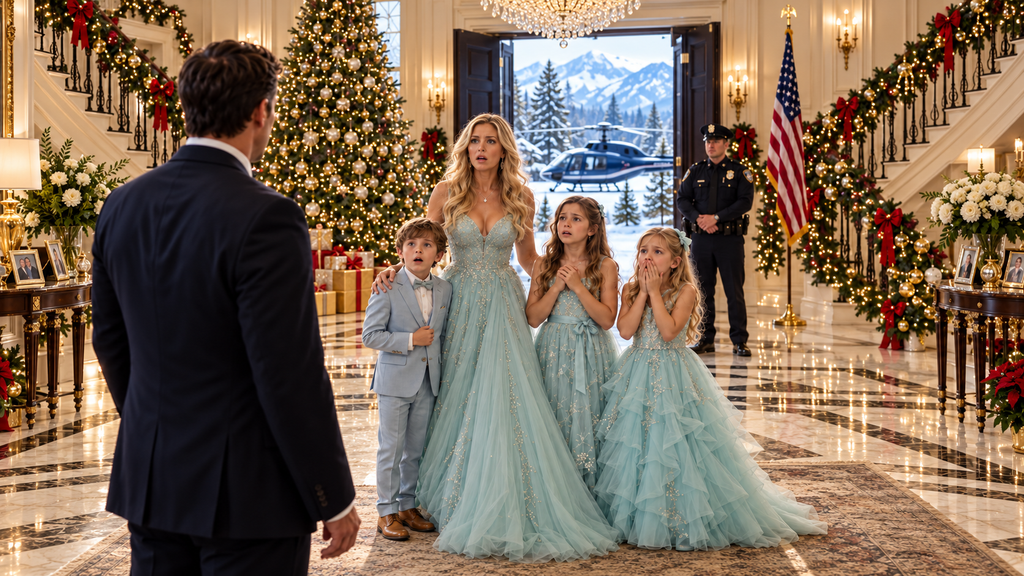
My hand rested gently on his shoulder.
“No, sweetheart.”
I looked directly at Marcus.
“That’s your father.”
The silence that followed was almost unbearable.
Sophia’s mouth fell open.
Ethan’s eyebrows pulled together.
Olivia looked from me to Marcus and back again.
Noah simply stared.
“Our father?”
His voice was so small that it broke something inside me.
“Yes.”
Marcus stumbled backward.
His hand struck the edge of a table.
A crystal ornament fell onto the carpet but somehow didn’t break.
Maybe that was fitting.
Everything else had.
His blonde fiancée slowly turned toward him.
Her name, I would later learn, was Claire.
Her face had lost every trace of color.
“Marcus?”
He didn’t look at her.
“Marcus, what does she mean?”
Still nothing.
Claire stepped closer.
“You told me she lied about being pregnant.”
That sentence changed the entire room.
I looked at her.
“What?”
Claire’s eyes filled with confusion.
“He told me…”
She swallowed.
“He told me your marriage ended because you tried to trap him with a fake pregnancy.”
I actually laughed.
It wasn’t because anything was funny.
It was because sometimes a lie is so enormous that the only alternative to laughter is screaming.
“Of course he did.”
Marcus finally found his voice.
“Kesha, don’t.”
I turned toward him.
“Don’t what?”
His eyes flicked toward the children.
“Not in front of them.”
Something inside me hardened.
“Interesting.”
I stood.
“Eight years ago, you weren’t worried about what happened in front of them.”
His jaw tightened.
“That isn’t fair.”
“No?”
I took one step toward him.
“You walked out before you knew whether there was one child or four.”
Marcus looked at the quadruplets again.
Noah.
Ethan.
Sophia.
Olivia.
Four faces.
Four pairs of familiar brown eyes.
Four versions of the man who had spent eight years pretending they never existed.
“I didn’t know.”
His voice cracked.
“I swear to God, Kesha, I didn’t know there were four.”
“You’re right.”
I nodded slowly.
“You didn’t.”
For one second, something like relief appeared in his face.
Then I finished.
“Because you didn’t stay long enough to find out.”
The relief disappeared.
Patricia gripped the back of a dining chair.
“This is impossible.”
I turned toward her.
“No.”
Her eyes sharpened.
“No, I mean medically. Four children?”
“Quadruplets.”
“But nobody said—”
“You mean Marcus didn’t tell you?”
“I mean…”
She stopped.
That hesitation told me something.
I studied her face.
“What exactly did Marcus tell all of you?”
Patricia looked toward her son.
Marcus stared at the floor.
Nobody answered.
Then a deep male voice came from behind us.
“He told us the baby died.”
Every head turned.
Robert Reynolds stood in the doorway to the study.
Marcus’s father.
He had aged more than Patricia.
His hair was almost completely white now, and the strong shoulders I remembered seemed slightly curved beneath his dark green sweater.
But his eyes were the same.
Kind.
Serious.
And at that moment, devastated.
Robert stared at the children.
Then at me.
“Kesha?”
“Hello, Robert.”
He took two slow steps forward.
His eyes were already shining.
“He told us you miscarried.”
I looked at Marcus.
There are moments when anger becomes so complete that it stops feeling hot.
It becomes cold.
Clear.
Almost peaceful.
“You told them our baby died?”
Marcus rubbed a hand over his face.
“I was angry.”
“You told your family my child died?”
“I thought—”
“No.”
My voice rose for the first time.
“You don’t get to say you thought.”
The children moved closer to me.
Immediately, I lowered my voice again.
That mattered more than anything.
They had not come here to watch adults destroy each other.
They had come because I had finally decided they deserved to know where half of them came from.
Marcus shook his head.
“I didn’t know there were four.”
“You knew I was pregnant.”
“I didn’t believe you.”
“You saw the test.”
“You could have—”
“The doctor confirmed it.”
He stopped.
I continued.
“You sat in the parking lot outside Dr. Monroe’s office while I cried in your passenger seat.”
Claire turned sharply toward him.
“You went to the doctor?”
Marcus said nothing.
I looked at Claire.
“He did.”
I could still remember that afternoon.
Eight years disappeared.
Suddenly I was twenty-five again.
My hands shaking.
The smell of antiseptic.
A paper bracelet around my wrist.
Marcus sitting beside me in a blue button-down shirt, bouncing one knee because he hated waiting rooms.
Dr. Monroe had smiled when she entered.
“Congratulations.”
I remembered turning toward my husband.
For one beautiful second, I expected him to smile too.
Instead, his entire face closed.
Not fear.
Not surprise.
Rejection.
He drove home in silence.
Two days later, he accused me of planning the pregnancy without him.
Three days after that, he slept in the guest room.
By the end of the week, he was staying at a hotel.
Two weeks later, divorce papers arrived.
The memory had once been capable of destroying me.
Now it was simply history.
Painful history.
But history.
“I told you I was pregnant,” I said.
Marcus’s eyes met mine.
“You told me you had stopped taking birth control.”
“I told you my prescription had changed.”
“You never told me before—”
“I told you three times.”
“Kesha—”
“You didn’t hear me because you never listened unless the conversation was about you.”
He stopped again.
Sophia tugged my hand.
“Mama?”
Immediately, I turned away from Marcus.
“Yes, baby?”
Her eyes were filling with tears.
“Did he not want us?”
I felt my heart split open.
That question.
That was the question I had feared for eight years.
Not whether Marcus would recognize them.
Not whether his family would believe me.
Not whether anyone would apologize.
That question.
Did he not want us?
I crouched in front of my daughter and took both her hands.
“You listen to me.”
The room disappeared.
There was only Sophia.
“You were wanted from the first second I knew you existed.”
“But by him?”
I inhaled slowly.
I would not lie.
Children remembered lies.
Sometimes longer than adults did.
“He was scared.”
Marcus whispered behind me.
“I was stupid.”
I turned my head.
“Please.”
His voice was rough.
“Let me answer her.”
For several seconds, I considered saying no.
Every instinct inside me wanted to shield them.
But one day they would be adults.
One day they would understand that truth sometimes hurt less than mystery.
So I looked at Sophia.
“Do you want him to answer?”
She hesitated.
Then nodded.
Marcus knelt several feet away.
Not too close.
That, at least, was wise.
Sophia studied him.
Marcus’s hands trembled.
“When your mother told me she was pregnant,” he began, “I was selfish.”
Patricia whispered his name.
He ignored her.
“I thought about my career.”
He swallowed.
“My freedom.”
His voice became quieter.
“My plans.”
Sophia frowned.
“What plans?”
Marcus gave a broken smile.
“Plans that seem very stupid right now.”
Nobody laughed.
He continued.
“I convinced myself your mom had done something wrong because that was easier than admitting I was afraid.”
“Afraid of babies?”
Ethan asked.
Marcus looked at him.
“Afraid of being responsible for someone besides myself.”
Noah’s expression tightened.
“That’s not very brave.”
A strange sound escaped Robert.
Half laugh.
Half sob.
Marcus nodded.
“No.”
His eyes filled.
“It wasn’t.”
Olivia folded her arms.
She had always been the most skeptical of my children.
The one who examined every promise like a contract.
“So you left?”
Marcus looked at her.
“Yes.”
“All of us?”
“I didn’t know there were four.”
Olivia’s expression didn’t change.
“But you knew there was one.”
That hit him harder than anything I could have said.
“Yes.”
“And one wasn’t enough to stay?”
Marcus closed his eyes.
“No.”
Olivia looked at me.
“Okay.”
One word.
But I knew my daughter.
That “okay” did not mean forgiveness.
It meant information received.
Filed away.
Remembered.
Robert lowered himself into an armchair.
He kept looking at them.
All four.
“You’re eight?”
Noah nodded.
“All of us.”
Robert’s mouth trembled.
“When are your birthdays?”
“August eighteenth,” Ethan answered.
Robert inhaled sharply.
I knew why.
Marcus’s birthday was August nineteenth.
One day apart.
“August eighteenth.”
He repeated the date as if committing it permanently to memory.
Then he looked at Marcus.
“You knew she was pregnant.”
Marcus stood.
“Yes.”
“And you told us she lost the child.”
“I thought the pregnancy might not even be real.”
“You just admitted you went to the doctor.”
Marcus looked away.
Robert’s voice changed.
I had never heard him speak to his son that way.
Not once.
“Look at me.”
Marcus did.
“You went to the doctor.”
“Yes.”
“You knew.”
“Yes.”
“And then you told your mother and me that Kesha miscarried.”
Marcus rubbed the back of his neck.
“Yes.”
Robert leaned forward.
“Why?”
The answer took a long time.
Finally Marcus whispered, “Because I didn’t want you trying to make me go back.”
Patricia’s hand flew to her mouth.
Robert stared at his son.
Something almost physical passed across his face.
Disappointment.
Not ordinary disappointment.
The kind a parent feels when they suddenly realize the person standing before them is not the person they believed they raised.
Robert stood.
“You let me mourn a grandchild who wasn’t dead.”
Marcus whispered, “Dad.”
“You watched your mother light a candle in church.”
Patricia turned away.
Robert’s voice broke.
“You watched us grieve.”
“I was twenty-seven.”
“And she was twenty-five!”
Robert pointed toward me.
“She was carrying your child.”
“Children,” Olivia corrected softly.
Every adult went silent.
Robert looked at her.
His face crumpled.
“Yes.”
He nodded.
“Children.”
Olivia seemed satisfied.
Robert’s gaze returned to Marcus.
“She was carrying your children.”
Claire slowly removed the diamond ring from her finger.
The movement was so quiet that nobody noticed at first.
Then she placed it on the table beside the untouched Christmas punch.
Marcus saw it.
“Claire.”
She stepped backward.
“No.”
“Can we talk privately?”
“No.”
“Please.”
“You told me this woman fabricated a pregnancy because she couldn’t accept that you wanted a divorce.”
Marcus stared at her.
Claire shook her head.
“You told me she harassed you for months.”
“She did contact me.”
I laughed again.
This time Claire looked at me.
“I contacted him three times.”
Marcus said nothing.
“Once after the first ultrasound.”
Claire’s eyes moved to him.
“Once when doctors discovered there were four heartbeats.”
Patricia made a soft sound.
“And once after they were born.”
Marcus went completely still.
Robert looked at me.
“You told him?”
“I tried.”
Marcus looked confused.
“No.”
“Yes.”
“No, you didn’t.”
“I sent a registered letter to your office.”
His forehead creased.
“I never got it.”
“I sent photographs.”
“I never saw them.”
“The birth certificates.”
His face changed.
“I never saw anything.”
I studied him.
For the first time since arriving, I believed him.
Not about the pregnancy.
Not about abandoning me.
But about that.
He genuinely had not seen the package.
“I mailed it to Reynolds Development.”
Marcus shook his head.
“I was in Denver by then.”
“It was addressed to you.”
“I never received it.”
Patricia suddenly sat down.
Too quickly.
Too heavily.
Robert looked at his wife.
“Pat?”
She didn’t answer.
A new silence filled the room.
Different from the others.
Marcus slowly turned toward his mother.
“Mom?”
Patricia stared at the carpet.
My stomach tightened.
“Patricia.”
She closed her eyes.
Robert’s voice became quiet.
“What did you do?”
Patricia whispered, “I thought I was protecting him.”
I stopped breathing.
Marcus looked as though someone had struck him.
“What?”
She pressed both hands against her face.
“I thought the entire situation was over.”
“What did you do?”
Marcus shouted it.
The children flinched.
I stepped in front of them immediately.
“Lower your voice.”
Marcus obeyed.
Patricia began crying.
“I was at the office when the package arrived.”
Nobody moved.
“You opened mail addressed to me?”
“You had already transferred to Denver. Important company correspondence was forwarded.”
“Did you open it?”
“Yes.”
“What was inside?”
Patricia’s shoulders shook.
She looked at me.
“Four photographs.”
My throat closed.
Of course I remembered them.
Noah asleep with his tiny fist beside his cheek.
Ethan under the blue NICU blanket.
Sophia with a feeding tube.
Olivia’s hand wrapped around my finger.
They had been three weeks old.
Each weighed less than five pounds.
Some less than four.
The smallest, Olivia, had barely weighed three.
I had written their names on the back of every photograph.
I had believed that even if Marcus hated me, seeing them might wake something human inside him.
Marcus stared at his mother.
“There were four babies?”
“Yes.”
“And you didn’t tell me?”
Patricia cried harder.
“I called your office in Denver.”
“I don’t remember that.”
“You were furious. You told me you didn’t want to hear anything about Kesha.”
Marcus’s face went blank.
I remembered him saying things like that.
I could imagine it perfectly.
Patricia continued.
“You said if anything else came from her, I should handle it.”
“And you decided that meant hiding four children?”
“I thought she wanted money.”
That sentence sliced through me.
I stepped forward.
“I never asked for one dollar.”
Patricia looked at me.
“I know that now.”
“No.”
I shook my head.
“You knew it then.”
Her face collapsed.
Because she did.
The package had contained no demand.
No threat.
No request for support.
Just a letter.
Marcus,
They were born on August 18.
There are four.
Two boys and two girls.
They are small but fighting.
I am not asking you to come back to me.
I am asking you whether you want to know your children.
If you do, contact me.
If you do not, I will never ask again.
Kesha.
I had spent eight years remembering every word.
Patricia whispered, “I was afraid.”
“Of what?”
“That he would go back.”
I stared at her.
“To his children?”
“To the marriage.”
My anger sharpened.
“So you took that decision away from him.”
“Yes.”
Marcus backed away from his mother.
“You knew for eight years.”
“I knew there were babies.”
“Four babies!”
“I thought Kesha would contact you directly eventually.”
“She couldn’t!”
Marcus slapped his hand against his chest.
“I changed my number!”
Everyone stared at him.
He realized what he had just admitted.
I didn’t need to say anything.
Neither did Patricia.
Marcus lowered his hand.
The truth was sitting in the center of the room now.
Patricia had hidden the package.
But Marcus had built the walls that made hiding it possible.
He changed his number.
Blocked my email.
Moved.
Instructed the family not to talk about me.
Told everyone the pregnancy had ended.
Then spent eight years congratulating himself for escaping a woman he had abandoned.
There was enough guilt to go around.
Claire picked up her coat.
Marcus stepped toward her.
“Please don’t leave like this.”
She stared at him.
“How should I leave?”
“Claire—”
“You invited her here to humiliate her.”
That caught my attention.
I looked at Claire.
Marcus froze.
She turned toward me.
“You were right.”
“About what?”
“He thought you were coming alone.”
Something inside me went cold again.
Claire looked ashamed.
“He told everyone you had never remarried.”
I said nothing.
“He said you had no children.”
Patricia covered her face.
Claire continued.
“He said you still followed his career online.”
I almost smiled.
I had not searched Marcus’s name in years.
“He said tonight was going to finally prove that leaving you had been the right decision.”
Robert whispered, “Jesus Christ.”
Marcus glared at Claire.
“That is not what I said.”
“It is exactly what you said.”
“I was joking.”
“No.”
She shook her head.
“You weren’t.”
Then she looked at me.
“He said, ‘Kesha always thought she would be somebody. Wait until you see what became of her.’”
For the first time that day, the helicopter suddenly mattered.
Not because I needed them to know I had money.
I didn’t.
Money had never healed a single night beside an incubator.
It had never held my hand when four babies screamed at once.
It had never whispered, “You can do this,” when I thought I couldn’t.
But Marcus had invited me because he believed suffering had destroyed me.
Because somewhere inside himself, he needed that to be true.
My success ruined the story he had told himself.
The children destroyed it completely.
Claire gave me a sad smile.
“I’m sorry.”
“You didn’t know.”
“No.”
She looked at Marcus.
“But he did.”
Then she walked toward the front door.
Marcus followed.
“Claire.”
She stopped.
He reached for her arm.
She pulled away.
“Don’t.”
“We can work this out.”
She stared at him.
“You have four children.”
“I didn’t know!”
“You knew about one.”
The sentence came from Olivia again.
Claire looked at my daughter.
Then back at Marcus.
“She understands it better than you do.”
Marcus’s face twisted.
Claire placed her engagement ring in his palm.
“I’m not ending this because you have children.”
She looked directly into his eyes.
“I’m ending it because of who you became to avoid them.”
Then she walked out.
The front door closed.
Marcus stared at the ring.
Nobody spoke.
Finally Ethan whispered to Noah, “Christmas here is weird.”
Against every instinct, I laughed.
A real laugh.
Noah laughed too.
Then Sophia.
Then Olivia.
Even Robert covered his mouth, smiling through tears.
The tension cracked just enough for all of us to breathe.
I knelt beside the children.
“Do you want to leave?”
They looked at one another.
That was something the four of them had always done.
A silent conference.
They had their own language.
Sometimes I thought they had invented it in the womb.
Noah finally said, “Can we meet Grandpa first?”
Robert’s eyes filled instantly.
I smiled.
“Yes.”
Robert slowly approached.
He stopped several feet away.
“May I?”
Noah looked at me.
I nodded.
Robert crouched.
His knees clearly protested, but he ignored them.
“I’m Robert.”
Noah smiled.
“I’m Noah.”
“I know.”
Robert laughed softly.
“Your mother said your names.”
Ethan stepped forward.
“I’m Ethan.”
“Sophia.”
“Olivia.”
Robert repeated each name.
Carefully.
Like they were sacred.
Then Noah asked, “Are you actually our grandpa?”
Robert’s voice shook.
“If you’ll let me be.”
Noah shrugged.
“Okay.”
And just like that, Robert Reynolds broke down.
He covered his eyes.
His shoulders shook.
The children looked startled.
Then Sophia did what Sophia always did.
She hugged him.
Robert froze.
His arms hovered awkwardly in the air.
He looked at me.
I nodded.
He wrapped them gently around her.
That made Ethan join.
Then Noah.
Olivia resisted for approximately six seconds.
Then she stepped into the hug too.
Robert closed his eyes.
Four children.
Eight lost years.
One embrace.
I had imagined this moment many times.
In some versions, I screamed.
In others, I walked away.
Sometimes Marcus begged.
Sometimes Patricia apologized.
But never once had I imagined Robert crying into Sophia’s hair.
Patricia stood several feet away.
Watching.
Her face looked destroyed.
She wanted to move toward them.
I could see it.
But she didn’t.
For once, Patricia understood that wanting access did not mean deserving it.
Robert finally pulled back.
“Would you like to see something?”
The children nodded.
He crossed the room toward the enormous Christmas tree.
Near the top hung a small silver angel.
He carefully removed it.
“I bought this eight years ago.”
Marcus stared.
Patricia turned away.
Robert held the ornament in his palm.
“We thought there was going to be one baby.”
His voice shook.
“Then we believed that baby was gone.”
He looked at me.
“I put this on the tree every Christmas anyway.”
My throat tightened.
Robert gave the angel to Noah.
“I suppose one angel isn’t enough anymore.”
Ethan grinned.
“You need four.”
“I certainly do.”
Sophia pointed toward the kitchen.
“Do you have cookies?”
Everyone laughed again.
Even me.
Robert wiped his eyes.
“Yes.”
“Chocolate chip?”
“Gingerbread.”
Sophia considered that.
“Acceptable.”
Robert laughed so hard he had to sit down.
And for ten minutes, something impossible happened.
Christmas returned.
The children wandered into the kitchen with Robert.
They inspected cookies.
Argued about frosting.
Asked questions about snow.
Noah wanted to know whether deer came into the yard.
Ethan discovered an old chessboard.
Sophia admired Patricia’s enormous miniature Christmas village.
Olivia silently counted the gifts beneath the tree.
I watched them.
My babies.
Except they weren’t babies anymore.
They were eight.
Eight years Marcus had missed.
First words.
First steps.
The first fever that sent us racing to the emergency room.
Sophia’s first dance recital.
Noah losing both front teeth in the same week.
Ethan learning to ride his bicycle and crashing into a mailbox.
Olivia crying because a teacher told her she was “too serious.”
Every ordinary miracle.
Gone.
Unrecoverable.
“You did all of that alone?”
Marcus’s voice came from behind me.
I didn’t turn.
“No.”
He seemed surprised.
I looked at him.
“I had help.”
Aunt Denise.
Dana.
Neighbors.
Teachers.
Nurses.
Friends.
Women from a church I hadn’t attended before the children were born who delivered casseroles for six straight weeks.
A retired nurse named Mrs. Alvarez who lived downstairs from my first apartment and somehow always appeared when all four babies started crying together.
“I just didn’t have you.”
Marcus looked toward the kitchen.
“How bad was it?”
I knew what he meant.
“The pregnancy?”
He nodded.
I hesitated.
Then answered.
“Terrifying.”
His eyes lowered.
“I was hospitalized at twenty-four weeks.”
His head snapped up.
“What?”
“My blood pressure became dangerous.”
“Kesha…”
“The doctors wanted me on bed rest.”
I gave a faint smile.
“Try being on bed rest while you’re also trying to figure out how you’re going to afford four babies after your husband empties half the joint account.”
His face changed.
“I didn’t empty it.”
“You took your half.”
“That was mine.”
“Yes.”
I nodded.
“It was.”
He looked ashamed.
“And I had my half.”
I continued.
“Until the medical bills started.”
His eyes closed.
“The babies came early?”
“Thirty-one weeks.”
Marcus looked toward them again.
“They were in the hospital?”
“Six weeks.”
“All of them?”
“Different lengths.”
My voice softened despite myself.
“Noah came home first.”
I remembered carrying him into that tiny apartment.
One baby.
Three empty car seats.
The happiness had felt guilty.
Ethan came home next.
Sophia a week later.
Olivia last.
She had struggled with breathing.
I had sat beside her incubator at two in the morning while a nurse named Caroline rubbed circles over my back.
“She’ll get there,” Caroline had whispered.
“What if she doesn’t?”
“She will.”
And she did.
I looked toward Olivia now.
Healthy.
Strong.
Suspicious.
Perfect.
“Olivia stayed longest.”
Marcus’s eyes followed mine.
“Was she…”
He couldn’t finish.
“She nearly died twice.”
His face collapsed.
“I didn’t know.”
“No.”
“I swear—”
“I know.”
Marcus blinked.
That was the first mercy I gave him.
Not forgiveness.
Mercy.
“I believe you didn’t know about the four.”
He inhaled.
“But you knew enough.”
His shoulders dropped.
“Yes.”
“You knew there was a pregnancy.”
“Yes.”
“You knew it had been confirmed.”
“Yes.”
“You left anyway.”
“Yes.”
I studied him.
For the first time, Marcus didn’t defend himself.
No excuses.
No anger.
No accusations.
Just one word.
“Yes.”
He sat down.
The engagement ring remained in his fist.
“Why didn’t you sue me for child support?”
I almost smiled.
“That’s what you want to know?”
“I’m trying to understand.”
“I considered it.”
“What stopped you?”
“At first?”
I folded my arms.
“Pride.”
He nodded slowly.
“Then fear.”
“Of me?”
“Of what you would do if the court forced you into their lives.”
Marcus looked wounded.
I didn’t soften it.
“You thought I was dangerous?”
“No.”
I shook my head.
“I thought you were indifferent.”
That hurt him more.
“Dangerous people can sometimes be avoided.”
I looked toward the kitchen.
“Indifferent fathers walk in and out.”
Marcus stared at me.
“I couldn’t let you teach them that they had to audition for your love.”
He lowered his eyes.
“So I built a life where your absence wasn’t the center of theirs.”
“How?”
The answer was too large.
How did anyone survive eight years?
One day at a time sounded cliché.
It was also true.
“I worked.”
He gave a short laugh.
“I gathered that.”
I looked down at my dress.
At the watch on my wrist.
At the snow outside where the helicopter sat like something from somebody else’s life.
“It didn’t begin like this.”
“I know.”
“No.”
I looked at him.
“You don’t.”
And suddenly I wanted him to know.
Not to impress him.
Not to punish him.
But because he had spent eight years believing my life ended when he left.
He needed to understand that it had almost ended.
And then it began.
“When the babies were six months old, I was working nights.”
His expression changed.
“At the logistics firm?”
“They fired me.”
“What?”
“I missed too much work.”
“You were on maternity leave.”
“My leave ran out.”
I shrugged.
“Four premature infants get sick.”
Marcus said nothing.
“I did medical billing from home.”
I smiled faintly.
“Usually at two in the morning.”
That was how it started.
A laptop.
A folding table.
Four cribs lined against one wall.
I learned scheduling.
Billing.
Contract negotiation.
Then procurement.
One small medical clinic asked me to organize its supply deliveries.
Then another.
Then three.
Then twelve.
By the time the quadruplets were three, I had six employees.
By five, seventy-two.
By seven, we had contracts in nine states.
I had sold part of the company the previous spring while retaining control.
The number had been large enough that Dana had cried when she saw the paperwork.
Marcus stared.
“You built Reynolds Medical Logistics?”
I raised one eyebrow.
“RML?”
“Yes.”
His mouth actually fell open.
“You’re K.R.?”
I smiled.
My initials.
Kesha Reynolds.
I had kept the surname after the divorce because changing everything while pregnant had felt like one more task I could not survive.
Later, when the company began succeeding, Reynolds had become mine in a different way.
Not his.
Mine.
“You’ve heard of it?”
Marcus gave a stunned laugh.
“Everyone in commercial development has.”
“That’s nice.”
“Kesha, your company is worth—”
“Don’t.”
He stopped.
I looked toward my children.
“If you want to understand my life, don’t measure it in dollars.”
His expression changed.
“The money came later.”
I touched my chest.
“The life came first.”
I remembered the apartment.
The broken air conditioner.
Coupons at the grocery store.
Counting diapers.
Four high chairs that didn’t match because three came from garage sales.
Making birthday cakes myself because I could not afford bakery prices.
I remembered crying once because Noah spilled an entire gallon of milk.
Not because of the mess.
Because there were only eleven dollars left until Friday.
That woman still lived inside me.
She always would.
“I survived because people helped me.”
Marcus looked toward Robert.
“Not us.”
“No.”
He winced.
“No.”
Then Noah called from the kitchen.
“Mama!”
I turned.
“Yes?”
“Grandpa says there are sleds in the garage!”
I looked at Robert.
He gave me an innocent expression.
“It’s Christmas.”
“Please!”
Four voices now.
“Please, Mama!”
I laughed.
“All right.”
The children exploded into cheers.
Within minutes they were pulling on borrowed gloves, scarves, and boots.
Robert found an old red sled.
Then another.
The snow outside glittered beneath the afternoon sun.
I stood on the porch watching them race toward the small hill beyond the driveway.
Robert followed carefully.
Noah threw the first snowball.
It struck Ethan in the shoulder.
War began immediately.
Sophia screamed.
Olivia tackled Noah.
Robert tried to maintain order for approximately thirty seconds before getting hit directly in the chest.
His shocked face sent all four children into hysterics.
I smiled.
Then I noticed Patricia standing behind the window.
Alone.
She did not join them.
I almost felt sorry for her.
Almost.
A few minutes later, she came outside.
She stopped beside me.
Neither of us spoke.
Finally she whispered, “They’re beautiful.”
“Yes.”
“Every one of them.”
“Yes.”
She wiped her cheek.
“I don’t deserve to ask.”
“No.”
The answer surprised her.
Maybe she expected politeness.
Eight years earlier, I would have given it.
I wasn’t twenty-five anymore.
Patricia looked down.
“But I need to say it.”
I waited.
“I am sorry.”
My chest tightened.
She continued.
“I opened that package because I believed my son when he said you had manipulated him.”
“You disliked me before that.”
She flinched.
“Yes.”
“At least admit it.”
“I do.”
“Why?”
Patricia stared across the yard.
“Because you didn’t need us.”
I frowned.
She laughed bitterly.
“That sounds ridiculous now.”
“Yes.”
“You were independent.”
She folded her arms against the cold.
“Marcus’s previous girlfriends wanted the Reynolds name.”
“I already had my own career.”
“I know.”
“You thought I was arrogant.”
“I thought you challenged him.”
“I did.”
“Yes.”
For the first time, Patricia smiled faintly.
“You did.”
Then it disappeared.
“I had spent his entire life protecting him from consequences.”
My gaze moved toward Marcus through the window.
He sat alone in the living room.
“I can see that.”
Patricia nodded.
“When the package arrived, I convinced myself I was protecting him again.”
“From his children.”
“Yes.”
“Say it.”
Her face tightened.
“From his children.”
I breathed in cold mountain air.
She continued.
“I kept the photographs.”
I turned sharply.
“What?”
“They’re here.”
Everything inside me stopped.
“You kept them?”
“Yes.”
“Where?”
“In my bedroom.”
I stared at her.
“You had pictures of my babies in this house for eight years?”
Her eyes filled.
“I couldn’t throw them away.”
“But you could hide them.”
“Yes.”
“You looked at them?”
She nodded.
“How often?”
Patricia began crying.
“Every Christmas.”
My hands curled into fists.
She immediately stepped backward.
“I know how awful that sounds.”
“You don’t.”
“Kesha—”
“You had pictures of my babies.”
“Yes.”
“While I was sitting beside them in a hospital wondering whether Olivia would survive.”
“I didn’t know that.”
“You knew they existed.”
“Yes.”
“You knew your son had walked away.”
“Yes.”
“And every Christmas you looked at photographs instead of picking up the phone?”
“I didn’t have your number.”
“You could have found me.”
She said nothing.
“You found me now.”
Her eyes closed.
That was the answer.
People found you when finding you became convenient.
Patricia whispered, “I’m sorry.”
I looked at the four children throwing snow at their grandfather.
“Your apology belongs to them.”
“I know.”
“But don’t give it today.”
She looked confused.
“Why?”
“Because today they met their father.”
I turned toward her.
“That is enough adult guilt for one Christmas.”
Patricia nodded.
Tears rolled down her face.
“May I give you the photographs?”
“Yes.”
She went inside.
Five minutes later she returned carrying a small wooden box.
My heart started pounding before she even opened it.
There they were.
Four photographs.
The corners slightly worn.
My handwriting on the back.
NOAH — 3 WEEKS.
ETHAN — 3 WEEKS.
SOPHIA — 3 WEEKS.
OLIVIA — 3 WEEKS.
I touched Olivia’s picture.
My vision blurred.
“May I keep them?” Patricia asked.
I looked at her.
The old version of me would have said no.
The wounded version.
The woman who wanted to take everything back.
But those photographs had never belonged to Patricia.
And somehow, over eight years, they had become evidence of something strange.
Even while hiding them, she had been unable to destroy them.
Guilt had kept my children alive in this house long before their bodies entered it.
“You may keep copies.”
Patricia nodded.
“Thank you.”
“Not for you.”
She accepted that.
“I understand.”
The front door opened.
Marcus stepped outside.
He saw the box.
His face changed immediately.
“Are those…”
Patricia handed him the photographs.
Marcus looked down.
He froze.
I watched eight years hit him all at once.
His thumb touched Noah’s tiny face.
Then Ethan.
Sophia.
Olivia.
He sat on the porch steps.
Slowly.
Like his legs had stopped working.
“They were so small.”
“Yes.”
His lips trembled.
“This is Noah?”
“Yes.”
“And…”
He turned the picture over.
“Ethan.”
Another.
“Sophia.”
Another.
He stopped.
“Olivia.”
I nodded.
Marcus pressed the photographs together.
His shoulders began shaking.
I looked away.
Not because I hated him.
That would have been easier.
I looked away because some part of me remembered loving him.
Really loving him.
Before the fear.
Before the accusation.
Before the divorce papers.
Before four incubators replaced wedding vows.
I remembered dancing with him barefoot in our first apartment.
Burning pancakes on Sunday morning.
Marcus painting the bedroom yellow because I said white walls made the room feel sad.
That man had existed.
Maybe he still existed somewhere inside this one.
But love did not erase consequences.
Love did not reverse time.
And nostalgia was not a reason to reopen a door.
Marcus eventually whispered, “Can I keep one?”
I looked at him.
“One photograph.”
His fingers tightened around them.
“Please.”
I considered it.
Then removed Noah’s picture.
I handed him the other three.
“Keep copies of all four.”
His face crumpled.
“Thank you.”
“You’re welcome.”
He stared down at them.
“What happens now?”
There it was.
The question beneath everything.
What happens now?
I could have answered angrily.
Nothing.
You missed your chance.
Live with it.
Part of me wanted to.
But that answer would have belonged to my pain.
Not my children.
So I chose carefully.
“That depends.”
“On what?”
“On them.”
Marcus looked toward the hill.
“And me.”
His eyes returned to mine.
“You do not get to walk into their lives because you discovered them on Christmas.”
“I know.”
“You don’t get to call yourself Dad tomorrow.”
“I know.”
“You don’t make promises you can’t keep.”
“I won’t.”
“You already did once.”
He looked down.
“I know.”
“If they want to see you, we do this slowly.”
His head lifted.
Hope appeared.
Small.
Fragile.
“Really?”
“Slowly.”
“Yes.”
“With a therapist.”
“Anything.”
“Don’t say anything.”
He stopped.
I continued.
“Think before you promise.”
Marcus nodded.
“Okay.”
“They have questions.”
“I’ll answer.”
“Truthfully.”
“Yes.”
“Even when the truth makes you look terrible.”
He stared at me.
“Yes.”
“No blaming me.”
“Yes.”
“No blaming your mother.”
Patricia looked surprised.
Marcus frowned.
“She hid them.”
“And you abandoned the pregnancy.”
His face tightened.
I stepped closer.
“She owns what she did.”
Then I pointed gently toward his chest.
“You own what you did.”
He nodded.
“Understood.”
“If you disappear again, I will not chase you.”
“I won’t.”
I held up my hand.
“No promises.”
Marcus swallowed.
Then corrected himself.
“I will do everything I can to show you I mean it.”
Better.
I nodded.
“That’s all you can say.”
The children came running back.
Red cheeks.
Wet gloves.
Wild laughter.
Noah was dragging the sled.
Ethan had snow packed down the back of his coat.
Sophia complained that Olivia had cheated.
Olivia insisted there were “no established rules regarding snowball combat.”
Marcus stared at them.
They slowed when they noticed him.
The mood changed immediately.
Children felt things adults thought they hid.
Marcus stood.
Noah looked at the photographs in his hand.
“What are those?”
Marcus hesitated.
Then crouched.
“You.”
Noah approached.
“What?”
“When you were babies.”
The other three crowded around.
Sophia squealed.
“I was tiny!”
“You were all tiny,” I said.
Ethan pointed.
“Why did you have tubes?”
I answered before Marcus could.
“You needed help breathing and eating.”
Olivia looked at her own picture.
“That’s me?”
“Yes.”
“I looked angry.”
“You were angry.”
She smiled proudly.
Marcus laughed.
The children looked at him.
He immediately stopped.
Then Noah asked, “Can we call you Marcus?”
I held my breath.
Marcus blinked.
“Of course.”
“We already have a dad word.”
Marcus looked confused.
Noah pointed at Robert.
“That’s Grandpa.”
Robert laughed from behind them.
Noah continued.
“So you can be Marcus until we figure it out.”
Marcus’s eyes filled.
“That sounds fair.”
Ethan nodded.
“Good.”
Sophia looked at Marcus.
“Do you like pancakes?”
He seemed startled.
“Yes.”
“Chocolate chip?”
“Yes.”
“Okay.”
She skipped toward the house.
Marcus watched her go.
“What does that mean?”
I smiled.
“With Sophia, probably more than you realize.”
Christmas dinner began two hours later.
Nothing about it resembled whatever Marcus had originally planned.
There was no humiliation.
No triumph.
No carefully staged announcement about his engagement.
Claire’s chair remained empty.
Her wineglass remained untouched.
Marcus barely spoke.
Patricia kept crying when she thought nobody was watching.
Robert sat between Noah and Sophia and listened to both of them talk at the same time.
Ethan explained his robotics project.
Olivia interrogated Robert about whether reindeer could scientifically survive at the North Pole.
The turkey went cold twice because everyone kept getting distracted.
At one point, Noah looked around the table.
“This is the strangest Christmas ever.”
I laughed.
Robert raised his glass.
“To strange Christmases.”
We all lifted ours.
Even Marcus.
Then Olivia said, “And truthful ones.”
Marcus’s expression changed.
He raised his glass slightly higher.
“And truthful ones.”
Later, after dessert, the children disappeared upstairs with Robert to look through old photo albums.
I remained downstairs.
Marcus stood near the fireplace.
Patricia sat on the sofa.
For a few minutes, nobody spoke.
Then Patricia looked at her son.
“I am sorry.”
Marcus stared into the fire.
“I don’t know what to do with that yet.”
“I understand.”
“No.”
He turned.
“You don’t.”
Patricia flinched.
Marcus held up the photographs.
“I had children.”
“You still do.”
“I missed everything.”
His voice broke.
“First steps.”
He looked at me.
“First words?”
“Yes.”
He laughed painfully.
“School?”
“They’re in third grade.”
Marcus covered his mouth.
“Third grade.”
Nobody spoke.
He looked at Patricia.
“You took some of that.”
“Yes.”
Then he pointed at himself.
“But I handed you the weapon.”
Patricia cried harder.
Marcus sat across from her.
“I made it easy.”
“You were angry.”
“I was a coward.”
“Marcus—”
“No.”
He shook his head.
“Stop saving me.”
That sentence seemed to shock her.
Marcus looked toward the stairs.
“I think you spent my entire life doing that.”
Patricia stared.
“And I let you.”
Robert appeared in the doorway.
He had clearly heard.
Nobody said anything.
Marcus looked at his father.
“Dad?”
“Yes?”
“Why didn’t you ever make me face things?”
Robert took his time answering.
“Sometimes I tried.”
Marcus gave him a look.
Robert sighed.
“Not enough.”
He sat beside Patricia.
“We loved you.”
Marcus laughed bitterly.
“That’s not the same thing.”
“No.”
Robert nodded.
“It isn’t.”
I watched them.
A family finally telling the truth.
Not beautifully.
Not neatly.
But truth rarely arrived neatly.
It arrived breaking things.
That evening, snow began falling again.
Thick.
Soft.
The children pressed their faces to the windows.
Our pilot warned that we would need to leave sooner than expected if we wanted to avoid worsening conditions.
I gathered coats.
The mood shifted.
Robert looked devastated.
“So soon?”
“We have to.”
“Of course.”
He helped Ethan with his scarf.
Patricia stood near Olivia.
“May I ask you something?”
Olivia looked at her.
“Yes.”
“May I hug you goodbye?”
Olivia considered it.
Then nodded.
Patricia bent carefully.
Olivia allowed the hug.
Patricia closed her eyes.
When she pulled back, she whispered, “Thank you.”
Sophia hugged her without being asked.
Noah gave her a high five.
Ethan accepted a container of cookies.
Small things.
Not forgiveness.
Not yet.
But beginnings were usually small.
Then the children reached Marcus.
Nobody knew what to do.
Marcus kept his hands at his sides.
Noah looked at him.
“So…”
“So.”
“Are we going to see you again?”
Marcus looked at me.
I gave no answer.
This was his moment.
He returned his attention to Noah.
“If you want to.”
Noah shrugged.
“I think maybe.”
Marcus smiled.
“Maybe works.”
Ethan stepped forward.
“Do you know chess?”
“Yes.”
“Grandpa says you’re terrible.”
Robert shouted from the doorway, “He is!”
Marcus rolled his eyes.
“I’m better than he says.”
Ethan nodded.
“Okay. Next time.”
Next time.
Marcus nearly lost control.
I saw it.
His eyes filled.
His throat moved.
But he nodded.
“Next time.”
Sophia held out her hand.
Inside was a gingerbread cookie.
Half broken.
“You can have this.”
Marcus accepted it like she had handed him a priceless object.
“Thank you.”
“You’re welcome.”
Then Olivia approached.
She stood directly in front of him.
Marcus seemed most nervous around her.
Probably because Olivia’s stare could make experienced attorneys rethink their careers.
She folded her arms.
“You lied.”
“Yes.”
“To Grandma.”
“Yes.”
“To Grandpa.”
“Yes.”
“To Claire.”
“Yes.”
“About Mama.”
His face tightened.
“Yes.”
Olivia nodded slowly.
“You should stop doing that.”
Marcus almost laughed.
Then realized she was serious.
“You’re right.”
“Okay.”
She turned away.
Then stopped.
“And you should say sorry to Mama.”
Marcus looked at me.
“I have.”
Olivia looked at me.
“Did he?”
“Not properly.”
Marcus blinked.
I smiled slightly.
Olivia faced him again.
“See?”
Then she marched toward the helicopter.
Robert burst out laughing.
Marcus rubbed his face.
“She’s terrifying.”
“You have no idea.”
For the first time in eight years, we smiled at each other.
Not as husband and wife.
Not as lovers.
Just two people who had once known each other better than anyone.
Then Marcus’s smile disappeared.
“Kesha.”
I waited.
He walked toward me.
The snow landed in his hair.
“I’m sorry.”
I said nothing.
He took another breath.
“I’m sorry I accused you of trapping me.”
Snow gathered across his shoulders.
“I’m sorry I made your pregnancy about what it might cost me.”
His voice trembled.
“I’m sorry I filed for divorce without giving you time to understand what was happening.”
My throat tightened.
“I’m sorry I changed my number.”
He looked down.
“I’m sorry I told my family the pregnancy ended because I was too ashamed to admit I abandoned you.”
Tears entered his eyes.
“I’m sorry you sat in a hospital alone.”
I blinked quickly.
“I’m sorry four babies came into the world wondering where I was.”
“They didn’t wonder then.”
He nodded.
“But they will.”
That was true.
“And when they do…”
His voice broke.
“I will tell them it was me.”
He pressed his hand to his chest.
“Not you.”
I looked at him for a long time.
Eight years ago, those words would have changed everything.
Eight years ago, I would have fallen into his arms.
Eight years ago, I would have begged him to come home.
But apologies had expiration dates when it came to restoring what had been broken.
They could still matter.
They could still heal.
But they could not always rebuild the original thing.
“Thank you.”
Marcus’s face fell slightly.
Maybe some tiny part of him had hoped for more.
Then he nodded.
“I don’t expect forgiveness.”
“Good.”
He gave a sad laugh.
“That sounds like you.”
“No.”
I smiled.
“It sounds like the woman I became.”
He looked toward the helicopter.
“You’re different.”
“So are you.”
His expression turned painful.
“I’m not sure I like who I became.”
“That isn’t my problem to solve.”
“I know.”
I stepped closer.
“But it can be yours.”
He looked at me.
“You have four children watching what you do next.”
That landed.
He nodded.
“I won’t waste it.”
I raised one eyebrow.
“No promises.”
Marcus actually smiled.
“Right.”
He corrected himself.
“I’ll try not to waste it.”
“Better.”
The children shouted from the helicopter.
“Mama!”
I turned.
“Coming!”
Marcus spoke once more.
“Kesha?”
I looked back.
“Are you happy?”
Of all the questions he could have asked, that was the one I least expected.
I thought about it.
About the office overlooking Austin.
About money.
About the company.
About sleepless nights.
About four children fighting over cereal.
About broken hearts.
About surviving.
Then I smiled.
“Yes.”
His eyes filled again.
“Good.”
And strangely, I believed he meant it.
I boarded the helicopter.
Robert and Patricia stood together on the lawn.
Marcus remained a few feet away.
The children waved.
Robert waved with both hands.
Patricia cried openly.
Marcus lifted one hand.
Noah waved back.
Then Ethan.
Sophia blew him a kiss.
Olivia hesitated.
Then lifted two fingers.
A tiny wave.
Marcus smiled.
The helicopter rose.
The house became smaller.
The people below became shapes.
Then colors.
Then nothing.
Sophia leaned against my shoulder.
“Mama?”
“Yes?”
“Why didn’t you tell us before?”
There it was.
Another question I had always known would come.
I looked at all four.
“Because I wanted you to be old enough to understand that what happened had nothing to do with your worth.”
They listened.
“When you were little, I could tell you your father wasn’t around.”
I brushed hair from Sophia’s face.
“But you might have thought that meant something was wrong with you.”
Noah looked down.
“There isn’t.”
“No.”
I touched his chin.
“There never was.”
Ethan asked, “Did you hate him?”
I looked through the window at the mountains.
“Sometimes.”
The children seemed surprised.
I smiled sadly.
“But hate is heavy.”
I placed my hand over my heart.
“And I had four babies to carry.”
Olivia rested her head against the seat.
“Do you hate him now?”
I thought again.
“No.”
“Do you love him?”
That question came from Noah.
I laughed softly.
“Not the way I used to.”
“What does that mean?”
“It means someone can be part of your story without being part of your future.”
They considered that.
Sophia frowned.
“That sounds like something adults say when they don’t want to explain things.”
I laughed.
“You’re probably right.”
The helicopter carried us away through the snow.
And for the first time in eight years, Marcus Reynolds was no longer a ghost in my life.
He was simply a man.
Flawed.
Regretful.
Late.
Very late.
But real.
I didn’t know then what would happen next.
I didn’t know whether he would call.
Whether he would disappear again.
Whether guilt would eventually become too uncomfortable and send him running.
I expected very little.
That had become one of the gifts hardship gave me.
Expectation was not trust.
Words were not actions.
And regret was not change.
Change required repetition.
Again.
Again.
Again.
Especially when nobody was applauding.
Three days after Christmas, Marcus called.
I stared at his name on my phone for nearly ten seconds.
Then answered.
“Hello?”
“Hi.”
His voice sounded nervous.
I almost smiled.
“Hi.”
“I wanted to ask about the therapist.”
That surprised me.
“What about it?”
“You said we should use one.”
“Yes.”
“I found three family therapists in Austin who specialize in reunification and estranged parents.”
I sat straighter.
“You researched that?”
“Yes.”
“When?”
“Yesterday.”
He hesitated.
“I didn’t want to call you on the twenty-sixth. I figured you deserved one day without me.”
I smiled despite myself.
“That was considerate.”
“I’m experimenting.”
I laughed.
Marcus laughed too.
Then he became serious.
“I can email you their information.”
“I’ll look.”
“No rush.”
“Good.”
“And Kesha?”
“Yes?”
“I’m not asking to speak to the kids.”
I waited.
“I just wanted you to know I called.”
That mattered.
More than I wanted it to.
“All right.”
“Goodnight.”
“Goodnight, Marcus.”
He hung up.
He called again four days later.
Not the children.
Me.
He asked whether I had reviewed the therapists.
I had.
We chose Dr. Elaine Porter.
Our first meeting included only Marcus and me.
He flew to Austin.
Commercial.
Not private.
That detail amused Dana.
“The man whose ex-wife owns three aircraft is flying economy?”
“Apparently.”
“Character development.”
“Dana.”
“What?”
I laughed.
Dr. Porter was in her late fifties.
Silver hair.
Kind eyes.
Absolutely no patience for self-deception.
She listened as Marcus told the story.
When he finished, she asked one question.
“Why are you here?”
Marcus answered immediately.
“To be in my children’s lives.”
Dr. Porter shook her head.
“Wrong answer.”
Marcus blinked.
I looked at her.
She folded her hands.
“You cannot control whether those children allow you into their emotional lives.”
Marcus swallowed.
“So why are you here?”
He thought longer.
“To become someone they might choose to let in.”
Dr. Porter smiled.
“Better.”
That became the beginning.
Not Christmas.
That room.
That sentence.
Marcus came to Austin every other weekend.
At first, he spent one hour with the children.
Supervised.
The first meeting happened at a park.
No fancy gifts.
That had been my rule.
“You cannot purchase eight years.”
He followed it.
He brought a football.
Ethan ignored him for twelve minutes.
Olivia for twenty-three.
Sophia asked seventy questions.
Noah asked only one.
“Are you leaving tomorrow?”
Marcus answered, “Yes.”
Noah looked disappointed.
“But I’ll come back in two weeks if you want.”
Noah shrugged.
“We’ll see.”
Two weeks later, Marcus returned.
Then two weeks after that.
And again.
And again.
The children began testing him.
They didn’t know they were doing it.
But I did.
Children tested permanence.
Noah deliberately stopped reminding Marcus about his soccer games.
Marcus found the schedule anyway.
Ethan became quiet when Marcus called.
Marcus kept calling.
Sophia once yelled, “You’re not my real dad because real dads don’t leave.”
I expected Marcus to defend himself.
He didn’t.
He said, “You’re right that I left. And you get to be angry.”
Sophia cried.
Then Marcus cried.
Eventually they ate ice cream.
Olivia was hardest.
Of course.
She watched him.
Measured him.
Remembered every inconsistency.
One Saturday, Marcus was supposed to arrive at ten.
His flight was canceled.
At ten-fifteen, Olivia came into my office.
“He’s not coming.”
“He called.”
“So?”
“There’s weather in Denver.”
She folded her arms.
“He still isn’t coming.”
I understood what she meant.
Facts didn’t matter.
Absence felt the same regardless of explanation.
At eleven-thirty, the doorbell rang.
Olivia frowned.
I opened it.
Marcus stood outside.
Hair disheveled.
Carrying one backpack.
Olivia stared.
“How?”
“My flight was canceled.”
“I know.”
“So I rented a car.”
I blinked.
“You drove?”
“Nine hundred miles.”
“You’re insane.”
“Probably.”
Olivia looked at him.
“You drove all night?”
“Yes.”
“Why?”
Marcus’s eyes met hers.
“Because I said I would be here.”
She stared at him.
Then shrugged.
“You’re late.”
Marcus smiled.
“Yes.”
“Come in.”
That was the first day Olivia allowed him to help with her homework.
Three months passed.
Then six.
There were no miracles.
There were mistakes.
Marcus forgot Ethan’s science fair date once.
Ethan refused to speak to him for two weeks.
Marcus apologized.
He did not buy him anything.
He simply came back.
Marcus once referred to himself accidentally as “Dad.”
Olivia corrected him immediately.
“You’re still Marcus.”
He nodded.
“You’re right.”
He never made the mistake again.
Robert and Patricia began visiting too.
Robert was easier.
The children adored him.
Within months, he had purchased four bicycles for his Boulder house and installed a ridiculous treehouse despite being told repeatedly that eight-year-olds did not require a structure with electricity.
Patricia moved carefully.
She wrote each child a letter.
Not asking forgiveness.
Explaining what she had done.
She gave the letters to me.
“You decide when they read them.”
I kept them for several months.
Eventually Dr. Porter said the children were ready.
They read them together.
Sophia cried.
Noah asked questions.
Ethan wanted to know why adults lied so much.
Olivia read hers twice.
Then she placed it on the table.
“She did a bad thing.”
“Yes.”
“But she’s trying now.”
“Yes.”
Olivia nodded.
“Okay.”
Children sometimes understood redemption better than adults.
Not because they forgot.
Because they watched the present more closely than the past.
Claire never married Marcus.
I learned through Patricia that she moved to Seattle several months after Christmas.
She sent me one message.
I hope the children are doing well. They deserved the truth.
I replied.
They are. Thank you.
Nothing else needed to be said.
By summer, Marcus had changed.
Not completely.
People did not transform because one Christmas went badly.
Real change was slower.
More boring.
Less cinematic.
He began attending therapy alone.
He stopped allowing Patricia to solve problems for him.
He sold the enormous house he had purchased with Claire.
He moved into a smaller place in Austin.
Not near me.
Near the children’s school.
When he told me, I stared at him.
“You moved?”
“Yes.”
“For them?”
“Partly.”
“What’s the other part?”
“I think I spent eight years building a life designed to prove I hadn’t made a mistake.”
That surprised me.
“And?”
He looked toward the backyard, where four children were spraying each other with a garden hose.
“I got tired.”
I understood that more than I expected.
Shame was exhausting.
Pretending was worse.
The quadruplets turned nine in August.
Their first birthday with Marcus happened at my house.
No giant celebration.
Just friends.
Cake.
A trampoline.
Too many balloons.
Marcus arrived early.
He helped set up chairs.
He carried ice.
He burned hamburgers.
The children mocked him without mercy.
Then came presents.
Marcus had asked me what he should buy.
“Nothing expensive.”
He listened.
For Noah, he found an old leather-bound book about astronomy.
For Ethan, a chess set.
For Sophia, a beginner’s camera.
For Olivia, a blank journal with her initials.
She ran her fingers over the cover.
“Why empty?”
Marcus smiled.
“So you decide what goes in it.”
Olivia looked at him for a long time.
Then hugged him.
It lasted maybe two seconds.
Marcus went completely still.
She pulled away.
“Don’t make it weird.”
“I wouldn’t dare.”
He turned toward me.
His eyes were wet.
I pretended not to notice.
That night, after everyone left, I found four envelopes beneath the cake stand.
Each child had written Marcus a card.
I never read them.
They were not mine.
A month later, Noah began calling him Dad.
It happened accidentally.
They were playing basketball.
Marcus missed an easy shot.
Noah yelled, “Dad, that was terrible!”
Everyone froze.
Noah’s face turned red.
Marcus didn’t move.
I stood near the patio holding a pitcher of lemonade.
Noah looked embarrassed.
“Sorry.”
Marcus’s voice barely worked.
“You don’t have to apologize.”
Noah shuffled his feet.
“Can I call you that?”
Marcus covered his mouth.
Then nodded.
“If you want.”
“Okay.”
And that was it.
No speech.
No music.
No perfect movie moment.
Just an eight-year-old boy choosing one word.
Ethan followed several weeks later.
Sophia had been calling him “Dad-Marcus” for months, which nobody understood but everyone accepted.
Olivia refused.
For almost a year.
Marcus never pressured her.
Then one evening, she became sick.
High fever.
I was in Dallas for a business meeting.
Dana called me.
“The school can’t reach you.”
“What happened?”
“Olivia’s sick.”
My heart stopped.
“Where is she?”
“With Marcus.”
I froze.
“He picked her up.”
I left the meeting immediately.
The flight home felt endless.
When I reached my house after midnight, the living room lamp was still on.
Marcus sat on the couch.
Olivia was asleep against his chest.
A cold cloth rested across her forehead.
His shirt was stained because she had thrown up on him.
A bowl sat on the floor.
Medicine on the table.
Marcus looked exhausted.
He whispered, “Fever’s down.”
I touched Olivia’s forehead.
Cooler.
Relief flooded me.
“She asked for you.”
“I know.”
“I told her you were coming.”
“Thank you.”
Marcus carefully shifted.
Olivia woke.
“Mama?”
“I’m here.”
She reached for me.
I gathered her into my arms.
Then she looked at Marcus.
“You stayed.”
He smiled.
“I said I would.”
Her eyes closed again.
“Thanks, Dad.”
Marcus stopped breathing.
Olivia was already asleep.
He looked at me.
I smiled.
“Don’t make it weird.”
A tear rolled down his cheek.
“I wouldn’t dare.”
One year after that unforgettable Christmas in Boulder, we celebrated again.
But this time, everyone came to Austin.
Robert.
Patricia.
Marcus.
No fiancée.
No helicopter entrance.
No revenge.
No performance.
Patricia arrived carrying four handmade ornaments.
Each had one name.
NOAH.
ETHAN.
SOPHIA.
OLIVIA.
Robert brought the original silver angel.
He handed it to me.
“This belongs with you.”
I hung it in the center of our tree.
The children argued over who got to place their ornaments.
Marcus stood on a ladder because Sophia insisted hers had to be “higher than Ethan’s but lower than the angel.”
Eventually all four ornaments hung together.
That evening, we ate dinner around my table.
My home.
My children.
My life.
At one point, Robert looked around and smiled.
“This feels different.”
“It is,” I said.
Marcus sat across from me.
His eyes met mine.
There was no longing there anymore.
At least not the romantic kind.
There was gratitude.
Respect.
Maybe grief for what we might once have been.
I felt it too.
But grief was not always an invitation.
Sometimes grief was simply proof that something mattered.
After dinner, Marcus helped wash dishes.
I dried.
For a few minutes, the scene felt strangely ordinary.
Like some alternate life we might have lived.
Then Marcus spoke.
“Do you ever wonder?”
I knew exactly what he meant.
“Yes.”
“What would’ve happened?”
“Yes.”
He waited.
I placed a plate in the cabinet.
“But wondering isn’t the same as wanting it.”
Marcus smiled sadly.
“I know.”
“I’m glad you’re here.”
His expression softened.
“As their father.”
“I know.”
“And as someone I can respect again.”
That surprised him.
“Again?”
“Yes.”
He looked down at the sink.
“That means more than you know.”
I believed him.
Marcus dried his hands.
“I thought success would prove I made the right decisions.”
I leaned against the counter.
“Did it?”
“No.”
He looked through the doorway.
The children were attacking Robert with wrapping paper.
Patricia was laughing.
“No.”
He smiled.
“It turns out success doesn’t tell you whether you built the right life.”
“No.”
“What does?”
I looked toward our children.
“That.”
Marcus nodded.
“Yes.”
Later that night, after everyone had gone to bed, I stood alone beside the Christmas tree.
The silver angel reflected the lights.
Eight years earlier, I had believed Marcus leaving was the worst thing that could happen to me.
I was wrong.
Worse things happened.
Hospital rooms.
Fear.
Debt.
Loneliness.
Watching four tiny chests rise and fall beneath fluorescent lights.
Wondering whether I was strong enough.
Wondering whether they were.
But beautiful things happened too.
Four first cries.
Four first smiles.
Four tiny hands reaching for me.
Birthdays.
School mornings.
Burned toast.
Bedtime stories.
Business meetings with applesauce on my blouse.
Laughter echoing down hallways.
Success.
Failure.
Life.
Real life.
Messy and enormous.
I once imagined that my greatest victory would be Marcus seeing what he had lost.
It wasn’t.
His face that Christmas morning had been satisfying for perhaps thirty seconds.
Then something much more important happened.
My children learned the truth.
And eventually, their father learned something too.
Fatherhood was not biology.
It was not four matching faces.
It was not regret.
It was not Christmas tears.
It was showing up.
Again.
And again.
And again.
Marcus could never recover their first eight years.
Nothing could give him Noah’s first step.
Ethan’s first word.
Sophia’s first recital.
Olivia’s first day of school.
Those belonged to the life he abandoned.
But he learned that regret did not have to become another excuse for running away.
He could not rewrite the beginning.
He could choose what came next.
And so could I.
I heard footsteps behind me.
Olivia appeared wearing Christmas pajamas.
“You’re supposed to be sleeping.”
“I needed water.”
She came beside me.
For several seconds, we stared at the tree.
Then she pointed toward the four ornaments.
“Grandma cried when she made those.”
“How do you know?”
“She told me.”
I smiled.
Olivia leaned against me.
“Do you forgive her?”
I considered the question.
“Yes.”
“All the way?”
I laughed softly.
“Forgiveness doesn’t work like a light switch.”
“What does that mean?”
“It means I don’t want to carry what she did anymore.”
“But you remember.”
“Yes.”
“You trust her?”
“More than I did.”
“But not completely.”
“Correct.”
Olivia nodded.
“That makes sense.”
Of course it did.
Then she looked at the silver angel.
“Do you forgive Dad?”
I smiled at the word.
Dad.
“Yes.”
“All the way?”
“Enough.”
She frowned.
“That’s not an amount.”
“It is when you’re older.”
She rolled her eyes.
“Adult answers are annoying.”
“They are.”
She rested her head against my arm.
“Mama?”
“Yes?”
“I’m glad he came back.”
I kissed her hair.
“So am I.”
“But if he leaves again, I’m done.”
I laughed.
“I think that’s fair.”
She looked serious.
“I mean it.”
“I know.”
Then she hugged me.
“Goodnight.”
“Goodnight, baby.”
She disappeared upstairs.
I turned off the living room lamp.
Only the tree remained glowing.
For years, I had thought the story of my marriage ended when Marcus walked away.
It didn’t.
That was simply the end of one chapter.
I thought becoming pregnant with four babies would destroy me.
Instead, those four babies rebuilt me.
I thought surviving alone meant I had failed at creating a family.
Instead, I learned something Marcus had needed eight years to understand.
Family was never the person who promised to stay.
Family was the people who did.
Sometimes family was blood.
Sometimes it was a retired nurse downstairs.
An assistant who became an aunt.
Friends who brought casseroles.
Doctors who stayed after their shifts.
Grandparents who admitted terrible mistakes and spent years making amends.
And sometimes, surprisingly, family could even become the man who once walked away—
if he had the courage to return without demanding that anyone forget why he left.
That Christmas invitation had been intended to embarrass me.
Marcus thought I would arrive alone.
Broken.
Childless.
Still waiting for him to validate the life he abandoned.
Instead, I arrived with four children.
But the children were never weapons.
They were never revenge.
They were proof.
Proof that abandonment had not ended us.
Proof that rejection had not defined us.
Proof that sometimes the thing someone throws away becomes the very thing that teaches them what mattered most.
And the helicopter?
People talked about that for years.
Dana still called it “the greatest entrance in recorded history.”
Robert claimed his neighbors had never recovered.
Patricia insisted the lawn still had marks.
The children remembered almost none of that.
When they talked about that Christmas, they remembered Grandpa crying.
Grandma’s cookies.
Snowball fights.
The silver angel.
And meeting Marcus.
That taught me something too.
Adults remembered drama.
Children remembered love.
So in the end, my revenge wasn’t landing on Marcus’s lawn in a helicopter.
It wasn’t becoming wealthy.
It wasn’t watching Claire remove her engagement ring.
It wasn’t seeing Patricia realize her secret had finally surfaced.
It wasn’t even watching Marcus stare into four familiar faces and realize exactly how much he had missed.
My revenge was that I had stopped needing revenge.
I had built a life so full that his absence was no longer the largest thing inside it.
I had raised four children who knew they were loved.
I had survived.
I had succeeded.
I had healed.
And when the man who once rejected us finally stood before the family he threw away, I no longer needed him to suffer.
I needed him to understand.
There was a difference.
Suffering looked backward.
Understanding created the possibility of something better.
Marcus understood.
Not in one afternoon.
Not because of four children standing beneath Christmas lights.
He understood through every soccer game he nearly missed.
Every difficult conversation.
Every therapy appointment.
Every long drive.
Every moment a child looked at him and silently asked:
Are you staying this time?
And every time, his answer had to be given with his actions.
Years later, when people asked me whether I regretted going to Boulder that Christmas, I always gave the same answer.
No.
Because I had gone expecting to close a door.
Instead, I opened four smaller ones.
For Noah.
For Ethan.
For Sophia.
For Olivia.
They deserved the choice I never had.
The choice to decide for themselves what Marcus would become to them.
He became Dad.
Not because biology entitled him to the word.
Because eventually, slowly, painfully, he earned it.
And me?
I never became Marcus Reynolds’s wife again.
I became something far more important.
I became Kesha.
Not the abandoned wife.
Not the pregnant woman crying in a parking lot.
Not the single mother counting dollars beside four cribs.
Not the executive stepping from a helicopter.
Just Kesha.
A woman who discovered that being left behind did not mean she had been defeated.
Sometimes being left behind simply meant the wrong person had stepped out of the way.
And on quiet Christmas nights, when the house was full of laughter and four voices argued upstairs about whose turn it was to choose the movie, I sometimes looked at that silver angel hanging above the ornaments and thought about the woman I had been eight years earlier.
Scared.
Pregnant.
Alone.
If I could speak to her now, I would not tell her everything would be easy.
It wasn’t.
I would not tell her Marcus would regret leaving.
That wasn’t the point.
I would not tell her she would become rich.
Money was useful.
It was never the miracle.
I would simply take her trembling hands in mine and say:
Keep going.
Four little hearts are beating inside you.
And one day, those four hearts will fill every empty place he left behind.
One day you will understand that his leaving did not ruin your family.
It revealed who your family truly was.
And one Christmas morning, eight years from now, you will walk back into the house of the people who thought your life ended when their son abandoned you.
You will not arrive begging.
You will not arrive broken.
You will not arrive alone.
Four children will walk beside you.
And the man who once looked at your pregnancy and saw a burden will look into their faces and realize he was never the one who escaped.
You did.
You escaped the version of yourself that believed you needed him to survive.
You escaped the fear that being abandoned meant being unlovable.
You escaped the belief that a broken marriage meant a broken future.
And when that front door opens…
when the Christmas lights glow…
when four little voices fill that silent house…
you will finally understand something that took eight painful years to learn.
You were never the woman who lost everything.
You were the woman who carried everything forward.
Four babies.
Four futures.
Four reasons to rise every morning when giving up would have been easier.
And when your son looks at the man who abandoned you and asks the question that freezes an entire room—
you will finally be strong enough to answer without anger.
Without shame.
Without fear.
“No, sweetheart.”
“That isn’t your grandpa.”
“That’s your father.”
And then, for the first time in eight years…
the truth will finally be his burden to carry.
Not yours.
THE END! THANK YOU FOR READING!