
Lucas stood beside the hospital door with the second envelope in his hand. For several seconds, none of us spoke. Douglas was watching me carefully. Not like a man waiting to be forgiven. Like a man who had spent forty-one years rehearsing a truth and had finally run out of time to make it sound beautiful.
I looked at Lucas. “What did your mother know?” He lowered his eyes. “More than Dad ever told you.” Douglas whispered, “Lucas.” “No, Dad.” His son’s voice was gentle. “You asked me to bring her here because you wanted the truth told.” Douglas closed his eyes. Then nodded.
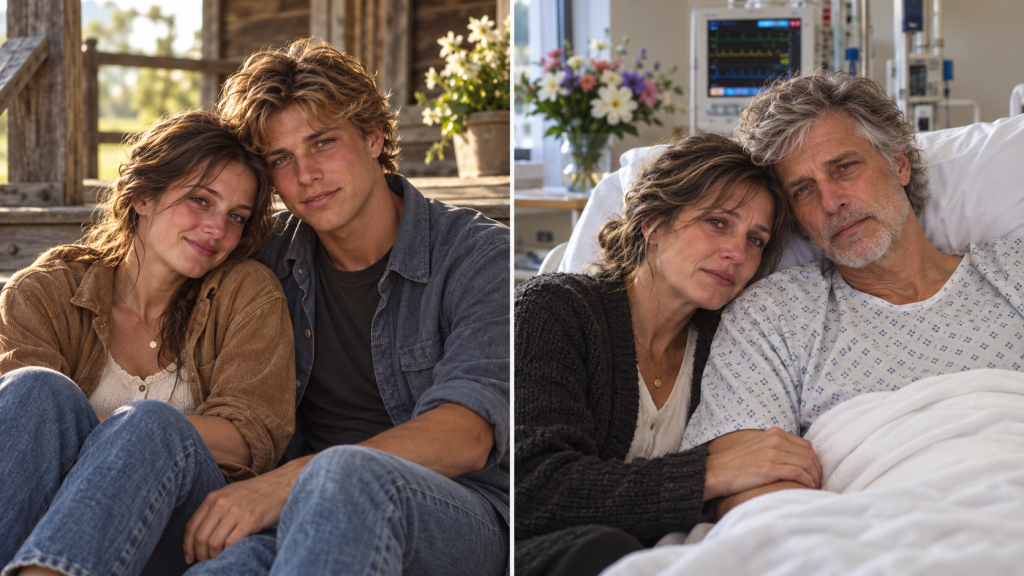
Lucas crossed the room and placed the envelope in my hands. Across the front, written in careful blue ink, was my name. HANNAH RUTH MORGAN No one had called me Hannah Ruth since my mother died.
I looked at Douglas.
“Who wrote this?”
He answered:
“Sarah.”
His wife.
The woman from that last letter.
The woman I had spent forty-one years trying not to imagine.
My fingers tightened around the envelope.
“When?”
“Seven years ago.”
I stared.
“Seven?”
Douglas nodded.
“Before she died.”
I almost dropped it.
“Your wife is dead?”
“For six years.”
The room seemed to tilt again.
I sat down hard in the chair beside his bed.
“You’ve been a widower for six years?”
“Yes.”
“And you never called?”
Pain crossed his face.
“No.”
I laughed once, but there was nothing amused in it.
“Then what exactly was the point of our promise?”
Douglas looked at me.
“Sixty.”
“You said sixty.”
“That was the promise.”
I could feel anger climbing through the grief.
“You remembered every birthday.”
“Yes.”
“You wrote forty-one cards.”
“Yes.”
“You were widowed at fifty-four.”
“Yes.”
“And you still waited?”
He closed his eyes.
“Yes.”
“Why?”
Douglas opened them again.
“Because you deserved at least one promise from me that I didn’t break.”
That silenced me.
Not because it made everything all right.
It didn’t.
But because I suddenly saw what the number sixty had become to him.
Not a joke beneath football bleachers.
A finish line.
A punishment.
A prayer.
I opened Sarah’s letter.
The first sentence made me stop breathing.
Dear Hannah,
If you are reading this, then either Douglas finally became brave, or time finally became cruel enough that bravery was no longer optional.
I looked at him.
A weak smile touched his mouth.
“That sounds like her.”
I continued.
First, I need you to know something I would want to know if our places were reversed: Douglas loved me.
My throat tightened.
He did not marry me because I looked like you. He did not spend our marriage staring out windows wishing I were someone else. We built a life. We laughed. We fought. We raised Lucas. We buried my mother. We remodeled two kitchens badly. We survived one bankruptcy scare, one rebellious teenager, and a dog that ate an entire Thanksgiving turkey.
Lucas smiled through tears.
“Buster.”
Douglas whispered:
“Worst dog ever.”
Lucas shook his head.
“Best dog.”
I looked back at the page.
Our marriage was real.
So was his love for you.
I had to stop.
There are sentences that hurt because they destroy an illusion.
That one hurt because it refused to destroy anybody.
Sarah was not offering herself as a villain so I could feel better.
She was asking me to hold two truths.
Douglas had loved his wife.
Douglas had loved me.
Life had not been kind enough to simplify itself.
I continued.
I learned about you eleven years into our marriage.
Not because Douglas confessed.
Because I found the ring.
I looked at the little velvet box in my lap.
Douglas turned toward the window.
I kept reading.
I was looking for the deed to our house in an old metal lockbox. Underneath the insurance papers was a sapphire ring and ten birthday cards addressed to a woman named Hannah.
Ten.
So by then, ten birthdays had already passed.
None had stamps. None had been mailed.
At first, I thought my husband was having an emotional affair with a ghost.
Despite myself, I smiled.
Then he told me about the football bleachers.
He told me about the pinky promise.
He told me he bought the ring at nineteen.
He told me his father said your family would lose their home if he kept seeing you.
My hands went cold.
Sarah’s next sentence was underlined.
Hannah, that part was a lie.
I looked up.
Douglas was crying.
“What?”
He whispered:
“I didn’t know.”
“When did you find out?”
“After my father died.”
“When?”
“Twenty-three years ago.”
The anger came back so quickly I stood.
“You knew for twenty-three years?”
“Hannah—”
“You knew your father lied for twenty-three years?”
“Yes.”
“And still said nothing?”
“Yes.”
I wanted to leave.
I actually reached for my coat.
Lucas moved but did not block me.
Good.
Nobody was going to block a door and call it love.
Douglas said:
“Read the rest.”
I stared at him.
“No.”
“Please.”
“You’ve had forty-one years of ‘please.’”
His face collapsed.
I hated that.
I hated that seeing him hurt still reached some part of me that had apparently never learned to protect itself.
Lucas spoke quietly.
“My mother explains the rest better than Dad can.”
I looked at him.
Then at the envelope.
Then sat again.
Sarah’s letter continued.
Douglas’s father did help your parents.
But not in the way Douglas was told.
Your father’s name was Arthur Morgan.
Mine had been June.
Arthur had suffered a serious heart problem when I was nineteen.
I remembered the hospital.
The whispers.
My mother sitting at the kitchen table with bills spread around her.
The red notices she hid whenever I walked into the room.
I remembered asking if we were going to lose the house.
She said:
“Adults figure things out.”
Apparently adults also bury things deep enough for their children to mistake silence for safety.
Sarah wrote:
According to the records Douglas found after his father died, your mother borrowed $21,500 from Walter Bennett in 1985.
Walter.
Douglas’s father.
The money covered medical bills, mortgage arrears, and household expenses while your father recovered.
I looked at Douglas.
“Twenty-one thousand five hundred?”
He nodded.
“In 1985.”
“Yes.”
That had been an enormous amount of money to us.
Sarah continued.
Walter told Douglas the money was a gift that could be withdrawn, converted to debt, or used to force the sale of your parents’ house if Douglas abandoned college and came home to marry you.
I whispered:
“That makes no sense.”
Douglas answered:
“It didn’t.”
“Not now.”
“At nineteen, with my father holding documents I didn’t understand…”
He stopped.
I looked back down.
The truth was simpler.
Your mother had signed an ordinary private loan.
No clause mentioned you.
No clause mentioned Douglas.
No clause gave Walter the power to take your house because his son loved you.
I closed my eyes.
Forty-one years.
Not destroyed by some magnificent legal trap.
A bluff.
A father’s certainty.
A frightened nineteen-year-old.
I kept reading.
Your mother repaid the loan. Every dollar.
Then a number:
$27,840 including interest, paid over twelve years.
I stared at it.
“Mom paid it back?”
Douglas nodded.
“Yes.”
“Every cent?”
“Yes.”
“When did you learn that?”
“When Dad died and I went through his financial records.”
“What year?”
“2003.”
My stomach twisted.
By 2003, Douglas had been married to Sarah for more than sixteen years.
Lucas was already a teenager.
I understood before he said it.
He had learned too late for the truth to be simple.
Not too late to contact me.
But too late to pretend only two lives were involved.
I continued reading.
Walter lied to both families differently.
He told Douglas your mother had begged him to keep Douglas away from you because she believed he would ruin your life.
He told June that Douglas had decided his future mattered more than a teenage attachment and that contact would only keep you from moving on.
My vision blurred.
That sounded like my mother.
Not what she believed.
What she might have feared enough to accept.
Then came the line from the little note.
Please let Hannah hate Douglas if hatred is what helps her survive losing him.
Sarah explained:
June wrote that sentence to Walter after Hannah had spent several weeks waiting for a letter Walter knew would never come.
I looked sharply at Douglas.
“Several weeks?”
He swallowed.
“Dad intercepted some of my letters.”
I stared.
“How many?”
“I don’t know.”
“Douglas.”
“I truly don’t.”
He struggled to sit higher.
Lucas adjusted his pillow.
Douglas continued.
“At least five.”
My heart broke in a completely new place.
“You wrote?”
“Every week.”
“For how long?”
“Months.”
“I received three.”
He covered his eyes.
“I know.”
“No.”
My voice shook.
“You don’t know.”
“I sat by our mailbox.”
“I knew the postman’s schedule.”
“I thought you had found college and forgotten me.”
Douglas lowered his hand.
“I thought you had stopped answering because your mother wanted you to.”
“You believed her?”
“I believed my father.”
“That’s worse.”
“Yes.”
He did not defend himself.
That mattered.
Sarah’s letter explained that June had eventually realized Walter had manipulated both sides.
She tried to correct it.
She wrote Douglas.
Twice.
Those letters never reached him.
Walter’s secretary had filed them in a private correspondence folder.
Why?
No one knew for certain.
Perhaps Walter intended to answer.
Perhaps he simply did what controlling people often do when they believe their interference is wisdom.
He made decisions for everyone and called the result order.
One of June’s letters had survived.
Douglas had it.
Lucas opened the blue shoebox again and found another envelope.
This one yellow with age.
My mother’s handwriting.
The date:
March 12, 1988.
I was twenty-one.
Douglas was already married.
My hands trembled.
Inside, Mom had written:
Douglas,
I was wrong.
I stopped.
The room blurred.
I tried again.
I let fear make me accept a cruel arrangement because your father convinced me you had already chosen another life and because Arthur was sick enough that I could not think beyond keeping a roof over Hannah’s head.
I never asked you to stop loving her.
I never wanted her to believe she was unwanted.
Your father told me you had no intention of returning.
If that was untrue, then I helped hurt two children I loved because I was frightened.
Children.
At twenty-one, that word would have insulted me.
At sixty, I understood.
We had been almost adults with adult-sized feelings and child-sized power.
Mom continued.
Hannah does not know about the money.
I will tell her someday when I can explain it without making her feel she owes her father’s life to losing you.
She never did.
My father died when I was twenty-seven.
My mother lived another twenty-four years.
She never told me.
I wanted to be angry at her.
I was.
I also saw her at thirty-eight years old, sitting at a kitchen table with a sick husband, overdue mortgage, terrified daughter, and a wealthy man telling her he knew what was best.
Explanation.
Not absolution.
Both.
Mom’s letter ended:
If you are happy, stay happy.
If you love your wife, love her well.
But someday, if you and Hannah are both free, please tell her the silence was never proof she meant nothing.
I pressed the page against my chest.
Douglas whispered:
“I didn’t receive that until 2003.”
I nodded.
I believed him.
That was the cruelest part.
I believed him.
Lucas spoke.
“Mom found all of this with Dad.”
I looked at him.
“You were there?”
“No.”
“I was sixteen.”
“They didn’t tell me then.”
He sat by the window.
“Mom told me later, when she got sick.”
Sarah.
Her letter still waited in my hands.
I returned to it.
When Walter died, Douglas and I found June’s letters together.
I wish I could tell you I reacted nobly.
I did not.
I almost smiled.
I was furious.
Not because Douglas loved you. I had made peace with that years earlier.
I was furious because suddenly I understood that our marriage had partly grown in the space created by another man’s lie.
That sentence stopped me.
There it was.
Sarah’s own wound.
Not villain.
Not saint.
A woman discovering that the road that led to her happiness had been cleared by someone else’s grief.
I asked Douglas whether he wanted to find you.
I looked at him.
He looked away.
He said yes.
My chest tightened.
Then he said no.
Of course.
He said he would not come into your life as a married man carrying a forty-year-old promise like a weapon against whatever life you had built.
I whispered:
“Twenty-year-old promise then.”
Douglas gave a tiny laugh.
“Sarah rounded emotionally.”
I smiled despite everything.
Sarah continued.
I told him I would not consider a letter to you a betrayal of me.
He refused.
He said if Hannah had married, he would not disturb her. If she had not married, he would not appear as a married man and ask her to hold an emotional place for him.
I stared at him.
“That sounds noble.”
He flinched.
“It was also cowardly.”
Good.
I needed him to know.
“I could have handled a letter.”
“I know.”
“You could have told me the truth without asking for anything.”
“I know.”
“You decided for me again.”
He closed his eyes.
“Yes.”
That was the pattern beneath all of it.
Walter decided for Douglas.
June decided for me.
Douglas decided for me.
Everyone kept calling silence protection.
No one asked what I wanted protected from.
Sarah’s final pages were written after she became ill.
She had ovarian cancer.
Two years of treatment.
Remission.
Then recurrence.
She wrote:
Hannah, I am going to ask something selfish.
If Douglas reaches sixty and you are both free, let him call.
You do not owe him love.
You do not owe him forgiveness.
You do not owe my memory loyalty.
I had my marriage.
That line broke me.
I had thirty-one years with him.
I had Lucas.
I had ordinary Tuesdays and bad vacations and Christmas mornings.
Please do not turn my life into a tragedy in order to justify whatever life might still be left for you.
I covered my mouth.
Lucas was crying openly now.
Douglas stared at the ceiling.
Sarah continued:
He loved me well.
He failed you badly.
Both are true.
Make him explain himself.
Then choose whatever lets you sleep peacefully.
At the bottom:
Sarah Bennett
Then, underneath:
P.S. I found your senior-year photograph once. You were prettier than he admitted. I resented you for eleven minutes. Then I got over myself.
I laughed.
A real laugh.
It escaped through forty-one years of grief so suddenly that Lucas laughed too.
Douglas smiled.
“She wrote that?”
I looked at him.
“You never read this?”
“No.”
“Why?”
“She sealed it.”
“She told Lucas to give it to you if I ever called.”
I looked at Lucas.
He nodded.
“Mom said Dad would edit himself into a martyr if left unsupervised.”
Douglas muttered:
“That sounds like her too.”
For the first time since I entered the room, the woman who had married Douglas did not feel like a rival.
She felt like a person.
One I wished I had known.
Then the doctor came in.
The atmosphere changed immediately.
His name was Dr. Patel.
Kind eyes.
No false cheerfulness.
He looked at me, then Douglas.
“You have company.”
Douglas said:
“The company.”
Dr. Patel nodded.
Then checked his chart.
I knew enough from his face.
“How long?” I asked.
Douglas frowned.
“Hannah.”
“What?”
“You called me here because you were dying.”
“So I’m allowed to ask.”
Dr. Patel looked at Douglas.
Douglas nodded.
The doctor answered carefully.
“The cancer has progressed despite treatment.”
“What kind?”
“Pancreatic.”
I closed my eyes.
Of course.
A quiet disease until it was no longer quiet.
“Days?”
“Likely not days.”
“Weeks to a few months is more realistic.”
Douglas whispered:
“I wanted sixty.”
Dr. Patel looked confused.
I understood.
He had been diagnosed eleven months earlier.
He had been trying to reach his sixtieth birthday.
Our promise.
My birthday had been three days before his.
I stared at him.
“You waited through cancer?”
He looked embarrassed.
“I was afraid if I called at fifty-nine, you’d accuse me of breaking the rules.”
I almost hit him.
Instead I cried.
“You ridiculous man.”
“Yes.”
Douglas was discharged into home hospice four days later.
Not because a miracle occurred.
Because sometimes dying happens outside hospitals.
Lucas had moved Douglas into the small house he and Sarah had bought after retirement.
I almost didn’t go.
That needs to be understood.
A forty-one-year love story sounds romantic when told quickly.
In real life, forty-one years is a long time.
Forty-one Christmases.
Forty-one summers.
Forty-one birthdays.
I had built a life inside that absence.
I was a high-school librarian for thirty-two years.
I bought my childhood home after my mother died.
I traveled.
I had friends.
I loved two men briefly enough to imagine marriage and wisely enough not to force it.
I cared for my father.
Then Mom.
I taught children to find books when they didn’t yet know what questions they were asking.
I was not frozen beneath football bleachers waiting for Douglas to return.
I needed him to understand that.
So on the first afternoon at his house, I told him.
He lay beneath a knitted blanket Sarah had made.
I sat beside the window.
“I didn’t wait for you.”
Douglas looked at me.
“I know.”
“No.”
“I need to say it.”
He nodded.
“I did not spend forty-one years refusing life because of you.”
“I know.”
“I had a life.”
“I know.”
“I had men who loved me.”
His mouth twitched.
“I dislike that.”
I laughed.
“Good.”
He smiled.
Then coughed.
When it passed, I continued.
“I never married because I never found a relationship that felt honest enough to build a whole life inside.”
“Was that because of me?”
“Partly.”
I would not lie to make him feel better.
“Partly because I was stubborn.”
“Partly because I learned to like my independence.”
“Partly because life is not a machine where every person receives a spouse if they behave correctly.”
Douglas nodded.
“Good.”
“What?”
“I’m glad you didn’t spend your whole life waiting.”
I looked at him.
“You still hurt me.”
“I know.”
“You don’t get to be relieved out of that.”
“I know.”
Good.
We opened the birthday cards slowly.
Not all at once.
The first was for my twentieth birthday.
Ruthie,
I saw a girl wearing yellow today and hated her for not being you.
I laughed.
“You were dramatic.”
“Nineteen.”
“Same disease.”
The twenty-first:
I hope you are dancing somewhere.
The twenty-fifth:
I heard Fleetwood Mac in a grocery store and stood beside the canned soup like an idiot.
The thirty-second:
Lucas lost his first tooth today. You would have told him the tooth fairy was a racket and then slipped him five dollars.
I looked at Douglas.
“You wrote about your son to me?”
“I wrote about everything.”
“You never intended to mail these.”
“No.”
“Then why?”
He thought.
“Because every birthday reminded me there was a version of my life that had once imagined knowing yours.”
That was beautiful.
Also sad.
Not tragic.
Just human.
Some cards mentioned Sarah.
I was grateful for that.
At thirty-seven:
Sarah says I should stop pretending I don’t know your middle name when I write these. She thinks “Ruthie” sounds suspiciously intimate. She is right.
I laughed so hard I had to stop reading.
At forty:
Sarah bought me a blue sweater I hate. If you ever meet her, side with me.
Lucas, from the kitchen, shouted:
“Mom was right about the sweater.”
Douglas yelled weakly:
“Traitor.”
Ordinary marriage.
Ordinary life.
Exactly as Sarah had promised.
At forty-nine, the card changed.
Dad died this spring.
I stopped.
Douglas watched.
I continued.
I found the loan records.
Your mother paid him back.
I found two letters from her that he never gave me.
I have spent thirty years blaming fear, timing, your mother, my father, youth.
Tonight Sarah told me something I did not want to hear: there comes a point when the reasons for silence stop excusing the person who keeps choosing silence.
I looked up.
Douglas’s eyes filled.
“She was right.”
“Yes.”
I read on.
I could find you.
I am not going to.
I do not know if this is respect or cowardice.
Maybe both.
If you are happy, I hope I never disturb it.
If you are lonely, I am sorry I do not know.
That one hurt more than the others.
Because by forty-nine, I had been lonely sometimes.
Not always.
But sometimes.
He could have called.
I could have chosen.
Instead he made another noble decision in a room I wasn’t allowed to enter.
I folded the card.
“I hate this one.”
Douglas nodded.
“So do I.”
“Good.”
Then came the card from my fifty-fourth birthday.
Sarah had died that year.
Douglas’s handwriting shook.
Ruthie,
Sarah died in April.
There is no language for the first morning after the person who shared your bed for thirty-one years is no longer in the world.
I swallowed.
Before she died, she made me promise something.
She said: “Do not call Hannah because I am dying. Call her when the promise says you can. Otherwise you’ll spend the rest of your life wondering whether grief made the choice for you.”
Sarah.
Even dying, she refused to become permission.
I kept reading.
So I will wait.
Six years.
If I am alive at sixty, I will call.
If you hang up, I will deserve it.
If you are married, I will bless the lucky bastard and leave you alone.
If you are free…
The sentence stopped.
Just three dots.
I looked at Douglas.
“What were you going to write?”
He smiled weakly.
“I didn’t know.”
“Liar.”
He laughed.
“Fine.”
“What?”
“I was going to ask if you wanted coffee.”
I stared at him.
“Coffee?”
“What did you expect?”
“Forty-one years and your plan was coffee?”
“I didn’t want to scare you.”
“You bought a ring at nineteen.”
“I had regressed into caution.”
I laughed.
For a little while, death moved to the edge of the room.
Three weeks passed.
Then five.
Douglas weakened slowly.
Not every day was emotional.
Some were boring.
That mattered.
We watched terrible television.
Argued about whether old movies were better.
He insisted the Denver Broncos had ruined several decades of his emotional health.
I told him sports were voluntary suffering.
He said loving me had been voluntary suffering.
I threw a pillow at him.
He was too weak to throw it back.
Lucas did it for him.
Traitor.
One afternoon, Douglas asked me to drive him somewhere.
Hospice nurse said no long trips.
“It’s fifteen minutes.”
I knew before he told me.
The old high school.
The football field had been rebuilt.
The bleachers replaced.
Of course they had.
Forty-one years do not preserve scenery out of sentiment.
Lucas pushed Douglas’s wheelchair along the track.
I walked beside them.
The new metal bleachers gleamed in the cold afternoon sun.
Douglas looked offended.
“They ruined them.”
“They were probably dangerous.”
“They were historic.”
“They smelled like wet pennies.”
He laughed.
Lucas parked the wheelchair beneath them.
Then gave us space.
Douglas looked upward.
“Right around there.”
“No.”
“Two sections over.”
“You remember?”
“I remember exactly.”
I sat beside him on the lowest bench.
He held out his pinky.
My heart broke.
“If neither of us is married by sixty…”
I hooked mine around his.
“We’ll stop being idiots.”
“And find each other.”
He smiled.
“Took long enough.”
I whispered:
“We found each other.”
His eyes filled.
“Yeah.”
Then he reached into his coat pocket.
The ring.
I froze.
“Douglas.”
“I’m not proposing.”
“Good.”
“That sounded enthusiastic.”
“You’re dying.”
“Romance has really changed.”
I laughed and cried at once.
He opened the velvet box.
The sapphire was small.
Old-fashioned.
Perfect.
“I bought this because blue was your favorite color.”
“It still is.”
“I know.”
“How?”
“You wore blue in the newspaper article about your retirement.”
I stared.
“You looked me up?”
“Publicly available information is not stalking.”
“That sentence sounds like stalking.”
He smiled.
Then became serious.
“I don’t want you to wear it because you think we should have married.”
I listened.
“We don’t know that.”
“What?”
“We might have been terrible.”
I laughed.
“You’re ruining this.”
“I mean it.”
“We were nineteen.”
“Maybe we would have married at twenty-two, fought over money, had children, divorced at thirty-seven, and hated each other in parking lots.”
“That is extremely unromantic.”
“It is honest.”
He held the ring toward me.
“I don’t want this to represent the life we were cheated out of.”
“What should it represent?”
“The truth.”
“Which truth?”
“That I loved you then.”
He swallowed.
“That I love you now.”
“And that both things are true even though everything between them was complicated.”
I took the ring.
I did not put it on my finger.
I threaded it onto the chain around my neck.
Beside the little silver cross my mother had given me.
Douglas smiled.
“Your mother would hate that.”
“The ring beside her cross?”
“Yes.”
“Good.”
We laughed until he coughed.
Then I held his hand until the coughing stopped.
The next twist arrived from someone I had not expected.
My mother.
Eight years dead.
Not literally, obviously.
In a box.
After reading her 1988 letter, I went through the attic of my childhood home.
Mom kept everything.
Tax receipts.
Birthday cards.
Appliance manuals for appliances we had thrown away in 1994.
At the back of a cedar chest, under my father’s military papers, I found a small notebook.
June Morgan’s handwriting.
Not a diary.
Household accounts.
Hospital: 3,420
Mortgage arrears: 2,870
Walter loan payment: 175
Page after page.
Then one note, written across the margin in 1987:
Hannah asked about Douglas again. I lied again. I told her some doors close because they must. What kind of mother teaches a child that love disappearing without explanation is normal?
I sat on the attic floor and cried.
Another entry:
Arthur says I should tell her. I am afraid if I tell her, she will hate me.
Dad knew?
That surprised me.
Apparently, after recovering, my father wanted Mom to confess.
Mom could not.
Fear had saved our house.
Then fear kept the truth buried.
A later entry:
Payment to Walter: 200. Balance 4,600.
And beneath it:
When this is paid, I will tell Hannah.
She paid it.
She did not tell me.
Why?
The final relevant entry came in 1998.
Loan finished.
Then:
Called Bennett residence. A woman answered. I heard a child in the background. I hung up.
Sarah.
Lucas.
My mother had called.
She realized Douglas had a family.
And once again, she chose silence.
Not because Walter controlled her anymore.
Because she thought telling the truth would only hurt more people.
I closed the notebook.
There it was again.
Our family’s favorite mistake.
Calling silence mercy.
I brought the notebook to Douglas.
He read those pages slowly.
Then whispered:
“She called.”
“Yes.”
“I wonder if Sarah would have told me.”
“Probably.”
“You think?”
“I read her letter.”
“She sounds terrifying.”
Douglas smiled.
“She was.”
Then his face softened.
“I’m sorry your mother carried that.”
“So am I.”
“Do you forgive her?”
I thought.
“I don’t know.”
“That’s fair.”
“She was scared.”
“Yes.”
“She was also an adult.”
“Yes.”
“She made choices.”
“Yes.”
I looked at him.
“So did you.”
He nodded.
“Yes.”
There was something healing about a person not asking to be released from responsibility.
By the second month, Douglas stopped walking.
Then he stopped eating much.
Time narrowed.
Morning medication.
Ice chips.
Sleep.
Visitors.
Lucas asked if I wanted more privacy.
I told him no.
This was his father.
I was not going to arrive after forty-one years and claim final ownership of a man who had belonged to many people.
Friends came.
Old colleagues.
Neighbors.
Sarah’s sister.
That meeting frightened me.
Her name was Beth.
She hugged Douglas.
Then looked at me.
“So you’re Hannah.”
I braced.
“Yes.”
Beth smiled.
“My sister would be furious you waited this long to show up.”
I almost laughed.
“I only found out two months ago.”
“Then she’d be furious at him.”
She pointed at Douglas.
He muttered:
“Everyone is enjoying hospice too much.”
Beth sat beside me.
“I read Sarah’s letter before she sealed it.”
I looked at her.
“She asked me if it was cruel.”
“What did you say?”
“I said everything was cruel.”
“That wasn’t helpful.”
“I’m a younger sister.”
“Not my job.”
I liked her immediately.
Beth became serious.
“Sarah never thought you threatened her marriage.”
“That matters to me.”
“She thought Walter stole everyone’s choice.”
I swallowed.
“Yes.”
Beth continued.
“She also thought Douglas used his father’s manipulation as an excuse for his own silence long after Walter lost the power to force anything.”
Douglas raised one finger from the bed.
“I’m right here.”
Beth said:
“Good.”
“I’ve wanted to tell you that for twenty years.”
I laughed.
Douglas groaned.
“Dying has absolutely ruined my authority.”
The final birthday card had been written before he called me.
My sixtieth.
It was still sealed.
He gave it to me six days before he died.
“Open after.”
“No.”
“Hannah.”
“I’m not accepting scheduled grief.”
“That is an excellent phrase.”
“I mean it.”
He looked at me.
“Then open it now.”
So I did.
The handwriting was weak.
Ruthie,
Sixty.
I made it.
I stopped.
His fingers tightened around mine.
I continued.
If you are reading this because I finally called, then I hope my voice did not sound as old as it feels.
If you refused to speak to me, that was your right.
If you came, thank you.
There is something I need you to know more than I need you to know I loved you.
I looked at him.
“What could be more important than that?”
“Read.”
You did not waste your life.
My breath caught.
If you never married, do not let our story turn that fact into evidence that you spent forty-one years waiting for me.
Tears blurred the page.
He knew.
Before I ever told him, he knew what people would say.
You lived.
Whatever you built without me counts.
Whoever loved you counts.
Every morning you woke without me and still found something worth doing counts.
I could not see anymore.
Lucas quietly left the room.
Douglas whispered:
“Keep going.”
I wiped my eyes.
I hope I get to hear about all of it.
And if I do not have enough time, please understand that knowing there was more to you than missing me will be one of the greatest comforts of my life.
At the bottom:
Happy birthday, Ruthie.
I kept my promise as badly as a man could keep one.
But I found you.
I put the letter down.
Then kissed him.
Not like teenagers.
Not like a stolen life had been restored.
Like two sixty-year-old people who had lost too much time to pretend love needed youth to be real.
When I pulled away, Douglas smiled.
“That was worth waiting for.”
I hit his arm.
Weakly.
He laughed.
He died on a Thursday morning.
Rain against the windows.
Lucas on one side.
Me on the other.
No dramatic last speech.
People imagine dying people save perfect sentences for the end.
Mostly they are tired.
Douglas woke around four.
Looked at Lucas.
Said:
“Proud of you.”
Lucas cried.
Then Douglas looked at me.
“Ruthie.”
“I’m here.”
He blinked slowly.
“Sixty.”
“Yes.”
A tiny smile.
“Told you.”
I laughed through tears.
“Idiot.”
Then he slept.
His breathing changed after sunrise.
Slowed.
Paused.
Returned.
Paused longer.
Then stopped.
I kept holding his hand because nobody told me to release it.
Eventually Lucas rested his head against my shoulder.
We cried for both of us.
For Sarah.
For Douglas.
For nineteen.
For sixty.
For everything that happened.
For everything that did not.
The funeral was four days later.
I sat with Lucas.
Not in Sarah’s place.
There was no Sarah’s place.
There was a seat beside Lucas.
I took it.
Douglas’s friends told stories I had never heard.
He once got fired from a college radio station for playing the same song seven times.
He coached Little League badly.
He hated mushrooms.
He could fix bicycles but not plumbing.
He volunteered at a food pantry every Tuesday after retirement.
A man I had known completely at nineteen had become an entire stranger while I was gone.
That hurt.
It also comforted me.
He had lived too.
Lucas gave the eulogy.
At the end, he said:
“My father taught me something late.”
He looked at me.
“Love does not excuse cowardice.”
The room went still.
“It also does not disappear simply because people make cowardly choices.”
“He loved my mother.”
“He loved me.”
“And before either of us, he loved a girl named Hannah under some football bleachers.”
People smiled.
Lucas continued.
“My mother knew that.”
“She was not threatened by truth.”
“My grandfather was.”
“That difference shaped more lives than he probably ever understood.”
Then Lucas unfolded a card.
“My dad wrote forty-one birthday cards he never mailed.”
“And if you’re wondering whether that is romantic, Hannah would like you to know it was also extremely stupid.”
The room laughed.
I covered my face.
Douglas would have loved it.
After the funeral, Lucas gave me the blue shoebox.
“I can’t take this.”
“Yes, you can.”
“These are your father’s.”
“They were written to you.”
“What about the ring?”
He looked at the chain around my neck.
“Seems like you already stole that.”
I laughed.
Then became serious.
“What did your mother want done with it?”
“She knew.”
“What?”
“Dad told her he wanted you to have it if he ever found you.”
I touched the sapphire.
“Lucas.”
He shook his head.
“You’re not taking anything from me.”
That mattered.
I did not want inheritance to complicate grief.
Douglas left me no money.
I was grateful.
His estate went to Lucas and charitable gifts Sarah and he had planned years earlier.
No dramatic last-minute will.
No suspicious transfer.
No wealth proving love.
Just the ring.
Cards.
Letters.
Truth.
Enough.
Months passed.
Then a year.
People assumed I was devastated every day.
I wasn’t.
Grief is rude that way.
It refuses performance.
Some mornings I woke sad.
Some mornings hungry.
Sometimes I forgot Douglas was dead for three seconds.
Sometimes I forgot I had found him at all.
The forty-one-year absence and the ten-week reunion became difficult to compare.
Which was bigger?
Time?
Intensity?
Regret?
There is no measurement.
I stopped trying.
Lucas stayed in my life.
Not because Douglas asked him to.
Because we liked each other.
He called once a month.
Then more.
His wife, Megan, invited me to Thanksgiving.
The first time I went, I almost said no.
Then Lucas texted:
Mom would haunt both of us if you spend Thanksgiving alone for symbolism.
I went.
Sarah’s photograph stood on the piano.
Beautiful woman.
Dark hair.
Bright smile.
I stopped in front of it.
Megan came beside me.
“That’s her.”
“I know.”
“You okay?”
“Yes.”
And I was.
I touched the frame.
“Thank you,” I whispered.
No ghost answered.
Good.
Years later, Lucas gave me another box.
He had been cleaning the attic.
Inside were Sarah’s journals.
He had marked one page.
Found Douglas writing Hannah’s birthday card again.
Asked him whether he wishes he married her.
He said, “I don’t know.”
I smiled.
Honest.
Sarah continued:
I told him good. Anyone who claims to know how a life not lived would have turned out is selling fiction.
I laughed.
Then:
I asked if he wishes he had been allowed to choose freely.
He said yes.
That I understand.
There it was.
The real loss.
Not guaranteed marriage.
Choice.
Walter had stolen choice.
June had surrendered choice.
Douglas had later withheld choice.
That was what hurt.
Not the fantasy that we definitely would have lived happily ever after.
Maybe we would have.
Maybe not.
But we should have been allowed to find out.
At sixty-five, I did something I never expected.
I dated again.
His name was Michael Harper.
Retired history teacher.
Widower.
He knew about Douglas before our third dinner because Lucas had apparently become incapable of subtlety.
Michael asked:
“Do I need to compete with a dead man?”
I looked at him.
“If you try, you’ll lose.”
He blinked.
Then I smiled.
“Because dead people cannot argue.”
He laughed.
Good answer.
We dated for three years.
Never married.
Not because Douglas remained my one true love.
Because Michael and I liked our homes.
Our independence.
Our lives.
We traveled.
We ended kindly when his daughter needed him closer to California.
Love can be meaningful without becoming permanent.
That was another lesson I learned too late to teach nineteen-year-old me.
At seventy, I returned to the football field alone.
The school had changed again.
Students ran track.
Music from someone’s phone echoed across the bleachers.
I sat in the lowest row.
Pulled Douglas’s ring from beneath my sweater.
The sapphire had scratched slightly over time.
Good.
Objects should look lived with.
I thought about Walter.
For years, I hated him.
Then less.
Not because he deserved forgiveness.
Because hatred was too much rent for a dead man.
I never learned every reason he did what he did.
Douglas believed his father saw him as destined for law school, business, status.
I was a local girl with a sick father and no money.
Perhaps Walter thought he was protecting his son.
Control often dresses itself in respectable clothes.
That does not make it love.
I thought about Mom too.
That was harder.
She had loved me.
That was not in question.
She also betrayed my right to know.
Both.
Again.
Always both.
I eventually had her notebook copied.
Then placed the original beside her photograph.
Not as accusation.
Evidence.
Human beings are often most dangerous when fear convinces them secrecy is kindness.
Mom had believed the truth would hurt me.
She was right.
It did.
It also belonged to me.
At seventy-six, Lucas had a granddaughter.
He named her Sarah.
I cried when he told me.
Then he said:
“We’re giving her Ruth as a middle name.”
I stopped.
“No.”
“What?”
“That child has enough ancestral emotional responsibility.”
He laughed.
Megan shouted in the background:
“I told you she’d say that!”
They named her Sarah Ruth anyway.
Traitors.
When little Sarah Ruth was six, she found Douglas’s ring around my neck.
“What’s that?”
“A promise.”
“What promise?”
I thought carefully.
“A promise two silly teenagers made.”
“Did they keep it?”
I smiled.
“Eventually.”
“Was it a good promise?”
I looked at her.
“No.”
She frowned.
“Then why do you wear it?”
“Because promises are not good just because they sound romantic.”
Now she looked very confused.
I laughed.
“Ask me when you’re older.”
She accepted that and asked for cookies.
Children understand priorities.
At eighty, I finally gave Lucas the blue shoebox back.
He resisted.
“These are yours.”
“They were written to me.”
“Yes.”
“But they are part of your father too.”
He looked down.
“Why now?”
“Because I don’t need forty-one paper proofs anymore.”
His eyes filled.
I continued.
“Keep the first card.”
“Keep the sixtieth.”
“Put the others somewhere safe.”
He nodded.
“What about the ring?”
I touched it.
“That stays.”
“Good.”
“Greedy.”
“Absolutely.”
That evening, alone in my childhood home, I took out Douglas’s final letter one more time.
You did not waste your life.
That sentence had become the center of the whole story.
Not:
I loved you first.
Not:
We were meant to be.
Not:
Sarah knew.
Not:
Walter lied.
Not even:
I found you.
The lesson was simpler.
A life does not become wasted because one love was lost.
A marriage does not become false because another love existed.
A mother’s fear does not become wisdom because she meant well.
A father’s control does not become protection because he paid the bills.
And silence does not become kindness merely because the truth is painful.
I used to think the saddest thing that happened to me was receiving Douglas’s goodbye letter in 1986.
Then I thought it was discovering the ring.
Then the loan.
Then Mom’s letter.
Then learning Douglas had been widowed for six years and still waited.
Then watching him die ten weeks after finally hearing his voice again.
But age changes the shape of sadness.
The saddest thing was not that we lost forty-one years.
It was that so many adults believed love was safer when choices were removed.
Walter chose for Douglas.
Mom chose for me.
Douglas later chose silence for me.
Everyone thought they were preventing pain.
They only changed its address.
If Douglas and I had married at twenty, perhaps we would have lasted sixty years.
Perhaps five.
Perhaps we would have had three children.
Perhaps none.
Perhaps he would have snored so badly I pushed him off the bed.
Perhaps I would have hated the way he loaded a dishwasher.
Perhaps money would have broken us.
Perhaps grief would have strengthened us.
There is no honest answer.
The life we did not live is not a memory.
It is imagination.
What I know is the life we did live.
At seventeen, he was my best friend.
At nineteen, he loved me.
At twenty, he lost me.
At sixty, he called.
And for ten weeks, we were no longer ghosts in each other’s stories.
We were real again.
Old.
Frightened.
Funny.
Angry.
Tender.
Too late for forever.
Still in time for truth.
The old landline remained in my childhood house until I was eighty-two.
Everyone begged me to remove it.
Lucas said:
“No one uses those.”
I said:
“One person did.”
He rolled his eyes.
Then one winter, the line finally stopped working.
The telephone company discontinued the old service after repeated infrastructure problems.
I held the receiver.
No dial tone.
Silence.
For once, silence did not frighten me.
I unplugged the phone.
Placed it in a box.
Then went outside.
The world was bright with snow.
My life had continued.
That was the miracle.
Not that Douglas returned.
Not that the promise survived.
That life continued before him, with him, after him.
Sometimes young people ask me whether I believe in soulmates.
I tell them no.
They always look disappointed.
So I explain.
I believe some people recognize parts of us very early.
Some people become a language we never entirely forget.
Some people arrive at the wrong time.
Some stay.
Some leave.
Some return.
But I do not believe one human being is the only door through which your life can enter.
That idea gives loss too much power.
Douglas was not my missing half.
I was never half.
He was my Douglas.
That was enough.
On what would have been his eighty-fifth birthday, Lucas and I went to the football field.
He brought coffee.
I brought the ring.
We sat beneath the bleachers.
Lucas looked around.
“This is where it happened?”
“Approximately.”
“Dad made it sound more romantic.”
“It smelled worse then.”
He laughed.
Then:
“Do you wish he had called earlier?”
“Yes.”
Immediate.
No hesitation.
“Do you wish he had left Mom after Grandpa died and found you?”
I looked at him.
“No.”
He seemed surprised.
“Why?”
“Because your mother was not a mistake that had to be corrected.”
His eyes filled.
“She was his wife.”
“His life.”
“Your mother.”
“I wanted the truth.”
“I did not need it purchased by destroying something honest.”
Lucas nodded.
Then asked:
“Do you wish Grandma June had told you everything?”
“Yes.”
“Even if nothing changed?”
“Yes.”
“Why?”
I looked toward the field.
“Because truth is not valuable only when it changes the outcome.”
He sat with that.
Then smiled.
“Dad would’ve stolen that line.”
“Probably.”
Before we left, I touched the sapphire ring.
Then held out my pinky to Lucas.
He laughed.
“What are we promising?”
“Nothing.”
“That defeats the purpose.”
“No.”
I smiled.
“We have enough promises.”
So instead, he took my hand.
And we walked away from the bleachers without making the future owe us anything.
That was what Douglas and I never knew at nineteen.
Love is not proven by a promise that survives forever.
Sometimes love is telling the truth while there is still time for the other person to choose what to do with it.
Douglas arrived late.
Very late.
But he arrived.
And when I heard his voice say “Ruthie” after forty-one years, I thought the miracle was that he remembered me.
I was wrong.
The miracle was that after all the lies, all the fear, all the letters hidden in drawers and birthdays written but never mailed, we finally stopped letting other people decide what our story was allowed to mean.
For ten weeks, the choice was ours.
And in the end, that was all I had ever wanted.