
Morgan did not confront Julian. That may have been the first decision that saved her after the necklace. Every frightened part of her wanted to march into the spare room, throw the velvet box onto his desk, and demand to know what he had put inside it. But the woman from the bus had already given her one instruction that proved worth listening to.
Don’t tell your husband. So Morgan stood in the kitchen with the phone pressed against her ear and listened to Evelyn Hart breathe on the other end. “My daughter is really alive?” Morgan asked. “Yes.” “And Julian was married to her?” “For seven years.” “He told me his first wife died.” “I know.” “How?” Evelyn’s voice tightened.
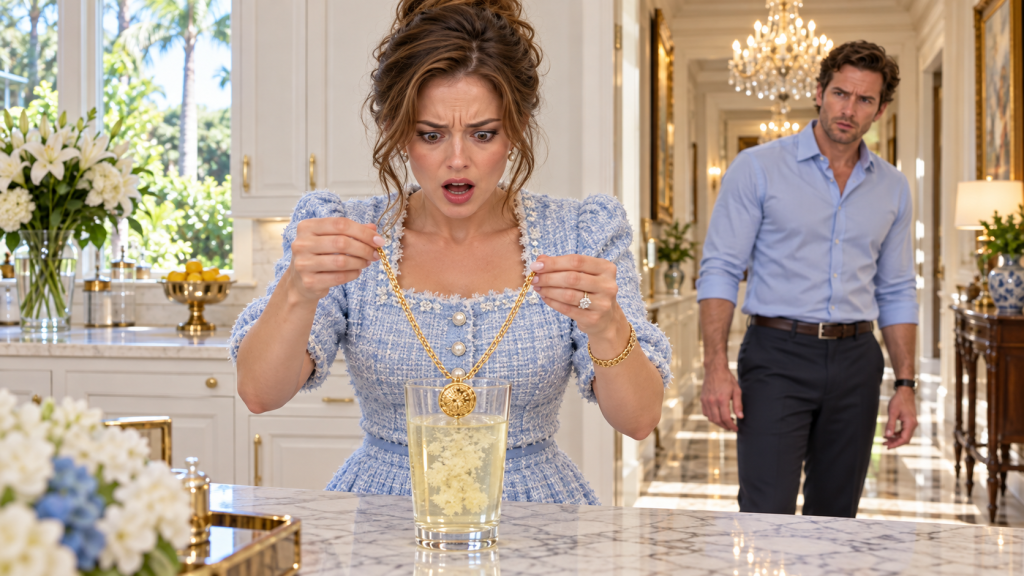
“Because Rebecca found you six months ago.” Morgan gripped the counter. “She found me?” “She recognized Julian in a photograph online.” “What photograph?” “Your construction company posted pictures from its Christmas party.” Morgan remembered. She and Julian had attended together.
Someone from work had posted a group photograph.
She had nearly asked for it to be taken down because Julian hated how he looked.
Instead, he joked about it.
Apparently that photograph had crossed hundreds of miles and reached a woman Morgan had been told was dead.
Evelyn continued.
“Rebecca saw his face.”
“She called me immediately.”
Morgan whispered:
“Why didn’t she contact me herself?”
“She tried.”
A chill moved through Morgan.
“What?”
“Twice.”
“Letters?”
“Yes.”
“I never got anything.”
“I know.”
“How do you know?”
“Because the second envelope came back marked return to sender.”
Morgan closed her eyes.
Julian collected the mail most days.
He worked from home.
Or claimed to.
“What did it say?”
“That she was Julian’s former wife.”
“That he lied about her death.”
“That you should keep control of your finances.”
“And not accept jewelry from him.”
Morgan looked toward the sealed necklace on the kitchen counter.
“Why jewelry?”
Evelyn hesitated.
Then said:
“Because that was how Rebecca finally realized he had been making her sick.”
Morgan’s knees weakened.
She lowered herself into a chair.
“What happened to her?”
“Not over the phone.”
“Evelyn.”
“I’m serious.”
“My daughter deserves to tell you that herself.”
Morgan looked toward the hallway.
Julian had left for what he called a breakfast meeting.
For the first time, she wondered whether any meeting he had ever mentioned actually existed.
“When can I meet her?”
“Today.”
“Where?”
“Police first.”
Morgan froze.
“What?”
“You called them, didn’t you?”
“Yes.”
“Good.”
“Then let them take the necklace.”
“Don’t bring it to me.”
“Don’t bring it to Rebecca.”
“Don’t touch it again.”
Morgan swallowed.
“You knew exactly what I would find in the water.”
“No.”
Evelyn’s answer came quickly.
“I knew what Rebecca found years ago.”
“That’s different.”
There was something almost comforting about the precision.
Evelyn was not pretending to know more than she did.
Morgan looked at the cloudy glass again.
The pale residue.
The tiny pieces from the clasp.
“I thought you were some strange old woman on a bus.”
Evelyn gave a weak laugh.
“I was a strange old woman on a bus.”
“You just weren’t there by accident.”
“No.”
“Why the bus?”
Silence.
Then:
“Because I was afraid he was watching you.”
Morgan’s skin went cold.
Evelyn explained.
Rebecca had located Morgan’s workplace through the company website.
She and Evelyn had spent weeks deciding whether to approach her.
Calling felt dangerous.
Letters had failed.
Showing up at Morgan’s apartment risked putting Rebecca directly in Julian’s path.
So Evelyn came to Chicago alone.
She waited near Morgan’s office after work.
Saw her board the bus.
Got on several stops later.
Then watched Morgan give up her seat.
“I almost lost my nerve,” Evelyn admitted.
“Then you stood up for me.”
“You didn’t even know me.”
“I thought…”
She stopped.
“What?”
Evelyn’s voice broke.
“I thought if you were kind enough to stand for an old woman, maybe you would listen when one told you something ugly.”
Morgan closed her eyes.
“You could have just said your daughter was alive.”
“And if you told Julian immediately?”
Morgan had no answer.
Exactly.
At 9:12 that morning, two officers arrived with an evidence technician.
Morgan showed them everything.
The glass.
The water.
The necklace.
The velvet box.
The receipt.
The number.
She repeated Evelyn’s warning.
Repeated Julian’s insistence that she wear the necklace.
Repeated his months of pressure over the Door County cottage.
She did not tell them:
My husband tried to poison me.
Because she did not yet know that.
She said:
“I am afraid he may have intended to make me ill.”
That was enough.
The necklace was photographed where it sat.
Then collected.
The glass too.
The officers asked whether Morgan felt safe remaining in the apartment.
She almost said yes automatically.
The old answer.
The polite answer.
Then she imagined Julian opening the cabinet.
Finding the glass gone.
Seeing the empty velvet box.
“No.”
The word surprised her.
“No, I don’t.”
Within three hours, Morgan had packed one suitcase.
Work clothes.
Medication.
Laptop.
Her grandmother’s photo.
The folder containing the Door County deed.
She left the apartment before Julian returned.
Not for the cottage.
Too isolated.
Too obvious.
She stayed with her coworker Tanya Brooks, a forty-two-year-old payroll manager who had spent seven years telling Morgan that Julian was “a very handsome unemployment problem.”
Tanya opened the door, saw the suitcase, and said nothing clever.
She simply stepped aside.
“Guest room.”
Morgan began crying.
“I’m sorry.”
“For what?”
“This is a mess.”
Tanya took the suitcase from her.
“You have listened to me complain about my sister’s boyfriend for four years.”
“You’ve earned at least one domestic disaster.”
Morgan laughed through tears.
Then she slept for five hours.
When she woke, her phone contained thirty-one missed calls.
All Julian.
The messages changed as the hours passed.
Where are you?
Then:
Did you take the necklace?
That one mattered.
Then:
Morgan, answer me.
Then:
You’re being ridiculous.
Then:
If this is about the cottage, we can discuss it.
Then:
I know someone has been talking to you.
Morgan stared at that sentence.
She forwarded everything to the detective assigned to the case.
I know someone has been talking to you.
He knew.
Maybe not who.
But he knew his past had finally caught up.
Morgan met Rebecca the following afternoon.
Not at a police station.
Not at Evelyn’s house.
At a quiet conference room attached to Rebecca’s attorney’s office.
Rebecca Hart was forty-one.
Morgan had expected someone fragile.
Someone obviously damaged.
Instead, Rebecca wore jeans, a navy sweater, and silver-framed glasses.
Her hair was cut short.
She carried herself carefully, as if every movement had once required more effort and some memory of that effort remained.
When Morgan entered, Rebecca stood.
Neither woman knew what to say.
Finally Rebecca looked at Morgan’s face.
“He bought you the gold one.”
Morgan stopped.
“What?”
Rebecca swallowed.
“Mine was silver.”
That sentence frightened Morgan more than any photograph could have.
They sat.
Evelyn remained near the door.
Rebecca placed a small folder on the table.
Inside was an old photograph.
A necklace.
Silver chain.
Small oval pendant.
Almost identical shape.
Morgan stared.
“He gave this to you?”
“On our fifth anniversary.”
“What happened?”
Rebecca folded her hands.
“He told me it had belonged to his grandmother.”
Morgan almost laughed.
Julian had told her the gold necklace had belonged to his grandmother.
“Of course he did.”
Rebecca nodded.
“At first nothing happened.”
“Then I started getting dizzy.”
“Confused.”
“I would lose pieces of afternoons.”
“I fainted twice.”
“My blood pressure dropped.”
“I couldn’t concentrate.”
Morgan felt cold.
“From the necklace?”
Rebecca shook her head immediately.
“We didn’t know.”
“And I still can’t tell you every symptom came from it.”
That honesty mattered.
Rebecca continued.
“I was sick for months.”
“Julian became the perfect husband.”
“Drove me everywhere.”
“Answered questions for me.”
“Handled the bills.”
“Told doctors I was anxious.”
“Told my mother I was depressed.”
Evelyn looked down.
Rebecca’s voice hardened.
“The worse I felt, the more control he took.”
Morgan whispered:
“What did he want?”
“My house.”
There it was.
Rebecca had owned a small two-flat in Evanston inherited from her father.
Worth around $310,000 at the time.
Mortgage nearly paid.
Julian had two failing businesses.
Debt.
Private loans.
A tax problem.
Sound familiar?
Morgan’s stomach turned.
Rebecca continued.
“He kept saying we should refinance.”
“I said no.”
“Then when I started getting sick, he changed the argument.”
“He said we needed money for treatment.”
“I eventually signed a home-equity loan.”
“How much?”
“$145,000.”
Morgan pressed her fingers to her lips.
“What happened to it?”
Rebecca gave a humorless laugh.
“About twelve thousand went to medical bills.”
“The rest disappeared into Julian.”
Businesses.
Debt.
A car.
Investments.
Cash withdrawals.
By the time Rebecca understood, most of the money was gone.
Then she discovered the necklace.
One night she forgot to remove it before showering.
The clasp loosened.
A small interior piece fell out.
Rebecca noticed residue.
She showed Evelyn.
Evelyn took the necklace to a lawyer.
The lawyer advised them to stop handling it and contact police.
The investigation began.
But years ago, evidence was messy.
Rebecca had worn the necklace for months.
She had medications of her own.
No direct video.
No confession.
No clean chain of custody from the earliest period.
A laboratory found drug residues consistent with medications capable of causing sedation, confusion, and cardiovascular effects.
But proving exactly how much Rebecca absorbed, how often, and whether every symptom came from the necklace was difficult.
Julian claimed Rebecca had modified it herself.
Then claimed Evelyn was framing him.
Then claimed he had no idea the clasp was hollow.
Criminal charges related to poisoning never produced the conviction Rebecca hoped for.
The financial case was stronger.
The loan.
Misrepresentations.
Unauthorized transfers.
Rebecca’s divorce.
Civil recovery.
She eventually reclaimed the building, but not the money.
“What happened to him?”
Morgan asked.
“Legally?”
Rebecca shrugged.
“He paid some restitution.”
“Lost some things.”
“Got sued.”
“Then moved.”
“And told the next woman I was dead.”
Morgan looked down.
Rebecca’s voice softened.
“I’m sorry.”
“For what?”
“For not trying harder to find you sooner.”
Morgan shook her head.
“This is not your fault.”
Rebecca smiled sadly.
“That’s what people told me for years.”
“It still took a long time to believe.”
Morgan thought about every bill she had paid for Julian.
Every failed business.
Every time she had heard herself say:
He’s trying.
How often love had translated instability into potential.
“What did six years of recovery mean?”
Morgan asked.
Rebecca looked toward Evelyn.
Then answered.
“Physically, I improved faster.”
“About eighteen months before I felt mostly like myself.”
“The rest was neurological follow-up, trauma therapy, rebuilding finances, learning to drive again without panicking when I got dizzy.”
“Learning not to believe every headache meant he had somehow reached me.”
Six years did not mean lying in bed.
It meant six years before Julian stopped occupying every symptom.
Morgan understood that instantly.
The preliminary laboratory report on Morgan’s necklace arrived four days later.
The detective explained it carefully.
Residues of two prescription medications had been found inside components of the necklace.
Both could produce dangerous effects if someone received enough.
Sedation.
Confusion.
Changes in blood pressure.
But the laboratory could not determine from the necklace alone what dose a wearer would have received.
Nor could they prove, from chemistry alone, what Julian intended.
Morgan asked:
“So this doesn’t prove he wanted to poison me.”
“Not by itself.”
She almost hated the answer.
Then the detective added:
“But cases are not built from one object.”
That turned out to be true.
A warrant was executed on the apartment.
Julian had already removed his laptop.
Bad decision.
Digital investigators recovered cloud backups anyway.
The spare-room computer contained business files.
Debt spreadsheets.
Property research.
Emails.
Photographs of Morgan’s cottage.
And a folder named:
DC PROJECT
Door County.
Morgan felt physically sick when the detective showed her.
Inside were estimates from developers.
Property maps.
County tax records.
Draft listing documents.
A preliminary letter of intent from a small development company interested in purchasing the cottage and orchard together.
Proposed price:
$390,000.
Below what Morgan believed it was worth.
The developer claimed Julian had represented himself as acting with his wife’s full authority.
Julian had even accepted a $25,000 advance into one of his business accounts tied to an anticipated transaction.
Morgan had never authorized any of it.
“He sold my cottage?”
“No.”
The detective corrected her.
“He appears to have promised something he did not yet have legal authority to sell.”
Important distinction.
The title remained in Morgan’s name.
No completed transfer.
No successful deed.
The cottage was still hers.
But Julian had spent almost all of the advance.
Morgan stared at the bank records.
“For what?”
Debt.
Always debt.
Private lenders.
Credit cards.
Business expenses.
A luxury lease.
A trading account.
Julian’s hidden liabilities were eventually calculated at approximately $287,000.
Morgan sat in Tanya’s kitchen reading the number.
Two hundred eighty-seven thousand dollars.
He had spent years pressuring her to sell a cottage worth roughly the same amount needed to erase his failures.
Not because the cottage was empty.
Because it was the last clean asset he had not already consumed.
Then investigators found a draft power-of-attorney document.
Morgan’s name.
Morgan’s address.
A signature line.
Not signed.
Yet.
Attached was an email Julian had sent to a document service asking:
If spouse is temporarily medically impaired, can husband execute property documents on her behalf?
Morgan stared at the sentence.
Her skin went cold.
The necklace.
The cottage.
The question.
No single piece said:
I intend to drug my wife until I can steal her property.
Real conspiracies rarely arrive labeled.
But together the pieces formed something prosecutors could finally evaluate.
Rebecca’s old case was reopened for review too.
Not because every old allegation could suddenly be prosecuted.
Time limits.
Lost evidence.
Different standards.
But investigators compared patterns.
The same kind of jewelry.
The same financial pressure.
The same language about illness.
The same attempt to become indispensable after making a wife seem incapable.
Then came the jewelry-shop record.
The receipt Morgan found led to a small shop in Cicero.
The owner remembered Julian because the request had been unusual.
Julian had brought in a necklace purchased elsewhere and asked for a decorative clasp to be modified.
The jeweler created a small internal cavity for what Julian claimed was a keepsake insert.
Nothing illegal about that.
The jeweler did not place medication inside.
That mattered.
But security footage showed Julian collecting the necklace.
He was alone.
And text messages on his phone later showed he had asked an acquaintance about obtaining prescription drugs not prescribed to him.
The acquaintance had refused.
Investigators found other evidence regarding how he ultimately acquired them.
Morgan was not given every operational detail.
She did not want it.
She had spent enough nights imagining.
Julian was arrested eleven days after Morgan placed the necklace in water.
Not outside her apartment.
Not during a dramatic chase.
At a coworking space in Schaumburg.
He had been sitting at a desk trying to rebuild a spreadsheet when officers walked in.
Morgan learned about it by phone.
She sat on Tanya’s sofa.
“Is he in custody?”
“Yes.”
She waited for relief.
Instead she started crying.
Tanya sat beside her.
“I thought I’d feel happy.”
“Why?”
“Because he can’t hurt me.”
“That doesn’t make fifteen years disappear.”
Morgan leaned against her shoulder.
“I still love parts of him.”
“I know.”
“I hate that.”
Tanya shook her head.
“Then hate what he did.”
“You don’t have to rewrite every good breakfast into poison.”
That sentence stayed with Morgan.
Because Julian had made pancakes on Sundays.
Rubbed her feet when she worked late.
Driven three hours when Clara, her grandmother, died.
He had also lied.
Taken money.
Manipulated.
Possibly attempted to make two wives sick.
The good memories were not proof of innocence.
The terrible acts did not retroactively make every ordinary moment fake.
Human beings are inconvenient that way.
Julian’s first message from jail came through his attorney.
He wanted to explain.
Morgan declined.
His second request came two months later.
Declined.
Then a letter arrived through counsel.
Morgan asked her attorney, Priya Desai, to read it first.
Priya called.
“It contains no threats.”
“Does it contain an apology?”
“Several.”
“Does it contain the word but?”
A pause.
“Yes.”
Morgan laughed.
“Then I’m not ready.”
The letter stayed sealed for almost a year.
The criminal case took nineteen months.
Not nineteen days.
Experts.
Motions.
Digital evidence.
Property records.
Toxicology.
Arguments over Rebecca’s earlier experience.
Defense attorneys fought to limit how much of the older case could be used.
The judge allowed some evidence for specific purposes and excluded other pieces.
Morgan learned that court was not storytelling.
You did not get to introduce every terrible thing simply because it felt relevant.
Evidence had rules.
That frustrated her.
Then reassured her.
If the system was going to take away someone’s liberty, anger should not be enough.
Julian’s defense argued the necklace was never intended to harm Morgan.
They claimed he had experimented with a private “wellness compound” and concealed it because Morgan disapproved of supplements.
Morgan nearly laughed when she heard.
His attorney also argued the Door County planning had been speculative.
That married couples frequently research property sales.
That the draft power of attorney had never been signed.
That the $25,000 advance was a business arrangement Julian intended to repay.
Some individual claims were difficult to prove.
Others were not.
The messages hurt him.
One exchange with a lender became especially important.
Lender:
You said Door County clears everything. When?
Julian:
Once M stops fighting me on it.
Lender:
Need certainty.
Julian:
She’ll be cooperative soon.
The message was sent three days before he gave Morgan the necklace.
Morgan read it once.
Then never again.
Another message:
After the cottage deal I’m clean.
Clean.
As though Morgan’s childhood orchard were detergent for his debt.
Rebecca testified in a pretrial hearing.
Morgan did not attend.
She did not need to watch another woman relive sickness for her.
But Rebecca called afterward.
“He looked at me.”
Morgan went quiet.
“How was that?”
“Smaller than I remembered.”
“Was that good?”
Rebecca thought.
“No.”
Then:
“Useful.”
“What’s the difference?”
“I spent years afraid of the version of him in my head.”
“The real one is just a man who made choices.”
That mattered to Morgan.
Julian eventually accepted a plea agreement before a full trial began.
Not to every accusation.
Some conduct remained disputed.
But he pleaded guilty to serious offenses arising from the financial fraud, attempted property scheme, and conduct involving the necklace that prosecutors could prove under the agreement.
The older Rebecca case contributed context but did not magically become a second complete prosecution.
He received a multi-year prison sentence.
Not life.
Not a theatrical hundred years.
Years.
Enough to matter.
Followed by supervision.
Restitution obligations.
Restrictions.
The $25,000 advance had to be addressed.
Additional civil liability remained.
Morgan attended sentencing.
She almost did not.
Then decided she wanted him to see her once.
Not to punish him.
To return the gaze.
Julian looked older.
Thin.
No expensive shirt.
No charm left big enough for the room.
When Morgan was invited to speak, she stood.
Her hands shook.
She let them.
“Julian,” she began.
“You spent years telling me the cottage was wasted because I refused to turn memory into money.”
He looked down.
“My grandmother left me that house because she believed people need one place in the world that does not ask them to perform.”
Morgan swallowed.
“You tried to turn it into payment for problems I did not create.”
Then she looked toward Rebecca.
Not dramatic.
Just a glance.
“And what frightens me most is that I was not the first woman whose trust you treated like an asset.”
Julian began crying.
Morgan continued.
“I do not need you to suffer forever.”
“I need you to stop telling yourself that needing money gave you permission to take choice from other people.”
Then:
“I will not spend the rest of my life being the woman who almost wore your necklace.”
“I have other names.”
“Daughter.”
“Granddaughter.”
“Accountant.”
“Friend.”
“And eventually, I hope, peaceful.”
She sat down.
Julian’s sentence did not restore her.
It did not need to.
The divorce had already begun.
Financial discovery was ugly.
Julian had hidden more than Morgan knew.
The $287,000 debt.
Accounts.
Trading losses.
A personal loan from a friend.
Taxes.
Morgan feared she would be responsible for everything.
Priya separated categories carefully.
Some obligations were Julian’s.
Some marital.
Some disputed.
The court dealt with evidence.
Not Morgan’s disgust.
The inherited cottage remained Morgan’s separate property.
Julian had no automatic ownership simply because he had spent years wanting it.
The apartment lease ended.
Joint accounts were unwound.
Credit reports monitored.
Morgan did not walk away perfectly untouched financially.
Real divorces rarely produce cinematic balance sheets.
She absorbed legal fees.
Some shared obligations.
Costs related to moving.
Lost work.
Therapy.
Security.
But she kept the cottage.
The first time Morgan returned after Julian’s arrest, she stood at the end of the gravel driveway for almost ten minutes.
Apple trees.
Weathered porch.
Lake air.
Her grandmother’s wind chime still hanging under the eave.
Morgan cried before she reached the front steps.
Inside, everything smelled like cedar and dust.
She found Clara’s old apron in a kitchen drawer.
A deck of cards missing the queen of hearts.
Three jars of jam far too old to eat.
A note taped inside the pantry door in Clara’s handwriting:
BUY CINNAMON
Morgan laughed through tears.
She had nearly lost this place for $287,000 worth of someone else’s panic.
Not because property mattered more than a marriage.
Because the cottage had become the place where Morgan learned the difference between compromise and surrender.
She did not sell.
She also did not turn it into a museum.
That mattered.
She repaired the porch.
Replaced the roof.
Hired someone to prune the orchard.
Let friends use it.
Tanya once spilled red wine on Clara’s ancient rug and looked terrified.
Morgan stared at the stain.
Then laughed.
“My grandmother hated that rug.”
Tanya nearly collapsed with relief.
Life entered the cottage again.
Rebecca visited two years later.
Evelyn came too.
The woman from the bus stood on Morgan’s screened porch looking over the orchard.
Morgan handed her lemonade.
“You realize this is the strangest friendship I’ve ever had.”
Evelyn smiled.
“You should meet my bridge club.”
Rebecca wandered toward an apple tree.
Morgan joined her.
For a while, neither spoke.
Then Rebecca said:
“I thought coming here would make me angry.”
“Why?”
“Because this is what he wanted from you.”
Morgan looked at the cottage.
“No.”
“This is what he wanted to turn into money.”
“That’s different.”
Rebecca smiled.
“Accountant.”
“Always.”
Rebecca touched the rough bark of the tree.
“He tried to make my house into money too.”
“Do you still have it?”
“No.”
“I sold it after the divorce.”
Morgan turned.
“Did that hurt?”
“At first.”
“Then I realized keeping it because Julian wanted it would still mean he was making the decision.”
Morgan absorbed that.
She looked at her own cottage.
One day, maybe she would sell.
Not now.
But if she did, it would not mean Julian won.
Choice.
Again.
Always choice.
Evelyn eventually confessed something that had been eating at her.
She had seen Julian once during Rebecca’s illness opening the silver necklace with a small tool.
She had assumed he was repairing it.
She said nothing.
Years later, she replayed that moment endlessly.
“What if I had taken it from her then?”
“What if I had called someone?”
Rebecca immediately said:
“Mom.”
But Evelyn shook her head.
“I should have known.”
Morgan looked at the old woman who had saved her from wearing the gold necklace.
“No.”
Evelyn frowned.
“You warned me.”
“Because Rebecca taught me what to look for.”
“You learned.”
Morgan said.
“That is not the same as having failed because you didn’t know before.”
Evelyn’s eyes filled.
Rebecca looked at Morgan.
“Therapy?”
“Obviously.”
All three laughed.
Morgan’s therapist was named Dr. Elise Warner.
In the first months, Morgan wanted answers.
Why did she stay with Julian through so many failures?
Why did she pay his credit cards?
Why did she keep believing the next business would work?
Why did his pressure about the cottage feel annoying rather than alarming?
Dr. Warner asked:
“Did Julian begin the marriage by asking for the cottage?”
“No.”
“By lying about a dead wife?”
“I didn’t know.”
“By demanding you finance everything?”
“No.”
“How did it begin?”
Morgan thought.
“Small.”
Exactly.
Julian did not begin with:
Give me your inheritance.
He began with:
Can you cover rent this month?
Then:
Can you help with my card?
Then:
Can we use your savings for inventory?
Then:
Why are you keeping the cottage empty?
Then:
If you loved me, wouldn’t you invest in us?
Boundaries moved by inches.
Morgan had mistaken gradual erosion for flexibility.
That was the work.
Not hating herself for kindness.
Learning that generosity needs edges.
At thirty-nine, Morgan was promoted from assistant accountant to controller.
Not because surviving Julian magically improved her skills.
She had already been good.
Her boss, Harold Chen, told her:
“You should’ve had this title two years ago.”
Morgan laughed.
“Why didn’t I?”
Harold looked embarrassed.
“You never asked.”
That sentence hit strangely.
Morgan had spent much of her life waiting to be recognized without creating inconvenience.
She learned to ask.
Salary.
Authority.
Vacation.
She even took three full weeks one summer.
Tanya nearly fainted.
“Who are you?”
“A woman with accrued PTO.”
“Terrifying.”
Morgan dated again eventually.
Very slowly.
His name was Caleb Morris.
A public-school science teacher.
Divorced.
Two grown sons.
On their fourth date, he brought her a small gift box.
Morgan froze.
Caleb noticed instantly.
“What?”
“Nothing.”
“That wasn’t nothing.”
He placed the box on the table.
“You don’t have to open it.”
Morgan laughed nervously.
“What is it?”
“A keychain.”
“Why?”
“You complained your keys keep disappearing in your purse.”
She stared.
Then laughed until tears came.
“What?”
“Long story.”
“You don’t have to tell it.”
That sentence mattered.
Later she did.
All of it.
Rebecca.
The bus.
The necklace.
The water.
Caleb listened.
Then looked at the small box.
“I can return the keychain.”
Morgan smiled.
“No.”
She opened it.
Bright orange.
Ugly.
Impossible to lose.
She loved it.
They never married.
Not because Morgan swore off marriage.
Because both were comfortable with the life they built.
Separate accounts.
Clear expenses.
No secret access.
The cottage remained Morgan’s.
Caleb loved it.
Never once asked what it was worth.
That became one of the least romantic and most romantic things about him.
Rebecca rebuilt too.
She became a physical therapist assistant after years of being a patient.
Not destiny.
She simply liked the work.
She remarried at forty-six.
Evelyn walked her down the aisle.
Morgan attended.
When Rebecca exchanged necklaces with her bridesmaids as gifts, she looked across the room at Morgan and raised one eyebrow.
Morgan mouthed:
“Water.”
Rebecca nearly ruined her makeup laughing.
Humor arrived where terror once lived.
That was healing too.
Julian wrote Morgan from prison once every few months during the first two years.
She ignored them.
Then one day, she opened one.
Not because he earned it.
Because she wanted to know whether he had learned to speak without manipulating.
The letter began:
Morgan, I have spent a long time trying to explain why I did what I did. Every explanation eventually becomes a way of asking you to feel sorry for me.
She kept reading.
I was in debt because I kept believing the next win would erase the previous failure.
When it didn’t, I stopped seeing money as belonging to people and started seeing it as trapped solutions.
Morgan paused.
That sounded true.
Then:
Rebecca’s house became a solution.
Your cottage became a solution.
You became an obstacle whenever you said no.
Her throat tightened.
That is the ugliest sentence I know how to write.
Good.
He continued.
I told myself I never wanted to kill anyone.
Morgan’s hands shook.
That sentence let me ignore how little control I had over what could happen when I tried to make another person impaired.
She stopped.
Breathed.
Then continued.
Intent does not make danger disappear.
No request for forgiveness.
No complaint about prison.
At the end:
You were not selfish for keeping the cottage.
I was not entitled to convert your no into a problem I was allowed to solve.
Morgan folded the letter.
She did not answer.
She kept it.
Not as proof Julian had changed.
She could not know that.
As proof that, at least once, he had named the thing accurately.
Julian was released years later under supervision.
Morgan received notification.
Her stomach reacted before her mind did.
Sweaty hands.
Tight chest.
She hated that.
Dr. Warner said:
“Your body remembers before your philosophy does.”
Morgan rolled her eyes.
“Do therapists all receive one book of sentences?”
“Yes.”
“Very secret.”
Morgan increased security at the cottage for a while.
Not because Julian threatened her.
Because caution was reasonable.
He obeyed no-contact restrictions.
Never approached.
Never called.
Eventually her body learned that release did not mean return.
Years later, Evelyn died.
Rebecca called Morgan.
The funeral was small.
Morgan sat in the second row.
Not family.
Not exactly not family.
Rebecca spoke.
She told stories about Evelyn burning toast.
Cheating at Scrabble.
Collecting ridiculous hats.
Then she looked at Morgan.
“My mother once followed a stranger onto a city bus because she was terrified history was repeating itself.”
People turned slightly.
Morgan cried.
Rebecca continued.
“She did not know whether Morgan would believe her.”
“She only knew that silence had already cost our family too much once.”
Afterward, Morgan stood beside Evelyn’s grave.
She thought about the green beret.
Lavender.
One strange warning.
A seat on a bus.
Such a tiny intersection.
Morgan had believed she was helping an elderly woman rest her legs.
Instead, Evelyn had been trying to hand her back her future.
But Morgan did not like the word saved.
Evelyn warned.
Morgan listened.
Police investigated.
Rebecca testified.
Lawyers worked.
Friends gave rooms.
Judges sorted evidence.
Therapists helped repair what law could not.
No one person saved her.
That mattered.
When Morgan turned fifty, she hosted a dinner at the Door County cottage.
Tanya.
Caleb.
Rebecca.
Rebecca’s husband.
Several coworkers.
Children running through the orchard.
Someone brought a cheap plastic necklace as a joke.
Morgan held it up.
“Absolutely not.”
Rebecca shouted from the porch:
“Glass of water!”
Everyone laughed.
Morgan laughed hardest.
Then, for one second, she remembered standing in her kitchen at six in the morning.
The cloudy water.
The hidden residue.
Julian sleeping down the hall.
The feeling that her whole life had become dangerous before breakfast.
The memory no longer owned the room.
It simply sat among many others.
That evening, after everyone left, Morgan remained on the porch.
Caleb brought two blankets.
One for her.
One for himself.
No grand declaration.
No question.
He sat.
Orchard dark.
Lake wind moving through the trees.
Morgan said:
“My grandmother used to tell me this place wasn’t valuable because of what it could sell for.”
Caleb looked around.
“What did she say made it valuable?”
“That nobody had to earn being welcome here.”
He smiled.
“That sounds expensive.”
Morgan laughed.
“Julian would’ve liked you.”
“Should I be concerned?”
“No.”
She leaned back.
“For years I thought protecting this place meant never changing anything.”
“Now?”
She looked at the repaired porch.
New screens.
Different paint.
Old trees beside young ones.
“Now I think protecting something means not letting fear make every decision.”
Caleb nodded.
Then:
“Are you ever going to sell?”
“Maybe.”
He looked surprised.
Morgan smiled.
“Not today.”
That was the point.
The cottage was hers to keep.
Hers to sell.
Hers to give away.
Hers to let decay if she wanted to make terrible financial decisions.
Choice did not need to be wise to remain hers.
At fifty-eight, Morgan did sell the cottage.
The decision shocked everyone.
Rebecca called:
“Are you sure?”
“Yes.”
“Julian wanted it sold.”
“I know.”
“Does that bother you?”
“No.”
And it did not.
Morgan sold to a family who promised nothing about preserving Clara’s curtains or the old orchard layout.
They paid a fair market price.
Morgan kept several family items.
The wind chime.
The apron.
The pantry note:
BUY CINNAMON
She used part of the proceeds to buy a smaller cabin farther north.
No sentimental history.
No husband had ever demanded it.
No grandmother had died there.
Morgan chose it because she liked the sunrise.
That felt important.
On the final day at the old cottage, Rebecca came.
They walked through empty rooms.
Rebecca touched the kitchen counter.
“You okay?”
Morgan nodded.
“I thought I’d cry more.”
“Maybe later.”
“Probably.”
They stepped onto the porch.
Morgan locked the door.
Then handed the keys to the realtor.
No dramatic backward glance.
No music.
Just gravel beneath her shoes.
Halfway to the car, Morgan laughed.
“What?”
Rebecca asked.
“I forgot something.”
She ran back.
The realtor unlocked the door.
Morgan went to the pantry.
Took down the yellowing note.
BUY CINNAMON
Rebecca stared.
“That’s what you came back for?”
“Yes.”
“Worth four hundred fifty thousand dollars?”
Morgan smiled.
“No.”
“Worth more.”
Rebecca rolled her eyes.
They drove away.
When Morgan was sixty-five, a granddaughter of Evelyn’s asked her to tell the necklace story.
Morgan did.
But not the internet version.
Not:
Old woman predicts poisoned necklace.
Not:
Evil husband nearly murders wife for cottage.
She told it accurately.
A troubled man.
A previous wife.
Evidence that had once been too weak.
A mother who remained watchful.
A second wife who listened.
A suspicious gift.
Police.
Financial motive.
Consequences.
Then the girl asked:
“Was the water magic?”
Morgan laughed.
“No.”
“Then why did Grandma Evelyn tell you to use it?”
“Because years earlier, water had loosened Rebecca’s necklace enough for her to notice something hidden inside.”
“So the water didn’t prove it was poison?”
“No.”
“Police and laboratories did the testing.”
The girl looked almost disappointed.
Morgan smiled.
“Real life is less magical.”
“Is it less scary?”
Morgan thought.
“No.”
Then:
“But it gives you more useful lessons.”
“What lesson?”
Morgan looked at the cheap orange keychain Caleb had given her decades earlier.
Still attached to her cabin keys.
She said:
“Listen when something feels wrong.”
“Preserve evidence.”
“Ask for help.”
“And never let someone convince you that love means they are entitled to everything you own.”
The girl nodded solemnly.
Then asked:
“Even necklaces?”
Morgan laughed.
“Especially necklaces.”
At seventy-one, Morgan kept no jewelry from Julian.
The gold necklace remained in evidence for years and was eventually disposed of according to legal procedure.
She never wanted it returned.
The velvet box disappeared too.
Good.
Objects do not need to become relics simply because terrible people touched them.
She kept one thing from that morning.
A photograph.
The glass on the kitchen counter.
Cloudy water.
Gold chain at the bottom.
She did not frame it.
She kept it in a folder with court papers she almost never opened.
On the back she had written:
THE MORNING I BELIEVED MYSELF.
That was how she eventually understood the story.
Not the morning Evelyn saved her.
Not the morning Julian was exposed.
Not the morning the cottage survived.
The morning Morgan looked at something strange, remembered a warning that sounded impossible, and chose not to explain the danger away because doing so would make marriage more comfortable.
For years, she had been excellent at explaining Julian.
Why he needed more time.
Why the business failed.
Why another credit card made sense.
Why he was irritable.
Why the cottage mattered so much to him.
Why she should pay one more bill.
The necklace was the first thing she stopped explaining.
She simply looked.
Then acted.
That is why the photograph mattered.
By the end of her life, Morgan did not think of herself as the woman whose husband tried to steal a $450,000 cottage.
She did not even think first of the necklace.
She thought about choices.
Rebecca choosing to warn the next woman rather than hide in shame.
Evelyn choosing to board a bus.
Morgan choosing to listen.
Tanya choosing to open a guest-room door.
Police choosing evidence over assumptions.
A judge choosing what could be proved rather than what made the best story.
Morgan choosing later to sell the cottage because it had finally become property again instead of a battlefield.
And Julian?
He had made choices too.
So many small ones that eventually became impossible to call accidents.
That was the part Morgan refused to soften.
People love asking when a bad person “became bad.”
Morgan stopped believing in that question.
Julian did not wake one morning transformed.
He crossed boundaries.
Renamed them.
Crossed larger ones.
Explained them.
Then found himself capable of something the younger version of him might once have found horrifying.
That lesson frightened Morgan.
It also freed her.
Because if destruction could be built through repeated choices, so could safety.
One boundary.
One truthful conversation.
One unlocked door.
One call for help.
One ordinary decision after another.
Years after the bus ride, Morgan found herself on another crowded train.
She was older now.
Silver beginning at her temples.
A cane in the hand of the woman standing beside her.
Morgan rose.
“Please.”
The woman smiled.
“Thank you.”
Morgan moved toward the door.
For one strange second, she remembered lavender perfume and a green beret.
The woman sitting down looked up.
“Are you all right?”
Morgan smiled.
“Yes.”
And she was.
Not untouched.
Not forgetful.
Not magically healed.
Just all right.
The train rolled forward.
Morgan held the rail.
Outside, Chicago blurred past in silver and brick.
No warnings.
No secrets.
No velvet boxes.
Just another morning.
And after everything she had survived, ordinary had become beautiful.