
“What happened to my baby brother?” The question came out of me before I had time to understand it. My mother’s face changed. Not anger. Not tears. Something I had almost never seen on Eleanor’s face. Fear. Emily stood several feet away, one arm wrapped around herself, the other resting over her stomach.
Samuel—my father, the man I had mourned for thirty years—remained seated on the dusty floor beside boxes of letters, photographs, medical records, and papers tied together with yellowing string. My mother backed toward the narrow passage. “David, come out of there.”
I stared at her. “No.” “You don’t understand what you’re looking at.” “You’re right.” My voice shook. “I don’t understand any of it.” I pointed toward Samuel. “My father is alive.” Then toward Emily. “My pregnant wife escaped through a wall after I locked her in a room.” Then toward the boxes.
“And now he’s telling me I had a brother.”
Mother pressed one trembling hand against her throat.
“Samuel is lying.”
My father gave a tired laugh.
“Still?”
That one word carried thirty years.
Mother snapped:
“You abandoned us.”
Samuel looked at me.
“No.”
Then he looked back at her.
“I stopped winning.”
The distinction landed strangely.
I didn’t understand it yet.
I would.
Emily suddenly swayed.
Everything else disappeared.
“Emily.”
I stepped toward her.
She flinched.
I stopped instantly.
That reaction broke something inside me.
Not because she rejected me.
Because I had taught my wife to fear my movement.
Samuel caught her elbow instead.
“Sit down.”
“I’m fine.”
“You’re pale.”
“I’ve been pale for a week.”
She looked at me when she said it.
I remembered dinner.
Her barely touching the food.
Her hand over her stomach.
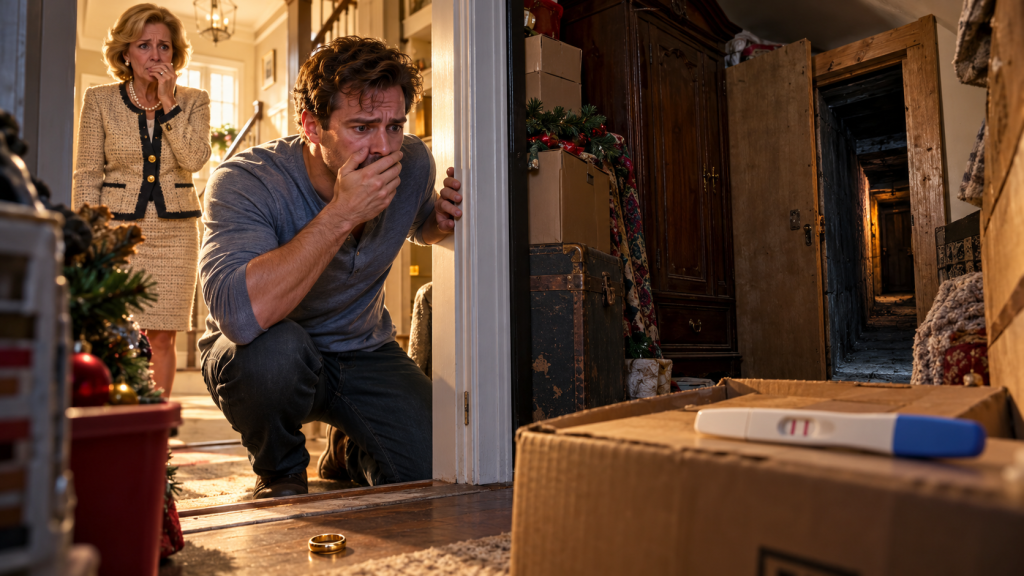
The pregnancy test lying on the storage-room floor.
“How far along?”
I whispered.
Emily’s eyes filled.
“Seven weeks.”
My knees nearly gave out.
Seven weeks.
Our child had been inside her while I dragged her by the arm.
Inside her while I turned the key.
Inside her when she begged:
Not today.
I covered my mouth.
“Oh God.”
Emily looked away.
There was no comfort in her face.
None should have been expected.
Samuel said quietly:
“She needs a doctor.”
“Yes.”
I reached for my phone.
Mother moved immediately.
“No.”
All three of us turned.
She realized what she had said.
“I mean… Emily is fine.”
I stared at her.
“How would you know?”
“Because nothing happened.”
Emily laughed.
It was the coldest sound I had ever heard from her.
“Nothing happened?”
Mother’s mouth tightened.
“You found the passage.”
“Yes.”
“You weren’t trapped.”
Emily looked at me.
Then back at Eleanor.
“So that’s how you justify it?”
I turned.
“What does she mean?”
Emily’s face changed.
“David, your mother knew this door was here.”
“I know Samuel said that.”
“No.”
“She knew exactly where it went.”
Mother snapped:
“Stop talking.”
Emily pointed toward the hidden room.
“She stored things here.”
Letters.
Boxes.
Photographs.
Records.
All the things no one was supposed to see.
My father spoke.
“That’s why I’m here.”
I looked at him.
“What?”
He held up a mobile phone.
“Emily called me at 2:41 this morning.”
I stared at her.
Emily nodded.
“I moved the wardrobe after midnight.”
“The panel opened.”
“I followed the passage because I was trying to get out.”
Her voice shook.
“I found this room.”
“And your father’s letters.”
“One of the newest had a phone number.”
My head spun.
“Newest?”
Samuel answered.
“I never stopped writing.”
I looked at the towers of envelopes.
Some had my childhood address.
Some had college addresses.
Some had the address of my first apartment.
Some were addressed to the very house we stood inside.
Hundreds.
“You knew where I lived?”
“For most of your adult life.”
“Then why didn’t you come?”
Samuel’s face folded with shame.
“I will answer that.”
“But not before we get Emily out of here.”
That was the first sane thing anybody said.
I called emergency services.
Then I did something I should have done twelve hours earlier.
I told the truth.
“My wife is pregnant.”
“I locked her inside a storage room overnight.”
“I physically put her there.”
“She escaped through a hidden passage.”
“My mother may have given me something in tea.”
The dispatcher went quiet for half a second.
Then her voice became professional.
She asked whether Emily was conscious.
Bleeding.
In pain.
She asked whether anyone had weapons.
Whether my mother remained nearby.
Whether Emily felt safe with me present.
That last question nearly destroyed me.
I looked at my wife.
The dispatcher repeated:
“Sir?”
I answered:
“I don’t know.”
Emily said:
“No.”
One word.
I closed my eyes.
The dispatcher heard.
“Then create distance.”
I did.
I moved back through the tunnel.
Past the baby blanket with my name.
Past the scratched panel.
Past the wedding ring on the floor.
I went into the living room.
And waited for strangers to come protect my wife from me.
Mother followed.
The moment we were alone, she grabbed my wrist.
“David, you cannot tell police you locked her in there.”
I stared at her.
“I did.”
“She was being hysterical.”
“She asked me not to.”
“You were disciplining your household.”
The sentence sickened me.
“Disciplining my wife?”
Mother’s expression hardened.
“Don’t use that tone with me.”
I almost laughed.
There it was.
Even then.
Even with sirens approaching.
Even with my dead father alive behind a false wall.
She still believed the greatest emergency in the room was disobedience.
Then she lowered her voice.
“You need to protect yourself.”
“From what?”
“Her.”
I stared.
“Emily?”
“She will use this against you.”
“Use what?”
“The thing I did?”
Mother’s mouth tightened.
“You were upset.”
“Because you cried.”
“She insulted me.”
“She said the soup was cold because you arrived late.”
“She has been poisoning you against me for years.”
My stomach twisted.
That phrase.
Poisoning.
Turning.
Manipulating.
Mother had used versions of those words my entire life.
About teachers.
Girlfriends.
Friends she disliked.
My first boss.
Anyone who made me disagree with her.
I whispered:
“What was in the tea?”
Her eyes flickered.
Nothing more.
Enough.
“What did you put in it?”
“Nothing.”
I moved toward the kitchen.
She grabbed me again.
“David.”
I yanked my arm free.
On the counter sat her handbag.
Inside the open side pocket was an orange prescription bottle.
Zolpidem.
I stared.
Mother said:
“That proves nothing.”
I picked it up.
The label was hers.
Ten-milligram tablets.
I had no prescription.
“You drugged me?”
“I helped you sleep.”
The room seemed to tilt.
“What?”
“You were agitated.”
“I knew you’d go back and let her manipulate you.”
I felt sick.
“You crushed this into my tea?”
Mother’s face changed.
Not denial now.
Just irritation that I had finally understood.
“One tablet.”
My hand started shaking.
“You drugged me so I wouldn’t open the door.”
“I calmed you down.”
“No.”
I looked at her.
“You removed my ability to change my mind.”
That sentence would stay with me for years.
Because it was true about more than the tea.
Police arrived first.
Then paramedics.
I did not enter the hidden room again while they examined Emily.
An officer separated Mother and me.
Another photographed the storage room.
The key.
The lock.
The wedding ring.
The pregnancy test.
The dragged wardrobe.
The false panel.
The prescription bottle.
Everything suddenly became evidence.
My life looked different through a camera lens.
Colder.
Less explainable.
One officer asked:
“Did your wife have access to a phone?”
“I don’t know.”
That ashamed me too.
I had not even checked.
“Did you provide food or water?”
“No.”
“Bathroom?”
“No.”
“How long was the door locked?”
“About ten hours.”
He wrote it down.
Ten hours.
Not:
One bad moment.
Ten hours.
I had gone upstairs.
Changed clothes.
Accepted tea.
Got into bed.
Heard noises.
Considered helping.
Chose not to.
The worst things we do are rarely only the first act.
Sometimes they are all the chances afterward when we decide not to stop.
Emily was taken to the hospital.
I was not allowed to ride with her.
Samuel went.
She asked for him.
Not me.
That hurt.
I deserved it.
Mother screamed when officers told her they wanted to ask questions about the medication.
“You cannot treat me like a criminal in my son’s home!”
The officer said:
“Ma’am, whose home it is doesn’t change what we’re investigating.”
I almost laughed at the irony.
Mother had spent my entire life teaching me hierarchy.
House.
Family.
Mother.
Wife.
Man.
Woman.
Respect.
Position.
The police cared about conduct.
It was a language I should have learned earlier.
I went to the hospital separately.
A detective met me there.
Her name was Mara Benton.
She was direct.
No cruelty.
No comfort either.
She asked me to explain the evening from the beginning.
I did.
Dinner.
Mother’s complaint.
Emily refusing to apologize.
My anger.
Dragging her.
The storage room.
The key.
Her begging.
Mother’s comment about stubborn women.
The thuds.
The tea.
Sleep.
Morning.
Everything.
Detective Benton stopped me only once.
“You said your mother told you how ‘stubborn women learn their place.’”
“Yes.”
“And you still left Mrs. Hale locked inside?”
I stared at the table.
“Yes.”
“Why?”
I could have blamed conditioning.
Fear.
Mother’s influence.
Years of manipulation.
All true.
None sufficient.
“I chose to.”
Detective Benton watched me carefully.
Then nodded.
“Keep answering like that.”
Not because confession guaranteed forgiveness.
Because truth had finally entered the room.
Emily’s examination showed bruising on her upper arm where I grabbed her.
Scrapes along both palms and one knee from crawling through the passage.
Dehydration.
Mild uterine cramping.
No major bleeding.
The pregnancy appeared intact.
At seven weeks, doctors found what they expected for gestational age and arranged follow-up.
No one promised me the baby was “fine.”
Early pregnancy does not work like that.
There are no magical guarantees.
But there was no evidence that night of immediate pregnancy loss.
I cried in the hospital bathroom when the nurse told me.
Not relief exactly.
Because relief would have implied I deserved comfort.
It was gratitude mixed with horror.
Emily refused to see me.
She asked for her sister, Rachel.
Rachel arrived two hours later.
She walked past me in the hallway.
Stopped.
Looked straight into my eyes.
And slapped me.
Hard.
A nurse shouted.
Security stepped closer.
Rachel lowered her hand.
“I’m sorry.”
The apology was for security.
Not me.
She said:
“You locked my pregnant sister in a closet.”
“Yes.”
“You put your hands on her.”
“Yes.”
“Because your mother cried?”
“Yes.”
Rachel’s face crumpled.
“I always thought Emily exaggerated how much control Eleanor had over you.”
I swallowed.
“So did I.”
She looked at me with disgust.
“That isn’t better.”
“I know.”
Then she walked away.
Samuel found me outside the hospital cafeteria.
My father.
Even thinking the word felt impossible.
He had changed clothes.
Someone had given him a clean shirt.
He carried two coffees.
He handed me one.
I didn’t take it.
His eyes moved to the cup.
Then understanding reached him.
“The tea.”
“Yes.”
He set both cups down.
“Fair.”
For a while we stood there.
Then I asked:
“Why are you alive?”
A terrible question.
He did not take offense.
“Your mother told you I died in the boating accident?”
“Yes.”
“I was injured.”
“How badly?”
“Broken shoulder.”
“Concussion.”
“Two cracked ribs.”
“I spent seventeen days in a hospital in Savannah.”
I stared.
“She held a funeral.”
His face changed.
“What?”
“A memorial.”
“At church.”
“I was six.”
“I remember people bringing casseroles.”
Samuel sat.
“Oh God.”
“You didn’t know?”
“No.”
He covered his mouth.
“She told me you knew I had survived.”
“What?”
“She said you were terrified of me.”
“That you blamed me for the accident.”
“What accident?”
Samuel took a breath.
“We fought that night.”
“Your mother and I.”
“I went out on my brother’s boat.”
“Storm came in.”
“Boat hit debris.”
“My brother died.”
My stomach turned.
“So someone did die.”
“Yes.”
“My younger brother, Nathan.”
Mother had built her lie around a real coffin.
That made it easier.
Worse.
Samuel continued.
“When I got out of the hospital, your mother had taken you to her sister’s.”
“She filed for emergency custody.”
“She said I was unstable.”
“Drinking.”
“Dangerous.”
“Were you?”
His face tightened.
“I was drinking too much then.”
Honest.
“I had also smashed a kitchen chair during an argument.”
“Never hit her.”
“Never hit you.”
“But I gave her enough true things to make the false ones believable.”
That mattered.
No saint.
No monster.
People.
Samuel obtained supervised visitation at first.
Then unsupervised.
But Mother began canceling.
David had a fever.
David was afraid.
David had school.
David had nightmares.
Samuel filed motions.
Spent money.
Fought.
Then Mother moved.
First to Columbia.
Then Charlotte.
Then back to Charleston.
Some moves were disclosed.
Some not.
The legal system intervened.
Orders changed.
He eventually got letters through.
Or thought he did.
Mother wrote back.
Not pretending to be me.
But claiming I had refused to read them.
She sent one drawing supposedly made by me.
A black stick figure.
Words:
GO AWAY.
I stared at the photocopy on his phone.
“I didn’t draw that.”
“I know now.”
“When did you know?”
“Years later.”
“How many?”
Samuel looked away.
Too many.
“That’s not a number.”
“Eight.”
I laughed bitterly.
“You let eight years pass.”
“Yes.”
“Why?”
His face broke.
“Because I was weak too.”
That answer kept me from hating him immediately.
Not from anger.
But from contempt.
He did not dress weakness as sacrifice.
He said:
“I told myself if you truly hated me, forcing my way into your life would hurt you.”
“I told myself I would wait until you were older.”
“Then you were sixteen.”
“Then eighteen.”
“Then in college.”
“At every stage, calling felt more intrusive than staying silent.”
I stared.
“So you let her decide for both of us.”
“Yes.”
“Then you kept deciding for me.”
He closed his eyes.
“Yes.”
There it was.
Mother controlled.
Father retreated.
I learned submission.
And Emily paid for all of it.
I asked about the letters.
Samuel had written almost every year.
Some returned.
Some ignored.
Some never mailed.
“Why did you keep writing if you weren’t sending them?”
He said:
“Because being your father did not stop simply because I stopped being brave enough to knock on the door.”
I wanted to be moved.
I was furious instead.
“You don’t get points for private fatherhood.”
He nodded.
“I know.”
Good.
Then I asked:
“My brother.”
Samuel became still.
“His name at birth was Jonathan.”
My stomach dropped.
“When?”
“Eleven months after the accident.”
I did the math.
Mother had been pregnant when she told me Dad died.
I remembered something.
A vague image.
Mother vomiting into the kitchen sink.
Grandma whispering.
Then nothing.
“She told me she lost the baby.”
Samuel looked at me.
“She told me the baby died during delivery.”
I went cold.
“And he didn’t?”
“No.”
“How do you know?”
Samuel’s jaw tightened.
“I found out fifteen years later.”
“From what?”
“An attorney.”
He opened his phone.
Showed me a scanned court record.
A private adoption finalized in Georgia.
Baby boy.
Born to Eleanor.
Father listed as:
Unknown / whereabouts unavailable.
Samuel’s face twisted.
“I was not unknown.”
I stared at the document.
“Who adopted him?”
“A couple named Robert and Diane Mercer.”
“Mercer?”
“No relation.”
“Do you know where he is?”
“Yes.”
The word struck like electricity.
“Alive?”
“Yes.”
“How old?”
“Thirty.”
“Does he know?”
“That he was adopted?”
“Yes.”
“That we exist?”
Samuel hesitated.
“He knows about me.”
My stomach twisted.
“And me?”
“Yes.”
I stood.
“He knows he has a brother?”
“Yes.”
“And nobody thought I should know?”
Samuel followed me with his eyes.
“I wanted to tell you.”
“Apparently wanting things is this family’s favorite hobby.”
He flinched.
Good.
Then I hated myself for enjoying it.
Jonathan’s name was now Jon Mercer.
He lived in Asheville.
Married.
One daughter.
Worked as a civil engineer.
He had found Samuel through DNA testing at twenty-seven.
Not a dramatic secret investigation.
A Christmas gift.
An ancestry kit.
A half-match.
Messages.
Records.
Shock.
Jon’s adoptive parents had always told him he was adopted.
They had not known Samuel had been intentionally excluded.
They believed Eleanor’s account that the biological father had disappeared before birth.
Jon had been loved.
Deeply.
That mattered.
His life was not a theft that needed to be undone.
The lie existed around the beginning.
Not the whole life.
“Does he want to meet me?”
I asked.
Samuel answered:
“He has wanted to for three years.”
I laughed bitterly.
“Of course.”
Then:
“Why didn’t he contact me himself?”
“Because I asked him not to.”
I stared.
Samuel immediately said:
“That was wrong.”
“Yes.”
“I thought if your mother had built your entire life around believing I died, appearing with a brother would destroy you.”
“So once again, everybody protected me from my own life.”
“Yes.”
I walked away.
I could not take more.
Emily was discharged that evening.
Not home.
To Rachel’s house.
Police arranged for her to collect essentials later with an officer present.
I did not see her.
She sent one message through Rachel:
I am safe. Please do not contact me directly. Speak through the lawyer once I have one.
I replied only:
I understand.
Then I blocked myself from sending anything else by giving my phone to my friend Marcus for the night.
Because remorse can become another form of intrusion if you use someone else’s pain to demand relief from your guilt.
I was beginning to learn.
Late.
But learn.
Mother was questioned that day.
She admitted giving me the sleeping medication.
Her explanation:
“I was afraid he would do something irrational.”
She meant opening the closet.
That sentence would eventually be read in court.
The irony was almost unbearable.
She claimed she did not tell me to lock Emily up.
Technically true.
She told me stubborn women learned through confinement.
She handed me the emotional match.
I lit it.
That distinction mattered legally.
And morally.
I had to own my part.
Police also examined the hidden room.
The passage was not supernatural.
Not some gothic family labyrinth.
The house had been built in 1912.
The storage room had once connected through a narrow service corridor to a coal cellar and rear carriage room.
During renovations in the 1970s, the openings were paneled over instead of completely removed.
Samuel knew about it because his grandfather had owned the house before Eleanor and I eventually inherited it through family arrangements.
Mother knew because she had used the hidden room for storage.
Specifically:
Things she did not want me to see.
Samuel’s letters.
Custody documents.
The adoption record.
Photographs.
An old box containing two baby blankets.
One embroidered:
DAVID
The other:
JONATHAN
That was the secret under my own staircase.
My entire childhood had been stored twenty feet from the sofa.
Emily had found the letters because after crawling through the panel, she saw my name on an envelope.
Then another.
Then hundreds.
She found Samuel’s recent contact number on a letter dated six months earlier.
She called him.
At first he thought it was a scam.
Then Emily said:
“I’m David’s wife.”
Samuel drove through the night.
The passage had an exterior access hatch behind the old carriage wall.
Emily managed to unlock it from inside.
He arrived shortly before dawn.
That was who I heard talking when I entered.
Not a ghost.
A father who had finally come through one of the doors he should have knocked on decades earlier.
The pregnancy continued.
That was not the same as the marriage continuing.
I need that distinction clear.
Emily did not look at the positive test and decide the baby required forgiveness.
She did not tell herself a child needed both parents under one roof.
She did not use pregnancy as glue for something that had become unsafe.
She hired an attorney.
Filed for legal protection.
Moved her belongings out.
And two weeks after the incident, she filed for divorce.
I cried when the papers arrived.
Then signed where instructed.
No pleading.
No surprise visits.
No flowers.
No standing outside Rachel’s house in the rain.
Romance had no place there.
Accountability did.
The criminal case against me was not erased because I confessed.
I had restrained Emily.
Dragged her.
Locked a door.
Kept her inside overnight.
The hidden passage did not undo the confinement.
Her escape did not make my act less serious.
My attorney explained that clearly.
So did the prosecutor.
The final resolution reflected:
My admission.
No prior record.
Emily’s documented injuries.
The length of confinement.
The domestic context.
My cooperation.
I accepted responsibility for an unlawful-restraint and assault-related offense.
I received probation, required intervention programming, counseling, and strict no-contact conditions except approved legal matters.
No cinematic twenty-year sentence.
No magical dismissal.
Consequences.
Appropriate ones.
The most painful condition was also the most necessary:
I had no automatic right to participate in Emily’s pregnancy simply because I was the father.
Medical appointments were hers.
Her body.
Her choice.
She sent updates through attorneys when legally relevant.
Nothing more.
Mother’s case involved the medication.
The crushed zolpidem.
The bottle.
Her admission.
She faced her own criminal consequences for administering medication without my knowledge and for her conduct surrounding the confinement.
The decades-old family lies were largely civil, historical, or beyond practical prosecution.
That frustrated me at first.
Then Detective Benton said something I needed.
“Not every terrible thing becomes a criminal charge.”
“Law and morality overlap.”
“They are not identical.”
I wrote that down later.
Mother moved out of my house.
Immediately.
Not because I heroically threw her onto the street.
Her sister took her in.
Her attorney advised distance.
I changed the locks after counsel confirmed I could.
For the first time in my life, my mother did not have a key to where I slept.
The silence inside the house felt terrifying.
Then peaceful.
Then terrifying again.
Freedom does not always feel good immediately when control was what taught you how to function.
I started therapy.
Three times a week initially.
My therapist was named Dr. Lena Price.
The first session, I spent forty minutes explaining Eleanor.
Her crying.
Her jealousy.
Her childhood.
Her control.
Her lies.
Her marriage.
Samuel.
Jonathan.
Dr. Price listened.
Then said:
“We should also talk about you.”
I stared.
“That’s what I’ve been doing.”
“No.”
“You’ve been talking about the person who taught you the pattern.”
“I’m asking about the adult who enacted it.”
That sentence made me angry.
Good therapists are apparently skilled at making guilty men angry for useful reasons.
I said:
“She manipulated me.”
“Yes.”
“She drugged me.”
“Yes.”
“She lied to me for thirty years.”
“Yes.”
“She trained me to see disagreement as disrespect.”
“Yes.”
Then Dr. Price leaned forward.
“And who locked the door?”
I closed my eyes.
“I did.”
That became the work.
Every session.
Not:
Why am I terrible?
But:
What did I believe gave me permission?
I believed being a husband made me referee.
I believed a wife owed my mother deference.
I believed disrespect justified punishment.
I believed my mother’s tears were evidence.
I believed Emily’s silence was defiance.
I believed love could survive humiliation if the person being humiliated was “wrong.”
Those beliefs did not arrive from nowhere.
They still belonged to me once I became an adult.
Samuel and I began meeting.
Public places.
Coffee shops.
Parks.
Sometimes not talking about the past.
He did not call me “son” immediately.
I appreciated that.
I did not call him Dad for months.
One day he said:
“I don’t deserve the word.”
I answered:
“It isn’t a medal.”
He nodded.
“Fair.”
We built from there.
He gave me copies of every letter.
Not the originals.
Those remained his.
I read one a week.
Sometimes two.
At age eight:
David, I saw a red bicycle today and remembered teaching you to ride. You screamed when I let go, then got angry when you realized you had been riding alone for half the block.
I remembered the bicycle.
I had thought the memory belonged to Uncle Nathan.
Mother had told me that.
At eleven:
I hope somebody has taught you how to throw a baseball properly because I never did.
No one had.
At sixteen:
You may hate me. I am trying to make peace with the fact that I might never know whether that hatred is yours.
That one destroyed me.
Then at twenty-two:
I found your university graduation notice online. I printed it. That feels pathetic. I am proud anyway.
I threw that letter across my apartment.
Private pride.
Again.
Always watching.
Never arriving.
When I told Samuel, he did not defend it.
“I should’ve come.”
“Yes.”
“I was afraid.”
“Yes.”
“Fear is not the same as helplessness.”
“No.”
Good.
We were learning truth without forcing forgiveness.
Jon contacted me himself after three months.
Not through Samuel.
Email.
Subject:
This is strange.
I almost laughed.
The message began:
Hi David. Apparently I’m your brother. I’ve rewritten that sentence about twenty times and none of the versions improve it.
I read the email six times.
He told me he did not want a dramatic reunion.
He loved his adoptive parents.
His father, Robert, had died.
His mother Diane was alive and knew he was contacting us.
He was not looking for a replacement family.
Good.
Neither was I.
He ended:
If you want coffee, I’ll drive halfway. If you don’t, I’ll understand. Unlike everyone else in this story, I’m trying not to decide for you.
I laughed until I cried.
I answered:
Coffee. Halfway.
We met in Columbia.
He looked nothing like me.
Then he smiled.
Exactly like Samuel.
I almost had to sit down.
Jon hugged me only after asking.
That mattered more than he knew.
We talked four hours.
His childhood was good.
Normal.
Baseball.
Bad grades in chemistry.
A mother who packed too much food.
A father who cried at movies and denied it.
No secret abuse.
No misery proving our family should have kept him.
That complicated everything beautifully.
Eleanor had done something profoundly wrong by denying Samuel’s rights and lying to us.
But Jon had also been genuinely loved by the people who raised him.
Life refused to give me a simple moral equation.
I appreciated that eventually.
Jon asked:
“What did Mom tell you about me?”
“That you died.”
He went still.
“She told me you died too.”
“What?”
“When Samuel found me.”
“He said Eleanor had once told him she informed David the baby died.”
Jon shook his head.
“So she erased both directions.”
“Yes.”
He stared into his coffee.
“Do you hate her?”
“I don’t know.”
“Me neither.”
“You met her?”
“Once.”
My stomach tightened.
“When?”
“Two years ago.”
Before I knew he existed.
Of course.
“What happened?”
Jon looked uncomfortable.
“She cried.”
“She said giving me up was the only unselfish thing she ever did.”
I laughed bitterly.
“Convenient.”
“Maybe.”
He shrugged.
“Diane thinks Eleanor convinced herself of that because the alternative was admitting she did it partly to keep Samuel from using another child to remain connected.”
That sounded like Mother.
Control wearing sacrifice as a coat.
I asked Jon whether the adoption had been happy.
“Yes.”
“Then do you wish it hadn’t happened?”
He thought.
“That’s impossible.”
“What?”
“If it didn’t happen, I’m not this person.”
“Maybe I don’t meet my wife.”
“Maybe my daughter doesn’t exist.”
“So I can’t wish away my life to punish how it started.”
That sentence helped me with Samuel too.
And later with my own child.
A painful beginning does not invalidate everything that grows afterward.
Emily’s pregnancy reached twelve weeks.
Then twenty.
Then twenty-eight.
I knew because her attorney sent basic updates.
No sonogram pictures.
No gender reveal.
No invitations.
That was her boundary.
I respected it.
At twenty-four weeks, she allowed me to send one letter.
Not to her.
To the baby.
I stared at a blank page for three days.
Then wrote:
I am your father.
That word does not give me ownership of you or your mother.
It gives me responsibility.
I am learning that difference later than I should have.
I did not write about Eleanor.
Samuel.
The tunnel.
My guilt.
A child should not inherit an adult’s confession as an obligation.
I wrote:
I hope when you make mistakes, the adults around you help you repair them without humiliating you.
I hope nobody ever teaches you that fear is respect.
I hope the first thing I give you is not my surname, but safety.
Emily kept the letter.
I learned that years later.
At thirty-six weeks, she called me herself.
First direct call in eight months.
I nearly dropped the phone.
“Emily?”
“Yes.”
I stood.
“Are you okay?”
“Yes.”
Then silence.
“I want you to know I’ve decided you can be at the hospital when the baby is born.”
I stopped breathing.
“Are you sure?”
“No.”
That was honest.
She continued.
“But I think I want you nearby.”
“Not in the room unless I ask.”
“Not making decisions.”
“Not speaking for me.”
“Rachel is my support person.”
“Yes.”
“Do you understand?”
“Yes.”
“If you argue once, you leave.”
“Yes.”
She exhaled.
“Okay.”
Then hung up.
I cried.
Not because I thought she was coming back.
She wasn’t.
Because she had given me access without surrendering authority.
A form of love I had never learned growing up.
Our daughter was born on a rainy Thursday at 3:12 a.m.
Grace Eleanor Hale.
The middle name shocked me.
I looked at Emily.
“You used Eleanor?”
Emily was exhausted.
Sweaty.
Holding seven pounds of furious life against her chest.
She said:
“Not for your mother.”
I waited.
“My grandmother was Eleanor too.”
I laughed.
Of course.
The world did not revolve around my mother, despite decades of evidence she believed otherwise.
Emily let me hold Grace after an hour.
I sat in a hospital chair.
Terrified.
Grace opened one eye.
Then slept.
I whispered:
“I’m sorry.”
Emily heard.
“Don’t.”
I looked up.
“She doesn’t need your apology.”
“She needs your behavior.”
Dr. Price could not have said it better.
I nodded.
Then held my daughter without turning guilt into a performance.
The divorce became final three months later.
Emily kept her name.
I did not ask her to reconsider.
We created a gradual parenting plan.
At first, my time with Grace was supervised.
Some people thought that was excessive.
I did not.
My history included domestic restraint against her mother during pregnancy.
Trust deserved structure.
Samuel attended one visit.
He sat across the room watching me feed Grace.
Later he said:
“You’re good with her.”
I answered:
“Being gentle with a baby for ninety minutes is not proof of character.”
He smiled sadly.
“No.”
“It’s a start.”
That I accepted.
Mother asked to see Grace.
Emily said no.
I agreed.
That caused our first real rupture after court.
Mother called me.
“You’re keeping my granddaughter from me.”
I said:
“You drugged me and encouraged me to confine her pregnant mother.”
“She is my blood.”
“Blood is not a visitor pass.”
She started crying.
For the first time in my life, her tears did not change the facts.
I listened.
Then said:
“I’m ending the call now.”
She shouted:
“David!”
I hung up.
My hands shook for twenty minutes.
Boundaries can feel like violence when you were raised to believe obedience is love.
They aren’t.
Mother eventually accepted a plea in her case related to the drugging and her conduct that night.
She received probation, treatment requirements, and strict limits.
No prison epic.
No dramatic collapse.
She moved into an apartment after my aunt made clear she could not stay indefinitely.
She hated living alone.
At first I felt guilty.
Then Dr. Price asked:
“Would you prefer Emily be unsafe so Eleanor doesn’t feel lonely?”
That ended the guilt quickly.
The older secrets had civil consequences but little criminal life left in them.
Samuel consulted an attorney about Jon’s adoption records mostly for truth, not reversal.
Jon did not want his adoption undone.
He was thirty.
His parents were his parents.
The record was eventually amended in limited ways to reflect biological history more accurately where allowed.
No one tried to erase Diane and Robert.
That mattered to Jon.
Samuel respected it.
Progress.
Mother’s lies about Samuel became the hardest relationship question.
Did I want contact with her at all?
For two years:
No.
Then:
Maybe.
Then:
Only letters.
She sent eleven.
The first six were terrible.
Your father poisoned you against me.
Emily took advantage of your guilt.
I made mistakes, but everything I did was because I loved you.
I did not respond.
The seventh changed slightly.
I do not know how to explain my choices without trying to excuse them.
Better.
The eighth:
I was terrified Samuel would take you.
When he survived the accident, I had already told you he was gone.
I stared at that sentence.
There.
The hinge.
Mother continued:
For three days, I intended to correct the lie.
Then I saw how completely you depended on me after believing your father was dead.
I mistook your dependence for safety.
That was painfully honest.
Then:
Every day I waited made the truth more expensive.
Eventually I built my entire motherhood around protecting the lie.
I cried.
Not forgiveness.
Recognition.
Her tenth letter addressed Jon.
I gave Jonathan up because I was afraid Samuel would use another child to force continued contact.
I also believed another baby would make it impossible for me to start over.
Both reasons were selfish.
Then:
His adoptive parents loved him well. I am grateful. Their love does not make my deception righteous.
Good.
Finally.
Her eleventh letter addressed Emily.
Not sent to Emily.
To me.
I told you that your wife needed to learn her place.
What I meant was that I needed her to stay beneath me.
I stopped reading.
Then continued.
I saw her pregnancy before you did.
My stomach tightened.
She was nauseated. Protective of her stomach. Tired. I found prenatal vitamins in the bathroom cabinet.
So Samuel had been right.
Mother knew.
I was afraid a baby would become the one bond stronger than your loyalty to me.
There it was.
Not soup.
Not disrespect.
Territory.
I provoked the argument.
My hands shook.
She continued:
I did not know you would lock her in the room until you did it.
When you did, I encouraged you because for one terrible moment I felt powerful enough to believe she deserved fear.
I had to stop.
Then:
That is the moment I finally became the kind of mother I spent my life claiming I was protecting you from.
I folded the letter.
I sent one response:
Thank you for telling the truth. I am not ready for more.
She respected it.
For once.
Grace turned three.
Then five.
She had Emily’s eyes.
My terrible habit of waking early.
Samuel’s smile.
At five, she once became angry because I told her she could not have ice cream before dinner.
She shouted:
“You’re mean!”
Everything inside my childhood lit up.
Disrespect.
Challenge.
Control.
For half a second, I heard Mother’s voice.
Correct her.
Then Grace crossed her arms and glared.
I knelt.
“You can be mad.”
Her face changed.
“What?”
“You can think I’m mean.”
“Can I have ice cream?”
“No.”
She screamed.
“I REALLY THINK YOU’RE MEAN!”
I almost laughed.
“Okay.”
She stormed to her room.
Did not slam the door because she was too small to make it satisfying.
Later she came back.
“Still no ice cream?”
“Still no.”
She sighed.
“Fine.”
That ordinary evening felt more important than any courtroom.
My child had challenged me.
Nothing bad happened.
No one lost belonging.
That was how cycles broke.
Boringly.
One dinner at a time.
Emily remarried when Grace was six.
His name was Michael Torres.
Teacher.
Kind.
Infuriatingly patient.
I hated him for exactly three weeks.
Then realized I was repeating old family math.
If Grace loved him, did that reduce me?
No.
If Emily trusted him, did that erase what we had once been?
No.
Love was not rank.
I had been raised to think it was.
Mother at the top.
Everyone else competing.
I refused to give that inheritance to Grace.
At Emily’s wedding, I did not attend.
She didn’t invite me.
Appropriate.
But I helped Grace practice walking with the flower basket.
When I dropped her off, she hugged me and said:
“Michael says I have two dads.”
I swallowed.
“What do you think?”
She considered.
“I have one Dad and one Michael.”
I laughed.
“Works for me.”
Samuel became Grandpa Samuel.
Carefully.
Grace loved him immediately because children have no respect for emotional pacing.
He made pancakes shaped like animals.
Badly.
She called one:
“The sick giraffe.”
He framed the picture.
Samuel and I became closer too.
Never erased.
Never restored to what should have been.
Something new.
He once said:
“I keep wishing I could go back and fight harder.”
I answered:
“I keep wishing I could go back and open the door.”
We sat quietly.
Then Samuel said:
“We can’t raise the dead versions of ourselves.”
“No.”
“So what do we do?”
I looked through the window where Grace was drawing.
“Better now.”
He nodded.
“Better now.”
That became our phrase.
Jon entered my life more slowly.
We saw each other four or five times a year.
Our daughters became cousins.
That helped.
Children make adults stop over-philosophizing.
At one Thanksgiving, Grace and Jon’s daughter Ava fought over a stuffed rabbit.
Jon and I both froze.
Two grown men with thirty years of family trauma staring at a toy bunny.
Ava shouted:
“I had it first!”
Grace shouted:
“No!”
Jon looked at me.
I looked at him.
Then he said:
“We can buy another rabbit.”
I started laughing.
He did too.
The girls thought we were insane.
Probably correct.
The hidden passage was sealed properly.
Not immediately.
For a year I could not touch it.
Then I hired a contractor.
He asked whether I wanted the whole corridor removed.
I said no.
The house was historic.
We documented it.
Closed unsafe sections.
Preserved one small service alcove.
Not a shrine.
Architecture.
The boxes came out.
Letters sorted.
Records copied.
The two baby blankets cleaned.
I gave Jon his.
He stared at JONATHAN embroidered across the faded blue edge.
“Do you want this?” I asked.
He thought.
“Yes.”
Then:
“Not because she kept it.”
“Because somebody once expected me.”
That distinction mattered.
I kept mine too.
Emily’s wedding ring remained in my safe for years.
Not because I hoped she would return.
She had left it on the storage-room floor intentionally.
Later, through attorneys, she said I could keep or sell it.
I kept it.
At Grace’s eighteenth birthday, I asked Emily whether I could give it to her.
She thought for a long time.
Then said:
“Only if you tell her what it means.”
So I did.
Grace held the ring.
“This was Mom’s?”
“Yes.”
“Why did she take it off?”
I breathed.
“Because I did something to her that made being married to me unsafe.”
Grace looked at me.
I had never told her every detail when she was young.
Now she was an adult.
She deserved truth.
“I locked your mother in a room overnight.”
Grace went very still.
“What?”
“I was angry.”
“My mother had manipulated me.”
“But I made the choice.”
“She was pregnant with you.”
Tears filled Grace’s eyes.
“Did you know?”
“No.”
“Would that make it better?”
“No.”
Good.
I continued.
“She left the ring because she did not want to remain my wife.”
Grace whispered:
“Did you hurt her?”
“Yes.”
I did not say:
Not badly.
Not intentionally.
Not usually.
Yes.
Grace cried.
So did I.
Then she asked:
“Why did Mom let me stay with you?”
That question hurt.
“Because over time, after court involvement, treatment, supervision, and years of behavior, she believed I could be a safe father even though I had been an unsafe husband.”
Grace looked at the ring.
“That’s complicated.”
“Yes.”
“Do you forgive yourself?”
I thought.
“Forgiveness isn’t the word I use.”
“What word?”
“Responsibility.”
She nodded slowly.
Then handed the ring back.
“I don’t want it.”
“Okay.”
No guilt.
No symbolism forced onto her.
I sold it the following year and donated the money to a local domestic-violence legal-services organization.
Not as penance that erased anything.
Just because the object no longer belonged to the story I wanted to keep.
Mother met Grace once.
Only once.
Grace was twenty-one.
Her choice.
Mother was seventy-nine.
Smaller.
White-haired.
No throne.
No audience.
We met at a quiet café.
Mother looked at Grace and began crying immediately.
Grace did not hug her.
She sat.
Asked:
“Why did you treat my mom that way?”
Eleanor’s face crumpled.
She looked at me.
I said nothing.
The answer was hers.
Finally Mother said:
“Because I was afraid she would become more important to your father than I was.”
Grace frowned.
“That’s weird.”
I nearly laughed.
Mother actually did.
A small sad laugh.
“Yes.”
“It was.”
Grace continued:
“Did you hate Mom?”
“No.”
“I hated what she changed.”
“What did she change?”
Mother looked at me.
“He started making decisions without asking me.”
Grace’s eyebrows rose.
“He was an adult.”
Mother nodded.
“I know.”
A lifetime late.
Still true.
Then Grace asked:
“Are you sorry?”
“Yes.”
“Do you expect me to call you Grandma?”
Mother’s eyes filled.
“No.”
“Good.”
Grace drank her coffee.
They talked another twenty minutes.
When we left, Grace said:
“She’s not scary.”
I looked back through the window.
Mother looked tiny.
“She was to me.”
Grace nodded.
“I know.”
That was enough.
Mother died two years later.
I attended the funeral.
Samuel did not.
Jon did not.
Grace did.
Emily didn’t.
Everyone chose.
That was perhaps the greatest proof our family had changed.
No one was ordered to perform grief.
I stood beside the casket and felt everything.
Love.
Anger.
Pity.
Gratitude for things she did right.
Grief for everything she distorted.
Then I whispered:
“I loved you.”
That was true.
“And you hurt us.”
Also true.
One sentence did not cancel the other.
Samuel died at eighty-one.
Different funeral.
Different grief.
He left me the original letters.
All of them.
I kept five.
Gave copies to an archive box for family history.
Shredded many.
Some people were horrified.
“How could you destroy them?”
Because I did not need 300 paper reminders that he wished he had been braver.
Five were enough.
One from age eight.
One from sixteen.
One from graduation.
One written after meeting me again.
And the last.
The last said:
David,
I spent half my life believing fatherhood could exist privately in my heart. It cannot. Love may begin as feeling, but children experience it through presence. I failed you there. You taught me that apology becomes meaningful only when it stops demanding the past change. Thank you for letting me know the man you became after you stopped defending the man you had been.
I still have that one.
Emily and I never remarried each other.
People sometimes expected us to.
Redemption-story logic.
Husband changes.
Wife forgives.
Family reunited.
No.
Emily built a good life with Michael.
I eventually dated too.
Then married again at fifty-two.
Her name was Nora Ellis.
Before we married, I told her everything.
Not the shortened version.
Everything.
The storage room.
The lock.
The drugged tea.
My mother.
Emily.
Court.
Treatment.
Grace.
Nora listened.
Then said:
“I don’t need you to promise you’ll never become angry.”
I waited.
“I need to know what you do when you are.”
That was wisdom.
We built rules.
No blocking doors.
No following each other room to room.
No grabbing.
No punishment silence.
No bringing parents into marital disputes.
If one person asks for space, space happens.
Simple.
Almost embarrassingly simple.
Yet nobody had taught me those things as a child.
So I learned them as a middle-aged man.
Late is not ideal.
Late can still matter.
Once, during our third year of marriage, Nora and I had a terrible argument.
She told me:
“You’re acting exactly like your mother.”
The sentence hit like a slap.
I felt rage.
Real rage.
My first instinct was:
How dare you?
Then I stopped.
My hands were shaking.
I said:
“I need ten minutes.”
Nora nodded.
I went outside.
Walked around the block.
Came back.
We finished the argument.
No locked doors.
No fear.
No audience.
No punishment.
Later I cried alone in the shower.
Not because Nora had insulted me.
Because I had finally been angry without becoming dangerous.
There are victories nobody claps for.
That was one of mine.
Grace became a physician assistant.
Jon’s daughter became an engineer like him.
Our family became boring in ways I once thought impossible.
Birthdays.
Graduations.
Parking tickets.
Bad vacations.
Normal conflict.
No hidden children.
No fake deaths.
No locked storage rooms.
I learned to treasure boring.
Years later, Grace asked Emily why she left the pregnancy test on the floor.
Emily told her.
Then Grace told me.
I had always wondered.
The ring made sense.
The test did not.
Emily said she had planned to surprise me that night.
She had written our surname and the date on the back.
Then dinner happened.
The lock.
The passage.
The letters.
By morning she decided to leave both objects behind.
The ring because she was no longer promising marriage.
The test because I needed to understand that my violence had touched a future I did not yet know existed.
Not physically, necessarily.
Morally.
She wanted me to see:
This is what you endangered.
Not only me.
The kind of father you were about to become.
I cried when Grace told me.
Then asked:
“Did your mom regret leaving it?”
Grace shook her head.
“No.”
Good.
Neither did I.
The torn childhood photograph had a simpler explanation.
It showed me at six sitting between Mother and Samuel.
Emily found it inside the first box behind the panel.
While forcing the wardrobe aside, the frame broke.
She pulled the photograph free.
It tore along an old crease.
She left both pieces beside the ring.
Not symbolism.
Accident.
That felt strangely important.
Not everything needs to be a sign.
Some things just break while people are escaping.
The baby blanket with my name became Grace’s eventually.
Not as a baby.
At twenty-five.
She asked for it after Samuel died.
“Why?”
She shrugged.
“Because it survived all of you.”
I laughed.
Fair.
She keeps it folded in a chest.
Jon keeps his too.
Two blankets.
Two boys.
One raised inside a lie.
One raised inside an adoption shaped by a lie.
Both alive long enough to compare notes.
That is more grace than our parents earned.
Maybe grace is often like that.
Unbilled.
I am seventy now.
The storage room still exists.
Not locked.
The oak door was removed years ago.
Nora suggested it.
I hesitated because removing a door felt symbolic.
She said:
“It’s also practical.”
Good.
We turned the room into bookshelves and pantry storage.
Light installed.
No key.
No lock.
Grace once walked in, looked around, and said:
“This is it?”
“Yes.”
“It’s tiny.”
“Yes.”
She stood inside.
Then stepped out.
Maybe that was healing.
The place that had once been enormous in everyone’s mind was only a small room under the stairs.
The horror had come from what I did with it.
Not the walls.
People sometimes ask which revelation changed me most.
My father being alive?
My brother existing?
My mother drugging me?
Her lies?
The pregnancy?
None.
The thing that changed me was Emily stepping backward when I reached for her.
That movement.
Six inches.
Maybe twelve.
Her body deciding before her mind spoke:
Do not let him touch you.
I had become unsafe to the person I claimed to love most.
Everything else was history.
That was present.
And for the first time, I stopped asking what my mother had done to me long enough to ask what I had done to someone else.
That is where accountability begins.
Not in self-hatred.
Not in excuses.
Not even in apology.
In accurate ownership.
Mother lied.
Samuel retreated.
Courts failed in places.
Adoption records hid truth.
Letters disappeared.
Generational fear traveled from one room to another.
All of that mattered.
None of it turned the key in my hand.
I did.
That sentence saved me because it meant something else was also true.
If my choices helped create harm, my choices could also stop repeating it.
Not erase.
Stop repeating.
That became enough.
Years after everything, Grace had a son.
My grandson.
Ethan.
At four, he had a tantrum in my kitchen because I turned off a cartoon.
He screamed:
“I HATE YOU!”
The old family ghost appeared for half a second.
Disrespect.
Punishment.
Then I laughed.
Not at him.
At history.
Ethan screamed harder.
“DON’T LAUGH!”
I knelt.
“You’re right.”
“That was rude.”
He sniffed.
“I hate you.”
“Okay.”
“You still love me?”
“Yes.”
His face changed immediately.
“Even if I hate you?”
“Yes.”
He thought.
“I only hate you a little.”
“Good to know.”
Then he climbed into my lap.
A four-year-old boy learned in thirty seconds what I needed fifty years to understand:
Anger does not cancel belonging.
Disagreement does not require punishment.
Love that needs obedience is not safe love.
When Ethan was six, he found the old brass key.
The storage-room key.
I had kept it in a box without thinking.
He held it up.
“What’s this?”
My heart stopped.
Nora watched me from across the room.
I took the key.
“Something I don’t need anymore.”
Then I threw it away.
No ceremony.
No speech.
The trash bag closed.
Garbage truck came Thursday.
Gone.
The past remained.
The key did not need to.
The last time I spoke to Emily about that night, we were both in our sixties.
Grace had hosted Thanksgiving.
Michael was carving turkey.
Nora was arguing with Jon about football.
Children everywhere.
Noise.
Life.
Emily and I stood alone for a moment near the back porch.
I said:
“I’m sorry.”
She looked at me.
Not annoyed.
Not moved.
Just curious.
“For what part this time?”
I smiled faintly.
“Not opening the door when I heard you moving boxes.”
Emily looked toward the yard.
“That’s the part you think about?”
“Yes.”
“Why?”
“Because I almost got up.”
She nodded.
“I know.”
I froze.
“What?”
“You came halfway down the stairs.”
My chest tightened.
“You heard me?”
“Yes.”
“I could see your shadow under the storage-room door.”
I felt sick.
“I stood there?”
“For maybe thirty seconds.”
Then I went back upstairs.
I remembered.
Vaguely.
Tea waiting.
Mother whispering.
Emily continued:
“For years that was the part I hated most.”
“Not the locking.”
“Not your mother.”
“The pause.”
“Because I thought you were going to choose differently.”
Tears filled my eyes.
“And I didn’t.”
“No.”
We stood quietly.
Then she said:
“But you did later.”
I looked at her.
She raised one hand.
“Don’t misunderstand me.”
“I’m not saying later fixes earlier.”
“I know.”
“I’m saying Grace grew up with a father who learned.”
“That mattered.”
My throat closed.
“Thank you.”
Emily nodded.
Then:
“That’s all I ever wanted the apology to become.”
“What?”
“Something our daughter could live inside.”
Then Michael called her.
Nora called me.
We went back inside.
No reunion.
No unfinished romance.
Something better.
Peace that did not require pretending.
That night, I looked around the table.
Samuel gone.
Mother gone.
Emily laughing with Michael.
Nora beside me.
Grace holding Ethan.
Jon arguing with someone about dessert.
A family built out of truths that arrived too late and choices made afterward.
And I finally understood what the hidden passage had really represented.
Not a secret corridor.
Not a gothic mystery.
A pattern.
Everything my family refused to say directly had been pushed behind walls.
Samuel’s letters.
Jon’s birth.
Mother’s fear.
My obedience.
Emily’s resentment.
My anger.
We stored truth until the pressure found another exit.
That night, Emily literally crawled through a hidden wall to escape the marriage I had turned into a locked room.
I spent the rest of my life trying to build relationships with doors.
Doors people could open.
Doors people could close.
Doors no one was punished for walking through.
If I could return to that dinner, I would not ask Emily to apologize.
I would not ask Mother to be kinder.
I would not ask the universe to reveal the secret earlier.
I would do one simple thing.
Listen when my wife said:
Your mother doesn’t want an apology. She wants me to disappear.
Then I would believe that sentence deserved investigation before punishment.
That is the lesson I wish I learned before becoming a husband.
Before becoming a father.
Before turning a key.
When someone you love tells you they are afraid, disrespected, controlled, or disappearing inside your family, do not immediately ask them to become more convenient.
Do not make obedience the price of peace.
Do not lock the door.
Ask what is happening.
Then listen long enough to risk discovering you may be part of the answer.
That is harder than anger.
It is also how families survive without requiring someone else to vanish.