
My attorney leaned toward me, her face pale, and whispered six words I would never forget. “Audrey, look at the woman behind Clara.” I stared at the photograph. At first, I saw only my kitchen. The white marble counter. The flowers I’d bought before being admitted to the hospital.
The dining table where my six-year-old stepson used to color pictures while I made dinner. And Clara Sterling. My husband’s mistress. Standing beside a pile of documents that should never have left my locked office. But then I looked closer. Behind Clara, reflected in the glass door of our kitchen cabinets, stood another woman.
She wore a cream-colored coat. Her dark hair was pulled into a neat bun. And in her hand was a folder I recognized instantly. Blue leather. A small silver clasp. A tiny scratch near the bottom corner. My mother’s folder. I stopped breathing. Because the woman holding it was someone I had trusted with my life. Someone who had held my hand when I buried my mother.
Someone who had promised to protect my unborn daughter.
Someone who had spent months telling me that Julian was cruel but that divorce was always better handled quietly.
My mother-in-law.
Evelyn Vance.
I grabbed the edge of the table.
“No.”
My attorney, Rebecca Hale, looked at me.
“Audrey?”
I shook my head.
“That can’t be right.”
Rebecca studied the picture.
“Do you recognize her?”
I couldn’t speak.
Because Evelyn had been the only person who knew where I kept the spare key to my office.
She had been the only person, other than Julian, who knew about my mother’s final letter.
And she had been the person who encouraged me to sign away everything.
The house.
The savings.
The vehicles.
The business.
All of it.
I had believed she wanted me to escape her son’s cruelty without another fight.
Now I was staring at evidence that she may have helped him prepare the very documents he wanted me to sign.
My unborn daughter kicked beneath my ribs.
I pressed one trembling hand against my stomach.
And suddenly, the greatest betrayal of my marriage was no longer standing beside Julian.
It was wearing the face of the woman who had called me her daughter.
Rebecca turned the photograph toward Judge Norris.
“Your Honor, may we approach?”
The judge examined the image.
Her expression hardened.
“Counsel, I want to be extremely careful about how this information is handled.”
Rebecca nodded.
“Of course.”
“This child has made serious statements. The court will not ask him to repeat them in front of the adults involved.”
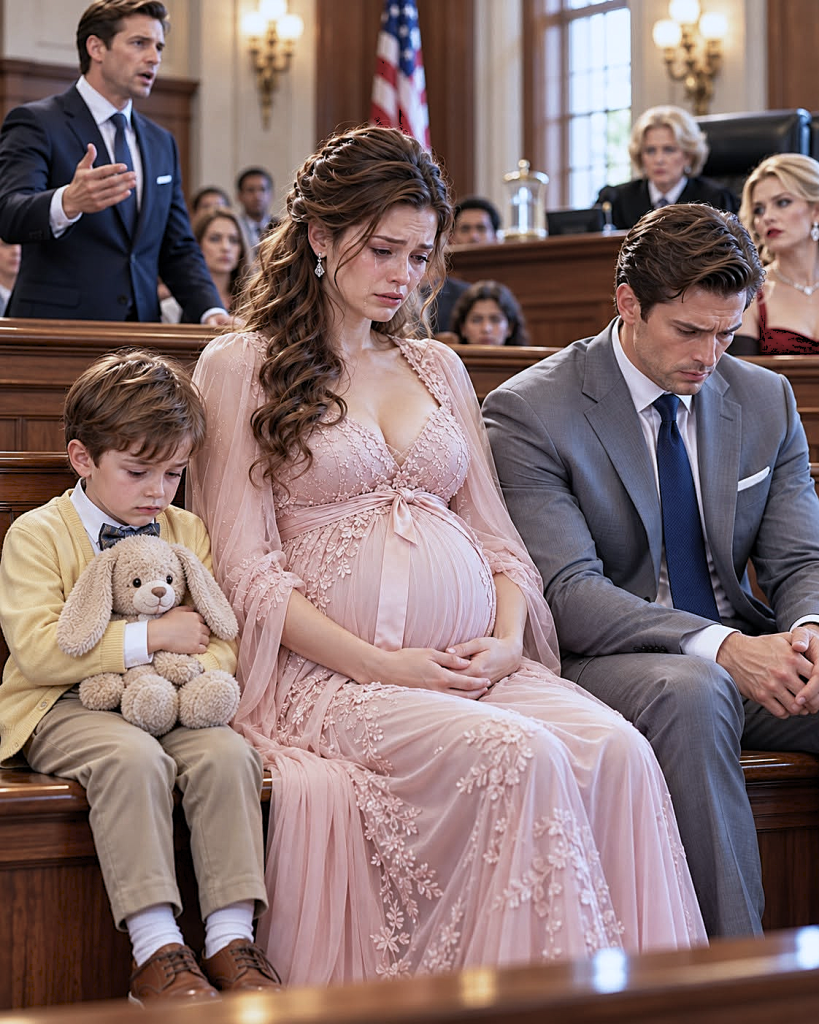
My eyes moved toward Leo.
He stood near the doorway beside a court-appointed child specialist, clutching his stuffed rabbit.
His little face was red from crying.
He looked exhausted.
Terrified.
And desperately worried that he had done something wrong.
I wanted to run to him.
To gather him into my arms.
To tell him he was safe.
But the specialist had already guided him away from the confrontation.
Judge Norris looked toward the attorneys.
“The property agreement will not be approved today. The allegations concerning document authenticity and the child’s welfare require appropriate review.”
Julian suddenly stood.
“This is absurd!”
The judge looked up.
“Sit down, Mr. Vance.”
“My son has been coached!”
Rebecca’s expression changed.
“By whom?”
Julian pointed at me.
“Her!”
I stared at him.
For seven years, I had known his anger.
The sharp voice.
The accusing finger.
The way he could turn his own choices into evidence of someone else’s supposed failure.
But this time, something inside me remained strangely still.
I was eight months pregnant.
My marriage was ending.
My financial security was uncertain.
And a six-year-old child had been frightened into silence.
I had nothing left to gain by protecting Julian’s reputation.
I stood carefully.
“Julian.”
He turned.
I looked directly into his eyes.
“Leo is not a weapon.”
His expression flickered.
I continued.
“He’s a child.”
Julian opened his mouth.
I didn’t let him interrupt.
“And whatever happens between us, you will not make him responsible for it.”
For a moment, he looked at me with something close to hatred.
Then the judge spoke.
“Mrs. Vance, please be seated. The court will address this through the proper process.”
I sat.
My hands were shaking.
But my voice hadn’t.
And that was the first sign that something in me had finally changed.
The court recessed.
Rebecca escorted me into a small conference room.
The walls were beige.
The table was scratched.
A clock ticked above a filing cabinet.
I sat down slowly, one hand supporting the underside of my belly.
For several minutes, neither of us spoke.
Then Rebecca pulled out the photograph again.
“Are you certain that’s Evelyn?”
I nodded.
“Yes.”
She studied me.
“How certain?”
I looked at the reflection.
The coat.
The hairstyle.
The small gold brooch shaped like a rose.
I knew that brooch.
I had given it to Evelyn for Mother’s Day three years earlier.
“Completely.”
Rebecca exhaled.
“Then we need to understand why she was there.”
I shook my head.
“She told me she was visiting her sister in Kansas City that week.”
Rebecca made a note.
“Did she have access to your office?”
My stomach tightened.
“Yes.”
“How?”
“I gave her a spare key after I was hospitalized with complications earlier in the pregnancy.”
Rebecca looked up.
“What complications?”
“High blood pressure. The doctors wanted to monitor me.”
I swallowed.
“Evelyn offered to collect my mail and handle a few things around the house.”
Rebecca’s pen stopped.
“Did you authorize her to take business records?”
“No.”
“Property documents?”
“No.”
“Your mother’s folder?”
My voice cracked.
“Never.”
I looked down at my hands.
My wedding ring felt suddenly heavy.
For months, I’d worn it while Julian went out with Clara.
I’d worn it during prenatal appointments he didn’t attend.
I’d worn it while reading messages from my husband telling me I was emotional, unstable, and impossible to live with.
And I’d worn it into the courtroom where he expected me to surrender everything.
I slowly removed it.
Placed it on the table.
And whispered, “I don’t even know who these people are anymore.”
Rebecca’s expression softened.
“Then we’re going to find out what the records can establish.”
I should explain something about the blue folder.
It wasn’t valuable because of the leather.
Or the clasp.
Or the documents alone.
It was valuable because my mother had given it to me three days before she died.
Her name was Margaret Bell.
She raised me by herself after my father died in a construction accident when I was nine.
For twenty-four years, she worked as a nurse.
Sometimes two shifts.
Sometimes weekends.
Sometimes holidays.
She could stretch a grocery budget farther than anyone I knew.
She sewed buttons onto old coats.
Clipped coupons.
Saved every birthday card.
And somehow, even when she was exhausted, she made me feel as though our small apartment was the safest place in the world.
When I was fifteen, I told her I wanted to become an architect.
She smiled.
“Then you’d better learn to make beautiful things last.”
I laughed.
“What does that mean?”
She touched my cheek.
“It means don’t build your dreams on something that can’t hold their weight.”
I hadn’t understood.
Not then.
Years later, when I met Julian, I thought I had found solid ground.
He was charming.
Ambitious.
Attentive.
He remembered how I took my coffee.
He called me during lunch.
He brought flowers when I had a difficult day.
And when he introduced me to his four-year-old son, Leo, I felt something in my heart open.
Leo had lost his biological mother when he was two.
He was shy.
Quiet.
He carried his stuffed rabbit everywhere.
The first time we met, he hid behind Julian’s leg.
I knelt.
Held out a small toy truck.
And said, “Hello, Leo.”
He stared at me.
Then whispered, “Are you nice?”
I smiled.
“I try to be.”
He considered that.
Then asked, “Do you like pancakes?”
I laughed.
“Very much.”
He stepped forward.
And placed his little hand in mine.
That was the moment I fell in love with him.
Long before I understood what kind of father Julian could become.
My mother loved Leo.
She called him her bonus grandson.
She bought him dinosaur pajamas.
Taught him to make biscuits.
And listened patiently whenever he explained the names of construction equipment.
When she became ill, Leo drew pictures for her hospital room.
One showed three people standing beneath a yellow sun.
Me.
Mom.
And Leo.
At the bottom, in uneven letters, he wrote:
OUR FAMILY.
Mom cried when she saw it.
Then kissed his forehead.
“Family is the people who show up, sweetheart.”
Leo smiled.
And I never forgot her words.
Three days before Mom died, she asked me to bring her blue folder.
I carried it to the hospital.
She placed it on her lap.
Then took my hand.
“Audrey, I need you to promise me something.”
I was already crying.
“Anything.”
She looked directly into my eyes.
“Don’t give away your future because somebody convinces you that keeping it makes you selfish.”
I shook my head.
“Mom…”
“Promise.”
I swallowed.
“I promise.”
She smiled faintly.
Then handed me the folder.
Inside were her estate documents.
Bank records.
Investment statements.
And a letter.
She had left me money she’d saved over decades.
More than I ever knew she possessed.
I stared at the numbers.
Then at her.
“Mom, how?”
She smiled.
“Small amounts. A long time. A little luck.”
I began crying.
She squeezed my hand.
“I wanted you to have something that nobody could make you feel guilty for needing.”
My voice broke.
“I don’t need money. I need you.”
Her eyes filled.
“Oh, sweetheart.”
She pulled me close.
And whispered, “I know.”
After Mom died, I used part of that inheritance to help Julian establish his construction consulting business.
He had dreams.
Big ones.
Commercial renovations.
Project management.
Eventually, his own development company.
I believed in him.
I believed in us.
And when he asked whether I would invest in the business, I said yes.
But Mom’s attorney insisted the arrangement be documented.
The initial capital came from my separate inheritance.
The agreement identified my investment and the ownership interest attached to it.
The records were signed and preserved.
Julian had smiled when we completed the paperwork.
“It’s just a formality, sweetheart.”
I smiled back.
“Of course.”
He kissed my forehead.
“One day, we’ll laugh about needing all this paper.”
But my mother had been right.
Beautiful things needed solid foundations.
And the blue folder contained the foundation Julian had apparently hoped I would forget.
Rebecca was still examining the photograph when someone knocked.
A court officer entered.
“Mrs. Vance?”
I stood too quickly.
A sharp discomfort moved through my lower back.
Rebecca immediately reached for me.
“Easy.”
I nodded.
The officer looked concerned.
“Are you feeling all right?”
“Yes.”
Then I asked the only question that mattered.
“Where’s Leo?”
The officer’s expression softened.
“He’s safe. He’s with the child specialist.”
My chest loosened.
“Can I see him?”
“There’s a plan being made for appropriate contact. We don’t want to place him in the middle of further questioning.”
I nodded.
“I understand.”
The officer hesitated.
“There’s something else.”
Rebecca straightened.
“What?”
The officer looked toward the hallway.
“Mrs. Evelyn Vance has arrived.”
My stomach dropped.
Of course.
Julian had called his mother.
Perhaps Clara had.
Perhaps Evelyn had already been waiting nearby.
I gripped the back of the chair.
“She’s here?”
“Yes.”
The officer continued.
“She’s asking to speak with you.”
I looked at Rebecca.
She shook her head slightly.
“You don’t need to see her.”
I swallowed.
For years, Evelyn had been the person who stepped between Julian and me whenever we fought.
She made tea.
Used soft words.
Told me everyone made mistakes.
She always sounded reasonable.
Always concerned.
Always kind.
But her advice consistently ended in the same place.
Audrey, give Julian time.
Audrey, don’t make this ugly.
Audrey, think of Leo.
Audrey, men sometimes behave foolishly when they’re under pressure.
And lately:
Audrey, just sign the agreement. Start over. You’ll feel better once it’s finished.
I looked at the photograph again.
The cream coat.
The gold rose brooch.
The blue folder.
Then I said, “I don’t want to speak to her without Rebecca.”
The officer nodded.
“I’ll let her know.”
Evelyn entered the conference room ten minutes later.
She looked immaculate.
Cream coat.
Pearl earrings.
Gold brooch.
The same brooch reflected in my kitchen cabinet.
Her perfume filled the room.
For a moment, I remembered the first time she hugged me.
She’d said, “Finally, Julian has found a woman who understands family.”
Now I wondered what she had meant.
Evelyn looked at me.
“Oh, Audrey.”
Her voice softened.
“You look exhausted.”
I didn’t answer.
She glanced toward Rebecca.
“Would you mind giving us a moment?”
Rebecca remained seated.
“Yes, I would.”
Evelyn blinked.
“I beg your pardon?”
“My client has asked me to remain.”
The older woman’s expression tightened.
Then she smiled.
“Of course.”
She turned back toward me.
“Sweetheart, Julian is very upset.”
I stared at her.
“Leo is upset.”
Evelyn waved one hand.
“Children get confused.”
My heart tightened.
“He said someone threatened to take my baby away.”
Evelyn sighed.
“Oh, Audrey. He’s six.”
“He’s frightened.”
“He’s imaginative.”
I felt anger rise.
Then Rebecca placed one hand lightly on the table.
A quiet reminder.
Stay focused.
I looked at Evelyn.
“Were you in my house while I was hospitalized?”
Her expression changed.
Only for a second.
But I saw it.
“What?”
“Were you in my kitchen with Clara?”
She laughed softly.
“Don’t be ridiculous.”
I slid the photograph across the table.
Evelyn looked down.
Her smile vanished.
For several seconds, she said nothing.
Then she looked up.
“Where did you get this?”
I felt my stomach twist.
Not that isn’t me.
Not you’re mistaken.
Where did you get this?
Rebecca spoke.
“Mrs. Vance, we need to understand whether you removed or handled documents from Audrey’s office.”
Evelyn sat straighter.
“I was helping my son organize his household.”
I stared at her.
“My household?”
She ignored me.
“Julian was trying to protect the business during a difficult divorce.”
I swallowed.
“By taking my mother’s folder?”
Evelyn’s eyes narrowed.
“That folder contained business information.”
“It contained my inheritance documents.”
“Which are relevant to the business.”
I stared at her.
Then whispered, “You knew.”
She frowned.
“Knew what?”
“That I never agreed to give away the company.”
Evelyn leaned forward.
“Audrey, you’re heavily pregnant. You’re emotional. You shouldn’t be making decisions based on hurt feelings.”
And there it was.
The same thing Julian always said.
Too emotional.
Too sensitive.
Too unstable.
Too pregnant to understand what was happening.
I looked at Evelyn.
Then at Rebecca.
And suddenly, the fear I’d carried into court began changing into something colder.
Clarity.
“Evelyn.”
She looked at me.
“I don’t want advice from you anymore.”
Her face tightened.
“Excuse me?”
“I said I don’t want your advice.”
She stared.
I continued.
“You told me to sign everything away because you wanted peace.”
“Audrey—”
“But you were in my office helping them take the documents.”
Her expression hardened.
“You don’t understand how difficult this has been for Julian.”
My eyes burned.
“He brought another woman into our home.”
Evelyn looked away.
“He betrayed his marriage.”
Silence.
“He frightened his son.”
Evelyn’s lips tightened.
“And you still think the person who needs to be understanding is me?”
For the first time since I’d met her, Evelyn had no gentle explanation ready.
She stood.
“I won’t be spoken to like this.”
I nodded.
“Then you should go.”
Her mouth fell open.
Rebecca quietly opened the conference-room door.
Evelyn looked at me one last time.
And whispered, “You have no idea what you’ve started.”
My hand moved instinctively to my stomach.
Then I answered.
“No, Evelyn.”
My voice trembled.
“But I’m finally going to find out.”
The next six weeks changed everything.
The divorce proceedings continued.
The disputed property documents were preserved for examination.
Rebecca requested financial records.
A forensic document examiner was retained.
Leo’s statements were addressed through professionals trained to work with children.
And the allegations surrounding his welfare were referred through the appropriate channels.
I moved into a small furnished apartment near my doctor’s office.
It had two bedrooms.
A narrow balcony.
And kitchen cabinets that never closed properly.
It wasn’t the house I’d spent years decorating.
It wasn’t the home where Leo had learned to ride his bicycle in the driveway.
But it was quiet.
For the first time in months, I could sleep without hearing Julian’s car pull into the garage and wondering whether Clara would be with him.
I placed the baby’s little clothes in a dresser.
Hung pale yellow curtains.
Set Mom’s photograph beside the crib.
And waited.
Every night, I talked to my unborn daughter.
I told her about her grandmother.
About Leo.
About how much I wanted to meet her.
Sometimes I cried.
Sometimes I laughed.
Sometimes I was frightened enough that I couldn’t stop shaking.
But I always ended with the same promise.
“You are wanted, sweetheart.”
I placed my hand against my stomach.
“Whatever happens next, you are wanted.”
Leo was placed temporarily with a trusted relative while the concerns were assessed.
That relative was Julian’s older sister, Caroline.
She was nothing like Evelyn.
Quiet.
Practical.
A pediatric nurse.
She had always kept her distance from the family drama.
When I married Julian, she hugged me and whispered, “If you ever need someone to tell you the truth, call me.”
I hadn’t understood why.
Now I did.
Caroline contacted me through the agreed arrangements.
“Audrey?”
Her voice was tired.
“Is Leo okay?” I asked immediately.
“He’s safe.”
My eyes filled.
“Is he eating?”
“Yes.”
“Sleeping?”
“Some.”
I closed my eyes.
“Does he ask about me?”
Caroline was quiet.
Then whispered, “Every day.”
My face crumpled.
“He thinks you left because of him.”
I covered my mouth.
“No.”
“I know.”
Her voice broke.
“He keeps asking whether telling the truth made you stop loving him.”
I began sobbing.
Caroline waited.
Then said gently, “He needs reassurance. We can work with the professionals involved so he receives it without putting him back in the middle of this conflict.”
I wiped my cheeks.
“Please tell him something.”
“What?”
“Tell him I love him.”
Caroline’s voice trembled.
“I will.”
“And tell him none of this is his fault.”
“I promise.”
Three days later, a drawing arrived.
Caroline sent a photograph of it.
It showed a little boy.
A woman with a large round belly.
And a baby wearing a pink hat.
Above them was a huge yellow sun.
At the bottom, in Leo’s careful handwriting, were the words:
AUDREY, I DIDN’T MEAN TO MAKE DADDY MAD.
I stared at the screen.
My heart broke.
Then another photograph arrived.
The back of the drawing.
I JUST WANTED BABY SISTER TO BE SAFE.
I pressed the phone against my chest.
And cried until there were no tears left.
The investigation into the paperwork uncovered more than a forged signature.
There were transfers from business accounts to an entity associated with Clara.
Personal expenses presented as business expenses.
Invoices that did not match actual services.
And a series of communications between Julian and Evelyn discussing how to classify my inheritance contribution.
The records did not prove every accusation.
Some transactions had ordinary explanations.
Others required further review.
But one thing became clear.
Julian had been trying to create a financial story in which the company belonged entirely to him.
A story that became much easier if I simply surrendered every claim without asking questions.
Rebecca placed the records on her desk.
“Do you understand why he wanted you to sign so quickly?”
I nodded slowly.
“Because he knew I was tired.”
She looked at me.
“And because he expected you to prioritize getting away over examining the agreement.”
I stared at the papers.
It hurt to see my marriage reduced to numbers.
Transfers.
Signatures.
Dates.
But sometimes numbers tell the truth more clearly than promises.
I looked up.
“Can we prove what belongs to me?”
Rebecca nodded.
“We can establish your documented investment and present the relevant evidence. The final allocation is for the court to determine under Missouri law.”
I took a shaky breath.
“I don’t want to take what’s his.”
She smiled gently.
“I know.”
“I just don’t want him to take what my mother left me.”
Rebecca’s eyes softened.
“Then we’re going to make sure the court sees those records.”
The blue folder itself was recovered during the document review.
When Rebecca handed it to me, I nearly cried.
The leather was scratched.
The clasp slightly bent.
But it was there.
My mother’s handwriting.
Her final letter.
Her careful records.
And the original agreement Julian had once called a formality.
I placed the folder on my lap.
For a moment, I could almost feel Mom beside me.
Her warm hands.
Her tired smile.
Her voice reminding me not to build my dreams on something that couldn’t hold their weight.
I opened the letter.
Read it again.
Then whispered, “I’m trying, Mom.”
Rebecca looked away to give me privacy.
And I sat there, holding the last gift my mother had left me.
Not merely money.
Not property.
But a way to remember that loving someone should never require surrendering myself.
My daughter was born on a rainy Thursday morning.
Three weeks early.
After a long night of contractions and medical monitoring, she entered the world with a furious cry.
I laughed and cried at the same time.
The nurse placed her against my chest.
She was warm.
Tiny.
Perfect.
I stared at her.
And the entire world narrowed to one extraordinary truth.
She was here.
My baby.
My daughter.
My second chance to build a family around love rather than fear.
I touched her cheek.
“Hello, sweetheart.”
She opened her mouth.
Made a tiny sound.
And settled against me.
I began crying harder.
A nurse smiled.
“What’s her name?”
I looked down.
Then whispered, “Margaret.”
My mother’s name.
The nurse smiled warmly.
“That’s beautiful.”
I kissed my daughter’s forehead.
“Margaret Rose Vance.”
Then I paused.
Because I realized I no longer wanted to carry Julian’s name into every part of my future.
The legal details could be handled later.
But the name I whispered to my daughter was the one that mattered most.
“My Maggie.”
She moved her tiny hand.
And I smiled through tears.
“Welcome home.”
Julian sent flowers to the hospital.
White roses.
My former favorites.
There was a card.
Congratulations on our daughter. I want to see her.
I stared at the message.
For years, flowers had been Julian’s way of covering difficult truths with something beautiful.
A missed anniversary.
A cruel argument.
An accusation.
A lie.
Flowers.
Always flowers.
But this time, I didn’t confuse a bouquet with responsibility.
I asked the nurse to remove them from my room.
Then contacted Rebecca to handle communication about the baby through appropriate arrangements.
I didn’t want to deny my daughter a lawful relationship with her father.
I wanted those decisions made safely, thoughtfully, and with her best interests at the center.
Not through Julian’s anger.
Not through Evelyn’s pressure.
And not through guilt.
When Leo met Maggie, he was wearing the same yellow cardigan he’d worn to court.
He carried his stuffed rabbit.
The edges were fraying now.
One ear had been sewn twice.
Caroline brought him for a supervised visit arranged with the relevant adults and professionals.
I was sitting on the hospital bed.
Maggie slept in my arms.
When Leo saw me, he stopped in the doorway.
His face changed.
“Audrey?”
My heart broke.
“Hello, sweetheart.”
He stared at Maggie.
Then at me.
“Did the baby come?”
I smiled through tears.
“She did.”
He stepped closer.
Very slowly.
As though he were afraid the moment might disappear.
I lifted the blanket slightly.
“This is your little sister.”
Leo’s eyes widened.
“She’s really small.”
I laughed softly.
“She is.”
He leaned closer.
Then whispered, “Hi, baby.”
Maggie moved her tiny mouth.
Leo gasped.
“She heard me!”
I laughed through tears.
“I think she did.”
He looked at me.
Then his expression crumpled.
“Audrey?”
“Yes, sweetheart?”
“Are you mad at me?”
My heart stopped.
I shook my head immediately.
“No.”
His lower lip trembled.
“Because I told.”
I began crying.
“Oh, Leo.”
I reached for his hand.
“You did nothing wrong.”
He stared at me.
“Daddy got angry.”
“I know.”
“Grandma Evelyn said I made everything worse.”
My chest tightened.
Caroline’s expression hardened.
I swallowed my anger.
Then looked at Leo.
“Listen to me carefully.”
He nodded.
“Adults are responsible for their own choices.”
His eyes filled.
“You are not responsible for Daddy’s anger.”
He swallowed.
“Or Grandma’s?”
“No.”
“Or Clara’s?”
“No, sweetheart.”
His face crumpled.
“Then why did everybody get so mad?”
I squeezed his little hand.
“Because sometimes grown-ups make choices they don’t want other people to know about.”
He looked confused.
I continued gently.
“But telling the truth about something that frightened you was not wrong.”
Tears slid down his cheeks.
He nodded.
Then asked the question I had dreaded.
“Do you still love me?”
I couldn’t speak.
My eyes filled.
I nodded.
Then whispered, “Always.”
He began sobbing.
I opened one arm.
He moved into it carefully.
And I held my two children.
One in my arms.
One against my shoulder.
For a moment, nothing else existed.
Not Julian.
Not Clara.
Not Evelyn.
Not the courtroom.
Not the house.
Not the money.
Just a little boy who needed reassurance.
And a newborn girl who had no idea how fiercely she was already loved.
The months after Maggie’s birth were difficult.
Not dramatic in the way people imagine.
There were no constant courtroom confrontations.
No endless shouting matches.
Mostly, there was paperwork.
Sleep deprivation.
Medical appointments.
Feeding schedules.
Legal meetings.
And the ache of missing Leo on days when he wasn’t with me.
Sometimes I cried while washing bottles.
Sometimes I fell asleep sitting upright with a burp cloth over my shoulder.
Sometimes I stared at my bank account and wondered whether I could afford another month of legal fees.
But then Maggie would open her eyes.
Or Leo would send a drawing.
Or Caroline would call to say he’d laughed at school that day.
And somehow, I found enough strength for the next morning.
I began working part-time from home.
Architecture had once been my dream.
Before Julian convinced me that helping his business was more important.
I opened my old laptop.
Found my design files.
And contacted a former colleague.
Her name was Dana Mitchell.
We had worked together before I married Julian.
When I explained that I wanted to return to design work, she became quiet.
Then she said, “Audrey, I have been waiting years for you to say that.”
I laughed through tears.
“Really?”
“Yes.”
She paused.
“You were one of the best people on our team.”
My throat tightened.
I had forgotten what it felt like to be valued for something other than how much I could sacrifice.
Dana continued.
“We have a small residential project that needs help.”
I smiled.
“Tell me about it.”
And just like that, a door opened.
Not a glamorous one.
Not a perfect one.
Just a real opportunity.
A way forward.
The first project was a small house for an elderly couple.
They wanted wider doorways.
A safe bathroom.
A kitchen where one spouse could cook while the other used a wheelchair.
Nothing extravagant.
Just a home designed around dignity.
I loved it.
I worked while Maggie slept.
Answered emails during nap time.
Sketched floor plans at the kitchen table.
Sometimes Leo sat beside me during approved visits, coloring buildings on scrap paper.
One afternoon, he looked at my drawings.
“Are you making a house?”
I smiled.
“Yes.”
“For who?”
“Two people who want to stay in their home as they get older.”
He nodded seriously.
“Will it have a big kitchen?”
“Yes.”
“A place for cookies?”
I laughed.
“Absolutely.”
He considered that.
Then asked, “Can you make us a house too?”
My hand stopped moving.
I looked at him.
His eyes were hopeful.
Careful.
The way children look when they’re afraid wanting something might cause trouble.
I took a breath.
“Maybe someday.”
He nodded.
Then smiled.
“Can it have a yellow room for Maggie?”
My eyes filled.
“Yes.”
“And a blue room for me?”
I swallowed.
“If we can make that happen, sweetheart, yes.”
He grinned.
Then bent over his paper.
And drew a house.
Three windows.
A red door.
A huge yellow sun.
At the bottom, he wrote:
OUR SAFE HOUSE.
I kept that drawing.
It became the first thing I hung in my new office.
The legal proceedings continued.
Julian’s business interests were examined.
The authenticity of the disputed documents was challenged.
His financial disclosures were reviewed against bank records.
Clara’s role in the transactions became part of the investigation.
And Evelyn’s handling of my documents was scrutinized.
As evidence developed, a separate criminal investigation concerning alleged forgery and financial misconduct proceeded.
Not every accusation resulted in charges.
Not every suspicious transfer was unlawful.
But several documents could not be reconciled with the genuine originals.
And the communications between Julian and Clara showed that they had discussed making my financial claims disappear.
One message became especially important.
It had been sent by Julian to Clara shortly before the divorce hearing.
She wants out badly enough to sign anything. We just need to make sure she doesn’t look too closely.
I read it in Rebecca’s office.
Then stared at the wall.
“She knew I was pregnant.”
Rebecca nodded.
“She knew I was exhausted.”
“Yes.”
I looked down.
“And he knew I was willing to give up everything just to stop being humiliated.”
Rebecca’s expression softened.
I swallowed.
“He used that.”
She nodded.
“Yes.”
For a long time, I couldn’t speak.
Then I whispered, “I loved him.”
Rebecca waited.
“I really loved him.”
My eyes filled.
She passed me a tissue.
And said gently, “That doesn’t make what he did acceptable.”
I nodded.
But the tears came anyway.
Because betrayal is painful enough when it steals your present.
It’s even worse when it forces you to question the past.
Every anniversary.
Every promise.
Every moment of tenderness.
You find yourself wondering which memories were real.
And which were simply useful to the person who wanted something from you.
Clara eventually requested a meeting through her attorney.
When Rebecca told me, I almost laughed.
“Why?”
“She wants to provide information.”
I stared at her.
“After laughing at me in court?”
Rebecca remained calm.
“Her interests may no longer align with Julian’s.”
I considered that.
Then asked, “Do I have to see her?”
“No.”
I shook my head.
“Then I don’t want to.”
Rebecca nodded.
“That’s fine.”
Clara could speak to investigators and attorneys without being granted access to me.
I had spent too long allowing people who hurt me to demand my attention whenever they wanted forgiveness.
I wasn’t doing it anymore.
The first major hearing after Maggie’s birth took place on a cold November morning.
The trees outside the courthouse had lost most of their leaves.
I wore a navy dress.
Flat shoes.
And the small silver necklace Mom had given me on my twenty-first birthday.
Rebecca stood beside me.
“You ready?”
I took a breath.
“No.”
She smiled faintly.
“That’s allowed.”
I laughed.
Then nodded.
“But I’m here.”
She squeezed my shoulder.
“That matters.”
Inside, Julian sat beside his attorney.
He looked older.
His face was thinner.
His hair less carefully styled.
Clara was nowhere in sight.
Evelyn sat in the back row.
When she saw me, she looked away.
I noticed.
But I didn’t care.
For the first time, I had come to court without the intention of surrendering.
I was there to tell the truth.
The judge reviewed the evidence presented by both sides.
The documented inheritance contribution.
The original ownership agreement.
The contested signatures.
The business records.
The disputed expenditures.
And the proposed division of property.
Rebecca explained that I was no longer asking to waive claims simply to end the marriage immediately.
I wanted a lawful resolution.
I wanted my documented interests considered.
I wanted to support my children.
And I wanted to rebuild a life without financial manipulation.
Julian’s attorney challenged parts of the evidence.
Arguments were made.
Questions were asked.
The process took hours.
At one point, Julian looked directly at me.
His eyes were wet.
I remembered the man who once kissed my forehead before work.
The man who taught Leo to throw a baseball.
The man who made pancakes on Sundays.
And for one painful second, I wondered whether we might have been happy if he’d made different choices.
Then I remembered the photographs.
The forged documents.
The messages.
The frightened little boy holding a stuffed rabbit.
And I understood.
A marriage cannot be saved by one person remembering the good parts while the other refuses responsibility for the harm.
When the hearing ended, no dramatic verdict came.
The court required additional steps.
Further review.
Updated records.
A process for resolving the disputed business interests.
And arrangements concerning the children that considered their safety and welfare.
I walked out exhausted.
But different.
Because I had finally stopped treating my legal rights as something selfish.
I had stopped believing that wanting security for my children made me greedy.
And I had stopped feeling ashamed for asking the court to examine the facts.
That winter, Leo began attending counseling.
Caroline told me he was slowly becoming more relaxed.
He still had nightmares.
Still worried about getting adults in trouble.
Still held his rabbit when he was frightened.
But he was beginning to understand that he hadn’t caused the conflict.
One afternoon, during a visit, he asked me something unexpected.
“Audrey?”
“Yes?”
“Do grown-ups ever get scared?”
I smiled gently.
“All the time.”
He looked surprised.
“You do?”
“Of course.”
He considered that.
“But you’re big.”
I laughed softly.
“Not as big as you think.”
He smiled.
Then asked, “What do you do when you’re scared?”
I thought carefully.
“Sometimes I talk to someone I trust.”
He nodded.
“Sometimes I ask for help.”
He looked down at his rabbit.
“And sometimes I remind myself that being scared doesn’t mean I’m doing something wrong.”
His eyes filled.
He whispered, “I was scared in court.”
I took his hand.
“I know.”
“I thought Daddy would hate me.”
My throat tightened.
I swallowed.
“Leo, your father’s feelings are his responsibility.”
He stared at me.
I continued.
“You don’t have to keep secrets that make you feel unsafe just to make an adult happy.”
He nodded slowly.
Then leaned against me.
For a long time, we sat quietly.
Maggie slept nearby.
And I realized that healing wasn’t always about grand speeches.
Sometimes it was simply a little boy asking whether grown-ups got scared.
And being told the truth.
The following spring, Julian and I reached a divorce settlement after extensive legal review.
It was not the agreement he’d placed before me that first morning.
The house was addressed through the division process.
My inheritance contribution and documented ownership interests were recognized in the financial resolution.
The business accounts had been examined.
The disputed liabilities were not simply accepted because Julian said they existed.
And provisions were made concerning financial support and the children’s needs.
The outcome did not give me everything.
It did not erase the legal fees.
Or the humiliation.
Or the emotional cost.
But it was fairer than the document I’d been prepared to sign while begging only to escape.
Rebecca called me when the final papers were ready.
“Audrey?”
“Yes?”
“We have the approved settlement documents.”
I sat down slowly.
For a moment, I couldn’t speak.
Then I whispered, “It’s over?”
“The divorce is finalized.”
I closed my eyes.
A long breath escaped me.
Then tears began sliding down my face.
Rebecca waited.
I laughed through tears.
“I thought I’d be happier.”
Her voice softened.
“Sometimes relief is quieter than we expect.”
I nodded.
“Yes.”
I looked toward Maggie sleeping in her crib.
Then at Leo’s drawing hanging above my desk.
And whispered, “We’re going to be okay.”
The criminal proceedings involving the disputed documents continued separately.
Some allegations resulted in negotiated resolutions.
Other matters were closed after review.
The court outcomes did not make every painful memory disappear.
Julian remained responsible for complying with the orders governing his conduct and financial obligations.
Evelyn’s involvement was examined according to the available evidence.
Clara’s cooperation affected how certain issues were resolved.
But I no longer needed to sit through every conversation about their choices.
My life was moving forward.
And for the first time, I wanted to give more attention to what I was building than to what they had tried to take.
Two years after the divorce, I bought a house.
Not a mansion.
Not the beautiful place Julian and I once owned.
A modest two-story home at the end of a quiet street.
White siding.
Blue shutters.
A little front porch.
A yard large enough for a swing set.
And a kitchen with wide windows that let in the morning sun.
I stood in the empty living room with Maggie on my hip.
Leo held my hand.
He was eight now.
Tall for his age.
His stuffed rabbit remained tucked under one arm.
He looked around.
Then whispered, “Is this ours?”
My throat tightened.
“Yes.”
He looked at me.
“Really ours?”
I nodded.
“Really.”
His eyes widened.
“Can I pick my room?”
I laughed.
“Of course.”
He ran upstairs.
Maggie squealed.
Then he shouted from the hallway.
“AUDREY!”
I looked up.
“What?”
“THERE’S A BLUE ROOM!”
I began laughing.
Then crying.
Because I’d painted that room before bringing him to see the house.
Blue walls.
White shelves.
A desk beside the window.
A place for his books.
A place for his drawings.
A place where a frightened little boy could finally feel that he belonged.
Maggie’s room was yellow.
Just as he’d asked.
And on the wall between their bedrooms, I hung his drawing.
OUR SAFE HOUSE.
We filled the rooms slowly.
Secondhand furniture.
Family photographs.
A dining table Dana helped me find.
Curtains I sewed myself.
A bookshelf built by a neighbor.
Nothing matched perfectly.
But everything had a story.
On the first night, I made spaghetti.
Leo insisted on setting the table.
Maggie dropped half her noodles onto the floor.
I laughed.
Leo laughed.
Maggie laughed because we were laughing.
And for one ordinary, beautiful moment, I realized how far we’d come.
No one was shouting.
No one was humiliating anyone.
No one was waiting for an angry person to arrive and change the atmosphere of the house.
There was only dinner.
A messy toddler.
An eight-year-old boy.
And a woman who had once believed she needed to give up everything to be free.
The custody and guardianship arrangements involving Leo required continued attention.
He was my stepson, not my biological child.
And although I had raised him for most of his life, love alone did not automatically give me parental rights.
That was one of the most painful truths I faced.
I worked with Rebecca and the relevant professionals.
Julian’s legal status as Leo’s father had to be respected and addressed.
The child’s welfare had to remain central.
Caroline continued supporting him.
And as circumstances changed, the adults and court reviewed appropriate arrangements.
I refused to make promises I couldn’t legally guarantee.
But I made one promise I could keep.
Whenever I was allowed to be there for Leo, I would show up.
Every time.
On his ninth birthday, Leo asked me a question.
We were sitting at the kitchen table.
Maggie was asleep.
His birthday cake had blue frosting.
A few candles remained in a drawer.
He looked down at his hands.
“Audrey?”
“Yes, sweetheart?”
“Am I allowed to call you Mom?”
I stopped breathing.
For years, he’d called me Audrey.
Sometimes Mama Audrey when he was little.
After the divorce, he had become careful.
Almost frightened of choosing the wrong word.
I set down my cup.
“Leo…”
He looked up.
His eyes were wet.
“I know you’re not the mommy who had me.”
My throat tightened.
“I know.”
“And I know she’s in heaven.”
I nodded.
He swallowed.
“But you’re the person who reads to me.”
My eyes filled.
“And helps when I’m sick.”
A tear slipped down my cheek.
“And remembers how I like my pancakes.”
I began crying.
He looked frightened.
“Did I say something bad?”
I shook my head immediately.
“No, sweetheart.”
I reached for his hands.
“You can call me whatever feels right to you.”
He stared.
“Even Mom?”
I smiled through tears.
“Even Mom.”
His face crumpled.
Then he launched himself into my arms.
“Mom!”
I held him.
And cried.
Not because I wanted to replace his first mother.
She would always matter.
Not because I needed a title.
But because a little boy who had spent years frightened of losing people was finally allowing himself to believe he could belong.
As time passed, Leo grew stronger.
Not overnight.
There were difficult days.
Questions.
Anger.
Sadness.
Confusion about Julian.
Some visits left him upset.
Some memories resurfaced when nobody expected them.
But he learned to talk.
To ask questions.
To understand that he could care about his father without excusing hurtful behavior.
He also learned that adults could disagree without screaming.
That a mistake did not make him unlovable.
That saying no was allowed.
And that home was not a place where children had to perform happiness to protect their parents.
Maggie was three when she first asked about our family.
We were driving home from preschool.
She sat in her car seat singing quietly.
Then suddenly said, “Mommy?”
“Yes, baby?”
“Why doesn’t Daddy live with us?”
My heart tightened.
I glanced at her in the rearview mirror.
I had known the question would come.
I had prepared for it.
But hearing it in her small voice still hurt.
I took a breath.
“Sometimes grown-ups can’t live together in a healthy way.”
She frowned.
“Because they fight?”
“Sometimes.”
She considered that.
“Did you fight?”
I swallowed.
“We had problems we couldn’t solve safely together.”
Maggie looked thoughtful.
Then asked, “Is it my fault?”
My heart stopped.
I pulled into a safe parking area.
Turned toward her.
And said clearly, “No.”
Her eyes widened.
“Never.”
I reached back and touched her little shoe.
“You did not cause anything that happened between your father and me.”
She nodded slowly.
I continued.
“And you are loved.”
She smiled.
“By you?”
“Always.”
“By Leo?”
I laughed through tears.
“Very much.”
She grinned.
Then asked, “Can we get ice cream?”
I burst out laughing.
Because children have a beautiful way of returning us to the present.
“Yes, sweetheart.”
And we did.
My architecture work continued growing.
Dana eventually offered me a partnership in a small design studio.
We specialized in homes for families with accessibility needs.
Older people who wanted to age in place.
Parents caring for children with disabilities.
Survivors starting over.
Families who needed spaces designed around safety and dignity.
I loved the work.
There was something meaningful about creating homes that considered the people living inside them.
Not just expensive finishes.
Not just beautiful windows.
But doorways wide enough to move through comfortably.
Bathrooms where someone could feel safe.
Bedrooms filled with natural light.
Kitchens where families could gather without feeling crowded.
One afternoon, Dana looked at a design I’d completed.
Then smiled.
“You know what makes your work different?”
I raised an eyebrow.
“What?”
“You think about how people feel inside the room.”
I considered that.
Then smiled sadly.
“I suppose I do.”
Because I knew what it was like to live in a beautiful house that felt unsafe.
And I never wanted to design one.
Five years after the divorce, I attended Leo’s middle-school graduation.
He was eleven.
Tall.
Nervous.
Wearing a navy shirt and a tie he had insisted on choosing himself.
Maggie sat beside me in a yellow dress.
She was five.
Full of energy.
She clapped for everyone.
When Leo’s name was called, he walked across the stage.
Accepted his certificate.
Then looked toward us.
His face lit up.
He waved.
Maggie screamed, “THAT’S MY BROTHER!”
The auditorium burst into laughter.
I began crying.
Leo laughed from the stage.
And I realized something.
We had become a family in ways no document could fully describe.
Not because life was simple.
It wasn’t.
Not because everyone had made the right choices.
They hadn’t.
But because we had kept showing up for each other.
Again.
And again.
And again.
After the ceremony, Leo came running toward us.
“Mom!”
My heart warmed.
He hugged me.
Then lifted Maggie off the ground.
She squealed.
I laughed.
Then Leo looked at me.
“Did you see me?”
I smiled through tears.
“Every second.”
He grinned.
Then became serious.
“Mom?”
“Yes?”
“Remember when I was little and I had to go to court?”
My stomach tightened.
“Yes.”
He looked down.
“I used to think that was the worst day of my life.”
My throat closed.
I reached for his hand.
He continued.
“But sometimes I think it was the day things started getting better.”
Tears filled my eyes.
“Leo…”
He smiled faintly.
“Because people finally listened.”
I began crying.
He hugged me.
And whispered, “Thank you for not leaving me.”
I held him tightly.
“Oh, sweetheart.”
My voice broke.
“Thank you for letting me be part of your life.”
Julian eventually wrote me a letter.
Not a demand.
Not a threat.
Not another attempt to convince me that everything had been my fault.
A letter.
He acknowledged that he’d hurt me.
That he’d betrayed our marriage.
That he’d involved Leo in adult conflict.
That he’d tried to manipulate the financial settlement.
He said he regretted it.
I read the letter carefully.
Then placed it in a drawer.
I did not respond immediately.
I had learned that forgiveness and reconciliation were not the same thing.
An apology could matter.
Accountability could matter.
But neither automatically restored trust.
Julian’s relationship with the children remained governed by appropriate arrangements.
And I no longer felt responsible for managing his emotions.
For years, I’d believed that if I found the right words, he’d understand.
If I cried enough, he’d care.
If I sacrificed enough, he’d stop hurting me.
Now I understood.
I could not make Julian become a different person.
I could only decide what kind of life I would build.
Evelyn contacted me once after the divorce.
She sent a handwritten card.
Inside, she apologized for taking documents and pressuring me during the separation.
She wrote that she’d believed protecting Julian meant protecting the family.
Then added:
I understand now that I was protecting his choices from their consequences.
I stared at those words.
For a long time, I felt nothing.
Then sadness.
Then something close to relief.
Because she had finally named the truth.
But I didn’t invite her back into my life.
I didn’t owe her access.
And I didn’t want Leo or Maggie learning that an apology required them to ignore their own boundaries.
I kept the card.
Then closed the drawer.
Some relationships can be repaired.
Others are best remembered from a safe distance.
Clara disappeared from our lives.
I heard that she and Julian separated after the financial investigation.
I did not celebrate.
I did not contact her.
I did not ask for details.
She had once laughed while I stood eight months pregnant, surrendering everything I thought I owned.
But years later, I no longer needed her humiliation to balance my pain.
I wanted something better than revenge.
I wanted peace.
And I had it.
One autumn evening, Maggie came home from school crying.
She was eight now.
Her hair was tied in two long braids.
She threw her backpack onto the floor.
Then ran into my arms.
“Mommy!”
I held her.
“What happened?”
She sobbed.
“A girl said our family isn’t real.”
My heart tightened.
I gently pulled back.
“What did she say?”
Maggie wiped her cheeks.
“She said Leo isn’t really my brother because we have different moms.”
I felt anger rise.
Then I took a breath.
I knelt in front of her.
“Maggie, families can be formed in different ways.”
She sniffled.
“But Leo is my brother.”
I smiled.
“Yes.”
“He reads to me.”
“Yes.”
“He helps me with homework.”
“Yes.”
“He taught me to ride a bike.”
I nodded.
“He did.”
She looked at me.
“Then why would she say that?”
I touched her cheek.
“Because sometimes people think a family has to look only one way.”
Her eyes filled.
“But love isn’t limited to one shape.”
Maggie considered that.
Then whispered, “So we’re real?”
My throat tightened.
I smiled through tears.
“As real as any family can be.”
She hugged me.
And I held her.
Then Leo appeared in the doorway.
He was fourteen now.
Tall.
Broad-shouldered.
Almost as tall as Julian had been when we married.
But his eyes were gentle.
He looked at Maggie.
“Who made you cry?”
She sniffled.
“A girl said you’re not my brother.”
Leo’s expression changed.
He walked over.
Knelt beside her.
And said something I will never forget.
“Maggie, I was your brother before you were born.”
Her eyes widened.
He smiled.
“I used to talk to you through Mom’s belly.”
Tears filled my eyes.
He continued.
“I told you stories.”
Maggie smiled through tears.
“Really?”
“Yes.”
“And when you came home, I held you while Mom made dinner.”
He hugged her.
“So nobody gets to tell me you’re not my sister.”
Maggie began crying again.
But this time, she was smiling.
Leo looked at me.
Then winked.
And I realized the frightened six-year-old boy who had once stood in a courtroom holding a rabbit had become someone who knew how to protect another person’s heart without hurting anyone.
At sixteen, Leo wanted to become a lawyer.
I nearly dropped my coffee when he told me.
“A lawyer?”
He grinned.
“Yeah.”
I laughed.
“Since when?”
He shrugged.
“A while.”
I studied him.
“Why?”
He became thoughtful.
Then said, “Because sometimes people know the truth but don’t know how to make anybody listen.”
My heart tightened.
I stared at him.
He continued.
“And I remember what it felt like when I was little.”
I swallowed.
“Leo…”
He smiled gently.
“I want to help kids who feel like that.”
Tears filled my eyes.
I hugged him.
And whispered, “Your heart is going to take you somewhere wonderful.”
He laughed.
“Hopefully law school.”
I burst out laughing.
“Hopefully.”
When Leo graduated from high school, he gave a speech.
He had been chosen as one of the student speakers.
I sat in the auditorium beside Maggie.
She was twelve now.
She wore a blue dress.
Held a bouquet of sunflowers.
And kept whispering that her brother looked nervous.
I smiled.
“He’ll be fine.”
Then Leo approached the microphone.
He adjusted it.
Looked toward the audience.
And began.
“When I was six years old, I learned that adults are not always right.”
A few people laughed.
My heart tightened.
He continued.
“I learned that people can be frightened into silence.”
The room grew quiet.
“And I learned that telling the truth can be difficult when the person you’re afraid of is someone you love.”
My eyes filled.
Leo paused.
Then smiled gently.
“But I also learned something else.”
He looked toward me.
“That one person’s courage can change the direction of another person’s life.”
Tears slipped down my cheeks.
He continued.
“When I was little, there was someone who showed up for me.”
“She read me stories.”
“She made pancakes.”
“She remembered my favorite color.”
“She helped me understand that being afraid did not make me weak.”
My face crumpled.
“And when my family fell apart, she didn’t treat me like something broken.”
He swallowed.
“She helped me find my way through it.”
Maggie squeezed my hand.
Leo looked directly at me.
“Mom, thank you.”
I began sobbing.
He smiled through tears.
“Thank you for teaching me that family isn’t only about who we’re born to.”
He paused.
“It’s about who chooses to care for us, and who keeps showing up when life gets hard.”
The audience applauded.
But I barely heard it.
Because I was looking at my son.
My little boy.
The child who had once stood trembling in a courtroom.
Now standing confidently before hundreds of people.
Speaking without fear.
After the ceremony, Leo ran toward us.
Maggie hugged him first.
Then I wrapped my arms around him.
He laughed.
“Mom, you’re crying.”
I smiled through tears.
“Of course I am.”
He grinned.
“I knew you would.”
I pulled back.
Looked at him.
And whispered, “I’m so proud of you.”
His expression softened.
“Thanks, Mom.”
Then he reached into his graduation gown.
And pulled out something small.
A worn stuffed rabbit.
My breath caught.
Leo smiled.
“Remember him?”
I began laughing through tears.
“Oh, Leo.”
The rabbit’s ears were frayed.
One eye had been replaced.
The fur was thin.
But I recognized it instantly.
The same rabbit he carried into court.
The same rabbit he held when he was afraid.
Leo looked down at it.
“I brought him today.”
I smiled.
“For luck?”
He shook his head.
“No.”
He looked at me.
“To remember how far I’ve come.”
My heart broke open.
He placed the rabbit gently in my hands.
“I want you to keep him.”
I stared.
“Sweetheart, are you sure?”
He nodded.
“Yeah.”
His eyes filled.
“You kept me safe when I needed it.”
He smiled.
“Now you can keep him safe.”
I began crying.
I hugged him.
Held the rabbit against my chest.
And whispered, “Always.”
Several years later, Leo graduated from college.
Maggie was preparing for high school.
My architecture firm had grown into a successful small business.
We employed twelve people.
Designed homes for families.
Worked with nonprofits.
And occasionally provided reduced-cost design services for people facing difficult circumstances.
I wasn’t wealthy in the way Julian had once dreamed of being.
But I was secure.
Independent.
Proud of my work.
And happy.
Not every day.
There were still hard days.
Stress.
Bills.
Illness.
Arguments.
The ordinary difficulties of family life.
But happiness no longer meant pretending everything was perfect.
It meant knowing the people in my home could make mistakes without becoming cruel.
It meant being able to disagree without fearing retaliation.
It meant sleeping peacefully.
And waking up to a life I recognized as my own.
One spring afternoon, Rebecca visited my office.
She had become more than my attorney.
Over the years, we’d developed a genuine friendship.
She looked around the studio.
The drafting tables.
The large windows.
The photographs of completed houses.
Then smiled.
“You’ve built something beautiful.”
I laughed softly.
“Literally.”
She laughed.
Then shook her head.
“Not just the buildings.”
I looked at her.
She smiled.
“Your life.”
My eyes filled.
I thought about the woman who stood before Judge Norris years earlier.
Eight months pregnant.
Exhausted.
Humiliated.
Ready to surrender everything just to escape.
I remembered Clara laughing.
Julian smirking.
Evelyn telling me to be reasonable.
And Leo walking into the courtroom holding a stuffed rabbit.
I swallowed.
“I almost gave up everything.”
Rebecca nodded.
“You did.”
I looked toward the framed drawing above my desk.
OUR SAFE HOUSE.
Then whispered, “I didn’t know what else to do.”
Rebecca’s expression softened.
“You did what you could with the strength you had at the time.”
I looked at her.
She continued.
“And when new information came to light, you made a different choice.”
My eyes filled.
I smiled.
“Yes.”
That evening, I went home early.
Maggie was in the kitchen making cupcakes.
Leo was visiting from college.
He stood beside the counter wearing an apron that said KISS THE COOK.
Maggie had flour on her nose.
Leo had frosting on his sleeve.
The kitchen was a disaster.
I stared.
“What happened here?”
Maggie grinned.
“Surprise!”
I laughed.
“What kind of surprise?”
Leo lifted a tray.
“Cupcakes.”
I looked at the lopsided cakes.
Then at the frosting-covered counter.
I burst out laughing.
“Clearly.”
Maggie ran toward me.
“Mom, we made your favorite!”
I hugged her.
Then looked at Leo.
“What’s the occasion?”
He shrugged.
“Nothing.”
I smiled.
“Nothing?”
He shook his head.
“Just felt like it.”
My throat tightened.
Because for years, I had lived in a house where affection was often attached to a demand.
A gift before a request.
Flowers after an argument.
Kindness used to erase hurt without changing behavior.
But here were my children.
Making cupcakes.
Destroying my kitchen.
Laughing.
Simply because they wanted to make me happy.
No hidden purpose.
No manipulation.
No fear.
Just love.
I looked at them.
And began crying.
Maggie frowned.
“Mom?”
I laughed through tears.
“Happy tears.”
Leo grinned.
“Again?”
I nodded.
“Again.”
On the twentieth anniversary of my mother’s death, I visited her grave.
I brought yellow roses.
Her favorites.
I sat beside the headstone.
The cemetery was quiet.
Birds moved through the trees.
A warm breeze touched my face.
I placed the flowers gently on the grass.
Then whispered, “Hi, Mom.”
For a long time, I didn’t speak.
I thought about everything that had happened since she left me.
The marriage.
The betrayal.
The divorce.
The children.
The house.
The business.
The years of rebuilding.
Then I smiled through tears.
“You were right.”
I touched the blue folder resting beside me.
I still kept it.
The leather was older now.
The clasp repaired.
Inside were the documents that helped me defend what she left.
But the most important thing in the folder was still her letter.
I unfolded it.
Read the final paragraph.
Then whispered, “I didn’t give away my future.”
My eyes filled.
“I almost did.”
A tear slipped down my cheek.
“But I didn’t.”
I smiled.
“Leo’s growing up.”
I laughed softly.
“He wants to be a lawyer.”
Then I looked toward the sky.
“And Maggie…”
My voice broke.
“Mom, she has your smile.”
Tears streamed down my face.
“She really does.”
I sat quietly.
Then whispered, “I wish you could meet them.”
The breeze moved through the trees.
I closed my eyes.
And for one beautiful moment, I remembered being a little girl in our kitchen.
Mom standing beside the stove.
Her hair tied back.
Her tired hands working dough.
Me sitting on the counter, asking a hundred questions.
She used to say, “Audrey, life doesn’t promise us easy days.”
Then she’d smile.
“But it gives us chances to make something good with what we have.”
I opened my eyes.
Looked at the flowers.
And whispered, “I think I finally did.”
Years later, when Maggie turned eighteen, she asked me to tell her the whole story.
Not the shortened version.
Not the careful childhood explanation.
The truth.
We sat at the kitchen table.
She wore a college sweatshirt.
Her hair fell over her shoulders.
She looked so much like Mom that sometimes my heart ached.
“Mom?”
“Yes?”
“I want to understand what happened before I was born.”
I took a breath.
“Are you sure?”
She nodded.
“Yes.”
So I told her.
About Julian.
About Clara.
About the courthouse.
About Leo.
About the blue folder.
About Evelyn.
About the documents.
About the fear.
The exhaustion.
The decision to walk away.
The long legal process.
The day she was born.
And the years we spent rebuilding.
Maggie listened quietly.
Sometimes she cried.
Sometimes she asked questions.
Sometimes she reached across the table and held my hand.
When I finished, she was silent for a long time.
Then she whispered, “Mom?”
“Yes?”
“Did you really think you had to give away everything to be free?”
My eyes filled.
I nodded.
“Yes.”
She shook her head slowly.
“That makes me so sad.”
I smiled sadly.
“Me too.”
She looked down.
Then asked, “Were you afraid I would hate you for leaving Dad?”
My throat tightened.
“Yes.”
Her eyes filled.
“Mom…”
I swallowed.
“I wanted you to have a family.”
Maggie reached for my hand.
“I did.”
I stared at her.
She smiled through tears.
“I had you.”
A tear slipped down my cheek.
“And Leo.”
She nodded.
“And Aunt Caroline.”
I began crying.
Maggie squeezed my hand.
“You didn’t take away my family.”
Her voice broke.
“You gave me a safe one.”
I covered my mouth.
And cried.
Because that was the sentence I had needed to hear for twenty years.
One evening, shortly before Leo’s law school graduation, I received an invitation.
He wanted me to attend a small ceremony honoring students who had completed work in family advocacy and children’s legal services.
I smiled when I read it.
Of course.
Leo had never forgotten the frightened child he’d been.
But instead of allowing that experience to define him through fear, he had turned it into a reason to help others.
At the ceremony, he gave a short speech.
He spoke about children caught in adult conflict.
About the importance of listening carefully.
About protecting their dignity.
About ensuring they weren’t made responsible for the consequences of grown-up decisions.
Then he looked toward me.
And smiled.
“There’s someone here tonight who taught me the meaning of family.”
My eyes filled.
He continued.
“When I was six, I believed telling the truth meant losing the people I loved.”
My throat tightened.
“But one person told me something I’ve never forgotten.”
He paused.
“She told me that adults are responsible for their own choices.”
Tears slipped down my cheeks.
“And that I did not have to keep frightening secrets to make someone else happy.”
He looked down.
Then smiled.
“Those words changed my life.”
I began crying.
He looked directly at me.
“Mom, thank you.”
The room applauded.
I covered my face.
Then Leo continued.
“And to every child who feels responsible for the anger, sadness, or mistakes of the adults around them, I want you to know something.”
The room became quiet.
“You are not responsible for fixing what you did not break.”
My heart nearly burst.
“You deserve to be heard.”
“You deserve to feel safe.”
“And your worth does not depend on keeping somebody else’s secrets.”
The applause rose again.
But I was looking at Leo.
My boy.
The child who once entered court clutching a worn rabbit.
Now standing before a room of future lawyers.
Speaking with courage.
Not because he’d forgotten what happened.
But because he had found a way to turn it into compassion.
After the ceremony, Leo came toward me.
He wore a dark suit.
His hair was neatly combed.
He looked so grown that I almost couldn’t recognize the little boy who once asked whether I liked pancakes.
I hugged him.
Hard.
He laughed.
“Mom!”
I cried.
He smiled.
“Still crying?”
I nodded.
“Always.”
He laughed softly.
Then took my hands.
“Do you remember the day in court?”
I swallowed.
“How could I forget?”
He nodded.
“I remember being so scared.”
My eyes filled.
“I know.”
He looked down.
“I thought everybody would be angry forever.”
I squeezed his hands.
He continued.
“But then I remember seeing you.”
My throat tightened.
“You were sitting there with your hand on your belly.”
I smiled through tears.
“Yes.”
“And when I walked in, you looked at me like I was the most important person in the room.”
My face crumpled.
“Leo…”
He smiled.
“I didn’t understand the papers.”
“The money.”
“The divorce.”
He swallowed.
“I only understood that I was scared.”
Tears streamed down my cheeks.
“And you looked like you still loved me.”
I pulled him close.
“Oh, sweetheart.”
He hugged me.
Then whispered, “That saved me.”
For a long time, neither of us spoke.
As I grew older, I began writing down our family story.
Not because I wanted fame.
Not because I wanted strangers to hate Julian.
But because I wanted Leo and Maggie to understand something.
Families can change.
Marriages can end.
People can make terrible choices.
And sometimes the future we imagined falls apart so completely that we cannot recognize the pieces.
But that does not mean life is finished.
It means we must decide what deserves to be carried forward.
I carried my mother’s love.
Leo’s courage.
Maggie’s laughter.
Caroline’s loyalty.
Rebecca’s determination.
Dana’s friendship.
And the belief that home should be somewhere people can breathe without fear.
I left behind the humiliation.
The lies.
The need to convince Julian that I’d been worthy of his honesty.
And the belief that sacrificing everything would make me a better mother.
On my sixtieth birthday, my children surprised me.
Leo had become an attorney.
He worked with families navigating difficult legal situations.
Maggie was studying pediatric medicine.
Both had lives of their own.
Friends.
Dreams.
Responsibilities.
But they came home.
Leo arrived first.
He carried a cake.
Maggie followed with flowers.
Yellow roses.
Of course.
I began crying as soon as I saw them.
Leo laughed.
“Mom, we haven’t even said happy birthday yet.”
I smiled through tears.
“You don’t have to.”
Maggie hugged me.
“Happy birthday, Mom.”
I held her tightly.
Then Leo placed a small wrapped box on the table.
“Open this.”
I looked at him.
“What is it?”
He smiled.
“Just open it.”
I carefully removed the paper.
Inside was a silver bracelet.
Engraved with three words.
YOU CHOSE US.
My heart stopped.
I stared at the bracelet.
Then at Leo.
He smiled through tears.
“Maggie and I wanted you to have something.”
My voice broke.
“I don’t understand.”
Maggie took my hand.
“Mom, you spent years thinking you lost everything that day in court.”
I stared at her.
She smiled.
“But you didn’t.”
Leo nodded.
“You chose a different life.”
Maggie’s eyes filled.
“And you chose to build it with us.”
I began sobbing.
Leo wrapped his arms around me.
Maggie joined him.
And the three of us stood in the kitchen.
Holding each other.
The cake forgotten.
The flowers untouched.
The years between us suddenly disappearing.
For a moment, I was thirty-two again.
Eight months pregnant.
Frightened.
Exhausted.
Standing in a Missouri courtroom.
Believing the only way to protect my baby was to surrender everything.
But now I could see the truth.
I hadn’t lost everything.
I had been standing at the beginning of something I couldn’t yet imagine.
A family built through courage.
A home filled with peace.
A future nobody could hand to me.
One I had to choose and build.
That evening, after dinner, Leo asked whether I still had the blue folder.
I laughed.
“Of course.”
Maggie grinned.
“Mom keeps everything.”
I smiled.
“Important things.”
Leo looked thoughtful.
“Can we see it?”
I nodded.
I went into my office.
Opened the bottom drawer.
And removed the folder.
Blue leather.
Silver clasp.
The same scratch near the corner.
The same object Julian once tried to keep from me.
I carried it to the kitchen table.
Leo and Maggie sat beside me.
I opened it.
Inside were photographs.
Letters.
The original investment documents.
Mom’s handwritten notes.
And one yellowed piece of paper.
Leo’s drawing.
OUR SAFE HOUSE.
He stared.
Then began laughing.
“Oh my God.”
Maggie leaned closer.
“You drew that?”
Leo nodded.
“When I was eight.”
She smiled.
“Your houses were terrible.”
He laughed.
“Excuse me?”
She pointed.
“The roof is crooked.”
I burst out laughing.
Leo shook his head.
“I was eight!”
Maggie grinned.
“And the windows are different sizes.”
I laughed harder.
Then looked at the drawing.
And began crying.
Because that crooked little house had become something real.
Not perfect.
Not enormous.
Not impressive.
But safe.
Loved.
Ours.
At the bottom of the folder, I found Mom’s final letter.
I unfolded it slowly.
The paper had become soft with age.
Her handwriting was still beautiful.
I read aloud the sentence that had guided me through the darkest years.
Don’t give away your future because somebody convinces you that keeping it makes you selfish.
Maggie’s eyes filled.
Leo looked down.
I continued.
Love should make room for your dreams, not require you to bury them.
My voice trembled.
And if you ever find yourself standing at a crossroads, choose the road where you can still recognize yourself.
I stopped reading.
Tears slid down my cheeks.
Leo reached for my hand.
Maggie took the other.
For a long time, we sat quietly.
Then Maggie whispered, “Grandma Margaret was wise.”
I smiled.
“She was.”
Leo nodded.
“She helped save us.”
I looked at him.
Then at the folder.
And smiled through tears.
“Yes.”
I swallowed.
“She did.”
Sometimes I think about Clara laughing in that courtroom.
The sound was sharp.
Cruel.
Confident.
She believed Julian had won.
He had the house.
The savings.
The cars.
The business.
And a wife who was willing to sign away every claim simply because she couldn’t endure another day of humiliation.
But Clara had misunderstood something.
So had Julian.
So had Evelyn.
They thought I was weak because I wanted peace.
They thought I was foolish because I loved Leo.
They thought I was powerless because I was pregnant and exhausted.
And they thought surrendering everything meant I had nothing worth fighting for.
But they were wrong.
I had two children.
One born from my body.
One born into my heart.
I had my mother’s wisdom.
I had work I loved.
I had people willing to stand beside me.
And I had a future that did not belong to Julian, Clara, or Evelyn.
It belonged to me.
I also think about Judge Norris.
The woman who looked at a pregnant wife offering to surrender everything and understood that something might be wrong.
She didn’t decide the entire case based on one child’s frightened words.
She didn’t turn the courtroom into a spectacle.
She paused.
Asked questions.
Allowed the relevant concerns to be examined.
And made sure the adults didn’t silence Leo simply because the truth was inconvenient.
I will always be grateful for that.
Because sometimes justice begins not with a verdict.
But with someone refusing to rush past a warning sign.
And I think about Leo.
Six years old.
Yellow cardigan.
Stuffed rabbit.
Trembling hands.
A little boy who believed telling the truth might make everyone stop loving him.
He had no idea what the documents meant.
No idea how business ownership worked.
No idea what a divorce settlement involved.
He only knew that adults were frightened of something he’d seen.
And that something about it felt wrong.
He was brave enough to speak.
But he should never have had to carry that burden alone.
That is the part I want people to remember.
Not that a child exposed a scandal.
Not that a husband lost his advantage.
Not that a mistress stopped laughing.
But that a frightened little boy deserved protection.
And when he asked whether telling the truth meant losing the woman who loved him, the answer was no.
Always no.
The last time I visited the Missouri courthouse, it was for a completely different reason.
Leo invited me to attend a professional ceremony.
He was being recognized for his work with children and families.
The building looked smaller than I remembered.
The hallway.
The security checkpoint.
The benches.
Even the courtroom doors.
I stood near the entrance.
And for a moment, the past returned.
Eight months pregnant.
One hand over my belly.
Clara laughing.
Julian smirking.
Judge Norris asking whether I truly intended to give up everything.
Then Leo stepping into the room.
His rabbit held tightly against his chest.
His little voice trembling.
Daddy, am I supposed to tell them what happened?
I closed my eyes.
The memory still hurt.
But it no longer swallowed me.
I opened my eyes.
And found Leo standing beside me.
Now a grown man.
An attorney.
A person whose voice carried confidence and compassion.
He smiled.
“Mom?”
I looked at him.
“Yes?”
“You okay?”
I nodded.
“Yes.”
He studied me.
Then looked toward the courtroom.
“Hard to come back?”
I considered.
“A little.”
He reached for my hand.
“We can go.”
I smiled.
“No.”
My voice was steady.
“I want to be here.”
He nodded.
Then we walked inside together.
During the ceremony, Leo spoke briefly.
He thanked his colleagues.
His mentors.
The people who supported his work.
Then he looked toward the audience.
“My mother is here today.”
My eyes filled.
He smiled.
“She taught me something when I was very young.”
The room became quiet.
“She taught me that the truth matters.”
A tear slipped down my cheek.
“But she also taught me that truth without compassion can leave people feeling just as alone.”
He paused.
“So I try to remember both.”
My heart tightened.
“To listen carefully.”
“To protect the vulnerable.”
“To understand that people sometimes need help finding the courage to speak.”
He looked directly at me.
“And to never confuse someone’s quietness with weakness.”
I began crying.
He smiled.
“Thank you, Mom.”
The applause rose.
And I realized that the courtroom where I once believed my life was ending had become the place where my son’s purpose was being honored.
The same walls.
A different story.
A different ending.
After the ceremony, we stood outside beneath the afternoon sun.
Maggie joined us.
She hugged Leo.
Then me.
We took photographs.
Laughed.
Talked about dinner.
Ordinary things.
Beautiful things.
Before leaving, I turned toward the courthouse one last time.
I remembered that first morning.
How frightened I had been.
How desperate.
How certain that giving up everything was the only way to escape.
I remembered the judge’s question.
Everything, Mrs. Vance?
And my answer.
Everything.
I had meant it.
I was willing to lose the house.
The money.
The cars.
The business.
Because I believed freedom required me to walk away empty-handed.
But now I understood something I couldn’t see then.
Freedom was not the same as surrender.
I didn’t have to abandon my rights to protect my peace.
I didn’t have to let dishonesty stand unchallenged to prove I wasn’t greedy.
And I didn’t have to sacrifice my future to convince someone I was a good mother.
I could leave.
Tell the truth.
Ask for help.
Defend myself.
And still choose kindness.
As we walked toward the parking lot, Maggie slipped her arm through mine.
“Mom?”
“Yes?”
“Are you happy?”
I looked at her.
Then at Leo.
At the clear blue sky.
At the courthouse behind us.
At the life we’d built beyond those doors.
I smiled.
“Yes.”
Maggie grinned.
“Really?”
I laughed softly.
“Really.”
Leo looked toward me.
Then smiled.
“Good.”
We reached the car.
Maggie climbed into the back seat.
Leo opened the passenger door for me.
I paused.
Then looked at my son.
“Leo?”
“Yes, Mom?”
I smiled through tears.
“Thank you.”
He frowned gently.
“For what?”
I thought about the little boy with the rabbit.
The blue folder.
The courtroom.
The years.
The courage.
The love.
Then I shook my head.
“For being you.”
His expression softened.
He hugged me.
And whispered, “Love you, Mom.”
I held him tightly.
“Love you too.”
That evening, we gathered at my house for dinner.
The table was full.
Leo brought dessert.
Maggie made salad.
Dana stopped by with flowers.
Caroline arrived carrying her famous baked potatoes.
Rebecca came with a bottle of sparkling cider.
We laughed.
Talked.
Shared stories.
And somewhere during dinner, Maggie asked whether I remembered the first meal we ate in our little house.
I smiled.
“Spaghetti.”
Leo laughed.
“And Maggie threw it everywhere.”
She gasped.
“I did not!”
He grinned.
“You absolutely did.”
I laughed so hard my eyes filled.
Maggie shook her head.
“You’re both terrible.”
Leo smiled.
“Family tradition.”
And then we all laughed.
The kind of laughter that fills a home and makes every room feel warm.
I looked around the table.
At the people who had helped me rebuild.
At the children who had grown into extraordinary adults.
At the life that once seemed impossible.
And I felt something I hadn’t expected.
Not triumph.
Not revenge.
Gratitude.
Deep, quiet gratitude.
For the people who stayed.
For the courage I found.
For the truth that survived.
And for the future I nearly gave away.
Later that night, after everyone left, I stood alone in the kitchen.
The dishes were stacked beside the sink.
A little frosting remained on a plate.
Flowers rested in a vase by the window.
The house was quiet.
Peaceful.
Mine.
I walked into my office.
Opened the bottom drawer.
And took out the blue folder.
I held it for a moment.
Then opened it.
Mom’s letter lay on top.
Beneath it were the records that had once frightened Julian.
The papers he thought he could hide.
The documents that helped protect my financial future.
And at the bottom, Leo’s drawing.
OUR SAFE HOUSE.
I traced the words with my fingertip.
Then smiled through tears.
For years, I thought that folder held proof of what I owned.
But now I understood.
Its greatest value was not the inheritance.
Or the company interest.
Or the financial documents.
It was the reminder that I had something worth protecting.
My future.
My dignity.
My children.
My right to be safe.
And my mother’s belief that I could build a beautiful life without surrendering myself.
I closed the folder.
Placed it carefully in the drawer.
Then looked toward the photograph of Mom on my desk.
“Thank you,” I whispered.
The room remained still.
But my heart felt full.
I don’t know what Julian tells people about our marriage now.
Perhaps he still believes I made everything harder than it needed to be.
Perhaps he remembers only the arguments.
Perhaps he regrets the things he did.
Perhaps he doesn’t.
I no longer spend time wondering.
Clara’s laughter is only a memory.
Evelyn’s disappointment no longer controls my decisions.
And the courthouse that once frightened me has become part of a story much larger than the betrayal that brought us there.
Because in the end, this was never simply about a cheating husband.
Or a mistress who thought she’d won.
Or a mother-in-law who helped conceal the truth.
It was about a woman who believed she had to surrender everything to survive.
A little boy who needed someone to listen.
An unborn daughter who deserved a safe beginning.
And the people who helped us build something better.
If I could speak to the woman I was that morning, standing eight months pregnant before Judge Norris, I would tell her something simple.
You do not have to give away your future to escape someone who hurt you.
You do not have to mistake exhaustion for defeat.
You do not have to apologize for wanting fairness.
And you do not have to prove you’re a good mother by allowing someone else to take everything you need to care for your children.
You are allowed to leave.
You are allowed to ask for help.
You are allowed to tell the truth.
You are allowed to defend what is yours.
And you are allowed to build a life that looks nothing like the one you originally imagined.
Sometimes the family you hoped for does not survive.
But another kind of family can grow from the love that remains.
A family where children are heard.
Where mistakes can be acknowledged.
Where kindness is not used as a weapon.
Where home means safety.
And where no one has to be afraid of telling the truth.
I will always remember the moment Leo walked into court.
The yellow cardigan.
The worn stuffed rabbit.
The trembling lip.
The frightened question.
Daddy, am I supposed to tell them what happened?
At the time, I thought that was the moment Julian’s plans began falling apart.
But years later, I see it differently.
It was the moment a little boy’s fear finally became visible.
And once people took it seriously, the adults could no longer pretend everything was simply an ordinary disagreement over money.
The truth required attention.
The documents required examination.
The child’s welfare required protection.
And I was finally able to see that my desperation to escape had made me ready to surrender rights I didn’t fully understand.
Leo didn’t save me by solving a legal case.
He was six.
He should never have been expected to.
But his frightened words helped bring concerns into the open.
And the adults who listened had a responsibility to act.
That is what changed the course of our lives.
Not revenge.
Not humiliation.
Not a spectacular courtroom victory.
Just the truth.
Carefully heard.
Properly examined.
And finally taken seriously.
On a quiet Sunday morning, many years later, Leo and Maggie came home for breakfast.
I made pancakes.
Leo set the table.
Maggie made coffee.
Sunlight streamed through the kitchen windows.
We laughed about old memories.
Talked about work.
Discussed plans for the holidays.
And for a moment, I looked at them and felt the years collapse.
Leo was six again.
Maggie was still beneath my heart.
And I was standing in a courtroom, frightened of everything that might happen next.
Then Leo looked up.
“Mom?”
I smiled.
“Yes?”
“More pancakes?”
I laughed.
“Of course.”
He grinned.
Maggie held out her plate.
“Me too.”
I shook my head.
“You two never change.”
Leo smiled.
“Some things are worth keeping.”
My eyes filled.
I looked at them.
My children.
My greatest joy.
The reason I learned to fight for a future I once believed I’d lost.
Then I placed another pancake on each plate.
And whispered, “Yes.”
I smiled.
“Some things really are.”
That morning, I understood the ending of my story wasn’t written in a courthouse.
It wasn’t written in the divorce decree.
Or the property settlement.
Or the investigation.
It was written in the ordinary moments that followed.
Birthday candles.
Bedtime stories.
School graduations.
Shared meals.
Safe bedrooms.
Quiet mornings.
Honest conversations.
And a thousand little acts of love that asked for nothing in return.
Julian believed he’d taken everything.
Clara believed she’d won.
Evelyn believed loyalty meant protecting her son at any cost.
But they had misunderstood the one thing that mattered most.
A person’s worth cannot be measured by how much someone else manages to take from them.
And a family cannot be built on fear and still be called a safe home.
I thought I was leaving court with nothing.
Instead, I was beginning the long journey toward the life I truly deserved.
It wasn’t easy.
It wasn’t quick.
And it wasn’t perfect.
But it was mine.
I stood by the kitchen window as Leo and Maggie laughed behind me.
The sunlight warmed my face.
The house smelled of pancakes and coffee.
A photograph of Mom rested on the shelf.
Beside it stood a framed drawing of a crooked little house.
Three windows.
A red door.
A huge yellow sun.
And beneath it, the words my little boy had written years earlier.
OUR SAFE HOUSE.
I smiled.
Then touched the silver bracelet around my wrist.
YOU CHOSE US.
And for the first time, I realized something that made tears rise in my eyes.
I hadn’t simply chosen my children.
They had chosen me too.
Leo, when he reached for my hand as a little boy.
Maggie, when she entered the world and settled against my chest.
And both of them, every day afterward, when they allowed me to love them and trusted that I would keep showing up.
That was the family we built.
Not perfect.
Not untouched by pain.
But real.
Strong.
And full of love.
I looked toward the photograph of my mother.
Then whispered the words I had carried in my heart for decades.
“We made something beautiful, Mom.”
Behind me, Leo called, “Mom, Maggie’s stealing the last pancake!”
Maggie shouted, “I am not!”
I burst out laughing.
Then turned toward them.
And walked back to the table.
Not because I had to.
Not because anyone demanded it.
But because that was where I wanted to be.
With my children.
In the home we had built.
Living the future I once almost surrendered.
And if there’s one thing I hope anyone remembers from our story, it’s this:
Never mistake giving up everything for finding peace. Sometimes real peace begins when you finally believe that your future is worth protecting.
I had stood before a judge ready to surrender my house, my savings, my cars, and every dollar connected to the business I’d helped build.
But when my six-year-old stepson walked into that courtroom, frightened and holding his little rabbit, the story changed.
Not because he was responsible for saving me.
But because he deserved to be safe.
And so did I.
And so did my unborn daughter.
What began as the darkest chapter of our lives became the beginning of a different kind of home.
One where the truth mattered.
One where love did not require silence.
One where children were never blamed for the mistakes of adults.
And one where we finally understood that the most valuable things in life are not always the things we own.
Sometimes they are the people we protect.
The courage we discover.
The dignity we refuse to surrender.
And the family we build, one loving choice at a time.