I stared at Michael Reyes as though he’d started speaking a language I no longer understood. “Adam was alone?” He nodded. “When the car began moving.” I gripped the edge of the dining table. “But Adam was four.” “I know.”
“He couldn’t drive.” Michael lowered his eyes. “He wasn’t driving.” Beyond the restaurant windows, the Atlantic Ocean stretched into darkness. The ship moved gently beneath us, and somewhere nearby, a waiter laughed while pouring champagne for a couple celebrating their anniversary.
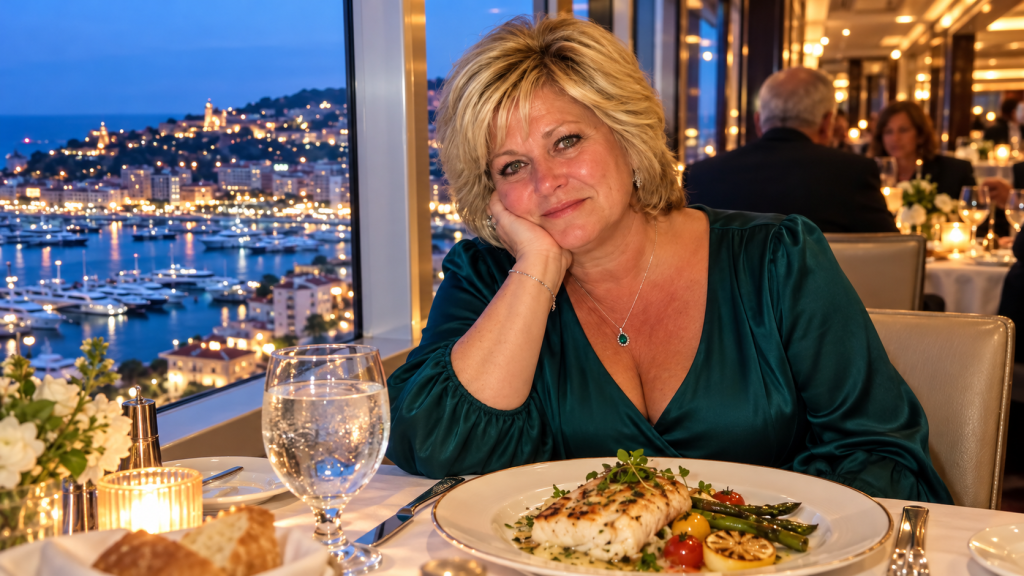
I wanted the world to stop. I wanted every light to go out. Because for seventeen years, I’d believed my son had died in a terrible traffic accident. My husband, Peter, had been driving. A truck had crossed the center line. Peter had swerved to protect our little boy. The car had struck a roadside barrier.
Adam hadn’t survived.
That was the story I’d told myself every time I woke from a nightmare.
Every time I passed the highway where it happened.
Every time I heard a child laugh and turned around expecting to see my son.
And now a stranger was telling me it wasn’t true.
“Explain yourself,” I whispered.
Michael glanced at the silver compass lying between us.
It was no larger than a cookie, with a dented brass rim and a crack across the glass.
Adam had called it his treasure.
Peter had bought it at a roadside souvenir shop during our last family vacation.
Our son had carried it everywhere.
He couldn’t read the directions properly, but he loved pointing toward the woods and announcing that he knew the way home.
After the funeral, Peter and I had placed it inside a wooden box and buried it beneath the rosebush in our backyard.
We couldn’t bear to put it in Adam’s coffin.
And we couldn’t bear to keep seeing it.
“Your husband brought me this six weeks ago,” Michael said.
My heart tightened.
“Why?”
“Because I contacted him after someone began reviewing old accident files.”
He opened the envelope.
Inside were copies of photographs, an incident report, and several pages of handwritten notes.
I recognized our old blue station wagon.
The front end was crushed against a guardrail.
The photograph had been taken at night.
Rain glistened on the pavement.
I felt sick.
“Please,” I whispered. “I don’t want to see him.”
Michael immediately moved the photographs aside.
“I’m sorry.”
I looked at him.
“Then tell me.”
He took a slow breath.
“That evening, Peter stopped on the shoulder of the reservoir road. The car was positioned on a slight slope.”
I closed my eyes.
I remembered the road.
Narrow.
Winding.
A steep descent toward an old bridge.
“Adam was in his car seat,” Michael continued. “Peter got out. A short time later, the car began rolling downhill.”
My hands went numb.
“No.”
Michael’s voice trembled.
“It gathered speed and struck the barrier.”
I shook my head.
“Peter was driving.”
“He told the police he was.”
“He had cuts on his hands.”
“He injured himself trying to reach Adam after the crash.”
I stared at him.
“How do you know?”
Michael’s eyes filled.
“Because I was the first paramedic to reach them. Peter was standing outside the vehicle when I arrived.”
My breath caught.
“He was screaming that he’d left his son alone.”
I covered my mouth.
For seventeen years, Peter had told me that he’d been behind the wheel.
That he’d fought desperately to keep the car on the road.
That the truck had vanished before anybody could identify it.
I’d held him through nightmares.
Comforted him when he blamed himself for not reacting quickly enough.
Told him again and again that he’d done everything he could.
And all that time, he’d known the truth was different.
“Why would he lie?”
Michael looked toward the table.
“He was frightened. The first thing he asked me was whether Adam was going to survive.”
I felt my chest tighten.
Michael continued.
“When it became clear how serious Adam’s injuries were, Peter kept saying that people would think he’d killed his son.”
I shook my head.
“He didn’t kill him.”
Michael swallowed.
“That’s not a legal or medical conclusion I can give you. But Peter knew he’d left a small child alone in a vehicle on a slope. He was terrified of what that meant.”
I stared at the papers.
“And you helped him.”
Michael nodded.
“Yes.”
The word hung between us.
I waited for an explanation.
A defense.
Anything.
Instead, he whispered, “I failed your son. And I failed you.”
I felt rage rise so suddenly that I nearly stood.
“Then why are you telling me now?”
His expression changed.
“Because seventeen years ago, I convinced myself that the only thing left to protect was a grieving father.”
He swallowed.
“And six weeks ago, I realized I’d spent seventeen years helping him deceive a grieving mother.”
I didn’t remember leaving the restaurant.
I remembered the hallway.
The soft blue carpet.
A painting of a sailboat.
The sound of my own breathing.
Then I was sitting on a bench near the elevator, holding Adam’s compass in both hands.
Michael sat several feet away.
He hadn’t tried to touch me.
I was grateful.
“How did you know I’d be on this cruise?” I asked.
He looked ashamed.
“Peter told me.”
My head lifted.
“He knew you were coming?”
“He knew I wanted to speak with you. When I confronted him about the discrepancy in the records, he said you were leaving on a cruise and that he didn’t want you disturbed.”
My stomach twisted.
“So you bought a ticket?”
Michael nodded.
“I know that was intrusive. I should have written to you first. But after seventeen years, I was afraid another letter would become another thing somebody put away and ignored.”
I looked at him.
“You don’t get to decide what’s best for me either.”
He lowered his head.
“You’re right.”
I held the compass tighter.
“Who found the discrepancies?”
“A retired traffic investigator named Louise Hart. She was reviewing old files for a road-safety project. She noticed the original dispatch notes didn’t match the final crash report.”
I stared at him.
“What original notes?”
He opened the envelope again.
“The first emergency caller reported seeing an unattended vehicle rolling down the slope. The official report described a truck forcing a moving vehicle into the barrier.”
I felt my stomach drop.
“How did they overlook that?”
“The witness was never properly reconciled with Peter’s account. And I failed to correct what I knew.”
His eyes filled.
“I wasn’t the investigating officer. I didn’t write the police conclusions. But when I was interviewed, I didn’t tell them Peter had admitted leaving the car unattended.”
I looked at him.
“You let them believe he was driving.”
“Yes.”
“Why?”
He wiped his face.
“Because I was young, because I was afraid, and because Peter begged me not to turn Adam’s death into a criminal investigation.”
I stared.
“Adam’s death was already the worst thing that could happen to our family.”
Michael nodded.
“I know.”
“No. You don’t.”
He said nothing.
I rose slowly.
“Do you have children?”
His face changed.
“Two.”
“Then imagine burying one.”
Tears filled his eyes.
“Mrs. Mercer—”
“Imagine spending seventeen years believing your husband had nearly died trying to save your child.”
My voice broke.
“Imagine comforting him for something he knew he’d lied about.”
Michael lowered his head.
I looked toward the compass.
“And imagine finding out that strangers helped him keep you from knowing what really happened.”
For several seconds, neither of us spoke.
Then Michael said quietly, “I don’t expect forgiveness.”
I wiped my face.
“Good.”
I turned toward the elevator.
Before stepping inside, I looked back.
“One question.”
He stood.
“Yes?”
“Why did my husband ask for a divorce?”
Michael closed his eyes.
Then answered.
“Because I told him that if he didn’t tell you the truth, I would.”
I stared.
“He had six weeks.”
Michael nodded.
“And instead of confessing, he decided to leave.”
I looked at the compass in my hand.
Suddenly, Peter’s explanation returned with terrible clarity.
I don’t think we’re supposed to grow old together.
Not because he’d stopped loving me.
Not because we’d become different people.
But because he’d decided that disappearing from my life was easier than facing what he’d done.
I stepped into the elevator.
And as the doors closed, I realized that the man I’d loved for twenty-two years had broken my heart twice.
Once with a lie.
And once by making me believe I was the reason he couldn’t stay.
I didn’t sleep that night.
I lay on top of the bedcovers in my cabin, watching moonlight spill across the carpet.
Adam’s compass rested on the nightstand.
Every few minutes, I picked it up.
Turned it over.
Ran my thumb across the cracked glass.
Then put it down again.
Seventeen years earlier, we’d bought it during a weekend trip to the mountains.
Adam had refused to leave the gift shop without it.
Peter told him that real explorers needed to know where north was.
Our son had looked at the little needle, thought carefully, and announced, “Then I can always find Mommy.”
I’d laughed.
Peter had laughed.
That night, Adam slept with the compass beneath his pillow.
For years after his death, that memory had made me smile.
Now it made me ache.
I wondered whether Peter had looked at the compass before burying it.
Whether he’d thought about the last time Adam held it.
Whether he’d wanted to confess and simply couldn’t.
Or whether he’d convinced himself that keeping the truth buried meant keeping us together.
At two in the morning, I called my sister, Tessa.
She answered immediately.
“Julia?”
I began crying at the sound of her voice.
“Something happened.”
Her tone changed.
“Are you safe?”
“Yes.”
“Then tell me.”
I told her everything.
The stranger.
The compass.
The false accident report.
Michael’s confession.
Peter’s ultimatum.
By the time I finished, my sister was crying too.
For several seconds, she said nothing.
Then whispered, “Oh, Julia.”
I pressed a hand against my eyes.
“I spent seventeen years telling him it wasn’t his fault.”
Tessa’s voice trembled.
“I know.”
“I told him he was brave.”
“I know.”
“I held him when he woke up screaming.”
She let me cry.
Then said, “You were comforting the person you believed had survived a terrible accident. You weren’t wrong to love him with the information you had.”
I stared at the ceiling.
“How am I supposed to tell Sophie?”
Our daughter had been two when Adam died.
She remembered almost nothing about her brother.
Her memories were assembled from photographs and family stories, the way children sometimes reconstruct a person they lost before they were old enough to understand death.
In those stories, Peter had always been the father who tried desperately to save his son.
I couldn’t imagine telling Sophie that the foundation of those stories had changed.
Tessa was quiet.
Then she said, “You don’t have to do it alone.”
I wiped my face.
“I don’t even know what’s true yet.”
“Then don’t pretend you do. Bring home the documents. Ask questions. Let the people responsible for investigating sort out the evidence.”
I looked at the compass.
“And Peter?”
Tessa sighed.
“Peter has had seventeen years to explain himself.”
I closed my eyes.
“You don’t have to protect him from the truth anymore.”
At breakfast, I found the older couple from Oregon waiting at our usual table.
Their names were Miriam and George.
They’d been married forty-six years and spent most meals teasing each other about small things.
George always misplaced his reading glasses.
Miriam always claimed she wasn’t hungry, then ate half his dessert.
On the first night, watching them had nearly made me cry.
Now, strangely, their ordinary affection felt like a reminder that marriage could be something other than a carefully maintained story.
Miriam studied my face.
“Didn’t sleep?”
I shook my head.
“Not much.”
She gently pushed the basket of toast toward me.
“Eat something.”
I managed half a slice.
For several minutes, they talked about the day’s excursion.
Then Miriam reached across the table.
“Honey, you don’t have to tell us what’s wrong.”
My eyes filled.
“But whatever it is, you don’t need to sit alone all day.”
I looked at her.
George nodded.
“We were going to look at the shops when we reach port. You’re welcome to join us.”
I smiled weakly.
“Thank you.”
I didn’t tell them the truth.
Not because I was ashamed.
Because I wasn’t ready to turn the worst day of my family’s life into a story I had to explain to people I’d just met.
But I went with them.
We walked slowly through a little harbor town.
George bought a ridiculous straw hat.
Miriam insisted on photographing him beside a fishing boat.
And for one brief moment, I laughed.
Then I felt guilty.
Adam was gone.
My marriage was collapsing.
And I was laughing at a man in an oversized hat.
Miriam seemed to sense the change.
She linked her arm through mine.
“You know,” she said quietly, “whatever you’re grieving doesn’t disappear because you have a good moment.”
I looked at her.
She smiled.
“And a good moment doesn’t mean you loved anyone less.”
I thought about Adam.
About the little boy who could find something funny in almost anything.
And I allowed myself to smile again.
That evening, Michael met me in a quiet lounge at my request.
I wanted him to show me the documents he’d brought.
Not because I trusted him.
Because I wanted to stop imagining details that might not be true.
He spread the pages across a small table.
The original emergency dispatch notes contained a time, location, and a summary of the first caller’s report.
A car had rolled down a sloping stretch of road and struck the guardrail.
The caller hadn’t seen another vehicle.
The final police report, completed after Peter’s interview, described a sudden evasive maneuver involving an unidentified truck.
I looked at the two versions.
“Could the caller simply have missed the truck?”
Michael nodded.
“That’s possible. Louise didn’t conclude the report was false solely from this difference.”
He showed me the next page.
It contained contemporaneous notes he’d kept after the crash.
Several lines had been written in hurried block letters.
One read:
FATHER STATES HE WAS OUTSIDE VEHICLE WHEN ROLL BEGAN.
I swallowed.
“Why did you write that?”
“Because it was what he told me when I arrived.”
“And then?”
Michael looked ashamed.
“When the police asked what happened, he said he’d been driving and swerved to avoid a truck.”
I stared at him.
“And you didn’t correct him.”
“No.”
“Did you lie when they interviewed you?”
He took a long breath.
“I described the injuries, the treatment, and the scene. When they asked whether Peter had been driving, I said I hadn’t witnessed the crash.”
I looked at him.
“Which was technically true.”
He nodded.
“But I omitted what he told me.”
He pushed the papers closer.
“I’ve now given Louise copies of my notes and a formal statement explaining the omission.”
I looked at the dates.
“Why did you keep the notes?”
“I kept a personal record of difficult calls early in my career. It wasn’t a substitute for the official medical chart, and I shouldn’t have relied on it to record something I omitted from the proper report.”
He swallowed.
“That night never left me.”
Then he showed me a photograph.
I stiffened.
“It’s only the road,” he said.
I looked.
The image showed the sloping shoulder where the station wagon had stopped.
There was a curve below it.
Then the guardrail.
I remembered Peter telling me that he’d barely had time to react when the truck appeared.
Now I could see something I hadn’t understood before.
The car could have rolled down that slope without anyone driving.
“Was something wrong with the brakes?” I asked.
Michael looked at his notes.
“The current review includes questions about how the vehicle was secured. I can’t tell you exactly why it began moving.”
I nodded.
It was a small mercy that he didn’t pretend to know more than he did.
Then I asked the question that had been haunting me.
“Was Adam frightened?”
Michael’s face changed.
For several seconds, he couldn’t answer.
“I don’t know what he experienced before the collision.”
My eyes filled.
“And afterward?”
He looked down.
“He was unconscious when we reached him.”
I closed my eyes.
“Did he suffer?”
Michael’s voice softened.
“I can’t give you an answer about everything he felt. We treated him as quickly as we could and transported him for emergency care.”
I began crying.
Michael sat quietly.
Then whispered, “I’m sorry.”
I looked at him.
“Don’t tell me you know what he was thinking.”
He nodded.
“I won’t.”
For the first time that evening, I felt something other than anger toward him.
Not forgiveness.
Not trust.
Just a recognition that even the people who had failed us could not answer every question I carried.
Some questions had been lost with Adam.
And I would have to learn how to live without forcing certainty into the spaces he left behind.
I returned home three days later.
Tessa met me at the airport.
She didn’t ask whether I enjoyed the cruise.
She simply opened her arms.
I stepped into them and began crying.
For twenty-two years, Peter had been the person waiting for me at airports.
Sometimes he’d bring flowers.
Sometimes he’d complain about traffic.
Once, when Adam was still a baby, he’d arrived holding a paper sign that said:
WELCOME HOME, MOMMY. YOUR FAN CLUB MISSED YOU.
Our son had slept through the entire reunion.
I’d kept that photograph in a frame until the divorce papers appeared.
Now the memory felt as though somebody had reached into it and changed the ending.
Tessa took my suitcase.
“How’s Sophie?”
I swallowed.
“I haven’t told her yet.”
My sister nodded.
“She’s at my house. She knows something important happened.”
I looked toward the parking garage.
“And Peter?”
“He called yesterday.”
My stomach tightened.
“What did he say?”
“He asked whether you’d spoken to Michael.”
I closed my eyes.
“Of course.”
Tessa continued.
“I told him he needed to speak with you directly.”
I looked at her.
“Did he say anything else?”
She hesitated.
“Just that he was sorry.”
I laughed bitterly.
“He’s been sorry for seventeen years.”
Tessa didn’t argue.
She drove us home in silence.
And as we turned onto the familiar street where Peter and I had raised our children, I felt a grief I’d never expected to experience.
I wasn’t returning to the house where my marriage had ended.
I was returning to the house where a lie had lived beside us for seventeen years.
Sophie was sitting at Tessa’s kitchen table when we arrived.
She stood immediately.
“Mom?”
I looked at my daughter.
At nineteen, she had her father’s dark eyes and my stubborn expression.
She was studying environmental science and had recently moved into a small apartment near her university.
She was proud of doing her own grocery shopping.
Less enthusiastic about doing her own laundry.
And still young enough to believe that parents knew more than they actually did.
I crossed the room and hugged her.
She held me tightly.
“Aunt Tessa said something happened on the cruise.”
I nodded.
We sat down.
Tessa placed a glass of water in front of me.
I looked at Sophie.
“Sweetheart, I need to tell you something about the night Adam died.”
Her face changed.
For most of her life, Adam had been a photograph on the mantel and a name spoken gently at family gatherings.
She remembered very little about him.
But she’d grown up with the shape of his absence.
The empty bedroom.
The way I became quiet every autumn.
The way Peter refused to drive the reservoir road.
“Is Dad okay?” she asked.
I felt tears rising.
“He’s alive and safe.”
Sophie nodded slowly.
“Then what happened?”
I took a breath.
And I told her.
Carefully.
Only what the records supported.
I explained that the new evidence suggested Peter hadn’t been driving when the car struck the guardrail.
That he’d left Adam alone in the vehicle.
That the car began rolling down a slope.
That Peter later gave a different account of the accident.
And that Michael, the first paramedic on the scene, had failed to disclose important information.
Sophie listened without speaking.
When I finished, she stared at the table.
Then whispered, “Dad lied?”
I nodded.
“For seventeen years?”
“Yes.”
Her eyes filled.
I reached for her hand.
“Sophie, none of this changes who Adam was. And none of it is your responsibility.”
She pulled her hand away.
Not angrily.
As though she needed room to understand.
Then she asked, “Did Dad know he was going to divorce you when he found out someone had discovered the truth?”
“I don’t know exactly when he decided. But he knew Michael wanted him to tell us before he asked for the divorce.”
Sophie looked toward the window.
“That’s why he wouldn’t explain.”
I nodded.
She began crying.
For years, Sophie had been angry with Peter for leaving me.
She’d asked him repeatedly why he’d suddenly ended our marriage.
He’d given her the same answer he’d given everyone.
We grew apart.
Now she was learning that he had concealed something far more serious.
She wiped her face.
“Mom, can I ask you something terrible?”
I took her hand.
“Anything.”
She swallowed.
“Was Adam awake when the car rolled?”
The question broke my heart.
I looked into her eyes.
“We don’t know, sweetheart.”
She began crying harder.
I held her.
And for the first time in seventeen years, I understood that Adam’s death had left unanswered questions for both my children.
One could no longer ask them.
The other had finally become old enough to understand why they mattered.
Two days later, Peter came to Tessa’s house.
I had agreed to meet him there because I didn’t want the conversation surrounded by the objects and rooms of our marriage.
Tessa stayed nearby at my request.
Sophie chose not to attend.
She told me she wanted to speak to her father separately when she felt ready.
I respected that.
Peter arrived wearing a gray sweater I’d bought him the previous Christmas.
He looked older than he had three weeks earlier.
His face was drawn.
His eyes were red.
And for the first time since I’d known him, he seemed genuinely frightened of me.
“Julia,” he whispered.
I remained seated.
“Peter.”
He looked toward the chair across from me.
“Can I sit?”
I nodded.
He sat.
For several seconds, neither of us spoke.
Then I placed the silver compass between us.
His expression collapsed.
“Where did you get that?”
“Michael returned it.”
He closed his eyes.
I waited.
Then asked, “Tell me what happened that night.”
Peter began crying.
I didn’t move.
For seventeen years, I’d moved toward his tears.
I’d wrapped my arms around him.
I’d told him it wasn’t his fault.
Now I needed him to speak before I decided what comfort, if any, I could offer.
He wiped his face.
“I was taking Adam home from my brother’s place.”
I nodded.
I remembered.
His brother had been hosting a small family dinner.
I had stayed home with Sophie, who was recovering from an ear infection.
Peter had offered to take Adam for a few hours.
Our son had been excited.
There was a model railway at his uncle’s house.
He’d spent the entire afternoon talking about it.
Peter looked down.
“On the way home, I noticed the car was making a strange noise.”
My stomach tightened.
“I pulled onto the shoulder near the reservoir to check it.”
He swallowed.
“Adam was asleep in his car seat.”
I gripped my hands together.
“I left the engine running because it was cold.”
I stared at him.
“And the parking brake?”
Peter’s face crumpled.
“I thought I’d set it properly.”
I closed my eyes.
“The car began moving?”
He nodded.
“I was behind it, looking at the rear wheel. Then I heard the tires.”
His voice broke.
“I turned and saw it rolling.”
I held my breath.
“I chased it.”
Tears ran down his face.
“I ran as fast as I could. I tried to grab the door.”
He covered his mouth.
“But it was already going downhill.”
I looked at him.
“And you told me a truck crossed the center line.”
Peter nodded.
I waited.
He whispered, “I panicked.”
I stared.
“Adam was dying, and you were thinking about what story to tell?”
He began shaking.
“At first I wasn’t. I swear to you, Julia. I was trying to reach him. I was screaming for somebody to help.”
I believed he had been screaming.
I believed he’d been terrified.
I believed he’d tried to reach our child.
None of that explained the next seventeen years.
“What happened afterward?” I asked.
Peter looked toward the floor.
“When the police asked me what happened, I couldn’t say I’d left him alone.”
I felt sick.
“I couldn’t stand the thought of you knowing.”
I leaned forward.
“Peter, you let me believe you’d been driving.”
He nodded.
“You let me thank God you survived.”
His shoulders shook.
“Yes.”
“You let me tell our daughter that her father had done everything possible to save her brother.”
He covered his face.
I stared at him.
Then I asked something I’d been afraid to ask since Michael showed me the records.
“Did you know there was a problem with the parking brake?”
Peter stopped crying.
His silence told me the answer before he spoke.
I felt the room turn cold.
“Peter.”
He looked up.
“Did you know?”
His voice was barely audible.
“The mechanic mentioned it the week before.”
I stared at him.
For a moment, I couldn’t speak.
“What did he say?”
“That the brake needed adjustment and the car shouldn’t be relied upon to stay stationary on a slope without being properly secured.”
My hands began trembling.
“Did you repair it?”
He shook his head.
I felt something inside me fracture.
“Why not?”
“I meant to.”
I stared at him.
Three words.
Three terrible, ordinary words.
I meant to.
Seventeen years of grief.
A four-year-old boy.
A family destroyed by loss.
And beneath everything was a repair he’d intended to arrange.
I stood.
Peter began crying harder.
“Julia, please.”
I looked at him.
Then whispered, “You knew the brake needed attention.”
He nodded.
“You left our son alone in the car on a hill.”
“Yes.”
“And afterward, you invented a truck.”
He bowed his head.
I took a breath.
“Then you let me spend seventeen years believing the world had taken Adam from us for no reason we could understand.”
Peter reached toward me.
I stepped back.
“No.”
He froze.
“I don’t know what to do with this yet,” I whispered.
“But I know you don’t get to ask me to make it smaller.”
Peter stayed at Tessa’s kitchen table for nearly an hour.
I finally sat down again because my legs had begun trembling.
He looked at the compass.
“I went back to the rosebush after Michael contacted me,” he said quietly.
I stared at him.
“Why?”
“I hadn’t touched that box since we buried it.”
He swallowed.
“I thought if I held something of Adam’s, I might find the courage to tell you.”
I looked away.
For seventeen years, I had tended that rosebush.
Pruned it.
Watered it.
Protected it from frost.
Sometimes I sat beside it and spoke to Adam.
I’d imagined his little compass resting safely beneath the roots, exactly where we’d left it.
While I was sleeping, Peter had dug it up.
He’d taken the one object we’d buried together as a promise.
And used it in a conversation he still hadn’t been brave enough to have with me.
“Why did you give it to Michael?”
Peter’s eyes filled.
“He told me he wasn’t going to keep the secret anymore. I asked him to give it back to you if I couldn’t.”
I stared.
“If you couldn’t what?”
“Tell you.”
I waited.
Then he whispered, “I thought once the truth came out, you’d never want to see me again.”
My voice was quiet.
“So you decided to leave first.”
He nodded.
I shook my head slowly.
“Peter, you asked me for a divorce because you were afraid I might ask for one myself.”
He began crying.
“I couldn’t stand the thought of looking at you when you knew.”
I took a breath.
“Did it ever occur to you that I deserved the choice?”
He looked up.
I continued.
“You decided what I should know about Adam’s death. Then you decided what I should know about our marriage ending.”
Tears ran down my cheeks.
“Seventeen years ago, you were afraid. I can understand fear. I can even understand somebody saying something terrible in the middle of unimaginable panic.”
I swallowed.
“But every morning afterward, you woke up and chose not to correct it.”
Peter covered his face.
“You watched me comfort you. You watched me blame a truck that may never have existed. You watched me struggle to understand why our little boy died.”
My voice broke.
“And when somebody finally confronted you, you made another decision without me.”
He whispered, “I’m sorry.”
I nodded.
“I believe you’re sorry.”
He looked up hopefully.
Then I said, “But your remorse doesn’t return the years when I could have understood my own son’s death.”
His expression crumpled.
I stood.
“I need you to cooperate fully with the investigation. I need the mechanic’s paperwork, the vehicle records, and anything else you’ve kept.”
He nodded.
“I will.”
“And I need you to stop making decisions about what Sophie and I can handle.”
“Yes.”
I walked toward the doorway.
Then stopped.
“Peter?”
He looked up.
“Did you ever stop loving me?”
His face collapsed.
“No.”
The answer hurt more than I expected.
I looked at him.
“Then you should have trusted me enough to tell me the truth.”
And I left the room.
The formal review took months.
Louise Hart, the retired investigator who’d noticed the inconsistencies, gave her findings to the appropriate authorities.
Michael submitted a detailed statement acknowledging what he had omitted seventeen years earlier.
Peter cooperated through his attorney.
The surviving records were examined, including the emergency dispatch notes, photographs, police reports, medical records, and the mechanic’s documentation.
The review found substantial reasons to question the original description of the crash.
There was no reliable evidence that another truck had forced our car off the road.
The evidence was more consistent with an unattended vehicle rolling down the slope.
But seventeen years had passed.
The station wagon was long gone.
Some witnesses could no longer be located.
And the available records couldn’t answer every question about exactly how the vehicle had been secured or why it began moving.
I learned that an investigation could uncover a devastating truth without producing a neat conclusion or a courtroom confession.
Legal responsibility, possible offenses, and filing deadlines were matters for the authorities to evaluate.
I wasn’t going to pretend the evidence guaranteed a particular outcome.
What mattered most to me was that the false account was no longer being repeated as unquestioned fact.
Adam’s death had not been the result of the mysterious truck Peter had described.
And my son was not responsible for what happened.
He had been four.
He had trusted the adults around him to keep him safe.
That truth was painful.
But I needed it.
Sophie met her father several weeks after my return.
She asked me not to come.
I respected her decision.
Later, she called me from her apartment.
“Mom?”
I knew from her voice that she’d been crying.
“Hello, sweetheart.”
She was quiet.
Then said, “Dad told me everything.”
I sat down.
“How are you feeling?”
She took a shaky breath.
“Angry.”
I nodded.
“And sad.”
“I know.”
She began crying again.
“All these years, I thought Dad hated driving near the reservoir because he remembered trying to save Adam.”
I closed my eyes.
“He may remember that too. He did try to reach the car.”
“But he also remembers lying.”
“Yes.”
Sophie was silent.
Then she said, “I told him I still love him.”
I swallowed.
“That’s okay.”
She began crying harder.
“Is it?”
“Of course.”
I took a breath.
“He’s your father. Loving him doesn’t mean you approve of what he did.”
She sniffled.
“I also told him I don’t want to see him for a while.”
“That’s okay too.”
She was quiet.
Then whispered, “Mom, I don’t remember Adam’s voice.”
My eyes filled.
“I know, sweetheart.”
“I feel guilty.”
My heart broke.
“Why?”
“Because I remember the photographs, and I remember Dad being sad, but I don’t remember my own brother.”
I closed my eyes.
“Sophie, you were two when he died.”
She began crying.
“That doesn’t mean you loved him less.”
I looked toward the shelf where I kept our family albums.
“Would you like to hear some stories about him?”
She sniffled.
“Real ones?”
I smiled through tears.
“Real ones.”
“Not just the accident?”
I took a shaky breath.
“Especially not the accident.”
So I told her about the time Adam poured an entire bag of flour across the kitchen floor because he wanted to make snow.
I told her how he called spaghetti long noodles with hair.
I told her how he’d once hidden six rocks in Peter’s shoes because he was convinced they were dinosaur eggs.
Sophie began laughing.
Then crying.
Then laughing again.
And suddenly I understood something important.
For seventeen years, we’d allowed the final night of Adam’s life to overshadow almost everything that came before it.
The lie had become part of our family history.
But our son had lived four beautiful, complicated, ordinary years.
He’d laughed.
Thrown tantrums.
Learned to say please.
Loved dinosaurs.
Hated peas.
And believed a little silver compass could lead him home.
Those memories were still ours.
Peter’s dishonesty couldn’t take them away.
By the time autumn returned, the divorce was moving toward its conclusion.
Peter didn’t ask me to reconcile.
Perhaps he’d finally understood that loving someone didn’t give him the right to decide what they knew, felt, or forgave.
We worked through our financial arrangements with lawyers.
We divided the property and the obligations we’d accumulated during twenty-two years together.
There were disagreements.
There were painful conversations.
And there were moments when I nearly called him simply because something ordinary had happened and he was still the first person I thought to tell.
That was one of the hardest parts.
Grief doesn’t erase habits.
Sometimes it makes them ache.
I missed the man who brought me coffee on Sunday mornings.
The man who knew I hated sleeping with the bedroom door closed.
The man who stood beside me when my mother died and held my hand through the funeral.
Those memories remained true.
But so did the lie.
I was learning that someone could have loved me deeply and still hurt me in ways that changed what I could trust.
Both things could exist.
And I didn’t have to return to the marriage simply because I missed what had once been good.
One afternoon, Michael called.
I almost didn’t answer.
Then I remembered that he’d promised to keep me informed of his cooperation with the review.
“Julia?”
“Hello, Michael.”
He sounded nervous.
“I wanted to let you know I’ve provided everything I have.”
I looked out the window.
“Thank you.”
He hesitated.
“I also wanted to apologize again.”
I closed my eyes.
“Michael, I know you’re sorry.”
“I should have spoken up that night.”
“Yes.”
His breathing changed.
“I’ve spent seventeen years telling myself there was nothing I could do once Adam was gone.”
I waited.
“But I could have told the truth.”
I nodded.
“You could have.”
He was quiet for a moment.
Then asked, “Do you think you’ll ever forgive me?”
I looked toward Adam’s photograph on the mantel.
My son was sitting in the grass, wearing a yellow raincoat and holding a plastic dinosaur.
He was smiling so widely that his eyes had nearly disappeared.
“I don’t know,” I answered.
Michael exhaled shakily.
“I understand.”
Then I said something I’d been thinking about for months.
“I hope that if you ever find yourself in a position where telling the truth might upset someone, you remember my son.”
Michael began crying.
“I will.”
“Because the truth isn’t something you protect people from simply because you’re afraid of how they’ll react.”
He didn’t answer.
I continued.
“Sometimes keeping a secret is what hurts them most.”
After we ended the call, I stood beside the window for a long time.
Then I went outside.
The rosebush was blooming.
I’d considered leaving the house after the divorce.
There were too many memories.
The kitchen where Adam had helped me bake cookies.
The staircase where Sophie used to sit waiting for Peter to come home.
The bedroom where I’d spent seventeen years waking beside a man who knew something I didn’t.
But when I walked through the garden, I felt something change.
The house hadn’t lied to me.
The kitchen hadn’t betrayed me.
The rosebush hadn’t hidden the truth.
People had.
And the good memories I’d made there still belonged to me.
With the help of my attorney and a carefully arranged property settlement, I was able to remain in the house.
I repainted the bedroom.
Rearranged the living room.
Turned Peter’s old office into a reading space filled with books and sunlight.
I didn’t do it to erase him.
I did it because I needed the house to reflect the life I was living now.
Then, one cool Saturday morning, Sophie came over with gardening gloves.
She found me standing beside the rosebush.
“Mom?”
I turned.
She smiled.
“Ready?”
I nodded.
We’d decided to place a small memorial stone near the flowers.
Not a gravestone.
Not another reminder of the accident.
Just something that celebrated Adam’s life.
Sophie had chosen the inscription.
ADAM MERCER
OUR LITTLE EXPLORER
ALWAYS LOVED. ALWAYS HOME.
I knelt beside the rosebush while she carefully cleared the soil.
For years, I’d come to that spot wondering what I might have done differently.
What would have happened if I’d gone to dinner with Peter and Adam.
If I’d suggested another route.
If I’d insisted they stay home.
Grief had taught me to search for impossible ways to change the past.
Now I understood that I couldn’t.
I had not been there that night.
I had not left the car unattended.
And I had not chosen to hide the truth afterward.
I could love my husband for the years we’d shared without carrying responsibility for decisions he had made.
Sophie placed the stone carefully beside the roots.
Then she sat next to me.
“Mom, do you have the compass?”
I nodded.
I’d kept it wrapped in a soft cloth in my bedroom drawer.
I took it from my pocket.
The glass was still cracked.
The needle still pointed west.
Sophie turned it over.
“Did Adam really think it could help him find you?”
I smiled through tears.
“Yes.”
She looked at it.
“Even when it didn’t work?”
I laughed softly.
“Especially then.”
She held it for a moment.
Then asked, “Can we keep it inside?”
I looked toward the rosebush.
For seventeen years, I’d believed Adam’s compass belonged beneath the ground, hidden where our grief couldn’t reach it.
Now I understood that the compass was not the tragedy.
It was a little boy’s treasure.
A reminder of the way he saw the world.
He had believed that if he kept looking, he’d eventually find his way back to the people he loved.
I smiled at Sophie.
“Yes, sweetheart. Let’s keep it where we can see it.”
She placed it carefully in my hand.
Then we sat together in the garden until the shadows grew long.
The following spring, I took another trip.
Not a cruise.
Not an attempt to escape my memories.
I went to the mountains with Sophie.
We stayed in a small cabin overlooking a lake.
There were hiking trails, little shops, and an old diner where they served pancakes larger than the plates.
One morning, we visited a souvenir store.
Near the register was a display of little brass compasses.
I stopped.
Sophie followed my gaze.
For a moment, neither of us spoke.
Then she smiled.
“Adam would’ve loved those.”
I nodded.
“He would.”
She picked one up.
“Do you think this one works?”
I laughed.
“Only one way to find out.”
We stepped outside.
Sophie held it flat in her palm.
The needle turned.
Then settled.
She grinned.
“North.”
I looked toward the mountains.
“North.”
For a moment, I felt the familiar ache of missing my son.
It was still there.
It always would be.
But it wasn’t swallowing everything else.
I thought of Adam holding his little compass.
Of his laughter.
His sticky hands.
The way he used to announce that he was going on an adventure whenever he walked to the end of our driveway.
And I smiled.
Because after seventeen years, I was finally learning to remember the life he’d lived instead of only the way it ended.
People sometimes ask whether I’ve forgiven Peter.
I tell them the truth.
I’m still figuring that out.
There are days when I feel compassion for the frightened man who chased a rolling car downhill and couldn’t reach his son.
And there are days when I feel furious at the husband who came home, looked into my eyes, and told me a story he knew wasn’t true.
I may always feel both.
Peter and I remain connected through Sophie and the memory of Adam, but our marriage is over.
I don’t wish him suffering.
I hope he lives honestly.
I hope he learns to face difficult things without hiding from the people who love him.
But I no longer believe my own peace depends on whether he becomes the man I needed him to be.
That is something I can build for myself.
I think often about the night Michael sat across from me on the cruise.
How frightened I was when he reached into his jacket.
How impossible the little silver compass seemed, resting on that white tablecloth.
I boarded that ship hoping to understand why my husband no longer wanted our marriage.
Instead, I discovered that the man I’d loved had been carrying a truth he couldn’t bear to share.
And that the end of our marriage wasn’t proof I’d stopped being worthy of love.
It was the consequence of decisions he had made long before I knew there was anything to question.
My husband told me we’d grown apart after twenty-two years. But the truth was that he’d spent seventeen years hiding what really happened the night our four-year-old son died.
He thought leaving me would be easier than telling me. He was wrong.
Because what I needed most wasn’t a husband who could protect me from every painful truth.
I needed someone who trusted me enough to face those truths beside me.
Now, when I look at Adam’s compass, I no longer think of the secrets buried beneath our rosebush.
I think of a little boy who believed the world was full of places worth exploring.
A little boy who loved dinosaurs, hated peas, and laughed whenever his father pretended to get lost.
A little boy who deserved to be remembered for more than the accident that took him.
And I think of myself.
A woman who boarded a ship feeling abandoned and returned carrying a truth that broke her heart.
A woman who had to grieve her son all over again.
A woman who learned that she could survive the loss of a marriage without losing the love she’d once given so freely.
For seventeen years, I’d been waiting for someone to explain why my world had fallen apart.
Now I know that healing doesn’t always begin with a comforting answer. Sometimes it begins with the truth you’ve been denied—and the courage to build a life around it.
One evening, I sat beside the rosebush as the sun disappeared behind the trees.
Sophie was inside making dinner.
The windows glowed warmly.
I held Adam’s little compass in my palm.
Its broken needle still pointed west.
I smiled.
“That’s all right, sweetheart,” I whispered.
“You don’t have to show me the way home anymore.”
Then I stood and walked toward the house.
I’d finally learned how to find my own way.