
For one terrible second, Zara thought the entire airplane had stopped breathing. Richard Bennett stood beside Seat 2A, his expensive newspaper lying open on the carpet. Naomi Price had just spoken seven words that changed the expression on his face. “Mr. Bennett, she warned us about you.”
The silver-haired businessman stared at her. “Who?” Naomi didn’t answer immediately. Instead, she turned her tablet toward the gate supervisor. “Please document the time boarding was suspended and confirm that the captain has been informed.” The supervisor nodded.
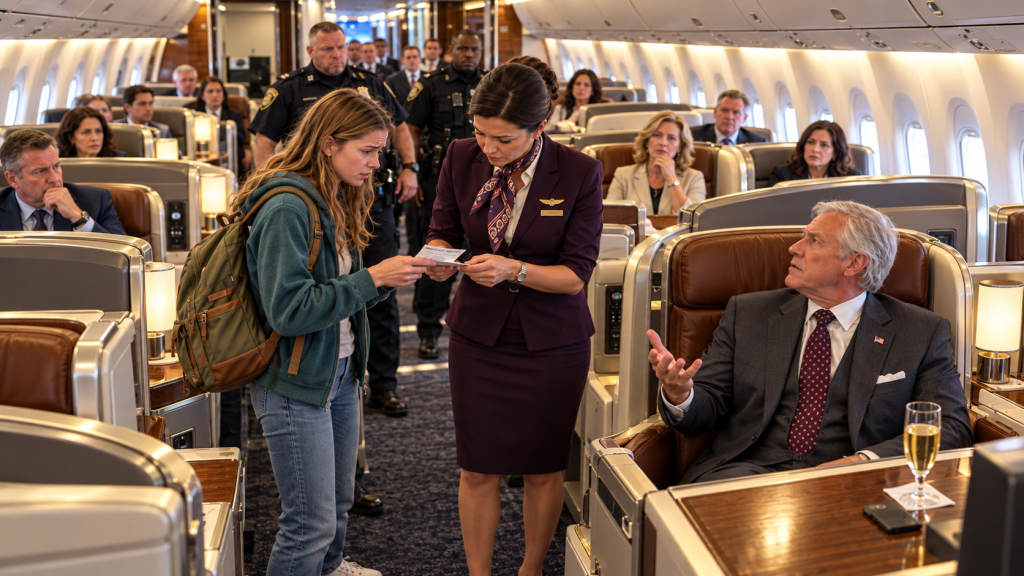
Elizabeth Hart remained beside Zara, one hand resting lightly on the galley counter. Passengers were watching from their seats. A woman in Row 3 held her tablet motionless. Across the aisle, a man who had been struggling with his seat belt now sat perfectly still. Richard looked toward Zara.
His eyes narrowed.
“Coleman,” he murmured.
Then his face changed.
“Wait. Coleman?”
Zara felt her stomach tighten.
She recognized that expression.
It was the moment an adult realized she might be connected to somebody important.
She had seen it at school events, airport receptions, and the occasional company gathering her father attended.
People who had spoken to her carelessly suddenly became friendly.
Their voices softened.
Their smiles widened.
They began asking questions about her parents.
But the change never made Zara feel respected.
It made her feel as though she hadn’t mattered until someone recognized her surname.
Richard pointed toward her.
“You’re Marcus Coleman’s daughter?”
Zara nodded.
“Yes.”
He gave a short, nervous laugh.
“Well, why didn’t you say so?”
She looked at him.
“Because my ticket already said 2A.”
The man across the aisle lowered his head to hide a smile.
Richard’s face reddened.
“Listen, young lady, this is a misunderstanding.”
Zara didn’t answer.
He continued.
“I would never have spoken to you that way if I’d known who your father was.”
That was when Elizabeth spoke.
“Mr. Bennett, that is precisely the problem.”
Richard turned sharply.
“Excuse me?”
Elizabeth stood straighter.
“She shouldn’t have needed to tell you who her father was.”
The words settled over the cabin.
Naomi glanced at Elizabeth, then back at Richard.
“Mr. Bennett, the captain is reviewing whether you may remain aboard after repeatedly refusing a verified crew instruction. Your business relationship with the airline does not determine that decision.”
Richard stared at her.
Then he lowered his voice.
“Do you understand what this delay is going to cost?”
Naomi nodded calmly.
“Delays affect passengers, crew, and operations. That’s why we need to resolve the situation promptly.”
He laughed bitterly.
“Over a seat?”
“No, sir.”
Naomi’s voice sharpened.
“Over your refusal to follow an instruction after your assigned seat was confirmed.”
Richard glanced toward the cockpit.
“I want to speak to the captain.”
“The captain has been briefed.”
“I want to speak to Marcus Coleman.”
Zara looked up.
Something inside her twisted.
For several minutes, Richard had treated her like an inconvenience.
Now he wanted her father.
Not to apologize.
Not to correct his behavior.
But to negotiate with someone he considered important enough to deserve respect.
Naomi shook her head.
“Mr. Coleman has referred the matter to the independent on-duty operations team. He will not decide the outcome of a complaint involving his daughter.”
Richard blinked.
“Then why is the flight being held?”
“Because the cabin crew reported an unresolved passenger-compliance issue before departure. The captain requested a boarding pause while we assess it.”
Richard opened his mouth.
Closed it.
Then turned toward Zara.
“Fine. Take your precious window seat.”
He reached for his jacket.
Zara watched him.
She had imagined this moment when she first asked him to move.
She thought she’d feel victorious.
Instead, she felt tired.
Her cheeks were burning.
Her hands were cold.
And she wanted nothing more than to disappear into her seat, fasten her belt, and reach London without another stranger staring at her.
But Naomi didn’t move.
“Mr. Bennett, please remain in the aisle for a moment.”
His face darkened.
“What now?”
“We still need to address your conduct toward the crew.”
He laughed.
“You’re joking.”
“No.”
The security officer stepped slightly closer, maintaining a respectful distance.
Richard looked around the cabin.
The other passengers had stopped pretending not to listen.
And for the first time since boarding, his certainty seemed to desert him.
Naomi guided Zara and Elizabeth into the forward galley.
She lowered her voice.
“Zara, I’d like to ask you a few questions. Is that all right?”
Zara nodded.
“Did Mr. Bennett threaten you?”
“He didn’t say he would hurt me.”
“Did he touch you?”
“No.”
“Did he refuse to move after Elizabeth confirmed the seats?”
“Yes.”
Naomi nodded.
“How many times?”
Zara thought carefully.
“Elizabeth asked him more than once. He said no.”
“And did you feel pressured to surrender your seat?”
Zara looked down.
“Yes.”
Naomi waited.
Zara swallowed.
“Not because he was bigger than me. Because everybody was watching, and he kept saying I didn’t belong here.”
Her voice began shaking.
“I thought if I argued, people would think I was rude.”
Elizabeth’s expression softened.
“Zara, you were polite throughout.”
“I know.”
But tears had begun gathering in her eyes.
She hated that.
She hated crying in front of strangers.
She especially hated the possibility that Richard might see and decide he’d been right about her being a child who didn’t belong.
Naomi seemed to understand.
“Would you like some water?”
Zara nodded.
Elizabeth handed her a bottle.
Then Naomi said something unexpected.
“Your mother would have been proud of the way you handled this.”
Zara froze.
Her fingers tightened around the bottle.
“You knew my mom?”
Naomi’s expression changed.
For a moment, she seemed to regret speaking so quickly.
Then she nodded.
“Yes.”
Zara stared at her.
“My mother died three years ago.”
“I know. I’m very sorry.”
Zara looked down.
Her mother’s name was Dr. Leila Coleman.
Before cancer took her life, Leila had worked in aviation safety, ethics, and passenger-protection policy.
She traveled constantly.
Read technical reports at the kitchen table.
And sometimes came home so exhausted that she fell asleep on the couch with her shoes still on.
But whenever Zara asked what her work was about, Leila had always given the same answer.
“Making sure people get home safely, sweetheart.”
Zara used to think that meant checking airplanes.
Only later did she understand that her mother’s work also involved the people responsible for them.
The managers who made decisions.
The contractors who followed procedures.
The executives who sometimes believed their authority placed them above rules.
Zara looked at Naomi.
“How did you know her?”
Naomi took a slow breath.
“Your mother submitted an ethics report involving Bennett Strategic Holdings several years ago.”
Zara’s heart began pounding.
“The man in my seat?”
“Yes.”
“What did he do?”
Naomi glanced toward Elizabeth.
Then back at Zara.
“Some details remain confidential because they involve employees and an ongoing commercial review. But your mother raised concerns about pressure being placed on airline personnel to overlook established procedures.”
Zara stared.
“By him?”
“By people associated with his company. Richard Bennett was named in her report.”
Zara looked toward the aisle.
Richard was still standing near Row 2, speaking angrily to the gate supervisor.
A strange feeling rose inside her.
For years, she’d carried memories of her mother that were becoming softer around the edges.
The smell of her perfume.
Her laugh.
The way she tucked Zara’s hair behind her ear before school.
Now, standing in an aircraft galley, Zara had suddenly encountered a part of her mother’s life she’d never understood.
A part that apparently reached all the way into the present.
Naomi’s voice softened.
“Zara, your mother believed an important safety rule should never depend on whether the person involved was wealthy, famous, or well connected.”
Zara swallowed.
Then whispered, “She used to say that at home.”
Elizabeth looked at her.
“What did she say?”
Zara thought of her mother sitting beside her bed during thunderstorms.
Her voice was gentle in the memory.
“She said, ‘The smallest rules often show us how people will behave when the big ones matter.’”
For a moment, Elizabeth closed her eyes.
Then she turned away.
And Zara noticed tears shining on the flight attendant’s cheeks.
Elizabeth turned back toward Zara.
For a moment, her carefully composed expression disappeared.
“I remember those words,” she whispered.
Zara stared.
“What?”
“Your mother said almost exactly the same thing to me.”
Naomi glanced toward the aircraft door.
“Elizabeth, you don’t have to discuss the earlier incident here.”
Elizabeth shook her head gently.
“I know.”
Then she looked at Zara.
“But she deserves to know why I remember her mother.”
The flight attendant took a breath.
“Six years ago, I was working a late departure out of New York. Bennett Strategic Holdings had supplied a contractor for a major airport technology project.”
Zara listened.
“The contractor’s representative wanted access to a restricted operations area without completing the required verification. The person responsible for approving that access wasn’t available.”
Elizabeth swallowed.
“Mr. Bennett insisted we should make an exception because his company had an important relationship with the airline.”
Zara glanced toward Richard.
“Did you?”
“No.”
Elizabeth smiled sadly.
“I told him the requirements applied to everyone.”
“What happened?”
“He complained to management. He said I’d been disrespectful. He claimed I’d caused an expensive delay and embarrassed an important business partner.”
Her voice softened.
“Within days, I was called into a meeting and told my judgment was being questioned.”
Zara felt her stomach tighten.
“Because you followed the rules?”
Elizabeth nodded.
“I was frightened. I had a mortgage. My husband had recently lost his job. I thought one powerful person could destroy my career.”
She paused.
“Then your mother asked to review the incident.”
Zara felt tears returning.
“Mom?”
“She interviewed the employees who were there. She checked the reports. And when people suggested I should apologize to keep an important customer happy, she said something I’ve never forgotten.”
Elizabeth’s voice trembled.
“She said, ‘An employee should never have to apologize for doing the right thing because somebody powerful dislikes being told no.’”
Zara covered her mouth.
She could almost hear her mother’s voice.
Elizabeth continued.
“Your mother made sure the complaint was documented accurately. She couldn’t control every decision afterward, but she refused to let anyone rewrite what happened.”
A tear slid down her cheek.
“I stayed in aviation because of her.”
Zara stared at the woman standing beside her.
A woman who had brought her hot chocolate on previous flights.
A woman who had calmly asked Richard to move from Seat 2A.
A woman who had protected Zara without knowing whose daughter she was.
And suddenly, Zara understood something extraordinary.
Her mother was gone.
But her courage wasn’t.
It had survived in people Zara had never met.
In decisions made quietly.
In employees who kept doing their jobs honestly.
In moments when somebody refused to treat another person as less important.
Zara wiped her cheeks.
“She would’ve liked you.”
Elizabeth laughed through tears.
“I certainly liked her.”
Naomi gently touched Elizabeth’s arm.
Then the gate supervisor approached.
“Ms. Price, the captain has made a decision.”
Everyone turned.
“The captain is requesting Mr. Bennett’s removal from this departure. He’s continued disputing the crew’s authority, and he won’t confirm that he’ll comply with instructions.”
Naomi nodded.
“Thank you.”
Zara felt her stomach drop.
“He’s getting off?”
“Yes.”
“Because of me?”
Naomi turned toward her.
“No, Zara. Because of his own conduct.”
Zara looked toward the cabin.
Richard was still standing beside Row 2.
He looked furious.
And for a moment, she wondered whether she should simply apologize.
She didn’t know what for.
But she had spent enough of her childhood watching adults avoid difficult conversations to understand how tempting it could be to accept blame just to make the noise stop.
Then she remembered her mother.
Never raise your voice simply because someone else wants you to lose control.
Zara straightened.
And said nothing.
Richard did not leave quietly.
When Naomi informed him that he would not be traveling on Flight 212, he laughed as though she’d told him an absurd joke.
“You cannot be serious.”
“The captain has declined to carry you on this departure following the unresolved compliance issue,” Naomi explained. “Our ground team will discuss your travel options and the review process.”
Richard stared.
“You’re removing a paying First-Class passenger because a teenager complained?”
“No, sir.”
Naomi’s voice remained calm.
“The crew verified your boarding pass. You refused to move from another passenger’s assigned seat. You repeatedly disputed their instructions and continued doing so after management became involved.”
He looked around.
“This is discrimination!”
The man across the aisle finally spoke.
“Sir, everyone saw what happened.”
Richard whipped around.
“Nobody asked you.”
The man held his gaze.
“Exactly. Nobody asked the girl whether she wanted you in her seat either.”
A few passengers murmured in agreement.
Richard pointed at Zara.
“This is because of her father.”
Naomi shook her head.
“Her father referred the matter away from himself. The captain made the carriage decision.”
Richard gave a bitter laugh.
“You expect me to believe Marcus Coleman had nothing to do with stopping this flight?”
Naomi answered carefully.
“Mr. Coleman contacted the duty team after his daughter reported the incident. The operational hold was confirmed through the crew’s report and the captain’s request. He has not directed the outcome.”
Richard looked toward Elizabeth.
“And you. You started this.”
Elizabeth met his eyes.
“I confirmed the boarding passes, sir.”
“You’ll regret it.”
The cabin became quiet.
Elizabeth didn’t respond.
Naomi did.
“Mr. Bennett, that statement will also be documented.”
Richard’s expression flickered.
For the first time, he seemed to realize that threatening a crew member in front of witnesses wasn’t going to make the situation disappear.
The security officer stepped forward.
“Sir, please collect your belongings.”
Richard stared at him.
Then slowly reached for his jacket.
His newspaper remained on the floor.
He bent to pick it up, but the pages slipped from his fingers.
For a second, he stood holding the scattered sections of a financial newspaper that no longer seemed capable of protecting him from the consequences of his behavior.
Then he walked toward the aircraft door.
Just before leaving, he turned.
His eyes found Zara.
“You have no idea what you’ve started, young lady.”
Zara’s heart raced.
She didn’t answer.
But Elizabeth moved a little closer.
Naomi looked directly at Richard.
“Your concerns can be addressed through the appropriate channels. Please continue with the ground team.”
He disappeared down the jet bridge.
The security officer followed.
And the aircraft grew quiet.
Zara looked toward Seat 2A.
The window was still there.
The sky beyond it was pale blue.
Her burgundy bag remained beside the galley.
It should have been a perfectly ordinary boarding process.
Yet somehow, the seat now felt heavier than it had twenty minutes earlier.
Elizabeth noticed her hesitation.
“Ready?”
Zara looked up.
“Can I ask something?”
“Of course.”
“Would you have helped me if my last name wasn’t Coleman?”
Elizabeth’s eyes filled again.
Then she answered without hesitation.
“Yes.”
Zara held her gaze.
“How do I know?”
Elizabeth smiled gently.
“Because I asked him to move before I recognized your name.”
Zara remembered.
She did.
Elizabeth had checked both tickets.
She had asked Richard to sit in 2B.
She had maintained the rule when he became angry.
Only afterward had the connection begun to make sense.
Zara nodded slowly.
“Thank you.”
Elizabeth smiled.
“You’re welcome.”
Then she handed Zara the boarding pass.
“Your seat is waiting.”
It was another forty-three minutes before Flight 212 was cleared to depart.
The crew completed the necessary reports.
The gate team reconciled the boarding records.
The captain made a brief announcement apologizing for the delay without identifying the minor passenger involved.
Zara remained in Seat 2A.
She buckled her seat belt.
Placed her engineering puzzle book on her lap.
And looked through the window.
The seat beside her was empty.
She had expected to feel triumphant.
Instead, she felt strangely hollow.
Her father’s number appeared on her phone.
She answered.
“Dad?”
“Hey, Z.”
His voice was gentle.
“Are you all right?”
Zara looked down at her hands.
“I think so.”
“Did anyone hurt you?”
“No.”
“Did the crew explain what happened?”
“Yes.”
A pause.
Then Marcus asked, “Do you want to continue to London?”
She considered the question.
Her aunt Miriam was waiting there.
So was the ceremony honoring her mother’s work.
They had planned the trip for months.
Zara had prepared a short speech, practiced it repeatedly, and packed a small photograph of Leila in her carry-on.
Now she was frightened.
Not of flying.
Of arriving.
Of standing on a stage and talking about a mother she missed so much that sometimes saying her name aloud still hurt.
“I want to go,” Zara whispered.
“Then go.”
She swallowed.
“Dad, did you stop the airplane because I’m your daughter?”
Marcus was silent for a moment.
Then he said, “I called the duty operations team because you reported a passenger refusing to comply with a crew instruction. I asked them to verify that you were safe and to make sure the captain had the information.”
Zara listened.
“Then I removed myself from decisions about the complaint.”
“Why?”
“Because I love you, Zara.”
She frowned.
“That doesn’t explain it.”
Marcus laughed softly.
“No. I suppose it doesn’t.”
He took a breath.
“Because if I used my position to punish somebody for being rude to my daughter, I’d be doing something too close to what he did.”
Zara looked through the window.
“Thinking the rules should change because you’re important?”
“Exactly.”
She was quiet.
Then whispered, “Mom would’ve said that.”
“I know.”
For a moment, neither spoke.
Then Marcus asked, “Zara, are you still angry?”
She thought about it.
“Yes.”
“That’s okay.”
“I wanted him to be embarrassed.”
Her father didn’t interrupt.
“Then when he was leaving, I felt bad.”
Marcus’s voice softened.
“You can feel sorry that a situation ended badly without taking responsibility for somebody else’s choices.”
Zara nodded.
She knew her father couldn’t see her.
But somehow, it helped.
Then he said, “I’m proud of you.”
Her throat tightened.
“Because I called you?”
“Because you gave clear information. You listened to the crew. And you didn’t let somebody convince you that your ticket mattered less than his opinion of you.”
Zara wiped a tear from her cheek.
“Dad?”
“Yes?”
“Naomi knew Mom.”
Marcus was silent.
Then he whispered, “I thought she might.”
“And Elizabeth did too.”
Another pause.
Zara looked down.
“She said Mom helped her keep her job.”
Her father’s breathing changed.
“Oh, sweetheart.”
“I didn’t know Mom did things like that.”
He laughed sadly.
“Your mother did so many things you haven’t heard about yet.”
Zara closed her eyes.
“I wish she could tell me herself.”
“I know, Z.”
His voice broke.
“Me too.”
A boarding announcement sounded in the background.
Zara looked toward Elizabeth.
The flight attendant smiled and gestured gently toward the seat-belt sign.
“Dad, I have to go.”
“All right.”
“I love you.”
“I love you more.”
Zara smiled.
“Not possible.”
He laughed.
Then whispered, “Have a good flight, sweetheart.”
She ended the call.
A moment later, the aircraft began moving away from the gate.
And Zara watched New York slide slowly past the window.
For the first time that morning, she allowed herself to breathe.
The airplane climbed above the clouds.
Zara watched sunlight stretch across the wing.
The city disappeared beneath a white blanket, and the noise of the airport gave way to the steady hum of flight.
Elizabeth returned with a warm towel and a cup of hot chocolate.
Zara looked up.
“You remembered?”
Elizabeth smiled.
“Window seat. Engineering puzzles. Hot chocolate.”
Zara laughed softly.
“That’s me.”
Elizabeth placed the cup on the tray table.
“Your mother used to drink hot chocolate during late meetings.”
Zara stared.
“Really?”
“With far too many marshmallows.”
A smile spread across Zara’s face.
“She did that at home too.”
Elizabeth nodded.
“She once told me coffee was for people who had forgotten how to enjoy life.”
Zara laughed.
Then tears filled her eyes.
She looked toward the window before they could fall.
Elizabeth waited.
Finally, Zara whispered, “Sometimes I can’t remember her voice clearly.”
Elizabeth sat briefly in the available crew seat opposite her, during a quiet moment before returning to her duties.
“That’s a hard feeling.”
Zara nodded.
“I can remember things she said. But sometimes I can’t remember exactly how she sounded.”
Elizabeth’s expression softened.
“Your mother spoke slowly when something mattered.”
Zara looked at her.
“She did.”
“And she had this little pause before saying something difficult.”
Zara’s eyes widened.
“Yes.”
Elizabeth smiled.
“She wanted people to listen instead of simply react.”
A tear slid down Zara’s cheek.
Then she asked, “Was she really brave?”
Elizabeth considered the question.
“She was frightened sometimes.”
Zara frowned.
“She was?”
“Of course. She knew that challenging powerful people could affect her career. She worried about colleagues being punished for speaking honestly.”
Elizabeth leaned closer.
“But courage isn’t the absence of fear. It’s deciding that something matters more than the fear.”
Zara looked down at her hands.
She had spent much of the morning trying not to cry.
Trying not to appear small.
Trying to act like the adults who surrounded her.
Now she realized that maybe being brave didn’t require pretending she wasn’t fourteen.
Maybe courage could be a girl with shaking hands holding a boarding pass and saying, That’s my seat.
Halfway across the Atlantic, a woman from Row 3 approached Elizabeth near the galley.
Zara recognized her.
She had watched the confrontation over the top of her tablet.
Her name was Amira Patel, and she was a school principal traveling to London for a family wedding.
She spoke quietly.
“I wanted to tell you something about what happened at boarding.”
Elizabeth nodded.
“Of course.”
Amira hesitated.
“I saw the entire exchange. The girl never raised her voice. The man refused to move even after you verified both tickets.”
Elizabeth thanked her.
Amira looked embarrassed.
“I should have said something sooner.”
Zara had stepped toward the galley to stretch her legs.
She heard the words.
Amira turned.
“Oh, sweetheart.”
Zara smiled faintly.
“It’s okay.”
Amira shook her head.
“No. I don’t think it is.”
She took a breath.
“I watched a grown man humiliate you because he thought he could. And I sat there thinking it wasn’t my business.”
Zara looked at her.
“People were watching.”
“I know.”
Amira’s eyes filled.
“Sometimes watching isn’t enough.”
She turned toward Elizabeth.
“If the airline needs a witness statement, I’d be willing to provide one.”
Elizabeth smiled.
“Thank you. The customer relations and review team can take your details.”
Amira looked back at Zara.
Then she said something Zara would remember for years.
“Being treated unfairly is painful. But realizing that everyone else saw it and stayed silent can make it hurt twice.”
Zara nodded.
She understood.
Richard’s words had stung.
But the silent faces surrounding him had made her wonder whether she was wrong to speak.
Now, one by one, those faces were becoming voices.
And she understood that ordinary people could change the weight of a moment simply by refusing to look away.
When Flight 212 landed in London, Aunt Miriam was waiting.
She stood beyond arrivals wearing a green coat and holding a handwritten sign.
WELCOME HOME, ZARA.
Zara laughed when she saw it.
“Aunt Miriam!”
Miriam opened her arms.
And Zara ran into them.
Her aunt smelled like lavender soap and the lemon biscuits she always kept in a tin beside the kitchen window.
For a moment, Zara felt eight years old again.
Small enough to be carried.
Safe enough to cry.
Miriam held her tightly.
“Your father called.”
Zara groaned.
“Of course he did.”
“He said you’ve had quite an adventure.”
Zara pulled back.
“It wasn’t an adventure.”
Miriam looked at her.
“No?”
“It was awful.”
Her aunt’s face softened.
“Then we’ll go home, have dinner, and talk about it when you’re ready.”
Zara nodded.
Then whispered, “Aunt Miriam, I met people who knew Mom.”
Miriam’s eyes filled.
“Oh, darling.”
“They said she helped them.”
Miriam smiled sadly.
“Your mother helped more people than she ever told us.”
Zara looked at her.
“Why didn’t she talk about it?”
Miriam considered.
“Because she didn’t believe kindness deserved applause every time it happened.”
Zara was quiet.
Then she asked, “Did she know Richard Bennett?”
Her aunt stopped walking.
The change was so sudden that Zara noticed immediately.
“Yes,” Miriam said.
Zara frowned.
“You knew?”
Miriam looked toward the crowded terminal.
“Let’s get home.”
And for the second time that day, Zara felt the past opening beneath her feet.
Miriam lived in a small brick house near Hampstead Heath.
There were books everywhere.
Plants crowded the windowsills.
Photographs covered nearly every wall.
Zara loved the house because it felt nothing like the polished spaces where her father attended business meetings.
Here, nothing matched.
There were chipped mugs, bright cushions, old wooden furniture, and a collection of postcards held to the refrigerator with magnets from cities around the world.
After dinner, Miriam brought a flat wooden box into the living room.
Zara recognized it immediately.
It had belonged to her mother.
The little brass clasp was shaped like a butterfly.
“Where did you get that?”
Miriam sat beside her.
“Leila gave it to me before she died.”
Zara stared.
“Why?”
“She wanted me to keep some of her professional papers safe. And some personal things for you.”
Miriam opened the box.
Inside were notebooks, photographs, letters, and a small silver necklace.
Zara reached for the necklace.
It held a tiny compass pendant.
“Mom wore this.”
Miriam nodded.
“Almost every day.”
Zara ran her thumb over the silver.
Then Miriam removed a blue notebook.
“This is part of the work she did concerning Bennett Strategic Holdings.”
Zara looked up.
“Can I read it?”
“Some of the papers concern other people’s private experiences, so those aren’t for us to share. But your mother left a personal note explaining why that work mattered to her.”
Miriam turned to a marked page.
Zara recognized her mother’s handwriting.
Neat.
Slanting slightly to the right.
The same handwriting that used to appear on lunch notes.
Have a wonderful day, my star.
Remember your umbrella.
Love you to the moon and back.
Now those familiar letters formed different words.
I was asked today whether one complaint was worth risking a commercial relationship.
Zara read slowly.
It is never only one complaint.
Every time someone in authority discovers that pressure can silence an employee, they become more willing to use it again.
Every time an organization rewards intimidation because a customer is influential, it teaches everyone else that fairness depends on rank.
Zara swallowed.
She continued.
I cannot know whether this report will change the people involved. But I can make sure the people who spoke up are not erased from the record.
At the bottom, Leila had written:
One day Zara will be old enough to understand why I spend so much time doing this work. I hope she knows I was trying to help build a world where nobody has to reveal who their parents are before being treated with dignity.
Zara stopped reading.
She stared at the page.
Then at her aunt.
Tears slid silently down her cheeks.
“She wrote about me.”
Miriam nodded.
“Yes.”
Zara looked back at the notebook.
It had been written six years earlier.
She was only eight then.
Her mother couldn’t possibly have known that one day she’d stand beside Seat 2A while a stranger told her she didn’t belong.
But she had understood the kind of world her daughter might encounter.
And she’d tried, in her own way, to make it fairer.
Zara pressed the notebook against her chest.
For a long time, she couldn’t speak.
Then Miriam whispered, “There’s something else.”
Zara looked up.
“Your mother knew that Bennett tried to have parts of the original report set aside during a commercial review.”
Zara frowned.
“Did he succeed?”
“Some recommendations were implemented. Others were disputed and delayed. Your mother was frustrated because she believed the protections needed to be stronger.”
Zara stared at the notebook.
“Then nothing changed?”
Miriam shook her head.
“That’s not true. Elizabeth kept her job. Other employees were heard. Procedures were clarified.”
She paused.
“But your mother always knew that progress could be incomplete.”
Zara looked down.
“Richard was still awful today.”
“Yes.”
Miriam touched her hand.
“And that’s why speaking up still matters.”
Three days after Zara arrived in London, an email reached Marcus Coleman.
It came from the airline’s independent ethics office.
The subject line read:
Bennett Strategic Holdings — Procurement Review Update.
Marcus read it in his office, then called Naomi Price.
“Has the board seen the report?”
Naomi nodded.
“The independent procurement committee has been briefed. They’re postponing the proposed contract award pending a fuller review.”
Marcus exhaled.
“Because of the seat incident?”
“Not solely.”
Naomi’s voice was firm.
“The incident prompted us to cross-reference an existing ethics file. That brought renewed attention to Leila’s report and to more recent complaints.”
Marcus sat back.
“What recent complaints?”
“Several former contractor employees have provided information about pressure to bypass routine reporting requirements. Our investigators are assessing those statements along with earlier records.”
Marcus was quiet.
Then Naomi said, “There’s another development.”
He frowned.
“What?”
“Richard Bennett contacted a member of the procurement team shortly after he was removed from Flight 212.”
Marcus closed his eyes.
“What did he say?”
“He suggested that the airline’s relationship with his company should depend on how the complaint involving your daughter was handled.”
Marcus stared at the wall.
For a moment, he thought of Leila.
Of the arguments she’d endured.
Of the meetings where she’d insisted that safety procedures couldn’t be treated as favors granted to influential business partners.
Naomi continued.
“The team documented the contact and referred it to the ethics investigators.”
Marcus took a slow breath.
“Good.”
Then he said, “And Zara?”
“Her account is being handled separately as a passenger complaint. We won’t use her age or family relationship as an excuse to disregard what happened.”
Marcus closed his eyes.
“Thank you.”
Naomi paused.
“Marcus, there’s something I think you’d want to know.”
He waited.
“Elizabeth Hart submitted a written statement. She also included a note about Leila.”
His throat tightened.
“What did it say?”
Naomi’s voice softened.
“She wrote that Leila once told her the purpose of an honest report wasn’t to defeat someone powerful.”
A pause.
“It was to make sure the next person who needed the rules could depend on them.”
Marcus covered his face.
For three years, he’d tried to find ways to keep his wife’s memory alive for Zara.
Photographs.
Stories.
A favorite song on her birthday.
A necklace tucked into a drawer.
Now he was learning that Leila had left something else behind.
Standards people still remembered.
Courage people still borrowed.
And a daughter who was beginning to understand why that mattered.
The ceremony honoring Leila Coleman took place on a Friday evening in London.
It was held in a modest auditorium at a university, not a glamorous hotel or an expensive conference center.
The room was filled with aviation professionals, students, researchers, and people who had known Leila during her career.
Zara sat in the front row beside Aunt Miriam.
She wore a navy dress and the little silver compass necklace.
Her mother’s necklace.
On the stage, a photograph of Leila appeared on a large screen.
She was smiling.
Her dark hair fell over one shoulder, and her eyes had the same determined brightness Zara remembered.
Beneath the photograph were the words:
DR. LEILA COLEMAN — A LEGACY OF COURAGE AND ACCOUNTABILITY.
Zara’s throat tightened.
Then the master of ceremonies announced her name.
“Please welcome Leila’s daughter, Zara Coleman.”
Applause filled the auditorium.
Zara stood.
Her hands were trembling.
She walked toward the podium carrying the speech she’d spent weeks preparing.
It was printed on three sheets of paper.
She had practiced it so often that she almost knew every sentence by heart.
But when she looked out over the audience, the words suddenly felt wrong.
Too formal.
Too distant.
Too much like something an adult had written for a girl who was trying not to cry.
She looked toward Miriam.
Her aunt smiled encouragingly.
Then Zara folded the pages.
And began speaking without them.
“My mom died when I was eleven.”
The auditorium grew quiet.
“For a long time, I thought the most important things she left me were photographs and memories.”
Zara swallowed.
“I thought missing her meant trying really hard not to forget the sound of her laugh.”
She glanced toward the photograph.
“Last week, something happened to me on an airplane.”
A few people shifted in their seats.
Zara continued.
“A man was sitting in my assigned seat. When I asked him to move, he told me I didn’t belong in First Class.”
She took a breath.
“I didn’t know what to do. I was embarrassed. Everybody was watching.”
She looked down at her hands.
“Eventually, I called my dad. But before I called him, a flight attendant had already stood up for me.”
Her voice strengthened.
“She didn’t know who my father was. She didn’t know anything about my family. She just knew that my boarding pass said 2A.”
A small smile moved through the audience.
Zara continued.
“Later, I learned that the flight attendant had known my mother.”
Her eyes filled.
“And that my mom had helped her when someone powerful tried to punish her for doing her job.”
Zara paused.
“I used to think bravery meant being fearless.”
She shook her head.
“But I was afraid on that airplane. And the flight attendant told me she had been afraid too.”
A tear slipped down Zara’s cheek.
She didn’t wipe it away.
“I think my mom understood that you don’t have to be fearless to do the right thing.”
She looked toward the audience.
“You just have to decide that somebody else’s dignity matters more than your comfort.”
The room was silent.
Zara took a breath.
“And I learned something else.”
She smiled faintly.
“My dad has an important job. But he couldn’t give me the right to be respected. I already had that right.”
Miriam covered her mouth.
Zara continued.
“So does everybody else.”
Her voice trembled.
“The people who clean the airplanes. The people who check the tickets. The people who are sitting in the cheapest seats. And the people who don’t have anyone important to call.”
She looked toward her mother’s photograph.
“I wish Mom could be here.”
Her voice broke.
“I wish I could tell her what happened.”
She paused.
“Maybe I can.”
Then she looked out across the room.
“Mom, I stood up for myself. And I met people who are still standing up for the things you believed in.”
Tears ran down her cheeks.
“Thank you for teaching me that being important isn’t the same as being better than someone else.”
For a moment, nobody moved.
Then the audience stood.
Applause filled the auditorium.
And Zara finally let herself cry.
Not because she was humiliated.
Not because she was frightened.
But because for the first time since her mother’s death, she understood that missing someone and carrying their legacy could happen at the same time.
Several months later, the airline completed its review of the incident involving Richard Bennett.
Passenger statements, crew reports, and operational records supported the account that he had refused to follow verified seating instructions and had made inappropriate remarks to airline personnel.
His complaints about being unfairly targeted did not change those findings.
He received formal notice of the airline’s conclusions and the restrictions applied to his future travel under its policies.
Separately, the independent procurement committee reviewed Bennett Strategic Holdings and the concerns raised by employees and earlier ethics reports.
The proposed contract was not awarded to his company.
The decision followed a broader evaluation of documented conduct and compliance concerns, not simply the confrontation over Seat 2A.
Richard’s company’s board also reviewed his behavior and leadership.
The consequences unfolded over months, through records, investigations, and decisions made by people responsible for those processes.
There was no magical button that instantly destroyed a powerful man.
No single telephone call that made everyone obey Zara’s father.
And that mattered.
Because the story was never supposed to be about how much power one family possessed.
It was about whether the rules could protect someone who possessed none.
On Zara’s fifteenth birthday, Marcus gave her a small framed photograph.
It showed Leila standing beside an airport window, smiling with a notebook tucked beneath her arm.
Behind her was an airplane.
On the back, Marcus had written a sentence Leila used to say:
Your voice matters before anyone knows your name.
Zara placed the photograph beside her bed.
That evening, her father came into her room to say goodnight.
“Anything else you want for your birthday?” he asked.
Zara thought for a moment.
Then smiled.
“Can we go somewhere together?”
“Of course.”
“Somewhere nobody knows who you are.”
Marcus laughed.
“That might be easy.”
Zara shook her head.
“No assistants. No special treatment. No important meetings.”
He nodded solemnly.
“Just us?”
“Just us.”
He sat beside her.
“Where would you like to go?”
Zara looked toward the photograph of her mother.
“Somewhere with a big sky.”
Marcus smiled.
“Your mom loved big skies.”
“I know.”
He put his arm around her.
For a while, they sat quietly.
Then Zara whispered, “Dad?”
“Yes, sweetheart?”
“I think I understand why Mom did her job.”
Marcus looked at her.
“Why?”
She smiled.
“Because she wanted the person who came after her to have an easier time doing the right thing.”
Her father’s eyes filled.
He kissed the top of her head.
“I think she’d love hearing you say that.”
Zara leaned against him.
And remembered the day she stood beside Seat 2A.
The newspaper.
The polished shoes.
The stranger who told her she didn’t belong.
For so long, she had believed the most important moment was when she’d called her father and asked him to shut everything down.
Now she knew better.
The most important moment had happened before that.
It was when she stood in the aisle, held up her boarding pass, and calmly asked another person to respect what was rightfully hers.
She hadn’t needed a famous name.
She hadn’t needed a powerful father.
She hadn’t needed to be older, wealthier, louder, or more impressive.
She had needed the courage to speak.
And people willing to listen.
Because respect isn’t a privilege reserved for those who can call someone powerful. It belongs to everyone, including a fourteen-year-old girl standing beside Seat 2A.