
The words hung between us like a door opening onto a darkness I had never imagined. “I have the wedding account statements,” Kelsey whispered again. “Natalie, there’s something you need to see.” I sat motionless on the edge of Rosie’s nursery chair, my phone pressed against my ear. Downstairs, Owen was washing the dishes from a dinner neither of us had managed to eat. Outside, rain tapped against the windows, soft and persistent, as though the entire world had learned to speak in whispers.
“What statements?” I asked. Kelsey hesitated. “The ones Mom and Dad have been hiding.” Before I could answer, I heard my mother’s voice in the background. “Kelsey! Who are you talking to?” “I’m calling you back,” my sister whispered.
The connection ended. I stared at my phone. For thirty-one years, I had known exactly where I stood in my family. Kelsey was the cherished daughter, the one whose happiness required sacrifices from everyone around her. I was the dependable daughter, the one expected to make those sacrifices without complaint.
Now, for the first time, Kelsey sounded frightened of the very people who had spent her entire life protecting her from consequences.
I heard Owen approaching and looked up.
“What happened?” he asked.
I told him about the call.
He leaned against the doorway, studying my face.
“Do you want to know what’s in those statements?”
I looked toward the empty crib.
“I don’t know what I want anymore.”
Owen crossed the room and knelt before me.
“Then you don’t have to decide tonight.”
I wanted to believe him.
But grief had already taught me that life rarely waits until you’re ready.
Twenty minutes later, Kelsey sent me an email.
There were seventeen attachments.
Bank transfers. Vendor receipts. Credit card statements. Screenshots of messages between my parents and a financial adviser.
And one document that made the blood drain from my face.
At the top, in bold letters, were the words:
HAYES FAMILY SUPPORT FUND — BENEFICIARY: NATALIE HAYES.
I opened it.
The fund had been established nearly four years earlier.
Its stated purpose was to provide financial assistance to me during a period of supposed unemployment and medical hardship.
Except I had never been unemployed.
And I had never asked anyone to raise money for me.
I scrolled down.
There were contributions from distant relatives, old family friends, business associates, and people whose names I barely recognized.
Aunt Margaret had given $8,000.
My father’s former business partner had contributed $12,500.
Several smaller donations ranged from a few hundred dollars to several thousand.
The total contributions exceeded $76,000.
My hands began shaking.
“Owen.”
He came to my side.
I turned the laptop toward him.
He read the document silently.
Then his expression changed.
“Natalie,” he said carefully, “did you know about any of this?”
I shook my head.
“They told people I needed charity?”
Owen continued scrolling.
Most of the money had been transferred into an account controlled by my father.
Some payments appeared to cover household expenses. Others went toward the printing company.
But several recent transfers had gone directly into the account being used for Kelsey’s wedding.
I felt something inside me fracture.
For years, I had sent my parents money because they insisted they were struggling.
Meanwhile, they had apparently been collecting donations in my name.
And now they were demanding another $42,000 while I mourned the daughter they hadn’t bothered to meet.
I pressed both hands over my mouth.
Owen closed the laptop.
“That’s enough for tonight.”
“No.”
“Natalie—”
“No, Owen. I need to understand.”
My voice sounded unfamiliar.
Not loud.
Not angry.
Just terribly empty.
“Was any of it real?”
He didn’t answer.
I looked at him.
“All those years they told me we were a family who helped each other. All those times Mom said I was the only person they could count on. Was I ever their daughter, or was I just another account they could withdraw from?”
Owen moved closer.
“You were their daughter,” he said softly. “They failed to treat you like one.”
And somehow, that distinction hurt more.
The following morning, Kelsey arrived at our house shortly after nine.
I hadn’t invited her.
Under ordinary circumstances, I would have been furious.
But when I opened the door, I barely recognized my younger sister.
Her hair was tied into a careless knot. She wasn’t wearing makeup. Her usually immaculate clothes were wrinkled, and there were dark circles beneath her eyes.
She held a large brown envelope against her chest.
“Can I come in?” she asked.
I stepped aside.
We sat at the kitchen table.
For several minutes, neither of us spoke.
Then Kelsey looked toward the hallway.
“Where’s Rosie’s room?”
My throat tightened.
“Upstairs.”
She nodded slowly.
“I brought something.”
She reached into her handbag and removed a tiny silver bracelet.
A rose charm dangled from its chain.
“I bought this for her,” she whispered. “Months ago. I was going to give it to you at the hospital.”
I stared at the bracelet.
Kelsey’s hands trembled.
“I know I wasn’t there.”
I looked away.
“I know,” I whispered.
She lowered her head.
“I didn’t know how bad things were until afterward.”
I felt anger rising.
“You knew my baby died.”
“Yes.”
“You knew I was in the hospital.”
“Yes.”
“And you still had your rehearsal dinner.”
Tears slipped down her cheeks.
“I did.”
There was no excuse in her voice.
For the first time in my life, Kelsey wasn’t trying to make herself smaller than her mistake.
She was simply admitting it.
“I told myself Mom and Dad would be with you,” she continued. “They said they were going to the hospital, and I believed them. When they came to dinner, Mom told me you’d asked them to leave because you wanted privacy.”
I stared at her.
“What?”
Kelsey nodded miserably.
“She said Owen was with you and you didn’t want visitors.”
I felt sick.
“I begged her to come.”
“I know that now.”
“Then why didn’t you call me?”
“Because I was selfish.”
The bluntness of her answer stunned me.
She wiped her eyes.
“I wanted one perfect evening. I didn’t want anything to ruin it. And while I was worrying about flowers and photographs, you were holding Rosie.”
Her voice broke.
“I can’t make that right.”
I stared at my sister for a long time.
Some apologies are offered to escape consequences.
Others are spoken by people finally willing to see themselves clearly.
I wasn’t ready to forgive Kelsey.
But I could hear the difference.
She pushed the brown envelope toward me.
“I found the statements because the venue called yesterday. Mom had missed another payment. She told me to sign an authorization allowing them to charge an account in your name.”
My stomach dropped.
“An account in my name?”
Kelsey nodded.
“I refused. Then I started looking through everything Dad had given the wedding planner.”
She swallowed.
“Natalie, there’s more.”
I looked at the envelope.
“Of course there is.”
She removed a document bearing my father’s company letterhead.
It was a copy of a loan application.
The requested amount was $85,000.
The listed purpose was business refinancing.
And on the second page, beneath the words Additional Guarantor, was my name.
A signature appeared below it.
It looked remarkably like mine.
But I had never signed that document.
The kitchen seemed to tilt.
Owen reached for the paper.
He examined it, then looked at Kelsey.
“Where did you get this?”
“Dad’s desk. The bank sent a copy for review because the application wasn’t complete.”
I struggled to breathe.
“He tried to use my name?”
Kelsey nodded.
“I think he planned to tell you after the loan was approved.”
I stared at the signature.
There was something monstrous about seeing your own name used as a tool by someone who had taught you how to write it.
I had spent years giving my father money willingly.
Apparently, that still wasn’t enough.
He wanted access to whatever I might have left.
Owen reached for my hand.
“We’re calling the attorney.”
Kelsey began crying again.
“I already told the bank I believed the signature wasn’t yours.”
I looked up.
She wiped her cheeks.
“And I canceled the wedding.”
For a moment, I couldn’t understand what she’d said.
“You what?”
“The wedding. At least the one Mom and Dad planned.”
She gave a shaky laugh.
“Apparently, my entire life has been organized around a party nobody could afford.”
I stared at her.
“What about your fiancé?”
“Daniel agrees with me.”
She lowered her eyes.
“He said he wanted to marry me, not spend our marriage paying for an evening designed to impress people.”
For the first time that morning, I saw something unfamiliar in my sister’s expression.
Humility.
Not the kind people perform when they want sympathy.
The kind that arrives when the life you’ve been handed finally collapses under its own weight.
“I thought I was special because they gave me everything,” she said.
She looked at the forged signature.
“Now I’m beginning to wonder how many people they hurt to do it.”
Our attorney, Rebecca Collins, met with us that afternoon.
She was a composed woman in her early forties who listened without interrupting and took careful notes.
I brought the signed loan agreement, bank records, monthly payment history, and every document Kelsey had given me.
When I finished explaining, Rebecca remained silent for a moment.
Then she folded her hands.
“Natalie, I want to separate three issues.”
I nodded.
“The money you voluntarily provided your parents, the documented loan your father hasn’t repaid, and the potentially unauthorized use of your identity.”
She tapped the questionable loan application.
“This last issue is particularly serious, but we need to verify exactly what was submitted and whether any lender acted on it.”
I felt relieved that she wasn’t immediately making promises.
For the first time in days, someone was treating the truth as something to establish carefully rather than something to manipulate.
“What about the fundraising account?” I asked.
“We’ll request records and examine how the fund was represented to donors. We shouldn’t assume every transaction was improper until we understand who controlled the money and how it was used.”
I nodded.
Rebecca looked at me kindly.
“There’s another thing I need you to understand.”
I waited.
“You do not have to resolve every part of this immediately.”
Something in my face must have changed, because her expression softened.
“You’ve experienced a devastating loss. Protecting yourself financially is important. But you are allowed to grieve while professionals handle the investigation.”
I stared at the table.
“Everyone keeps telling me I’m allowed to grieve.”
My voice trembled.
“But grief doesn’t pay lawyers. It doesn’t stop people from calling. It doesn’t make my daughter come back.”
Rebecca was quiet.
Then she said, “No. It doesn’t.”
I looked up.
“And I’m sorry that protecting yourself has become another responsibility at a time when you should be receiving care.”
That was when I started crying.
Not delicately.
Not quietly.
I cried with the unbearable exhaustion of someone who had spent an entire lifetime being praised for surviving things she should never have been forced to carry.
Owen held me.
Rebecca passed me a tissue.
Nobody told me to calm down.
Nobody reminded me that other people had problems.
For once, I was allowed to fall apart without someone asking me to pay for the privilege.
Two days later, my father came to our house.
He arrived in his polished black sedan, wearing the same expensive watch he’d bought after claiming he couldn’t afford his mortgage.
Owen saw him through the window.
“Don’t open the door,” he said.
But I was already standing.
“I want to hear what he says.”
Owen looked at me.
“Only if you’re sure.”
I nodded.
We opened the door together.
Dad stood on the porch holding his phone.
His face was red.
“What the hell have you done?”
I said nothing.
He stepped closer.
“The bank called me. My business accounts are being reviewed. Margaret called asking about that support fund. Do you understand the damage you’re causing?”
I studied him.
There had been a time when his anger could make me apologize for things I hadn’t done.
Now, all I could see was the man who had stood in this same doorway and told me that my dead daughter no longer had a future worth considering.
“Did you sign my name to a loan application?” I asked.
He stiffened.
“That’s complicated.”
“Did you?”
“I was trying to keep the business alive.”
I felt Owen tense beside me.
“That wasn’t my question.”
Dad exhaled impatiently.
“You were going to agree anyway.”
I stared at him.
“How could you possibly know that?”
“Because you’ve always helped this family.”
I almost laughed.
There it was.
The entire philosophy of my childhood, spoken as plainly as a fact.
I helped.
They expected.
And because I had given so much, they believed everything remaining belonged to them.
“You don’t get to decide what I would have agreed to,” I said.
Dad’s expression hardened.
“Natalie, you’re acting emotionally.”
I looked at him.
“My daughter died.”
He glanced away.
“I understand you’re upset.”
“No,” I whispered. “You don’t.”
His jaw tightened.
“We all have responsibilities.”
I thought about the hospital.
The quiet room.
The little pink blanket.
The daughter whose entire lifetime had passed between my arms.
“You’re right,” I said.
Dad seemed encouraged.
Then I continued.
“Parents have responsibilities too.”
His expression changed.
“You’re not going to lecture me about parenting.”
“Why not?”
He stared.
“Because I’m your father.”
I swallowed.
“And Rosie was my daughter.”
The words seemed to strike him harder than anything I’d said.
For a moment, he looked almost uncertain.
Then his pride returned.
“You’re destroying this family over money.”
I shook my head.
“No, Dad. The money is only how I finally discovered what this family had become.”
He opened his mouth.
I stepped back.
“All communication goes through my attorney.”
Then I closed the door.
My hands shook so badly that Owen had to help me sit down.
But beneath the trembling, something unfamiliar was growing.
Not happiness.
Not triumph.
Freedom.
That night, my mother sent a message.
Your father is under tremendous stress. You should be ashamed of yourself.
I read it once.
Then again.
For years, those words would have sent me into a panic.
I would have called, apologized, transferred money, and begged her to understand that I hadn’t meant to cause trouble.
Instead, I placed my phone facedown.
Owen was sitting beside me on the couch.
“Are you okay?” he asked.
“No.”
He nodded.
“Do you want to talk?”
I looked toward the hallway.
“I want to talk about Rosie.”
He reached for my hand.
For a long time, I’d avoided saying her name because every time I did, I felt as though I was reopening a wound.
But I had begun to understand that silence didn’t heal grief.
It only made it lonelier.
“Do you remember how she used to kick when you played music?” I asked.
Owen smiled through tears.
“The piano recordings?”
I nodded.
“She always moved when you played them.”
“I remember.”
“And how you used to talk to her about basketball?”
He laughed softly.
“She was going to be a fan.”
I looked down.
“We had so many plans.”
Owen’s smile faded.
“I know.”
I pressed my palm against my chest.
“Sometimes I feel like everyone else is moving forward, and I’m still in that hospital room.”
He moved closer.
“Then I’ll sit in that room with you whenever you need me.”
I began crying.
“I miss her, Owen.”
He wrapped his arms around me.
“I miss her too.”
And in that moment, I understood something I hadn’t been able to see through the chaos my parents had created.
Our daughter had been real.
Her life had mattered.
And even if nobody else remembered her birthday, her tiny hands, or the way we had loved her before she was born, Owen and I would carry her with us.
Not as a burden.
As love that had nowhere visible to go.
A week later, Kelsey called again.
This time, she wasn’t crying.
“Natalie, Daniel and I are getting married on Saturday.”
I froze.
“So soon?”
“We’re going to the courthouse.”
I waited.
“No wedding planner. No ballroom. No expensive flowers.”
She paused.
“Just us, two witnesses, and lunch afterward.”
I felt something tighten in my chest.
“Are you telling me because you want me there?”
There was a long silence.
“No,” she said softly. “I’m telling you because I don’t want you to find out from someone else.”
I closed my eyes.
“Thank you.”
“And Natalie?”
“Yes?”
“I don’t expect you to come.”
I couldn’t answer.
Kelsey continued.
“I know your life isn’t supposed to revolve around me. I’m sorry it took me twenty-eight years to understand that.”
I sat silently, looking at the sunlight spilling across the kitchen floor.
For the first time, my sister had offered me something without attaching a request.
Consideration.
It was such a small thing.
And yet I realized how starved I’d been for it.
“I hope you’re happy, Kelsey,” I whispered.
She began crying.
“I hope someday you can be too.”
When the call ended, I sat quietly for several minutes.
Then I went upstairs.
I opened Rosie’s nursery.
The room smelled faintly of lavender and freshly washed cotton.
I touched the edge of her crib.
For weeks, I had felt guilty whenever anything made me smile.
As though happiness were a betrayal.
As though loving my daughter required me to remain shattered forever.
But standing in that quiet yellow room, I wondered whether grief could eventually become something other than an endless punishment.
I didn’t have an answer.
Not yet.
Saturday morning arrived with clear skies.
Kelsey married Daniel in a modest ceremony attended by a handful of close friends.
I didn’t go.
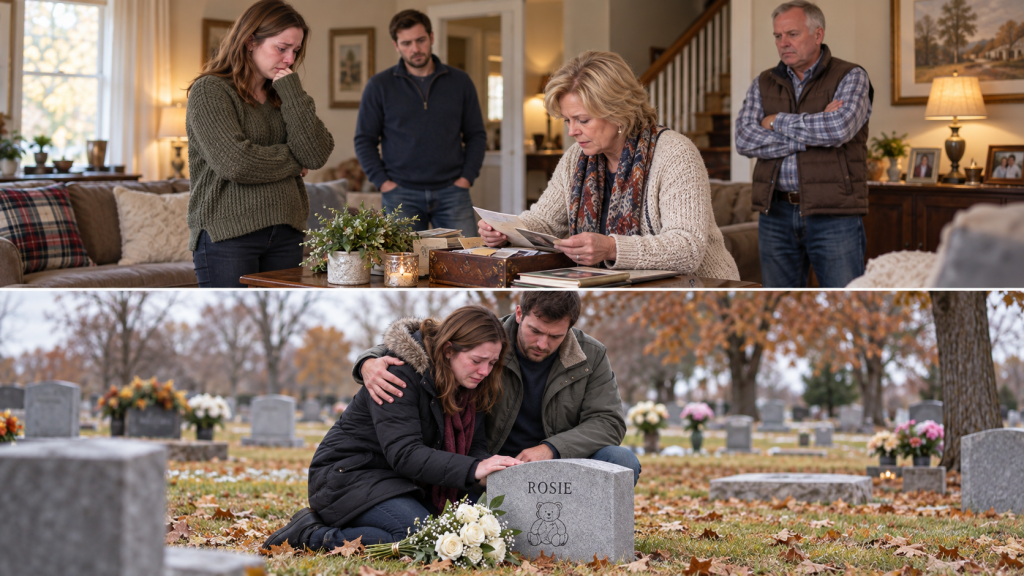
Instead, Owen and I drove to the cemetery.
We brought pale pink roses.
Her headstone had been placed only days earlier.
ROSIE ELIZABETH HAYES
Forever Our Daughter. Forever Loved.
I stood before the stone, struggling to breathe.
The world seemed unbearably ordinary.
Birds sang in the trees.
Cars passed on the distant road.
Somewhere, people were celebrating weddings, birthdays, and the simple miracle of another morning.
And my daughter was buried beneath the earth.
I knelt.
“Hi, sweetheart.”
My voice broke immediately.
Owen rested a hand on my shoulder.
“I don’t know how to do this,” I whispered.
I touched the cold stone.
“I don’t know how to be your mother when I can’t hold you.”
Tears blurred my vision.
“I had so many things to teach you.”
I thought about bedtime stories.
First steps.
Little shoes by the front door.
The sound of laughter echoing down our hallway.
“I wanted to show you the ocean. I wanted to braid your hair badly and have you complain about it. I wanted to watch you become someone I couldn’t even imagine yet.”
Owen knelt beside me.
For a long moment, we held each other.
Then he whispered, “We were her parents.”
I turned toward him.
“We still are.”
Those four words settled into my heart.
We still are.
I had been Rosie’s mother for every second of her life.
And death had not erased that relationship.
It had only changed the way I could express it.
I placed the roses beside her stone.
“Your daddy and I love you,” I whispered. “And we’re going to find a way to keep living with that love.”
Three weeks later, Rebecca called with an update.
The lender had confirmed that the disputed loan application had not resulted in an approved loan or disbursement.
I nearly collapsed with relief.
But the matter wasn’t finished.
The signature was being examined, and my father had been asked to explain how the application was prepared.
Separately, the documents concerning the support fund had raised serious questions.
Several donors told Rebecca they had believed the money would go directly toward my medical expenses and living costs.
One woman had even been told that Owen had abandoned me during an illness.
I stared at my phone.
“Owen?”
Rebecca paused.
“Yes. That was one of the representations reported to us.”
I felt my cheeks burning.
My parents hadn’t merely used my name.
They had invented an entire version of my life.
A helpless daughter.
An absent husband.
A family struggling to rescue her.
All while I was paying their bills.
“Why would they say something like that?” I whispered.
Rebecca answered carefully.
“I can’t tell you their motives. But we can document what was said and pursue appropriate remedies.”
I thanked her.
After the call, Owen found me standing in the kitchen.
“What happened?”
I told him.
He closed his eyes.
Then, unexpectedly, he laughed.
It wasn’t a happy laugh.
It was the exhausted sound of a man who had reached the edge of disbelief.
“Apparently, I abandoned you.”
I looked at him.
He shook his head.
“That’s interesting, considering I remember being here.”
I began laughing too.
Then the laughter turned into tears.
Owen embraced me.
“I’m sorry,” he whispered.
I shook my head.
“No. I just can’t believe how much of our lives they were willing to rewrite.”
He kissed my forehead.
“They can lie about us, Natalie. But they can’t change what we know.”
I thought about Rosie.
About the hospital room.
About Owen holding our daughter with such tenderness that even the nurse had begun crying.
“No,” I whispered.
“They can’t.”
The first unexpected visitor came on a Thursday afternoon.
Her name was Margaret Hayes.
My father’s older sister.
Growing up, Aunt Margaret had always seemed stern and distant. She sent birthday cards containing modest checks, rarely attended family gatherings, and never stayed long when she did.
I had assumed she simply didn’t like us very much.
Now she stood on my porch holding a casserole dish.
“Natalie,” she said. “May I come in?”
I stepped aside.
She placed the dish on the kitchen counter.
Then she looked at me with eyes so full of sadness that I immediately understood she hadn’t come to discuss money.
“I heard about Rosie.”
My throat tightened.
Margaret reached for my hands.
“I am so sorry.”
I began crying before I could stop myself.
She held me.
Not awkwardly.
Not briefly.
She held me the way I’d always imagined my mother would.
After a while, we sat down.
Margaret looked around the kitchen.
“You’ve made a lovely home.”
I gave a small, exhausted smile.
“Thank you.”
She folded her hands.
“There’s something I owe you an explanation for.”
I looked up.
“About the fund?”
She nodded.
“Your father told me you were ill. He said Owen had left, that you were embarrassed, and that you didn’t want anyone contacting you directly.”
I stared.
“He told you not to call me?”
“Yes.”
“Why didn’t you ask?”
Margaret lowered her eyes.
“Because I believed him.”
She looked at me.
“And because I had spent years keeping my distance from your father rather than confronting him.”
I was quiet.
She took a slow breath.
“Natalie, this is not the first time your father has mishandled money.”
I felt my stomach tighten.
“When your grandfather died, he left funds intended for both of us. Your father was responsible for settling certain expenses. There were disagreements over the accounting.”
“What happened?”
Margaret looked toward the window.
“We resolved what we could through attorneys. But I learned that your father could persuade himself he was entitled to money simply because he needed it.”
I stared at her.
“Why didn’t anyone tell me?”
She sighed.
“Because families often mistake silence for peace.”
The words stayed with me.
Margaret reached into her handbag and removed a photograph.
It showed me at about six years old, standing beside a birthday cake.
My grandfather had his arm around my shoulders.
“He adored you,” Margaret said.
I smiled through tears.
“I remember him.”
“He used to say you had a generous heart.”
She paused.
“But he also said something else.”
I looked at her.
“He said generous people must learn that love doesn’t require them to become empty.”
I lowered my eyes.
For years, I had believed my value came from how much I could give.
How many problems I could solve.
How quietly I could endure disappointment.
Now I wondered how different my life might have been if someone had taught me that generosity was supposed to be a choice, not a sentence.
Margaret squeezed my hand.
“You don’t owe your father your future, Natalie.”
I began crying again.
And this time, I didn’t apologize.
The next development came through Kelsey.
She called one evening, sounding nervous.
“Mom wants to meet you.”
I closed my eyes.
“No.”
“I told her you probably wouldn’t.”
I waited.
Kelsey continued.
“She says she wants to explain everything.”
“Then she can explain it to Rebecca.”
There was silence.
Then Kelsey whispered, “She asked me to convince you not to pursue the loan.”
My chest tightened.
“Of course she did.”
“But I’m not going to.”
I looked up.
“What?”
“I told her I wouldn’t be involved.”
I remained silent.
“Natalie, I spent my whole life letting Mom and Dad fix things for me. I didn’t realize how often fixing things for me meant taking something from you.”
Her voice trembled.
“I won’t do that anymore.”
I swallowed.
“Thank you.”
Kelsey paused.
“There’s something else.”
I waited.
“Daniel and I received a refund from one of the wedding vendors. It’s $6,800.”
I didn’t understand.
“Okay.”
“I want to give it to you.”
I closed my eyes.
“Kelsey—”
“Not because it fixes anything. It doesn’t.”
She took a shaky breath.
“But some of the original deposits came from money you gave Mom and Dad. I don’t know exactly how much. I want you to have this back while the rest gets sorted out.”
I stared at the wall.
For years, my sister had received things without asking where they came from.
Now she was asking who had paid the cost.
“I appreciate that,” I said quietly. “But please send the documentation to Rebecca first. I want everything handled properly.”
“I will.”
She hesitated.
“And Natalie?”
“Yes?”
“Could you tell me something about Rosie?”
The question caught me completely off guard.
“What?”
“I don’t know much about her,” Kelsey whispered. “And I should.”
Tears filled my eyes.
I looked toward the staircase.
“She liked music,” I said.
Kelsey was quiet.
“Whenever Owen played piano recordings, she’d kick.”
My voice broke.
“And she always moved when I drank orange juice.”
Kelsey gave a small, tearful laugh.
“Really?”
“Really.”
We talked for nearly an hour.
For the first time, my sister didn’t ask me about my bank account, my advice, or my ability to solve a problem.
She asked me about my daughter.
And I found myself grateful for the simple kindness of having someone listen.
Two months after Rosie’s funeral, I began seeing a grief counselor.
Her name was Dr. Elaine Brooks.
At our first appointment, she asked a question nobody had asked me before.
“Who takes care of Natalie?”
I stared at her.
Then I laughed bitterly.
“My husband.”
She nodded.
“And who else?”
I considered.
“I’m not sure.”
She waited.
I looked down at my hands.
“I’ve spent so much of my life being useful that I don’t know how to be anything else.”
Elaine leaned forward.
“What happens when you’re not useful?”
The answer came too quickly.
“I feel guilty.”
“Why?”
I stared at the carpet.
“Because somebody always needs something.”
She remained quiet.
Then she said, “Natalie, your daughter did not need you to earn the right to love her.”
I looked up sharply.
“Rosie loved nothing conditionally. She simply existed, and you loved her.”
Tears filled my eyes.
“Would you have demanded that she prove her worth by sacrificing everything for everyone around her?”
“No.”
“Would you have wanted her to feel responsible for other people’s happiness?”
“Never.”
Elaine nodded.
“Then perhaps you can begin considering whether you deserve the same compassion you wanted for her.”
I began crying.
There were moments in grief when I felt as though I had lost not only my daughter, but also the future version of myself I had imagined becoming.
The mother who packed lunches.
Who attended school concerts.
Who argued about bedtime.
Who grew older watching her daughter grow.
But perhaps some part of that imagined mother could still teach me something.
Perhaps loving Rosie could help me learn how to stop abandoning myself.
The investigation into my father’s financial dealings continued.
Some of the questions about the support fund remained unresolved for months. Records had to be obtained, transactions traced, and statements reviewed.
Rebecca warned me repeatedly not to expect a dramatic conclusion.
Real life, she explained, rarely delivers justice in a single breathtaking moment.
More often, accountability arrives in the form of documents, difficult conversations, and consequences that unfold slowly.
She was right.
My father eventually acknowledged through his attorney that he had authorized preparation of the loan application without obtaining my permission.
The lender confirmed that no loan had been issued.
The matter was referred for further review, but Rebecca was careful not to predict whether criminal charges would follow.
Separately, my father’s attorney contacted us about the $52,000 personal loan.
He offered to negotiate a repayment schedule.
At first, I thought I had misheard.
For six years, Dad had acted as though my savings were a gift he was entitled to keep.
Now, faced with a signed agreement and someone who would no longer accept excuses, he suddenly remembered that debts could be repaid.
Rebecca advised me to consider the offer seriously.
We requested financial information and negotiated terms designed to make repayment enforceable.
I didn’t receive a miraculous check.
There was no enormous windfall.
Just a structured agreement, an initial payment, and continuing obligations.
It wasn’t everything.
But it was something I had never possessed before.
A boundary that existed on paper.
One that other people couldn’t erase simply by raising their voices.
The hardest conversation happened unexpectedly.
It was late autumn when my mother called from an unfamiliar number.
I almost ended the call.
But something made me listen.
“Natalie?”
I recognized her voice immediately.
“Mom.”
She began crying.
“Please don’t hang up.”
I stared out the window.
“What do you want?”
“I wanted to hear your voice.”
I closed my eyes.
For years, those words would have filled me with longing.
Now I felt only exhaustion.
“Is Dad with you?”
“No.”
“Does this have anything to do with the investigation?”
She hesitated.
“Everything in our lives has something to do with it now.”
I waited.
Then she whispered, “Your father and I have separated.”
I felt a strange stillness.
“I see.”
“He’s staying somewhere else.”
I said nothing.
Mom continued.
“I never thought our lives would end up this way.”
Her voice trembled.
“We’ve lost friends. People are angry. Your father barely speaks to me. Kelsey doesn’t visit the way she used to.”
I looked toward Rosie’s photograph on the mantel.
“What do you want me to say?”
She began crying harder.
“I want my family back.”
The words pierced me.
Not because they were cruel.
Because they revealed how differently we understood what had happened.
“Mom,” I whispered, “I wanted my family too.”
She fell silent.
“I wanted you at the hospital. I wanted Dad to hold my hand. I wanted somebody to tell me I didn’t have to be strong while my daughter died.”
My voice broke.
“I wanted my mother.”
I heard her breathing.
Then she whispered, “I know.”
“No,” I said. “I don’t think you do.”
She began crying.
“I made a terrible mistake.”
I closed my eyes.
“It wasn’t one mistake.”
Silence.
“It was years of telling me my needs mattered less. Years of treating my savings like family property. And when Rosie died, you chose a party.”
Mom sobbed.
“I didn’t understand how serious it was.”
My heart seemed to stop.
I opened my eyes.
“She was dead, Mom.”
“I know.”
“I told you she was dead.”
Her breathing became uneven.
“Please, Natalie.”
“And you told me there was nothing you could do about it.”
She said nothing.
For the first time, I didn’t rush to rescue her from the consequences of her own words.
I allowed the silence to remain.
Finally, she whispered, “I don’t know how to make you forgive me.”
I looked at Rosie’s photograph.
“Maybe you can’t.”
She cried quietly.
I felt no pleasure in her pain.
But I couldn’t confuse her suffering with my responsibility.
“Mom, I need space. If you want to make amends, be truthful with Rebecca and the people affected by the fund. Don’t ask me to fix this for you.”
She was silent for a long time.
Then she whispered, “I understand.”
I didn’t know whether she did.
But for once, I allowed that uncertainty to exist without trying to resolve it.
Christmas arrived quietly.
We didn’t put up the large tree we’d bought the previous year.
The thought of decorating Rosie’s first Christmas without her made my chest ache.
Instead, Owen brought home a small evergreen and placed it near the living room window.
He didn’t ask whether I wanted ornaments.
He simply waited.
One evening, I found him standing beside the tree holding a tiny glass rose.
“What’s that?” I asked.
He smiled sadly.
“I bought it when you were seven months pregnant.”
My throat tightened.
“I was going to surprise you.”
He turned the ornament in his hands.
“Rosie’s first Christmas.”
I approached slowly.
The little glass petals caught the light.
For a moment, I wanted to turn away.
The pain felt too sharp.
Then I reached for the ornament.
“Can we hang it?”
Owen nodded.
Together, we placed it near the top of the tree.
It looked so small against the green branches.
And yet it changed the entire room.
I began crying.
Owen held me.
“I thought we weren’t supposed to do things like this,” I whispered.
“Like what?”
“Celebrate.”
He brushed a tear from my cheek.
“Natalie, remembering her isn’t the opposite of living.”
I looked at the ornament.
Its delicate shape reflected the warm lights around it.
For the first time, I understood that our daughter’s absence would always be part of our holidays.
But her memory could be part of them too.
On Christmas Eve, a package arrived.
There was no return address.
Inside was a handmade quilt.
Soft yellow fabric covered one side.
The other was patterned with tiny pink roses.
A note lay folded between the layers.
Dear Natalie and Owen,
I know I cannot repair the hurt I caused by my absence. I also know that gifts cannot purchase forgiveness.
When I learned about Rosie’s nursery, I remembered that Mom had taught me to sew. I wanted to make something with my own hands instead of using money to express feelings I have failed to show.
You do not have to keep this.
I am sorry I wasn’t there.
Love, Kelsey.
I sat down slowly.
Owen touched the quilt.
“It’s beautiful.”
I nodded.
For years, Kelsey’s gifts had been expensive things our parents purchased for her to give.
This was different.
The stitches weren’t perfect.
One corner was slightly uneven.
But the fabric was soft, and the tiny roses had been sewn with obvious care.
I pressed it against my chest.
Then I cried.
Not because everything was forgiven.
Not because one quilt could repair an entire childhood.
But because I could see my sister making an effort that didn’t require me to surrender something in return.
And sometimes healing begins with recognizing that change, however imperfect, is possible.
The following spring, I received another phone call from Rebecca.
The review of the support fund had reached an agreement concerning the money donors had provided.
My father had agreed to cooperate with an independent accounting and a restitution process addressing verified misrepresentations and payments that could not be justified.
Some funds were to be returned to contributors under the resulting arrangements.
Certain expenses had legitimate documentation; others had been improperly described or remained disputed.
Rebecca explained the details carefully, reminding me that the resolution of those financial questions did not necessarily settle every legal issue.
I listened.
Then asked the question that mattered most to me.
“Will people finally know I never asked for that money?”
“Yes,” she said. “A written correction is being prepared for the contributors.”
I closed my eyes.
For years, I had been frightened of embarrassing my parents.
Now, I felt relieved that the people they’d misled would finally receive the truth.
Not a dramatic accusation.
Not a public performance.
Just the truth.
After the call, I stepped outside.
The air smelled of fresh grass and rain.
A bird landed on the fence.
I looked up at the pale blue sky.
For months, I’d imagined that accountability would feel like victory.
Instead, it felt like setting down a heavy suitcase I’d been carrying for so long that I’d forgotten what my arms were supposed to feel like without it.
I didn’t feel triumphant.
I felt tired.
And grateful.
On what would have been Rosie’s first birthday, Owen and I invited a few people to our home.
Aunt Margaret came.
Kelsey and Daniel came.
My closest friend, Hannah, arrived carrying a small bouquet of pink flowers.
We didn’t call it a birthday party.
We called it a day to remember Rosie.
I made her favorite cake in my imagination: vanilla with strawberry frosting.
I knew it was ridiculous to imagine a favorite flavor for a daughter who had never tasted cake.
But grief is full of small, impossible wishes.
Owen placed Rosie’s photograph beside a single candle.
For a while, nobody spoke.
Then Hannah said, “Would you tell us about her?”
I looked around the room.
For months, I had feared that speaking of Rosie would make people uncomfortable.
But here were people sitting in my living room, asking to hear about the daughter I had loved so fiercely.
I smiled through tears.
“She was stubborn.”
Owen laughed softly.
“Definitely.”
I continued.
“She always stopped moving when someone else tried to feel her kick.”
Kelsey smiled.
“And she liked orange juice, right?”
I looked at my sister.
She remembered.
Tears filled my eyes.
“Yes.”
Margaret reached for my hand.
“And music,” Owen added.
“Especially piano,” I whispered.
We spent the afternoon sharing memories of the pregnancy.
The first ultrasound.
The ridiculous arguments about baby names.
The day Owen assembled the crib backward and had to start over.
For the first time, we spoke about Rosie without allowing the circumstances of her death to consume every memory.
She had existed before that hospital room.
She had been loved before the silence.
And she deserved to be remembered for more than the moment we lost her.
Later, I asked everyone to join us in the backyard.
There, beside the fence, stood a young rosebush.
Owen had planted it that morning.
Its first blossoms were just beginning to open.
I knelt beside it.
“Happy birthday, sweetheart,” I whispered.
The wind stirred the leaves.
I knew it wasn’t a sign.
It didn’t need to be.
The rosebush was simply something beautiful that we could nurture in her memory.
Sometimes, that was enough.
After the gathering, Kelsey remained behind.
She stood in the kitchen drying dishes while I washed them.
For a while, neither of us spoke.
Then she said, “Can I ask you something?”
I nodded.
“Do you think we’ll ever be close?”
I continued washing a plate.
“I don’t know.”
She accepted that without argument.
Then she whispered, “I wish I’d been a better sister.”
I turned off the water.
“Kelsey, I spent years resenting you.”
She looked down.
“I know.”
“I resented your birthdays. Your vacations. Your wedding. Every time Mom said you needed something, I heard the part she didn’t say.”
Kelsey’s eyes filled.
“That I mattered more.”
I nodded.
She wiped her cheeks.
“I grew up believing love meant getting what I wanted.”
I remained quiet.
“Daniel says I spent so much time being protected from disappointment that I never learned how to recognize when someone else was hurting.”
I looked at her.
“And now?”
She took a slow breath.
“Now I’m trying to learn.”
I studied my sister.
She wasn’t the spoiled little girl who used to cry until Dad bought her another toy.
She wasn’t entirely the woman who had ignored my tragedy for a rehearsal dinner either.
She was someone standing between what she’d been taught and what she was finally choosing to become.
“I can’t promise we’ll be close,” I said.
She nodded.
“But we can start by being honest.”
She smiled through tears.
“I’d like that.”
We finished the dishes together.
Nothing miraculous happened.
No music swelled.
No lifelong resentment disappeared.
But when Kelsey left, she hugged me gently and didn’t ask me for anything.
And for the first time in years, I found myself looking forward to seeing her again.
Summer arrived.
The rosebush bloomed.
The financial matters continued moving through their necessary channels.
My father made the payments required under his repayment agreement, although sometimes they arrived only after reminders from his attorney.
My mother began attending counseling, according to Kelsey, but I chose not to ask for details.
I wasn’t ready for contact.
And I was learning that not being ready was a complete answer.
One afternoon, Aunt Margaret invited Owen and me to lunch.
As we sat at a small restaurant patio, she looked at me thoughtfully.
“You seem different.”
I smiled faintly.
“Older?”
She laughed.
“Perhaps wiser.”
I looked down.
“I don’t feel wise.”
“What do you feel?”
I considered.
“Sad. Sometimes angry. Sometimes peaceful.”
I hesitated.
“And sometimes I feel guilty when I’m happy.”
Margaret nodded.
“Grief has a way of making joy feel disloyal.”
I looked at her.
“Does that ever stop?”
She thought for a moment.
“I don’t think love stops hurting simply because time passes.”
My eyes filled.
“But I think eventually we discover that joy doesn’t erase the people we miss.”
She reached across the table.
“You can love Rosie for the rest of your life without spending the rest of your life suffering to prove it.”
I held her hand.
For years, I’d believed love required sacrifice.
First for my parents.
Then, after Rosie died, I had begun believing that love for my daughter required endless sorrow.
But perhaps both beliefs misunderstood something essential.
Love could involve sacrifice.
It could survive sorrow.
Yet its purpose wasn’t to consume the person who gave it.
Its purpose was to help us become more fully human.
A year after Rosie’s death, Owen and I returned to the hospital.
Not because we were expecting another baby.
Not because we had found some miraculous cure for our sadness.
We went because I had written a letter to the nurse who cared for us on the day Rosie was born.
Her name was Sarah.
I remembered her gentle voice.
The way she had asked whether we wanted photographs.
The way she had handled our daughter with such tenderness.
And the way she had told us there was no need to hurry when it came time to say goodbye.
I had carried those small acts of kindness through the darkest year of my life.
When Sarah came into the reception area, she recognized us.
“Oh, Natalie.”
Her eyes filled.
I embraced her.
For a moment, neither of us spoke.
Then I handed her the letter.
“Thank you,” I whispered.
She looked at the envelope.
“For what?”
“For treating my daughter as though she mattered.”
Sarah’s expression softened.
“She did matter.”
I began crying.
“She still does.”
Sarah nodded.
“She always will.”
I had also brought a donation for the hospital’s bereavement program, funded from money Owen and I had deliberately set aside.
We asked that it help provide keepsake boxes, photographs, and other support for families facing the kind of loss we had experienced.
I knew those things could never take away the pain.
Nothing could.
But I remembered leaving the hospital with Rosie’s tiny footprints.
I remembered how precious that little box had become.
And I wanted another mother, somewhere in the future, to have something tangible to hold when her arms were unbearably empty.
As we walked back to the car, Owen slipped his hand into mine.
“That was beautiful,” he whispered.
I looked at him.
“I think Rosie would have made us kinder people.”
Owen smiled sadly.
“I think she already has.”
That evening, I went into Rosie’s nursery.
We had changed the room gradually.
The crib was still there.
So was the rocking chair.
But we had also added bookshelves, a small desk, and a comfortable reading lamp.
I had started writing again.
At first, just a few sentences.
Memories.
Fragments.
Letters to Rosie.
Eventually, the pages became a journal filled with things I wanted my daughter to know.
I wrote about the first time I heard her heartbeat.
About Owen assembling her crib.
About the way I used to imagine her laughter.
And about the terrible morning when silence changed everything.
I didn’t pretend the story was beautiful in every part.
Some pages were full of anger.
Others were stained with tears.
But I kept writing.
Because Rosie’s life, however brief, deserved to be remembered honestly.
I sat in the rocking chair and opened my journal.
On the first page, I’d written:
Dear Rosie,
Before you existed, I thought love was something I had to earn.
Then you came into our lives, and I loved you before you had done a single thing.
You didn’t need to make me proud.
You didn’t need to be useful.
You didn’t need to repay me.
You were simply mine to love.
And somehow, even though I never got to watch you grow, you taught me something I had spent thirty-one years trying to understand.
I was worthy of love before I learned how to give everything away.
I closed the journal.
Outside, the last light of evening rested on the windowsill.
For a long time, I sat quietly.
Then I heard Owen calling from downstairs.
“Natalie? Dinner’s ready.”
I smiled.
“Coming.”
I placed the journal beside Rosie’s memory box and stood.
For the first time, leaving the nursery didn’t feel like leaving my daughter behind.
It felt like carrying her with me.
Two years after Rosie’s death, my father sent a letter.
It arrived through Rebecca’s office.
By then, most of the documented personal loan had been repaid under the agreement. The separate financial review had resulted in corrective notices and restitution arrangements for affected contributors, though certain legal matters had taken longer to resolve.
The letter contained no request for money.
That alone surprised me.
I opened it slowly.
Natalie,
For most of my life, I believed providing for my family meant controlling everything around me.
When the business struggled, I convinced myself that borrowing from you was justified. When you kept helping, I stopped seeing your generosity as something freely given and started treating it as something I deserved.
I have spent a long time blaming other people for what happened.
But the decision to use your name without permission was mine.
And the words I spoke after Rosie’s funeral were cruel.
I stopped reading.
My hands trembled.
Owen sat beside me.
“You don’t have to finish it.”
I took a breath.
“I want to.”
The letter continued.
I cannot pretend that I understand the pain of losing a child the way you and Owen do.
I also cannot claim I was a good father simply because I believed I was working for my family.
When you needed me most, I was worried about money and appearances.
I cannot give you back the years you spent supporting us. I cannot take back what I said. And I cannot expect forgiveness because I have finally admitted the truth.
I am sorry.
Dad.
I folded the letter.
For a long time, I said nothing.
Owen watched me carefully.
“What do you think?”
I stared at the envelope.
“I think he may finally understand what he did.”
Owen nodded.
“And?”
I looked toward Rosie’s photograph.
“And I don’t know whether that changes anything between us.”
He squeezed my hand.
“That’s okay.”
I placed the letter in a drawer.
Not the trash.
Not the memory box beside Rosie’s things.
Just a drawer.
A place where I could leave it without making an immediate decision.
I had spent my entire life responding urgently to my parents’ needs.
Now, I could give myself time.
The following autumn, Kelsey came to visit with Daniel and their newborn son.
They had named him Benjamin.
When she called to ask whether I’d be comfortable meeting him, I surprised myself by saying yes.
But as the day approached, anxiety settled in my stomach.
I hadn’t held a newborn since Rosie.
The thought of Benjamin’s tiny hands and warm weight against my chest filled me with both tenderness and dread.
When Kelsey arrived, she noticed immediately.
“You don’t have to hold him,” she whispered.
I smiled gratefully.
“Thank you.”
We sat together in the living room.
Benjamin slept in Daniel’s arms, his little mouth making soft movements.
I watched him.
He was beautiful.
And my heart hurt.
Not because I resented him.
But because love sometimes awakens the deepest places where loss still lives.
Kelsey looked at me.
“Would it be okay if I told him about Rosie someday?”
My eyes filled.
I nodded.
“I’d like that.”
She smiled.
“I want him to know he had a cousin.”
Tears rolled down my cheeks.
Had.
Such a small word.
Such an enormous absence.
Kelsey reached for my hand.
“I’m sorry, Natalie.”
I shook my head.
“You don’t have to apologize for him being here.”
She swallowed.
“I know.”
I looked at Benjamin again.
After a while, I held out my arms.
“May I?”
Kelsey’s eyes widened.
“Are you sure?”
I nodded.
Daniel gently placed Benjamin against my chest.
He was warm.
Alive.
His tiny fingers curled around mine.
For a moment, grief rose so sharply that I thought I might stop breathing.
Then I looked down.
And beneath the sadness, I felt something else.
Love.
Not the love I’d had for Rosie.
Nothing could replace that.
But love all the same.
Benjamin opened his eyes briefly, then closed them.
I laughed through tears.
“Hello, little one.”
Kelsey began crying.
Owen moved closer and rested his hand on my shoulder.
For the first time, I understood that my heart hadn’t become smaller after losing Rosie.
It had become wounded.
And wounded hearts, given time and kindness, can still make room for others.
That winter, Owen and I took a trip to the mountains.
It was our first vacation since Rosie’s death.
We rented a small cabin with a stone fireplace and windows overlooking pine-covered hills.
For three days, we slept late, cooked simple meals, and walked along quiet trails.
One evening, snow began falling.
We sat near the fireplace beneath a thick blanket.
Owen held my hand.
“Can I ask you something?”
I smiled.
“Of course.”
“Are you happy?”
The question startled me.
I considered it carefully.
There was still a space in my life where Rosie should have been.
I still cried unexpectedly.
Sometimes, I would see a little girl holding her father’s hand and feel grief rise so suddenly that I had to turn away.
There were days when I could barely look at her photograph.
And others when I wanted to talk about her for hours.
But I also laughed.
I enjoyed quiet mornings.
I loved my husband.
I had begun building friendships that didn’t depend on what I could provide.
And I was learning how to rest.
“I think,” I said slowly, “I’m learning how to be happy again.”
Owen smiled.
“Good.”
I leaned against him.
“Does that sound terrible?”
“No.”
“Sometimes it feels terrible.”
He kissed my forehead.
“Natalie, our daughter was loved every moment she was here.”
I closed my eyes.
“That doesn’t stop being true because you smile.”
Outside, snow drifted past the windows.
I watched it settle softly over the dark ground.
Then I whispered, “I think I’m finally starting to believe that.”
Three years after Rosie was born, I received a small envelope in the mail.
It was from my mother.
Inside was a photograph.
I recognized it immediately.
It showed me standing beside my own birthday cake at age seven.
I wore a crooked paper crown.
My grandfather stood behind me.
On the back, in Mom’s handwriting, were the words:
You were always worth celebrating.
Below that, she’d written a short note.
Natalie, I should have shown you this every day instead of teaching you that love was something you had to earn by being helpful. I am sorry for the mother I failed to be when you needed me. I understand if you never want contact. I hope you have peace.
I read the note twice.
Then I placed it beside my father’s letter.
I didn’t call.
I didn’t send a long response.
But I no longer needed to turn every expression of regret into a battle inside my heart.
I could acknowledge an apology without deciding that everything was repaired.
I could wish my parents well without inviting them back into my life.
And I could love the younger version of myself who had spent so many years believing that one day, if she gave enough, everyone would finally choose her.
That little girl deserved compassion too.
On Rosie’s third birthday, Owen and I woke before sunrise.
We drove to the cemetery carrying a small bouquet of roses.
The air was cool.
The sky slowly brightened above the trees.
We sat beside her headstone and watched the morning arrive.
I told Rosie about Benjamin.
About Kelsey’s new job.
About Aunt Margaret’s garden.
About the little rosebush in our backyard that had grown taller than either of us expected.
Owen told her about the cabin in the mountains.
About the snow.
About the piano recording he still played sometimes when he missed her.
Then we sat quietly.
For a long time, I had imagined that healing meant reaching a day when Rosie’s death no longer hurt.
I understood now that such a day might never come.
And perhaps it didn’t need to.
The pain had changed.
It no longer filled every room.
It no longer controlled every morning.
But it remained part of me.
A reminder of how deeply I had loved.
I brushed a leaf from her headstone.
“Sweetheart,” I whispered, “I’ve been thinking about something.”
Owen turned toward me.
I smiled through tears.
“When you were inside me, I used to worry about whether I’d be a good mother.”
I touched the stone.
“I worried about making mistakes. About being tired. About not knowing what to do.”
My voice trembled.
“But I think I understand now.”
I took a breath.
“Being a good mother wasn’t about being perfect.”
Tears slipped down my cheeks.
“It was about loving you without asking you to become anything other than yourself.”
Owen reached for my hand.
“And you did,” he whispered.
I closed my eyes.
For the first time, I allowed myself to believe him completely.
When we returned home, the house was quiet.
Sunlight poured through the kitchen windows.
The rosebush outside had begun producing new buds.
Owen made coffee.
I sat at the table and opened my journal.
I turned to a blank page.
Then I wrote the words I’d been trying to find for three years.
Dear Rosie,
When you died, I thought the world had ended.
Then I discovered that some people I trusted had never loved me the way I needed them to.
For a while, I believed those two losses would destroy me.
But your daddy stayed.
Good people came closer.
And little by little, I learned that family is not measured by the demands people make of us, but by the care they offer when we have nothing left to give.
I learned that saying no does not make me cruel.
That forgiveness cannot be demanded.
That grief does not have an expiration date.
And that love does not disappear simply because the person we love is no longer within reach.
I stopped writing.
Outside, a breeze moved through the rosebush.
I smiled.
Then continued.
I used to believe the greatest tragedy of my life was that I never got to bring you home.
And that will always hurt.
But I also know that for eight months, you were home.
You lived beneath my heart.
You listened to your father’s voice.
You were loved before we saw your face.
And when your short life ended, you left behind something that no one can steal.
You taught me what unconditional love feels like.
You taught me that a person’s worth is not measured by money, usefulness, or the sacrifices others can demand from them.
You taught me that even the briefest life can leave a lasting mark on the world.
And you taught me that I deserve the same gentleness I would have given you.
I paused.
Tears blurred the page.
Then I wrote one final sentence.
Thank you for making me your mother.
I closed the journal.
Owen walked into the kitchen and placed a cup of coffee beside me.
“What are you thinking about?” he asked.
I looked at him.
Then toward the sunlight.
“Rosie.”
He smiled sadly.
“Me too.”
I reached for his hand.
For years, I’d spent my life waiting for my parents to prove that I mattered.
I thought if I paid enough bills, solved enough problems, and swallowed enough disappointment, they would eventually see me as someone worth protecting.
But I had been looking for love in the wrong place.
Love had been there in the hospital, when Owen held me while we said goodbye to our daughter.
It had been there in a nurse’s gentle hands.
In Aunt Margaret’s casserole.
In Kelsey’s imperfect quilt.
In the friends who remembered Rosie’s birthday.
And in the quiet mornings when my husband sat beside me, asking for nothing more than my company.
My father once told me that my daughter was gone and my sister still had her future ahead of her.
For a long time, those words haunted me.
But now I understood what he had failed to see.
Rosie had a future too.
Not the one we dreamed of.
Not birthdays filled with balloons or school mornings filled with laughter.
Her future lived in the kindness we offered in her name.
In the families who received keepsake boxes because we remembered what it felt like to leave the hospital empty-handed.
In the rosebush that bloomed each spring.
In the stories we told about her.
And in the woman I was becoming because I’d finally learned that love should never require me to disappear.
I looked at Owen and smiled through tears.
“Do you think we’re going to be okay?”
He squeezed my hand.
“I think we’re already learning how.”
I leaned against him.
Outside, the morning light fell across the roses.
And I understood that moving forward did not mean leaving my daughter behind.
It meant allowing the love she’d awakened in me to travel wherever life carried us.
I would always miss Rosie.
I would always wish for one more moment with her.
But I would no longer spend my life trying to earn affection from people who could not offer it freely.
I had lost my daughter.
I had lost the illusion of the family I thought I possessed.
But I hadn’t lost my ability to love, to hope, or to build a life filled with tenderness.
And perhaps that was the quietest, most unexpected kind of victory.
Not watching the people who hurt me suffer.
Not receiving every dollar they owed.
Not hearing apologies I’d spent my whole life waiting for.
But waking up one morning and realizing that my heart, though forever changed, still belonged to me.
I touched Rosie’s photograph one last time.
“Mommy loves you,” I whispered.
Then I turned toward Owen, toward the life waiting beyond the kitchen door, and took his hand.
Because my daughter had taught me something my parents never could.
Love is not proven by how much pain we are willing to endure for someone. It is proven by how gently we hold them when they have nothing left to give.
And finally, after all those years, I knew I was allowed to be held too.
THE END STORIES! THANK YOU FOR READING GOOD LUCK !