
“Your father arranged it because he was afraid this would happen.” I spoke so quietly that Denise had to lean forward to hear me. Paul stood beside the mantel, his telephone still ringing. The realtor had stopped pretending she wasn’t listening. The young couple who’d been examining my living-room walls moved toward the front door.
And Margaret Ellis, the woman holding the mortgage on my house, stood beside me with a calmness that seemed to make my children more nervous than shouting ever could. Denise stared at the statement. “Dad knew you were going to borrow money against the house?” I shook my head.
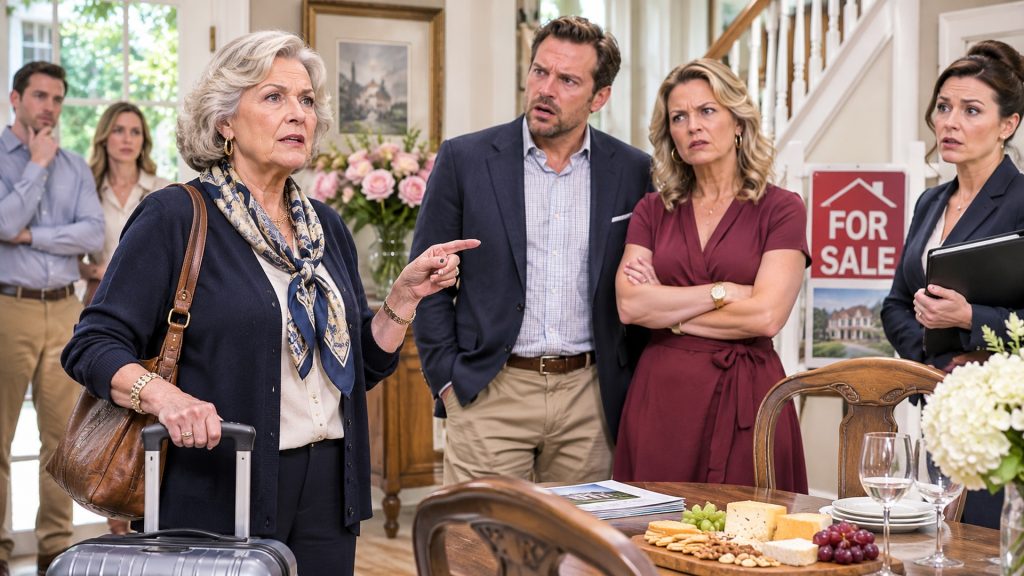
“No, sweetheart. Your father died before the loan was made. But he knew something about this family that I didn’t want to believe.” Paul silenced his phone. “What are you talking about?” I looked at him. “Frank knew you and Denise were already discussing what would happen to this house after we were gone.” Paul’s expression changed. “That was just practical planning.”
“Your father didn’t think so.”
I reached into my handbag and removed a small envelope.
Frank’s handwriting covered the front.
For my Eleanor, if the children forget what a home means.
Denise covered her mouth.
Paul stopped moving.
And for the first time since I had walked through my front door, nobody asked me to explain myself.
They simply waited.
My name is Eleanor Whitcomb.
I was seventy-four years old the Saturday I came home from visiting my sister and discovered that my children had tried to sell the house where I had spent forty-three years of my life.
Until then, I thought the worst thing grief could do was take away the person you loved.
I was wrong.
Grief also leaves empty spaces that other people sometimes mistake for opportunities.
Frank died in November 2021.
For forty-six years, he had been my husband, my closest friend, and the one person who could make me laugh when the world felt unbearable.
He was a quiet man.
An engineer by profession, a gardener by choice, and a terrible dancer by every measurable standard.
He loved old jazz records, strong coffee, and the ridiculous little ceramic birds I collected from antique shops.
He repaired anything that broke.
And he believed a house was never truly finished because the people living inside it were always changing.
When we bought the place on Birch Lane, Paul was three years old and Denise wasn’t yet born.
The roof needed replacing.
The basement smelled of damp wood.
And the kitchen cabinets were a dreadful shade of orange.
But Frank stood in the backyard, looking at the old maple tree, and smiled.
“Ellie,” he said, “I think this could be home.”
I laughed.
“You haven’t seen the plumbing.”
He kissed my forehead.
“That’s why I brought tools.”
We spent four decades making that house ours.
And now our children had filled it with strangers, brochures, and a cheese platter.
Margaret gently touched my arm.
“Eleanor, perhaps we should finish clearing the house before discussing the family documents.”
I nodded.
She was right.
The prospective buyers had already begun moving toward the entrance.
The realtor, a woman named Claire Benton, looked pale.
“Mrs. Whitcomb,” she said, “I am terribly sorry. I was led to believe your children were legally authorized to handle the sale.”
I studied her.
“Did you verify that?”
Her face tightened.
“I reviewed the documents they supplied, but it appears there was a serious misunderstanding about their scope.”
Margaret spoke calmly.
“Authority to make health-care decisions is not authority to convey real property. You’ll want your brokerage’s counsel to review the matter immediately.”
Claire nodded.
“Of course.”
I looked around at the strangers standing in my living room.
“This isn’t your fault,” I told them. “But the house isn’t for sale.”
The young woman who had been examining the wall smiled apologetically.
“We understand.”
Her husband picked up their brochures.
“It’s a beautiful home.”
I looked toward the staircase.
“Yes,” I whispered. “It is.”
Within fifteen minutes, the visitors had left.
Claire removed the brochures.
Margaret photographed the sign and gathered copies of the paperwork.
And Paul stood beside the dining table, looking as though he’d just discovered that the ground beneath his feet wasn’t as solid as he believed.
“Mom,” he said, “you’re making this into a bigger problem than it needs to be.”
I turned slowly.
“A bigger problem?”
He sighed.
“Denise and I were trying to help you.”
I looked at the cheese platter.
At the wineglass he’d placed on Frank’s mantel.
At the muddy footprints strangers had left on my hallway rug.
Then I asked, “Paul, where were you planning to move my belongings?”
He hesitated.
“Mom—”
“Where?”
Denise answered.
“We were going to hire movers.”
“And take everything to Meadowbrook?”
She lowered her eyes.
“Some things could go there.”
I stared at her.
“What about the rest?”
Silence.
I nodded.
“My books?”
No answer.
“Your father’s records?”
Paul looked away.
“The photographs?”
Denise began crying.
I swallowed.
“And what about the roses Frank planted with me the spring after you were born?”
Paul rubbed his forehead.
“Mom, it’s a house.”
I looked at my son.
Then said, “No, Paul. It’s my home.”
He tried again.
“You’ve been alone since Dad died. This place is too much for you.”
I folded my arms.
“Have I missed a property tax payment?”
He frowned.
“What?”
“Have the utilities been shut off?”
“No.”
“Have the repairs been neglected?”
He hesitated.
“Not exactly.”
“Have I asked either of you for money to maintain it?”
Denise whispered, “No.”
I nodded.
“Then tell me what evidence you have that I cannot live here.”
Paul looked uncomfortable.
“Mom, you’re seventy-four.”
I almost laughed.
“I know how old I am, Paul. I was present for all seventy-four years.”
Margaret pressed her lips together.
Denise looked down.
Paul continued.
“You fell last year.”
“Yes.”
“And you were hospitalized.”
“For a fractured wrist after slipping on wet steps.”
He gestured toward the hallway.
“That’s exactly what worries us.”
I took a breath.
“Then you could have offered to repair the steps.”
He didn’t answer.
I looked at Denise.
“You could have asked whether I wanted help.”
Her eyes filled.
“Mom, we thought—”
“You thought you were entitled to decide for me.”
Margaret placed the mortgage statement on the dining table.
“Eleanor, would you like me to explain the arrangement?”
I nodded.
“Please.”
She turned toward my children.
“In 2022, your mother entered into a properly documented private loan. My company funded the loan, and the mortgage was recorded against the property.”
Paul frowned.
“Why would Mom borrow money? Dad paid this house off years ago.”
Margaret looked toward me.
I answered.
“Because I wanted to make some changes.”
Denise stared.
“What changes?”
I took a breath.
“After your father died, I realized I needed a plan for growing older.”
Paul looked momentarily relieved.
“Exactly. That’s what we’ve been saying.”
I raised one hand.
“Let me finish.”
He stopped.
“I wanted to remain in my home as long as I reasonably could.”
I looked around the room.
“So I had the bathrooms modified, improved the downstairs bedroom, replaced the dangerous back steps, and made the entrances easier to use.”
Denise blinked.
“I didn’t know you did all that.”
I smiled sadly.
“You never asked.”
The loan had funded more than renovations.
It also provided part of a carefully structured reserve for future care expenses.
I had worked with a financial planner and an attorney to ensure I understood the obligations.
The loan was real.
The mortgage was real.
And it would have to be addressed in any legitimate sale.
But the lender wasn’t a traditional bank.
Margaret’s private lending firm had provided the financing under an arrangement involving Frank’s family trust.
That part required explanation.
And I knew my children weren’t going to like it.
Paul picked up the statement.
“It says payments are received by the Frank Whitcomb Family Trust.”
I nodded.
“Yes.”
He looked at Margaret.
“So you work for the trust?”
She shook her head.
“My firm holds the recorded mortgage as lender. Under a separate documented arrangement, the trust has an economic interest in the loan payments.”
Paul looked irritated.
“That sounds deliberately complicated.”
Margaret remained calm.
“It’s an ordinary principle that the owner of a mortgage and the party entitled to certain economic payments may be different under properly documented agreements. The exact rights depend on the relevant contracts.”
I watched my son’s face.
He hated explanations that didn’t end with him being right.
Then he asked, “And who’s in charge of this trust?”
I took a breath.
“I am one of its trustees.”
Denise looked up.
“Mom?”
I nodded.
“And there is an independent co-trustee.”
Paul frowned.
“Who?”
Margaret answered.
“Attorney Samuel Brooks.”
My son’s expression darkened.
“You’ve got some stranger managing Dad’s money?”
I felt anger rise.
“Samuel has been our family’s attorney for twenty-three years.”
Paul looked away.
“That’s not what I meant.”
I nodded.
“Then perhaps you should choose your words more carefully.”
I opened Frank’s envelope.
The paper inside was folded twice.
His handwriting looked exactly as I remembered it.
Strong.
Slightly slanted.
With little loops at the bottom of certain letters.
My throat tightened.
I had read the letter before.
Once after his death.
And again the night I signed the new mortgage documents.
But reading it in front of my children felt different.
It felt like opening a door Frank had left closed for a reason.
I began.
My dear Ellie,
If you are reading this because somebody has made you feel that our home is no longer yours, I want you to remember something.
We built that house together.
Not for our children to inherit before we are gone.
Not for anybody to measure its value against a retirement brochure.
We built it because we wanted a place where our family could grow.
My voice trembled.
Denise began crying.
Paul stared at the floor.
I continued.
I hope the children will always love you well.
But loving you does not give them the right to decide your life for you.
If the day comes when you need help, accept it from people who respect your wishes.
And if you are still capable of choosing, Ellie, never let anyone make you ashamed of choosing for yourself.
I stopped.
The room was silent.
Paul looked at me.
“Dad wrote that?”
I nodded.
“Yes.”
“When?”
“Several months before he died.”
He frowned.
“Why?”
I took a long breath.
“Because he had a conversation with you that bothered him.”
Paul’s face changed.
“What conversation?”
I looked directly at him.
“The one about selling this house.”
Frank had been ill for nearly a year before he died.
There were hospital visits.
Treatments.
Good weeks.
Difficult weeks.
And eventually, the quiet realization that we were running out of time.
During one of his final summers, Paul visited while I was buying groceries.
Frank was resting in the living room.
Paul sat beside him and began discussing what would happen to the house after his death.
At first, Frank thought his son was simply being practical.
Then Paul suggested the property should be sold as soon as possible.
He mentioned how much it was worth.
He talked about the difficulty of maintaining a large house.
And he said that once Frank was gone, Denise and he would need to make decisions about my living arrangements.
Frank asked him one question.
“What does your mother want?”
Paul answered that I’d probably be too emotional to know.
Frank never forgot that sentence.
I looked toward my son.
“Your father told me what you said.”
Paul swallowed.
“Dad was sick. He misunderstood.”
I shook my head.
“He wrote down the conversation afterward.”
Denise stared at her brother.
“You never told me that.”
Paul looked at her.
“It was years ago.”
I continued.
“Frank asked Samuel to review our estate planning because he wanted to make sure nobody could confuse future inheritance expectations with present ownership.”
Paul’s jaw tightened.
“Are you saying Dad didn’t trust us?”
I considered.
Then answered honestly.
“He loved you.”
My eyes filled.
“But he was worried that you were beginning to think of this house as money waiting to be divided.”
Denise covered her mouth.
“Mom, I didn’t know.”
I looked at her.
“Your father hoped the trust arrangements would encourage everyone to respect my choices.”
She began crying.
I continued.
“After he died, I reviewed the documents and made decisions of my own.”
Paul crossed his arms.
“So this mortgage was some kind of trap?”
“No.”
I shook my head.
“It was a financial arrangement made for my needs, not yours.”
Margaret nodded.
“The mortgage was never designed to surprise the children. It was properly recorded. A legitimate title search would reveal it.”
I looked toward Claire’s abandoned brochures.
“Which is why I asked whether anybody checked who held the mortgage.”
Paul sat heavily.
Then muttered, “This is ridiculous.”
I watched him.
“Which part?”
He looked up.
“The whole thing. You could have just sold and moved somewhere safe.”
I took a breath.
“Paul, have you ever visited Meadowbrook?”
He hesitated.
“Denise did.”
I turned toward my daughter.
“Did you?”
She looked down.
“I toured the model apartment.”
“Did you ask whether I wanted to live there?”
She began crying.
“No.”
I nodded.
“And did you ask whether I could afford to remain here?”
“No.”
“Then why did you decide I couldn’t?”
Denise looked toward Paul.
He said nothing.
And suddenly, I understood.
They hadn’t been planning around my needs.
They’d been planning around assumptions.
And perhaps something more.
I asked them to leave.
Not forever.
Not because I had stopped loving them.
But because I needed quiet.
I needed my house emptied of people who had treated it as though I were already gone.
Paul argued.
Denise cried.
Margaret stood beside me while I repeated my request.
Eventually, they gathered their belongings.
Claire had already contacted her brokerage and legal counsel to address the invalid listing and purported acceptance.
The buyer’s attorney would need to be informed that no authorized seller had accepted an offer.
The transaction could not simply proceed because Paul had shaken someone’s hand and announced it was finished.
The paperwork mattered.
Ownership mattered.
Authority mattered.
And nobody had the legal right to sell my house merely because they were related to me.
After they left, Margaret helped me collect the brochures.
There were twenty-seven.
I counted them.
Twenty-seven pieces of paper describing my home as an investment opportunity.
Each had photographs of the kitchen.
The living room.
The upstairs bedrooms.
The garden.
One showed Frank’s reading chair beside the fireplace.
The caption read:
Charming sitting area with excellent natural light.
I stared at it.
Then began crying.
Margaret put an arm around me.
“Eleanor.”
I shook my head.
“That was his chair.”
She nodded gently.
“I know.”
I looked at the photograph.
“He sat there every evening.”
My voice broke.
“He read the newspaper. He fell asleep during baseball games. He held our grandchildren there.”
Tears streamed down my cheeks.
“And now it’s a charming sitting area.”
Margaret squeezed my shoulder.
I cried until I couldn’t cry anymore.
The following Monday, I met Samuel Brooks at his office.
He was seventy-one, tall and silver-haired, with the patient expression of a man who had spent his career explaining complicated matters to frightened families.
He had known Frank for decades.
He greeted me with a hug.
“Eleanor.”
I held him tightly.
“Samuel.”
He guided me into his office.
A pot of tea was waiting.
So was Margaret.
They’d already gathered the relevant property records.
The deed.
The recorded mortgage.
The trust documents.
The health-care power of attorney.
And the paperwork Paul and Denise had used to list the house.
Samuel looked at me.
“First, your ownership is not erased by what your children attempted.”
I closed my eyes.
He continued.
“The listing and purported offer acceptance were unauthorized based on the documents we’ve reviewed. We’ll take the appropriate steps to correct the records and address any damage.”
I nodded.
“And the realtor?”
“The brokerage is cooperating with the review. Responsibility will depend on what was represented, what was verified, and the actual documents involved.”
I took a breath.
“Could the buyers sue me?”
Samuel answered carefully.
“Anyone can raise a claim, but you did not authorize the sale. We’ll respond appropriately if an issue arises.”
I nodded.
Then whispered, “Thank you.”
Samuel also explained something that frightened me.
The situation might not end with canceling a listing.
If Paul and Denise had signed documents representing that they possessed authority they didn’t have, their conduct could have legal consequences.
We would need to preserve the records.
Review what had been submitted.
And determine whether any other documents or transactions had been attempted.
I stared at him.
“Do you think they’ve done something else?”
Samuel hesitated.
“I don’t know.”
He looked toward Margaret.
“But I believe we should find out.”
Two days later, he called.
“Eleanor, are you sitting down?”
I was in the kitchen.
I looked toward Frank’s photograph.
“Yes.”
Samuel took a breath.
“We found correspondence suggesting Paul had been discussing the expected sale proceeds with a private lender.”
My stomach tightened.
“What?”
He continued.
“The documents refer to an anticipated inheritance distribution.”
I stared at the wall.
“Frank’s inheritance?”
“Yes.”
I swallowed.
“But I’m alive.”
Samuel was quiet.
Then said gently, “I know.”
The truth emerged over the following weeks.
Paul had been struggling financially.
His construction supply business had lost two major customers.
He’d borrowed to keep operations running.
Then borrowed more to cover existing obligations.
His expenses remained high.
And instead of admitting the business was in trouble, he continued presenting himself as successful.
He drove a beautiful SUV.
Wore expensive watches.
Took vacations.
And told everyone he was expanding.
In reality, he was running out of options.
The house on Birch Lane represented what he imagined was an easy solution.
A property worth approximately six hundred thousand dollars.
Two siblings expecting to inherit someday.
A mother he believed could be persuaded to move into a retirement community.
And a sale he hoped could happen before anyone asked too many questions.
Paul had already discussed potential access to funds he expected to receive.
There was no established right to those funds.
No inheritance had vested simply because he wanted it.
And my house was not his to sell.
But he had been speaking as though the money were practically in his account.
When Samuel told me, I felt physically ill.
“Did Denise know?”
He paused.
“Her involvement is less clear.”
I swallowed.
“What do you mean?”
“She participated in the listing, but the financial correspondence we’ve reviewed appears primarily connected to Paul.”
I closed my eyes.
“And now?”
“We’ll address the conduct supported by the records. I don’t want you drawing conclusions beyond what we can establish.”
I nodded.
I was grateful for his restraint.
Because when your child betrays you, anger can make every suspicion feel like certainty.
And I needed the truth.
Not another story built from assumptions.
Denise called me that evening.
I almost didn’t answer.
But eventually, I picked up.
“Hello.”
“Mom?”
Her voice was trembling.
“Yes.”
“Can I come over?”
I hesitated.
“For what?”
She began crying.
“Because I need to tell you something.”
I sat down.
“Tell me now.”
There was a long silence.
Then she whispered, “Paul said you were going to lose the house anyway.”
My chest tightened.
“What?”
“He told me you’d taken out a mortgage you couldn’t afford.”
I stared at the kitchen wall.
“He said you were hiding financial trouble because you were ashamed.”
I closed my eyes.
The pattern became painfully clear.
Paul had used the existence of my loan to create an entirely different story.
One in which I was financially irresponsible.
One in which selling the house was necessary.
One in which my children were rescuing me rather than taking control.
Denise continued.
“He said if we waited, the lender would foreclose.”
I took a breath.
“Did you ask the lender?”
She began crying.
“No.”
“Did you ask me?”
“No.”
My voice broke.
“Why not?”
She whispered, “Because Paul said you’d deny it.”
I sat very still.
For months, my children had apparently been discussing my finances without me.
They hadn’t reviewed my actual payment history.
Hadn’t spoken with my adviser.
Hadn’t looked at the money I’d set aside for care.
And hadn’t asked whether I needed help.
They’d simply accepted the explanation that made their plan seem reasonable.
I took a breath.
“Denise, I have never missed a mortgage payment.”
She began sobbing.
“I know that now.”
“The loan was part of a plan to help me remain independent.”
“I know.”
I swallowed.
“And your brother used it to frighten you.”
She whispered, “Yes.”
I looked toward Frank’s reading chair.
Then asked, “Did you ever consider that your mother might know what she’s doing?”
Denise cried harder.
“I’m sorry.”
I didn’t invite her over that night.
I needed time.
I told her we could meet at Samuel’s office after the relevant information had been reviewed.
She agreed.
Then I ended the call.
And sat alone in the kitchen.
For forty-three years, that table had held report cards.
Birthday cakes.
School projects.
Sunday dinners.
And the occasional argument over who forgot to take out the trash.
Now it held mortgage statements and legal documents proving that my own children had tried to remove me from my home.
I stared at the empty chairs.
Then whispered, “Frank, how did we get here?”
The answer came slowly.
Not from one dramatic confession.
But from years of small changes.
Paul had always been ambitious.
Even as a boy, he wanted the biggest bicycle.
The newest shoes.
The most impressive summer job.
Frank used to tell him, “Son, there’s nothing wrong with wanting more. Just don’t forget to appreciate what you already have.”
Paul would smile.
Then ask for something else.
Denise was different.
Quiet.
Careful.
Always trying to keep everyone happy.
When Paul made a decision, she often followed.
When he argued, she tried to calm things down.
And when he insisted something was best for the family, she rarely challenged him.
Frank worried about both of them.
He feared Paul’s ambition would become entitlement.
And Denise’s desire to avoid conflict would make her vulnerable to people who spoke with certainty.
I used to tell him he worried too much.
Now I wished I’d listened more carefully.
The review of the attempted sale continued.
The brokerage withdrew the listing and notified the prospective buyers.
The purported acceptance was addressed through the appropriate legal communications.
The property records remained in my name, subject to the recorded mortgage.
There was no completed transfer.
No buyer took possession.
And nobody received sale proceeds.
But the incident still had consequences.
The brokerage examined how the documents had been handled.
Samuel reviewed whether any formal complaints or claims were warranted.
And I took steps to prevent future confusion about who could act on my behalf.
I revoked the old health-care authorization and replaced it with carefully considered documents reflecting my current wishes.
I also updated my estate plan.
Not to punish my children.
To protect my independence.
One afternoon, Samuel asked me a question.
“Eleanor, have you considered appointing someone other than your children to make decisions if you become unable to do so?”
I looked down.
“Yes.”
He waited.
I swallowed.
“My sister Carol.”
He smiled gently.
“Have you spoken with her?”
I nodded.
“She said she’d be honored.”
Samuel made a note.
“And financial decisions?”
I took a breath.
“I’d like an independent professional involved.”
He nodded.
“That’s reasonable. We’ll discuss options, duties, and safeguards.”
I stared at my hands.
“Samuel, I never imagined I’d need protection from my own family.”
His expression softened.
“Sometimes the people we love have conflicts of interest.”
I nodded.
“And recognizing that doesn’t mean you love them less.”
I looked up.
He smiled sadly.
“It means you’re making decisions based on reality.”
Carol flew in the following month.
She was seventy-eight, sharp-tongued, and the only person who could tell me I was being ridiculous without making me angry.
She arrived carrying a suitcase, a bag of homemade cookies, and a look of determination.
I opened the door.
She hugged me.
“Ellie.”
I held her tightly.
Then she stepped back.
“Where’s the cheese platter?”
I burst out laughing.
For the first time in weeks, I laughed until my stomach hurt.
Carol grinned.
“I figured if we’re selling your house without permission, we ought to at least get decent snacks.”
I wiped my eyes.
“Oh, Carol.”
She hugged me again.
Then whispered, “I’m sorry, sweetheart.”
I began crying.
And she held me.
That evening, we sat in Frank’s old living room drinking tea.
Carol looked around.
“This place hasn’t changed much.”
I smiled.
“Some things have.”
She nodded.
“The roses are beautiful.”
I looked toward the garden.
“Frank planted the first ones.”
Carol smiled sadly.
“I remember.”
We sat quietly.
Then she asked, “Ellie, what do you want?”
I stared.
“What?”
“Not what Paul wants.”
I looked down.
“Not what Denise thinks you should want.”
She leaned forward.
“What do you want?”
For a moment, I couldn’t answer.
I’d spent so much time defending my right to remain in my house that I hadn’t considered the possibility of choosing something different someday.
I took a breath.
“I want to stay here for now.”
Carol nodded.
“Good.”
“I want to travel while I still feel well enough.”
She smiled.
“Excellent.”
“And I want to know that if I ever need help, somebody will listen to me.”
Carol reached for my hand.
“Then that’s what we plan for.”
We spent the next week making lists.
Not lists of things to sell.
Lists of things I wanted to do.
Visit New England in autumn.
Take a pottery class.
Learn how to use the video camera Frank bought shortly before he died.
Invite friends for dinner more often.
And finally repair the little garden fountain that had been broken for years.
Carol looked at the list.
“Ellie, you know what this means?”
I smiled.
“What?”
“You’re not finished living.”
My eyes filled.
“No.”
She squeezed my hand.
“Then don’t let anybody act like you are.”
Denise and I met at Samuel’s office six weeks after the open house.
She arrived without Paul.
That mattered.
For most of her life, she had allowed her brother to speak first.
This time, she sat across from me with her own folder.
Her hands trembled.
“Mom.”
I nodded.
“Denise.”
She took a breath.
“I’ve been going through the paperwork.”
I waited.
She continued.
“I signed the listing documents.”
My chest tightened.
“Yes.”
“And I told the realtor we had authority.”
She looked down.
“I was wrong.”
I nodded.
She began crying.
“I didn’t understand the difference between the medical paperwork and the power to sell property.”
I took a breath.
“Denise, you didn’t understand because you didn’t ask.”
She looked up.
“I know.”
I continued.
“You weren’t buying a sofa.”
“You were trying to sell my home.”
Her face crumpled.
“I know.”
She reached into her folder.
Then placed a handwritten letter on the table.
I looked at it.
“What’s this?”
“An apology.”
I hesitated.
She continued.
“I wanted to say everything without getting scared and letting Paul speak for me.”
My throat tightened.
I picked up the letter.
Her handwriting looked much as it had when she was a little girl.
Rounded letters.
Careful spacing.
The occasional word crossed out.
I began reading.
Mom,
I told myself I was helping you.
But the truth is that I was afraid of making decisions alone, so I let Paul make them for me.
I didn’t ask what you wanted.
I didn’t respect your ability to decide.
And I treated the home you and Dad built as something that could be rearranged without your permission.
My eyes filled.
I continued.
I remember you teaching me how to ride a bicycle on Birch Lane.
You ran beside me until your legs hurt.
You never let go until I was ready.
Now I understand that I tried to take away your freedom because I was afraid of what might happen if I let you make your own choices.
I stopped reading.
Tears streamed down my cheeks.
Denise began crying too.
I set the letter down.
“Denise.”
She looked up.
“I love you.”
Her face crumpled.
“I love you too, Mom.”
I swallowed.
“But I need you to understand something.”
She nodded.
“Being my daughter does not give you the right to decide my life for me.”
“I know.”
I took a breath.
“And an apology doesn’t automatically restore the trust you broke.”
She wiped her eyes.
“I understand.”
I looked toward Samuel.
Then back at her.
“We can work toward rebuilding our relationship.”
Denise began crying harder.
“But it has to be different.”
She nodded.
“I want that.”
Paul was another matter.
He didn’t apologize immediately.
He sent angry messages.
Accused me of embarrassing him.
Said I’d made him look dishonest in front of the realtor.
Claimed Samuel was manipulating me.
And insisted that I was being unreasonable about a house I couldn’t possibly need.
I didn’t respond to every message.
I forwarded relevant communications to Samuel.
And eventually, I told Paul I would only discuss the property matter through the appropriate professional channels.
For several months, he stopped speaking to me.
That hurt.
Of course it hurt.
He was my son.
I remembered holding him as a newborn.
Taking him to school.
Cheering at his baseball games.
Helping him move into his first apartment.
But I had learned something important.
A parent’s love should not require surrendering their dignity to keep an adult child comfortable.
Paul’s business difficulties continued.
The lender he had approached did not provide funds based on the anticipated sale.
The house was never transferred.
And his assumption that a quick property transaction would solve his financial problems collapsed.
He eventually had to address those problems directly.
He sold equipment.
Negotiated with creditors.
Reduced expenses.
And admitted to his wife that the business was struggling.
The consequences were painful.
But they were his to manage.
I didn’t write a check to rescue him.
Not because I wanted him to suffer.
Because I’d finally understood that repeatedly protecting someone from every consequence can prevent them from learning how to live responsibly.
Nearly a year after the open house, Paul called.
I was pruning roses in the backyard.
My phone rang.
I looked at the screen.
Then answered.
“Hello, Paul.”
There was a long silence.
“Mom.”
His voice sounded different.
Tired.
Uncertain.
“Can we talk?”
I sat on the garden bench.
“About what?”
He swallowed.
“About what happened.”
I looked toward the house.
Then said, “I’m listening.”
He took a shaky breath.
“I was wrong.”
I stared at the roses.
For a moment, I wondered whether I’d imagined the words.
Then he continued.
“I knew I didn’t have the right to sell the house.”
My chest tightened.
I closed my eyes.
He swallowed.
“I told myself you would eventually agree.”
I didn’t speak.
“And I thought if we got a good enough offer, you wouldn’t want to lose it.”
I looked down.
“So you decided to make the choice before I could say no.”
He was quiet.
Then whispered, “Yes.”
Tears filled my eyes.
I took a breath.
“Paul, why?”
His voice broke.
“Because I was desperate.”
He told me about the business.
The debts.
The sleepless nights.
The creditors.
The embarrassment of admitting he’d failed.
He said he’d convinced himself that selling the house would solve everything.
That I’d be safe in a retirement community.
That Denise and he could eventually divide whatever remained.
He believed that if he could just complete the transaction quickly enough, everyone would eventually accept it.
I listened.
Then said quietly, “Paul, you treated my life like a financial obstacle.”
He began crying.
“I know.”
I swallowed.
“You decided where I would live.”
“Yes.”
“What would happen to my possessions.”
He cried harder.
“Yes.”
“And what my home was worth to you.”
He whispered, “I’m sorry.”
I looked toward the rosebush beside me.
Then asked, “Did you ever think about what it was worth to me?”
There was a long silence.
Finally, he said, “Not enough.”
We didn’t reconcile that afternoon.
I wasn’t ready.
He wasn’t ready.
There were still legal and financial matters to resolve.
And I needed to see whether his apology would be followed by different behavior.
But we began speaking occasionally.
Short conversations.
Careful ones.
He asked about my health.
I asked about his family.
We avoided money at first.
Then, gradually, we learned to discuss difficult subjects without turning them into arguments.
Paul continued addressing the consequences of his decisions.
The property-related issues were resolved through the appropriate legal processes.
No unauthorized sale occurred.
Any claims and responsibilities were handled on their merits.
I didn’t pretend the episode had never happened.
But I stopped allowing it to occupy every corner of my life.
The following spring, Denise asked whether she could help with the garden.
I laughed.
“Denise, you hate dirt.”
She smiled sheepishly.
“I know.”
I looked at her.
“Why the sudden interest?”
She hesitated.
“Because I remember helping Dad plant roses when I was little.”
My chest tightened.
She continued.
“And I’d like to spend time with you.”
I smiled.
“Then come Saturday.”
She arrived wearing old jeans and gardening gloves.
We spent three hours weeding, trimming branches, and preparing a new flowerbed.
At one point, she knelt beside the roses and looked up.
“Mom?”
“Yes?”
“Did Dad really plant all these with you?”
I nodded.
“Most of them.”
She smiled sadly.
“He loved you so much.”
My eyes filled.
“Yes.”
Denise looked toward the house.
“I think I forgot how much of your life is here.”
I took a breath.
“That’s what I’ve been trying to tell you.”
She nodded.
Then whispered, “I’m listening now.”
Two years after the open house, I hosted Christmas dinner.
Carol came from Tucson.
Denise arrived with her family.
Paul attended after we’d discussed boundaries and agreed that the gathering would not be used to revisit financial arguments.
The grandchildren filled the house with noise.
Someone spilled cranberry sauce on the tablecloth.
The oven timer rang three times.
And Carol insisted she’d made better stuffing in 1987.
I laughed until my sides hurt.
For the first time in years, the house felt alive in a way that didn’t depend on grief.
It wasn’t the same family we’d been before Frank died.
Too much had changed.
But there was still love.
And now, at least, we were learning to express it without confusing it with control.
After dinner, Paul stood beside Frank’s photograph.
He looked at it for a long time.
Then turned toward me.
“Mom?”
I smiled.
“Yes?”
“Can I ask something?”
“Of course.”
He hesitated.
“Did Dad really worry about me?”
My chest tightened.
I walked toward him.
“Yes.”
Paul looked down.
“Was he disappointed?”
I thought carefully.
“He was concerned about how much pressure you put on yourself to appear successful.”
Paul swallowed.
I continued.
“But he loved you.”
His eyes filled.
“He wanted you to be happy.”
Paul looked toward the photograph.
Then whispered, “I wish I’d listened.”
I put a hand on his shoulder.
“So do I.”
Later that evening, the house was quiet.
The grandchildren had gone home.
Carol was upstairs reading.
And I stood in the living room beside Frank’s old chair.
The Christmas tree lights reflected in the windows.
I looked around.
The room was filled with memories.
Our first Christmas here.
Paul opening a bicycle.
Denise losing her first tooth.
Frank dancing badly beside the fireplace.
The night he told me his illness was getting worse.
The morning I came downstairs after his funeral and realized I would never hear him singing in the kitchen again.
For a long time, I’d believed staying in the house meant holding onto him.
Now I understood something else.
Staying was also about holding onto myself.
I continued making changes.
I hired help for heavier maintenance.
Kept the accessibility improvements up to date.
Reviewed my finances annually.
And made sure my care plans reflected what I wanted.
I didn’t assume I could remain at Birch Lane forever.
Perhaps someday I’d choose a smaller home.
Perhaps I’d need additional support.
Perhaps my health would change.
But those possibilities were reasons to plan.
Not reasons for my children to seize control before I was ready.
One afternoon, Carol and I sat on the porch drinking lemonade.
She looked at the roses.
“Ellie, do you think you’ll ever move?”
I smiled.
“Maybe.”
She raised an eyebrow.
“Really?”
I nodded.
“Someday, if I want to.”
Carol grinned.
“And where would you go?”
I thought for a moment.
“Somewhere with a garden.”
She laughed.
“Of course.”
I smiled.
“And room for you to visit.”
She squeezed my hand.
“Then I’ll come.”
The mortgage remained part of my financial planning.
I made payments according to the loan documents.
The care reserve was managed responsibly.
And the trust arrangements continued under professional oversight.
I learned that having a mortgage wasn’t proof of failure.
It was a financial obligation that needed to be understood and managed.
The danger wasn’t borrowing money.
The danger was letting people who didn’t understand the arrangement invent stories about what it meant.
Margaret and I became friends.
She was a thoughtful woman with a dry sense of humor.
We met for lunch occasionally.
Sometimes we talked about property.
Sometimes about gardening.
Sometimes about Frank.
One afternoon, she looked at me over a cup of tea.
“Eleanor, do you know what impressed me most about you that day?”
I smiled.
“What?”
She laughed.
“You came home to strangers in your bedroom and didn’t scream.”
I chuckled.
“Oh, I wanted to.”
She grinned.
“I could tell.”
I took a breath.
“But I knew shouting wouldn’t make them listen.”
Margaret nodded.
“So you asked about the mortgage.”
I smiled.
“Yes.”
She laughed.
“Best question I’ve heard at an open house.”
The older I grew, the more I understood that independence wasn’t about refusing help.
It was about having the right to participate in decisions affecting your life.
Sometimes I needed assistance.
Sometimes I accepted advice.
Sometimes I changed my mind.
But those were my choices to make while I remained capable of making them.
My children could worry.
They could offer suggestions.
They could disagree.
But they could not turn concern into ownership.
On what would have been Frank’s seventy-ninth birthday, I visited his grave.
I brought yellow roses.
His favorite.
I knelt beside the headstone and brushed away a few leaves.
“Hello, darling.”
The cemetery was quiet.
I placed the flowers carefully.
Then smiled.
“You would not believe what our children got up to.”
My eyes filled.
I told him about the open house.
The realtor.
The cheese platter.
The mortgage.
The letter.
And the long, painful conversations that followed.
I laughed through tears.
“You always said Paul needed to learn the difference between wanting something and having a right to it.”
I wiped my cheeks.
“And you always said Denise needed to trust her own judgment.”
The wind moved through the trees.
I touched the headstone.
“I think they’re learning.”
Then I took a breath.
“And I’m learning too.”
My voice trembled.
“I spent so many years being your wife and their mother that I sometimes forgot I was still Eleanor.”
I smiled sadly.
“But I’m remembering.”
I looked toward the sky.
“I’m still here, Frank.”
The tears came then.
Quietly.
Not from anger.
Not from fear.
But from gratitude.
For forty-six years of marriage.
For a home filled with memories.
And for the chance to keep living after the person I loved most was gone.
A few months later, I took a trip to New England with Carol.
We visited small towns.
Walked through autumn markets.
Ate apple pie.
And stayed in a little inn with creaking wooden floors.
One evening, we sat beside a fireplace.
Carol looked at me.
“Ellie?”
“Yes?”
“Are you happy?”
I considered.
For years after Frank died, happiness had felt like something I wasn’t supposed to admit wanting.
As though enjoying life without him would somehow diminish what we’d shared.
But sitting beside my sister, watching the fire, I realized I had changed.
“Yes,” I said.
Carol smiled.
“Good.”
I looked toward the window.
“I still miss him.”
“I know.”
“But I’m happy.”
She squeezed my hand.
“Frank would’ve wanted that.”
I nodded.
“I think so too.”
When I returned to Birch Lane, the roses were blooming.
Denise had watered them while I was away.
Paul had repaired the loose gate latch after asking permission.
Small gestures.
Ordinary ones.
But meaningful.
They were beginning to understand that helping me meant offering support, not taking control.
The third anniversary of the open house passed quietly.
I didn’t mark it with a celebration.
Didn’t remind everyone what they’d done.
I simply spent the day in my garden.
Pruned roses.
Made tea.
And read a book in Frank’s old chair.
At one point, I looked toward the dining table.
I could almost see the cheese platter.
The brochures.
The smiling realtor.
The strangers wandering through my bedroom.
I remembered setting down my suitcase.
Asking about the mortgage.
And watching my children’s confidence collapse when they realized they didn’t understand the legal or financial position of the property they’d tried to sell.
But what stayed with me most wasn’t their embarrassment.
It was the feeling of standing in my own home and realizing I had to defend my right to remain there.
That feeling changed me.
Not into a bitter woman.
Not into someone who stopped loving her children.
But into someone who understood that love without boundaries can become dangerous.
I learned that family relationships don’t replace legal authority.
That a health-care power of attorney isn’t permission to sell somebody’s house.
That adult children don’t inherit property simply because they’re impatient.
And that growing older doesn’t automatically mean losing the right to decide where and how to live.
I learned that good intentions must be accompanied by respect.
And that when someone’s actions contradict their claims of concern, it’s reasonable to ask what they’re really trying to accomplish.
Paul eventually apologized without asking for anything in return.
That mattered.
One evening, while we were sitting on the porch, he looked toward the yard.
“Mom?”
“Yes?”
“I’ve been thinking about that day.”
I nodded.
He swallowed.
“When I said the house was just a house.”
My chest tightened.
“I remember.”
He looked down.
“I was wrong.”
I waited.
He continued.
“I was thinking about what it could pay for.”
His voice trembled.
“And I forgot what it had already given us.”
I looked toward the garden.
He took a breath.
“Dad taught me how to ride a bicycle out there.”
I smiled sadly.
“Yes.”
“You used to wait on the porch when I came home from school.”
I nodded.
“And Denise and I played hide-and-seek in the hallway.”
His eyes filled.
“I forgot that it was your home before it ever became something we might inherit.”
I swallowed.
“Thank you for saying that.”
He reached for my hand.
And for the first time since the open house, I let myself believe he was beginning to understand.
Denise changed too.
She became more confident.
Stopped allowing Paul to make every family decision.
Asked questions.
Read documents.
And learned that keeping peace doesn’t mean agreeing with the loudest person in the room.
One afternoon, she told me she’d started volunteering with a local organization that helped older adults understand financial planning and personal decision-making.
I smiled.
“Really?”
She nodded.
“I wanted to learn more.”
My eyes filled.
“That’s wonderful.”
She took a breath.
“I keep thinking about how easily I accepted what Paul told me.”
I reached for her hand.
“The important thing is what you do differently now.”
She nodded.
“I’m trying.”
Our family was never perfect.
There were still disagreements.
Occasional hurt feelings.
And days when old patterns resurfaced.
But now we talked about them.
We asked questions.
We listened.
And we respected the difference between offering help and making decisions for someone else.
One bright Saturday afternoon, I hosted a garden party.
Not an open house.
Not a sale.
A celebration.
Carol came.
Margaret brought lemon cake.
Samuel stopped by with his wife.
Paul and Denise arrived with their families.
The grandchildren played beneath the maple tree.
And I sat on the porch watching everyone enjoy the place Frank and I had spent forty-three years building.
There was food on the dining table.
Flowers in the kitchen.
Music playing softly through the open windows.
And laughter drifting from the garden.
At one point, Denise appeared beside me.
“Mom?”
I smiled.
“Yes?”
“Are you having a good time?”
I looked around.
Then nodded.
“The best.”
She kissed my cheek.
And went back outside.
I watched the roses move in the breeze.
Then looked toward Frank’s chair by the window.
For a moment, I imagined him sitting there.
A newspaper in his lap.
That familiar smile on his face.
I could almost hear him say:
“Well, Ellie. Looks like you’ve still got a full house.”
I laughed softly.
“Yes, darling.”
Then I whispered, “And this time, everyone was invited.”
When people ask what happened after my children tried to sell my house, they sometimes expect a dramatic story about revenge.
They want to hear that I disinherited them immediately.
That I humiliated them publicly.
That I bought an even bigger mansion just to prove a point.
But none of those things happened.
I protected my home.
Corrected the records.
Updated my legal arrangements.
Required accountability.
And made sure the people who loved me understood that my age did not erase my rights.
Then I went on living.
That was enough.
My children thought my house was an asset they could sell.
I knew it was a home I still had the right to choose.
They thought concern gave them authority.
I reminded them that love requires respect.
And when the truth finally became clear, we all had a choice.
They could continue treating me as someone whose life needed to be managed.
Or they could learn to see me as the woman who had raised them, loved them, and still had dreams of her own.
Slowly, painfully, they chose the second.
Today, I still live on Birch Lane.
The staircase creaks.
The upstairs window sticks in July.
The roses bloom every spring.
And Frank’s reading chair remains beside the fireplace.
Someday, I may choose to move.
Perhaps to a smaller home.
Perhaps closer to Carol.
Perhaps somewhere with fewer stairs and more sunshine.
But if that day comes, I will be part of the decision.
I will ask questions.
Review the documents.
Choose what matters.
And make sure the next chapter of my life begins because I am ready for it.
Not because somebody else decided my story was finished.
One evening, as the sun settled behind the maple tree, I stood in the doorway where I’d once returned carrying a suitcase and found strangers in my bedroom.
The house was quiet.
The dining table was clear.
There was no real estate sign in the yard.
No realtor handing out brochures.
And no children telling me everything was already decided.
I looked around the home Frank and I had built.
Then smiled.
Because the most valuable thing I had protected wasn’t the six-hundred-thousand-dollar property.
It was my right to keep living my own life.
And that, I finally understood, was worth more than any offer.