
For the first time in my thirty-one years of military service, I stared at an official document and felt my hands turn cold. The name at the bottom of the memorandum was unmistakable. Ethan Whitmore. The same young man who had sat silently at his father’s dinner table while my daughter fought back tears.
The same man who had proposed marriage to Olivia six months earlier. And the same man whose father was now under investigation for possible misconduct involving military equipment and procurement procedures. I read the final sentence again.
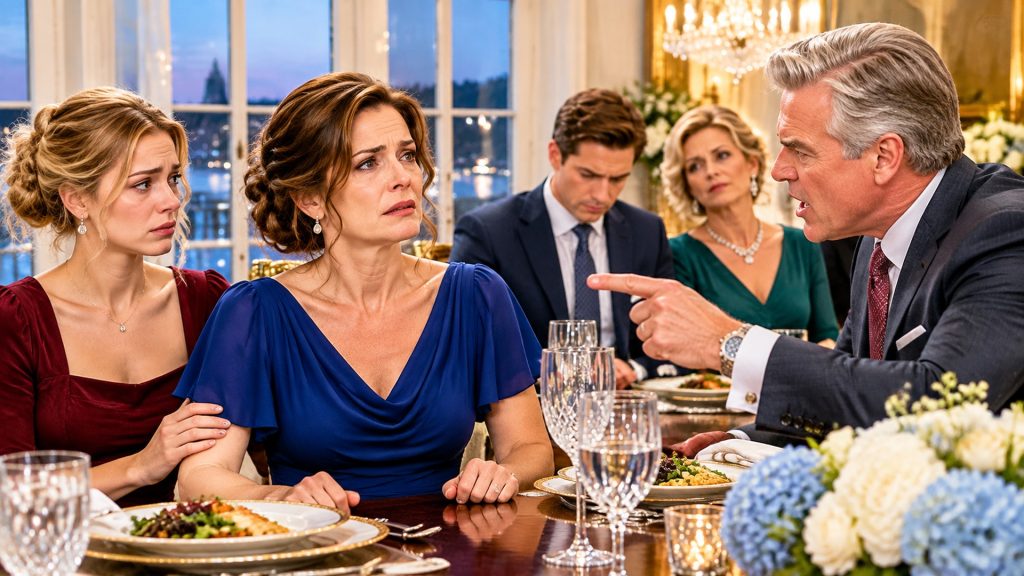
My father threatened Olivia if I told anyone. I looked toward my aide, Lieutenant Colonel Rebecca Foster. “Where did this come from?” “Through the Navy investigative liaison, ma’am. The reporting sailor asked that it reach the oversight team.” I lowered the paper. “Has the source been verified?”
“Not completely. The Navy investigator is confirming the statement and its supporting documents.”
I nodded slowly.
“Then we treat it as an allegation until the evidence establishes what happened.”
Rebecca watched me carefully.
“Yes, General.”
I looked toward the conference room door.
Captain Richard Whitmore had walked through it only minutes earlier.
He had entered that morning expecting a routine oversight meeting.
Instead, he had discovered that the woman he’d humiliated at dinner was a three-star Army general.
But now something more troubling was emerging.
His own son might have evidence of misconduct.
And my daughter might have become part of the pressure used to keep that evidence hidden.
I handed the memorandum back to Rebecca.
“Make sure the appropriate investigators receive everything. Preserve the original submission and its handling record.”
“Yes, ma’am.”
“And Rebecca?”
She stopped.
“Keep me out of any investigative decision involving my daughter’s relationship unless there’s a clear official requirement for my participation.”
She nodded.
“Understood.”
I waited until she left.
Then I closed my office door.
For several seconds, I stood alone.
I had spent a lifetime learning how to remain composed during emergencies.
But nothing in my training had prepared me to read my daughter’s name in a report suggesting someone might have threatened her.
I picked up my personal phone.
And called Olivia.
My name is Lieutenant General Victoria Hayes.
I was fifty-three years old when I learned that the hardest kind of leadership wasn’t commanding soldiers.
It was knowing when to step aside and let people you trusted do their jobs.
For more than three decades, I had served in the United States Army.
I had led soldiers far from home.
Managed difficult assignments.
Made decisions with consequences that extended well beyond my office.
I understood responsibility.
Accountability.
And the importance of preserving trust.
But I had also raised a daughter alone.
My husband, Michael, died when Olivia was four.
He was an Army officer too.
A good man with a gentle smile and a habit of leaving handwritten notes inside my luggage before deployments.
After he died, I made Olivia a promise.
I would never allow her to feel that she had lost both parents.
There were difficult years.
Long separations.
Birthday celebrations arranged around military obligations.
Phone calls from distant places.
And nights when I cried quietly because I missed my husband and worried whether I was giving our daughter enough.
But Olivia grew into a thoughtful, independent woman.
At twenty-six, she worked as a physical therapist.
She loved her patients.
Volunteered with organizations supporting veterans.
And believed people should be treated with dignity regardless of their circumstances.
I was proud of her.
More proud than any medal or promotion had ever made me.
And now her future was tangled in a situation that threatened everything she believed about the man she intended to marry.
Olivia answered on the third ring.
“Mom?”
“Hello, sweetheart.”
She sounded tired.
“Are you okay?”
I looked toward the window.
“Yes. But I need to ask you something.”
She went quiet.
“Okay.”
I took a breath.
“Has Richard Whitmore ever threatened you?”
Silence.
Then she whispered, “Why?”
My stomach tightened.
“Olivia.”
She exhaled shakily.
“Mom, what happened?”
I closed my eyes.
“I can’t discuss the details of an official investigation. But I’ve received information that makes me concerned about your safety.”
She didn’t answer.
I waited.
Then I asked gently, “Has he threatened you?”
A long silence followed.
Finally, she whispered, “Yes.”
My heart seemed to stop.
I sat down.
“When?”
“Last Wednesday.”
I looked at the calendar on my desk.
Two days before the dinner.
“What happened?”
Olivia began crying.
“Ethan had been arguing with his father.”
I listened.
“Richard told him to stop asking questions about something at work.”
My chest tightened.
“Did Ethan tell you what it was?”
“No.”
She sniffled.
“He said there were things happening that made him uncomfortable.”
I gripped the phone.
“Go on.”
Olivia took a breath.
“Richard came to my apartment that afternoon.”
My eyes widened.
“Alone?”
“Yes.”
“What did he say?”
Her voice broke.
“He told me Ethan needed to remember where his loyalties belonged.”
I closed my eyes.
“And?”
“He said if Ethan embarrassed the family, he’d make sure my professional reputation suffered.”
My jaw tightened.
Olivia continued.
“He said people in important positions could make life difficult for someone working in healthcare.”
I stared at the wall.
“He mentioned my employer.”
My chest tightened.
“And he told me not to interfere in family business.”
For a moment, every instinct in me wanted to march directly to Richard’s office.
I wanted to demand answers.
To remind him that my daughter wasn’t someone he could intimidate.
To make him understand that threatening a young woman because he believed she lacked influence was unacceptable.
But I knew anger could complicate an investigation.
And I knew Olivia needed her mother more than she needed a general.
So I took a breath.
“Sweetheart, are you safe right now?”
“Yes.”
“Where are you?”
“At home.”
“Is anyone with you?”
“No.”
I considered.
“Would you like me to come over?”
Her voice broke.
“Please.”
I stood.
“I’ll be there.”
I arranged for the appropriate officials to handle the matter without my personal involvement in the investigative decisions.
Then I left the office.
No dramatic confrontation.
No demand that Richard be arrested.
No order based on a mother’s anger.
Just a report forwarded to the people responsible for examining it.
I had learned long ago that legitimate authority came with limits.
And those limits mattered most when emotions ran high.
Olivia opened her apartment door before I knocked.
Her eyes were red.
She was wearing the same gray sweater she’d worn during college finals, the one she always reached for when she was anxious.
“Mom.”
I stepped forward.
She fell into my arms.
For a long time, we stood in the doorway.
She cried against my shoulder.
And I held her as though she were four years old again, waking from nightmares after her father’s funeral.
Finally, she whispered, “I’m sorry.”
I pulled back.
“For what?”
“For not telling you.”
I looked into her eyes.
“You didn’t cause Richard’s behavior.”
She began crying again.
I guided her to the couch.
We sat together.
Then I asked, “Why didn’t you tell me?”
She stared at her hands.
“Because Ethan asked me not to make things worse.”
My chest tightened.
“Did he know his father had threatened you?”
She nodded.
“Yes.”
I closed my eyes.
“And what did he do?”
Olivia swallowed.
“He told me he’d handle it.”
I looked toward the window.
Outside, traffic moved along the street.
People went about their ordinary lives.
I thought about Friday’s dinner.
Richard insulting me.
Patricia laughing.
Olivia fighting tears.
And Ethan staring at his plate.
I had wondered whether his silence was cowardice.
Now I began to understand that fear had been growing inside that family long before I’d entered their mansion.
But understanding someone’s fear didn’t erase the consequences of remaining silent.
I turned toward Olivia.
“Sweetheart, do you feel safe with Ethan?”
She hesitated.
“I love him.”
I nodded.
“I know.”
She looked down.
“But I’m not sure I trust him to stand up to his father.”
My heart ached.
I took her hand.
“That’s something you deserve to understand before marrying him.”
Olivia began crying.
“I thought he was different.”
I listened.
“He’s kind when we’re alone.”
She swallowed.
“He volunteers. He helps his friends. He’s wonderful with children.”
Her eyes filled.
“But when his father is around, he becomes someone else.”
I nodded slowly.
She continued.
“He apologizes afterward.”
I looked at her.
“But he doesn’t stop it.”
I squeezed her hand.
“Then you have a question to answer.”
She looked up.
“Can you build a marriage with someone who understands what’s right but is afraid to act on it?”
We sat quietly.
I didn’t tell Olivia to cancel the wedding.
I didn’t tell her to forgive Ethan.
I didn’t make the choice for her.
I had spent her childhood teaching her to think independently.
I wasn’t going to abandon that principle simply because I disliked her future father-in-law.
But I also wasn’t going to pretend that love made every problem harmless.
Later that evening, Ethan called.
Olivia stared at the screen.
Then looked at me.
“Should I answer?”
I took a breath.
“Do you want to?”
She nodded slowly.
“Then answer.”
She put the phone on speaker with his knowledge.
“Ethan?”
His voice sounded exhausted.
“Liv.”
She swallowed.
“What happened?”
A pause.
Then he said, “I heard Dad was removed from the oversight meeting.”
I remained silent.
Ethan continued.
“He knows your mother’s a general.”
Olivia looked at me.
“Yes.”
Another pause.
Then he whispered, “I should’ve told you everything.”
My stomach tightened.
Olivia closed her eyes.
“Then tell me now.”
Ethan began explaining.
He was twenty-eight and served as a Navy logistics officer at a different level of responsibility from his father.
Several months earlier, he’d become aware of discrepancies involving equipment movement records at an installation associated with his father’s oversight responsibilities.
At first, he assumed the issues were administrative.
Missing entries.
Incorrect serial numbers.
Items appearing in one inventory system but not another.
But when he asked questions, he encountered resistance.
A junior sailor had reported similar concerns.
That sailor’s supervisor allegedly dismissed the report.
Ethan began keeping notes.
He wanted to make sure the discrepancies were properly examined.
Then Richard found out.
“Dad told me I was embarrassing him,” Ethan said.
His voice shook.
“He said people make mistakes in logistics all the time.”
Olivia looked down.
“And?”
“He said I was turning routine paperwork problems into accusations.”
I listened.
Ethan continued.
“Then he told me I needed to decide whether I was loyal to my family.”
Olivia began crying.
“Ethan, why didn’t you tell me?”
His voice broke.
“Because I was afraid.”
I looked at her.
She wiped her cheeks.
“Afraid of what?”
A long pause.
“Of losing everything.”
Ethan admitted that his father had exerted enormous influence over his life.
Richard had pushed him toward the Naval Academy.
Chosen much of his career path.
Introduced him to influential people.
And repeatedly reminded him that family reputation mattered more than personal feelings.
Whenever Ethan disagreed, Richard accused him of being weak.
Ungrateful.
Disloyal.
Ethan had learned to avoid confrontation.
He became successful professionally.
But when it came to his father, he still behaved like a frightened boy.
Olivia listened.
Then asked quietly, “Did you know he threatened me?”
Ethan didn’t answer immediately.
Finally, he whispered, “Yes.”
Her face crumpled.
“And you still asked me to stay quiet?”
His voice broke.
“I thought I could fix it.”
Olivia shook her head.
“Ethan, he came to my workplace’s parking lot.”
I turned sharply.
That was new.
I looked at her.
She continued.
“He waited beside my car after my shift.”
My chest tightened.
“Olivia,” I whispered.
She raised one hand, asking me to let her finish.
I nodded.
She spoke into the phone.
“He knew where I worked, Ethan.”
Her voice trembled.
“And you told me not to make things worse.”
Ethan began crying.
“I know.”
Olivia closed her eyes.
Then said something that made me proud.
“Ethan, I love you.”
His breath caught.
“But I cannot marry someone who expects me to accept intimidation to keep his father happy.”
He began sobbing.
“Please, Liv.”
She swallowed.
“I need time.”
He was silent.
Then whispered, “I understand.”
She ended the call.
And collapsed into my arms.
I held her for a long time.
Not as a general.
Not as someone with authority.
Just as a mother watching her daughter grieve the future she’d imagined.
The following morning, Olivia contacted the appropriate authorities about Richard’s threats.
She provided a factual account.
Dates.
Locations.
What he had said.
Any messages or records she still possessed.
I encouraged her to document what she remembered while it was fresh.
But I did not tell her what conclusion investigators should reach.
Her safety and independence mattered.
So did the integrity of the process.
Meanwhile, the Navy investigation continued.
The allegations concerning equipment records were reviewed by the responsible investigative and oversight offices.
There were questions about procurement authorizations.
Inventory tracking.
Potential misuse of position.
And whether personnel had faced retaliation after reporting concerns.
Different agencies and commands had different responsibilities.
No one person could simply declare a verdict.
The records needed examination.
Witnesses needed to be heard.
And Richard needed an opportunity to respond through the applicable procedures.
I recused myself from decisions where my connection to Olivia or the Whitmore family created a personal conflict.
That meant I received fewer details than some people expected.
I didn’t call investigators demanding updates.
Didn’t ask my staff to access information I wasn’t entitled to see.
And didn’t turn the inquiry into a personal campaign.
It frustrated me.
Of course it did.
But integrity isn’t simply doing the right thing when it’s convenient.
It’s respecting the process when you have powerful reasons to want a particular outcome.
One afternoon, Rebecca approached me after a briefing.
“General Hayes?”
I looked up.
“Yes?”
“The Navy liaison has confirmed that the memorandum attributed to Ethan has been authenticated as his submission.”
I nodded.
“And the information?”
“They’re examining the supporting records.”
“Good.”
Rebecca hesitated.
“Ma’am, there’s something else.”
I looked at her.
She continued.
“Ethan requested to provide additional information through the proper investigative channel.”
My chest tightened.
I thought about the young man who’d stared at his dinner plate while his father humiliated me.
Perhaps he was finally beginning to find his voice.
Ethan’s decision didn’t come without consequences.
Richard was furious.
He accused his son of betrayal.
Called him ungrateful.
Threatened to withdraw financial support connected to various family arrangements.
And warned him that the family would never forgive him.
Ethan didn’t tell me those things directly.
Olivia learned some of them later.
But I could imagine how difficult it was.
For years, Ethan had built his identity around his father’s approval.
Now he was facing the possibility of losing it.
Two weeks after the original briefing, Ethan asked whether he could speak with me.
I considered carefully.
Because of the ongoing investigation and our family connection, I couldn’t discuss the official allegations with him privately.
But I could speak with him as Olivia’s mother, provided we maintained clear boundaries.
I agreed to a conversation at my home with that understanding.
He arrived wearing civilian clothes.
A plain blue shirt.
Dark trousers.
No expensive watch.
No confident smile.
When I opened the door, he stood awkwardly.
“General Hayes.”
I looked at him.
“Victoria is fine here.”
He swallowed.
“Thank you.”
I stepped aside.
We sat in the living room.
For a moment, Ethan stared at the photographs on the mantel.
One showed Olivia as a little girl sitting on Michael’s shoulders.
Another showed her at college graduation.
A third showed the two of us laughing during a vacation in Colorado.
Ethan looked at them.
Then whispered, “She loves you so much.”
I smiled gently.
“And I love her.”
He nodded.
His eyes filled.
Then he turned toward me.
“I’m sorry.”
I waited.
He continued.
“For Friday.”
I nodded.
He swallowed.
“I should have stood up.”
“Yes.”
His face crumpled.
“I wanted to.”
I looked at him.
“But you didn’t.”
He nodded.
“No.”
For a long moment, neither of us spoke.
Then Ethan said, “My father has always been like that.”
I listened.
“He makes people feel small.”
His voice trembled.
“And when someone challenges him, he acts like they’re attacking the whole family.”
I nodded.
“That’s a difficult environment to grow up in.”
He looked down.
“But it doesn’t excuse what I did.”
I felt a small measure of respect for him.
“No,” I agreed. “It doesn’t.”
He took a breath.
“I love Olivia.”
I nodded.
“I believe you.”
His eyes filled.
“But I hurt her.”
“Yes.”
He covered his face.
“I don’t know how to fix it.”
I considered.
“Ethan, some things can’t be fixed by one conversation.”
He looked up.
“Then what do I do?”
I thought about the soldiers I’d mentored over the years.
Young officers who made mistakes.
Leaders who needed to learn that responsibility meant more than making promises.
I leaned forward.
“You become someone whose actions match his values.”
He swallowed.
“You tell the truth.”
He nodded.
“You accept consequences.”
Another nod.
“And you learn to stand up for people even when doing so costs you approval.”
His eyes filled.
I continued.
“Especially when it costs you approval.”
He sat quietly.
Then whispered, “Do you think Olivia will ever forgive me?”
I looked toward her photograph.
“That belongs to Olivia.”
He nodded.
“I know.”
I smiled gently.
“But whatever happens between you, becoming a more courageous man will still be worthwhile.”
Ethan left shortly afterward.
He didn’t ask me to intervene.
Didn’t ask me to influence the investigation.
Didn’t ask me to persuade Olivia to take him back.
That mattered.
Because for the first time, he seemed to understand that he couldn’t solve the problem by getting someone more powerful to make it disappear.
He would have to change his own behavior.
Months passed.
The investigation continued through the proper channels.
Some findings supported serious concerns about how equipment records had been managed.
Other allegations required further examination or were not substantiated.
The authorities considered the evidence relating to Richard’s conduct, his supervisory responsibilities, and any improper interference with reporting.
There were administrative decisions.
Formal proceedings.
And accountability measures based on the conduct established through the applicable process.
Richard’s career was affected.
His responsibilities changed.
And his reputation suffered consequences that no dinner-table apology could erase.
I took no pleasure in it.
Because military accountability isn’t supposed to be personal revenge.
It exists to protect the integrity of the service and the people who depend on it.
One evening, Olivia came to my house carrying a paper bag from our favorite bakery.
She looked tired.
But calmer.
“Mom?”
I smiled.
“Hello, sweetheart.”
She set the bag on the counter.
“I brought cinnamon rolls.”
I laughed.
“Bribery?”
She grinned.
“Absolutely.”
We made coffee.
Sat at the kitchen table.
And talked about ordinary things.
Her patients.
A funny conversation with a coworker.
The weather.
Then she grew quiet.
“Mom?”
“Yes?”
“I talked to Ethan.”
I looked up.
“How was it?”
She considered.
“Different.”
I nodded.
“How?”
She looked down.
“He didn’t make excuses.”
My chest tightened.
“He apologized.”
I waited.
“And he didn’t ask me to forgive him immediately.”
I smiled faintly.
“That’s a meaningful difference.”
She nodded.
“He said he understands that I need someone who will stand beside me when things are difficult.”
I looked at her.
“And what do you think?”
Her eyes filled.
“I think I still love him.”
I took her hand.
“Love doesn’t disappear simply because someone disappoints us.”
She nodded.
“But trust can be damaged.”
“Yes.”
She swallowed.
“And rebuilding it takes time.”
I smiled.
“Exactly.”
Olivia didn’t rush back into the engagement.
She returned the ring to Ethan temporarily.
They agreed to spend time apart.
Both sought counseling.
Ethan worked on understanding how his father’s behavior had shaped his own responses.
Olivia worked through the fear and disappointment she’d experienced.
They spoke occasionally.
Then more regularly.
But without promising a wedding date.
I respected that.
Because marriage should never become a race to avoid embarrassment.
During that time, Olivia began volunteering more frequently with a program supporting military families.
She worked with spouses and children adapting to deployments, relocations, and other challenges.
One afternoon, she told me about a young woman she’d met.
The woman’s husband was away on assignment.
She was caring for two children while working full-time.
And she felt overwhelmed.
Olivia listened.
Helped her find appropriate support resources.
And stayed after the session to make sure she understood her options.
When Olivia told me, her eyes filled.
“Mom, she reminded me of you.”
My throat tightened.
“Me?”
She nodded.
“When Dad died.”
I looked down.
Olivia continued.
“You were doing everything.”
My eyes filled.
“Working.”
“Taking care of me.”
“Trying to make sure I was okay.”
I smiled sadly.
“I had help, sweetheart.”
She nodded.
“But you never let me feel like we weren’t a real family.”
For a moment, I couldn’t speak.
Then Olivia reached for my hand.
“That’s why what Richard said hurt so much.”
My throat tightened.
She continued.
“He made it sound like growing up with one parent meant something was missing from who I was.”
I swallowed.
“Olivia.”
She smiled through tears.
“But I never felt like less of a person because it was just you and me.”
I began crying.
She squeezed my hand.
“You gave me a beautiful childhood, Mom.”
I thought about all the nights I’d worried.
The missed school events.
The deployments.
The phone calls from distant bases.
The times I’d come home exhausted and wondered whether I was enough.
I had never needed a medal as much as I needed those words.
I reached for my daughter.
And held her tightly.
The months continued passing.
Ethan remained in the Navy.
His involvement in reporting the concerns did not make him immune from scrutiny regarding his own actions, but he cooperated with the appropriate review.
He continued counseling.
Learned to set boundaries with his father.
And stopped treating Richard’s approval as the measure of his worth.
Those changes weren’t dramatic.
They happened through ordinary choices.
Speaking honestly.
Following procedures.
Accepting discomfort.
And refusing to ask Olivia to tolerate disrespect for the sake of keeping peace.
One Sunday, Olivia asked whether Ethan could join us for dinner.
I considered.
Then smiled.
“Of course.”
She looked relieved.
“Thank you.”
I laughed softly.
“Sweetheart, I’m not going to make you hide your life from me.”
Her eyes filled.
“I know.”
Ethan arrived carrying flowers.
Nothing extravagant.
A simple bouquet of yellow roses.
He looked nervous.
“Victoria.”
I smiled.
“Hello, Ethan.”
He handed me the flowers.
“These are for you.”
I raised an eyebrow.
“Trying to bribe me?”
He laughed nervously.
“Maybe a little.”
I smiled.
“Then you should know I prefer chocolate.”
Olivia burst out laughing.
For the first time since Friday’s dinner, the three of us laughed together.
The meal was simple.
Roast chicken.
Potatoes.
Green beans.
And homemade bread.
I had cooked everything myself.
Ethan offered to help carry the dishes.
I handed him a serving bowl.
He smiled.
“Thank you.”
We sat.
Talked.
And gradually relaxed.
At one point, Ethan looked around my dining room.
“This is a beautiful home.”
I smiled.
“Thank you.”
He glanced toward the photographs.
“Olivia told me you bought it when she was little.”
I nodded.
“Yes.”
He smiled.
“She said you used to let her paint the garden fence.”
I laughed.
“Unfortunately.”
Olivia grinned.
“I made it colorful.”
I shook my head.
“You made it purple.”
She laughed.
“And orange.”
I smiled.
“And orange.”
For a moment, I looked at the two of them.
They seemed comfortable.
Not trying to impress anyone.
Just enjoying dinner.
Then Ethan grew serious.
“Victoria, may I say something?”
I nodded.
“Of course.”
He looked at me.
“I’ve thought a lot about that Friday evening.”
I remained quiet.
He continued.
“I remember watching my father push that glass toward you.”
His face tightened.
“And I remember knowing it was wrong.”
I nodded.
He swallowed.
“But I stayed silent.”
I waited.
He looked toward Olivia.
“And when he insulted your family, I still didn’t speak.”
Olivia’s eyes filled.
Ethan turned back toward me.
“I’m sorry.”
I looked at him.
“Thank you for saying that.”
He nodded.
I continued.
“But I hope you’ve learned something more important than how to apologize.”
He swallowed.
“What?”
I smiled gently.
“That respect shouldn’t depend on whether someone turns out to outrank you.”
His eyes filled.
“I have.”
I leaned forward.
“You should have defended Olivia’s mother because she was being treated cruelly.”
He nodded.
“Not because she was a general.”
“Yes.”
I smiled.
“Then keep remembering that.”
Later, while Olivia washed dishes, Ethan helped me clear the table.
He carried plates into the kitchen.
Then returned for the glasses.
I watched him.
At one point, he noticed my expression.
“What?”
I smiled.
“Nothing.”
He laughed nervously.
“Did I do something wrong?”
I shook my head.
“No.”
Then I said, “You know, Ethan, helping with dishes is a very respectable activity.”
He smiled.
“I agree.”
From the kitchen, Olivia laughed.
“Especially when you’re the one doing it!”
We all laughed.
And something inside me softened.
Not because everything had been forgotten.
But because ordinary kindness was beginning to replace old embarrassment.
A year after the dinner at the Whitmore mansion, Olivia and Ethan decided to become engaged again.
This time, they made the decision quietly.
No elaborate announcement.
No expensive celebration.
No pressure from either family.
Ethan proposed during a walk along the Chesapeake Bay.
Olivia later told me he’d said something simple.
“I want to build a life where we always choose honesty over fear.”
She’d cried.
Then said yes.
When she called me that evening, I was sitting in my office reviewing a briefing.
“Mom?”
I smiled.
“Hello, sweetheart.”
She was laughing and crying at the same time.
“Ethan proposed.”
I closed the folder.
“And?”
She laughed.
“I said yes!”
My eyes filled.
“Oh, Olivia.”
She began crying.
“Mom, I’m happy.”
I smiled through tears.
“Then I’m happy for you.”
The wedding took place six months later.
It was small.
A garden ceremony near Annapolis.
Family.
Close friends.
A few military colleagues.
And people who’d been part of Olivia and Ethan’s lives for years.
Richard did not attend.
His relationship with Ethan remained strained.
There had been attempts at communication, but Richard was not ready to acknowledge the harm caused by his behavior without shifting blame.
Ethan had decided that his wedding would not be another occasion where his father’s anger controlled everyone else.
It wasn’t an easy choice.
But it was his.
And he accepted responsibility for it.
Patricia attended.
She had apologized to Olivia and me after considerable time and reflection.
At first, she’d insisted the dinner had been a misunderstanding.
But eventually, she acknowledged that she’d participated in the humiliation.
She’d laughed.
Dismissed my work.
And allowed her husband’s status to shape how she treated me.
Her apology didn’t erase that.
But it opened the possibility of a more respectful relationship.
On the morning of the wedding, Olivia asked me to help fasten her necklace.
We stood in a quiet room overlooking the garden.
She wore a simple ivory gown.
Her hair was pinned back.
And around her neck was a small pendant that had belonged to Michael.
She looked at herself in the mirror.
Then turned toward me.
“Mom?”
I smiled.
“Yes?”
“Do you think Dad would be proud?”
My throat tightened.
I looked at the pendant.
Then at my daughter.
“Oh, sweetheart.”
She began crying.
I took her hands.
“Your father loved you more than anything in the world.”
Her eyes filled.
“And he would’ve been proud of the woman you’ve become.”
She swallowed.
“Even though he isn’t here?”
I smiled through tears.
“Especially because you’ve grown into someone who carries his kindness with you.”
She hugged me.
For a long time, I held her.
Then she whispered, “Thank you for raising me.”
My heart broke open.
I kissed her forehead.
“Thank you for letting me.”
The ceremony was beautiful.
Not because of the flowers.
Not because of the venue.
But because it felt honest.
Ethan stood beneath the archway looking nervous.
When Olivia appeared, his eyes filled.
I walked beside her.
She held my arm tightly.
As we reached the front, Ethan stepped forward.
He looked at me.
Then said quietly, “Thank you, Victoria.”
I smiled.
“Take care of each other.”
He nodded.
“We will.”
I kissed Olivia’s cheek.
Then took my seat.
Their vows were simple.
Ethan promised to listen.
To speak up.
To be honest even when the truth was uncomfortable.
Olivia promised to offer the same respect.
To face difficulties together.
And to build a home where kindness mattered more than appearances.
I cried.
Of course I did.
I was a general.
But I was also a mother.
And nothing about rank makes watching your child marry any less emotional.
During the reception, Patricia approached me.
She looked nervous.
“Victoria?”
I smiled politely.
“Patricia.”
She took a breath.
“I wanted to thank you for being here.”
I nodded.
“Of course.”
She hesitated.
“May I say something?”
I waited.
She looked down.
“I’ve spent many years allowing Richard’s opinions to become my own.”
Her eyes filled.
“I laughed that night because I wanted to support my husband.”
I remained quiet.
She continued.
“But I was wrong.”
I nodded.
“Yes.”
She swallowed.
“I should have treated you with respect regardless of what you did for a living.”
I smiled gently.
“That’s true.”
She looked up.
“And I should have defended Olivia.”
My eyes filled.
“Yes.”
Patricia began crying.
“I’m sorry.”
I took a breath.
“Thank you for acknowledging that.”
We didn’t become close friends overnight.
But we began speaking more respectfully.
Sometimes that was enough.
The beginning of something better doesn’t always announce itself dramatically.
Sometimes it’s simply one person choosing not to repeat an old mistake.
The investigation into Richard’s conduct eventually reached its formal conclusion.
The findings and resulting actions belonged to the responsible military authorities.
I did not control them.
I did not ask for special treatment.
And I did not use my daughter’s marriage as a reason to influence the result.
The established misconduct brought professional consequences.
Other allegations were evaluated according to the evidence.
The process was difficult for everyone involved.
But it reinforced something I’d believed throughout my career.
Military authority isn’t personal property.
It exists within a system of law, duty, and accountability.
And no one should be allowed to use rank or influence as a shield against legitimate scrutiny.
As for Ethan, he continued building his own career.
He learned to separate respect for his father from obedience to every demand.
He remained committed to serving honorably.
And he became more thoughtful about how his actions affected the people around him.
One afternoon, he told me something that stayed with me.
“Victoria, I used to think courage meant never being afraid.”
I smiled.
“Many people do.”
He nodded.
“But I was afraid of Dad for years.”
I listened.
“And I kept waiting until I felt brave enough to disagree with him.”
I smiled gently.
“What changed?”
He considered.
“I realized I might never stop being afraid.”
His eyes filled.
“So I had to decide what mattered more.”
I nodded.
“That sounds like courage to me.”
Olivia and Ethan built a life together.
Not perfect.
No marriage is.
But honest.
They worked.
Paid bills.
Argued occasionally.
Apologized.
And learned to make decisions as partners.
Sometimes they asked my advice.
Sometimes they didn’t.
I respected that.
They were adults.
Their marriage belonged to them.
I continued serving in the Army.
There were briefings.
Assignments.
Personnel decisions.
Long days.
And difficult conversations.
But as I grew older, I began thinking more about what I wanted my legacy to be.
Not just the missions I’d supported.
The positions I’d held.
Or the stars on my uniform.
I wanted to be remembered as someone who treated people fairly.
Someone who listened.
Someone who understood that leadership required humility.
And someone who never confused authority with personal importance.
One morning, a young Army captain approached me after a professional development session.
“General Hayes?”
I looked up.
“Yes, Captain?”
He looked nervous.
“May I ask you something?”
“Of course.”
He hesitated.
“How do you know when to speak up?”
I considered.
“About what?”
“When someone senior is doing something you believe is wrong.”
I looked at him.
Then smiled gently.
“That’s one of the hardest questions in leadership.”
He nodded.
I continued.
“You start by understanding the facts and the proper channels available.”
He listened.
“Then you remember that loyalty to the mission and the people you serve is not the same as personal loyalty to someone who outranks you.”
His expression changed.
I smiled.
“And you don’t need to be fearless.”
He looked up.
“You don’t?”
I shook my head.
“You need to be willing to act responsibly despite fear.”
He stood quietly.
Then nodded.
“Thank you, General.”
I smiled.
“You’re welcome.”
As he walked away, I thought about Ethan.
About Richard.
About Friday’s dinner.
And about how easily people can mistake rank for character.
A few months later, Olivia called with news that made me sit down.
“Mom?”
“Hello, sweetheart.”
She sounded excited.
“Are you busy?”
I laughed.
“Always.”
She giggled.
“Can I tell you something?”
My heart jumped.
“Of course.”
A pause.
Then she whispered, “You’re going to be a grandmother.”
For a moment, I couldn’t speak.
Then tears filled my eyes.
“Olivia.”
She laughed through tears.
“Mom!”
I covered my mouth.
“Oh, sweetheart.”
She began crying too.
“Are you happy?”
I laughed.
“Happy?”
My voice broke.
“I’m overjoyed.”
The months that followed were filled with anticipation.
Olivia and Ethan prepared their home.
Painted a nursery.
Read books.
Attended appointments.
And asked more questions than any two people I’d ever met.
I tried not to overwhelm them with advice.
Though I occasionally failed.
One afternoon, Olivia laughed.
“Mom, you’ve commanded thousands of soldiers, but you cannot command this baby to arrive on schedule.”
I grinned.
“Are you sure?”
She laughed.
“Very.”
When my granddaughter was born, I held her with trembling hands.
She was tiny.
Warm.
Perfect.
Olivia watched from the hospital bed.
Ethan stood beside her.
His eyes were filled with tears.
I looked down at the baby.
Then whispered, “Hello, sweetheart.”
She stirred.
I smiled.
“I’m your grandmother.”
For a moment, I thought about Michael.
How much he would’ve loved this.
Then I looked at Olivia.
At Ethan.
At the family they were building.
And I felt something peaceful settle inside me.
They named her Grace.
A name that seemed fitting.
Not because life had been easy.
But because it had taught us how much tenderness mattered.
One evening, when Grace was several months old, I visited Olivia’s house.
She was sitting on the couch, exhausted.
Grace slept nearby in a safe sleep space.
Ethan was in the kitchen preparing dinner.
I sat beside my daughter.
“Tired?”
She laughed softly.
“More than I knew was possible.”
I smiled.
“Welcome to motherhood.”
She leaned against me.
“Mom?”
“Yes?”
“Did you ever feel like you weren’t doing enough?”
My throat tightened.
I thought about all the years I’d questioned myself.
The deployments.
The missed birthdays.
The nights I cried after putting her to bed.
I smiled sadly.
“Every day.”
She looked up.
“Really?”
I nodded.
“Yes.”
Her eyes filled.
“But I learned something.”
“What?”
I took her hand.
“Children don’t need perfect parents.”
She listened.
“They need love, safety, honesty, and people willing to keep learning.”
Olivia smiled through tears.
“I hope I’m doing that.”
I kissed her forehead.
“You are.”
Later, Ethan carried dinner into the living room.
He placed the plates on the table.
Then smiled.
“Victoria, we saved you the largest portion.”
I raised an eyebrow.
“Trying to impress the general?”
He laughed.
“Always.”
Olivia rolled her eyes.
“Ethan.”
We laughed.
Then I looked at the little family around me.
The warm room.
The sleeping baby.
The man who’d once been too frightened to defend my daughter.
The woman who’d learned to demand respect without surrendering compassion.
And I felt grateful.
Not because everything had unfolded perfectly.
But because they had chosen to grow.
I thought about Richard occasionally.
The man who’d pushed his empty wineglass toward me.
The man who’d mocked me for raising a daughter alone.
The man who’d believed his rank gave him permission to humiliate someone he considered beneath him.
He had no idea who I was.
But that was never the real problem.
The problem was that he believed respect should be reserved for people with status.
And that belief had shaped far more than one dinner.
It had influenced his family.
His relationships.
And the way people around him understood authority.
I never wanted revenge.
I wanted accountability.
And I wanted my daughter to know that she never had to accept cruelty to earn a place in someone’s family.
People sometimes ask whether I enjoyed watching Richard discover my rank.
I won’t pretend the moment wasn’t memorable.
His expression changed instantly.
The laughter disappeared.
And the man who’d spoken so confidently at dinner suddenly struggled to meet my eyes.
But the real lesson wasn’t that I outranked him.
The real lesson was that I shouldn’t have needed three stars on my uniform to deserve basic respect.
A waitress deserves dignity.
A single mother deserves dignity.
A government clerk deserves dignity.
A military spouse deserves dignity.
A young sailor reporting concerns deserves dignity.
And a woman raising her child alone deserves to be treated as a complete family, not a lesser one.
I had spent my life serving in a profession built on responsibility.
And the longer I served, the more clearly I understood that rank was not proof of character.
It was a responsibility to exercise authority carefully.
To protect the people entrusted to you.
And to remember that the uniform did not make you more human than anyone else.
One evening, I stood in my study looking at a photograph of Michael.
He was smiling in uniform.
The same photograph Olivia used to keep beside her bed as a child.
I touched the frame.
For a moment, I imagined telling him everything.
About Friday’s dinner.
Richard’s arrogance.
Olivia’s tears.
Ethan’s silence.
The investigation.
The postponed wedding.
And the day our daughter finally married a man who’d learned to stand up for what mattered.
I imagined Michael listening.
Then giving that familiar gentle smile.
And saying, “Vic, you raised her well.”
My eyes filled.
I whispered, “We did.”
Outside, the evening sky turned pink.
I walked toward the window.
The house was quiet.
For years, I’d worried that my career had taken too much from Olivia.
That she’d missed something because I couldn’t be home for every moment.
That being a single mother had somehow made our family incomplete.
But now I understood something.
Our family had never been defined by the number of adults sitting at the dinner table.
It had been defined by the love we gave each other.
The promises we kept.
And the way we showed up when life became difficult.
The following Sunday, Olivia and Ethan invited me for dinner.
Grace was awake when I arrived.
She squealed when she saw me.
I laughed.
“Hello, my little sweetheart.”
Olivia smiled.
“She’s been waiting for Grandma.”
I lifted Grace gently.
Then kissed her forehead.
Ethan came from the kitchen carrying a tray.
“Victoria, would you like some wine?”
I smiled.
“Thank you.”
He poured me a glass.
Then paused.
For a moment, we both remembered another dinner.
Another table.
Another man holding out an empty glass.
Ethan looked at me.
Then smiled.
“Would you like me to bring it to you?”
I laughed.
“That would be lovely.”
He placed the glass beside me.
No command.
No humiliation.
Just kindness.
Later, while Olivia put Grace down for the night, Ethan and I stood beside the kitchen window.
He looked toward the dining room.
“Victoria?”
“Yes?”
“I still think about that first dinner.”
I nodded.
“So do I.”
He swallowed.
“I wish I’d done something different.”
I looked at him.
“I know.”
He continued.
“I can’t change what happened.”
“No.”
His eyes filled.
“But I hope I’ve shown you I’ve learned.”
I smiled gently.
“Ethan, you’ve shown me you’re trying to become a better man.”
He nodded.
“And that’s something worth continuing.”
He smiled.
Then returned to the kitchen.
I watched him go.
And thought about how much had changed.
Not because anyone had discovered my rank.
But because some people had finally learned that real strength wasn’t humiliating others.
It was standing up for them.
When dinner was ready, Olivia called from the dining room.
“Mom!”
I smiled.
“Coming, sweetheart.”
I walked toward the table.
Grace’s little blanket rested on a chair.
Family photographs lined the walls.
The room smelled of fresh bread and roasted vegetables.
I sat beside my daughter.
Ethan took the seat across from us.
And for a moment, everything felt wonderfully ordinary.
Olivia reached for my hand.
“Mom?”
I turned.
“Yes?”
“Thank you for walking out with me that night.”
My throat tightened.
I squeezed her hand.
“You never had to stay somewhere you were being treated cruelly.”
Her eyes filled.
“I know that now.”
I smiled.
“Good.”
Ethan looked at us.
Then said quietly, “I’m grateful you did.”
I raised an eyebrow.
“Really?”
He nodded.
“Because I might never have understood how much I needed to change.”
I smiled gently.
“Then make sure you remember the lesson.”
He nodded.
“I will.”
We ate dinner.
Laughed.
Talked about Grace.
Discussed work.
And planned a weekend visit.
Nobody shouted.
Nobody mocked anyone’s background.
Nobody measured another person’s worth by their title.
It was simply a family sharing a meal.
And after everything we’d been through, that felt extraordinary.
As I drove home that evening, I thought about the night Richard Whitmore pushed his empty wineglass toward me.
He believed I was a poor single mother.
Someone beneath him.
Someone he could command.
He laughed when I stood up.
He laughed when I walked away.
He laughed when I told him I understood military discipline better than he thought.
But the following Monday, the laughter disappeared.
He saw the stars on my uniform.
And discovered the woman he’d humiliated was a lieutenant general.
Yet the greatest lesson wasn’t the shock on his face.
It was what happened afterward.
The truth came out.
The appropriate authorities investigated.
My daughter learned to protect her dignity.
Ethan learned that loyalty didn’t mean silence.
And our family found a way forward through honesty rather than fear.
I didn’t need Richard to respect me because of my rank.
I needed him to understand that every person deserves respect even when they have no rank at all.
When I reached home, I took off my coat and walked into my study.
My uniform hung neatly in the closet.
Three stars gleamed on the shoulder boards.
I looked at them for a moment.
Then glanced toward the photograph of Olivia and Grace on my desk.
I smiled.
The uniform represented decades of service.
Responsibility.
Sacrifice.
And professional achievement.
But the photograph represented something even more precious.
The family I’d loved and protected through every difficult season of my life.
I picked up the photograph.
Then whispered, “This is what matters.”
Richard Whitmore had once asked what kind of family a single mother could possibly raise.
I finally had the answer.
A family that understood kindness.
A family that knew dignity couldn’t be measured in rank.
A family willing to face uncomfortable truths.
And a family that would never confuse arrogance with strength.
I turned off the study light.
As I walked toward the living room, my phone buzzed.
A message from Olivia.
Love you, Mom. Thank you for always showing me what real strength looks like.
I smiled through tears.
Then typed back:
Real strength is knowing when to stand tall, when to walk away, and when to stand beside someone who needs you.
I pressed send.
And for the first time in a long while, I felt completely at peace.
Because the greatest honor of my life had never been the three stars on my uniform.
It was being Olivia’s mother.