
The most difficult role Drew Barrymore ever played was not Gertie in E.T., the rebellious teenager in Poison Ivy, or the fearless woman who helped bring Charlie’s Angels to a new generation. It was learning how to become the adult she had needed when she was a child.
Because there is a strange cruelty in becoming famous before you understand what fame means. Millions of strangers recognize your face. They know your smile. They remember the way you laughed in a movie theater. They believe they know your childhood because they watched it unfold on a screen.
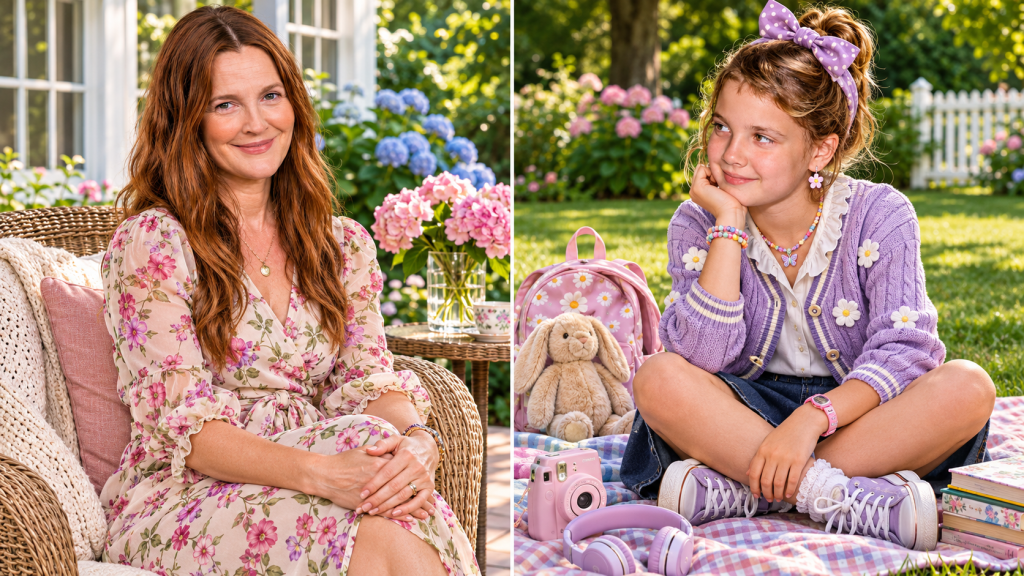
But they have no idea what happens when the cameras stop. And for Drew Barrymore, that difference between the child the world loved and the child who needed protection became one of the defining struggles of her life. She had been celebrated before she could understand success.
Judged before she understood adulthood.
And forced to rebuild her identity before most teenagers had even begun discovering theirs.
Yet the most remarkable part of her story is not that she escaped the worst possibilities of early fame.
It is that she kept changing.
Even after the public declared her recovered.
Even after her career flourished.
Even after she became a mother.
Because the truth about surviving a difficult childhood is that growing older does not automatically make the pain disappear.
Sometimes the hardest questions arrive when you finally have enough peace to hear them.
Imagine being fourteen years old and discovering that freedom has a terrifying second meaning.
You no longer have to live beneath the authority of adults whose decisions have repeatedly placed you in danger.
But suddenly, you are responsible for decisions that children should not have to make alone.
Where will you sleep?
How will you pay the rent?
Who will help when something goes wrong?
Who will tell you that you’ve made a mistake without turning the mistake into proof that you’re worthless?
These are ordinary adult concerns.
For a teenager emerging from addiction treatment and a deeply unstable family environment, they can become overwhelming.
Drew’s emancipation was a crucial turning point, but it was not a magical transformation from troubled child into confident woman.
It was a legal beginning.
The emotional work had barely started.
Accounts of her early independence describe her working at a coffeehouse and learning to manage life outside the structures that had previously controlled her. Sources differ slightly in how they describe her age at emancipation and moving into her own apartment, but the central fact remains: by her midteens, she was making adult decisions extraordinarily early. CBS News+2
There is something heartbreaking about that picture.
A teenager who had already appeared in one of the most beloved movies in history, trying to build a normal life.
A young woman with a famous surname, learning the unfamiliar discipline of ordinary responsibility.
An actress whose face could attract a crowd, but whose daily struggles could not be solved by applause.
The world saw independence.
She was discovering what independence actually demanded.
For much of Hollywood history, child stars have occupied an uncomfortable position.
They are celebrated for seeming older than their years.
Praised for their maturity.
Admired for delivering performances filled with emotions they may not yet understand.
Yet when their childhood needs become inconvenient, the same world can become impatient.
A child who performs brilliantly is called extraordinary.
A teenager who behaves chaotically is called irresponsible.
The transition between those judgments can happen without anyone asking what support the young person received along the way.
Drew’s childhood unfolded inside that contradiction.
Her parents came from a family already associated with entertainment history. The Barrymore name carried cultural prestige long before she appeared on screen.
But family reputation was not the same as family stability.
Her father, John Drew Barrymore, was largely absent from her upbringing, and her relationship with her mother, Jaid, became intertwined with the demands and dangers of early fame.
Drew later described the confusion of being exposed to adult environments long before she possessed the emotional tools to navigate them.
She experienced treatment, institutionalization, and estrangement at an age when most children are still learning how to organize their schoolwork.
Those experiences were serious.
And they deserve to be understood as more than colorful details in a celebrity legend. Los Angeles Times+1
Because a troubled child is still a child.
Even when that child is famous.
Especially then.
The first remarkable thing about Drew’s comeback was that it did not begin with a triumphant movie premiere.
It began with the willingness to accept a much less glamorous version of life.
For someone whose earliest memories included film sets, public attention, and adults making major decisions around her, ordinary work represented something unexpected.
Accountability without applause.
Routine without excitement.
The slow discovery that self-respect does not always arrive through external approval.
A paycheck earned outside Hollywood did not make her childhood disappear.
But it offered another way to understand herself.
She could be a person with responsibilities rather than merely a face people remembered.
That distinction mattered.
Because fame had arrived before she had a stable sense of who she was.
Now she needed to discover whether she could exist without it.
And that question would follow her for years.
Then Hollywood began looking at her differently.
The child who had once made audiences laugh in E.T. was now growing into a young woman whose public image carried controversy.
Her performance in Poison Ivy became part of a deliberate shift away from the innocent roles associated with childhood stardom.
The transformation was striking.
But perhaps more important was what it represented.
Drew was no longer waiting for the industry to preserve the image it had created for her.
She was exploring how to work within an industry that had already formed powerful opinions about her.
Some of those choices were provocative.
Some attracted criticism.
Some challenged the public’s lingering expectation that the little girl from E.T. should remain forever recognizable.
But childhood fame creates a peculiar prison.
Grow up too quickly, and people condemn you.
Try to remain the same, and people eventually stop seeing you as an adult.
Drew’s career required her to escape both expectations.
She had to become someone audiences could imagine in entirely different stories.
And she had to do that while the world continued comparing every new version of her to the child it remembered. Biography+1
By the mid-1990s, a different possibility was emerging.
Drew could do more than appear in films.
She could help decide which films existed.
In 1995, she founded Flower Films with Nancy Juvonen, a partnership that became a major force in her professional reinvention.
That decision changed the shape of her career.
An actor waits to see which roles are offered.
A producer participates in developing the stories, assembling the teams, and making the projects happen.
The distinction is enormous.
For a woman who had grown up being directed by adults, the chance to exercise creative judgment carried particular significance.
She wasn’t simply asking Hollywood to give her another opportunity.
She was helping create opportunities herself.
And that became one of the most important lessons of her career.
When the world has already decided what kind of person you are, sometimes the most powerful answer is to build something it didn’t expect. Us+1
Then came Scream.
The year was 1996.
Horror audiences expected familiar rules.
The recognizable star would survive.
The opening scene would introduce the danger.
The real story would begin afterward.
But Scream disrupted those expectations.
Drew played Casey Becker, the young woman whose terrifying telephone conversation opens the film.
Her appearance was heavily associated with its promotion.
Audiences had good reason to expect she would remain central to the story.
Instead, Casey died in the opening sequence.
It was shocking.
A famous actress, gone before the audience had settled into the movie.
The scene helped establish that the film was prepared to break the assumptions viewers brought into the theater.
And in an unexpected way, it mirrored something about Drew’s career.
The version of the story everyone anticipated was not necessarily the one she had to tell.
The familiar image could disappear.
Something new could follow.
What makes that performance especially memorable is not simply the surprise.
It is the vulnerability.
The fear.
The gradual recognition that the situation is far more dangerous than it first appeared.
Drew’s performance helped make the opening sequence one of modern horror cinema’s most recognizable moments.
And it reminded audiences that the actress they thought they understood could still surprise them.
She had not returned merely to preserve her childhood fame.
She had grown into a performer capable of using that fame in unexpected ways.
But the real turning point in her career was not any single scene.
It was the growing confidence to work across genres.
To be frightening in one film.
Funny in another.
Romantic in the next.
And eventually to help produce the movies in which she appeared.
In 1998, The Wedding Singer introduced audiences to a different side of her.
Opposite Adam Sandler, she played Julia, a kindhearted woman trying to understand what she truly wanted from love.
The film’s appeal came partly from the chemistry between its leads.
Their characters were awkward.
Sincere.
Sometimes ridiculous.
And deeply recognizable.
Drew possessed a kind of romantic-comedy warmth that audiences responded to.
It wasn’t the distant elegance of an untouchable movie star.
It was something more accessible.
The possibility that an ordinary person might still find extraordinary affection in an imperfect world.
There is a reason that kind of performance matters.
Comedy asks audiences to trust that the people on screen can make vulnerability feel safe.
And Drew had learned how to let warmth become part of her professional identity.
Then came Ever After.
A Cinderella story.
But not quite the fairy tale audiences expected.
Drew’s Danielle was intelligent, outspoken, and determined.
She did not simply wait for someone to recognize her worth.
She challenged the assumptions of the world around her.
She defended people treated as less important.
And she helped shape the future she wanted.
It would be too simple to claim that Drew chose every role as a conscious statement about her own childhood.
Only she can fully explain her private motivations.
But the roles that came to define this period of her career shared an intriguing quality.
They presented women who wanted to be seen as complete human beings.
Not decorative figures.
Not permanent victims.
Not people whose value depended entirely on being rescued.
In a career that began with a child being watched by the world, those stories formed a striking evolution.
And then came one of her most beloved films.
Never Been Kissed.
Drew played Josie Geller, a newspaper copy editor whose undercover assignment sends her back into the social world of high school.
Josie is successful in some ways.
But emotionally, she still carries the pain of adolescence.
She remembers humiliation.
Exclusion.
The feeling of being judged before anyone truly knows her.
The movie is a romantic comedy.
Yet beneath its jokes lies something more tender.
The recognition that growing older doesn’t automatically erase the loneliness of being young.
Sometimes adults carry their teenage selves into every room.
Sometimes the person standing before the world as accomplished and confident still remembers being rejected in a school hallway.
And sometimes healing begins when a person stops treating those memories as evidence that they were never worthy of love.
For audiences, Josie was funny and lovable.
For Drew, the role became another step in a career increasingly shaped by romantic comedies and production work.
Never Been Kissed was also associated with Flower Films, further establishing the company’s place in her professional life.
What began as a young actress reclaiming her career was becoming something bigger.
A creative business.
A partnership.
An ability to move between acting and producing.
She was not only surviving Hollywood’s changing expectations.
She was helping shape a place for herself within them.
Then, in 2000, Charlie’s Angels arrived.
‘Charlie’s Angels’ Is Full Of Peak Y2K Fashion Outfits
Celebrities Who Are Businessman | Celebrity Entrepreneurs
6
Three women.
Three distinct personalities.
A movie filled with action, humor, friendship, and spectacle.
Drew starred alongside Cameron Diaz and Lucy Liu, while Flower Films helped bring the project to the screen.
The film became an important commercial success and expanded the company’s visibility.
But beyond its box-office appeal, it represented something meaningful about Drew’s professional evolution.
She had become part of a team developing major studio entertainment.
A child star once viewed as a cautionary tale was now exercising creative and business influence in the industry that had watched her struggle.
There is a quiet satisfaction in that reversal.
The world had once treated her future as something already ruined.
Now she was helping produce movies watched by audiences around the world. Us+1
Yet success did not make her life a perfect upward climb.
That is one of the most important truths about her story.
Celebrity biographies often turn hardship into a simple arrangement.
A troubled childhood.
A dramatic recovery.
A triumphant career.
The end.
But life rarely honors such neat divisions.
A person can achieve extraordinary professional success and still struggle privately.
They can be deeply loved by audiences and still feel uncertain about themselves.
They can possess financial security and still confront the emotional consequences of instability.
Drew continued to evolve professionally.
She acted.
Produced.
Explored new genres.
And built a public identity that was increasingly associated with humor, warmth, and emotional openness.
But the questions raised by her childhood had not vanished.
They had simply taken new forms.
In 50 First Dates, she reunited with Adam Sandler.
The film told a fictional love story built around memory, patience, and repeated acts of commitment.
It resonated with audiences partly because its central relationship required affection to be demonstrated again and again.
Love wasn’t simply declared.
It had to be renewed.
Although the movie’s portrayal of memory impairment belongs to Hollywood fiction rather than medical reality, its emotional premise was recognizable.
Care is more than a grand gesture.
It is consistency.
The willingness to keep showing up.
The understanding that another person may need reassurance even when you wish they didn’t.
Those themes would later feel especially relevant to the way Drew spoke publicly about family and relationships.
Another important turning point came in 2009.
Drew directed Whip It.
A coming-of-age story about a teenage girl discovering roller derby and finding a sense of identity beyond the expectations placed upon her.
Directing demanded a different kind of leadership.
She wasn’t simply responsible for her own performance.
She had to help shape the entire film.
Guide creative choices.
Collaborate with actors and crew.
And carry responsibility for the finished work.
It was an important expansion of her artistic identity.
And it added another layer to the story of a child who had once been directed by others.
She was now the director.
A person responsible for making decisions and bringing a vision to life.
That didn’t erase the vulnerability she’d experienced when young.
But it demonstrated the distance she’d traveled professionally.
There is something powerful about an artist becoming more than the first role that made them famous.
Drew might have remained forever identified with Gertie.
The little girl who loved an extraterrestrial.
The child whose face became part of a cultural memory.
Instead, she developed a career spanning comedy, drama, horror, producing, directing, and eventually television hosting.
Some projects succeeded.
Others didn’t.
Some drew praise.
Others attracted criticism.
But she kept working.
And perhaps more importantly, she kept searching for the kind of work that suited the person she was becoming.
That is the part of the comeback story people often overlook.
A career isn’t redeemed once and permanently secured.
It has to be negotiated through changing interests, audiences, and personal circumstances.
Especially when the person building it has already lived several public identities before adulthood.
Then came motherhood.
And with it, a question that success could not answer.
What happens when a woman whose childhood lacked ordinary boundaries becomes responsible for creating those boundaries for someone else?
Drew welcomed two daughters, Olive and Frankie, with Will Kopelman.
Motherhood changed her priorities profoundly.
In interviews, she has spoken about wanting to give her daughters the stability and presence she had missed.
She has also been candid about the complexity of the task.
She didn’t simply announce that her children would have a different childhood and assume the work was finished.
She recognized that her own experiences could influence the way she understood separation, independence, and safety.
She wanted to protect her daughters without making them responsible for her emotional needs.
She wanted to be available without denying them the freedom to grow.
And she wanted their childhood to belong to them rather than becoming another chapter of her public career. AARP+1
Think about the difference between those two childhoods.
One child becomes famous before she understands why.
The world follows her private struggles.
Adults make choices that expose her to situations she isn’t prepared to handle.
Years later, that child becomes a mother.
Now the question is not how to maintain the attention of strangers.
It is how to create ordinary mornings.
School routines.
Meals.
Bedtimes.
Boundaries.
The unremarkable consistency that so many children take for granted.
There is no glamorous award for answering a child’s questions patiently.
No movie premiere for showing up when a daughter is sick.
No standing ovation for protecting a child’s privacy.
Yet for someone who grew up without enough dependable structure, those moments can carry enormous meaning.
They represent the chance to give another generation something different.
But motherhood also brought new emotional difficulties.
Drew had imagined building a traditional family.
When her marriage to Will Kopelman ended, that vision was painfully disrupted.
The divorce was not simply another celebrity headline.
By her own account, it forced her to confront feelings of failure and abandonment that connected with the experiences of her childhood.
She had wanted to give her daughters the kind of family stability she had missed.
Now she was facing the possibility that the family would look different from the one she’d pictured.
That can be devastating even when parents remain committed to caring for their children.
Because divorce doesn’t only change household arrangements.
It can also change a parent’s understanding of the future they thought they were building.
Drew has discussed the difficulty of this period with unusual candor.
She described struggling to find her footing.
Questioning her identity.
And feeling overwhelmed by the collapse of her hoped-for family structure.
Her professional achievements did not make those emotions disappear.
Nor did her fame provide a simple answer.
She was an adult woman with an extraordinary career, yet she was still confronting questions about belonging that had followed her since childhood.
The story was no longer about whether Hollywood would accept her.
It was about whether she could accept herself in a life that had not unfolded according to plan. Los Angeles Times+1
And there was another struggle.
Alcohol.
A substance that had entered her life when she was far too young to understand its dangers.
For years, her public image contained a complicated relationship with partying and excess.
But as she grew older, the meaning of those habits changed.
What had once seemed like part of an adventurous personality became connected to questions about coping, anxiety, and emotional pain.
Drew has spoken publicly about deciding to stop drinking and about the difficult work of understanding why alcohol had occupied such a place in her life.
She did not describe the decision as magically fixing everything.
Instead, she spoke about needing to examine the emotional patterns that remained after alcohol was no longer part of her daily life.
That distinction is important.
Changing a behavior can be a major achievement.
Understanding what the behavior helped someone avoid can require a different kind of courage. Us+1
For Drew, this was not a continuation of childhood in the simple sense.
She was no longer a teenager navigating addiction treatment.
She was an established adult reconsidering a long relationship with alcohol.
The circumstances had changed.
So had her responsibilities.
But her willingness to speak about the difficulty made the story more human.
It resisted the fantasy that a celebrity’s recovery can be measured by one triumphant appearance or one inspirational announcement.
Progress can be uneven.
It can involve seeking support.
Changing habits.
Reevaluating relationships.
And being willing to admit that what once felt manageable is no longer helping.
That may not make for a neat Hollywood ending.
But it is far more meaningful than pretending every painful chapter has closed forever.
One of the most revealing moments in her public reflections concerned her experience with therapy.
During a difficult period after her divorce, Drew described how her drinking became a serious obstacle in the work she was trying to do with her therapist.
The relationship was interrupted.
Later, after making changes, she returned to that therapeutic relationship.
What mattered in her account was not the drama of the rupture.
It was the realization that wanting to improve and actually changing could be two different things.
And that someone who had already achieved enormous professional success could still need help confronting private patterns.
There is humility in admitting that.
Especially for a person who has spent her entire life being watched.
The public may want its stars to appear permanently transformed.
But being human means remaining capable of change.
Even after fifty.
Even after success.
Even when the world thinks it already knows your story. Los Angeles Times
Then, in 2020, another unexpected chapter began.
The Drew Barrymore Show.
On paper, the transition made sense.
A famous actress with decades of experience becomes a television host.
Another celebrity career move.
But the program gradually revealed something more personal about the way Drew wanted to connect with audiences.
She laughed openly.
Reacted emotionally.
Listened closely.
And often allowed conversations to become less polished than conventional celebrity interviews.
The show became associated with her enthusiasm, vulnerability, and willingness to engage with people in ways that felt intimate.
That approach attracted affection.
It also sometimes attracted criticism.
Her style was not to everyone’s taste.
But it was recognizably hers.
And the woman who had spent much of her childhood under public examination now occupied a different role.
She was asking questions.
Inviting people to speak.
Creating space for stories beyond her own. Us+1
There is an important difference between performing happiness and allowing happiness to coexist with pain.
The first requires an audience to believe that nothing difficult remains.
The second accepts that a person can laugh while carrying sadness.
Can be grateful while remembering loss.
Can celebrate a career without pretending childhood was easy.
That tension became part of Drew’s television identity.
She seemed interested in people not only as celebrities or public figures, but as human beings with histories.
Her conversations often moved between humor and serious personal subjects.
The approach was sometimes messy.
Sometimes exuberant.
But it allowed her to present an adult identity that did not require hiding every difficult feeling.
And for a woman whose childhood struggles had been turned into public entertainment, choosing how to discuss vulnerability became a meaningful form of agency.
Yet one of the most complicated relationships in her life remained her relationship with her mother.
Jaid Barrymore had been central to her early career.
She had also been part of the environment in which Drew was exposed to adult nightlife while still a child.
Their relationship went through estrangement, conflict, and changing degrees of contact.
Drew has spoken with nuance about it.
She has not presented the relationship as a simple fairy tale of forgiveness.
Nor has she treated the pain of childhood as something that can be erased because she is now an adult.
She has described empathy for her mother’s circumstances while also maintaining boundaries.
That distinction deserves attention.
Understanding a parent’s struggles does not mean every decision was harmless.
Feeling compassion does not require surrendering one’s own safety or emotional wellbeing.
And forgiveness, when someone chooses it, need not mean returning to the relationship exactly as it once existed. People.com
The deeper meaning of that story is not that anger is always wrong.
Anger can identify harm.
It can reveal boundaries that were crossed.
It can motivate someone to protect themselves or seek change.
But anger alone cannot tell a person what kind of relationship is possible afterward.
That requires choices.
Sometimes distance.
Sometimes conversation.
Sometimes limited contact.
Sometimes accepting that another person may never provide the apology or understanding one hoped to receive.
Drew’s public reflections suggest an ongoing effort to approach her family history without letting it become the only explanation for who she is.
And perhaps that is one of the most mature forms of recovery.
Not pretending the past was harmless.
Not letting it decide every future possibility.
There is another part of Drew’s story that deserves more attention.
Her relationship with work.
For many people, work begins in adolescence or adulthood.
It offers a sense of purpose, independence, money, and identity.
For Drew, work arrived before her earliest school memories had fully formed.
She appeared in advertising as an infant.
Acted in films as a child.
And became internationally recognizable while still in elementary school.
That means the ordinary question of who she was apart from work became unusually difficult.
Was she Drew Barrymore the person?
Drew Barrymore the actress?
The Barrymore family descendant?
The child star?
The troubled teenager?
The successful producer?
The romantic-comedy heroine?
The mother?
The talk-show host?
For much of her life, those identities competed for attention.
And she had to learn that no single role could contain the whole person.
In later interviews, Drew has spoken about stepping back from film acting in order to focus more closely on motherhood and personal development.
It was a significant decision for someone whose life had been shaped by performance.
She wanted a schedule that allowed her to be present for her daughters.
She wanted to learn who she was outside the demands of playing characters.
And she wanted meaningful work that could coexist with the daily responsibilities of parenting.
The talk show became part of that new arrangement.
Not simply another credit.
A different professional structure.
A way of connecting with audiences while reshaping her life around changing priorities. Us+1
It would be easy to describe that decision as sacrificing a career for her children.
But that would miss something important.
Drew did not stop being creative.
She changed the form of her creativity.
She continued working.
Developing projects.
Building businesses.
Hosting conversations.
And exploring what success meant at a different stage of her life.
Her career became less about proving she could survive Hollywood and more about choosing the work that fit the life she wanted.
That is a different kind of freedom.
As a child, she had been famous before she could meaningfully choose the conditions of fame.
As an adult, she could decide which opportunities aligned with her priorities.
She could say yes.
And, when necessary, no.
Another part of the story appears whenever she discusses her daughters’ growing awareness of her past.
Children eventually become curious about their parents.
They discover old photographs.
Ask questions.
Find information online.
And sometimes confront adults with choices those adults made long before parenthood.
Drew has described navigating those conversations with Olive and Frankie, including the awkwardness of explaining decisions from her younger years while establishing appropriate boundaries for her children.
In a 2024 conversation with Christina Aguilera, she spoke about how her own public history complicated ordinary parenting discussions.
The lesson was not that parents must pretend to have lived perfect lives.
It was that experience does not eliminate the responsibility to make thoughtful choices for children.
A parent can acknowledge a complicated past without making that past a rulebook for the next generation. ABC News
That may be one of the most profound reversals in Drew’s life.
The child who once experienced too few boundaries became a mother trying to establish them with care.
The girl who was exposed to adult situations prematurely became an adult thinking carefully about age, independence, and protection.
The teenager who had to separate legally from her parents became a parent trying to keep relationships stable even when her family structure changed.
But her daughters are not simply symbols of her recovery.
They are people with their own identities.
Their own needs.
Their own futures.
That is an essential distinction.
Children should not be expected to heal their parents.
Parents can be inspired by their children while still accepting responsibility for their own wellbeing.
And Drew has spoken publicly about trying to understand that balance.
In a 2025 interview reflecting on turning fifty, she discussed the pain of divorce and the work of becoming a healthy, independent parent.
She described the importance of loving her daughters deeply without making them responsible for her entire identity.
It was an unusually thoughtful distinction.
Because there is a temptation, after an unstable childhood, to seek absolute security in the family one creates.
To imagine that if everything is perfect enough, no one will ever leave.
No one will be disappointed.
No one will suffer.
But families cannot offer guarantees against every hardship.
What they can offer is effort.
Attention.
Accountability.
And the willingness to repair relationships when something goes wrong. AARP
Drew’s life complicates the familiar idea of a comeback.
Usually, a comeback is measured in public achievements.
A movie succeeds.
An album tops a chart.
A business becomes profitable.
A celebrity wins an award.
The crowd applauds.
The cameras flash.
And everyone agrees that the person has returned.
But returned to what?
A career?
Public favor?
Financial security?
Those things can matter.
They can represent enormous effort and legitimate accomplishment.
But they cannot answer every question about a person’s inner life.
Drew had achieved career success long before she finished confronting some of her most difficult personal struggles.
Professional reinvention and emotional recovery did not follow the same schedule.
She could be thriving on screen while privately searching for stability.
That does not make her success false.
It makes her human.
Perhaps the most revealing evidence of change is not that she speaks openly about her difficulties.
It is that she refuses to present herself as someone who has mastered every aspect of life.
In interviews, she has acknowledged imperfections in her routines, her confidence, and her understanding of herself.
She has described learning through mistakes rather than pretending to be a flawless authority on personal growth.
That matters because celebrity culture often rewards certainty.
People are expected to offer definitive lessons.
Perfect routines.
Clear transformations.
A polished formula for overcoming adversity.
But the most useful part of Drew’s story may be her willingness to say that growth remains unfinished. Us
There is also something worth remembering about the actress she was at seven.
Gertie was not merely a character in a successful film.
For many viewers, she represented the innocence and wonder of childhood.
The ability to love something unfamiliar.
To respond with curiosity rather than fear.
To believe that a stranger from another world could become a friend.
The irony is painful.
While audiences watched Drew portray a little girl discovering tenderness, the actress herself was growing up inside circumstances that often demanded premature toughness.
Yet she has continued to express affection for the people and experiences that made her early career meaningful.
Her relationship with Steven Spielberg, who directed E.T., has remained an important part of the way her childhood in Hollywood is remembered.
She has spoken warmly about the stability she felt on that film’s set.
That does not cancel the instability elsewhere in her life.
It shows that childhoods are rarely made of a single emotional truth.
They can contain genuine joy and serious harm.
Meaningful relationships and painful absences.
Wonderful memories and experiences nobody should have endured.
It is tempting to choose one version of Drew Barrymore.
The adorable child.
The troubled teenager.
The fearless young actress.
The romantic-comedy star.
The successful producer.
The emotional television host.
The devoted mother.
But she has been all of them.
And none tells the entire story.
To reduce her to childhood addiction would ignore decades of creative work.
To reduce her to a cheerful talk-show personality would overlook the serious experiences she has chosen to discuss.
To portray her motherhood as a perfect repair of the past would place an unfair expectation upon her and her daughters.
Her life is more complicated.
And more interesting.
Because she has repeatedly resisted becoming only what other people expected.
One of the great pressures of celebrity is the assumption that every personal experience must carry a universal moral.
An actor struggles.
The audience wants a lesson.
An actress succeeds.
The audience wants inspiration.
A famous mother discusses parenting.
The audience wants a definitive answer about family life.
But real people are not parables.
Their experiences can illuminate questions without providing perfect solutions.
Drew Barrymore has lived an unusually public life.
Her childhood challenges were widely documented.
Her professional achievements are visible.
Her interviews offer insights into how she understands her past.
But there are also private dimensions of her life that remain hers.
And that privacy deserves respect.
Her daughters deserve it too.
The most meaningful way to tell her story is not to invent scenes of private reconciliation or intimate conversations no one has witnessed.
It is to recognize what the documented journey already reveals.
A child exposed to adult instability became a woman capable of making increasingly deliberate choices about work, relationships, and family.
Not without mistakes.
Not without pain.
And not without continuing questions.
At fifty, Drew found herself in a position that the world once might have considered impossible.
She was no longer a child star fighting to be taken seriously.
No longer a teenager whose struggles filled sensational headlines.
No longer an actress whose future seemed dependent on convincing Hollywood to give her another chance.
She was a mother.
An entrepreneur.
A producer.
An experienced performer.
And a television personality with a platform built partly around the kind of emotional honesty that celebrity culture has not always welcomed.
But perhaps the most meaningful change was quieter.
She could look backward without allowing every painful memory to dictate what came next.
In her reflections on reaching fifty, she spoke about learning to see her life with greater perspective.
Not as a flawless transformation.
But as a journey in which difficult experiences and personal choices continued to shape her understanding of herself. AARP
There is an important lesson in that.
Healing does not require a person to become unrecognizable.
Drew did not need to erase the spirited, impulsive, exuberant parts of herself in order to grow.
She did not need to pretend her youth contained nothing joyful.
Nor did she need to defend every choice she had made.
She could acknowledge that some experiences were harmful while appreciating other memories.
She could change her relationship with alcohol without denying that earlier parts of her life had been complicated.
She could love her mother while maintaining boundaries.
She could grieve a divorce while continuing to build a loving family life.
And she could choose different work without treating her acting career as something she needed to escape.
The person she was becoming did not have to destroy every earlier version of herself.
She simply had to stop allowing those earlier versions to control her future.
Think about the distance between two images.
In the first, a young Drew Barrymore appears on screen in E.T.
Her face is bright with curiosity.
Her performance feels spontaneous and joyful.
She becomes part of one of the most beloved movies of its generation.
The world sees a child destined for extraordinary things.
In the second, decades later, Drew sits before a television audience.
She listens to someone else’s experience.
Sometimes laughs.
Sometimes cries.
Sometimes shares a piece of her own history.
The girl who was once watched by millions has become a woman who chooses to listen.
The difference is not simply age.
It is agency.
The opportunity to decide how she participates in the world.
When people describe Drew as Hollywood’s comeback queen, they usually mean that she refused to let early controversy end her career.
That is true.
But the description misses something deeper.
She did not make only one comeback.
She made many.
She returned to acting after a troubled adolescence.
She developed a new identity through romantic comedies.
She expanded her influence through producing.
She directed a film.
She reshaped her career around motherhood.
She confronted the role alcohol had played in her adult life.
And she entered daytime television after years of working primarily in film.
Each transition required a different kind of adjustment.
Some were public.
Others were personal.
Some involved creative ambition.
Others involved the difficult decision to change habits that no longer served her.
And none of them guaranteed the next would be easy.
That may be the most compelling part of her life.
She continued adapting without knowing exactly how every chapter would end.
There’s a familiar temptation when telling stories about famous people who survived difficult beginnings.
We want to say that suffering made them strong.
But suffering doesn’t automatically make anyone stronger.
Sometimes it causes lasting harm.
Sometimes it makes ordinary relationships harder.
Sometimes it teaches people to expect abandonment even when love is available.
Drew’s childhood should never be romanticized as the necessary price of becoming a successful woman.
She did not need to experience addiction, instability, or public humiliation in order to deserve the career she built.
Her childhood should have been safer.
That truth matters.
Her accomplishments are remarkable not because the harm was somehow justified, but because the harm did not eliminate her capacity to create a meaningful life.
And the people who helped her along the way deserve recognition too.
No one rebuilds an entire life through determination alone.
There are collaborators.
Friends.
Mentors.
Counselors.
Family members.
Professional partners.
People who offer accountability.
People who provide opportunities.
People who stay present through difficult periods.
Nancy Juvonen’s long collaboration with Drew through Flower Films is one visible example of the importance of sustained professional partnership.
Their work demonstrates that building something meaningful often requires more than individual talent.
It requires trust.
Shared judgment.
And the ability to keep working together as circumstances change.
That idea reaches beyond Hollywood.
A child who grows up without dependable care may eventually have to learn how to recognize trustworthy relationships.
How to accept support without feeling ashamed.
How to establish boundaries without becoming isolated.
And how to remain connected to people without surrendering independence.
Those are not simple lessons.
They cannot be completed during one successful film production or one interview.
They take time.
And, as Drew’s own reflections suggest, they may remain important throughout adulthood.
But perhaps the most profound question raised by her journey is the one that has followed her since she became a mother.
What does it mean to give children a childhood different from your own?
It does not mean guaranteeing that nothing painful will ever happen.
No parent can promise that.
It does not mean creating a perfect home in which every day unfolds without arguments, disappointments, or mistakes.
That home does not exist.
It means recognizing that children need room to be children.
They need adults who make adult decisions.
Boundaries that are clear enough to create security.
Affection that does not depend on performance.
And the freedom to develop their own identities.
A child should not have to become extraordinary to deserve protection.
They should not have to entertain strangers.
Earn money.
Demonstrate maturity beyond their years.
Or carry an adult’s emotional burdens.
They should be allowed to be ordinary.
To make mistakes.
To be embarrassed.
To learn.
To play.
To change their minds.
To discover who they are before the world decides for them.
For someone who became famous before she could understand the implications, that ordinary freedom can carry enormous significance.
Drew has spoken about wanting her daughters to have stability, age-appropriate boundaries, and the opportunity to grow outside the pressures that shaped her own childhood.
The deeper point is not that her family has become a flawless example of parenting.
It is that she has made the difference between her experiences and her daughters’ experiences a subject of serious thought and deliberate choice. ABC News+1
And perhaps that is enough to make her story extraordinary.
Not because she has solved every problem.
But because she has continued asking better questions.
What do I need to change?
What am I carrying from childhood?
Which relationships help me become healthier?
What kind of mother do I want to be?
What work allows me to live according to my priorities?
How can I appreciate the life I’ve built without pretending it has been easy?
These are questions without permanent, effortless answers.
But they are also questions that make growth possible.
The public once looked at Drew Barrymore and saw a little girl who might not survive the dangers surrounding her.
Later, it saw a young woman determined to redefine herself.
Then a romantic-comedy star.
A producer.
A mother.
A television host.
Yet behind every new image was the same human being, carrying the accumulated experiences of her life.
And that is why the most meaningful part of her comeback cannot be measured in ticket sales or television ratings.
It is found in her willingness to keep living beyond the story other people wrote about her.
The child star did not disappear.
She grew older.
She learned.
She made mistakes.
She sought help.
She found new forms of creativity.
And she continued becoming someone the world had not yet met.
There is no need to imagine a single dramatic moment in which all her childhood pain vanished.
No private conversation that suddenly resolved every family conflict.
No perfect morning when she woke to discover that the past no longer mattered.
Real transformation is rarely so convenient.
It is more likely to be found in accumulated choices.
In the decision to change a harmful habit.
In the courage to ask for professional support.
In the willingness to establish healthier boundaries.
In choosing work that reflects changing values.
And in helping the next generation experience greater safety than the one before it.
That is a quieter kind of victory.
But it may be the one that matters most.
Drew Barrymore was seven when the world fell in love with her.
She was still a child when the world began questioning whether she had a future.
She was a teenager when she had to begin building a life beyond her parents’ authority.
And she was still young when she discovered that Hollywood’s judgments could change almost as quickly as its applause.
But she refused to let any one moment become the entire definition of her life.
Not the fame.
Not the addiction.
Not the scandal.
Not the success.
Not the divorce.
Not even the comeback.
She kept changing the story by continuing to live it.
And now, when audiences watch her laugh, cry, and embrace the unpredictable moments of daytime television, they are seeing something that goes beyond the familiar image of the girl from E.T.
They are seeing a woman with a long, complicated history who has chosen to remain emotionally engaged with the world.
A woman who has spoken about difficult experiences without pretending they were easy.
A woman who has built a career through repeated reinvention.
And a mother who has openly considered how to offer her daughters what she needed most when she was young.
The story is not finished.
That is part of its beauty.
Because Drew Barrymore is not a character whose life must end when the audience applauds.
She is a person who continues to make choices, face challenges, and discover what matters.
And if there is one lasting lesson in her journey, it is this:
Your first chapter does not determine every chapter that follows.
The circumstances of childhood can shape a life profoundly.
They can leave wounds that deserve care and understanding.
But they do not make future happiness, growth, or meaningful relationships impossible.
Drew’s life offers no guarantee that recovery will be easy.
No promise that success will erase pain.
No evidence that fame can replace family.
What it offers is a real example of someone who has repeatedly found ways to change direction.
The little girl who loved an alien became a woman who built a creative business.
The teenager whose future was publicly questioned became an actress capable of carrying successful films.
The adult who struggled with alcohol became someone willing to examine that relationship openly.
And the child who grew up too quickly became a mother determined to think carefully about the childhood her own daughters experience.
None of those achievements required her to pretend the earlier chapters never happened.
At the beginning of this story, the world saw a famous child.
At the end, we see something more meaningful.
A woman who has spent decades learning that a person’s value does not depend on remaining famous, being perfect, or meeting everyone else’s expectations.
And perhaps the greatest measure of her success is not how many times Hollywood welcomed her back.
It is that she developed the freedom to decide what coming back meant.
Sometimes it meant stepping onto a movie set.
Sometimes directing a film.
Sometimes building a company.
Sometimes seeking support.
Sometimes choosing family over another acting role.
And sometimes simply acknowledging that life remains difficult while believing it is still worth embracing.
Drew Barrymore was never merely a child star who escaped a tragic ending.
She became a woman who refused to let the world decide that her hardest years were the only years that mattered.
And the most powerful part of her story is not that she became famous again.
It is that she continued building a life in which fame was no longer the only thing that defined her.
Because the deepest comeback is not always a return to the spotlight.
Sometimes it is the discovery that you deserve to be loved even when nobody is watching.
That your mistakes do not erase your worth.
That you can seek help without surrendering dignity.
And that the life you build today can be different from the life you were given yesterday.
The world first knew her as Gertie.
Then as a troubled teenager.
Then as a Hollywood success story.
But beyond all those descriptions is Drew herself.
Still growing.
Still learning.
Still making choices.
And perhaps that is the ending this story deserves.
Not a promise that every wound has healed.
Not a claim that every struggle has disappeared.
But the recognition that a difficult beginning does not have to become a permanent identity.
Hollywood once wondered whether Drew Barrymore would survive her childhood.
Decades later, her story reminds us that survival can be the beginning of a much longer journey toward freedom, responsibility, connection, and hope.
And the little girl the world once watched with such fascination grew into a woman who could finally ask a more important question:
Not how to remain the person everyone remembered.
But how to keep becoming the person she wanted to be.