
For six years, I had imagined my sons drowning. I’d pictured their frightened faces beneath the dark lake water. I’d wondered whether Daniel had managed to hold them close, whether they’d called for me, whether their final moments had been filled with terror. Now I was standing in my hallway, staring at a six-year-old recording that suggested something even more horrifying.
My boys might never have entered the boat. And the man who had spent six years comforting me might have known exactly where they went. “Mom?” Sophie was holding my arm. Her sisters, Lily and Grace, stood behind her. Grace was eleven now. She had been only five when her father and brothers disappeared. Her eyes moved anxiously between us.
“What’s happening?” I wanted to tell her everything was fine. For six years, I’d become an expert at saying those words when nothing was fine. But this time, I couldn’t. “We found something important,” I whispered. “The police are going to help us understand it.” Lily looked frightened. “Is it about Dad?” I nodded. She swallowed. “And the boys?” My throat tightened.
“Yes.”
Grace began crying.
I gathered all three daughters into my arms.
For a moment, I was back in the terrible first week after the disappearance, holding three frightened little girls who couldn’t understand why their father and brothers weren’t coming home.
Only now, there was something different.
For the first time in six years, we had evidence that might lead somewhere.
And hope frightened me almost as much as grief.
My name is Claire Bennett.
I was thirty-eight when my husband, Daniel, disappeared with our three sons.
Our eldest, Matthew, was fourteen.
Owen was eleven.
And little Caleb had just turned nine.
Daniel had always been a careful father.
He checked life jackets twice before allowing anyone near the water. He never let the boys fool around near the boat’s motor. He taught them to respect the lake because he understood how quickly ordinary afternoons could become dangerous.
That was why the official conclusion had never settled comfortably in my heart.
The damaged boat had been found across the lake.
There were signs of impact and water intrusion.
But no bodies.
No confirmed account of exactly what had happened.
And no definitive evidence explaining why all four had vanished.
Eventually, the investigation had focused on a probable boating accident.
I knew accidents sometimes left families without answers.
But I’d never been able to stop asking questions.
Dean, Daniel’s younger brother, always discouraged me.
“Claire, you’re torturing yourself.”
“Claire, the police searched everywhere.”
“Claire, you have three daughters who need you.”
He said those things so often that eventually I stopped telling him what I was thinking.
But now I knew Daniel had recorded a warning about Dean the day before he disappeared.
And my husband’s final recording contained a child’s voice saying Uncle Dean had already taken care of their bags.
I couldn’t ignore that.
We were halfway down the driveway when my phone rang.
Dean.
His name glowed on the screen.
I stopped walking.
Sophie looked at it.
Her face went pale.
“Mom, don’t answer.”
I didn’t.
The phone continued ringing.
Then a message appeared.
I’m here for dinner. Where is everybody?
I looked toward our house.
Dean’s silver SUV was pulling into the driveway.
My blood turned cold.
“Girls, get in the car.”
Sophie opened the back door.
Lily climbed in beside Grace.
I hurried into the driver’s seat.
Dean stepped out of his SUV and raised a hand.
“Claire!”
I started the engine.
He approached.
“Where are you going?”
I lowered the window only slightly.
“Something came up.”
He frowned.
“What’s wrong?”
“Nothing I can discuss right now.”
His expression changed.
“Is Sophie okay?”
I glanced toward my daughter.
Then back at him.
“We’re fine.”
Dean looked into the back seat.
Grace was crying silently.
He noticed.
“Claire, what’s happened?”
I tightened my grip on the steering wheel.
“We have to go.”
He moved closer.
“Wait.”
I didn’t.
I backed carefully out of the driveway and drove toward the main road.
In the rearview mirror, I saw Dean standing beside his SUV.
He wasn’t waving anymore.
He was reaching for his phone.
Twenty minutes later, we arrived at a police facility where Detective Maria Alvarez had arranged to meet us.
She had been involved in the later stages of the original disappearance investigation.
She was older now, with short dark hair threaded with gray, but I recognized her immediately.
“Mrs. Bennett.”
I stepped toward her.
“Detective.”
She looked at my daughters.
Then at the phone in Sophie’s hand.
“Come inside.”
We were escorted to a private room.
An officer brought water for the girls.
Another arranged for someone to stay with them while I spoke with Alvarez.
I sat across from the detective and placed Daniel’s phone on the table.
My hands were trembling.
“Sophie found this among his belongings.”
Alvarez looked at the device.
“Has anyone altered or deleted anything?”
“No. Sophie charged it and opened the gallery. We watched two recordings. That’s all.”
The detective nodded.
“Good. We’ll document how it was found and arrange a forensic examination.”
I swallowed.
“Did you see the videos I sent?”
“Yes.”
Her expression was serious.
“And I have questions.”
I stared at her.
“Do you think Dean killed my husband?”
Alvarez didn’t answer immediately.
“We have evidence that raises serious concerns about what occurred before the disappearance. But we need to verify the recordings, establish their provenance, and determine what happened afterward.”
I looked down.
She continued.
“The original case was never resolved by recovering your husband’s or sons’ remains. The working conclusion was a probable accident. These materials justify reopening important parts of that investigation.”
My eyes filled.
“Then you believe me?”
She leaned forward.
“Claire, I believe we have a responsibility to investigate what you’ve brought us.”
For the first time in six years, I felt somebody was hearing the questions I’d been afraid to ask.
Alvarez requested a detailed account of Daniel’s relationship with Dean.
I told her about the months before the disappearance.
The financial disagreements I’d barely understood.
The strange tension between the brothers.
Daniel becoming increasingly protective of our documents.
And Dean’s insistence that I shouldn’t concern myself with my grandmother’s trust.
That trust had been established after my grandmother, Evelyn, died.
She had left money and investment assets intended to provide financial security for me and our children.
I had never managed investments myself.
After Daniel disappeared, Dean offered to help me with the paperwork.
He said he understood the accounts because he had worked in finance years earlier.
I trusted him.
He was family.
He attended the girls’ school events.
He repaired our dishwasher.
He brought groceries when I couldn’t get out of bed.
He sat beside me during memorial services.
I thought he was helping us survive.
Now I wondered whether he’d been making sure I never looked too closely at the records.
Alvarez asked whether I had copies of the trust documents.
“Some,” I answered. “But Dean handles most of the information.”
“Are you a trustee?”
“I’m listed as a beneficiary. The trust has a professional co-trustee, but Dean acted as a family liaison and helped prepare paperwork.”
She made a note.
“Do you know whether he ever had authority to move money independently?”
“I’m not sure.”
“That’s something we can establish.”
I lowered my head.
“I should have asked.”
Alvarez’s voice softened.
“Your husband’s disappearance was a profound trauma. We’re going to concentrate on what the documents show, not on blaming you for accepting help.”
I nodded, wiping my eyes.
Then she asked the question that stayed with me.
“Claire, did Daniel ever tell you he was afraid of his brother?”
I thought about it.
At first, I wanted to say no.
But then I remembered a conversation from the week before the fishing trip.
Daniel had come home late from work.
He’d stood in the kitchen staring at a stack of financial statements.
I was washing dishes.
“Everything okay?” I’d asked.
He’d looked up.
“Dean’s been doing things with the trust that don’t make sense.”
I remembered turning off the faucet.
“Like what?”
He’d hesitated.
“Transfers that don’t match the reports. I want to review them with an independent accountant.”
I’d asked whether he thought Dean was stealing.
Daniel hadn’t answered directly.
He’d only said, “I hope I’m wrong.”
Then he’d kissed my forehead.
“Don’t worry until we know.”
I stared at Detective Alvarez.
“He did say there were transactions he couldn’t explain.”
“Did he mention what he planned to do?”
I nodded slowly.
“He said he’d speak to a lawyer after the fishing trip.”
Alvarez wrote something down.
Then looked up.
“That could matter.”
The forensic review of Daniel’s old phone began immediately.
Investigators couldn’t simply assume the displayed dates were accurate.
They needed to examine the original files, metadata, device history, and any evidence of editing.
They also requested the original disappearance records.
Search reports.
Photographs of the recovered boat.
Witness statements from the marina.
And any available information about the truck, trailer, and boat launch.
I was told those steps would take time.
For six years, I’d been told to stop asking questions.
Now people were finally asking them for me.
That evening, the police helped us arrange somewhere safe to stay while they assessed whether Dean posed an immediate threat.
We went to my sister-in-law’s cousin, Margaret, an older woman who had remained close to our family without being involved in Dean’s financial affairs.
She lived forty minutes away in a quiet neighborhood.
Her house smelled of fresh bread and lavender.
When she opened the door and saw the girls, her expression changed.
“Claire?”
I began crying.
She stepped aside immediately.
“Come in, all of you.”
She didn’t demand an explanation.
She didn’t tell me to calm down.
She simply made room.
Later, after the girls had gone to bed, Margaret sat beside me at the kitchen table.
I told her about the videos.
By the time I finished, she was crying too.
Then she whispered something that made me look up.
“Daniel came here before the trip.”
My heart stopped.
“What?”
Margaret nodded.
“Two days before he disappeared.”
I gripped the edge of the table.
“Why?”
“He asked whether I’d ever seen Dean become violent.”
I stared.
“What did you tell him?”
“That I’d seen Dean lose his temper, but never witnessed him physically harm anyone.”
She wiped her cheeks.
“Daniel looked frightened. He said he was worried his brother had become desperate about money.”
I swallowed.
“Why didn’t you tell the police?”
“I did tell an officer during the original investigation that Daniel had visited me about a family dispute. I didn’t know about a threat against him. The officer took notes, but I was never contacted again.”
My hands began shaking.
Margaret leaned forward.
“Claire, there’s something else.”
I could barely breathe.
“Daniel left an envelope with me.”
I stared at her.
“An envelope?”
“He said it was a copy of financial documents. He asked me to hold it until he returned.”
“Where is it?”
Margaret stood.
“In my filing cabinet.”
She returned carrying a brown envelope, its corners softened by age.
My husband’s handwriting appeared across the front.
Margaret — please keep this safe.
I touched the words.
For six years, I’d been starving for something ordinary from Daniel.
A note.
A shopping list.
Anything written by his hand.
Now his handwriting was staring back at me.
Margaret sat down.
“I should have brought it to you years ago.”
I looked at her.
“Why didn’t you?”
She began crying.
“After they vanished, Dean told me the police had everything they needed. He said the envelope contained confidential financial records that belonged to the trust, and I should avoid interfering.”
My chest tightened.
She continued.
“I wasn’t comfortable handing it to Dean, so I kept it. But I convinced myself it had nothing to do with the accident.”
I looked down at the envelope.
Margaret whispered, “I’m sorry.”
I took her hand.
“Please don’t open it.”
She nodded.
“I’ll call Detective Alvarez.”
The following morning, investigators collected the envelope and documented its custody.
I never imagined that a forgotten folder in an elderly woman’s filing cabinet could matter so much.
But it contained copies of transactions Daniel had been reviewing.
Some involved my grandmother’s trust.
Others involved a business Dean had established with a man named Victor Shaw.
The paperwork didn’t immediately explain the disappearance.
But it gave investigators a reason to examine Dean’s financial activity much more closely.
And then something happened that changed the entire investigation.
An old marina employee came forward.
His name was Harold Pierce.
He was seventy-three and had worked at the lake for nearly twenty years.
After learning that the case had been reopened, he contacted the detectives.
He remembered seeing Daniel’s truck near the boat ramp on the morning of the disappearance.
But he also remembered another vehicle.
A dark utility van.
Parked beyond the marina office.
At the time, he’d assumed it belonged to a maintenance contractor.
Now he remembered something else.
There had been children near that van.
Three boys.
And one of them had been crying.
When Detective Alvarez told me, I had to sit down.
“Three boys?”
She nodded.
“The witness recalls three children consistent with your sons’ approximate ages. We’re treating his account carefully because six years have passed, but we’re comparing it with the original records.”
I covered my mouth.
“Did he see who was driving?”
“He remembers a man with a dark baseball cap. He can’t positively identify him.”
I looked at her.
“Was it Dean?”
“We don’t know.”
I wiped my cheeks.
Alvarez continued.
“He recalls the van leaving before the boat was launched.”
For a moment, everything went silent.
If the witness was right, then the boys might have been taken away from the lake.
And the boat might have been used to create the appearance of a tragedy.
I stared at the detective.
“Does this mean my children could still be alive?”
Her expression softened.
“Claire, it’s a possibility we’re taking seriously. But I can’t tell you what happened until we find evidence that answers that question.”
I nodded.
I understood.
Yet for the first time in six years, I allowed myself to imagine something I’d forbidden my mind to consider.
Matthew.
Owen.
Caleb.
Alive.
Somewhere beneath the same sky as me.
That night, I couldn’t sleep.
I lay awake listening to the quiet breathing of my daughters in the next room.
I imagined Matthew at twenty.
Owen at seventeen.
Caleb at fifteen.
Would I recognize them?
Would they remember the house?
Would Caleb still have the small crescent-shaped scar near his left eyebrow from the time he fell off his bicycle?
Would Owen still laugh with his whole body?
Would Matthew still stand in front of his younger brothers whenever he thought somebody might hurt them?
I pressed a hand against my chest.
Hope was beautiful.
But after six years of grief, it was also terrifying.
Because if they were alive, another question waited behind that possibility.
Where had they been?
And why hadn’t anyone brought them home?
Three days later, Detective Alvarez called before sunrise.
“Claire, are you somewhere private?”
I was sitting at Margaret’s kitchen table.
The girls were asleep upstairs.
“Yes.”
“We’ve identified Victor Shaw’s former business premises.”
I straightened.
“The man connected to Dean?”
“Yes. He operated a storage and equipment business in northern Wisconsin. Several properties were associated with him over the years.”
My heart raced.
“What does that have to do with my sons?”
Alvarez paused.
“Financial records suggest a vehicle matching the description of the marina van was purchased through that business shortly before the disappearance.”
I closed my eyes.
She continued.
“We’re also examining records from properties where Shaw’s company operated after that date.”
“Have you found my boys?”
“Not yet.”
I swallowed.
“But there’s reason to continue looking.”
I stared toward the window.
The sky was turning pale blue.
“Please,” I whispered. “Whatever you find, please tell me.”
“We will keep you informed as we can without compromising the investigation.”
When the call ended, I remained at the table for a long time.
Then Margaret appeared in the doorway.
“Claire?”
I looked up.
She saw my face and immediately sat beside me.
I whispered, “They found the van.”
She took my hand.
And we sat together until the sun rose.
The investigation began moving in directions I’d never imagined.
Detectives obtained financial records, reviewed property transactions, and interviewed people who had worked for Victor Shaw.
Some records suggested Shaw’s business had been struggling before my family disappeared.
Others showed payments from entities connected to Dean.
The money alone didn’t prove a kidnapping.
But combined with the videos, the suspicious financial activity, and Harold Pierce’s recollection, investigators had enough reason to pursue additional leads.
One of those leads came from a former employee named Samuel Brooks.
Samuel had worked at a rural equipment storage site owned by Shaw.
He remembered three boys arriving there with adults shortly after the summer my family vanished.
The oldest appeared to be in his early teens.
The youngest was small and frightened.
Samuel said the men described the children as relatives staying temporarily because of a family emergency.
He had believed them.
But one detail had troubled him.
The oldest boy kept asking when they were going home.
When Alvarez shared that information, I began trembling.
“Did Samuel speak to them?”
“Briefly.”
“What did they say?”
She examined her notes.
“The oldest boy reportedly asked whether Samuel knew how to call his mother.”
I covered my mouth.
Tears spilled down my face.
Matthew.
It had to be Matthew.
He’d always looked after his brothers.
He was the one who remembered to pack their jackets, reminded Caleb to take his allergy medication, and made sure Owen never wandered too far from the campsite.
I could imagine him standing in an unfamiliar building, trying desperately to find a way home.
Alvarez continued.
“Samuel told investigators he became suspicious, but he was dismissed from the property shortly afterward. He says he didn’t see the children again.”
I stared at her.
“Why didn’t he report it?”
“He says he didn’t understand what he was witnessing until later. Whether his account is accurate will be examined alongside other evidence.”
I wiped my cheeks.
Then asked, “Where are they now?”
“We’re working to find out.”
That evening, Sophie found me sitting on the edge of my bed.
She came in quietly.
“Mom?”
I looked up.
“Yes, sweetheart?”
She sat beside me.
“Do you think they’re alive?”
I closed my eyes.
“I don’t know.”
She nodded.
Then whispered, “I’m scared to hope.”
I put my arms around her.
“So am I.”
She began crying.
“I barely remember Matthew’s voice.”
My heart broke.
Sophie had been twelve when the boys disappeared.
She remembered more than her younger sisters, but six years had changed the details.
The sound of laughter.
The rhythm of footsteps.
The way Matthew used to call her Soph when he wanted to annoy her.
Time had softened some memories and sharpened others.
I kissed her hair.
“You found that phone, sweetheart. Whatever happens, you helped us find answers we didn’t have before.”
She shook her head.
“What if the answers are terrible?”
I held her tighter.
“Then we won’t face them alone.”
The next breakthrough came from records that had survived only because nobody had thought them important.
Investigators traced a storage facility that Shaw’s company had leased for several years.
A former manager supplied archived records, including photographs taken during routine property inspections.
Most showed machinery.
Sheds.
Work trailers.
And piles of construction materials.
But one image contained a figure standing near a workshop door.
A young man.
Tall.
Thin.
Wearing a faded green jacket.
The photograph had been taken approximately eighteen months earlier.
Alvarez asked me to come to the police station.
I knew something was different the moment I entered the room.
She looked serious.
But there was something else in her expression.
Something cautiously hopeful.
“Claire,” she said, “we’d like you to examine a photograph.”
My hands trembled.
She placed the image on the table.
For several seconds, I saw only the workshop.
Then my eyes found the young man.
My breath stopped.
He was standing sideways.
His hair was longer than Matthew’s had been.
His face had matured.
But I recognized the way he stood.
One shoulder slightly higher than the other.
His left hand tucked into his pocket.
And the small scar near his chin from the time he fell while learning to skateboard.
I reached toward the photograph.
“Oh, my God.”
Alvarez watched me.
“Do you recognize him?”
I began sobbing.
“That’s Matthew.”
My voice broke.
“That’s my son.”
The detective allowed me a moment.
Then explained that the photograph wasn’t conclusive identification by itself.
The image quality was limited, and the young man would need to be identified through reliable evidence.
But the timing and location supported further investigation.
I nodded.
I understood the caution.
Yet I knew that face.
I’d kissed his forehead countless times.
Held him through fevers.
Watched him lose his baby teeth.
And listened to him tell his brothers that he was old enough to protect them.
I knew my child.
Even after six years.
Investigators sought and obtained legal authority for further searches and records where the evidence justified it.
They traced Shaw’s network of properties and business contacts.
What emerged was deeply disturbing.
The men appeared to have used rural work sites to conceal people and move them between locations.
Investigators identified records suggesting that several vulnerable individuals had been housed and made to work under coercive conditions.
Some were adults.
Others had been minors when they first arrived.
The investigation was broader than my family.
And the more I learned, the more frightened I became.
Because if Matthew had been held among those people, his brothers might have been too.
One afternoon, Alvarez arrived at Margaret’s house with another detective.
I knew immediately that something significant had happened.
She asked to speak with me privately.
I sat down.
“Claire, we have located Matthew.”
For a moment, I didn’t understand the words.
I stared at her.
“What?”
“We’ve located a young man whose identity has been confirmed as Matthew Bennett.”
My entire body went cold.
I gripped the arm of the chair.
“He’s alive?”
Alvarez nodded.
“Yes.”
The room seemed to move around me.
I covered my mouth.
Then began crying so hard I could barely breathe.
My son.
My firstborn.
The boy I’d watched disappear down the driveway at fourteen.
He was alive.
Somewhere in the world, Matthew was breathing.
I pressed both hands against my face.
“Where is he?”
“He’s receiving appropriate care at a secure location. His condition is being assessed, and we’re working with professionals experienced in supporting people who’ve endured prolonged coercion and trauma.”
I looked up desperately.
“Can I see him?”
“We’re arranging that as soon as it’s appropriate and safe. We also need to respect what he is ready for.”
I nodded rapidly.
“Of course.”
Then the question I’d feared asking rose into my throat.
“What about Owen and Caleb?”
Alvarez’s expression became more serious.
“Matthew has given us information that may help locate his brothers.”
My heart tightened.
“Are they alive?”
“He believes they were alive when he last saw them. We’re investigating urgently.”
I closed my eyes.
Hope flooded through me.
And behind it came terror.
Because finding one child meant understanding how long he had been without us.
Matthew’s account began to explain the disappearance.
He told investigators that Dean had met Daniel and the boys at the marina.
Victor Shaw was there with the utility van.
Dean told them there had been an equipment problem and asked the boys to help move supplies.
Matthew remembered being told their father would join them shortly.
Then the men drove away.
The boys protested.
Matthew tried to open a door at a stop, but one of the men threatened him and his brothers.
They were taken to a rural property.
For several days, they were told their father was dealing with an emergency.
Later, they were told he’d died in the lake.
Then came an even crueler lie.
They were told I had died too.
I pressed a hand against my chest when I heard that.
My sons had spent years believing they were orphans.
While I sat in our house grieving them, they were grieving me.
And the man responsible had sat beside my daughters at Christmas dinner, pretending to share our loss.
According to Matthew’s account, the brothers remained together for several months.
Then the men began separating them.
Matthew was moved between properties and made to work.
He had little freedom and limited contact with the outside world.
He was repeatedly threatened with consequences for his younger brothers if he tried to escape.
Eventually, as he grew older, he began searching for ways to leave without placing them in danger.
Investigators had located him after tracing recent movements connected to Shaw’s business network.
He had cooperated and provided information about several locations.
He also told them something that gave me hope.
The last time he’d seen Owen and Caleb, they had been together.
They were older.
Frightened.
But alive.
I wanted to go directly to the place where Matthew was receiving care.
I wanted to run through every doorway until I found him.
Instead, I was asked to wait while his immediate needs were assessed and a reunion was arranged in a way that wouldn’t overwhelm him.
He was twenty now.
Not the fourteen-year-old boy I remembered.
He had lived six years without knowing whether I was alive.
The reunion needed to be about what he could bear.
Not only what I desperately wanted.
I understood that.
Even though every hour felt impossible.
Two days later, I saw my son.
The meeting took place in a quiet room at a support facility.
A counselor spoke with me beforehand.
She explained that Matthew might respond differently from what I expected.
He might be frightened.
Angry.
Withdrawn.
Or overwhelmed.
He might need breaks.
He might not want physical contact immediately.
I nodded.
I would have accepted anything.
I only wanted him to know I was there.
Then the door opened.
And Matthew walked in.
For a moment, I forgot how to breathe.
He was taller than Daniel had been.
His shoulders were narrow.
His face looked older than twenty.
There were shadows beneath his eyes.
But he had the same brown eyes he’d had as a baby.
The same eyes that used to look at me over breakfast and ask whether we could have pancakes instead of cereal.
He stopped in the doorway.
“Mom?”
My knees weakened.
I covered my mouth.
“Matthew.”
He stared at me.
Then his face crumpled.
“Mom?”
I took one careful step forward.
“Yes, sweetheart.”
He made a sound I will remember for the rest of my life.
Half sob.
Half disbelief.
Then he crossed the room.
And I held my son.
I cannot describe those first moments without crying.
His arms wrapped around me.
Mine closed around him.
I felt the weight of the years between us.
Every birthday.
Every Christmas.
Every school photograph that never existed.
Every night I’d wondered whether he was cold or frightened or hungry.
He buried his face against my shoulder.
“They told me you were dead.”
I held him tighter.
“I’m here.”
He began sobbing.
“They said you were gone.”
“I’m here, sweetheart.”
I kissed his hair.
“I never stopped looking for you in my heart. Not for one day.”
He shook against me.
Then whispered something that nearly destroyed me.
“I tried to keep them safe.”
I pulled back slightly.
“Your brothers?”
He nodded.
Tears streamed down his face.
“I tried, Mom.”
I held his cheeks between my hands.
“Matthew, listen to me.”
He looked at me.
“You were a child. What happened was not your responsibility.”
He shook his head.
“I was the oldest.”
“I know.”
“I promised Dad I’d look after them.”
My heart broke.
I pressed my forehead against his.
“Your father loved you. And I love you. Neither of us would ever have wanted you to carry that burden alone.”
Matthew began crying again.
I held him.
And for the first time in six years, one of the empty places inside my heart was filled by the warmth of a living child.
When Matthew was ready, he asked about his sisters.
I showed him photographs.
Sophie at graduation.
Lily playing the violin.
Grace holding a science-fair ribbon.
He stared at them.
“They’re so big.”
I smiled through tears.
“So are you.”
He touched Sophie’s photograph.
“She looks like Dad.”
I nodded.
“She does.”
Then he looked at Grace.
“She was little when we left.”
I swallowed.
“She still remembers you.”
His eyes filled.
“Really?”
“Yes.”
I told him about the time Grace insisted Matthew would come back to teach her how to ride a bicycle.
About the birthday cards Sophie had kept making for her brothers.
About Lily refusing to remove their photographs from the hallway.
Matthew listened with tears rolling down his face.
Then he whispered, “I thought everyone forgot us.”
I took his hand.
“Never.”
Before I left, Matthew asked about Daniel.
The room became quiet.
I looked at the counselor, then back at my son.
“The investigation is still working to establish exactly what happened to your father.”
Matthew lowered his eyes.
“I remember hearing the boat.”
My chest tightened.
“What do you mean?”
He swallowed.
“That morning. After the van left, I heard something far away. Like an engine.”
He stared at his hands.
“Later, Dean told us Dad drowned because he tried to follow us.”
I took a slow breath.
“Sweetheart, what Dean told you may not be true.”
Matthew nodded.
“I know that now.”
I squeezed his hand.
“We’re going to find out what we can.”
Two weeks later, investigators located Owen and Caleb.
The operation involved multiple law enforcement agencies and professionals prepared to assist vulnerable young people.
The boys were found at another rural property associated with Shaw’s network.
They were seventeen and fifteen now.
Both needed medical assessment, psychological support, and time to understand that the danger they’d lived under was being addressed.
Neither had been able to live a normal childhood.
Both had been told lies about their family.
And both had learned to mistrust adults.
But they were alive.
When Detective Alvarez told me, I fell to my knees.
Not because I wanted to be dramatic.
Because my legs could no longer hold me.
I cried until my chest hurt.
Then I laughed.
Then I cried again.
Three sons.
Three boys I’d mourned for six years.
Alive.
All three.
The reunions happened gradually.
Owen came first.
He entered the room cautiously.
At seventeen, he was almost as tall as Matthew.
His face was thinner than I remembered, but his smile was still recognizable.
He stood near the door.
“Mom?”
I nodded, crying.
“Yes.”
He stared.
Then whispered, “I remember your voice.”
I put a hand over my mouth.
He took a step forward.
Then another.
“Can I hug you?”
I opened my arms.
“Always.”
He reached me and held on as though he were afraid I might vanish again.
Caleb needed more time.
He’d been nine when he disappeared.
Six years was most of the childhood he could consciously remember.
When we first met, he stayed near the counselor.
He looked at me carefully.
Then asked, “Are you really my mom?”
My heart broke.
I nodded.
“Yes, sweetheart.”
He frowned.
“They told us you died.”
“I know.”
His eyes filled.
“I don’t remember your face very well.”
I swallowed.
“That’s okay.”
He looked surprised.
I sat down so we were at a comfortable distance.
“You don’t have to remember everything. We can get to know each other again.”
He watched me.
Then asked, “Did we have a dog?”
I smiled through tears.
“Yes. Biscuit.”
His expression changed.
“A brown dog?”
“With one white ear.”
Caleb began crying.
“I remember Biscuit.”
I nodded.
“He used to steal your socks.”
Caleb laughed through tears.
Then he moved closer.
Not into my arms immediately.
Just close enough to sit beside me.
I didn’t rush him.
For six years, the adults around him had controlled too much of his life.
I wanted him to know he could choose what happened next.
After a while, he leaned his head against my shoulder.
And I sat there, barely moving, afraid that if I did, I might disturb the most precious moment of my life.
The investigation into Dean and Victor continued.
As the boys received care, investigators gathered evidence from financial records, property searches, witness statements, and the accounts of people who had been held at the rural sites.
Dean was arrested and charged in connection with the alleged kidnapping conspiracy, financial crimes, and other offenses supported by the investigation.
Victor faced serious charges as well.
Their arrests didn’t mean the entire story had been proved in court.
There would be hearings, attorneys, evidence, and a legal process that could take years.
I understood that.
But for the first time, Dean could no longer walk into my house pretending he was the loving uncle who had helped us through our grief.
And my daughters no longer had to wonder whether he’d come through the front door with his familiar smile.
One afternoon, Detective Alvarez asked me to return to the station.
I knew before I entered the room that the news involved Daniel.
She placed a tissue box within reach.
My stomach tightened.
“Claire, we’ve recovered additional evidence concerning your husband.”
I gripped my hands together.
She explained that information obtained during the investigation had led searchers to an isolated area near an abandoned quarry road.
Human remains had been located.
A medical examiner had conducted an examination, and identification had been confirmed through appropriate forensic testing.
They belonged to Daniel.
For several seconds, I couldn’t move.
I had known for years that he was probably dead.
I’d held a memorial service.
I’d stood before an empty grave.
I’d learned to introduce myself as a widow.
But somewhere inside me, a small part had continued waiting for him.
Now that waiting was over.
I covered my face.
And began crying.
Alvarez gave me time.
Then she explained what investigators believed the evidence showed.
Daniel had apparently discovered that Dean was diverting money connected to my grandmother’s trust through transactions involving Victor’s businesses.
He intended to report the matter.
Dean and Victor had then arranged to intercept the family fishing trip.
The available evidence suggested that the boys were taken away in the van while Daniel was confronted near the marina.
A violent struggle followed.
Investigators believed Daniel had been fatally injured and his body moved.
The boat was later used in an attempt to create evidence consistent with a boating disaster.
That account remained subject to the legal proceedings and the evaluation of all evidence.
But it explained why the damaged boat was found without any of our family members aboard.
And why Daniel, a man who checked every life jacket twice, had appeared to vanish during an ordinary fishing trip.
I pressed a hand against my chest.
“He was trying to protect us.”
Alvarez nodded gently.
“The evidence indicates he was confronting wrongdoing that affected your family.”
I closed my eyes.
For six years, I’d imagined Daniel making one terrible mistake on the water.
Now I was learning that his final actions may have been an attempt to protect the people he loved.
The financial investigation revealed serious discrepancies in the management and reporting of assets associated with my grandmother’s trust.
The professional trustee cooperated with investigators, and independent accountants examined the records.
Some transactions had been misrepresented.
Others involved entities associated with Dean and Victor.
Civil recovery efforts proceeded separately from the criminal case.
Not all the money was immediately recoverable.
And there was no sudden revelation that a hidden fortune could make up for everything we’d lost.
But funds and assets were traced, financial controls were strengthened, and the trust arrangements were reviewed to protect the beneficiaries.
I learned more about investments and legal documents than I’d ever wanted to know.
This time, however, I didn’t hand everything to someone simply because he called himself family.
I asked questions.
I read statements.
I retained independent professionals.
And I made sure my children’s interests were represented.
Our reunion as a family was not a fairy-tale ending.
I wish I could say that the moment my sons returned, every wound disappeared.
But trauma doesn’t obey the wishes of a mother who has spent six years praying.
Matthew sometimes woke from nightmares.
Owen became anxious when anyone changed plans without telling him.
Caleb struggled with unfamiliar places and people.
All three needed time to adjust to ordinary choices.
What to eat.
What to wear.
When to rest.
Whether they wanted company.
We worked with professionals experienced in supporting survivors of prolonged coercion.
We learned to listen.
To avoid forcing conversations.
And to understand that recovery could move forward one day and feel painfully difficult the next.
I had imagined welcoming my boys home with a hundred hugs.
Instead, I learned to ask before touching them.
I had imagined cooking all their favorite childhood meals.
Instead, I learned that some foods brought back difficult memories.
I had imagined filling every silence with questions.
Instead, I learned to sit quietly beside them.
Because bringing my children home didn’t mean reclaiming the childhood they’d lost.
It meant helping them build a future in which they finally felt safe.
The girls had their own feelings.
Sophie was overwhelmed with relief, but she also struggled with guilt.
“If I hadn’t found Dad’s phone sooner…” she began one evening.
I took her hands.
“Sophie, no.”
She started crying.
“Maybe they could’ve come home years ago.”
I shook my head.
“You were a child. You weren’t responsible for investigating what happened.”
She looked down.
“But the phone was there all along.”
I pulled her into my arms.
“Sweetheart, the people who hurt our family are responsible for what happened. Not you.”
She cried against my shoulder.
Then whispered, “I just wanted my brothers back.”
I kissed her hair.
“And you helped us find them.”
Lily struggled differently.
She had spent six years imagining the boys exactly as they were when they disappeared.
Now she was learning to live with young men who had memories and experiences she didn’t share.
Sometimes she felt left out.
Sometimes she became angry without understanding why.
Grace was overjoyed but frightened that her brothers might disappear again.
She checked on them repeatedly.
Asked where they were going.
And occasionally cried when one of them left the house for an appointment.
We made room for those feelings too.
There was no perfect way to reassemble a family that had been torn apart.
We could only keep showing up.
Again.
And again.
Six months after the boys were found, we held a funeral for Daniel.
Not a memorial beside an empty grave.
A funeral in which we could finally lay him to rest.
All six children attended.
Matthew stood beside me.
Owen held Lily’s hand.
Caleb remained close to Sophie and Grace.
The church was filled with people who remembered Daniel.
Friends from work.
Neighbors.
Former teachers.
People who had spent years wondering what happened to him.
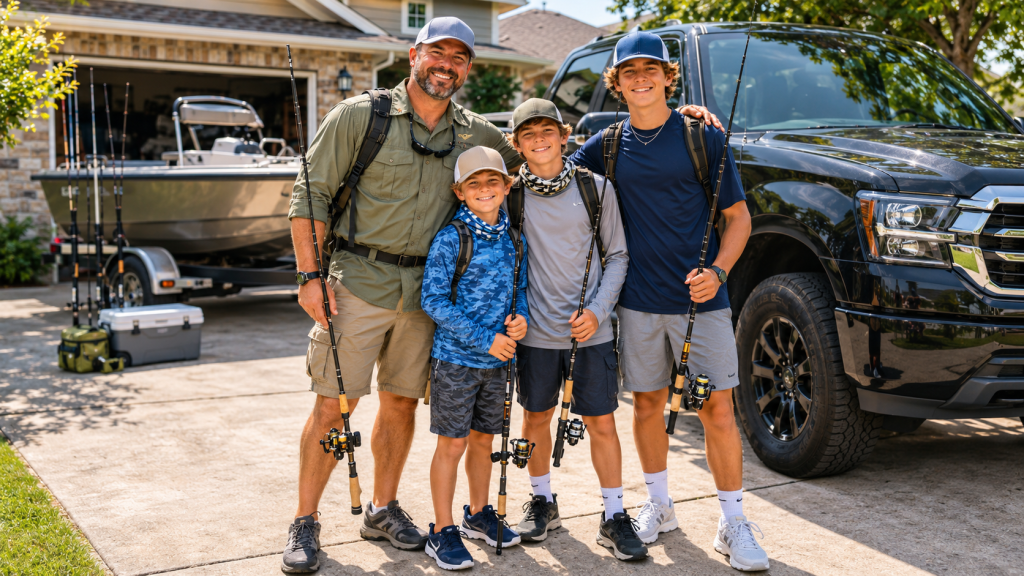
I stood before them holding the photograph I’d taken on the morning of the fishing trip.
Daniel smiling beside our three sons.
The photograph that had haunted me for six years.
I looked at it.
Then began speaking.
“Daniel loved being a father.”
My voice trembled.
“He wasn’t perfect. None of us are. But he believed that the happiest moments in life were often the simplest.”
I looked toward our children.
“A fishing trip. A family dinner. A Saturday afternoon spent fixing something in the garage.”
Tears gathered in my eyes.
“For years, I believed the lake had taken him from us. Now we know there was more to the story.”
I paused.
“I can’t undo what happened. I can’t give our children back the years they lost.”
My voice broke.
“But I can tell them something their father would want them to know.”
I looked at Matthew, Owen, Caleb, Sophie, Lily, and Grace.
“You were loved before you understood what love meant. You were loved during every year we were separated. And you will be loved for the rest of your lives.”
After the service, Matthew approached me near Daniel’s grave.
He held a small object in his hand.
A fishing lure.
Blue and silver.
I recognized it.
Daniel had given it to him when he caught his first large fish.
Matthew stared at the lure.
“I kept this hidden.”
My eyes filled.
“All those years?”
He nodded.
“They took most of our things. But I managed to keep it.”
He looked toward his father’s grave.
“I want Dad to have it.”
I put an arm around his shoulders.
“Then let’s give it to him.”
Matthew knelt and placed the lure beside the flowers.
For a long moment, he remained there.
Then he whispered, “I tried, Dad.”
My heart broke.
I knelt beside him.
“Matthew, you brought your brothers through things no child should ever have faced.”
He began crying.
“But you don’t have to protect everyone anymore.”
I took his hand.
“You’re allowed to be someone’s son now.”
He turned toward me.
Then rested his head on my shoulder.
And together, we cried for the man we loved.
A year later, our family gathered at the kitchen table for breakfast.
It was loud.
Chaotic.
And absolutely wonderful.
Owen argued with Lily about the last pancake.
Grace complained that Caleb had borrowed her headphones.
Sophie reminded Matthew about an appointment.
And Matthew laughed when I told everyone to stop talking at once.
For a moment, I stood near the stove, watching them.
Six children.
All six.
The sight still overwhelmed me.
Not because everything was perfect.
It wasn’t.
We still attended counseling.
There were difficult days.
There were memories that arrived without warning.
And there were questions about the past that might never receive complete answers.
But we were together.
And we were learning how to live.
Caleb noticed me standing still.
“Mom?”
I smiled.
“Yes, sweetheart?”
“Why are you crying?”
I wiped my cheeks.
“Because I’m happy.”
He looked confused.
“People cry when they’re happy?”
Owen laughed.
“Mom does.”
Everybody smiled.
Caleb considered that.
Then stood and walked toward me.
“Can I hug you?”
I opened my arms.
“Of course.”
He wrapped his arms around my waist.
A moment later, Owen joined us.
Then Matthew.
Then the girls.
Six children crowded around me in the kitchen.
And I held them.
All of them.
For a moment, I closed my eyes.
I remembered standing in the driveway six years earlier, waving goodbye to my husband and sons.
I remembered the empty boat.
The search crews.
The memorial service.
The lonely birthdays.
And the old cellphone Sophie had discovered among her father’s belongings.
I thought about how easily I might have accepted the answers I’d been given.
How close I’d come to believing that questions were simply another form of grief.
Then I looked at my children.
Alive.
Growing.
Healing.
And I understood something that would remain with me forever.
Sometimes the truth cannot restore what was stolen. But it can open a door to the life you thought was lost forever.
My name is Claire Bennett.
For six years, I believed my husband and three sons had drowned in a lake.
I raised my daughters while carrying a grief that never truly left me.
Then my oldest daughter found an old cellphone.
A recording exposed the possibility that the people closest to us had concealed something terrible.
And the investigation that followed changed everything.
I learned that betrayal can wear the face of a helpful relative.
That truth deserves patience, evidence, and courage.
And that healing is not the same thing as pretending the past never happened.
I lost Daniel.
No revelation can bring him back.
But I found my three sons.
And every day, I am grateful for the chance to know the young men they are becoming.
Last Sunday, we visited the lake.
Not to go fishing.
Not yet.
We went together, with the support and agreement of the children, to stand near the place where our family had last been seen six years earlier.
The water was calm.
Sunlight shimmered across its surface.
Matthew stood beside Owen.
Caleb held Grace’s hand.
Sophie and Lily remained close to me.
For a while, nobody spoke.
Then Owen looked toward the water.
“I used to dream about coming home.”
My eyes filled.
He continued.
“Sometimes I couldn’t remember what the house looked like.”
I took his hand.
He smiled faintly.
“But I remembered how Mom used to sing while cooking.”
Lily laughed.
“She still does.”
“And she’s still terrible,” Sophie added.
Everyone laughed.
Even me.
Then Matthew turned toward his siblings.
“Ready to go?”
They nodded.
We walked back toward the car together.
Before getting in, I looked once more at the lake.
For six years, I’d believed it held every answer I’d ever need.
Now I understood that the greatest answer wasn’t beneath the water.
It was standing beside me.
Six children who had endured more than any family should.
Six lives still unfolding.
Six reasons to keep moving forward.
I climbed into the driver’s seat.
The doors closed.
And as the familiar sound of my children’s voices filled the car, I finally allowed myself to believe something I’d been afraid to say for years.
We were going home.
Together.