
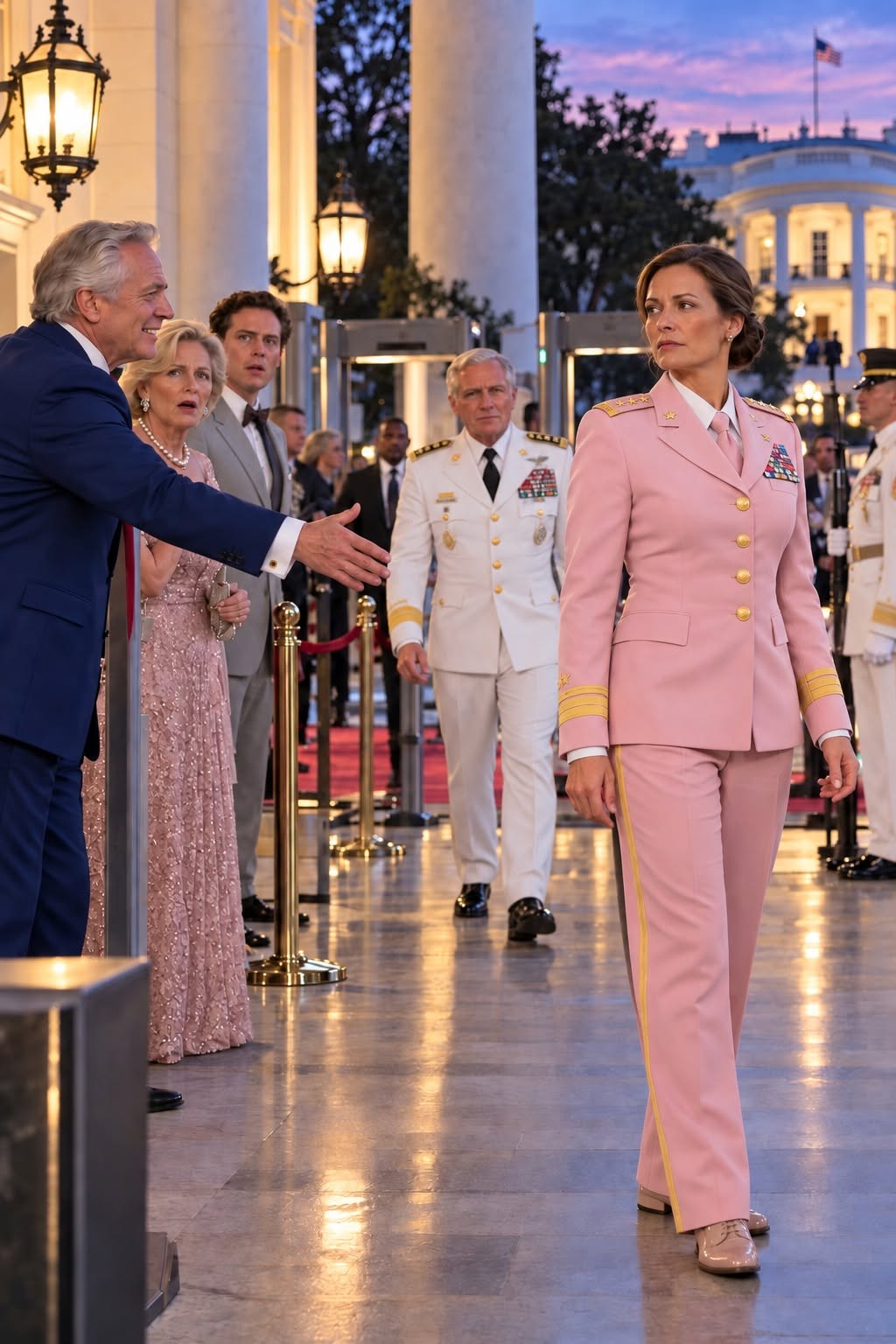
General Vance walked straight past my father.
Arthur’s outstretched hand remained suspended in the air.
For one extraordinary second, the billionaire CEO of Mercer Defense Tech looked like a man who had arrived at the wrong party.
Then the general stopped directly in front of me.
His expression softened.
“Kate.”
I straightened and offered a formal salute.
“General Vance, sir.”
He returned it.
Then, to the astonishment of everyone standing near the security checkpoint, he extended his hand.
“It’s good to see you again, General Mercer.”
My father’s smile disappeared.
Trevor’s mouth fell open.
And Evelyn, who had spent the last five minutes treating me like an unwelcome member of the security staff, suddenly looked as though she had forgotten how to breathe.
General Vance glanced at the three of them.
“Is there a problem here?”
I lowered my hand.
“No problem that requires your attention, sir.”
His eyes moved briefly toward my father, then to the red marks beginning to appear on my sleeve where Arthur had grabbed me.
He frowned.
“Are you certain?”
Before I could answer, Arthur stepped forward.
“General, there’s obviously been some confusion. This is my daughter, Katherine. I had no idea she was acquainted with you.”
Vance looked at him.
“Acquainted?”
He paused.
Then he said, “Mr. Mercer, Major General Katherine Mercer is the incoming deputy commander of the Joint Strategic Readiness Command. She has spent twenty-six years serving this country, and she’s one of the principal military leaders being recognized at today’s event.”
Arthur stared at me.
The general continued.
“She is also the officer your company will be required to address through the appropriate acquisition and technical-review channels if it participates in the readiness modernization program.”
The silence was absolute.
My father had spent twenty-six years telling people that I had thrown away my future.
Now he was standing at the White House, discovering that the daughter he had disowned was a two-star general.
And the contract he had come to pursue was connected to a program in which I held a senior leadership position.
But that wasn’t the most important revelation waiting for him that afternoon.
Because while Arthur had been trying to hide our relationship, I had already learned something about Mercer Defense Tech that would force both of us to make a decision neither of us had ever imagined.
My name is Katherine Elizabeth Mercer.
Most people call me Kate.
I was fifty years old when I stood outside the White House in my Army dress uniform and came face-to-face with my father for the first time in twenty-six years.
By then, I had spent more than half my life in military service.
I had commanded soldiers, worked on demanding multinational assignments, and experienced moments of responsibility that changed the way I understood leadership.
I had also made mistakes.
Lost people I cared about.
Missed family celebrations.
And spent years learning that professional achievement did not automatically heal the wounds we carried from childhood.
But the deepest wound in my life had always been my relationship with Arthur Mercer.
To understand why his words at the White House hurt me, even after so many years, I have to begin with the family I was born into.
My father was already a successful businessman when I was a child.
He had inherited a small electronics company from his father and transformed it into a major defense-technology business.
By the time I was twelve, Mercer Defense Tech employed hundreds of people and supplied electronic components to several large manufacturers.
Arthur was ambitious, intelligent, and extraordinarily disciplined.
He worked long hours.
Traveled constantly.
And believed that success could be measured by the size of a company’s balance sheet and the influence of the people who returned your telephone calls.
He expected everyone around him to share his priorities.
Especially me.
I was his only child from his first marriage.
And from the day I was old enough to understand what the company did, he made it clear that I was supposed to inherit it.
My mother, Caroline, was very different.
She had been a high school history teacher before marrying Arthur.
She loved books, gardening, and long conversations about subjects my father considered impractical.
She encouraged me to ask questions.
To think independently.
And to understand that wealth was a resource, not a measure of human worth.
When I was thirteen, she took me to a community event honoring local veterans.
Several of the speakers described their experiences in military service and the importance of helping younger generations understand the responsibilities of citizenship.
I was fascinated.
Afterward, I began reading about military history and leadership.
My mother encouraged the interest.
My father dismissed it.
“Interesting hobby,” he said when he found me reading a book about military strategy. “But don’t confuse studying soldiers with becoming one.”
I didn’t argue.
At the time, I still believed he would eventually understand.
My mother died when I was sixteen.
A sudden illness took her from us in less than three months.
Her death changed everything.
My father threw himself into work.
He rarely spoke about her.
And he seemed increasingly determined to control the parts of his life that remained.
Two years later, he married Evelyn.
She was younger than he was, socially ambitious, and deeply interested in the lifestyle his money provided.
She had a son from a previous relationship.
Trevor was seven years younger than me.
Arthur quickly embraced him as the heir he hoped would eventually help manage the family business.
I didn’t resent Trevor when he was a child.
He had lost stability in his own life and was trying to find his place in a new family.
But Evelyn made it clear that she viewed me as competition.
And Arthur gradually began treating every independent decision I made as an act of disloyalty.
When I was eighteen, I received offers from several universities.
My father wanted me to attend the University of Pennsylvania, study business, and eventually pursue an MBA at Wharton.
He had already spoken to executives who could provide internships.
He had mapped out the first ten years of my career.
And he spoke about my future as though the decisions had already been made.
But I wanted something different.
I wanted to serve in the military.
I wanted to become an officer.
And I wanted to build a career based on my own abilities rather than my father’s reputation.
I accepted an ROTC scholarship.
When I told Arthur, he stared at me for nearly a minute.
Then he laughed.
“Very funny, Katherine.”
I remained serious.
“I’m not joking.”
His expression changed.
“You’re turning down the opportunity to run a multimillion-dollar company so you can march around carrying a rifle?”
“I’m choosing a career that matters to me.”
He stood.
“Everything I’ve built was supposed to be yours.”
I looked at him.
“I never asked you to build it for me.”
That was the sentence he never forgave.
The argument lasted for hours.
Arthur accused me of being ungrateful.
Evelyn said I was embarrassing the family.
And Trevor, who was still young, watched from the doorway without understanding what was happening.
Finally, my father delivered an ultimatum.
“If you walk out of this house and pursue that ridiculous military fantasy, don’t expect to come back.”
I stared at him.
“Dad, I’m not rejecting you.”
He shook his head.
“That’s exactly what you’re doing.”
I tried to explain.
He refused to listen.
Then he told me that if I accepted the scholarship, I would no longer be his daughter in any meaningful sense.
I left the house two weeks later.
I was eighteen years old.
I carried two suitcases, a box of my mother’s photographs, and enough savings to cover my immediate expenses.
My father didn’t come outside to say goodbye.
For the next several years, I tried to maintain contact.
I sent birthday cards.
Called on holidays.
And wrote letters describing my training and university experiences.
Most went unanswered.
When I graduated and received my commission, I invited Arthur to the ceremony.
He declined.
When I completed my first demanding assignment, I sent him a photograph.
He returned it without a note.
Eventually, I stopped trying.
Not because I no longer cared.
But because every attempt to reconnect reopened a wound I was struggling to close.
My military career was not easy.
There were early mornings when I questioned my decisions.
Training exercises that exposed weaknesses I didn’t know I had.
And assignments that required me to leave behind people and places I had grown to love.
I learned that discipline was not the absence of fear.
It was the ability to act responsibly despite uncertainty.
I also learned that leadership had very little to do with making people afraid of you.
The officers I respected most were the ones who listened, accepted responsibility, and treated their soldiers with dignity.
They expected high standards.
But they didn’t confuse cruelty with strength.
That distinction became increasingly important to me.
During my first assignment, I met Captain Daniel Brooks.
He was a logistics officer with a dry sense of humor and an extraordinary ability to remain calm when everyone around him was frustrated.
We became friends.
Then, gradually, something more.
Daniel never seemed impressed by my father’s wealth.
He was interested in who I was.
He listened when I talked about my mother.
Encouraged me when I doubted myself.
And understood why I sometimes struggled with the idea that my father had chosen his company over his daughter.
We married when I was twenty-eight.
It was a small ceremony attended by friends, colleagues, and Daniel’s family.
My father received an invitation.
He did not respond.
Daniel and I built a life around the demands of our careers.
We moved frequently.
Learned to celebrate holidays whenever our schedules allowed.
And developed a habit of leaving handwritten notes for each other during difficult assignments.
When our daughter, Emma, was born, I was thirty-two.
Holding her for the first time changed the way I understood my own childhood.
I looked at her tiny face and couldn’t imagine loving her only if she made the choices I preferred.
I promised myself that she would never have to earn her place in our family through obedience.
My career continued to develop.
I held command positions.
Completed advanced military education.
And worked on assignments involving operational planning, readiness, and coordination between organizations.
Some of the work was highly visible.
Much of it wasn’t.
There were long days spent reviewing plans, evaluating risks, and making decisions that rarely appeared in photographs or public announcements.
I found satisfaction in the responsibility.
And I gradually stopped measuring my success against the life my father had imagined for me.
Daniel remained my closest friend.
He was the person who could make me laugh after an exhausting day.
The person who reminded me to eat when I became absorbed in work.
And the person who understood that my ambition did not mean I loved my family any less.
When Emma was nine, Daniel was diagnosed with a serious illness.
For nearly two years, we balanced treatment, work, parenting, and the uncertainty that accompanies a difficult medical diagnosis.
He fought hard.
But eventually, the illness progressed.
He died when Emma was eleven.
I was forty-three.
And for the second time in my life, I lost someone who had made the world feel safe.
After Daniel’s death, I considered leaving the military.
I was exhausted.
Grieving.
And worried about how Emma was coping.
But she surprised me.
One evening, she found me sitting at the kitchen table reviewing retirement paperwork.
She looked at the documents.
“Are you quitting because of Dad?”
I took a breath.
“I’m thinking about what would be best for us.”
She sat beside me.
“Dad was proud of what you do.”
My eyes filled.
“I know.”
She took my hand.
“He’d want you to make the decision because it’s right for you. Not because you’re sad.”
I hugged her.
She was only eleven.
But in that moment, she sounded remarkably like her father.
I remained in service.
I also made changes to protect our family time and ensure that Emma had the support she needed.
My sister-in-law, Rachel, helped during demanding assignments.
Daniel’s parents remained closely involved.
And Emma gradually developed into a thoughtful, independent young woman.
By the time she entered college, she was studying biomedical engineering and had inherited her father’s love of terrible jokes.
She also had something I had struggled to find at her age.
The confidence to pursue her own interests without fearing that my love depended on her choices.
Two years before the White House event, I was promoted to brigadier general.
The ceremony was one of the proudest moments of my career.
Emma attended.
So did Daniel’s parents.
Several former colleagues traveled considerable distances to be there.
I thought briefly about inviting Arthur.
Then I decided against it.
He had made his position clear.
I no longer wanted to place myself in situations where I had to beg for recognition from someone who had spent decades withholding it.
My subsequent assignment involved senior leadership responsibilities in a joint readiness organization.
The work required coordination between military personnel, civilian officials, and technical specialists.
It also involved programs that depended on equipment and services supplied by private companies.
That meant understanding the importance of procurement integrity.
Military leaders could not allow personal relationships, financial interests, or outside pressure to influence acquisition decisions.
The rules existed for good reasons.
Public resources had to be managed responsibly.
Companies had to compete through appropriate processes.
And decisions needed to be based on documented requirements and authorized evaluations.
I took those responsibilities seriously.
I had no idea that they would eventually bring me face-to-face with my father.
The White House event was a formal reception recognizing military leadership, public service, and cooperation between government organizations and industry.
I had been invited in connection with my assignment and recent promotion.
General Vance, a four-star officer serving on the Joint Chiefs of Staff, was one of the senior military participants.
I had worked with him on several projects.
He was demanding, direct, and exceptionally attentive to professional standards.
He also knew about my family history.
Not every detail.
But enough to understand why the name Mercer sometimes made me uncomfortable.
I arrived at the White House that afternoon wearing my Army dress uniform.
I had reviewed the event schedule.
Confirmed my credentials.
And planned to meet several colleagues before the formal program began.
I wasn’t expecting anything unusual.
Then someone shoved my shoulder.
“Move aside, uniform. You’re blocking the VIP lane.”
I turned.
Trevor.
My stepbrother.
He was now in his early forties, dressed in an expensive tuxedo that seemed designed to attract attention.
For a moment, I barely recognized him.
Then Arthur appeared.
He grabbed my arm.
And twenty-six years of silence collapsed into a single confrontation.
My father looked older.
His hair had turned silver.
There were deeper lines around his eyes.
But his expression was painfully familiar.
The same impatience.
The same contempt.
The same certainty that his money entitled him to control the people around him.
When he recognized me, he didn’t ask how I was.
He didn’t ask about Emma.
He didn’t mention Daniel.
Instead, he looked at my uniform and demanded to know why I was there.
Then he told me to pretend I didn’t know him.
I had imagined meeting my father again many times.
Sometimes I pictured an apology.
Sometimes an awkward conversation.
Occasionally, I imagined that age might have softened him.
But standing beside the security checkpoint, listening to him call me a failure, I realized that he was still judging me according to the same standards he had used when I was eighteen.
He saw a uniform.
He assumed I was insignificant.
And he believed his presence at an exclusive event made him more important than the daughter he had disowned.
I didn’t argue.
I had learned long ago that explaining myself to someone determined not to listen was rarely productive.
Then General Vance appeared.
After introducing me, Vance turned toward my father.
“Mr. Mercer, I understand your company is interested in the readiness modernization program.”
Arthur recovered enough to smile.
“Very much so, General. We’ve developed some remarkable technology.”
Vance nodded.
“Then I’m sure your team is familiar with the established procurement procedures.”
“Of course.”
Arthur glanced at me.
Then he looked back at Vance.
“Perhaps we could arrange a private discussion.”
The general’s expression remained neutral.
“Any discussion concerning a potential contract will need to take place through the authorized channels.”
Arthur’s smile tightened.
“Naturally.”
Then Vance looked at me.
“General Mercer, are you ready?”
“Yes, sir.”
He nodded.
“Let’s go.”
I followed him toward the entrance.
But before we reached the doors, a Secret Service agent approached.
“General Mercer, may I speak with you briefly?”
I stopped.
“Of course.”
The agent informed me that the interaction at the checkpoint had been observed and that the security team needed to document the physical contact and interference near the controlled entry area.
I provided a factual account.
I explained that Arthur Mercer was my estranged father and that he had grabbed my arm during an argument.
The agent thanked me.
I was not asked to make a dramatic accusation or turn the incident into a public confrontation.
The security personnel simply followed their procedures.
Arthur looked furious.
But for once, his influence did not allow him to dictate how the situation would be handled.
Inside the White House, General Vance and I walked toward the reception area.
For several minutes, neither of us spoke.
Then he glanced at me.
“Are you all right?”
I nodded.
“Yes, sir.”
He studied my expression.
“That’s a complicated family situation.”
I gave a small, humorless laugh.
“That’s one way to describe it.”
He stopped near a quiet corridor.
“Kate, you don’t have to pretend that what happened didn’t affect you.”
I looked at him.
“I know.”
He nodded.
“Good.”
Then his expression became serious.
“There’s something else we need to discuss.”
I had been aware for several weeks that Mercer Defense Tech was among the companies expressing interest in the readiness modernization program.
The company had submitted preliminary technical information through the appropriate channels.
Because Arthur was my father, I had disclosed the relationship to the relevant ethics officials and recused myself from matters where my participation could create an actual or apparent conflict of interest.
I had also made it clear that I had no financial interest in the company.
Arthur had disinherited me decades earlier.
I owned no shares.
Held no position.
And had no involvement in its operations.
But the family connection still required careful handling.
General Vance looked at me.
“The acquisition team has identified discrepancies in some of the technical information submitted by Mercer Defense Tech.”
I frowned.
“What kind of discrepancies?”
He shook his head.
“I can’t discuss the details here. And given your relationship to the company, you shouldn’t be involved in the review.”
I nodded.
“Understood.”
He continued.
“The appropriate officials are examining the matter. I wanted you to be aware because the company may become a subject of discussion during the event.”
I felt a familiar tightening in my chest.
For years, I had tried to separate my military career from my father’s business.
Now the two were intersecting in the most uncomfortable way imaginable.
The reception began shortly afterward.
Senior military leaders, civilian officials, and invited guests gathered in the elegantly decorated room.
There were speeches about service, innovation, and the responsibilities shared by public institutions and private industry.
I spoke briefly with several colleagues.
Accepted congratulations on my new assignment.
And tried to focus on the purpose of the event.
But I could see Arthur across the room.
He was watching me.
Evelyn stood beside him.
Trevor looked increasingly uncomfortable.
For the first time in twenty-six years, my father seemed unsure how to approach me.
Eventually, he crossed the room.
“Katherine.”
I turned.
“Arthur.”
His expression tightened at the use of his first name.
Then he forced a smile.
“I think we got off on the wrong foot.”
I looked at him.
“Did we?”
He glanced around.
“There’s no need to make a scene.”
“I haven’t.”
He lowered his voice.
“Why didn’t you tell me you were a general?”
I stared at him.
For a moment, I couldn’t believe the question.
Then I answered.
“You stopped speaking to me twenty-six years ago.”
He looked away.
“Well, you could have reached out.”
“I did.”
He frowned.
I continued.
“I sent letters. Invitations. Photographs. You returned some of them and ignored the rest.”
Arthur shifted uncomfortably.
“That was a long time ago.”
“Yes,” I said. “It was.”
He glanced at the stars on my shoulders.
Then he smiled.
“Well, you’ve obviously done better than I expected.”
I felt a familiar ache.
Even now, he couldn’t offer a simple expression of pride without reminding me that he had expected me to fail.
I took a breath.
“Arthur, what do you want?”
His smile faded.
He looked around again.
Then he leaned closer.
“I understand you’re involved in the modernization program.”
I immediately straightened.
“My responsibilities are separate from the acquisition process, and I’ve disclosed our family relationship.”
He frowned.
“I’m not asking for anything improper.”
“Then there’s nothing we need to discuss about your company’s proposal.”
His expression hardened.
“Katherine, don’t be difficult.”
I looked at him.
“I’m being professional.”
He gave a short laugh.
“You always did enjoy proving a point.”
I shook my head.
“This isn’t about us. It’s about my responsibilities.”
Arthur stepped closer.
“Mercer Defense Tech employs thousands of people. A contract of this size could secure their jobs for years.”
“I understand.”
“Then surely you can make sure our proposal receives proper consideration.”
“It will receive whatever consideration the authorized process requires.”
He stared at me.
Then he said, “You owe this family something.”
For a moment, the room seemed to grow quieter.
I looked at him.
“No, Arthur. I don’t.”
His face reddened.
“Everything you had growing up came from me.”
I nodded.
“You provided for me. And I’m grateful for the opportunities I had.”
Then I continued.
“But that doesn’t give you the right to use my position for your business.”
Arthur’s expression changed.
The polished businessman disappeared.
For a moment, I saw the same angry father who had stood in our living room twenty-six years earlier.
“You think you’re better than me because you have a few stars on your shoulders?”
I remained calm.
“No.”
He leaned closer.
“Then remember where you came from.”
I looked directly at him.
“I do. Every day.”
Then I stepped away.
I didn’t see him again during the formal program.
But later that evening, after the reception had ended, I received a message from my daughter.
Mom, I saw the event photos online. You look amazing! Grandpa Mercer was there?
I stared at the screen.
Emma knew about my relationship with Arthur.
She had asked questions over the years.
I had answered honestly without trying to make her hate him.
But she had never met him.
I called her.
She answered immediately.
“Mom!”
I smiled.
“Hi, sweetheart.”
She sounded excited.
“You looked incredible.”
“Thank you.”
Then her tone softened.
“Was it weird seeing him?”
I sat down.
“Yes.”
She hesitated.
“Did he say anything nice?”
I considered the question.
“Not really.”
There was a pause.
Then Emma said, “I’m sorry.”
I closed my eyes.
“It’s all right.”
She answered gently.
“Mom, it doesn’t have to be all right.”
I felt tears rise.
For a moment, I couldn’t speak.
Then I smiled.
“You sound like your dad.”
She laughed softly.
“I’ll take that as a compliment.”
The following week, the matter involving Mercer Defense Tech became more serious.
The acquisition review identified inconsistencies between certain performance claims in the company’s proposal and the supporting test documentation.
The discrepancies required further examination.
The appropriate contracting and oversight officials requested additional information.
The company was given opportunities to respond.
And the review proceeded through the established process.
I remained recused from the relevant decisions.
I did not receive privileged details beyond what I was authorized to know.
And I made no attempt to influence the outcome.
But I knew that the situation could have significant consequences for Arthur’s company.
Two weeks later, Arthur called me.
I almost didn’t answer.
Then I decided to hear what he wanted.
“Katherine.”
“Arthur.”
His voice sounded strained.
“We need to talk.”
“About what?”
“The company.”
I closed my eyes.
“If this concerns the acquisition review, I can’t discuss it.”
He exhaled sharply.
“I’m not asking you to break the law.”
“Then speak with your attorneys and the authorized contracting officials.”
He was silent for several seconds.
Then he said, “Trevor has made some mistakes.”
I sat upright.
“What kind of mistakes?”
Arthur hesitated.
“Decisions involving the technical submissions.”
I felt my stomach tighten.
“Arthur, I can’t advise you on this.”
He sounded frustrated.
“I’m your father.”
I took a breath.
“Yes. And that doesn’t change my professional obligations.”
He began speaking rapidly.
He explained that Trevor had taken on increasing responsibility within the company.
He had been eager to demonstrate that he could secure major contracts.
According to Arthur, he had approved certain statements in the proposal without ensuring that the supporting documentation was complete.
I listened.
But I didn’t ask for details.
I didn’t want to receive information that could complicate the official review.
When Arthur finished, I told him to consult independent legal counsel and cooperate fully with the authorized process.
He was silent.
Then he said, “You could help us.”
I looked out the window.
“Not in the way you’re asking.”
He ended the call.
Several months passed.
The investigation continued.
Mercer Defense Tech faced significant scrutiny over its technical representations and internal approval procedures.
The company eventually withdrew the disputed proposal while the relevant issues were addressed.
Separate administrative and legal reviews examined whether the discrepancies involved negligent oversight, deliberate misrepresentation, or other misconduct.
The findings led to serious consequences for individuals responsible for the inaccurate submissions.
Trevor was removed from his executive responsibilities.
The company implemented new compliance controls.
And Arthur faced pressure from the board to step back from day-to-day management.
I learned most of this through public disclosures and ordinary family communications.
I did not participate in the decisions.
The experience changed Arthur.
Or at least, it seemed to.
For the first time in decades, he was confronting a problem that money and influence could not immediately resolve.
His company had been his identity.
His reputation had been built around the belief that he could control every outcome.
Now he was being forced to recognize the limits of that control.
But I wasn’t waiting for his transformation.
I had spent too many years organizing my emotions around what he might eventually become.
One evening, several months after the White House event, Arthur appeared at my home.
I was living in Virginia at the time.
Emma was visiting during a university break.
When I opened the door, my father stood on the porch holding a small leather box.
He looked older than he had at the reception.
His shoulders were slightly hunched.
And the confidence that had once seemed inseparable from him was noticeably diminished.
“Kate,” he said.
I stared at him.
“What are you doing here?”
He looked down.
“I was hoping we could talk.”
I considered telling him to leave.
I had every reason to.
But Emma was standing behind me.
And I realized that I wanted to hear what he had to say.
Not because I owed him forgiveness.
But because I wanted to decide for myself whether there was anything left between us worth rebuilding.
I stepped aside.
“Come in.”
We sat in the living room.
Emma brought coffee, then excused herself.
Arthur looked around.
His eyes settled on a photograph of Daniel.
“Your husband?”
I nodded.
“Yes.”
He studied the picture.
“I heard he passed away.”
I felt a sharp ache.
“He died seven years ago.”
Arthur looked down.
“I’m sorry.”
I waited.
Then he said, “I should have been there.”
I didn’t answer immediately.
Finally, I said, “Yes. You should have.”
Arthur opened the leather box.
Inside was a silver watch.
I recognized it immediately.
It had belonged to my grandfather.
He had worn it every day while running the small electronics business that eventually became Mercer Defense Tech.
When I was a child, he sometimes let me wind it.
Arthur placed the box on the table.
“Your grandfather wanted you to have this.”
I stared at him.
“Why are you giving it to me now?”
He looked at his hands.
“Because I’ve spent twenty-six years being angry about a decision that was never mine to make.”
I felt my throat tighten.
He continued.
“I thought you were rejecting everything I’d built. I thought you were throwing away opportunities that other people would have given anything to have.”
He paused.
“But when I saw you at the White House, I realized you hadn’t thrown your future away.”
I looked at him.
“Arthur, I didn’t need to become a general for my choice to deserve respect.”
He closed his eyes.
Then he nodded.
“I know.”
For the first time in my life, my father apologized without immediately explaining why he believed his behavior had been justified.
He apologized for disowning me.
For ignoring my letters.
For missing my wedding.
For never meeting Daniel.
And for allowing his pride to keep him away from Emma.
He also apologized for the way he had treated me at the White House.
I listened.
Some of his words were things I had wanted to hear since I was eighteen.
Others arrived too late to repair what had been lost.
I thought about my mother.
My wedding.
Daniel’s illness.
The years Emma had grown up without knowing her grandfather.
An apology could acknowledge those absences.
It could not erase them.
When Arthur finished, he looked at me.
“Can you forgive me?”
I took a long breath.
“I don’t know.”
He nodded slowly.
“I understand.”
I looked at him.
“I appreciate the apology. But we can’t pretend that twenty-six years didn’t happen.”
He swallowed.
“I know.”
I continued.
“If we’re going to have any relationship, it will take time. And it won’t involve your company, your money, or your expectations about my career.”
He nodded.
“All right.”
Then I added, “And Emma gets to decide for herself whether she wants to know you.”
Arthur looked toward the hallway.
“Of course.”
We didn’t become a close family overnight.
In fact, the first several months were awkward.
Arthur called occasionally.
Sometimes we spoke for only a few minutes.
Other times, we talked about ordinary things.
The weather.
Books.
Emma’s university courses.
My work, to the extent that I could discuss it.
I gradually learned that he had begun stepping back from the company and spending more time outside the business.
He had also started seeing a counselor.
I didn’t ask for details.
His personal work was his responsibility.
Emma eventually agreed to meet him.
They had lunch at a restaurant near her university.
I didn’t attend.
I wanted their relationship, if they chose to have one, to develop on its own terms.
Afterward, she called me.
“He’s kind of awkward,” she said.
I laughed.
“That sounds familiar.”
She hesitated.
“Mom, I think he really regrets what happened.”
I looked out the window.
“Maybe he does.”
She continued.
“But I told him that he doesn’t get to make you feel guilty if you need time.”
My eyes filled.
“Thank you, sweetheart.”
She laughed.
“Someone has to keep you two in line.”
Over the next year, Arthur made an effort to remain consistent.
He respected my boundaries.
Stopped asking about military contracts.
And never again suggested that my career should serve his business interests.
We met for lunch occasionally.
Sometimes Emma joined us.
There were still difficult conversations.
And moments when old habits resurfaced.
But I no longer felt compelled to accept disrespect simply because he was my father.
When he crossed a boundary, I addressed it.
And when he responded appropriately, I acknowledged the effort.
It was a different kind of relationship from the one I had imagined as a young woman.
But it was more honest.
My military career continued.
I eventually took on a new assignment involving senior leadership and organizational development.
I worked with younger officers who reminded me of myself at eighteen.
Some came from wealthy families.
Others had grown up with very little.
Some had supportive parents.
Others were trying to build lives that their families did not understand.
I made a point of reminding them that professional success did not require everyone in their personal lives to approve of their choices.
But I also encouraged them to remain humble.
To seek guidance.
And to recognize that independence was not the same thing as refusing help.
One afternoon, a young lieutenant approached me after a leadership seminar.
She seemed nervous.
“Ma’am, may I ask you something personal?”
I nodded.
“Within reason.”
She smiled.
“My parents don’t want me to stay in the Army. They think I’m wasting my education.”
I studied her.
“Do you want to stay?”
“Yes, ma’am.”
“Then you need to evaluate your decision based on your goals, your responsibilities, and the realities of the career. Not simply on whether your parents approve.”
She looked relieved.
Then she asked, “Did your family support you?”
I considered the question.
“Some of them did.”
She waited.
I smiled faintly.
“And some needed a very long time to understand.”
I am fifty-two now.
Emma has graduated from university and begun her career.
Arthur is no longer involved in the daily management of Mercer Defense Tech.
The company has continued operating under a restructured leadership team and strengthened compliance procedures.
Trevor eventually pursued work outside the family business.
Our relationship remains distant, but we occasionally exchange messages.
Evelyn and I have little contact.
And Arthur and I are still learning how to have a relationship that isn’t defined by the expectations he once placed on me.
Some days are easier than others.
But I no longer measure my worth by his approval.
Last month, Arthur attended a small family dinner at my home.
Emma was there.
So were Daniel’s parents and several close friends.
We ate in the garden because the weather was beautiful.
At one point, Arthur noticed a photograph on the mantel.
It showed me at my promotion ceremony, standing beside Emma.
He picked it up.
“You look happy.”
I smiled.
“I was.”
He studied the photograph.
Then he looked at me.
“I’m proud of you, Kate.”
For a moment, I couldn’t speak.
I had waited more than twenty-six years to hear those words.
But when they finally came, I realized something unexpected.
I was grateful.
I was moved.
But I no longer needed them to believe in the life I had chosen.
I already did.
Later that evening, after everyone had gone home, I sat on the porch with a cup of tea.
The air was cool.
The garden lights glowed softly.
And the silver watch my grandfather had left me rested on the small table beside my chair.
I thought about the day I left home at eighteen.
The two suitcases.
My mother’s photographs.
And the terrible feeling that choosing my own future meant losing my father forever.
Then I remembered the White House.
The security checkpoint.
Trevor’s shove.
Arthur’s hand gripping my arm.
And the way he had told me to pretend I didn’t know him.
He had looked at my uniform and seen failure.
He had looked at the wealthy guests around him and believed they represented success.
And he had assumed that the four-star general approaching us was coming to greet him.
He had been wrong about all of it.
But the greatest lesson of that day wasn’t that I had achieved a rank my father never imagined I could reach.
It wasn’t that General Vance recognized me.
And it wasn’t that Arthur’s company later faced consequences for its own business decisions.
Those events mattered.
But they weren’t what ultimately changed my life.
What changed my life was realizing that I could stand in front of my father without becoming the frightened eighteen-year-old who had once begged him to understand.
I could listen to his opinions without accepting them as the truth.
I could enforce my professional responsibilities without apologizing for them.
And I could decide whether to rebuild our relationship without surrendering the independence I had spent decades developing.
Twenty-six years ago, my father disowned me because I refused to live the life he had chosen for me.
At the White House, he tried to humiliate me because he still believed that money and influence were the only meaningful measures of success.
He didn’t know that the uniform he mocked represented decades of service, sacrifice, leadership, and responsibility.
But I didn’t need a four-star general to tell him who I was. I already knew.
The stars on my shoulders were an honor. My career was a source of pride. And the family I had built with Daniel and Emma was the greatest achievement of my life.
My father’s eventual apology gave us an opportunity to begin again, but it did not create my worth. That had never been his to grant or take away.
When I walked out of his house at eighteen, he believed I was abandoning my future.
Twenty-six years later, standing in my dress blues at the White House, I finally understood that I had been walking toward it all along.
THE END.