
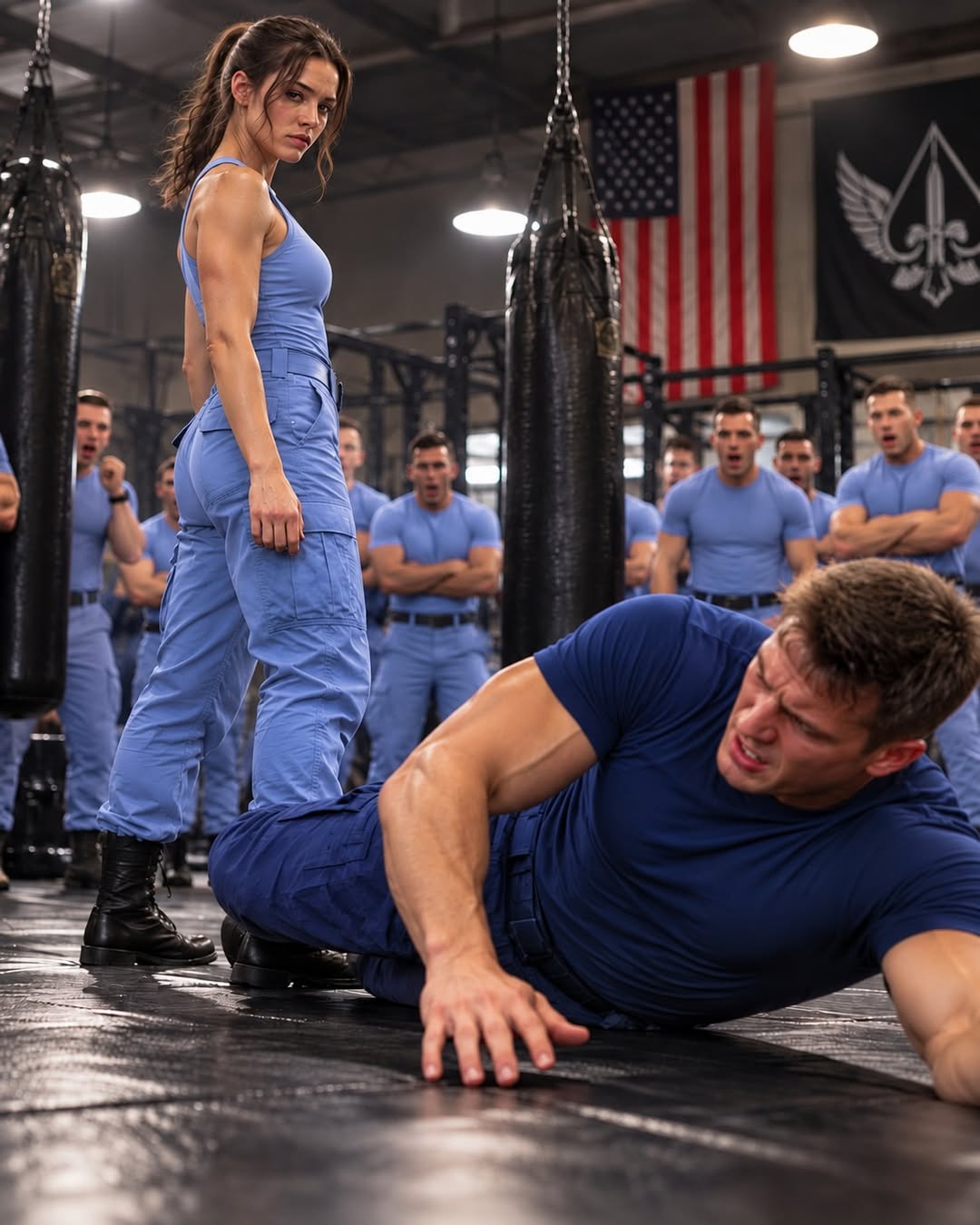
For several seconds, Sergeant Knox stared at the young woman as though she had just violated a law of nature.
His chest rose and fell beneath his gray training shirt. His jaw was clenched, and a flush of embarrassment spread from his neck to his ears.
Around the mat, the soldiers remained silent.
Nobody was laughing now.
The woman standing opposite Knox had barely moved since the exchange ended. A few strands of dark hair clung to her forehead, but her breathing was steady. She had not raised her fists in celebration or looked toward the spectators for approval.
She simply waited.
Knox took a step toward her.
“You got lucky.”
She tilted her head slightly.
“Is that what you think?”
His expression hardened.
“Don’t get arrogant.”
“I wasn’t.”
The quietness of her answer seemed to irritate him more than any insult could have.
He glanced toward the instructor standing near the equipment racks.
“Sir, I want another round.”
The instructor, Master Sergeant Daniel Mercer, studied both of them.
Then he looked at the woman.
“Lieutenant, are you willing to continue?”
She nodded.
“Yes, Master Sergeant.”
Knox rolled his shoulders.
This time, he wasn’t smiling.
But before Mercer could authorize the next exchange, a voice came from the doorway.
“That won’t be necessary.”
Everyone turned.
A tall officer in a dark uniform stood just inside the training room. Silver hair framed a weathered face, and the insignia on his chest immediately brought the room to attention.
Brigadier General Robert Whitaker.
He was the commanding officer overseeing the installation’s advanced training program.
His eyes moved from Knox to the young woman.
Then he asked a question that made every soldier in the room straighten.
“Who authorized this lieutenant to participate in an unsupervised challenge?”
Mercer stepped forward.
“Sir, I was supervising the exercise.”
Whitaker looked at him.
“Then perhaps you’d like to explain why I could hear your soldiers mocking a candidate from halfway down the corridor.”
Nobody answered.
The general turned toward the woman.
“Lieutenant, state your name.”
She stood at attention.
“Lieutenant Alexandra Hayes, sir.”
Whitaker studied her for a moment.
Then his expression changed.
“Hayes?”
“Yes, sir.”
He glanced toward the folder in his hand.
“Lieutenant Alexandra Hayes, formerly assigned to the Joint Personnel Recovery Training Directorate?”
The room went still.
Alexandra nodded.
“Yes, sir.”
Whitaker closed the folder.
“Then I believe there are several things we need to discuss.”
My name is Alexandra Hayes.
I was twenty-eight years old when I walked into the advanced combat training facility at Fort Ridgeway, a fictional military installation in the southeastern United States.
By then, I had spent almost a decade in uniform.
I had completed difficult training programs, served in demanding assignments, and worked with people whose experience far exceeded my own.
I was proud of my career.
But I had learned that pride was most useful when it remained quiet.
The moment you started believing your reputation made you untouchable was usually the moment you stopped learning.
That lesson had been taught to me long before I met Sergeant Knox.
And it was the reason I had come to Fort Ridgeway in the first place.
I grew up in a small town in North Carolina.
My father, Michael Hayes, was a firefighter. My mother, Rebecca, worked as an emergency-room nurse.
Our family didn’t have much money, but our house was always busy.
My parents believed in hard work, responsibility, and helping people who couldn’t help themselves.
My father was a patient man.
He rarely raised his voice.
But when he gave an instruction during an emergency, people listened.
My mother was different.
She was direct, practical, and remarkably calm under pressure.
I once watched her return home after a sixteen-hour hospital shift, prepare dinner, and then spend another hour helping a neighbor who had fallen on the front steps.
When I asked how she managed to remain so composed, she smiled.
“Panic doesn’t make a difficult situation easier.”
I carried those words with me for years.
I was fifteen when I first became interested in military service.
A career presentation at my high school introduced me to several different military occupations.
I was particularly drawn to the fields involving emergency response, leadership, and personnel recovery.
The idea of working with a team to help people in dangerous situations appealed to me.
I began researching the requirements.
I improved my grades.
Joined the track team.
And started training regularly.
At eighteen, I entered a military commissioning program while pursuing a university degree.
I knew the path ahead would be demanding.
What I didn’t fully understand was how often I would be required to prove that I belonged.
During my early training, I encountered people who assumed that my size or appearance determined my capabilities.
I was five feet six inches tall and weighed considerably less than many of the men around me.
Some instructors underestimated me.
Others expected me to fail.
A few seemed genuinely surprised when I met the same standards as everyone else.
At first, their comments bothered me.
I wanted to argue.
To explain.
To make them understand that I had worked just as hard as the other candidates.
But one of my instructors gave me advice that changed my approach.
“Hayes, you don’t need to win every argument. You need to meet the standard.”
I remembered that.
And I kept training.
Over the following years, I developed a reputation for discipline and careful decision-making.
I wasn’t the strongest person in every room.
I wasn’t the fastest.
And I certainly wasn’t the most intimidating.
But I was consistent.
I listened.
I prepared.
And I learned from people who knew more than I did.
Eventually, I was assigned to a joint training organization that supported personnel recovery and operational readiness.
My work involved planning exercises, evaluating training procedures, and helping teams improve their responses to complex situations.
Some assignments were physically demanding.
Others required careful analysis and coordination.
I learned that effective performance depended on far more than strength.
It required judgment.
Communication.
Trust.
And the ability to remain composed when a situation became unpredictable.
By twenty-eight, I had been selected for an advanced leadership and assessment program at Fort Ridgeway.
The program brought together personnel from different units and professional backgrounds.
Its purpose was to evaluate candidates under demanding conditions and identify areas for further development.
I was excited.
But I also knew that some people would question why I had been selected.
I had experienced that before.
I simply hadn’t expected the hostility to begin on my first morning.
Sergeant Knox was one of the senior enlisted participants in the training group.
He was thirty-four, physically imposing, and widely respected for his previous assignments.
He had spent years in demanding combat-related roles and possessed considerable practical experience.
He was also accustomed to being the most dominant personality in the room.
When I arrived, he looked me over.
Then he smiled.
“Lost, Lieutenant?”
I shook my head.
“No, Sergeant.”
He glanced at my training folder.
“This is an advanced program.”
“I know.”
He laughed.
“Just making sure.”
Several soldiers nearby smiled.
I ignored the remark and continued checking in.
But Knox wasn’t finished.
During the morning briefing, he questioned whether I had enough field experience to participate in the practical exercises.
When I answered, he interrupted.
When I asked a technical question, he made a joke about classroom knowledge.
And when the group moved into the training facility, he began treating me as though I were there for entertainment.
I tried to remain professional.
I wasn’t interested in competing for his approval.
But his behavior gradually began affecting the other participants.
A few joined in.
Others remained silent.
And some looked uncomfortable but said nothing.
By the time we reached the controlled defensive-training exercise, Knox had apparently decided that humiliating me would be the highlight of his morning.
The exercise was supposed to involve supervised, limited-contact scenarios.
Participants were expected to follow established safety rules, demonstrate control, and stop immediately when directed.
But Knox treated it as an opportunity to establish dominance.
He repeatedly questioned my ability.
Mocked my background.
And encouraged the others to laugh whenever I made a minor mistake.
During one exchange, he shoved me with unnecessary force.
I lost my balance and slid across the mat.
My palm struck the floor.
The room erupted in laughter.
Then Knox spread his arms.
“Get up. Or get out.”
I rose slowly.
Not because I wanted revenge.
But because I wasn’t finished.
When Knox challenged me again, I assessed the situation.
I knew he was stronger.
I knew he was heavier.
And I knew that allowing his aggression to dictate my response would be a mistake.
I also knew that the exercise was supposed to test controlled defensive skills, not reward reckless behavior.
When he moved toward me, I reacted within the limits of the exercise.
His momentum carried him off balance.
He fell onto the mat.
The exchange ended.
It lasted only a moment.
But the reaction was immediate.
The laughter stopped.
Knox stood, embarrassed and angry.
Then he demanded another round.
And that was when General Whitaker entered the room.
The general’s presence changed everything.
He was not impressed by the spectacle.
He didn’t congratulate me for putting Knox on the floor.
And he didn’t treat the exchange as proof that one person was inherently superior to another.
Instead, he asked why a controlled training environment had deteriorated into a personal challenge.
Master Sergeant Mercer explained that the group had been conducting a defensive-skills exercise.
Whitaker listened.
Then he asked whether the established procedures had been followed.
Mercer hesitated.
“Not entirely, sir.”
The general nodded.
“Then we’ll address that first.”
Knox stood rigidly beside the mat.
He looked furious.
But he remained silent.
Whitaker turned toward me.
“Lieutenant Hayes, are you injured?”
“No, sir.”
“Do you require medical evaluation?”
“I don’t believe so, sir.”
He nodded.
Then he looked at Mercer.
“Ensure the appropriate checks are completed. I want the exercise documented accurately.”
Mercer acknowledged the instruction.
The general then addressed the entire group.
“This program exists to develop capable professionals. It does not exist to provide an audience for personal rivalries.”
Nobody moved.
He continued.
“If you believe a candidate doesn’t meet the standard, evaluate that candidate against the standard. You do not create your own test because you dislike the person standing in front of you.”
His gaze moved across the room.
“And you certainly don’t confuse humiliation with leadership.”
After the training session was suspended, Whitaker asked me to accompany him to his office.
I followed him through the corridor.
The building was quiet.
For several minutes, neither of us spoke.
Then he asked, “Do you know why I recognized your name?”
I considered the question.
“No, sir.”
He opened the folder he had been carrying.
Inside were documents relating to my previous assignment.
He turned one page toward me.
“Your work on Exercise Northern Passage.”
I nodded.
“Yes, sir.”
He studied me.
“I reviewed the final evaluation.”
I remained silent.
Then he said, “Your recommendations were adopted across several training teams.”
I was surprised.
I had helped prepare the evaluation, but I hadn’t known the report had reached his office.
“Thank you, sir.”
Whitaker closed the folder.
“Don’t thank me. Your work speaks for itself.”
Exercise Northern Passage had taken place the previous year.
It was a complex training event designed to evaluate how different units coordinated during a simulated personnel-recovery operation.
The exercise involved changing conditions, incomplete information, and multiple competing priorities.
My role had been to help assess decision-making and identify weaknesses in communication between teams.
During the exercise, I noticed that several groups were relying on assumptions that had not been verified.
Those assumptions created delays.
They also caused important information to be overlooked.
I documented the problems and helped develop recommendations for improving the procedures.
The work wasn’t glamorous.
There were no dramatic confrontations.
No public recognition.
And no heroic photographs.
But it mattered.
Because effective training could help people make better decisions when the consequences were real.
Whitaker leaned back in his chair.
“Your previous commander described you as disciplined, analytical, and unusually calm under pressure.”
I felt slightly embarrassed.
“That’s generous, sir.”
He shook his head.
“It’s an evaluation, Lieutenant. Not a compliment.”
I nodded.
Then his expression became serious.
“Which is why I’m concerned about what happened this morning.”
I straightened.
“Yes, sir.”
He looked at me.
“You handled the physical exchange appropriately based on the information I’ve received. But you also allowed yourself to be drawn into a situation that was becoming personal.”
I considered his words.
He was right.
I had remained composed.
But I had also wanted to prove Knox wrong.
And that desire had influenced my decision to continue.
“I understand, sir.”
Whitaker nodded.
“Good. Because leadership sometimes means walking away from a challenge you know you can win.”
The conversation stayed with me.
I had spent years learning not to let other people’s opinions define my abilities.
But I was still vulnerable to the temptation to prove myself.
Especially when someone questioned whether I belonged.
Whitaker wasn’t asking me to tolerate mistreatment.
He was reminding me that professionalism required judgment even when other people behaved badly.
That distinction mattered.
Later that afternoon, I was called to a meeting with Master Sergeant Mercer and the program’s senior instructor.
They reviewed the morning’s events.
I provided my account.
Knox provided his.
Several witnesses were interviewed.
And the available training footage was examined.
The review established that Knox had exceeded the intended limits of the exercise and had engaged in conduct inconsistent with the program’s expectations.
It also identified failures in supervision.
Mercer acknowledged that he should have intervened sooner.
The program leadership addressed those failures through the appropriate administrative procedures.
Knox was removed from the training group pending further review.
The decision was not based simply on the fact that he had fallen during the exchange.
It was based on his conduct before and during the exercise.
He had used his experience and position to intimidate another participant.
He had encouraged an atmosphere in which humiliation was treated as entertainment.
And he had allowed personal frustration to interfere with professional judgment.
Those were serious concerns in a program designed to develop leadership.
The following morning, I returned to the training facility.
The atmosphere was different.
Several soldiers who had laughed during the previous day’s confrontation avoided looking at me.
Others approached quietly.
One apologized.
Another admitted that he had joined in because he didn’t want Knox to turn his attention toward him.
I listened.
I appreciated the honesty.
But I didn’t pretend that everything was immediately resolved.
Respect had to be demonstrated through behavior.
Not simply offered after someone in authority intervened.
A soldier named Carter approached me during a break.
He was twenty-six and had been standing near the back of the room when Knox shoved me.
“Lieutenant, can I ask you something?”
I nodded.
“Of course.”
He hesitated.
“Why didn’t you get angry?”
I considered the question.
“I did.”
He looked surprised.
“You didn’t show it.”
I smiled faintly.
“Being angry doesn’t mean I have to let anger make my decisions.”
Carter nodded slowly.
Then he asked, “Were you afraid of him?”
I thought about that.
“I respected the fact that he was stronger and more experienced in some areas. But I wasn’t afraid of being evaluated fairly.”
Carter looked down.
“I should’ve said something when he started mocking you.”
I nodded.
“Yes. You should have.”
He looked up.
I continued.
“But you can make a different choice next time.”
Over the following weeks, the program became more demanding.
We completed physical assessments.
Leadership exercises.
Team coordination scenarios.
And complex problem-solving evaluations.
Some days went well.
Others exposed weaknesses I needed to address.
I made mistakes.
Received criticism.
And occasionally struggled with tasks that other participants completed more easily.
But I kept learning.
And gradually, the group began treating me as a colleague rather than an outsider.
One of the most difficult exercises involved a simulated emergency in which our team had to coordinate the evacuation of several role players while managing incomplete information.
Carter was assigned as team leader.
I was responsible for a supporting role.
Early in the exercise, he made a decision that created confusion between two groups.
I recognized the problem.
But I also knew that interrupting him publicly without providing a clear alternative could make the situation worse.
I approached him and explained the issue concisely.
He listened.
Then he adjusted the plan.
The team completed the exercise within the required parameters.
During the debriefing, Carter acknowledged the mistake.
He also credited the team members who had helped correct it.
I was impressed.
Not because the exercise had been perfect.
But because he had demonstrated the willingness to listen and adapt.
That was leadership.
Several days later, Knox returned to the installation.
He had been reassigned from the program while the review of his conduct continued.
I saw him outside the administrative building.
For a moment, I considered walking past.
Then he called my name.
“Hayes.”
I stopped.
He approached.
His expression was guarded.
“I heard you’re still in the program.”
“Yes.”
He nodded.
Then he looked away.
“I wanted to say something about what happened.”
I waited.
He took a breath.
“I was out of line.”
I studied him.
He continued.
“I let my ego get in the way. I shouldn’t have treated you like that.”
I nodded.
“Thank you for acknowledging it.”
He hesitated.
Then he said, “I was embarrassed when you put me on the mat.”
“I know.”
He gave a humorless laugh.
“Pretty obvious, huh?”
I didn’t smile.
“Knox, the problem wasn’t that you lost an exchange. The problem was how you treated people before and after it.”
His expression changed.
He looked down.
Then he nodded.
“Yeah.”
We spoke for several more minutes.
He told me that he had been ordered to complete additional professional development and that his future assignments would depend on the outcome of the administrative review.
He seemed frustrated.
But he also appeared to understand that the consequences were connected to his own decisions.
Before leaving, he looked at me.
“For what it’s worth, you’re good.”
I shook my head.
“I’m still learning.”
He smiled faintly.
“Fair enough.”
Then he walked away.
I didn’t become friends with Knox.
We didn’t suddenly develop a close professional relationship.
And I didn’t consider his apology a reason to ignore what had happened.
But I appreciated that he had taken responsibility.
I hoped he would learn from the experience.
Because the military needed experienced people who could lead others without using humiliation as a substitute for authority.
At the end of the program, our group completed a final assessment.
It was a demanding exercise that required planning, communication, physical endurance, and the ability to make decisions under pressure.
I was assigned to lead one of the teams.
Carter served as my deputy.
We spent hours reviewing the scenario and preparing our approach.
When the exercise began, several things went wrong.
A planned route became unavailable.
Communication between two groups was interrupted.
And an unexpected change in the scenario forced us to revise our priorities.
For a moment, I felt the familiar pressure rising in my chest.
Then I remembered my mother’s advice.
Panic doesn’t make a difficult situation easier.
I took a breath.
And worked with the team to adjust our plan.
We completed the exercise.
Not perfectly.
But effectively.
During the final debriefing, the instructors identified several areas where our team could improve.
They also praised our communication and willingness to adapt.
Carter looked relieved.
I was simply grateful that we had been able to work together.
Then General Whitaker addressed the group.
He congratulated everyone who had completed the program.
He spoke about discipline, humility, and the importance of continuous learning.
Then he said something I never forgot.
“Professional competence is not measured by how loudly you announce it. It is measured by how consistently you demonstrate it.”
I thought about the first day.
The laughter.
Knox’s challenge.
The moment he fell.
And the silence that followed.
At the time, I had believed that putting him on the mat would finally make everyone respect me.
But the weeks that followed had taught me something more important.
Respect built on a single dramatic moment was fragile.
Respect built through consistent performance and integrity was far more meaningful.
After the program, I returned to my assigned organization.
I continued working in training and operational planning.
Over time, I took on greater responsibilities.
I helped develop new exercises.
Mentored junior personnel.
And worked with teams whose members brought different strengths and experiences to the table.
I also made a conscious effort to notice the people who were being overlooked.
The quiet candidate who rarely volunteered.
The junior officer who hesitated to ask questions.
The enlisted specialist whose practical knowledge was dismissed because of rank or appearance.
I remembered how it felt to enter a room where people had already decided what I was capable of.
And I tried not to make the same mistake.
Two years later, I was invited to return to Fort Ridgeway as a guest instructor.
The program had changed.
The leadership team had strengthened its procedures for supervising practical exercises and addressing inappropriate conduct.
The curriculum also included additional material on team dynamics and professional responsibility.
I was asked to speak about decision-making under pressure.
I accepted.
On the morning of my presentation, I walked into the same training facility where Knox had shoved me across the mat.
The room looked almost identical.
The heavy bags still hung from the ceiling.
The mats were the same dark gray.
And the familiar smell of disinfectant and heated rubber filled the air.
For a moment, I remembered the sound of the soldiers laughing.
Then I looked at the new group of candidates.
They were younger than I remembered being.
Some looked confident.
Others appeared nervous.
And a few were clearly trying to determine where they stood in the informal hierarchy of the room.
I smiled.
“Good morning.”
They responded together.
I introduced myself.
Then I began.
I didn’t tell them the story of how I had put Knox on the floor.
I didn’t need to.
Instead, I asked them a question.
“What makes someone effective under pressure?”
Several hands went up.
One candidate said strength.
Another said experience.
A third said confidence.
I nodded.
“All of those can matter.”
Then I looked around the room.
“But what happens when the strongest person makes a bad decision? What happens when the most experienced person refuses to listen? And what happens when confidence becomes arrogance?”
The room grew quiet.
I continued.
“Your responsibility is not to prove that you’re the most impressive person in the room. Your responsibility is to help the team succeed.”
We spent the next several hours working through scenarios.
I encouraged questions.
Challenged assumptions.
And made sure that quieter participants had opportunities to contribute.
When someone made a mistake, we discussed it.
When someone offered a useful idea, we acknowledged it.
And when a candidate began mocking another participant, I stopped the exercise immediately.
I didn’t shout.
I didn’t humiliate him.
I simply explained that the behavior was unacceptable and asked him to demonstrate a more professional approach.
He apologized.
Then the exercise continued.
Afterward, a young lieutenant approached me.
She had dark hair and a serious expression.
“Ma’am, can I ask you something?”
“Of course.”
She hesitated.
“Have you ever had people assume you couldn’t do something because you’re a woman?”
I looked at her.
“Yes.”
She nodded.
“How did you deal with it?”
I considered the question.
Then I smiled.
“Sometimes I challenged the assumption. Sometimes I reported inappropriate behavior. And sometimes I focused on the task in front of me.”
She looked thoughtful.
“Did it ever stop bothering you?”
I shook my head.
“Not completely.”
Then I added, “But I learned that someone else’s assumptions don’t have to become my limits.”
She smiled.
“Thank you, ma’am.”
I nodded.
“Keep learning. And don’t be afraid to ask for help.”
That evening, I walked across the installation toward my car.
The sun was beginning to set.
The training buildings cast long shadows across the pavement.
And somewhere in the distance, I could hear a group of soldiers calling cadence.
I paused beside the parking lot.
For a moment, I thought about the person I had been when I first arrived at Fort Ridgeway.
I had wanted to prove that I belonged.
I had wanted to silence the people who doubted me.
And when Knox challenged me, I had believed that winning the exchange would finally settle the question.
But I understood now that belonging was not something another person’s approval could grant or take away.
I had earned my place by meeting the requirements of my profession.
And I continued to earn it by doing my work responsibly.
I am thirty-two now.
I have served in several demanding assignments.
I have worked with extraordinary people.
And I have learned from colleagues whose experiences are very different from my own.
I have also made mistakes.
Sometimes serious ones.
But I have tried to respond by taking responsibility, learning, and improving.
I no longer feel compelled to answer every insult.
I don’t need to win every argument.
And I don’t believe that strength is demonstrated by humiliating someone who is less powerful.
The people I respect most are those who remain disciplined when they have every opportunity to behave otherwise.
Last month, I received a message from Carter.
He had been promoted and was preparing to take on a new leadership assignment.
He thanked me for the guidance I had given him during our training program.
Then he wrote:
I still remember what you said about anger. Being angry doesn’t mean you have to let anger make your decisions. I use that advice almost every day.
I smiled when I read it.
I had nearly forgotten that conversation.
But it reminded me that leadership often leaves its greatest impact through small moments.
A word of encouragement.
An honest correction.
A decision to listen.
Or the willingness to intervene when someone is being treated unfairly.
I still remember Knox.
The broad grin.
The mocking laughter.
The way he spread his arms and challenged me to show him what I could do.
I remember the moment he moved toward me.
The brief exchange.
And the sound of his body striking the mat.
But when I think about that day now, I don’t remember it as my greatest victory.
I remember it as the beginning of a lesson I needed to learn.
I had entered the room wanting to prove that I was capable.
I left understanding that capability meant very little without judgment.
Knox thought strength was something he could demonstrate by making someone else look weak.
He believed that his size, experience, and reputation gave him the right to decide who belonged in the room.
But the moment he lost control of the exercise, he discovered that confidence without discipline could become a liability.
I didn’t need to humiliate him to prove that I deserved my place. I needed to meet the same standards as everyone else and remain professional when those standards were challenged.
And the most important thing I learned that day wasn’t how to put a stronger opponent on the mat.
It was that real strength is knowing when to stand your ground, when to seek help, and when to walk away from a fight that serves no purpose beyond someone’s pride.
THE END.