
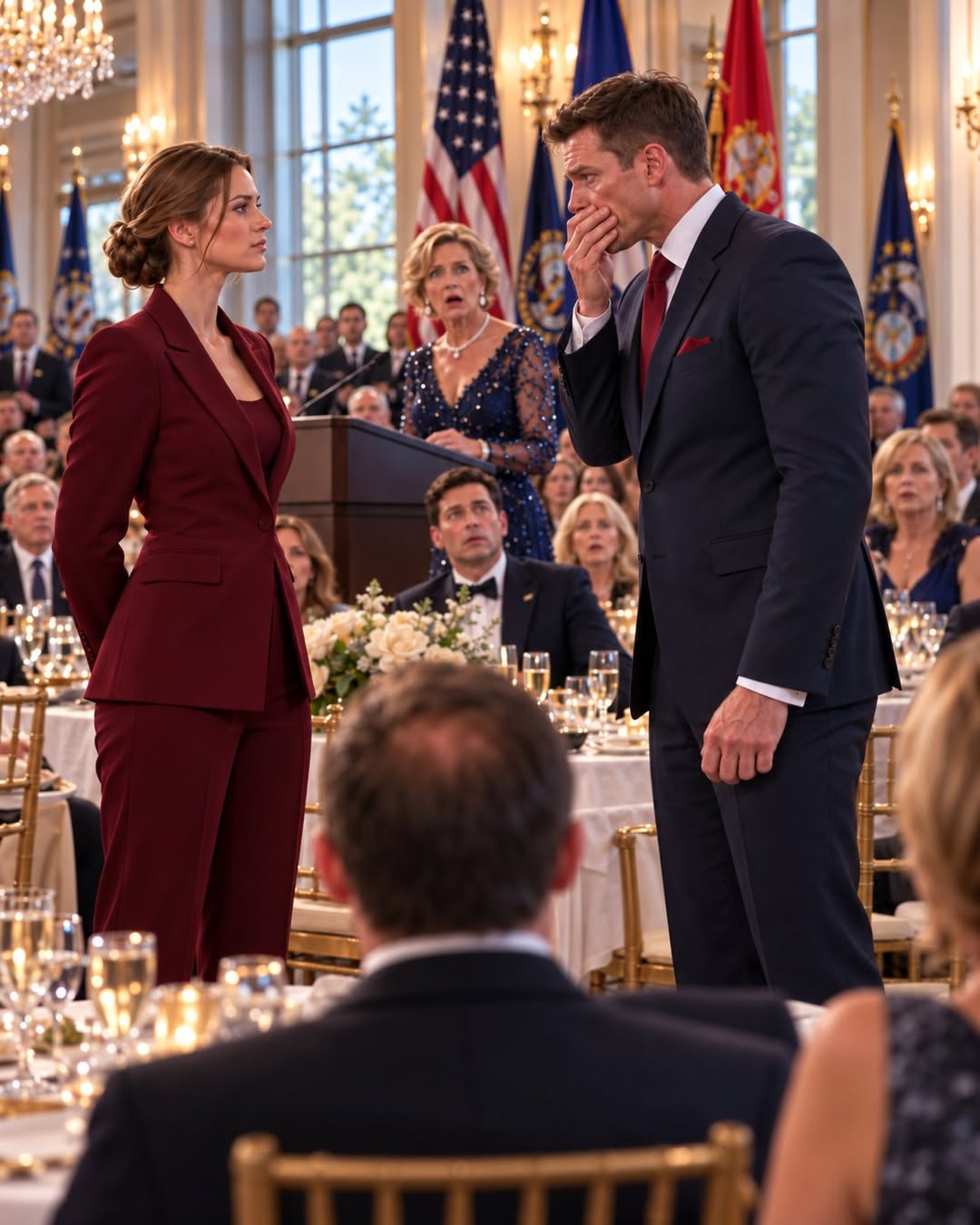
Ethan Rourke stood at attention in front of me, his expression so serious that even my mother seemed to realize something had gone terribly wrong.
“Captain Bennett,” he said, “I was on the extraction team during Operation Sentinel. The operation in which your intelligence assessment helped bring us home.”
I felt my stomach tighten.
There were things about that mission I could discuss. There were others I could not. But I remembered the men involved, the uncertainty of those long hours, and the enormous relief when confirmation finally arrived that everyone had been recovered.
I nodded.
“I’m glad you made it home, Chief.”
He swallowed.
“Ma’am, we were told that the officer who identified the critical discrepancy in the intelligence reports was known as One-Eighty-Seven.”
“That was my analyst identifier.”
He stared at me for another moment.
Then he extended his hand.
“It’s an honor to finally meet you.”
I shook it.
Behind him, my mother gave a sharp, impatient laugh.
“Ethan, dear, what on earth are you talking about? Rebecca works behind a desk.”
He turned toward her.
For the first time that evening, the warmth disappeared from his expression.
“Mrs. Bennett, your daughter is an intelligence officer. Her work helped the command make decisions during an operation involving my team.”
My mother blinked.
“Well, I’m sure she helped with some paperwork.”
Ethan’s jaw tightened.
“Ma’am, I wouldn’t describe it that way.”
A murmur moved through the hall.
My mother looked toward the audience, searching for someone who would share her amusement.
Nobody laughed.
Then Ethan reached for the microphone.
“Ladies and gentlemen, may I have a moment?”
My mother hesitated before stepping aside.
And as the decorated Navy SEAL turned toward the two hundred people she had gathered to witness my humiliation, I realized that the evening was about to become something neither of us had expected.
My name is Rebecca Bennett.
I was thirty-eight years old, a captain in the United States Marine Corps, and the only child of a woman who had spent most of my life wishing I had been a boy.
My father, Richard Bennett, had been a high school history teacher in Orlando.
He was a quiet man with a gentle smile, a remarkable memory, and an almost unreasonable belief that people were capable of becoming better versions of themselves.
My mother, Judith, was different.
She was elegant, socially ambitious, and deeply concerned with appearances.
She served on charity committees, organized fundraising events, and maintained an impressive network of acquaintances who admired her generosity.
In public, she was charming.
At home, she could make me feel worthless without ever raising her voice.
When I was seven, I won a school science competition.
She told me the project was messy and that I should have spent more time learning to behave like a young lady.
When I was twelve, I joined a swimming team.
She complained that my shoulders were becoming too broad.
When I was sixteen, I told her I wanted to pursue a military career.
She laughed.
“Rebecca, don’t embarrass yourself. Leave that sort of thing to the boys.”
My father, who had been reading at the kitchen table, lowered his newspaper.
“Judith, that’s enough.”
She rolled her eyes.
“Richard, I’m only being realistic.”
He looked at me.
“What do you want to do, sweetheart?”
“I want to become a Marine.”
He nodded.
“Then learn what it takes and decide whether you’re prepared to do the work.”
That was my father.
He never promised that my dreams would be easy.
He simply believed I deserved the opportunity to pursue them.
I entered college on a scholarship and earned a commission through an officer training program.
The day I received my commission, my father stood in the audience with tears in his eyes.
My mother attended, but she spent most of the ceremony complaining about the heat.
Afterward, she looked at my uniform and said, “Well, at least you look presentable.”
My father hugged me.
“I’m proud of you, Rebecca.”
I held on to him longer than usual.
At the time, I didn’t know how much I would eventually depend on the memory of those words.
My early years in the Marine Corps were demanding.
I learned that leadership required far more than confidence.
It required discipline, judgment, accountability, and a willingness to accept responsibility when things went wrong.
I also discovered that I had a particular aptitude for intelligence analysis.
I enjoyed finding patterns in complicated information, identifying inconsistencies, and helping commanders understand the consequences of their decisions.
My assignments eventually brought me into joint operational environments where Marines worked alongside personnel from other branches of the military.
The work was often exhausting.
It involved long hours, careful analysis, and the constant awareness that an overlooked detail could have serious consequences.
But I found it meaningful.
My mother did not.
Whenever relatives asked what I did, she told them I answered telephones on a military base.
Sometimes she joked that I spent my days filing paperwork and cleaning offices.
I corrected her at first.
Then I stopped.
It was difficult to explain my work to someone who had already decided it wasn’t worth understanding.
The deepest wound between us came when my father became ill.
He was diagnosed with an aggressive form of cancer when I was thirty-two.
At the time, I was serving overseas.
I requested leave as soon as his condition deteriorated, but operational requirements and travel arrangements meant I could not return immediately.
My mother told the family that I had chosen my career over my dying father.
By the time I reached Florida, Aunt Paula was barely speaking to me.
Uncle Dean accused me of abandoning my responsibilities.
My cousin Tyler said he would never have left his father alone.
I didn’t argue.
I went directly to the hospital.
My father was lying in bed beside a window overlooking the parking lot.
He looked smaller than I remembered.
But when he saw me, his face brightened.
“There she is.”
I sat beside him and took his hand.
“I’m sorry I couldn’t get here sooner.”
He squeezed my fingers.
“You’re here now.”
I began to cry.
He waited until I had calmed down.
Then he said, “Rebecca, don’t let anyone make you ashamed of doing your duty.”
I looked at him.
“I should have been here.”
“You came as soon as you could.”
He smiled faintly.
“And I’ve never been anything but proud of you.”
He died eleven days later.
I was holding his hand.
At the funeral, my mother told relatives that I had arrived only when it was convenient.
She said my father had spent his final months wondering why his daughter cared more about the military than her family.
I knew it wasn’t true.
But I was grieving, exhausted, and unwilling to turn his funeral into a public argument.
So I remained silent.
That silence became the foundation of a story my mother repeated for years.
I was selfish.
I was ungrateful.
I was a disappointment.
And because I rarely challenged her, the family gradually accepted her version of events.
The assignment that earned me the nickname One-Eighty-Seven began several years later.
I was supporting a joint task force during an overseas deployment.
Our responsibilities included evaluating intelligence from multiple sources and providing assessments to the commanders responsible for operational decisions.
My analyst identifier ended in 187.
It was a routine administrative designation.
But because I frequently worked with the same operational personnel, people began referring to me informally by the number.
One-Eighty-Seven.
I never considered it particularly important.
It was simply how people identified my work in a busy operations center.
Then came the mission Ethan Rourke would never forget.
A special operations team was conducting a mission in a remote area when the situation changed unexpectedly.
Communications became unreliable.
Information from different sources began to conflict.
And the original extraction arrangements could no longer be treated as dependable.
The task force needed a clearer understanding of what was happening.
I was part of the intelligence team responsible for reviewing the available information.
During that process, I noticed a discrepancy between two reports that had initially been treated as consistent.
The difference was small.
But its implications were significant.
I brought it to the attention of the appropriate personnel.
Other analysts reviewed the information.
Additional sources were checked.
And the command reassessed its understanding of the situation.
The resulting decisions involved numerous people across intelligence, communications, logistics, medical support, and operational leadership.
I was one member of that effort.
But my contribution helped identify a problem that might otherwise have been overlooked.
Eventually, the team was recovered.
The men returned home.
And the operation became one of those experiences that everyone involved remembered for different reasons.
Afterward, I received formal recognition for my contribution.
I accepted it with gratitude.
But I never believed the outcome belonged to me alone.
The men on the ground had faced the immediate danger.
The extraction personnel had carried out their responsibilities.
The communications teams had maintained contact under difficult circumstances.
And the commanders had made decisions with incomplete information.
Success had required all of us.
That was why I had never been comfortable with the exaggerated stories that sometimes circulated about One-Eighty-Seven.
I had done my job.
Others had done theirs.
And people had come home.
That was enough.
Back at the Central Florida Veterans Hall, Ethan stood before the microphone.
He looked out over the audience.
“I want to clarify something about Captain Bennett,” he began.
My mother stood beside him, smiling uncertainly.
“During an operation involving my team, we encountered a situation that required extensive support from personnel who were not physically with us.”
He paused.
“Some of those people worked in intelligence. Others handled communications, planning, logistics, and operational coordination. Their work helped the command make decisions that contributed to our safe return.”
He looked toward me.
“Captain Bennett was one of those people.”
The room was completely silent.
“Her assessment identified a critical discrepancy in the information available to the task force. That contribution was recognized by the people involved in the operation.”
He took a breath.
“I knew her only by her analyst identifier. One-Eighty-Seven.”
An elderly veteran near the front nodded slowly.
Ethan continued.
“I never expected to meet her at a dinner in Florida. And I certainly never expected to hear someone describe her service as a disgrace.”
My mother’s smile vanished.
Ethan looked directly at her.
“Mrs. Bennett, I understand that families can have disagreements. But I won’t participate in belittling another service member, particularly one whose work contributed to bringing my team home.”
My mother opened her mouth.
Then closed it.
For once, she had nothing prepared.
Ethan stepped away from the microphone and approached me.
“Captain Bennett, thank you.”
I shook his hand.
“I’m glad you’re here, Chief.”
He smiled.
“So am I.”
Then the applause began.
Not all at once.
A few people near the front stood first.
Then others joined them.
Within moments, much of the hall was on its feet.
I felt heat rise in my face.
I had never enjoyed being the center of attention.
And the last thing I wanted was for the evening to become a competition between my mother’s cruelty and my military record.
But I understood what Ethan was trying to do.
He was correcting a false impression.
He was refusing to allow my mother to use his service as a weapon against mine.
And he was reminding everyone in the room that respect should not depend on whether a person’s contributions were visible.
My mother remained beside the podium.
Her face had gone pale.
Aunt Paula slowly lowered her telephone.
Uncle Dean put down his bourbon.
Tyler stared at the tablecloth.
For years, those people had laughed at my mother’s stories.
They had accepted her descriptions of my career without asking whether they were accurate.
Now they were being forced to confront the possibility that the woman they had treated as a family embarrassment was someone they had never bothered to know.
When the applause faded, the event organizer, Colonel James Whitaker, approached me.
He was a retired Army officer in his sixties who had spent years supporting veterans in Central Florida.
“Captain Bennett, would you like to say a few words?”
I hesitated.
Then I nodded.
I walked toward the podium.
My mother stepped aside.
For a moment, I stood in the same place where she had humiliated me.
I looked out at the audience.
Then I began.
“Thank you, Chief Rourke, for your kind words. I’m grateful that you and your teammates returned safely.”
I paused.
“But I want to make something clear. I was one person in a much larger effort. Many people contributed to that outcome, and some of them will never receive public recognition.”
I looked toward the veterans seated near the front.
“Military service takes many forms. Some people serve in combat. Others provide intelligence, medical care, transportation, maintenance, communications, or administrative support. Every one of those responsibilities matters.”
Several people nodded.
Then I took a breath.
“I also want to say something about respect.”
My mother shifted beside the podium.
I continued.
“No one should have to reveal a decoration, a rank, or a remarkable story to deserve basic dignity. A person’s worth isn’t determined by whether other people understand the work they do.”
I looked toward the audience.
“And family should never be the place where someone has to prove they deserve to be treated with kindness.”
The room was silent.
I stepped away from the microphone.
And for the first time that evening, I felt as though I had said exactly what needed to be said.
I did not stay for dessert.
Colonel Whitaker offered to arrange a private room where I could sit until the event ended.
I thanked him but declined.
I needed fresh air.
I needed distance.
And I needed a few minutes in which nobody was looking at me.
Ethan accompanied me toward the exit.
When we reached the doors, he stopped.
“Ma’am, I hope I didn’t overstep.”
I looked at him.
“You didn’t.”
He nodded.
“I just couldn’t stand there and listen to that.”
I smiled faintly.
“Neither could I.”
He hesitated.
“May I ask you something?”
“Of course.”
“Did your mother really not know about your career?”
I considered the question.
“She knew enough to understand that I was an officer. She knew I had deployed. She knew I had received recognition for my service.”
I looked back toward the hall.
“She simply never believed any of it mattered.”
Ethan’s expression softened.
“I’m sorry.”
I shook my head.
“You didn’t cause it.”
He nodded.
Then he extended his hand again.
“It really was an honor to meet you.”
“Likewise, Chief.”
We shook hands.
Then I walked outside.
The Florida night was warm and humid.
I stood beside my car and took a slow breath.
For several minutes, I simply listened to the distant traffic.
Then my telephone began vibrating.
Aunt Paula.
Uncle Dean.
Tyler.
Three messages from relatives I hadn’t spoken to in years.
I ignored them.
Then a message from my mother appeared.
You humiliated me in front of everyone.
I stared at the screen.
For a moment, I almost laughed.
Then I put the telephone away.
I had spent decades trying to explain to my mother that her words hurt me.
And now, after humiliating me in front of two hundred people, she was furious because someone had corrected her.
I got into my car and drove home.
The following morning, the video began circulating through the family.
Aunt Paula had recorded nearly the entire confrontation.
At first, she had intended to capture my mother’s speech.
Instead, she had preserved the moment Ethan recognized me and publicly challenged her description of my service.
Several relatives sent me the recording.
Others sent apologies.
Some were sincere.
Some seemed motivated by embarrassment.
I did not respond immediately.
I had learned that an apology was more meaningful when it was followed by changed behavior.
And I was no longer interested in accepting words simply because they made other people feel better.
By Monday afternoon, my mother had called fourteen times.
I finally answered.
“Rebecca.”
Her voice was sharp.
“Do you have any idea what you’ve done?”
I sat down at my kitchen table.
“Good afternoon, Mom.”
“Don’t take that tone with me.”
“What would you like to discuss?”
She inhaled sharply.
“Everyone is talking about what happened at the dinner.”
“I imagine they are.”
“Paula says people are accusing me of being a terrible mother.”
I remained silent.
My mother continued.
“And that Navy man made me look like a fool.”
“Ethan corrected what you said about my service.”
“He had no right to interfere in a family matter.”
I took a breath.
“You introduced him as the son you wished you’d had. You made him part of the conversation.”
She was quiet for a moment.
Then she said, “You could have stopped him.”
I looked toward the window.
“Why would I stop someone from telling the truth?”
My mother’s voice hardened.
“You’ve always enjoyed making me look bad.”
I closed my eyes.
There it was.
The same accusation she had used since I was a child.
Whenever I succeeded at something she didn’t approve of, I was showing off.
Whenever I defended myself, I was being disrespectful.
Whenever someone recognized my accomplishments, I was deliberately embarrassing her.
I took a breath.
“Mom, you stood in front of two hundred people and called me the greatest shame of your life.”
She sighed.
“Oh, Rebecca. It was a joke.”
“No.”
“You’ve become so sensitive.”
“No, Mom. You meant what you said.”
She was silent.
I continued.
“You’ve been saying versions of the same thing for twenty years. The only difference is that this time, someone challenged you.”
She began crying.
For a moment, the familiar guilt rose in my chest.
I had spent much of my life trying to avoid making my mother cry.
But I was beginning to understand that her tears did not automatically mean I had done something wrong.
“I don’t know why you hate me,” she whispered.
I looked down at my hands.
“I don’t hate you.”
“Then why are you doing this?”
“Because I’m no longer willing to let you humiliate me.”
She sniffed.
“I raised you.”
“Yes.”
“I sacrificed for you.”
“I know.”
“And this is how you repay me?”
I took a breath.
“Mom, raising a child doesn’t give you the right to mistreat that child for the rest of her life.”
The silence that followed was long.
Then she said, “Your father would be ashamed of you.”
Something inside me became very still.
For years, that sentence had been her most effective weapon.
She knew how much I loved my father.
She knew how deeply I regretted the time I had missed with him.
And she knew that invoking his memory could make me question almost any decision.
But this time, I remembered his final words.
Don’t let anyone make you ashamed of doing your duty.
I looked toward the framed photograph of him on my bookshelf.
Then I spoke.
“Mom, Dad told me he was proud of me.”
She was silent.
“He told me that in the hospital, eleven days before he died.”
Her breathing changed.
I continued.
“You can tell people whatever you want about my relationship with him. But you cannot change what he said to me.”
She began to speak.
I interrupted her.
“And I won’t allow you to use his memory to hurt me anymore.”
Then I ended the call.
I sat at the kitchen table for a long time afterward.
My hands were trembling.
I had faced difficult assignments, demanding commanders, and situations in which the consequences of a mistake were far more serious than an uncomfortable family conversation.
Yet standing up to my mother had required a kind of courage I had spent years avoiding.
Because the danger wasn’t physical.
It was emotional.
I was afraid that if I stopped accepting her treatment, I would lose the last remaining connection to the family I had grown up in.
But the truth was that I had already lost much of that connection.
I had simply been pretending otherwise.
Over the following weeks, I began making changes.
I stopped answering every call from my mother.
I told relatives that I would not participate in conversations where my career, character, or relationship with my father were treated as subjects for ridicule.
I declined invitations to gatherings where I knew I would be expected to tolerate the same behavior.
And I began working with a counselor to understand why I had spent so many years trying to earn approval from someone who seemed determined to withhold it.
The process was uncomfortable.
There were days when I felt guilty.
Days when I wondered whether I was being too harsh.
Days when I missed the idea of having a mother who was proud of me.
But gradually, I began to understand that boundaries were not punishments.
They were decisions about what I was willing to accept in my life.
Ethan contacted me about a month after the dinner.
He had obtained my professional contact information through appropriate channels and sent a brief message asking whether I would be comfortable meeting for coffee while he was in the area.
I agreed.
We met at a small café near the base.
He arrived in civilian clothes, carrying a paper cup of coffee.
Without the formal setting of the veterans dinner, he seemed more relaxed.
We talked about our careers.
About the challenges of working in joint environments.
About the people who had helped us along the way.
And about the strange experience of being recognized for something that had required the efforts of so many others.
At one point, Ethan looked at me.
“Ma’am, I hope you know I wasn’t trying to make you uncomfortable that night.”
I smiled.
“You didn’t.”
He nodded.
“I just couldn’t let your mother use my service to diminish yours.”
I looked down at my coffee.
“Thank you.”
He hesitated.
“Can I tell you something?”
“Of course.”
“My mother used to tell me that the most important people in a mission aren’t always the ones who get photographed afterward.”
I smiled.
“She sounds wise.”
He laughed.
“She is.”
Then he became serious.
“Your work mattered, Captain. Whether your family understands it or not.”
For the first time in a long while, I allowed myself to accept the compliment without minimizing it.
“Thank you, Ethan.”
Our friendship developed gradually.
We occasionally exchanged messages.
Sometimes we met for coffee when our schedules allowed.
He never treated me as a legend.
I never treated him as a symbol of military heroism.
We were simply two service members who understood that professional respect had to be earned through conduct, not reputation alone.
And I appreciated having someone in my life who knew the difference between admiration and performance.
My relationship with my extended family changed as well.
Aunt Paula eventually called to apologize.
She admitted that she had spent years accepting my mother’s version of events without asking me what had actually happened.
She also acknowledged that recording my humiliation had been cruel.
I thanked her.
But I told her that rebuilding our relationship would require more than one conversation.
Uncle Dean was less reflective.
He insisted that everyone had become too sensitive and that families should be able to joke with one another.
I told him I was not interested in discussing the matter further.
Tyler sent a brief message saying that he had always respected my service.
I did not challenge him.
But I did not pretend that his behavior at the dinner had demonstrated that respect.
I responded politely and left it there.
Three months after the event, Colonel Whitaker invited me to speak at a small gathering for young people considering military service.
I hesitated.
Public speaking had never been my favorite activity.
And after the veterans dinner, I was reluctant to become the center of another event.
But the gathering had a worthwhile purpose.
So I agreed.
There were about forty students in attendance.
Some were interested in the military.
Others were simply curious about the different careers available.
I spoke about my experiences.
About leadership.
About the importance of education.
And about the wide range of responsibilities performed by service members.
I did not discuss sensitive operational details.
I did not tell dramatic stories designed to impress the audience.
Instead, I talked about preparation, teamwork, and the importance of understanding one’s responsibilities.
Afterward, a teenage girl approached me.
She was wearing a navy-blue sweater and carrying a notebook.
“Captain Bennett?”
“Yes?”
She hesitated.
“My family thinks I shouldn’t join the military because I’m a girl.”
I felt something tighten in my chest.
I looked at her.
“What do you want to do?”
“I want to become an officer.”
I smiled.
“Then learn about the requirements. Talk to people who have served. Consider the different career paths. And make an informed decision about whether it’s right for you.”
She nodded.
Then she asked, “Do you think I can do it?”
I considered the question.
“I don’t know you well enough to predict your future. But being a girl isn’t a reason to stop you from trying.”
Her face brightened.
“Thank you.”
I smiled.
“You’re welcome.”
As she walked away, I thought about the seventeen-year-old girl who had once stood in her mother’s kitchen and announced that she wanted to become a Marine.
I wished someone had said those words to me then.
Six months after the veterans dinner, my mother sent me a letter.
It arrived in a cream-colored envelope with her familiar handwriting on the front.
I left it unopened for two days.
Then I sat at my kitchen table and read it.
The letter was three pages long.
Most of it described how difficult the previous months had been for her.
She had lost her position as chair of the fundraising committee.
Several acquaintances had distanced themselves.
And she felt that the community had judged her unfairly.
She blamed Aunt Paula for sharing the video.
She blamed Ethan for speaking publicly.
And she blamed me for refusing to defend her.
Near the end, she wrote that she was sorry if her words had hurt my feelings.
I read that sentence several times.
Then I placed the letter on the table.
It wasn’t the apology I had hoped for.
But it was the first time my mother had acknowledged, however indirectly, that her behavior might have caused harm.
I decided not to respond immediately.
A week later, she called.
I answered.
“Rebecca?”
“Yes, Mom.”
“Did you receive my letter?”
“I did.”
She hesitated.
“Well?”
I took a breath.
“I appreciate that you wrote. But I need you to understand that what happened wasn’t simply a misunderstanding.”
She sighed.
“I said I was sorry.”
“You said you were sorry if my feelings were hurt.”
“Isn’t that the same thing?”
“No.”
She was silent.
I continued.
“You publicly called me the greatest shame of your life. You lied about my service. You used Dad’s memory to make me feel guilty. And when someone corrected you, you blamed me for the embarrassment.”
Her breathing became uneven.
I waited.
Then she whispered, “I don’t know how to fix this.”
For the first time, I heard something in her voice that sounded less like anger and more like uncertainty.
I considered my answer carefully.
“You can start by acknowledging what you did without explaining why everyone else is responsible.”
My mother did not respond immediately.
Then she said, “I was wrong to say those things about you.”
I closed my eyes.
It was a small sentence.
But I had waited more than twenty years to hear it.
She continued.
“I was angry. And I was embarrassed that you had built a life I didn’t understand.”
I felt tears gathering.
“Mom, you didn’t have to understand every part of my career. You just had to respect me.”
She began to cry.
“I know.”
I wanted to believe that the conversation marked a permanent change.
But I had learned not to confuse a moment of honesty with a lifetime of different behavior.
So I thanked her.
And I told her that I needed more time.
Over the following year, our relationship improved slowly.
We began speaking occasionally.
At first, our conversations were brief.
We discussed ordinary things.
The weather.
Her garden.
My work.
The neighbors.
Whenever she made a dismissive comment, I addressed it immediately.
Sometimes she apologized.
Sometimes she became defensive.
And sometimes I ended the conversation.
Gradually, she began to understand that maintaining a relationship with me required her to treat me differently.
I did not expect perfection.
But I expected respect.
The first real turning point came on my father’s birthday.
My mother called and asked whether I would visit his grave with her.
I hesitated.
Then I agreed.
We met at the cemetery on a cool February morning.
She brought flowers.
I brought a small photograph of my father from the day I received my commission.
We stood beside his grave for several minutes.
Then my mother looked at the photograph.
“I remember that day.”
I nodded.
“He was so proud.”
She swallowed.
“Yes.”
I looked at her.
“Did he ever tell you that?”
She nodded.
“All the time.”
My chest tightened.
She continued.
“He used to show your photographs to his friends. He kept every letter you sent him.”
I stared at her.
I had never known that.
My mother looked down.
“I was jealous.”
The word surprised me.
“Jealous?”
She nodded.
“You and your father understood each other in a way I never did. And when you joined the Marines, I felt like I was losing you.”
I took a breath.
“So you decided to make me feel guilty for leaving.”
Her eyes filled.
“Yes.”
For a moment, neither of us spoke.
Then she whispered, “I’m sorry, Rebecca.”
This time, she did not add an explanation.
She did not blame Ethan.
Or Aunt Paula.
Or the people who had watched the video.
She simply apologized.
I looked at my father’s grave.
For years, I had imagined that repairing my relationship with my mother would require one dramatic conversation in which she finally understood everything she had done.
But standing there beside her, I realized that healing was more complicated.
There would be no single moment that erased the past.
No apology that restored the years we had lost.
No perfect ending in which every wound disappeared.
There would simply be choices.
Her choice to behave differently.
My choice to maintain boundaries.
And our shared willingness to build whatever relationship was still possible.
I reached for her hand.
She took it.
We stood together for a while.
Then we left the cemetery.
Two years after the veterans dinner, I returned to the Central Florida Veterans Hall.
This time, I had been invited by Colonel Whitaker to speak at a smaller recognition event honoring service members and their families.
I accepted because I respected the organization and the work it did.
My mother attended as a guest.
She did not organize the program.
She did not control the seating arrangements.
And she did not attempt to turn the evening into a performance.
When I arrived, she was standing near the entrance.
She smiled.
“Rebecca.”
“Hello, Mom.”
She looked at my uniform.
“You look wonderful.”
I smiled.
“Thank you.”
Then she said something I had never heard from her before.
“I’m proud of you.”
I stood very still.
For a moment, I didn’t know what to say.
Then I nodded.
“Thank you, Mom.”
Ethan was there too.
He had been invited to participate in a panel discussion about military teamwork.
When he saw me, he grinned.
“One-Eighty-Seven.”
I laughed.
“Chief Rourke.”
He shook my hand.
“Good to see you, ma’am.”
“Likewise.”
Then he looked toward my mother.
She approached us.
For a moment, I wondered whether the old tension would return.
Instead, she extended her hand.
“Chief Rourke, I owe you an apology.”
Ethan looked surprised.
She continued.
“I put you in an unfair position two years ago. And I said things about my daughter that were untrue and unkind.”
He nodded.
“Thank you for saying that, Mrs. Bennett.”
She looked at me.
Then she smiled faintly.
“I’ve been learning.”
I believed her.
Not because she had suddenly become a different person.
But because I had seen her make difficult choices over time.
Later that evening, I stood at the podium.
I looked out over the audience.
At the veterans.
The families.
The young service members.
And the people who had gathered to recognize their contributions.
I spoke about teamwork.
About responsibility.
About the importance of recognizing the people whose work often remained invisible.
Then I told them something I had learned outside the military.
“Respect isn’t something we should reserve for people with impressive titles or remarkable accomplishments. It’s something we owe one another as human beings.”
I paused.
“Recognition can be meaningful. Awards can be meaningful. But no one should have to achieve something extraordinary before the people who love them treat them with kindness.”
The room was quiet.
Then the applause began.
I stepped away from the microphone.
And this time, I didn’t feel as though I had anything to prove.
I am forty now.
I continue to serve in the Marine Corps.
My career remains demanding.
There are long days, difficult decisions, and responsibilities that require constant attention.
But I love the work.
I love the people I serve alongside.
And I am proud of the contribution I have been able to make.
My relationship with my mother is not perfect.
Sometimes she falls back into old habits.
Occasionally, she makes a comment that reminds me of the woman who once stood before two hundred people and called me a disgrace.
But now I address those moments when they happen.
I no longer remain silent simply because challenging her might create tension.
And she has learned that maintaining a relationship with me requires her to respect my boundaries.
Last month, I visited her for lunch.
She made roast chicken, mashed potatoes, and green beans.
We sat at the kitchen table where my father used to read his newspaper.
For a while, we talked about ordinary things.
Then she reached into a drawer and took out a small wooden box.
“I found these while cleaning your father’s study.”
She placed it in front of me.
Inside were photographs.
Letters.
Newspaper clippings.
And a small collection of programs from my military ceremonies.
I recognized the handwriting on the envelopes immediately.
My father’s.
I picked up one of the letters.
It was dated several years before his death.
He had written it to an old friend.
Near the bottom, he had added a short paragraph about me.
Rebecca has become an extraordinary young woman. She works hard, takes her responsibilities seriously, and cares deeply about the people around her. I couldn’t be prouder to be her father.
I read the words twice.
Then I began to cry.
My mother reached across the table and took my hand.
“He meant every word.”
I nodded.
“I know.”
That evening, I returned home and placed the wooden box on my bookshelf.
Beside it stood a photograph of my father from the day I received my commission.
He was smiling.
His arm was around my shoulders.
And his eyes were filled with the kind of pride I had spent years trying to earn from my mother.
I looked at the photograph for a long time.
Then I smiled.
For the first time, I understood that I had never needed to earn his pride.
He had given it freely.
And I had never needed to earn my mother’s respect by becoming someone else.
I had deserved it all along.
Sometimes people ask whether I regret attending the veterans dinner.
I don’t.
I regret that my mother chose to humiliate me.
I regret that so many relatives remained silent.
And I regret that it took a public confrontation for some of them to question the stories they had believed for years.
But I do not regret standing in that aisle.
I do not regret allowing Ethan to correct the false impression.
And I do not regret finally telling my mother that I would no longer accept her cruelty.
Because the truth is, I never wanted to embarrass her.
I wanted her to understand that I was not the failure she had spent years describing.
And more importantly, I wanted to stop measuring my worth through her disappointment.
This morning, I woke before sunrise.
I made coffee and sat beside the window.
The sky was still dark.
My uniform hung neatly in the closet.
My father’s photograph stood on the bookshelf.
And my telephone displayed a message from Ethan.
Morning, One-Eighty-Seven. Hope you’re doing well. The team is getting together next month. We’d be honored if you could join us.
I smiled and replied that I would check my schedule.
Then another message appeared.
This one was from my mother.
Good morning, Rebecca. I hope you have a wonderful day. I’m proud of you.
I read it twice.
Then I set the telephone down.
For years, those were the words I had wanted more than anything.
Now, hearing them felt good.
But they were no longer the foundation of my self-worth.
I had built that foundation myself.
Through work.
Through discipline.
Through mistakes and difficult lessons.
Through the people I had served alongside.
And through the quiet knowledge that I had lived according to values I believed in.
Two years ago, my mother stood before two hundred people and called me the greatest shame of her life.
She introduced a decorated Navy SEAL as the son she had always wished she’d had.
She expected him to join her in humiliating me.
Instead, he recognized my service and reminded the room that my contributions mattered.
For a few minutes, the balance of power changed.
The relatives who had laughed became silent.
My mother became embarrassed.
And the people who had treated me as a failure suddenly looked at me differently.
But the most important lesson of that evening had nothing to do with my rank, my decorations, or the nickname One-Eighty-Seven.
It was that I had deserved respect before Ethan recognized me.
I deserved it when I was a frightened seventeen-year-old girl trying to explain my dreams.
I deserved it when I was a young officer learning to lead.
I deserved it when I was grieving my father.
And I deserved it when I stood alone in the center aisle of the veterans hall, waiting for my mother to finish humiliating me.
My mother believed that a decorated warrior could prove her daughter was a disgrace.
Instead, he reminded her that the daughter she had spent years looking down on had already earned the respect of people whose lives depended on her work.
But the greatest victory of my life wasn’t earning that respect. It was finally understanding that I had never needed my mother’s permission to be proud of who I was.
THE END