
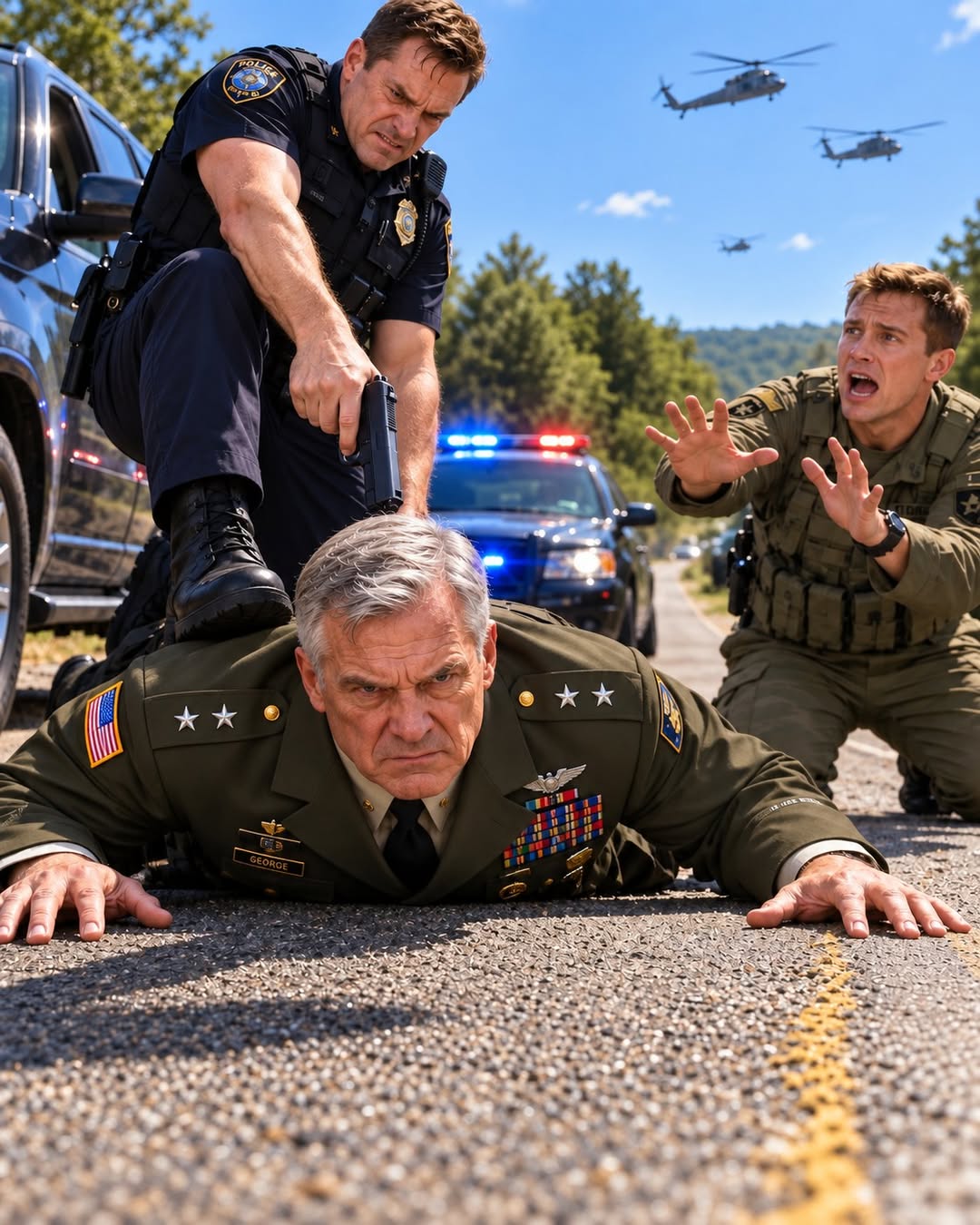
For the first time in twenty-nine years of military service, I understood that my rank, my uniform, and every decoration I had earned might mean absolutely nothing to the man holding a gun against my head.
Officer Brett Cheney pressed his boot harder into my back.
The asphalt was hot enough to burn my cheek. Gravel dug into my palms, and somewhere behind me, Sergeant Calvin Hendry was shouting that we were unarmed.
“Sir, please! We’re cooperating!”
“Shut your mouth!” Cheney barked.
I heard the weapon shift.
Then he leaned closer.
“You military boys think you’re special. Think you can come through my town and tell me how to do my job.”
I kept my hands open against the pavement.
“Officer, nobody is challenging your authority. We’re asking you to lower your weapon so this doesn’t become a tragedy.”
He laughed.
“A tragedy?”
His boot shifted against my shoulder blade.
“You haven’t seen a tragedy yet.”
A few yards away, a truck slowed as it passed. I heard its tires crunch over the gravel, followed by the sound of a horn.
Cheney straightened.
“Keep driving!” he shouted.
The truck accelerated.
And I realized that the most dangerous thing about this situation was not simply that Cheney had drawn his weapon.
It was that he seemed completely comfortable doing it.
He wasn’t frightened.
He wasn’t confused.
He wasn’t responding to a threat.
He was enjoying the control.
I had encountered men like him before, in places where authority was enforced through intimidation rather than earned through responsibility.
But I had never expected to encounter one while driving to visit my mother in Georgia.
And I had certainly never expected to encounter one wearing an American police uniform.
My name is Nathaniel Langford. I was fifty-four years old, a major general in the United States Army, and the father of two daughters.
I had served in Iraq and Afghanistan, commanded soldiers in dangerous environments, and spent much of my career making decisions that could affect hundreds of lives.
I understood risk.
I understood fear.
And I understood the importance of maintaining discipline when emotions threatened to overwhelm judgment.
But lying on that highway, with a pistol pressed against my skull, I was not thinking about my career.
I was thinking about my wife, Rebecca.
I was thinking about our daughters.
And I was thinking about my eighty-two-year-old mother, who was waiting for me to arrive with the peach preserves she liked from a little shop outside Atlanta.
I had promised to be there before lunch.
Now I wasn’t certain I would ever see her again.
The trip had begun like any other.
Calvin picked me up shortly after sunrise.
He had served as my military aide for nearly three years and was one of the most dependable soldiers I had ever known.
He was thirty-two, married, and the father of a little boy who had recently learned to ride a bicycle.
During the drive, we talked about ordinary things.
His son’s birthday.
An upcoming training exercise.
A mechanical problem with his wife’s car.
I called Rebecca when we stopped for coffee.
She reminded me to take my medication, asked whether I had packed the preserves, and told me not to let my mother persuade me to repair her entire house in one afternoon.
I laughed.
“She’s eighty-two, Rebecca. I’m not arguing with her.”
“Then don’t complain when she has you climbing onto the roof.”
I promised to be careful.
Those were the last normal words I spoke to my wife before Officer Cheney pulled us over.
Cheney had claimed he smelled marijuana.
Neither Calvin nor I smoked.
There were no drugs in the vehicle.
And although I did not know why he had stopped us, I understood that arguing on the roadside would accomplish very little.
My priority was simple.
Keep everyone alive.
Preserve whatever evidence we could.
And allow the proper authorities to review what had happened.
But Cheney seemed determined to turn a routine encounter into something far more dangerous.
“Where’s your weapon?” he demanded.
“I am not carrying one,” I answered.
“Don’t lie to me.”
“I’m not lying.”
He pressed the pistol harder against my head.
Calvin’s voice trembled.
“Officer, we’re both active-duty Army personnel. Our identification is in the vehicle. Please contact your supervisor.”
Cheney turned toward him.
“You want to tell me how to do my job?”
“No, sir.”
“Then get on your knees.”
Calvin complied.
I heard the scrape of his boots against the gravel.
Cheney stepped away from me long enough to shove Calvin toward the side of the SUV.
Then he returned.
“Now,” he said, “let’s find out what you’re hiding.”
He searched us.
He found my wallet, military identification, telephone, and the folded photograph of my daughters that I had carried for years.
He tossed the photograph onto the pavement.
I watched it slide beneath the SUV.
Something inside me tightened.
But I said nothing.
Then Cheney searched Calvin.
He found his military identification, a set of keys, and a small notebook.
Nothing else.
Cheney looked irritated.
He walked to the SUV and began opening doors.
I heard the glove compartment slam.
A suitcase hit the ground.
Then another.
He pulled clothing from one of the bags and scattered it across the shoulder.
A passing vehicle slowed.
Cheney shouted at the driver to keep moving.
Then he returned to us.
“Where’s the marijuana?”
“There isn’t any,” Calvin said.
Cheney stared at him.
“Wrong answer.”
What Cheney did not know was that Calvin had activated the vehicle’s emergency communication function shortly after the stop began.
It had transmitted our location to the designated security contact associated with my official travel arrangements.
The notification did not mean the Army could take over a civilian traffic stop.
It did not authorize anyone to interfere with local law enforcement.
But it did create a record of where we were and that something had gone wrong.
And when Calvin failed to respond to the subsequent check-in, the situation began attracting attention.
Meanwhile, my wife had already received a call from my office.
Rebecca had spent twenty-seven years married to a soldier.
She knew the difference between a delayed arrival and an emergency.
She also knew that the Pentagon was not a magical switch that could be flipped to summon helicopters or override civilian police authority.
So she did what she had learned to do during years of deployments and crises.
She contacted my chief of staff, provided everything she knew, and asked that the appropriate military and civilian authorities be notified.
Within minutes, the matter was being escalated through established channels.
None of that helped me on the highway.
Not yet.
Cheney had just finished searching the vehicle when a second patrol car arrived.
A younger officer stepped out.
He was tall and thin, with short brown hair and an expression that changed immediately when he saw me lying on the pavement.
“Brett, what’s going on?”
Cheney turned.
“Possible narcotics. Two suspects refusing to cooperate.”
The younger officer looked at Calvin, who was kneeling beside the SUV with his hands visible.
Then he looked at me.
“Are they armed?”
“Not that I’ve found.”
“Did they threaten you?”
Cheney’s face hardened.
“They’re being difficult.”
The younger officer hesitated.
Then he said, “I’m Officer Daniel Price. Sir, are you injured?”
I lifted my head slightly.
“Yes. My cheek and back.”
Cheney stepped toward him.
“Don’t talk to them.”
Price looked at Cheney’s drawn weapon.
Then at me.
“Brett, I think we need a supervisor.”
For a moment, Cheney seemed ready to explode.
Then he holstered his pistol.
“Fine. Call whoever you want.”
Price stepped away and used his radio.
I heard him request a supervisor and medical assistance.
It was the first moment since the stop began that I believed we might leave the highway alive.
A few minutes later, an ambulance arrived.
Then another patrol car.
Then a third.
The roadside became crowded with emergency vehicles.
Cheney paced near his cruiser, speaking angrily into his radio.
Price remained beside us.
He did not remove my restraints immediately, but he made sure the paramedics could examine me and asked that the circumstances of the stop be documented.
My cheek was bleeding.
My back hurt.
And I had a headache that made the sunlight feel unusually sharp.
One paramedic recommended that I be transported to the hospital for further evaluation.
I agreed.
Then I looked at Calvin.
“Are you all right, Sergeant?”
He nodded, although his face was pale.
“Yes, sir.”
I knew he was trying to sound steady for my sake.
I also knew he had just watched a man point a loaded weapon at his commanding officer’s head.
Neither of us would forget that.
The supervising officer arrived shortly afterward.
His name was Lieutenant Harold Voss.
He was a broad-shouldered man in his late forties, with a weathered face and a carefully controlled expression.
He listened to Cheney’s explanation.
Then he spoke briefly with Price.
Finally, he approached me.
“Major General Langford?”
“Yes.”
“I’m Lieutenant Voss. I’m sorry about the circumstances. We’re going to review what happened.”
I looked at him.
“Lieutenant, your officer pointed a weapon at my head while I was restrained on the ground. I want that fact documented.”
Voss nodded.
“It will be.”
“And I want the body-camera and dash-camera recordings preserved.”
He hesitated.
Then said, “We’ll follow the appropriate procedures.”
I held his gaze.
“I expect nothing more. And nothing less.”
I was transported to a local hospital.
Calvin was examined separately.
My injuries were painful but, thankfully, not life-threatening.
I had abrasions on my face, bruising along my shoulder and back, and a mild concussion that required monitoring.
The doctor recommended rest and follow-up care.
I listened.
Signed the necessary paperwork.
And asked for my telephone.
There were seventeen missed calls from Rebecca.
I called her immediately.
She answered before the first ring had finished.
“Nathaniel?”
“I’m here.”
Her breathing changed.
For a moment, she couldn’t speak.
Then she asked, “Are you hurt?”
“A little. I’m at the hospital.”
“Are you safe?”
“Yes.”
There was a long silence.
Then she began to cry.
I closed my eyes.
“I love you,” I said.
“I love you too.”
I had survived combat tours, dangerous assignments, and years of uncertainty.
But hearing my wife cry because she had spent the morning wondering whether I was alive was one of the hardest moments of my career.
Rebecca told me that my chief of staff, Colonel Michael Avery, had coordinated with the appropriate Army authorities after the emergency notification.
The local sheriff’s office had also been contacted.
Because the incident involved a senior military officer, it attracted attention at several levels.
But the central issue was not my rank.
It was whether a police officer had used force unlawfully against two people who were complying with his instructions.
That question belonged to the appropriate civilian investigative and judicial authorities.
And I intended to cooperate fully.
By late afternoon, the incident had reached the county sheriff.
Sheriff Raymond Collins had served in law enforcement for nearly thirty years.
He was not a man who enjoyed surprises.
And according to Colonel Avery, he was particularly unhappy to discover that a serious use-of-force incident involving one of his officers had escalated before he received a complete report.
Collins requested the available recordings and ordered that Cheney be removed from patrol duties pending the initial review.
He also arranged for investigators who were not involved in the stop to begin collecting statements and evidence.
That was when the first serious inconsistencies appeared.
Cheney’s account described two aggressive occupants who had refused instructions and made him fear for his safety.
Officer Price’s preliminary statement described two men who were compliant when he arrived.
The paramedics documented injuries consistent with my account of being forced onto the pavement.
And the available video recordings raised questions that could not be explained away as a simple misunderstanding.
That evening, I received another call from Colonel Avery.
“Sir, there’s something else you should know.”
I was sitting in the hospital room, waiting for Rebecca to arrive.
“What is it?”
“The sheriff has requested assistance with a broader review of Officer Cheney’s conduct.”
I frowned.
“Broader?”
“There have apparently been previous complaints.”
I closed my eyes.
Of course there had.
I had recognized the confidence in Cheney’s behavior.
The casual threats.
The complete absence of hesitation.
But I had hoped I was wrong.
“How many complaints?”
“I’m still waiting for verified information, sir.”
“Then don’t speculate.”
“Yes, sir.”
I looked toward the window.
Outside, the sky was turning orange.
“Michael, make sure our people preserve everything they have. Then let the investigators do their jobs.”
“Understood.”
Rebecca arrived just after sunset.
She entered the room carrying my overnight bag and wearing the expression I had seen only a handful of times during our marriage.
The expression that meant she was frightened, furious, and determined not to let either emotion interfere with what needed to be done.
She stopped beside the bed.
Then she touched my cheek.
“Oh, Nathaniel.”
I took her hand.
“I’m all right.”
She looked at the bandage.
“No, you’re not.”
I smiled faintly.
“I will be.”
She sat beside me.
For a while, neither of us spoke.
Then she said, “Your mother knows.”
I groaned.
“Rebecca.”
“She called me six times. I wasn’t going to lie to her.”
“What did you tell her?”
“That you’re safe, you’re being treated, and you’ll visit when the doctor says you can.”
I sighed.
“She’ll be furious.”
Rebecca gave me a small smile.
“She already is.”
The next morning, Sheriff Collins came to the hospital.
He arrived without cameras, reporters, or an entourage.
Just one investigator and a folder.
He introduced himself to Rebecca, then asked whether I felt well enough to speak.
I agreed.
He began with a formal apology for the distress caused by the incident.
I listened.
Then I said, “Sheriff, I appreciate your concern. But what matters now is the investigation.”
He nodded.
“I agree.”
He explained that Cheney had been placed on administrative leave while the department reviewed the incident and the appropriate outside authorities considered whether further action was warranted.
The sheriff’s office was preserving recordings, dispatch records, reports, and relevant evidence.
Investigators were also reviewing earlier complaints to determine whether they had been handled appropriately.
I asked whether Calvin had been interviewed.
“Yes.”
“Has he been treated fairly?”
“To my knowledge, yes.”
I nodded.
“Good.”
Then Collins said something that stayed with me.
“General, I understand this has attracted considerable attention because of who you are.”
I looked at him.
“Yes.”
He hesitated.
“But I want you to know that the investigation would be warranted regardless of your rank.”
I held his gaze.
“I hope so, Sheriff.”
He nodded.
I continued.
“Because if Officer Cheney was willing to do this to a man in a military uniform who identified himself clearly, I want to know what he did to people who had no reason to believe anyone would listen to them.”
Collins looked down at the folder.
Then he said, “That’s one of the questions we’re examining.”
Within days, the story reached the local news.
A senior Army officer had been injured during a traffic stop.
A police officer had been placed on leave.
Investigators were reviewing allegations of excessive force and misconduct.
My office issued a brief statement confirming that I was receiving medical care and cooperating with the appropriate authorities.
We did not release dramatic accusations.
We did not speculate about criminal charges.
And we did not suggest that the Army would take control of a civilian police department.
But the public attention had an unexpected effect.
Other people began coming forward.
The first was a delivery driver named Marcus Hill.
He was forty-one, married, and the father of three children.
He said Cheney had stopped him the previous year while he was driving home from work.
According to Marcus, Cheney claimed to smell drugs, searched his vehicle, and detained him for nearly two hours.
No drugs were found.
Marcus had filed a complaint.
He said he never received a meaningful response.
Then a college student came forward.
Then a retired mechanic.
Then a woman who said Cheney had threatened to arrest her after she questioned a traffic citation.
Not every allegation was identical.
Not every complaint was substantiated.
And investigators had to examine each one separately.
But together, they raised serious questions about whether the department had ignored warning signs.
I met Marcus several weeks later.
By then, I had returned home and was recovering from my injuries.
He contacted my attorney through a local civil-rights organization, and after discussing the matter with counsel, I agreed to meet him.
We sat in a quiet conference room.
Marcus was nervous.
He kept turning his wedding ring around his finger.
Finally, he said, “General, I almost didn’t come.”
“Why?”
He looked down.
“Because I figured nobody would believe me.”
I said nothing.
He continued.
“When I complained, they told me the officer had been doing his job. I started thinking maybe I should’ve just kept my mouth shut.”
I leaned forward.
“Marcus, I can’t tell you what the investigation will find. But you have every right to report what happened to you.”
He nodded.
Then he looked at me.
“You know what’s strange?”
“What?”
“When I saw your story, I thought, if he can do that to a general, maybe people will finally understand what it’s like for the rest of us.”
I felt a heaviness settle in my chest.
Because Marcus was right about something important.
My rank had not protected me on the highway.
But it had ensured that my disappearance triggered immediate concern.
It had given me access to experienced counsel.
And it had made it difficult for the incident to disappear quietly.
Marcus had not enjoyed those advantages.
Neither had many of the other people who came forward.
I thought about that conversation for days.
Then I spoke with my attorney about what I could responsibly do.
I did not want to interfere with the investigation.
I did not want to turn the incident into a personal campaign against an entire police department.
And I did not want my military position to be used as leverage in a civilian legal dispute.
But I could speak about my own experience.
I could cooperate with investigators.
And I could support the principle that allegations of misconduct should be examined fairly, regardless of the complainant’s occupation, income, race, or social standing.
That was what I chose to do.
The investigation continued for several months.
The outside investigators reviewed the recordings, interviewed witnesses, examined medical records, and compared Cheney’s statements with the available evidence.
The department also reviewed its handling of previous complaints.
Eventually, the district attorney announced that Cheney would face criminal charges arising from the stop.
The specific charges reflected the evidence and applicable state law.
Cheney pleaded not guilty.
His attorney argued that he had believed the occupants posed a threat and that his actions had been misinterpreted.
The prosecution disputed that account.
The case proceeded through the courts.
I testified when required.
So did Calvin.
So did Officer Price.
And so did several other witnesses.
Testifying was harder than I expected.
I had given briefings to senior commanders.
Spoken before congressional committees.
Addressed thousands of soldiers.
But sitting in a courtroom and describing the sensation of a gun pressed against my skull was different.
The prosecutor asked me to explain what happened after Cheney ordered us out of the vehicle.
I described the sequence as accurately as I could.
The collar.
The pavement.
The boot.
The weapon.
The threat.
Then the prosecutor asked what I had been thinking.
I paused.
For a moment, I was back on the highway.
The heat.
The gravel.
Calvin shouting.
The metallic sound of the pistol.
Finally, I answered.
“I was trying to stay alive.”
The courtroom was silent.
During cross-examination, Cheney’s attorney questioned my recollection of the events.
He asked whether I had been frightened.
Whether the stress might have affected my perception.
Whether I could be certain about every movement and every word.
I answered carefully.
I acknowledged what I remembered clearly.
I distinguished those memories from details I could not verify.
And I refused to exaggerate.
I had spent my career teaching soldiers that credibility depended on accuracy.
I was not going to abandon that principle because I was angry.
Calvin testified the following day.
He described the stop, our compliance, and his efforts to request a supervisor.
He also described the moment Cheney pressed the weapon against my head.
His voice shook.
The judge allowed him a moment to collect himself.
Then he continued.
I watched from the courtroom gallery.
Calvin had served in dangerous environments.
He had experienced combat.
But that did not make him immune to fear.
And I realized that I had been so focused on my own injuries that I had not fully understood what the incident had done to him.
After court, I found him in the hallway.
“Sergeant.”
He straightened automatically.
“Sir.”
I shook my head.
“Not today.”
He smiled faintly.
Then I put a hand on his shoulder.
“You did everything you could.”
His eyes filled.
“I thought he was going to kill you, sir.”
“I know.”
“I kept thinking I should’ve done something.”
I looked at him.
“You did. You stayed alive, you followed lawful instructions, and you made sure the emergency notification went out.”
He looked down.
I continued.
“You were not responsible for that officer’s choices.”
For a moment, neither of us spoke.
Then Calvin nodded.
“Thank you, sir.”
The criminal case eventually concluded with a conviction on charges supported by the evidence presented at trial.
The court imposed a sentence under the applicable law.
Cheney also lost his position with the department.
Separate civil proceedings addressed the injuries and other consequences of the incident.
Those matters took time.
There were motions.
Hearings.
Negotiations.
And difficult conversations about accountability.
Nothing happened as quickly as people on the internet seemed to expect.
There was no dramatic moment when a fleet of helicopters descended on a police station and carried away every corrupt official.
There was no general issuing orders to civilian judges.
There was no magical use of military rank that made the legal system move faster.
There was simply evidence.
Procedure.
Witnesses.
And the slow, imperfect work of holding people accountable through lawful institutions.
The department’s internal review also produced changes.
Its leadership revised several policies governing vehicle searches, use-of-force reporting, supervisory review, and the preservation of recordings.
Additional training was required.
The department established a clearer process for referring serious misconduct allegations for independent review.
Some officers welcomed the changes.
Others resented them.
But Sheriff Collins publicly acknowledged that the department had failed to respond adequately to warning signs.
He did not pretend that one conviction would repair every problem.
Neither did I.
Accountability was necessary.
But it was not the same thing as rebuilding public trust.
That required consistent conduct over time.
Officer Daniel Price remained with the department.
Several months after the trial, he wrote me a letter.
He said he had replayed the roadside encounter in his mind more times than he could count.
He wished he had challenged Cheney sooner.
He wished he had understood the danger more quickly.
And he worried that his hesitation had allowed the situation to continue longer than it should have.
I wrote back.
I thanked him for requesting a supervisor and medical assistance.
Then I told him something I believed he needed to hear.
Recognizing a problem was not enough.
The next time he saw a colleague placing someone in unnecessary danger, he needed to act within his training and authority to protect that person.
Professional loyalty could not mean remaining silent when someone abused the power of a badge.
A few weeks later, he called to thank me.
We spoke for nearly an hour.
My recovery took longer than the doctors initially expected.
The bruises faded.
The abrasions healed.
But I had recurring headaches for several weeks, and certain sounds brought back memories of the stop.
The click of a metal object against a hard surface.
A sudden shout.
The sound of tires on gravel.
Rebecca noticed before I did.
One evening, she found me standing in the garage, staring at the SUV.
“Are you all right?”
I nodded.
Then I shook my head.
“I don’t know.”
She came closer.
“You don’t have to pretend with me.”
I looked at her.
For years, I had been the person other people relied on during crises.
The commander.
The husband.
The father.
The man who was supposed to remain steady.
But that evening, I admitted something I had been reluctant to say.
“I thought I was going to die.”
Rebecca took my hand.
“I know.”
“And I couldn’t do anything about it.”
She wrapped her arms around me.
For a long time, we stood together in the garage.
I eventually sought professional support to help process what had happened.
Calvin did too.
Neither of us considered that a failure.
We had experienced a frightening event.
Recovering from it required more than waiting for our physical injuries to disappear.
The Army supported the necessary medical follow-up, and I gradually resumed my normal duties.
But the experience changed the way I thought about leadership.
I had always believed that rank carried responsibility.
Now I understood that the principle applied far beyond the military.
A person entrusted with authority had a duty to exercise it lawfully, carefully, and with restraint.
And an institution that granted authority had an obligation to respond when that trust was abused.
Three months after the trial, I finally visited my mother.
She was waiting on the front porch when we arrived.
Rebecca had insisted on driving.
Calvin had taken a few days of leave to spend time with his family.
The afternoon was warm, and the air smelled of freshly cut grass.
My mother stood beside her rocking chair, wearing a blue cardigan and the expression she had used whenever I came home late as a teenager.
I stepped out of the SUV.
She walked down the porch steps.
Then she took my face between her hands.
“Nathaniel Langford.”
“Yes, ma’am.”
“Don’t you ever frighten me like that again.”
I laughed softly.
“I’ll do my best.”
She looked at the faint scar near my cheek.
Her eyes filled.
Then she pulled me into her arms.
For a moment, I was not a general.
I was simply her son.
We spent the afternoon in her kitchen.
She made sweet tea.
Rebecca helped prepare dinner.
And I finally delivered the peach preserves I had promised to bring months earlier.
My mother examined the jar.
“About time.”
I laughed.
Then she set it on the counter and looked at me.
“I watched the news.”
I nodded.
“I know.”
“I heard what that officer said to you.”
I looked down.
She reached across the table and took my hand.
“Your father would’ve been proud of how you handled yourself.”
My throat tightened.
My father had died when I was thirty-seven.
He had been a school principal, a quiet man who believed discipline was meaningless without compassion.
He used to tell me that the measure of a person’s character was not how he treated people who could help him, but how he treated people who had no power over him.
I thought about Officer Cheney.
About Marcus Hill.
About Calvin.
About the other people who had come forward.
Then I looked at my mother.
“I hope I handled it the way Dad would have wanted.”
She squeezed my hand.
“You did.”
Several months later, I was invited to speak at a professional leadership conference attended by military personnel, public-safety officials, and community representatives.
The organizers asked whether I would discuss the roadside incident.
I agreed, with the understanding that I would focus on leadership, accountability, and the responsibilities that accompany authority.
I did not want to deliver a speech about revenge.
I did not want to suggest that every police officer was corrupt.
And I certainly did not want to portray myself as a hero simply because I had survived another man’s misconduct.
I wanted to talk about what happens when people confuse authority with personal power.
I stood at the podium and looked across the room.
There were soldiers in uniform.
Police officers.
Firefighters.
Emergency medical personnel.
Civilian leaders.
People who had chosen careers built around public trust.
I began by describing the moment Cheney drew his weapon.
Then I explained what I had learned.
“I spent much of my military career believing that the greatest test of leadership occurred under enemy fire,” I told them. “But sometimes the greater test happens when you have power over someone who cannot safely resist you.”
The room was silent.
I continued.
“A badge does not make a person honorable. A uniform does not make a person honorable. Rank does not make a person honorable.”
I paused.
“Those things create obligations. Honor comes from how we fulfill them.”
After the conference, a young police officer approached me.
He looked nervous.
“General, may I ask you something?”
“Of course.”
He hesitated.
“How do you keep trusting law enforcement after what happened to you?”
I considered the question.
Then I answered.
“By remembering that Officer Cheney made his own choices. Officer Price made different choices. The paramedics made different choices. The investigators made different choices.”
The young officer nodded.
I continued.
“Trust should never mean refusing to recognize wrongdoing. It should mean expecting people and institutions to demonstrate that they’re worthy of it.”
He looked thoughtful.
Then he shook my hand.
“Thank you, sir.”
My relationship with Calvin changed after the incident.
We had always respected each other professionally.
But surviving that roadside encounter created a bond neither of us could easily describe.
He eventually moved into another assignment, one that offered greater responsibility and more time with his family.
Before he left, he came to my office.
He stood at attention.
“Sir, it’s been an honor.”
I smiled.
“The honor has been mine, Sergeant.”
He hesitated.
Then he said, “I’ve been thinking about that day.”
I nodded.
“So have I.”
He looked at me.
“I used to think courage meant not being afraid.”
I smiled faintly.
“And now?”
“Now I think it means doing what you’re supposed to do even when you’re terrified.”
I stood and shook his hand.
“That’s a lesson worth keeping.”
Two years have passed since the traffic stop outside Carthage.
I still serve in the Army.
Rebecca still reminds me to take my medication.
Our daughters still call whenever they need advice, although they have become increasingly selective about following it.
My mother still complains that I don’t visit often enough.
And every time I drive through Georgia, I remember the heat of that highway.
The sound of Cheney’s voice.
The weight of his boot.
The pistol against my skull.
Those memories have not disappeared.
But they no longer control my life.
Last month, I received a letter from Marcus Hill.
He wrote that he had completed a training program and started a small delivery business of his own.
His oldest daughter had graduated from high school.
His wife had returned to college.
And his family was doing well.
Near the end of the letter, he wrote:
For a long time, I thought speaking up was pointless. Watching your case made me realize that being heard can take time, but that doesn’t mean our experiences don’t matter.
I read the letter twice.
Then I placed it in the same drawer where I keep photographs of my soldiers, letters from former colleagues, and the small collection of things that remind me why I chose a life of service.
Sometimes people ask whether I wish I had told Cheney who I was more forcefully.
Whether I should have demanded special treatment.
Whether I should have threatened to call senior military officials.
The answer is no.
I identified myself clearly.
I complied with his instructions.
I requested a supervisor.
And I tried to keep the situation from becoming deadly.
My rank did not give me the right to intimidate a civilian police officer.
But his badge did not give him the right to threaten an unarmed, compliant person.
The law was supposed to protect both of us.
That was the principle worth defending.
People also ask about the helicopters.
The story grew in the telling.
By the time it circulated online, some versions claimed that military aircraft had surrounded the precinct, that armed soldiers had stormed the building, and that I had personally ordered Cheney’s arrest.
None of that happened.
Military personnel did coordinate my safety and medical support through proper channels, and the incident received attention from senior officials.
But the investigation and prosecution were carried out through civilian legal processes.
There was no dramatic military takeover.
And there did not need to be.
The most important thing that happened was not the arrival of overwhelming force.
It was the preservation of evidence and the willingness of people to act on it.
I think about that distinction often.
On the highway, Cheney believed he controlled everything.
He had the weapon.
The badge.
The authority to issue commands.
And two men who were trying desperately not to give him a reason to use force.
He mistook that temporary control for absolute power.
But real authority does not come from making people afraid.
It comes from accepting responsibility for the consequences of your decisions.
Cheney forgot that.
And eventually, the institutions responsible for reviewing his conduct held him accountable.
A few weeks ago, I was driving with Rebecca when we passed a highway patrol vehicle parked along the shoulder.
An officer was helping an elderly man change a tire.
The officer had removed his jacket and rolled up his sleeves.
The elderly man stood nearby, holding a flashlight.
Rebecca noticed me looking.
“What are you thinking?”
I smiled.
“That this is what the uniform is supposed to mean.”
She took my hand.
We continued driving.
I have spent almost three decades wearing the uniform of the United States Army.
I have seen extraordinary courage.
I have seen terrible mistakes.
I have seen people rise to the responsibilities of leadership, and I have seen others fail under the weight of authority they were never prepared to exercise.
But the lesson I carried away from that Georgia highway was simpler than anything I learned in a command course.
A person’s dignity does not depend on rank.
A person’s right to safety does not depend on status.
And a person entrusted with public authority must never forget that the power he exercises belongs to the office, not to his ego.
Officer Cheney looked at my uniform and saw someone he wanted to humiliate.
He thought the weapon in his hand made him untouchable.
He thought my compliance meant weakness.
And he thought nobody would question his account of what happened.
He was wrong.
Not because I was a major general.
Not because my wife knew whom to call.
And not because senior officials became involved.
He was wrong because the authority he carried did not place him above the law.
I still have the photograph that fell from my wallet that morning.
The one showing Rebecca and our daughters standing beside me at a family barbecue.
One corner is bent.
There is a faint mark across the surface where it scraped against the pavement.
I could replace it.
I have the original photograph saved on my computer.
But I keep the damaged copy.
It reminds me of what mattered when I was lying on that road.
Not my stars.
Not my command.
Not my career.
My family.
My life.
And the lives of the people who depend on those entrusted with authority to exercise it responsibly.
That morning, Officer Brett Cheney believed he had found two men he could intimidate without consequences.
He believed his badge would protect him from scrutiny.
And he believed the uniform I wore was nothing more than another opportunity to demonstrate his power.
But the most important thing he failed to understand was that the measure of authority is not how much force a person can command.
It is how carefully that person chooses to use it.
I did not survive that highway because I outranked him.
I survived because we remained disciplined, other people intervened, and the evidence was preserved.
And the lesson I took from that day will remain with me long after I take off my uniform for the final time.
No one should have to be a general to be treated with dignity.