
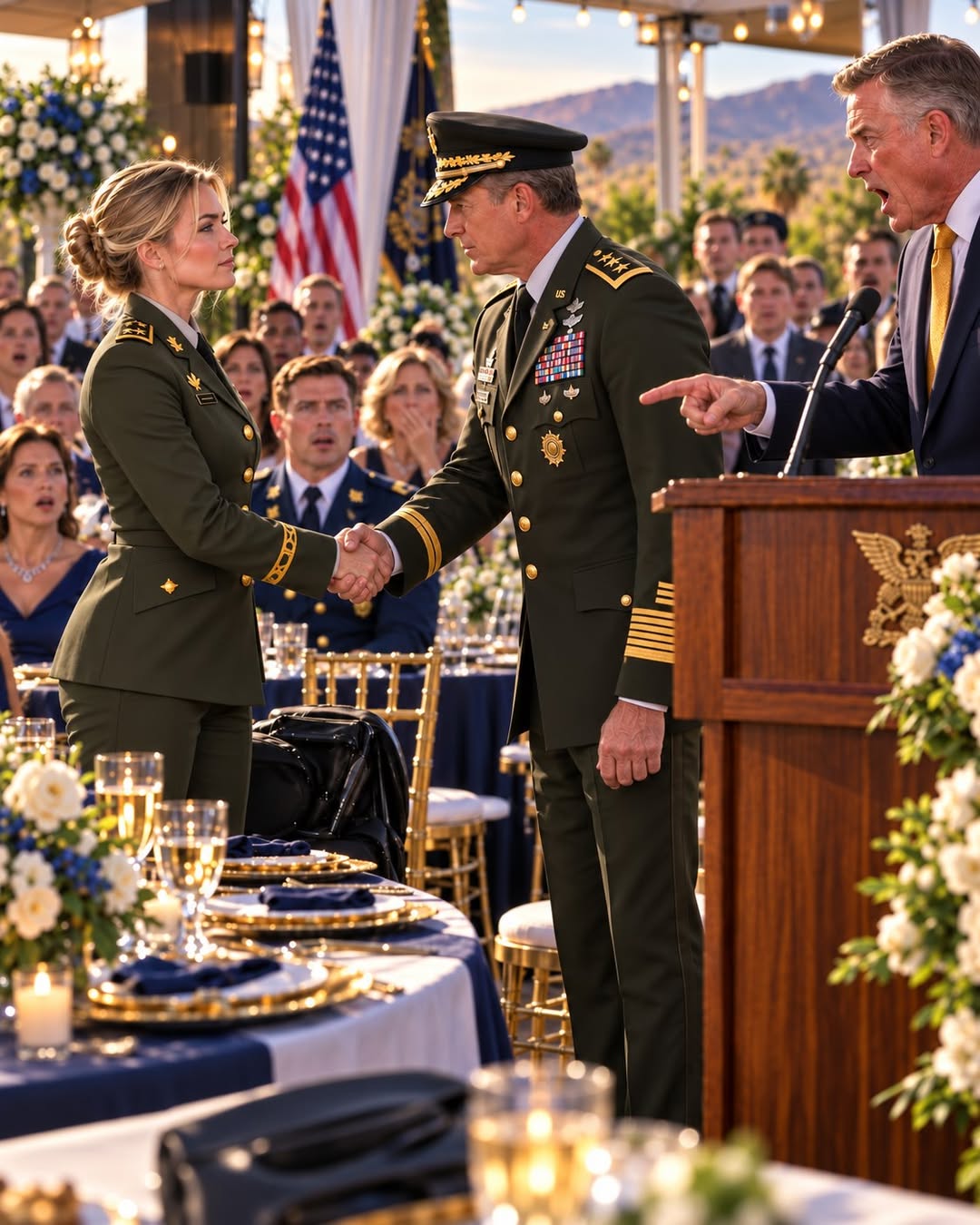
Garrett slowly turned in his chair.
Not toward the senior officer.
Toward me.
For the first time that evening, my brother looked at me without embarrassment, irritation, or the careful neutrality he had perfected whenever Dad started talking about my career.
He looked confused.
Then something deeper appeared.
Recognition.
Not of what I had done.
Of how little he actually knew.
The officer stopped beside my table.
He was Brigadier General Nathaniel Mercer, deputy commanding general for an organization whose name meant very little to most of the families beneath that pavilion and considerably more to people who worked in secure communications.
I knew him.
Not socially.
Not well.
But enough.
Years earlier, he had been a colonel supervising a multinational communications modernization effort.
I had been one of the officers buried inside the technical integration work.
Long days.
Windowless rooms.
No photographs.
No social media.
No dramatic stories at Thanksgiving.
Just systems that had to work when somebody thousands of miles away needed them.
Mercer looked at me.
“Captain Kincaid.”
There it was.
Captain.
Not contractor.
Not discharged.
Not civilian pretending she had served.
Captain.
My father’s fingers tightened around the microphone.
Garrett’s face changed again.
General Mercer extended his hand.
I stood.
“General.”
We shook.
“You look well.”
“Thank you, sir.”
“I heard you were here.”
“I was attempting not to be.”
That earned the smallest smile.
“I can see how successful that strategy has been.”
A few nervous laughs moved through the pavilion.
Dad did not laugh.
He stepped forward.
“General, with respect, this is a family matter.”
Mercer turned.
“Colonel Kincaid.”
Even retired, Dad instinctively straightened.
“Sir.”
“You made your daughter’s military status a public matter approximately three minutes ago.”
Dad’s face reddened.
“I was correcting misinformation.”
“No.”
The word was quiet.
Dad blinked.
Mercer continued.
“You stated that Captain Kincaid was dishonorably discharged.”
“Yes.”
“She was not.”
The pavilion went completely still.
Dad stared at him.
“You don’t know the entire situation.”
Mercer’s expression barely changed.
“I know enough to tell you that statement is false.”
Mom finally looked at me.
Her lips parted.
Garrett whispered:
“Adelaide?”
I ignored him.
Not cruelly.
I simply was not ready.
Dad recovered quickly.
He always did.
“My daughter left active service.”
I spoke for the first time.
“That’s not the same as a dishonorable discharge.”
He looked at me.
“You disappeared into contract work.”
“I transitioned from the career path you expected.”
“You left the Army.”
“My service record does not become dishonorable because you dislike my career decisions.”
He lifted the microphone again.
Mercer reached over and switched it off.
Not dramatically.
Click.
Dad stared at him.
“General—”
“This event is not the venue for adjudicating your daughter’s career.”
Dad gave a bitter laugh.
“Convenient.”
“No.”
Mercer stepped back.
“Necessary.”
Then he looked at me.
“Captain, may I speak with you privately?”
“Yes, sir.”
That should have ended it.
It didn’t.
Garrett stood.
“Sir.”
Mercer turned.
Garrett’s face had gone pale.
“What did you mean about my unit’s network authority?”
I closed my eyes briefly.
Of all the sentences Mercer could have used.
That one.
Mercer glanced at me.
I answered instead.
“He meant what he said.”
Garrett looked at me.
“You worked on our architecture?”
“Parts of systems and authorities supporting capabilities used by multiple units.”
“When?”
“I can’t discuss everything here.”
His voice dropped.
“Was it before my deployment?”
“Yes.”
“How long before?”
“Garrett.”
“Did you know my unit was using it?”
“Later.”
He stared.
“Why didn’t you tell me?”
I almost laughed.
“Tell you what?”
“That you were involved.”
“Involved how?”
He opened his mouth.
Nothing came out.
Exactly.
The story sounded impressive only when stripped of detail.
Reality was technical.
I had not been hiding in the mountains directing his patrols.
I had not secretly saved Garrett with a joystick from another continent.
I had worked with teams responsible for communications architecture, operational-network authorization, resilience, integration and support.
Other people built components.
Other people tested them.
Other people maintained them.
Other people operated them.
No one person “saved” a deployed unit.
But the work mattered.
And some of it had carried my signature.
Mercer answered carefully.
“Major Kincaid, your sister’s work supported capabilities used beyond any single unit. Anything more specific belongs in an appropriate setting.”
Garrett nodded automatically.
“Yes, sir.”
Then he looked at me.
“But Dad said you were discharged.”
“I know.”
“He said you washed out.”
“I know.”
“He said—”
“I know what he said.”
That stopped him.
Because suddenly Garrett had to confront something I had lived with for years.
He had not merely heard Dad’s version.
He had accepted it.
Mom stood.
“Marshall.”
Dad turned toward her.
Her voice shook.
“Is it true?”
He frowned.
“What?”
“That she wasn’t dishonorably discharged.”
Dad looked around.
Two hundred families.
Officers.
Spouses.
Children.
Veterans.
People who had heard him confidently pronounce his daughter a disgrace.
His eyes returned to Mom.
“She wasn’t progressing.”
That was not an answer.
Mom knew it.
“So you lied?”
“I simplified.”
My entire body went cold.
Simplified.
Years of service.
Reduced to one word.
A false one.
Mom’s voice became almost inaudible.
“You told me she was discharged.”
Dad’s jaw tightened.
“She might as well have been.”
Something inside me finally snapped into perfect clarity.
Not rage.
Not even pain.
Clarity.
I walked toward him.
“You knew.”
He looked at me.
“You knew I was still serving when you started telling people that.”
“You were buried in some obscure assignment.”
“You knew.”
“You had thrown away your trajectory.”
“You knew.”
His face hardened.
“Yes.”
There it was.
Under the Arizona sky.
In front of everyone.
Not an admission of every lie.
But enough.
Garrett sat back down.
Slowly.
As though his legs had stopped working.
I looked at Dad.
“Why?”
He laughed bitterly.
“Why?”
“Yes.”
“You had every advantage.”
There it was.
The old speech.
West Point contacts.
His reputation.
Family name.
Mentors.
Introductions.
The Kincaid legacy.
“You could have commanded.”
“I did.”
“Not the way you should have.”
“According to whom?”
“According to what you were capable of.”
I shook my head.
“No. According to what you could brag about.”
His eyes flashed.
“That is not fair.”
“Neither was telling people I was dishonorably discharged.”
Mercer stepped closer.
“Captain.”
A warning.
Not because I was wrong.
Because this was still a military family event.
I understood.
I stepped back.
“General, you’re right.”
Dad gave a small triumphant smile.
He mistook restraint for retreat.
Again.
Then Mercer said:
“Colonel Kincaid, I recommend you leave the podium.”
The smile vanished.
Dad walked away.
Mom followed ten seconds later.
Garrett didn’t.
He remained seated.
I returned to my table.
My brisket was still there.
Cold now.
Garrett approached.
He pulled out the chair opposite me.
“Can I sit?”
I considered saying no.
Instead:
“Yes.”
He sat.
For several seconds, neither of us spoke.
Then:
“Are you really still a captain?”
I looked at him.
“That’s your first question?”
His face flushed.
“No.”
“Good.”
He rubbed his palms against his trousers.
“I don’t know what to ask.”
“Then don’t.”
He nodded.
Silence.
Then:
“Did Dad interfere with your promotion?”
My eyes moved toward him.
That question had not come from anything Mercer said.
“How do you know about that?”
Garrett swallowed.
“I don’t.”
“Then why ask?”
“Because I heard something once.”
My heartbeat changed.
“What?”
“Dad was on the phone.”
“When?”
“Maybe three years ago.”
I stared at him.
Garrett looked miserable.
“He was talking to Colonel Bishop.”
I knew the name.
Of course I knew the name.
Colonel Alan Bishop had been adjacent to my rating and senior leadership chain during one of the periods when my career stalled.
“What did you hear?”
Garrett lowered his voice.
“Dad said you weren’t ready.”
I stopped breathing for a second.
“What else?”
“He said you were unstable after deployment.”
The word landed like a stone.
“Anything else?”
“He said putting you in greater responsibility would embarrass the family.”
I stared at him.
Garrett looked away.
“You knew.”
“No.”
“You just told me you heard it.”
“I heard one side of a phone call.”
“And you never asked me?”
“I believed him.”
There it was.
Again.
I believed him.
Three words capable of doing enormous damage when attached to the wrong person.
“Why?”
I asked.
Garrett’s eyes filled.
“Because he was Dad.”
I laughed once.
Not because it was funny.
Because it was honest.
“He knew everybody. He knew the system. He’d been a colonel. When he said your career had gone wrong…”
“You assumed I caused it.”
“Yes.”
“And when yours went right?”
Garrett looked at the gold oak leaf on his chest.
“I assumed I earned it.”
I leaned forward.
“You did.”
He looked up.
“Don’t do that.”
“Do what?”
“Make me feel better.”
“I’m not.”
I pointed gently toward his insignia.
“You earned your promotion. Dad’s interference with my career does not mean your career is fraudulent.”
His face crumpled slightly.
“But he compared us.”
“Yes.”
“All the time.”
“Yes.”
“And I let him.”
“Yes.”
He closed his eyes.
That yes hurt him.
It needed to.
Not forever.
Just long enough to become useful.
General Mercer found me twenty minutes later.
“We need to talk tomorrow.”
“About what?”
He glanced toward Garrett.
“Not here.”
I understood.
“0800?”
“0730.”
“Of course.”
He smiled faintly.
“Still hate mornings?”
“Sir, classified work did not make sunrise more appealing.”
That actually made him laugh.
Garrett stared at us.
For perhaps the first time in his life, he was seeing me exist inside a professional relationship Dad had not created.
The next morning, I entered a secure administrative building at 0727.
Mercer was waiting with an attorney from the appropriate legal office and a senior personnel officer.
That immediately told me the conversation was serious.
Mercer closed the door.
“What do you know about your father’s contacts with your chain of command?”
“Two calls.”
“Documented?”
“Yes.”
“How did you learn about them?”
I explained.
Months earlier, during an administrative review related to an unrelated personnel matter, I had become aware of records indicating Dad had contacted officers connected to my career.
I had not accessed anything improperly.
I had not gone digging through classified systems.
The information surfaced through legitimate channels.
One call raised questions about my judgment.
Another questioned my loyalty and suitability for increased responsibility.
At the time, I had been advised not to jump to conclusions about whether those calls had actually influenced promotion decisions.
That distinction mattered.
Dad had interfered.
Whether his interference caused a specific promotion outcome was a separate question.
I had spent months learning to live with that uncertainty.
The personnel officer, Colonel Rebecca Sloan, opened a folder.
“Captain Kincaid, I want to be precise.”
“Please.”
“Your father’s contacts were inappropriate.”
I said nothing.
“However, we cannot simply state that you would have been promoted but for those contacts.”
“I understand.”
“Promotion systems involve multiple factors.”
“I know.”
“Records, evaluations, timing, vacancies, board considerations.”
“Yes.”
She studied me.
“You seem remarkably calm.”
“I’ve had practice.”
Mercer did not smile.
Sloan continued.
“What we can examine is whether improper external influence affected material placed before decision-makers or influenced evaluations.”
My hands tightened beneath the table.
“And if it did?”
“Then there are mechanisms for review and correction where appropriate.”
Not:
You’ll be a major by lunch.
Not:
Your father stole your oak leaf.
Process.
Evidence.
Review.
That was exactly what I wanted.
Because if I ever pinned Major, I needed to know I had earned it.
Not inherited it from my father’s guilt.
The review took months.
Seven.
The hardest seven months of my career.
People wanted updates.
I gave almost none.
Mom called repeatedly.
Garrett texted.
Dad sent emails.
I answered none of his.
The pavilion story spread anyway.
Stories always do.
By the time it reached people three installations away, I had apparently been a secret intelligence commander personally responsible for half the Army’s communications network.
Nonsense.
I corrected what I could.
My work had been significant.
It had also been collaborative.
Classified did not mean magical.
Secrecy does not turn technical professionals into superheroes.
Sometimes classified service means doing extremely difficult work in extremely boring rooms and then going home unable to explain why you missed Christmas.
That had been my life.
The review found something worse than I expected.
And something less dramatic.
Dad had not somehow controlled a promotion board.
He had not possessed that power.
But his calls had reached people who knew him.
People who respected him.
One officer had documented concerns after speaking with Dad.
Language about my “judgment under stress” appeared later in discussions surrounding an evaluation period.
Investigators could not attribute every career outcome to Dad.
But there was enough to conclude that improper external input had contaminated part of the record and warranted corrective review.
That distinction became important to me.
Dad had interfered.
But I would not rewrite history and claim he single-handedly stole two promotions.
My career was more complicated than that.
So was the Army.
So was I.
Then came the second discovery.
Colonel Bishop had not been comfortable with Dad’s calls.
He had documented one.
His note was short.
Retired COL Marshall Kincaid contacted undersigned regarding CPT Adelaide Kincaid. Caller expressed personal concerns unsupported by official documentation. No action should be based solely on familial representation.
I read that sentence three times.
Dad had tried.
Someone had noticed.
Not everyone had believed him.
That mattered.
Garrett visited me during the review.
No uniform.
Jeans.
Polo shirt.
He brought coffee.
We sat outside my apartment.
For a while, he watched cars pass.
Then:
“I found something.”
“What?”
“A deployment notebook.”
I looked at him.
“Yours?”
“Yes.”
He pulled a small green notebook from his pocket.
Pages bent.
Corners worn.
He opened to a date I recognized.
Not because I had been with him.
Because I knew what systems had been active in that theater during that period.
Garrett tapped a page.
“We lost primary connectivity.”
I said nothing.
“Not completely. Enough to scare us.”
He turned another page.
“Then an alternate pathway came up.”
My throat tightened.
“We had been briefed on it before deployment.”
He looked at me.
“Was that yours?”
“No.”
His face fell slightly.
I smiled.
“Not mine alone.”
“What does that mean?”
“It means I worked with the team responsible for parts of the architecture and authorization framework that supported capabilities like that.”
His eyes filled.
“So yes.”
“Partly.”
“Why do you keep saying partly?”
“Because dozens of people mattered.”
I leaned back.
“Engineers. Signal personnel. Cyber professionals. planners. maintainers. commanders. operators. people whose names neither of us will ever know.”
Garrett looked at his notebook.
“We thought the system saved us.”
“The people who built, approved, maintained and operated it helped you.”
He nodded.
Then whispered:
“And you were one of them.”
“Yes.”
He cried.
My brother.
Major Garrett Kincaid.
Dad’s golden son.
Cried sitting on a cheap patio chair outside my apartment.
“I spent years thinking you failed.”
“I know.”
“I felt sorry for you.”
“That part I definitely knew.”
He laughed through tears.
“God.”
Then his face changed.
“Dad used me against you.”
“Yes.”
“And he used you against me.”
I frowned.
“How?”
“He made your career the warning.”
I stared at him.
“What do you mean?”
“Every time I wanted something different, he said, ‘Look what happened to Adelaide when she stopped listening.’”
My chest tightened.
“He told me your career was proof that his advice mattered.”
Suddenly Garrett’s success looked different too.
Not fake.
But burdened.
Dad had not simply elevated one child and diminished another.
He had built a system.
Garrett was rewarded for obedience.
I was punished for independence.
Neither of us had been allowed to exist without comparison.
“Why didn’t you ever defend me?”
I asked.
Garrett looked at me.
No excuses.
“Because being the favorite felt good.”
That answer was brutal.
And honest.
He continued.
“I knew he was unfair sometimes.”
My eyes burned.
“But every time he put you down, I moved higher.”
He looked at his hands.
“I told myself I wasn’t participating because I wasn’t the one saying it.”
I thought about the pavilion.
His eyes on the table.
Mom’s hand around the water glass.
Dad at the microphone.
Silence.
Garrett looked at me.
“I was participating.”
“Yes.”
He nodded.
“I am sorry.”
I believed him.
Not because he cried.
Because he didn’t ask me to make his apology easier.
Mom came next.
She brought a cardboard box.
Inside were my father’s letters.
Copies of old evaluations.
Photographs.
Academy graduation.
Commissioning.
My first assignment.
A photograph of me and Garrett as children wearing Dad’s oversized patrol caps.
Mom sat on my sofa.
“I knew he called people.”
I went still.
“How much did you know?”
“Not everything.”
“How much?”
She started crying.
“Enough.”
I stood.
I couldn’t sit.
“You knew?”
“He said he was helping.”
“Helping what?”
“Your career.”
“By telling senior officers I was unstable?”
“He didn’t use that word with me.”
“What word did he use?”
She looked down.
“Difficult.”
Of course.
The family word for a woman who would not comply.
“Why didn’t you tell me?”
“I was afraid you’d confront him.”
“I would have.”
“I know.”
“And?”
“He would have exploded.”
I laughed.
“So you protected him.”
“I was trying to keep the family together.”
“No.”
My voice sharpened.
“You were keeping him comfortable.”
She flinched.
“That isn’t fair.”
“Neither was letting me spend years wondering why people who once trusted me suddenly looked at me differently.”
She cried.
I did too.
But I did not rescue her from the conversation.
That was new.
Then Mom said something I had never expected.
“He was jealous of you.”
I stared.
“Dad?”
“Yes.”
“That’s absurd.”
“No.”
She wiped her face.
“Marshall spent his whole career wanting proximity to work he was never selected for.”
I said nothing.
“He loved being a soldier. He was proud of his service. But there were doors that never opened for him.”
My stomach tightened.
“And when he realized some of those doors had opened for you…”
“He tried to close them?”
“I think he told himself he was protecting you.”
“From what?”
“Becoming someone he couldn’t understand.”
That sentence stayed with me.
Not because it excused him.
It didn’t.
But for the first time, Dad’s behavior had a shape beyond simple cruelty.
Control.
Pride.
Fear.
Jealousy.
Love distorted by ownership.
A father who believed his daughter’s success reflected him—until her success entered territory he could not claim.
Eight months after the pavilion incident, the corrective process concluded.
I received official notification privately.
I read it alone.
Then twice more.
Corrections had been made where warranted.
Certain material influenced by unsupported external representations was addressed through appropriate personnel mechanisms.
My record would receive the consideration available under the applicable process.
There was no ceremonial apology from the Army.
No general arrived carrying an oak leaf on a velvet pillow.
Real institutional correction is often paperwork.
Boring.
Precise.
Enormously important.
I folded the letter.
Then called Garrett.
“What happened?”
he asked.
“The review is complete.”
“And?”
“Corrections were made.”
Silence.
“Does that mean Major?”
“Not automatically.”
He exhaled.
“Are you okay?”
I thought about it.
“Yes.”
And I was.
Because for the first time, whatever happened next would happen with a record closer to the truth.
That was enough.
Dad requested to see me.
I refused.
He requested again.
I refused again.
Six months later, I agreed.
Neutral location.
Daytime.
A café outside Tucson.
He arrived early.
Of course.
Colonel Marshall Kincaid had spent his entire life believing punctuality was morality.
I sat across from him.
He looked older.
Not defeated.
Just older.
“Adelaide.”
“Dad.”
He stared at me.
“I owe you an explanation.”
“You owe me an apology.”
His jaw tightened.
There he was.
For a second, I thought he might leave.
Instead:
“Yes.”
That surprised me.
He looked toward the window.
“I called Bishop.”
“I know.”
“And others.”
“I know.”
“I believed your assignments were taking you somewhere dangerous.”
“They were.”
“Not physically.”
He shook his head.
“Professionally.”
I waited.
“You stopped asking my advice.”
There it was.
The center.
“You stopped telling me things.”
“I couldn’t tell you many things.”
“You became secretive.”
“My work required discretion.”
“You treated me like an outsider.”
I leaned forward.
“You were an outsider to classified work you had no need to know.”
His face reddened.
“I was your father.”
“That is not a clearance.”
He looked away.
For years, I had imagined confronting him.
In those fantasies, I gave magnificent speeches.
He collapsed.
Apologized.
Admitted everything.
Reality was smaller.
Sad.
He had confused fatherhood with jurisdiction.
“You told people I was dishonorably discharged.”
He closed his eyes.
“Yes.”
“Why?”
“Because I was angry.”
“That’s not enough.”
“I wanted people to stop asking me about you.”
That hurt.
“Why?”
“Because I didn’t know what to tell them.”
“You could have said, ‘My daughter serves in work she can’t discuss.’”
“I didn’t know if that was true.”
“You could have asked me.”
“You wouldn’t tell me anything.”
“I told you everything I was allowed to.”
“That never felt like enough.”
I sat back.
“That was your problem.”
He looked at me.
And for once, he did not argue.
Then I asked the question.
“Did you want Garrett promoted before me?”
His eyes moved downward.
“Yes.”
There it was.
“Why?”
“He followed a traditional command path.”
“So?”
“I understood his career.”
“And mine frightened you.”
He looked at me.
“Yes.”
Honesty arrived very late in my family.
But occasionally, it arrived.
“I thought if you got promoted again, you’d disappear completely into that world.”
“So you tried to damage my career to keep me closer?”
“When you say it like that—”
“There is no flattering way to say it.”
He nodded slowly.
“No.”
Then Dad cried.
I had seen him cry twice.
When his father died.
And when Garrett deployed the first time.
Now he cried in a Tucson café while a teenager behind the counter cleaned an espresso machine.
“I was proud of you.”
I felt anger rise.
“Don’t.”
“I was.”
“Then why did you make me feel ashamed?”
He had no answer.
“I don’t know.”
I believed that too.
Sometimes people understand what they did before they understand why they did it.
“I can’t give you those years back,” he said.
“No.”
“I can’t fix the boards.”
“No.”
“I can’t undo what I told people.”
“No.”
He swallowed.
“What can I do?”
Finally.
Not:
What do you want me to say?
What can I do?
“Correct the lie.”
His brow furrowed.
“How?”
“The same way you spread it.”
He understood.
Publicly.
Not every classified detail.
Not my assignments.
Not my record.
Just the lie.
I had not been dishonorably discharged.
He had knowingly said otherwise.
That was his to repair.
Three weeks later, Dad wrote a statement.
His first version was terrible.
It said:
I may have created an inaccurate impression regarding my daughter’s military service.
I sent it back.
His second:
I previously made statements suggesting my daughter Adelaide left military service under dishonorable circumstances. Those statements were incorrect.
Better.
Still incomplete.
His third version said:
I knowingly described Captain Adelaide Kincaid as dishonorably discharged. That was false. I also contacted individuals connected to her career and expressed personal opinions about her suitability for increased responsibility. I should not have inserted myself into her professional chain. I regret doing so. Adelaide’s service record should be judged on its official merits, not on statements I made as her father.
That one I accepted.
He sent it to relatives and individuals to whom he could reasonably correct the false claim.
No classified revelations.
No dramatic confession about secret missions.
Just truth.
It was enough.
Fourteen months after the pavilion, I received another message.
This one changed everything quietly.
Selection.
Major.
I sat at my desk staring at the notification.
No music.
No audience.
No father.
No brother.
Just me.
Forty-two years old.
Years later than I once imagined.
I covered my face.
And cried.
Not because the Army had finally declared me worthy.
A promotion cannot do that.
I cried because I had spent years looking at Garrett’s gold oak leaf and seeing evidence that Dad had been right about me.
Now I understood something I should have known all along.
Garrett’s rank had never been proof of my failure.
My delayed promotion had never been proof of his superiority.
We were two officers.
Two careers.
Two different paths.
Dad had turned them into one scoreboard.
We didn’t have to keep playing.
I asked Garrett to pin me.
That surprised everyone.
Especially Garrett.
“You’re serious?”
“Yes.”
“After everything?”
“Because of everything.”
At the ceremony, he stood in front of me holding the gold oak leaf.
His hands shook.
“Stop that,” I whispered.
“I’m trying.”
“You’ve deployed under worse conditions.”
“None of those involved my sister murdering me if I pin this crooked.”
I almost laughed.
Mom sat in the front row.
Dad was not there.
That was my choice.
I had forgiven parts of what happened.
Forgiveness did not automatically restore access.
Garrett attached the insignia.
Then stepped back.
His eyes were wet.
“Major Kincaid.”
I looked at him.
“Major Kincaid.”
He laughed.
For the first time, the title belonged to both of us without comparison.
Afterward, Garrett handed me a small wooden box.
Inside was his deployment notebook.
The original.
“I can’t take this.”
“Open the back.”
Inside the cover he had written:
For Adelaide.
I didn’t know your name was connected to anything that helped us over there. Maybe I never needed to. The people who build what keeps others alive rarely get the photograph.
Then:
I should have defended you before I knew any of this.
That line mattered most.
Not:
I respect you because you secretly did impressive work.
I should have defended you before I knew.
Exactly.
Dad and I speak now.
Occasionally.
Our relationship never returned to what it had been.
I no longer wanted it to.
He learned to ask:
“Can you talk about what you’re working on?”
And when I say:
“No,”
he answers:
“Understood.”
The first time he did that, I nearly cried.
Such a tiny sentence.
Years late.
Still valuable.
Mom stopped translating between us.
Garrett stopped letting Dad compare our careers.
Once, at dinner, Dad started:
“When Garrett made Major—”
Garrett interrupted.
“Dad.”
Just that.
Dad stopped.
Progress.
Years later, I returned to Fort Huachuca for another family event.
Same mountains.
Different pavilion.
I stood near the edge watching young soldiers chase children across the grass.
A lieutenant approached.
“Major Kincaid?”
“Yes?”
“My commander said you worked on some of the earlier network-resilience efforts.”
“Some.”
“He said there are stories.”
“There are always stories.”
He smiled.
“Were they true?”
“Probably not the exciting parts.”
He laughed.
Then became serious.
“Can I ask you something?”
“Sure.”
“How do you handle doing important work nobody knows about?”
I looked toward the mountains.
That question would have destroyed me fifteen years earlier.
Back then, I needed Dad to know.
Needed Mom to understand.
Needed Garrett to see.
Needed the world to confirm that invisible service still counted.
Now I knew the answer.
“You decide whether the work matters without applause.”
The lieutenant nodded.
“That sounds difficult.”
“It can be.”
I smiled.
“But invisible isn’t the same as insignificant.”
Sometimes people still tell the pavilion story incorrectly.
They say a retired colonel accused his daughter of being dishonorably discharged, then a general appeared and revealed she was some secret super-soldier who had saved her brother overseas.
That’s a better movie.
It isn’t my life.
I didn’t personally save Garrett.
Teams of people kept those systems alive.
I was one of them.
Dad did interfere with my career.
But he did not secretly control promotion boards.
The review found a more complicated truth.
His inappropriate influence contaminated parts of my professional environment.
Corrective mechanisms addressed what could be addressed.
The rest became history I had to live with.
And when I finally made Major, I did not defeat Garrett.
I joined him.
The real victory happened before that.
It happened when Dad corrected the lie.
When Mom admitted silence had protected him.
When Garrett said he had enjoyed being the favorite.
When I stopped measuring myself against my brother.
When my family finally understood that secrecy was not shame.
And when I understood I no longer needed them to understand every detail in order to know my own life had mattered.
I still have the bronze pin I wore that night.
It sits in a small box beside my Major insignia.
Garrett’s note is there too.
Sometimes I think about Dad standing beneath those pavilion lights.
“She was dishonorably discharged.”
Two hundred families listening.
His certainty.
His smile.
My silence.
He thought silence meant I had nothing to say.
What he never understood was that much of my adult life had trained me to carry truths I could not explain.
I had spent years working without public credit.
Years watching other people use systems without knowing the names of everyone behind them.
Years learning that the mission does not become less important simply because your photograph never appears beside it.
My father needed visible proof.
Rank.
Commands.
Awards.
Stories he could repeat at dinner.
I spent too long believing that made his definition of service the correct one.
It wasn’t.
Garrett served honorably.
So did I.
His career was visible.
Mine often wasn’t.
Neither fact made one of us more real than the other.
And that is what I wish my father had understood before he ever touched that microphone.
A uniform can be seen.
A rank can be announced.
A promotion can be celebrated.
But some of the most important work in any institution is done by people whose names never enter the story.
They do not need applause to make the work real.
They do not need family approval to make the sacrifice real.
And they certainly do not need a father’s permission to make their service honorable.
That evening at Fort Huachuca, Dad thought he had finally exposed me.
Instead, he exposed something else:
how little he knew about the daughter he had spent years judging.
The general’s arrival didn’t give me back my career.
The review didn’t give me back the lost years.
Making Major didn’t erase what happened.
But eventually I received something better than revenge.
The record was corrected.
The lie was corrected.
My brother and I stopped competing in a contest neither of us had created.
And I stopped needing my father to tell me whether my life counted.
Because by then, I already knew.
The work had counted when nobody knew my name.
The service had counted when my own family misunderstood it.
And I had been honorable long before anyone under that pavilion learned the truth.