
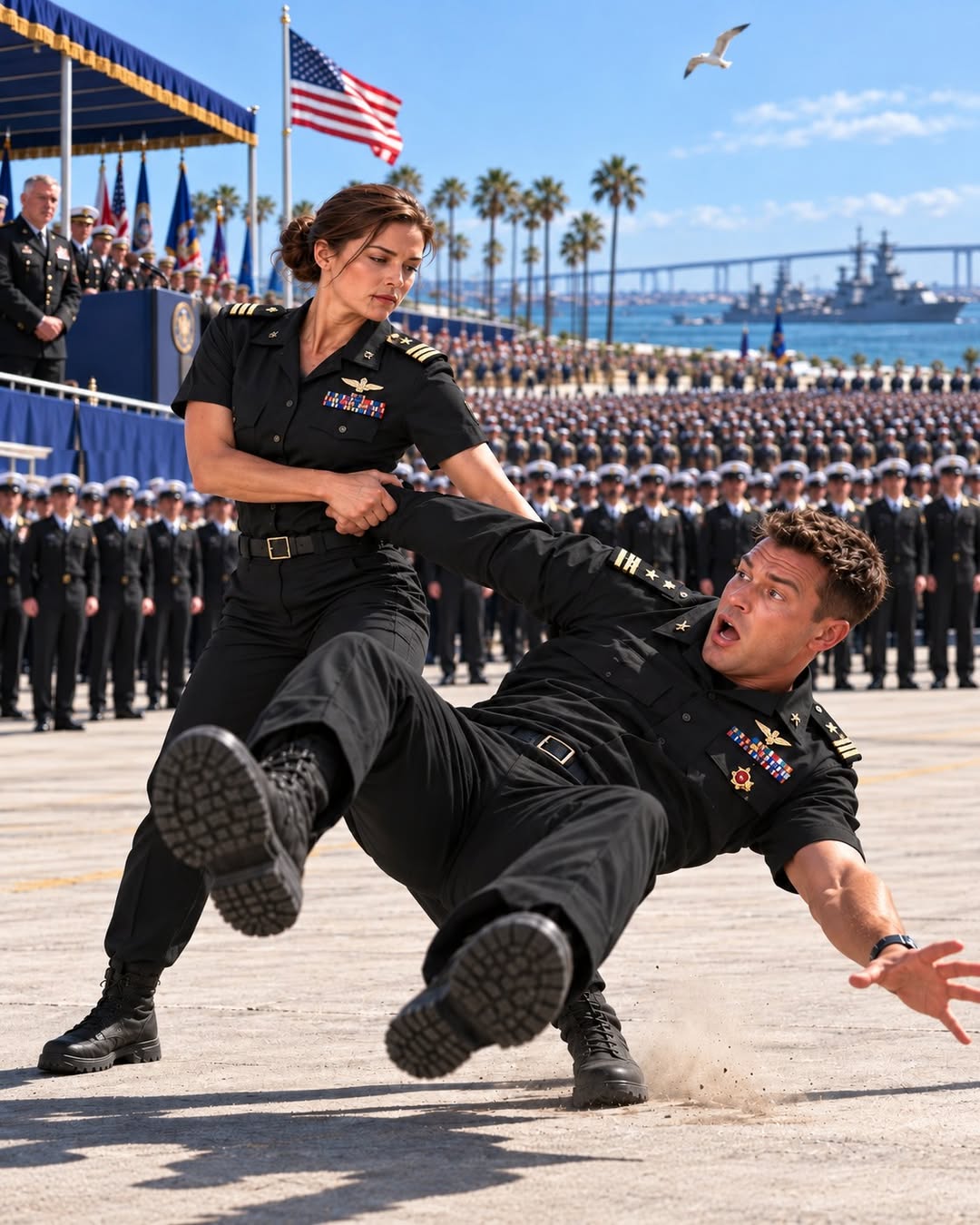
“COMMANDER SULLIVAN! STAND DOWN!”
The shout came from the reviewing stand.
Loud.
Sharp.
Absolute.
My movement stopped before Brock hit the ground.
Instead of completing the throw my body had already begun, I redirected his momentum, stepped aside and released his wrist.
He stumbled.
One boot slid across the pavement.
His shoulder twisted.
But he remained standing.
Barely.
That mattered.
Because I had not come to Coronado to prove I could put Brock Sullivan on the ground.
I had come to determine whether men under his authority were being trained to believe that power excused misconduct.
And in less than thirty seconds, he had answered the question himself.
Brock spun around.
His face was red.
“Who the hell—”
Then he saw the man descending from the reviewing stand.
Rear Admiral Jonathan Mercer.
The color disappeared from Brock’s face.
Mercer was sixty-one, silver-haired, narrow-shouldered and calm in the unsettling way of someone who had spent decades learning that volume and authority were not the same thing.
He walked directly toward us.
Behind him came Sergeant Major Thomas Reed and two other senior officers.
Nobody in formation moved.
One thousand forty service members remained standing beneath the California sun.
Watching.
Listening.
The microphone was still live.
Mercer stopped several feet from Brock.
“Commander Sullivan.”
Brock straightened automatically.
“Sir.”
“Step away from Captain Hayes.”
Brock blinked.
“Sir, she assaulted—”
“Step.”
One word.
Brock stepped back.
Mercer turned toward me.
His eyes dropped briefly to my lip.
“Captain?”
“I’m functional, sir.”
“Do you require immediate medical attention?”
“Not immediate.”
He nodded.
Then he turned toward Sergeant Major Reed.
“Medical evaluation regardless.”
“Yes, sir.”
Only then did Mercer look back at Brock.
Brock seemed to be trying to reconstruct the world.
I understood why.
Everything he thought he knew had just stopped fitting together.
He looked at me.
Then at Mercer.
Then at the senior officers behind him.
“Sir, Captain Hayes was insubordinate.”
Mercer stared at him.
“Captain Hayes?”
“Yes, sir.”
“You ordered Captain Hayes to remember your rank?”
Brock hesitated.
“Yes, sir.”
Mercer’s expression did not change.
“And what rank do you believe Captain Hayes holds?”
The silence that followed was almost painful.
Brock looked at my uniform.
Really looked.
Not at my face.
Not at my gender.
Not at whatever story he had constructed about why I was standing near the reviewing stand.
My insignia.
His eyes changed.
He had seen it before.
He simply had not processed what it meant.
Because he had already decided who I was.
“Captain,” he said.
Mercer waited.
Brock swallowed.
Then the arithmetic finally happened.
In the United States Navy, captain was not the junior company-grade rank Brock seemed to have mentally translated it into.
A Navy captain was O-6.
Commander Brock Sullivan was O-5.
I outranked him.
He stared at me.
“No.”
It escaped almost involuntarily.
Mercer’s eyes hardened.
“No?”
Brock looked toward him.
“I was told she was an administrative observer.”
I finally spoke.
“You were told I was observing.”
His eyes returned to me.
“That isn’t the same sentence.”
The first crack in Brock Sullivan’s authority did not come when I caught his wrist.
It came when everyone watching realized his entire performance had been built on an assumption.
He had seen a woman standing quietly near the reviewing area.
He had heard I was there in an administrative and assessment capacity.
He had decided that meant insignificant.
He had never asked.
Never checked.
Never read closely enough.
And now 1,040 people had watched him strike an officer senior to him.
Twice, if you counted the attempted second blow.
But the rank issue was not the worst part.
Not even close.
Because if I had been an ensign, what he did would still have mattered.
If I had been a civilian employee, it would have mattered.
If I had been the lowest-ranking person on that field, it would have mattered.
Rank changed the irony.
It did not create the misconduct.
That distinction would become important later.
Mercer looked toward the reviewing stand.
“End the formation.”
Brock stepped forward.
“Sir, with respect—”
Mercer turned.
“Commander.”
Brock stopped.
“You are relieved of participation in today’s ceremony pending further review.”
The words moved through the field without anyone visibly reacting.
No cheering.
No dramatic gasps.
Just silence.
Military silence.
The kind containing a thousand thoughts nobody is stupid enough to say aloud.
Brock looked at me.
“This is because of her?”
Mercer answered before I could.
“This is because I personally witnessed you strike another service member and then attempt to strike her again.”
“She grabbed me.”
“After you advanced on her.”
“She challenged my authority.”
Mercer’s expression became colder.
“Commander Sullivan, stop talking.”
For once, Brock did.
Sergeant Major Reed came toward me.
“Ma’am.”
“Sergeant Major.”
“Medical.”
“I know.”
His eyes flicked toward my lip.
Then toward Brock.
“You all right?”
“Yes.”
He gave me a look that said he did not believe the answer.
I corrected myself.
“I will be.”
That satisfied him more.
As we walked away, he lowered his voice.
“You could have put him down.”
“Yes.”
“Why didn’t you?”
I looked toward the formations beginning to move under controlled commands.
“Because the second he stopped being an immediate threat, my job stopped being to win a fight.”
Reed nodded once.
That was all.
The medical clinic was quieter than the parade field.
The examination was documented.
The injury was treated.
Photographs were taken through appropriate channels.
Statements would follow.
The process mattered.
That afternoon, I sat alone in a small office with an ice pack and a legal pad.
For the first time all day, my hands shook.
Not much.
Enough.
People misunderstand calm.
They think calm means absence of fear.
It doesn’t.
Training teaches you to delay certain reactions until they are useful.
My body had simply waited until I was safe.
There was a knock.
“Come in.”
Rear Admiral Mercer entered.
He closed the door.
For several seconds, he said nothing.
Then:
“How bad?”
“I’ll live.”
“That wasn’t the question.”
I lowered the ice pack.
“Manageable.”
He sat across from me.
“You want to continue?”
“Yes.”
“You don’t have to.”
“I know.”
That was why the answer mattered.
My assignment at Coronado had begun six weeks earlier.
Not because I was there to expose Brock Sullivan personally.
Not because some admiral had secretly dispatched a legendary warrior to catch a villain.
Reality was less theatrical.
There had been concerns.
Training climate.
Retention.
Reporting.
Unusual attrition from one joint program.
Complaints that did not individually prove much but, taken together, suggested a pattern worth examining.
Humiliation disguised as correction.
Physical intimidation rationalized as intensity.
Technical disagreements treated as personal disloyalty.
Junior personnel afraid that raising concerns would damage careers.
None of that meant Commander Sullivan was automatically guilty of everything people whispered about him.
That was why I had been sent to observe.
Not prosecute.
Observe.
Ask.
Listen.
Document.
My operational background mattered because I understood demanding environments.
I knew the difference between high standards and theatrical cruelty.
I had trained people under pressure.
I had made decisions in circumstances far worse than a California parade field.
And I knew something Brock apparently did not.
Discipline without control is not discipline.
It is temperament wearing a uniform.
Mercer folded his hands.
“There were cameras.”
“I know.”
“Multiple angles.”
“I know.”
“The microphone was live.”
“I know.”
He studied me.
“You sound disappointed.”
“I am.”
“Why?”
“Because now everything becomes about the slap.”
Mercer leaned back.
“Explain.”
“The review was bigger than me.”
“Yes.”
“Tomorrow everyone will talk about what he did to Captain Hayes.”
I put the ice pack down.
“But if we’re not careful, nobody will talk about what happens when the person being humiliated is nineteen and has no admiral watching.”
Mercer was quiet.
Then he nodded.
“Good.”
“Sir?”
“That is why you’re still leading the assessment.”
Brock was temporarily removed from the training role while the appropriate command and investigative processes proceeded.
Temporarily.
That word irritated people later.
They wanted instant punishment.
Immediate dismissal.
A dramatic ending before sunset.
Real institutions do not work well when accusation and adjudication become the same act.
There were witnesses.
Video.
Audio.
My statement.
His statement.
Other statements.
Applicable regulations.
Command procedures.
Questions about prior incidents.
Everything had to be examined.
Even obvious misconduct deserved proper process.
Especially obvious misconduct.
Otherwise accountability becomes vengeance with paperwork.
I wanted no part of that.
The next morning, I entered a briefing room containing twenty-three people.
Most were junior.
A few senior.
All nervous.
I had changed uniforms.
My lip was swollen.
There was no hiding it.
A young Marine corporal kept staring at the table.
“Corporal?”
His head snapped up.
“Ma’am.”
“You were looking at me.”
“Sorry, ma’am.”
“You’re allowed.”
A few people smiled.
The tension loosened slightly.
I sat rather than standing behind the lectern.
“This isn’t a speech.”
Nobody believed me.
“It isn’t.”
I looked around.
“Yesterday happened.”
Silence.
“You don’t need me to describe it.”
Still silence.
“What I need from you is something harder.”
A sailor near the back looked up.
“I need you to tell the truth about what happened before yesterday.”
Nobody moved.
I waited.
Ten seconds.
Twenty.
Thirty.
People hate silence.
Commanders often fill it because they are uncomfortable.
I had learned to let it work.
Finally, a petty officer raised his hand.
Not fully.
Halfway.
“Ma’am?”
“Yes.”
“What happens to us if we talk?”
There it was.
The real question.
Not:
What happens to Brock?
What happens to us?
I answered carefully.
“I will not promise outcomes I don’t control.”
He nodded slowly.
“I will tell you what channels exist, what protections and limits apply, and what I can do with information you provide. If I don’t know something, I’ll say I don’t know.”
He looked at me.
“And if somebody retaliates?”
“Document it and report it through the appropriate channels immediately.”
He swallowed.
“Even if it’s someone senior?”
“Especially then.”
Another hand rose.
Then another.
By lunchtime, we had work to do.
The stories were not identical.
That mattered.
Some people liked Brock.
Several respected him.
One senior chief described him as demanding but effective.
Another officer said Brock had defended his team during a budget fight.
A junior sailor said Brock had personally helped his family during an emergency.
People are complicated.
Misconduct does not require a person to have been monstrous every minute of every day.
That fact makes accountability harder.
And more honest.
But other accounts were troubling.
Public humiliation.
Shouting inches from faces.
Threats about careers.
Punishments that some personnel believed followed disagreement.
One incident involving a junior officer being shoved during a heated correction.
Another involving equipment being thrown across a room—not at someone, according to witnesses, but hard enough to frighten everyone present.
Several people described learning one rule:
Do not challenge Sullivan publicly.
Then came the phrase I heard four times from four different people.
“He needs to win the room.”
That stayed with me.
Command is not winning the room.
Command is being responsible for it.
Three days after the parade incident, I received an envelope.
No return address.
Inside was a single sheet of paper.
Typed.
Ma’am,
I saw what happened.
Two months ago something similar happened to me. Not as bad. I convinced myself it didn’t count because nobody else called it wrong.
Yesterday I realized it counted.
No name.
No signature.
I read it three times.
Then handed it through the appropriate review channel.
That letter mattered more to me than the video.
Because that was the danger of what Brock had been doing.
Not merely physical aggression.
Normalization.
When enough people watch power behave badly without consequence, they begin editing their own definition of acceptable.
Yesterday had interrupted that process.
Now the institution had to decide what came next.
Brock requested to speak with me.
I declined initially.
There was an ongoing process.
Later, when appropriate and with the relevant people aware, the conversation happened.
He entered wearing service khakis.
No swagger.
No audience.
He remained standing.
“Captain.”
“Commander.”
He looked at my face.
The swelling had mostly disappeared.
“I’m sorry.”
I waited.
“For striking you.”
Still I waited.
“And for trying again.”
Better.
He swallowed.
“I lost control.”
“Yes.”
“I thought you were disrespecting me.”
“Yes.”
“I thought—”
He stopped.
“What?”
His jaw tightened.
“I thought you were some staff officer who had been sent to criticize a program you didn’t understand.”
There it was.
“Would that have made striking me acceptable?”
“No.”
He answered immediately.
Good.
“Then my résumé is irrelevant.”
His eyes dropped.
“I know.”
“Do you?”
“Yes, ma’am.”
“Don’t call me ma’am because you discovered my rank.”
His eyes returned to mine.
“Then why?”
“Because if your apology depends on who I turned out to be, it isn’t an apology.”
He stood very still.
“I understand.”
“I hope so.”
He looked toward the window.
“I heard things about you afterward.”
I said nothing.
“Operations.”
Silence.
“Classified work.”
I leaned back.
“You heard rumors.”
“Yes.”
“Most people hear more exciting versions of classified careers than the people who actually had them.”
That almost made him smile.
Almost.
He became serious again.
“If I’d known—”
“No.”
He stopped.
“That sentence is exactly the problem.”
I stood.
“If you had known what?”
He did not answer.
“That I had operational experience?”
Silence.
“That I had commendations?”
Silence.
“That I outranked you?”
His face tightened.
“Yes.”
“You would have treated me differently.”
“Yes.”
“Then you still haven’t understood.”
I walked closer.
Not threatening.
Just close enough that he could not escape the point.
“You don’t need my biography before deciding whether I’m entitled to basic professional treatment.”
He nodded.
“You don’t need to know whether the quiet woman in front of you has been under fire.”
Another nod.
“You don’t need to know whether the nineteen-year-old sailor you’re humiliating will someday become an admiral.”
His eyes dropped.
“You treat people with dignity because discipline requires it now.”
“Yes.”
“Not because they might secretly be important later.”
“Yes.”
I stepped back.
“That’s the lesson.”
The review lasted months.
The final outcome was not mine alone to determine.
That was important.
Evidence from the parade incident was considered alongside the broader record and the applicable command processes.
Some allegations were better supported than others.
Some could not be substantiated sufficiently.
Some accounts described behavior that was abrasive but not necessarily prohibited.
Others raised more serious concerns.
Brock’s conduct on the parade field, however, had been witnessed and recorded.
The consequences were real.
He lost the training command.
Further administrative and disciplinary actions followed through the relevant processes.
His career changed.
But I refuse to describe that as me destroying him.
I didn’t.
Brock made decisions.
The institution evaluated them.
Consequences followed.
There is a difference.
The more important changes happened quietly.
Training staff received clearer standards for corrective conduct.
Reporting mechanisms were reinforced.
Senior leaders were expected to document material concerns rather than allowing informal reputations to substitute for records.
Junior personnel were reminded that high-pressure training could be demanding without becoming personally degrading.
We also changed something I had not anticipated.
Leadership evaluations began including more structured feedback about command climate.
Not popularity.
Leadership is not a customer-satisfaction contest.
But patterns matter.
If everyone below a leader is afraid to deliver bad news, eventually the leader stops receiving reality.
And reality always sends an invoice.
Sergeant Major Reed found me on the beach one evening after the review concluded.
I was sitting on a concrete barrier watching the Pacific turn orange.
He handed me coffee.
“You still think you should’ve dumped him?”
I laughed.
“I never said that.”
“You thought it.”
“Possibly.”
He sat.
For a while, we watched waves.
Then he said:
“You know what everyone’s favorite part of the story is?”
“What?”
“The rank reveal.”
I groaned.
“Of course.”
“They love that.”
“Navy captain outranks commander. Stunning discovery.”
He laughed.
“That’s not why.”
“Why?”
“Because they think it’s justice.”
I looked at him.
“He hits the quiet woman. Turns out she’s more senior. Instant reversal.”
“Exactly.”
I drank my coffee.
“That’s the wrong lesson.”
“I know.”
We sat quietly.
Then Reed said:
“What’s the right one?”
I looked toward the water.
“That he shouldn’t have hit anyone.”
Reed nodded.
“That’s less cinematic.”
“Truth usually is.”
Six months later, I spoke to a class of newly commissioned officers.
Someone asked about Coronado.
They always did.
A young ensign raised his hand.
“Captain Hayes, is it true Commander Sullivan didn’t know who you were?”
“He knew my name.”
Laughter.
“You know what I mean.”
“Yes.”
“He didn’t know your background?”
“Apparently not.”
“Did you know you could take him?”
The room laughed.
I didn’t.
I waited.
The laughter died.
“That question is more interesting than you think.”
The ensign looked embarrassed.
“I didn’t mean—”
“I know.”
I walked away from the lectern.
“The story has been told as though the satisfying part is that Commander Sullivan picked the wrong woman.”
Several heads nodded.
“That’s dangerous.”
Silence.
“Because it suggests there might have been a right woman.”
Nobody moved.
“A junior sailor?”
I continued.
“A civilian employee?”
Silence.
“Someone physically weaker?”
I looked around.
“Someone without classified experience, medals, connections or rank?”
Now they understood.
“There is no correct person to abuse.”
I let that sit.
“You should not need to discover someone’s secret résumé before deciding they deserve dignity.”
A woman in the second row raised her hand.
“Then why didn’t anyone move?”
That question stayed in the room.
One thousand forty people.
One strike.
Silence.
“Because institutions train people to respond to authority.”
I paused.
“And usually that’s necessary.”
Nobody builds an effective military by encouraging everyone to improvise whenever they dislike an order.
“But discipline cannot mean moral paralysis.”
I continued.
“The answer isn’t that everyone should have tackled a commander.”
A few people smiled.
“The answer is that organizations need trusted mechanisms for intervention, reporting and accountability—and leaders must demonstrate those mechanisms actually work.”
The woman nodded.
I looked around.
“Courage is not always charging forward.”
“Sometimes it’s documenting.”
“Sometimes it’s reporting.”
“Sometimes it’s being the first person in the room to say, respectfully, ‘Sir, that’s not appropriate.’”
I paused.
“And sometimes it’s admitting you watched something wrong and froze.”
A year after Coronado, a package arrived at my office.
Inside was a white handkerchief.
Not mine.
New.
Folded perfectly.
No return address.
There was a card.
Captain Hayes,
You probably don’t remember me. I was standing in the third formation that day.
I was the one who inhaled when he hit you.
I stopped reading.
That sound.
I remembered.
The tiny gasp behind me.
The writer continued.
I hated myself for not moving.
Later, when a senior person in my unit humiliated one of my sailors, I didn’t freeze. I didn’t yell either. I reported what happened and stood by the sailor while the issue was handled.
I thought you’d want to know.
Respectfully,
E. Martinez
I read it twice.
Then folded the card.
The handkerchief went into my desk.
Beside the stained one from Coronado.
I had kept that too.
Not as a trophy.
As evidence of a lesson.
Years passed.
The story followed me longer than I wanted.
It became distorted.
In one version, I knocked Brock unconscious.
False.
In another, I secretly outranked everyone on the base.
Definitely false.
One version claimed I was an undercover admiral.
I found that one particularly creative.
The real story was simpler.
A commander lost control.
A captain refused to be intimidated.
Senior leadership intervened.
Evidence was reviewed.
Consequences followed.
An institution learned something.
So did I.
What nobody tells you about command is how often restraint feels less satisfying than action.
I could have completed that takedown.
My body knew exactly how.
For a fraction of a second, Brock’s balance belonged to me.
But then I heard:
“Commander Sullivan! Stand down!”
And the situation changed.
So I changed with it.
That is discipline.
Not the ability to hurt someone.
The ability to know when you no longer need to.
I still remember that parade field.
California sunlight.
Tan uniforms stretching into the distance.
The American flag moving in the ocean wind.
The metallic taste in my mouth.
The drop landing on my boot.
Brock saying:
“Remember my rank.”
For a long time, people assumed my answer came when Rear Admiral Mercer revealed mine.
It didn’t.
My answer came years later, in that classroom full of young officers.
A student asked:
“Captain, what’s the most important rank in a confrontation like that?”
I thought for a moment.
Then answered:
“Your own responsibility.”
The room went quiet.
“Rank gives you authority.”
I looked at them.
“It does not give you permission to lose control.”
I thought about Brock.
About the anonymous letter.
About Martinez.
About the 1,040 people who had stood frozen while one man’s anger echoed through a microphone.
“And if you ever become powerful enough that people are afraid to tell you you’re wrong, that is exactly when you need enough discipline to listen.”
Nobody wrote for a moment.
Then pens started moving.
I smiled.
That sound meant more to me than applause ever could.
Because Brock Sullivan had believed rank was power.
He had believed volume was command.
He had believed silence meant submission.
He was wrong about all three.
The strongest person on that parade field wasn’t the one who could hit hardest.
It wasn’t even the one with the highest rank.
Strength belonged to every person who eventually understood that authority carries a burden:
The more power you have over others, the more control you must have over yourself.
And that is why, when Brock’s boots almost left the ground that afternoon, I did not finish the throw.
I didn’t need to.
He had already fallen much farther than I could ever have thrown him.