
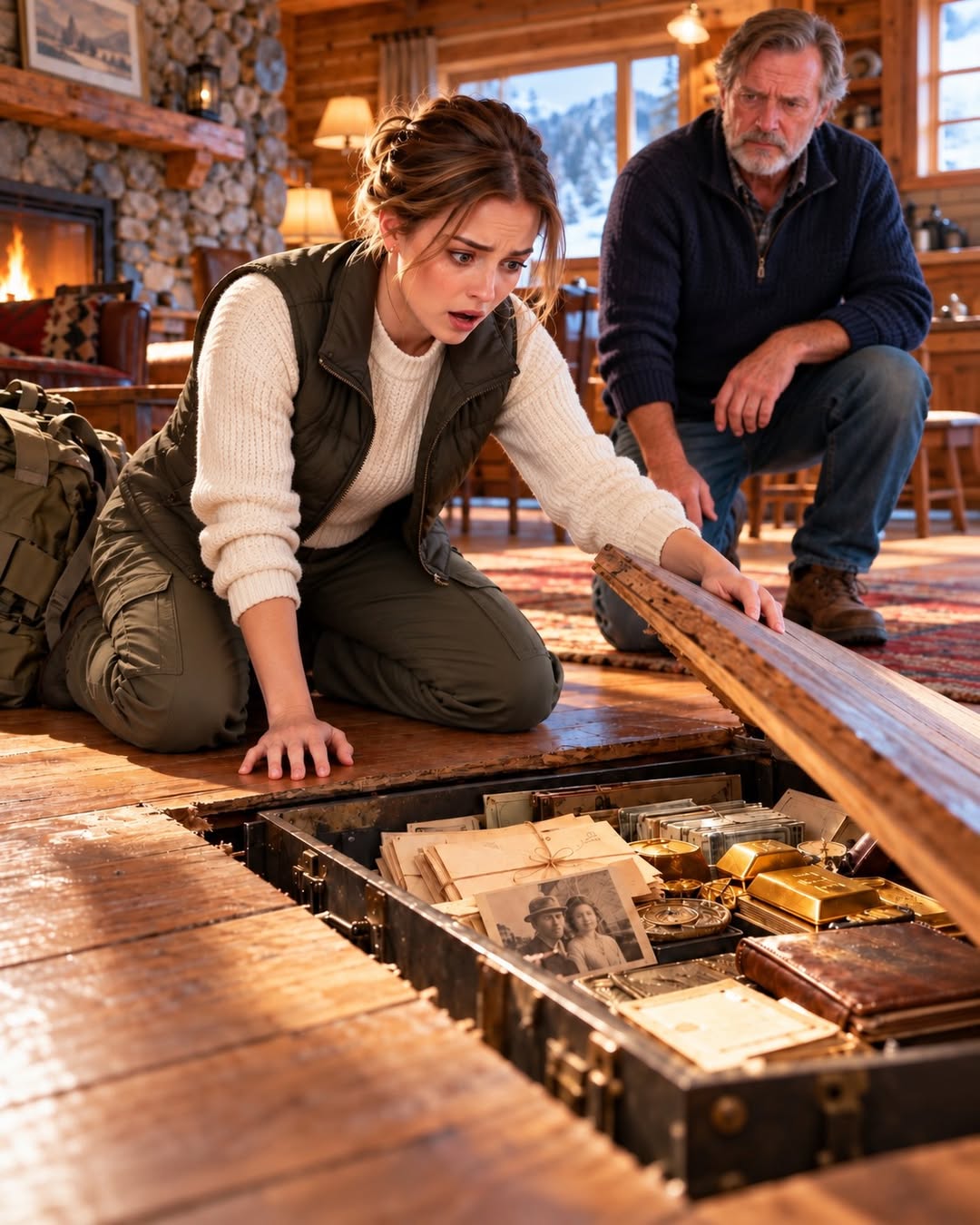
I waited until morning.
That surprises people when I tell this story.
They expect me to say I dropped to my knees the second Jack Reynolds left, ripped up the kitchen floor with my bare hands and discovered a suitcase filled with diamonds.
I didn’t.
I was exhausted.
My father had been dead nine days.
My mother wanted me to surrender the only thing he had specifically left me.
My sister had spent the week treating his will like the scoreboard at a sporting event.
And I had driven almost eleven hours to reach a cabin I had been told was practically worthless.
So I locked the door.
Ate Jack’s stew.
Built a fire.
And slept.
For the first time since Dad died, I dreamed about him.
Not the sick version.
Not the man I had seen in the hospital.
Dad was forty again.
Broad shoulders.
Plaid shirt.
Work boots.
He was standing beside a lake I didn’t recognize.
I kept asking him where we were.
He never answered.
He just smiled.
Then pointed toward the ground.
I woke before sunrise.
The cabin was cold.
I pulled on Army sweats, made terrible instant coffee and stood in the kitchen staring at the floor.
Beneath the kitchen floorboard.
That was all Jack had said.
No directions.
No X.
No dramatic map.
I spent fifteen minutes examining every plank.
Most were old pine.
Beautifully worn.
Then I noticed one beside the pantry.
Four brass screws.
Not nails.
Screws.
And unlike everything around them, they were relatively new.
My pulse accelerated.
I found a screwdriver in the utility drawer.
Of course Dad had left one there.
He had probably anticipated that his eldest daughter could survive military training but might still forget to bring a Phillips-head screwdriver to a mystery inheritance.
I removed the screws.
Lifted the board.
Underneath was not money.
It was a steel box.
Dark green.
Heavy.
Locked.
And taped to the top was an envelope.
My name was written across it.
HANNAH.
Dad’s handwriting.
I sat down on the kitchen floor.
For several minutes, I couldn’t open it.
Seeing the handwriting of someone who has died is a strange kind of violence.
Their voice is gone.
Their hands are gone.
But there is the curve of an H they made on an ordinary afternoon when they still existed.
Finally, I opened it.
There was one page.
Hannah,
If you’re reading this, you came.
I hoped you would.
Before you open the box, understand one thing.
I did not leave you less.
I left you something different.
Call Robert Carter before signing, transferring, selling, leasing, mortgaging or promising anyone anything connected to this property.
Especially family.
Yes, I know exactly how that sounds.
Trust me anyway.
The key is taped behind your grandmother’s photograph.
Love,
Dad
P.S. Your sister will hate this place. For once, that may be useful.
I laughed.
Then covered my mouth.
Then cried.
Hard.
Sitting on the floor.
Holding that ridiculous letter.
Dad had known Megan.
He had known Mom.
And apparently, he had known me well enough to understand I would come here convinced I had received leftovers.
The key was exactly where he said.
Behind Grandma Rose’s photograph.
I unlocked the steel box.
Inside were four folders.
A leather journal.
A small velvet pouch.
And another envelope.
The folders were labeled:
ROSE WHITMORE PROPERTY
WHITMORE CONSTRUCTION — ORIGIN
LAND / RIGHTS / LEASES
HANNAH — READ WITH ROBERT
My heartbeat became uncomfortable.
I did not open the fourth folder.
Dad had specifically told me to call Robert.
So I did.
He answered on the third ring.
“Hannah?”
“Robert.”
A pause.
“You’re at the cabin.”
It wasn’t a question.
“How did you know?”
“Your father.”
I stared at the box.
“What did he tell you?”
“Enough to know you’d eventually call.”
“Does Mom know?”
“No.”
“Megan?”
“No.”
“What is this?”
Another pause.
“Hannah, do not photograph or send those documents to anyone yet.”
That immediately made me nervous.
“Why?”
“Because some contain private financial and ownership information, and I want you to understand the documents before they begin circulating through your family.”
I sat at the table.
“Is the cabin worth more than everyone thinks?”
Robert exhaled.
“The cabin?”
“Yes.”
“The cabin itself isn’t particularly extraordinary.”
My stomach dropped.
Then he continued.
“The property is.”
Robert arrived shortly after noon the next day.
Jack came too.
He brought chili.
Apparently, major family revelations in the Adirondacks required stew or chili.
Robert spread documents across the dining table.
Then he looked at me.
“Your father was very specific about how he wanted this explained.”
“Then explain it.”
He opened the Rose Whitmore folder.
“Your grandmother was Rose Whitmore.”
“I gathered that.”
“She was your father’s mother.”
“Why have I never heard of her?”
Robert glanced toward Jack.
Jack answered.
“Because your father spent most of his adult life pretending he came from nowhere.”
That sounded like Dad.
He had been proud of building Whitmore Construction.
Almost obsessively proud.
The family story was simple.
Dad started with one truck.
One employee.
Small renovation jobs.
Then commercial construction.
Development.
Warehouses.
Regional expansion.
By the time Megan and I were teenagers, Whitmore Construction had become the kind of company whose logo appeared on cranes.
But apparently, that wasn’t the whole story.
Robert slid an old deed toward me.
“Rose owned this land.”
“All two hundred acres?”
“Originally more.”
“How much more?”
“Just over eleven hundred.”
I stared at him.
“What happened to it?”
“Some was sold over the decades. Some transferred. Some placed into separate entities.”
He opened another document.
“Your grandmother also lent your father the money that allowed him to buy his first truck and equipment.”
I looked toward her photograph.
Dad had always said he borrowed money.
He never said from whom.
“Why hide her?”
Jack leaned back.
“He wasn’t ashamed of her.”
“Then why?”
Jack thought for a moment.
“Your grandmother didn’t want credit.”
That answer irritated me.
“Convenient.”
Robert smiled faintly.
“There’s more.”
Of course there was.
Rose had inherited timberland from her father.
She had expanded it slowly.
Bought adjacent parcels.
Leased portions.
Sold timber selectively.
And when Dad was twenty-three and convinced he could build a construction business, she backed him.
Not with millions.
With enough.
Enough for equipment.
Enough for insurance.
Enough to survive the first year.
The myth that Dad had started with nothing was exactly that.
A myth.
He had worked brutally hard.
That part was true.
But somebody had stood underneath the first rung of the ladder.
Rose.
My grandmother.
A woman Megan and I had barely known existed.
“Why didn’t Dad tell us?”
Robert opened the leather journal.
“Eventually, he planned to.”
He pushed it toward me.
The first page was dated fourteen months before Dad’s death.
Dad’s handwriting.
The older I get, the less comfortable I am with the story everyone tells about me.
I swallowed.
The next line:
I built the company. But Rose made it possible for me to start building. There is a difference between earning success and pretending nobody helped you reach it.
I closed the journal.
I couldn’t read more.
Not yet.
“What’s in the other folder?”
Robert opened LAND / RIGHTS / LEASES.
This was where the story became complicated.
And far more interesting than a suitcase of cash.
The two hundred acres were not merely recreational land surrounding an old cabin.
They included valuable forest acreage managed under a long-term plan.
There were access agreements.
Timber-management rights.
A small communications lease on a remote portion of the property.
And interests connected to adjoining acreage held through an entity Dad had established years earlier.
None of those things meant I had instantly inherited some fantastical fortune.
Some income was periodic.
Some rights carried restrictions.
Some land was protected by conservation provisions.
Some arrangements required professional management.
Taxes existed.
Maintenance existed.
Lawyers existed.
Reality, as usual, was less glamorous than family gossip.
But Robert finally gave me a preliminary valuation range for the property and associated interests.
I stared at him.
“Say that again.”
He did.
I sat back.
Megan’s Miami apartment was valuable.
Very valuable.
The cabin property was potentially worth substantially more.
Not because of the cabin.
Because Dad had spent decades quietly consolidating and protecting what surrounded it.
“Does Megan know?”
“No.”
“Mom?”
“Your mother knows Rose existed and that your father had property here. I don’t believe she knows the current structure or valuation.”
I laughed once.
“No wonder Dad told me not to sign anything.”
Robert’s expression became serious.
“Your father anticipated pressure.”
That hurt.
“He knew Mom would ask me to give it to Megan?”
“He believed it was possible.”
“Why?”
Robert hesitated.
“Read the fourth folder.”
HANNAH — READ WITH ROBERT.
Inside was a letter.
Much longer than the first.
Dad had dated it six weeks before his death.
Hannah,
There is a possibility that by the time you read this, you will believe I loved your sister more.
I need you to understand that I made these decisions because I know my daughters are different people.
Megan understands visible wealth.
That isn’t an insult. It is an observation.
She likes the apartment. She understands the company shares. She understands things she can see, price and show other people.
You understand responsibility.
Sometimes too much.
I stopped.
Robert waited.
I continued.
The land is not a prize.
It is work.
It requires decisions.
Some years it will produce income. Some years it will produce bills. It contains agreements you must honor and opportunities you should not rush.
Your grandmother Rose protected it because she believed land teaches patience.
I am leaving it to you because you have spent your adult life proving you can carry responsibility without needing an audience.
That sentence broke me.
I put the letter down.
My eyes blurred.
Dad had understood.
All those years I thought he barely noticed.
Megan stayed close.
Megan attended company events.
Megan posted birthday photographs.
Megan remembered Father’s Day dinners.
I deployed.
Trained.
Moved.
Missed holidays.
Called from airports.
Sent gifts late.
I had always assumed proximity had made her the daughter Dad understood.
I was wrong.
I kept reading.
Do not use this letter to humiliate Megan.
If she mocks the cabin, let her.
If she thinks she won, let her.
Inheritance is not a contest unless the survivors make it one.
The Miami apartment is hers because I want her to have it.
Her company interest is hers because I want her connected to the business, but not in control of it.
Your property is yours because I want you to decide its future.
Do not combine the gifts merely to make things look equal.
Fairness is not always identical arithmetic.
Then came the sentence that made Robert look away while I cried.
And Hannah, I was proud of you every single time you left.
I know you sometimes thought leaving meant you loved us less.
I never thought that.
You went where your duty called you.
I wish I had told you that more often.
Dad
I pressed the letter against my chest.
For ten minutes, nobody spoke.
My phone rang.
Megan.
Of course.
I almost ignored it.
Robert said:
“You can answer.”
I did.
“Hello?”
“Well?”
“What?”
“Did you see the shack?”
“Yes.”
She laughed.
“I’m sorry. Is it awful?”
I looked around.
Fire glowing.
Rose’s photograph.
Dad’s journal.
Two hundred acres outside the window.
“No.”
She sounded disappointed.
“Seriously?”
“Seriously.”
“Mom said you’re meeting with Robert.”
I looked at him.
He raised an eyebrow.
Apparently, Mom’s information network remained operational.
“Yes.”
“Why?”
“Estate matters.”
“What estate matters?”
“Mine.”
Silence.
“What does that mean?”
“It means I’m handling the property Dad left me.”
She laughed.
“You don’t need a lawyer to own a hunting cabin.”
“Apparently I do.”
That changed her tone.
“Hannah.”
“Yes?”
“What did Dad leave you?”
“The cabin and land.”
“You know what I mean.”
I did.
“I have to go.”
Then I ended the call.
Megan arrived the following afternoon.
Uninvited.
Mom was with her.
I watched their SUV crawl up the gravel drive.
Jack, who had stopped by to inspect a frozen pipe, looked out the window.
“Reinforcements?”
“Apparently.”
“You want me to stay?”
I thought about it.
“Yes.”
“Good. I already made coffee.”
Marines, I learned, are remarkably difficult to frighten away from family drama when coffee is available.
Megan entered first.
She looked around.
Her expression changed almost immediately.
The polished floors.
Restored furniture.
Stone fireplace.
The view.
“This isn’t falling apart.”
“No.”
“You said it was.”
“I never said that.”
“Dad did.”
Interesting.
Mom entered behind her.
She saw Rose’s photograph.
Stopped.
“Oh.”
I looked at her.
“You knew her.”
Mom’s face tightened.
“A little.”
“She was Dad’s mother.”
“Yes.”
“You never thought to mention my grandmother?”
“It was complicated.”
Family’s favorite word.
Complicated.
Usually meaning:
We made choices and hoped nobody would ask about them later.
Megan spotted the documents.
“What are those?”
“Private.”
She laughed.
“Hannah.”
“No.”
Her face changed.
“What?”
“You don’t get to read them.”
“I’m Dad’s daughter.”
“So am I.”
“If they involve the estate—”
“They involve property distributed to me.”
Mom stepped in.
“Hannah, there’s no need to become territorial.”
I looked at her.
“Territorial?”
“That isn’t what I meant.”
“You came here after asking me to give Megan control of my property.”
“I said manage.”
“No. You said control.”
Megan rolled her eyes.
“You don’t even live here.”
“Correct.”
“So what are you going to do with two hundred acres?”
“I’ll decide.”
“You’re stationed in North Carolina.”
“I know where I’m stationed.”
“This is ridiculous.”
I looked at her.
“Then why are you so interested?”
That silenced her.
Mom sat down.
“Your father wanted the family taken care of.”
“He made a will.”
“Yes.”
“And it distributed his property.”
“Yes.”
“So why are we rewriting it?”
Nobody answered.
Megan crossed her arms.
“Because this isn’t fair.”
There it was.
“What isn’t?”
“She got the apartment,” Mom said carefully.
“Yes.”
“And the company shares.”
“Yes.”
Megan stared at me.
“What is this place worth?”
I smiled.
Not cruelly.
Just enough.
“I don’t know exactly.”
That was true.
Robert had provided estimates.
Valuation was not a magic fixed number.
“Ballpark.”
“No.”
“Why won’t you tell me?”
“Why do you need to know?”
“Because Dad might have screwed up.”
I felt something cold move through me.
“How?”
“He was sick.”
Mom immediately said:
“Megan.”
But Megan continued.
“If he left you something worth way more than he realized—”
I stood.
“Stop.”
She stared.
“You’re suggesting Dad’s wishes should matter only if you like the valuation.”
“That isn’t what I said.”
“It is exactly what you said.”
Then Megan saw Dad’s letter.
My name across the top.
She reached toward it.
I placed my hand over the page.
“Don’t.”
She froze.
“Seriously?”
“Yes.”
“It’s from Dad.”
“To me.”
Her expression twisted.
“God, you’re selfish.”
And suddenly I was back at the will reading.
Stinking woman.
Enjoy your shack.
All that certainty.
All that triumph.
I could have destroyed her in that moment.
I could have told her everything.
The valuation.
Rose.
The leases.
The history.
Dad’s assessment of her.
I could have watched her face collapse.
For one delicious second, I wanted to.
Then I remembered Dad’s letter.
Do not use this letter to humiliate Megan.
Damn him.
Even dead, the man was assigning homework.
“Your inheritance is yours,” I said.
She frowned.
“What?”
“The apartment.”
I continued.
“The shares.”
“Yes.”
“I don’t want them.”
She looked confused.
“Okay.”
“I don’t want half.”
Mom stared at me.
“Megan doesn’t owe me equalization.”
Megan said nothing.
“And I don’t owe her any either.”
There.
That was the boundary.
Not revenge.
Not victory.
Ownership.
Dad had made decisions.
We could dislike them.
We could misunderstand them.
But neither daughter was entitled to confiscate the other’s gift because hindsight produced a different scoreboard.
Mom started crying.
I hated that.
Not because I believed tears were manipulative.
Mom was genuinely hurting.
But for years, her tears had been the mechanism that ended difficult conversations before anything changed.
I remained seated.
“I wanted you girls to be close.”
“We aren’t.”
“Hannah.”
“We can become closer. But pretending we already are hasn’t helped.”
Megan looked away.
I continued.
“Every time she insulted me, you called it sibling rivalry.”
Mom’s face tightened.
“Every time I responded, you told me I should know better because I’m older.”
“You were always stronger.”
There it was.
I almost laughed.
“Do you know how expensive that sentence was for me?”
She stared.
“You were stronger.”
“So I deserved less protection?”
“No.”
“That’s what happened.”
Mom cried harder.
Megan looked uncomfortable.
Good.
Some conversations should be uncomfortable.
They left an hour later.
Megan did not apologize.
Not yet.
Mom hugged me.
I let her.
Then I stood on the porch and watched them disappear between the trees.
Jack came beside me.
“That went better than expected.”
I looked at him.
“What were you expecting?”
“Gunfire.”
I laughed.
“Marine humor?”
“No. Family experience.”
I spent another week at the cabin.
I read Dad’s journal.
Slowly.
Some pages were business.
Some memories.
Some guilt.
He wrote about Rose.
About Mom.
About Megan.
About me.
I discovered my father had understood our family much better than he ever admitted aloud.
That made me angry.
Why hadn’t he spoken?
Why wait until death to become emotionally articulate?
One journal entry answered me.
I spent too many years believing providing was the same thing as explaining.
That sentence became my father’s final confession.
He had given us things.
Education.
Security.
Travel.
Homes.
Opportunities.
But explanations?
Rarely.
Emotions?
Almost never.
Dad could negotiate a thirty-million-dollar construction contract.
Ask him whether he was proud of you and he became fascinated by the weather.
I loved him.
I also wished he had done better.
Death does not make people perfect.
It simply ends their opportunity to improve.
The velvet pouch contained Rose’s ring.
Nothing spectacular.
Small sapphire.
Worn gold band.
Dad’s note:
She wore this while signing the papers that kept the land when everyone told her to sell. Thought you should have it.
I put it on.
It fit.
Of course it did.
Stories require one impossible coincidence.
I decided I was allowed that one.
Over the next year, I did almost nothing dramatic with the property.
That frustrated Megan enormously.
She expected me either to sell immediately or announce some giant development project.
Instead, I learned.
Forestry.
Conservation.
Property taxes.
Lease structures.
Local history.
I hired professionals where I lacked expertise.
Kept existing management arrangements that made sense.
Changed those that didn’t.
I did not pretend military discipline magically made me an expert in Adirondack land management.
Competence includes knowing when someone else knows more.
Jack helped.
Robert helped.
A forester named Elaine Morris became indispensable.
I spent leave at the cabin whenever possible.
I repaired the roof.
Updated plumbing.
Replaced unsafe wiring.
Kept the old fireplace.
Kept Rose’s photograph exactly where Dad left it.
Then Whitmore Construction ran into trouble.
Not collapse.
Not bankruptcy.
Trouble.
A major project was delayed.
Costs rose.
A regional expansion underperformed.
Megan’s minority stake suddenly felt less glamorous.
She called me.
“Did Dad tell you anything about the company?”
“Some.”
“Robert says you don’t own shares.”
“Correct.”
“Then why are there company documents at the cabin?”
I paused.
“How do you know that?”
“Mom.”
Of course.
“They’re historical.”
“About Grandma Rose?”
“Yes.”
Silence.
Then:
“Dad didn’t start with nothing.”
“No.”
Another silence.
“He lied.”
“I don’t think that’s the right word.”
“He told everyone he built it himself.”
“He did build it.”
“With her money.”
“With her help.”
“That changes everything.”
“No.”
I thought about Dad’s journal.
“It changes the story. Not everything.”
Megan visited alone that autumn.
No designer dress.
No performance.
Jeans.
Boots.
Hair pulled back.
She stood on the porch holding a bottle of wine.
“Am I allowed in?”
The question surprised me.
“Yes.”
She entered.
Looked at Rose’s photograph.
Then asked:
“Can I see Dad’s journal?”
“No.”
Her face tightened.
I expected an argument.
Instead:
“Okay.”
That was new.
I poured wine.
We sat by the fire.
For nearly an hour, neither of us discussed inheritance.
Then Megan said:
“I was horrible to you.”
I looked at her.
“At the will reading.”
“Yes.”
She stared into her glass.
“I wanted to win.”
“Why?”
“I don’t know.”
“Yes, you do.”
She smiled bitterly.
“Still annoying.”
“Still your sister.”
She sighed.
“Because Dad respected you.”
That shocked me.
“What?”
“He respected you.”
“Megan, Dad barely understood what I did.”
“He knew exactly what you did.”
She looked at me.
“He talked about you constantly.”
My throat tightened.
“What did he say?”
“That you were disciplined. Brave. Independent.”
She laughed without humor.
“He used to show people pictures of you in uniform.”
I stared at her.
“He never told me that.”
“I know.”
“How?”
“Because he told me not to.”
That sounded like Dad.
Megan continued.
“I stayed.”
“Yes.”
“And I thought staying should count for more.”
“It did count.”
“Not the way I wanted.”
Her eyes filled.
“I helped when he got sick.”
“I know.”
“I drove him to appointments.”
“I know.”
“I sat with him.”
“I know.”
“And every time someone asked about his children, he’d say, ‘Megan is helping me here, and Hannah is serving.’”
She wiped her eyes.
“I hated that.”
I finally understood.
“You thought he was making us equal.”
“I thought he was making you better.”
Oh.
There it was.
The wound beneath the cruelty.
Not an excuse.
But an explanation.
“You had medals.”
She continued.
“A career. Stories. People respected you. I had Dad’s company and family dinners.”
“Megan—”
“When he left me Miami, I thought…”
She stopped.
“You thought he chose you.”
“Yes.”
“And when you got the cabin…”
“I thought he finally admitted I mattered more.”
That hurt.
But not in the way she intended.
Because suddenly the will reading looked different.
Her laughter had not been confidence.
It had been relief.
Ugly relief.
But relief.
She had been competing in a race I did not know we were running.
“I wasn’t competing with you,” I said.
“I know.”
“Do you?”
“Now.”
I looked at her.
“You called me a stinking woman.”
She covered her face.
“I know.”
“That was remarkably specific.”
“I panicked.”
“You panicked into a nineteenth-century insult?”
She started laughing.
I did too.
For the first time in years, we laughed together without someone losing.
Then she became serious.
“I’m sorry.”
I waited.
“I was cruel.”
“Yes.”
“I treated Dad’s death like a competition.”
“Yes.”
“And I tried to make you feel unwanted because I wanted proof that I was wanted more.”
There it was.
An apology with no escape hatch.
I nodded.
“Thank you.”
“Do you forgive me?”
“Not completely.”
She looked surprised.
Then nodded.
“Fair.”
That was the beginning.
Two years after Dad died, Mom finally told us the full story about Rose.
She had known her.
Not well.
Rose died when Megan was an infant.
I had been four.
I had actually met her.
There was a photograph.
Rose holding me on the cabin porch.
I stared at it for almost an hour.
Mom explained that Dad and Rose had a complicated relationship.
Rose had helped him financially but disliked the mythology growing around his success.
Dad loved her.
He also wanted desperately to prove he was more than the son whose mother financed his beginning.
After she died, he simplified the story.
Then simplified it again.
Eventually omission became family history.
Mom allowed it.
“Why?”
I asked.
She looked ashamed.
“Because your father liked the story.”
There it was.
Not evil.
Not conspiracy.
Weakness.
Families are built from enormous acts of love and tiny acts of cowardice.
Sometimes the cowardice lasts longer.
I eventually left active Army service.
Not because of the cabin.
My career had reached a natural transition point, and after careful planning, I moved into a civilian defense role that gave me more control over where I lived.
I did not move permanently to the Adirondacks.
Not immediately.
But I spent summers there.
Then longer stretches.
The cabin became something I had never expected.
Home.
Not because Dad gave it to me.
Because I chose it.
The land appreciated.
Some income arrangements performed well.
Others didn’t.
One timber cycle generated significant revenue.
A conservation agreement on part of the acreage created financial and environmental benefits after extensive professional review.
The communications lease remained boring and reliable.
The property became financially meaningful.
But I never told Megan the exact number.
Eventually she stopped asking.
That mattered more than any valuation.
Whitmore Construction stabilized too.
Megan surprised everyone.
Including herself.
She began attending shareholder meetings prepared.
Actually prepared.
She took finance courses.
Asked embarrassing beginner questions.
Then better questions.
She stopped treating the company stake like jewelry.
Five years after Dad died, she joined a board committee.
Not because she was Dad’s favorite.
Not because she demanded it.
Because she had done the work.
One evening she called me after a meeting.
“You know what’s horrible?”
“What?”
“I think Dad gave us exactly the things we needed to grow into.”
I groaned.
“Don’t say that.”
“Why?”
“Because then he wins.”
She laughed.
“He’s dead.”
“He’ll still be smug.”
We both knew exactly what his face would look like.
Mom changed too.
Slowly.
She stopped asking me to give Megan things.
Stopped asking Megan to “be the bigger person” whenever we disagreed.
She learned that peace between daughters cannot be manufactured by consistently requiring one to surrender.
At seventy-one, Mom came to the cabin alone.
She stood on the porch for a long time.
Then touched the railing.
“Rose painted this green.”
I looked at her.
“You remember?”
“Yes.”
“What else do you remember?”
That afternoon, she gave me something no legal document could.
Stories.
Rose hated canned peaches.
Loved card games.
Swore when machinery broke.
Kept peppermint candy in her coat.
Could reverse a trailer better than Dad.
Once chased a black bear away from the garbage cans by banging two pot lids together.
My mysterious grandmother became human.
That was worth more to me than another parcel of land.
Ten years after Dad died, we held a family gathering at the cabin.
Megan came from Miami.
Mom came.
Jack was eighty by then and still brought food as though none of us had learned to cook.
Robert came too.
Lily—Megan’s daughter, born years after Dad’s death—ran through the trees collecting pinecones.
At sunset, Megan and I sat on the porch.
She looked across the property.
“You know I really thought you got screwed.”
“I know.”
“I was thrilled.”
“I also know.”
“That’s awful.”
“Extremely.”
She smiled.
“What did you think when Robert read Miami?”
“That Dad loved you more.”
She turned.
“Seriously?”
“Yes.”
She laughed softly.
“We were idiots.”
“Yes.”
Then she asked:
“Do you think he planned all this?”
I looked toward the cabin.
At Rose’s ring on my hand.
At Mom telling Lily a story.
At Jack asleep in a porch chair.
At the land disappearing into evening.
“No.”
Megan looked surprised.
“No?”
“Dad planned the estate.”
I smiled.
“The rest was us.”
That distinction matters.
For years, I was tempted to turn Dad into a mastermind.
The brilliant father who secretly knew everything.
Who distributed his estate with supernatural precision.
Who predicted every fight.
Every apology.
Every future decision.
He wasn’t.
He was a man.
A complicated, stubborn, emotionally constipated man who loved his daughters and made choices he hoped would help us.
Some were wise.
Some created pain.
Some truths he should have told us while he was alive.
The cabin did not contain a magical secret fortune.
It contained context.
History.
Documents.
Responsibility.
And evidence that the story I had been told about my father—and about myself—had never been complete.
That was the real hidden inheritance.
Dad’s first letter is framed now.
Not the financial documents.
Those belong in secure storage.
The letter.
I did not leave you less. I left you something different.
Underneath it sits the photograph of Rose and Dad from 1962.
Beside that is another photograph.
Megan and me.
Taken ten years after the funeral.
She’s wearing expensive sunglasses.
I’m wearing an old Army sweatshirt.
We’re sitting on the porch with coffee.
On the back, Megan wrote:
To Hannah. You got the shack. I got Miami. Somehow you still have better sunsets.
Underneath:
P.S. Sorry about the stinking woman thing. Seriously. What was wrong with me?
I keep that one too.
I’m fifty-one now.
The cabin is no longer crumbling.
The roof is new.
The plumbing works.
The shutters are open.
But I refused to make it luxurious.
Dad would hate that I installed heated bathroom floors.
Rose, based on everything I’ve learned about her, would probably approve immediately.
The forest remains.
The lake remains.
And beneath one kitchen floorboard there is still a hollow space.
The steel box is gone.
But I kept the floorboard.
Sometimes visitors ask why four brass screws sit in one otherwise ordinary piece of pine.
I usually say:
“Family history.”
That is enough.
I used to think inheritance told you how much someone valued you.
Megan thought so too.
That belief nearly destroyed us.
An apartment can be worth millions and still tell you very little about love.
Two hundred acres can be worth millions and still tell you very little about love.
Stock.
Cash.
Jewelry.
Property.
Those things can express intention.
They cannot accurately measure affection.
Dad’s real mistake was leaving us to figure that out after he was gone.
His real gift was giving us enough truth to eventually do it.
When Robert first read the will, Megan believed she had won.
I believed I had lost.
We were both wrong.
There had never been a contest.
Dad left Megan something visible.
A beautiful apartment overlooking blue water.
A stake in the company whose name she had spent her whole life carrying.
He left me a quiet cabin in the mountains.
Land requiring patience.
A photograph.
A journal.
Rose’s ring.
And a floorboard hiding a steel box.
But the most valuable thing he left me was one sentence written in his own hand:
I was proud of you every single time you left.
For years, I had believed leaving meant I had abandoned my family.
Dad understood something I didn’t.
Sometimes leaving is how you become yourself.
And sometimes coming back is how you finally understand where you came from.
That first night in the Adirondacks, I thought my father had hidden an inheritance beneath the kitchen floor.
He had.
It just wasn’t the kind Megan or I had expected.
The money mattered.
The land mattered.
But the secret beneath that floorboard was bigger than either.
It was the truth about the woman who helped my father begin.
The truth about the father who had quietly understood his oldest daughter.
And eventually, the truth about two sisters who had wasted years asking which one was loved more.
Dad had given Megan the inheritance everyone could see.
He gave me the one hidden beneath the trees.
And after all those years, I finally understood:
He hadn’t left me the lesser gift.
He had left me the unfinished story—and trusted me to decide what happened next.