
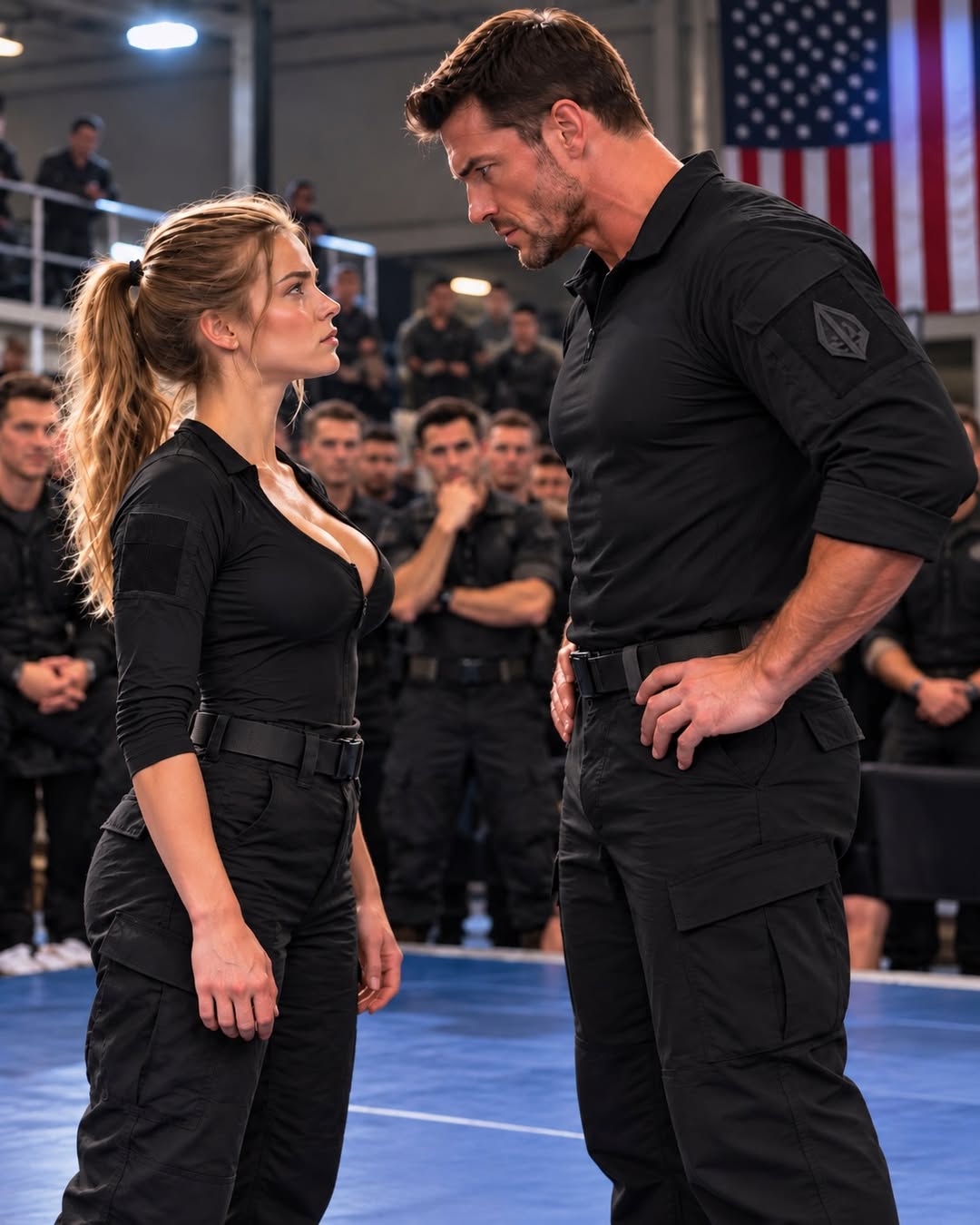
I didn’t yank his leg.
I didn’t twist his knee.
I didn’t try to make him pay for four days of humiliation in one dramatic second.
I simply redirected his momentum.
Briggs had committed too much weight to the kick.
That was his first mistake.
His second was assuming I would react emotionally.
His third was believing size automatically meant control.
I stepped off the line, guided his captured leg past me, and released it.
Briggs stumbled forward.
His palms hit the mat.
A sound moved through the spectators.
Not laughter.
Not cheering.
Surprise.
Briggs scrambled back to his feet.
His face had changed.
The grin was gone.
I raised my hands again.
“Ready?”
That made him angrier than any insult could have.
He rushed me.
Briggs was strong.
Anyone pretending otherwise would have been lying.
He probably outweighed me by sixty pounds. His reach was longer. His upper-body strength was obvious, and unlike the jokes he had made all week, his training was real.
But strength was only one variable.
Timing mattered.
Balance mattered.
Distance mattered.
Most importantly, judgment mattered.
Briggs fought as if the objective was proving something.
I fought as if the objective was solving something.
There is a difference.
He drove forward.
I gave him space.
He expected resistance.
Instead, I changed the angle.
His shoulder passed mine.
I controlled his arm long enough to prevent him from immediately turning into me, then disengaged.
The referee repositioned us.
Briggs stared at me.
I could see him calculating now.
Good.
For the first time since I arrived, he was treating me like an opponent instead of a joke.
“Come on, princess,” he muttered.
The referee heard him.
“Sergeant.”
Briggs ignored the warning.
He came again.
This time slower.
Smarter.
He feinted high.
Then changed levels.
I recognized the entry.
We collided.
For several seconds, the match became exactly what Briggs wanted—a strength contest.
His shoulder pressed into me.
My ribs screamed.
The strike from the semifinal had left them sore, and Briggs found the injury almost immediately.
Maybe accidentally.
Maybe not.
His forearm pressed across the same area.
Pain flashed through my side.
He felt me react.
Then he smiled.
There it was.
He drove harder.
The crowd disappeared.
The bleachers disappeared.
The phones disappeared.
There was only pressure.
Breathing.
Position.
Decision.
I shifted my hips.
Created space.
Changed my base.
Briggs tried to capitalize.
Too fast.
Too eager.
I turned with him.
His grip slipped.
One second later, I was no longer underneath his pressure.
He was.
The crowd erupted.
I heard it this time.
Briggs hit the mat and immediately tried to roll.
I followed.
Not recklessly.
Not angrily.
Technically.
He fought for position.
I denied it.
He tried to muscle free.
I adjusted.
Then I secured control.
The referee moved closer.
Briggs refused to tap.
I applied only enough pressure to establish the submission.
“Tap,” I said quietly.
His face reddened.
“No.”
“Ryan.”
It was the first time I had used his first name.
His eyes met mine.
“This is over.”
He strained again.
I did not increase the pressure beyond what the controlled match required.
The referee was already watching carefully.
“Sergeant Briggs,” he warned.
Briggs tried once more to escape.
Couldn’t.
Then his hand struck the mat.
Once.
Twice.
Three times.
Tap.
I released him immediately.
The referee stepped between us.
For perhaps half a second, the entire training field was silent.
Then five hundred people exploded.
I stood.
My ribs hurt.
My lungs burned.
Sweat ran down the back of my neck.
But I didn’t raise my arms.
I didn’t point at Briggs.
I didn’t look toward the soldiers who had laughed at me.
The referee reached for my wrist.
I let him raise it.
“Avery Mitchell!”
The applause grew.
Across from me, Briggs stood slowly.
His face looked like someone had removed the version of reality he had been relying on.
He stared at me.
I expected anger.
Instead, I saw humiliation.
That worried me more.
Humiliated people often have two choices.
Learn.
Or retaliate.
Briggs chose quickly.
“You got lucky.”
The referee turned.
“Sergeant, step back.”
Briggs pointed at me.
“She knew I was injured.”
I stared at him.
I hadn’t known.
The irony almost made me laugh.
“You attacked my bad side!”
The referee’s expression hardened.
“Sergeant Briggs.”
“You all saw it.”
Commander Daniel Hayes was already standing.
So were several senior officers in the front row.
And that was when Briggs finally seemed to remember who had been watching.
Not just soldiers.
Not just his friends.
Commanders.
Instructors.
Evaluators.
Observers.
People whose job was not to care who looked impressive.
Their job was to notice behavior.
Briggs looked around.
Nobody was laughing now.
The younger soldier I had overheard at lunch stood near the edge of the crowd.
He looked almost relieved.
Briggs turned toward me again.
“You think this proves something?”
I wiped sweat from my forehead.
“No.”
That stopped him.
“What?”
“The match proves I won the match.”
His face tightened.
“That’s all.”
I looked toward the referee.
“Permission to step off the mat?”
He nodded.
I left.
That should have been the end.
It wasn’t.
Because the tournament had never been the real test.
What happened afterward was.
Commander Hayes found me twenty minutes later near the medical station.
A corpsman was checking my ribs.
“Bruising,” she said. “Nothing obviously unstable, but I want you properly evaluated.”
“Yes, Petty Officer.”
Hayes waited until she finished.
Then he crossed his arms.
“You knew he would target the injury.”
“I suspected he might notice it.”
“And you competed anyway.”
“Yes, sir.”
He looked irritated.
I knew that look.
It was the expression senior officers wore when they were trying to decide whether to congratulate you or write your name into a safety briefing.
Finally, he said, “Good match.”
“Thank you, sir.”
Then:
“Now tell me about the tiara.”
My expression changed.
“What?”
“The pink plastic tiara in your locker.”
I said nothing.
Hayes watched me.
“Mitchell.”
“How do you know about that?”
“Because someone photographed it.”
My stomach tightened.
“Who?”
“That’s being determined.”
I sat straighter.
Hayes continued.
“And apparently the photograph was sent through a group chat.”
I stared at him.
That was different.
Private stupidity was one thing.
A documented group chat was another.
“How many people?”
“Enough.”
I looked toward the field.
Briggs was speaking with two instructors.
His posture had changed.
The swagger was gone.
“What else?” I asked.
Hayes didn’t answer immediately.
That told me there was more.
“Several people came forward during the tournament.”
“About Briggs?”
“About the last four days.”
I looked at him.
“One reported the shoulder-checking.”
Another pause.
“Another reported comments in the dining facility.”
I felt something cold settle in my stomach.
“Sir, I didn’t ask anyone to—”
“I know.”
“I never filed a complaint.”
“I know.”
“Then why—”
“Because this stopped being solely about you.”
That silenced me.
Hayes pulled a folding chair closer.
“Mitchell, do you know why I stopped you outside the barracks last night?”
“Because you thought Briggs would hurt me.”
“That was part of it.”
“What was the other part?”
“I wanted to know whether you felt pressured to participate.”
I frowned.
He continued.
“There’s a difference between volunteering for a controlled competition and believing you have to fight someone to prove you belong here.”
I looked away.
Maybe he saw the answer on my face.
“Damn it, Mitchell.”
“With respect, sir, I never said I had to prove anything.”
“You said every woman here had watched men like him get away with it.”
“Yes.”
“That sounds like something bigger than a tournament.”
“It is.”
Hayes nodded.
“Exactly.”
That afternoon, the awards ceremony took place.
I expected a trophy.
A handshake.
Maybe some jokes.
Instead, the senior training commander stepped to the microphone.
Colonel Marcus Reed.
He was a broad-shouldered man in his fifties who had spent most of the week observing without saying much.
He announced the placements.
Third.
Second.
Then my name.
I walked forward.
He handed me the tournament award.
“Congratulations.”
“Thank you, sir.”
His handshake was firm.
Then he kept hold of my hand for half a second.
“Stay afterward.”
My stomach dropped.
“Yes, sir.”
That phrase never sounded encouraging.
When the field cleared, six people remained.
Colonel Reed.
Commander Hayes.
Two instructors.
A senior enlisted adviser.
Me.
And Sergeant Ryan Briggs.
Briggs stood twenty feet away.
His arms were rigid at his sides.
Reed looked at both of us.
“This is not about the final.”
Briggs glanced at me.
Reed continued.
“The competition was conducted under supervision. The result stands. Nobody is being investigated because Sergeant Briggs lost.”
I appreciated that immediately.
This was not going to become some cartoon where losing to a woman destroyed a man’s career.
That would have been almost as insulting as Briggs’s original behavior.
Reed held a folder.
“This concerns conduct before and during the training period.”
Briggs spoke.
“Sir, with respect, Mitchell never complained.”
Reed looked at him.
“That is not a defense.”
Silence.
“If a person does not complain, does that make unprofessional conduct professional?”
“No, sir.”
“Does it make harassment acceptable?”
“No, sir.”
“Does it erase witnesses?”
“No, sir.”
Briggs stared straight ahead.
Reed looked at me.
“Mitchell, you will be interviewed separately.”
“Yes, sir.”
“You are not expected to make conclusions about Sergeant Briggs. You will provide facts.”
“Understood.”
Then he looked at Briggs.
“And you will be afforded the same process.”
Something in Briggs’s shoulders loosened slightly.
That mattered too.
Accountability was not revenge.
If I wanted rules to protect me, they had to protect him from assumptions as well.
Facts.
Witnesses.
Records.
Context.
Then conclusions.
Not the other way around.
The interviews began that evening.
I told them everything.
The first comment.
“Who let the lost kid wander in here?”
The “little girls play operator” remark.
The running commentary.
The unnecessary corrections.
The classroom questions.
The shoulder bumps.
The dining facility laughter.
The tiara.
I also told them what I did not know.
I did not know who put the tiara in my locker.
I did not know whether Briggs instructed anyone to shoulder-check me.
I did not know whether every laugh had been directed at me.
I did not know what conversations occurred when I wasn’t present.
The investigator nodded.
“Thank you.”
That surprised me.
“For what?”
“For distinguishing what you know from what you assume.”
I shrugged.
“Evidence matters.”
“Yes.”
I thought about the sentence I had repeated to myself all week.
Sometimes silence was evidence.
I realized then that I had only been partly right.
Silence itself wasn’t evidence.
Observation was.
Documentation was.
Witnesses were.
Facts were.
Silence had simply given me enough space to collect them.
The investigation took longer than four days.
Real accountability usually does.
There was no dramatic announcement the next morning.
No commander publicly ripping insignia from Briggs’s uniform.
No crowd watching him get destroyed.
Instead, people were interviewed.
Messages were reviewed through proper channels.
Training records were examined.
Instructors were questioned.
And the picture that emerged was larger than me.
Briggs had a pattern.
Not identical incidents.
Not all involving women.
But a pattern of humiliating junior personnel and disguising it as motivation.
He mocked people he considered weak.
He encouraged group ridicule.
He used physical intimidation.
And when challenged, he called it training culture.
Some people had laughed because they agreed.
Others laughed because they didn’t want to become his next target.
That distinction mattered.
The pink tiara became especially important.
Briggs hadn’t placed it in my locker.
A corporal named Evans had.
When interviewed, Evans admitted he had done it after hearing Briggs joke that I needed a crown if I wanted “special treatment.”
Evans thought Briggs would find it funny.
Briggs had.
Someone took the photograph.
Someone posted it.
Several people responded with laughing emojis.
One person wrote:
This is getting stupid.
Nobody listened.
Now the entire conversation was part of the review.
Evans found me three days later.
“Mitchell.”
I stopped.
He looked miserable.
“I owe you an apology.”
I waited.
“The tiara.”
“I know.”
His face reddened.
“I thought it was funny.”
“Was it?”
“No.”
“Why not?”
He seemed surprised by the question.
“Because it was disrespectful.”
“That’s part of it.”
He waited.
I continued.
“You didn’t know me.”
He nodded.
“You decided I was a joke because someone else told you I was.”
His eyes dropped.
“Yes.”
“That should bother you more than the tiara.”
He looked at me again.
“It does.”
I believed him.
“Good.”
I walked away.
Briggs did not apologize.
Not then.
For several weeks, he maintained that people were overreacting.
He said military training was supposed to be uncomfortable.
He said people had become too sensitive.
He said I had proven I could handle myself, so obviously no real harm had occurred.
Then Colonel Reed asked him a question during one of the formal sessions.
“If Mitchell had lost the tournament, would your behavior toward her during the preceding four days have become acceptable?”
Briggs apparently had no answer.
I learned about that question later.
I thought about it for a long time.
Because that was the trap.
If respect had depended on me beating Briggs, then Briggs’s worldview would still have won.
I would only deserve respect because I proved I was physically capable of defeating him.
What about the woman who couldn’t?
What about the smaller recruit?
The slower runner?
The inexperienced operator?
The person who admitted they didn’t know an answer?
Did they deserve humiliation?
Of course not.
Professional respect could not be a prize awarded only to the strongest person in the room.
My ribs healed.
Training continued.
And something strange happened.
People started talking to me.
Not admiring me.
Talking.
The younger soldier who had questioned Briggs at lunch introduced himself.
Specialist Jordan Lee.
“You knew he was going to kick low, didn’t you?”
“No.”
He looked disappointed.
“But you caught it.”
“I reacted.”
“That’s less cool.”
“Reality often is.”
He laughed.
Then he became serious.
“I should’ve said something earlier.”
“About what?”
“The comments.”
I looked at him.
“Why didn’t you?”
He shrugged.
“Briggs is Briggs.”
I waited.
Lee sighed.
“That sounds terrible when you say nothing.”
“Yes.”
“I figured you could handle it.”
“I could.”
He looked confused.
“Then—”
“Being able to handle something doesn’t make it acceptable.”
He nodded slowly.
“Right.”
That conversation mattered more to me than the applause after the final.
Two weeks later, Commander Hayes asked me to speak to a group of junior personnel.
I refused.
He stared at me.
“No.”
“Why?”
“Because I know what you want.”
“What do I want?”
“The inspirational speech.”
He almost smiled.
“Do I?”
“Small woman defeats giant bully. Believe in yourself. Never give up.”
Hayes laughed.
“Terrible.”
“Exactly.”
“That isn’t what I want.”
“What do you want?”
“I want you to explain why you didn’t file a complaint.”
That surprised me.
“Sir?”
“You stayed quiet for four days.”
“Yes.”
“Why?”
I thought about it.
“Because I assumed complaining would confirm what Briggs already thought.”
“Which was?”
“That I needed special treatment.”
Hayes nodded.
“And now?”
“Now I think that was a mistake.”
He raised an eyebrow.
“Interesting.”
“I still don’t regret competing.”
“I didn’t ask if you did.”
“But I should have reported the pattern sooner.”
“Why?”
“Because I thought enduring it proved strength.”
I looked toward the training field.
“It mostly proved I could endure something that shouldn’t have been happening.”
Hayes smiled faintly.
“That’s the speech.”
So I gave it.
No dramatic music.
No tournament footage.
Just me standing in front of eighty service members.
I told them something I wish someone had told me years earlier.
“Resilience is useful. Silence sometimes is too. But neither should become an excuse for allowing misconduct to continue.”
The room was quiet.
“You do not have to win a fight before you deserve professional treatment.”
A few heads lifted.
“You do not have to outrun someone, outshoot someone, outlift someone, or outrank someone before basic standards apply.”
I paused.
“And if you witness behavior you know is wrong, laughing because you’re uncomfortable still sounds like laughter to the person standing alone.”
That one hit.
I could see it.
Good.
Briggs was reassigned away from instructional responsibilities while the process ran its course.
I was not told every administrative detail.
I didn’t need to be.
His career was not mine to manage.
Months later, however, I saw him again.
Different facility.
Different training event.
I was walking toward a briefing room when I heard:
“Mitchell.”
I turned.
Briggs stood about fifteen feet away.
He looked the same physically.
Maybe slightly leaner.
But the energy was different.
No audience.
No grin.
No performance.
“Sergeant.”
He approached.
Then stopped at a respectful distance.
“I owe you an apology.”
I said nothing.
He looked uncomfortable.
Good apologies often are.
“I treated you like you didn’t belong.”
I waited.
“I made comments about you being a woman. I encouraged other people to treat you like a joke.”
Still I waited.
“And when you beat me, I blamed you instead of admitting I had underestimated you.”
“That’s true.”
His jaw tightened.
Then he nodded.
“I was angry for a long time.”
“At me?”
“At everyone.”
He looked away.
“Mostly myself, I think.”
I crossed my arms.
“Can I tell you something you’re still getting wrong?”
He looked at me.
“What?”
“This was never about me beating you.”
His expression shifted.
“You think that’s why I’m apologizing?”
“I think it’s still part of how you understand what happened.”
He didn’t answer.
“So imagine I lost.”
He frowned.
“Imagine your first kick ended the match.”
Silence.
“Would calling me a little girl have become professional?”
“No.”
“Would the tiara become funny?”
“No.”
“Would humiliating me for four days suddenly be good leadership?”
His eyes dropped.
“No.”
“That’s the point.”
He nodded.
This time, slowly.
“I understand.”
Maybe he did.
Maybe he was beginning to.
That was enough for me.
He held out his hand.
I looked at it.
Then shook it.
Not forgiveness.
Not friendship.
Recognition.
Two professionals standing in a hallway after one of them had finally learned something the other should never have been required to teach.
“Take care, Mitchell.”
“You too, Briggs.”
We walked in opposite directions.
A year later, I returned to the original training facility.
The field looked smaller than I remembered.
Maybe places always do after they stop carrying so much emotional weight.
Commander Hayes had been promoted.
Colonel Reed had moved to another assignment.
Jordan Lee was now a sergeant.
And the hand-to-hand tournament was happening again.
I stood near the back of the bleachers.
Nobody announced me.
That was intentional.
Two competitors entered the mat.
One was a large infantry soldier.
The other was a young woman I had seen during training earlier that week.
She was nervous.
I could tell from the way she kept flexing her fingers.
The man across from her was nearly twice her size.
Someone behind me whispered:
“She’s going to get destroyed.”
Another voice responded.
“Maybe. Maybe not.”
Then Jordan Lee turned around.
“Either way, she belongs on the mat.”
I smiled.
He didn’t see me.
That made it better.
The woman lost.
Cleanly.
Professionally.
Her opponent helped her stand.
They shook hands.
The crowd applauded both of them.
No humiliation.
No jokes.
No pink tiara waiting in a locker.
She walked away disappointed.
But she walked away respected.
And I realized that was the outcome I had wanted all along.
Not a world where every woman defeats every man.
Not a fantasy where size, experience, and strength stop mattering.
A world where losing does not prove you never belonged.
Where winning does not grant you humanity.
Where professional respect exists before the contest begins.
Hayes found me afterward.
“You’re smiling.”
“Am I?”
“It’s unsettling.”
“Congratulations on the promotion, sir.”
“Thank you.”
We watched the next competitors warm up.
Then he said, “Do you ever think about that final?”
“Sometimes.”
“Still proud?”
“Yes.”
He glanced at me.
“Of winning?”
I thought about it.
“No.”
“Then what?”
I watched Jordan Lee correct a young soldier who made a joke at someone else’s expense.
The soldier immediately apologized.
No spectacle.
No humiliation.
Just a standard being enforced.
“That it didn’t end when the match did.”
Hayes nodded.
“I’ll take that.”
People still tell the story differently.
Some say Sergeant Ryan Briggs spent four days mocking a 130-pound Navy woman and then got humiliated in front of five hundred soldiers.
It makes a good story.
It’s also the least important version.
Yes, I beat Briggs.
Yes, he underestimated me.
Yes, the moment I caught his kick was satisfying.
I’m human.
But catching one leg did not prove women belonged in military training.
Women were already there.
My victory did not create their competence.
Briggs’s defeat did not create their worth.
And five hundred people applauding me did not suddenly make me more deserving of respect than I had been four days earlier when I walked into that facility carrying my gear.
The real lesson came afterward.
When witnesses stopped laughing.
When people started documenting.
When commanders separated facts from assumptions.
When junior personnel realized silence could protect a bully as easily as it could protect a target.
When Briggs finally understood that respect was not something weaker people had to earn from stronger ones.
And when I understood that endurance alone was not always strength.
Sometimes strength meant speaking.
Sometimes it meant reporting.
Sometimes it meant standing beside the next person before they had to stand alone.
I still have the pink tiara.
Evans offered to throw it away after the investigation.
I told him not to.
He stared at me.
“Why would you want it?”
“Evidence.”
He looked horrified.
Then I laughed.
“I’m kidding.”
Mostly.
Years later, it sits on a shelf in my office.
Beside challenge coins.
Training photographs.
A tournament medal I almost never mention.
Young operators sometimes notice it.
Eventually someone asks.
“Ma’am, why do you have a plastic crown?”
And I tell them:
“Because once, a room full of people thought humiliation was harmless as long as the person being humiliated could take it.”
They usually wait for the dramatic part.
“So what happened?”
I smile.
“They learned.”
Sometimes they ask about Briggs.
I tell them he learned too.
Because the point was never to destroy him.
It was to stop what he was doing.
There is a difference.
Sergeant Ryan Briggs thought my silence meant I was afraid of him.
He thought my size meant I was weak.
He thought being a woman made me an outsider.
And when I caught his leg in front of five hundred people, he finally understood that he had underestimated the person standing across from him.
But that wasn’t the mistake that mattered most.
His biggest mistake had happened four days earlier.
The moment I walked into that facility, Briggs decided I had to prove I deserved to be there.
He was wrong.
I never needed to defeat him to prove I belonged.
He needed to learn that I belonged before the fight ever began.