
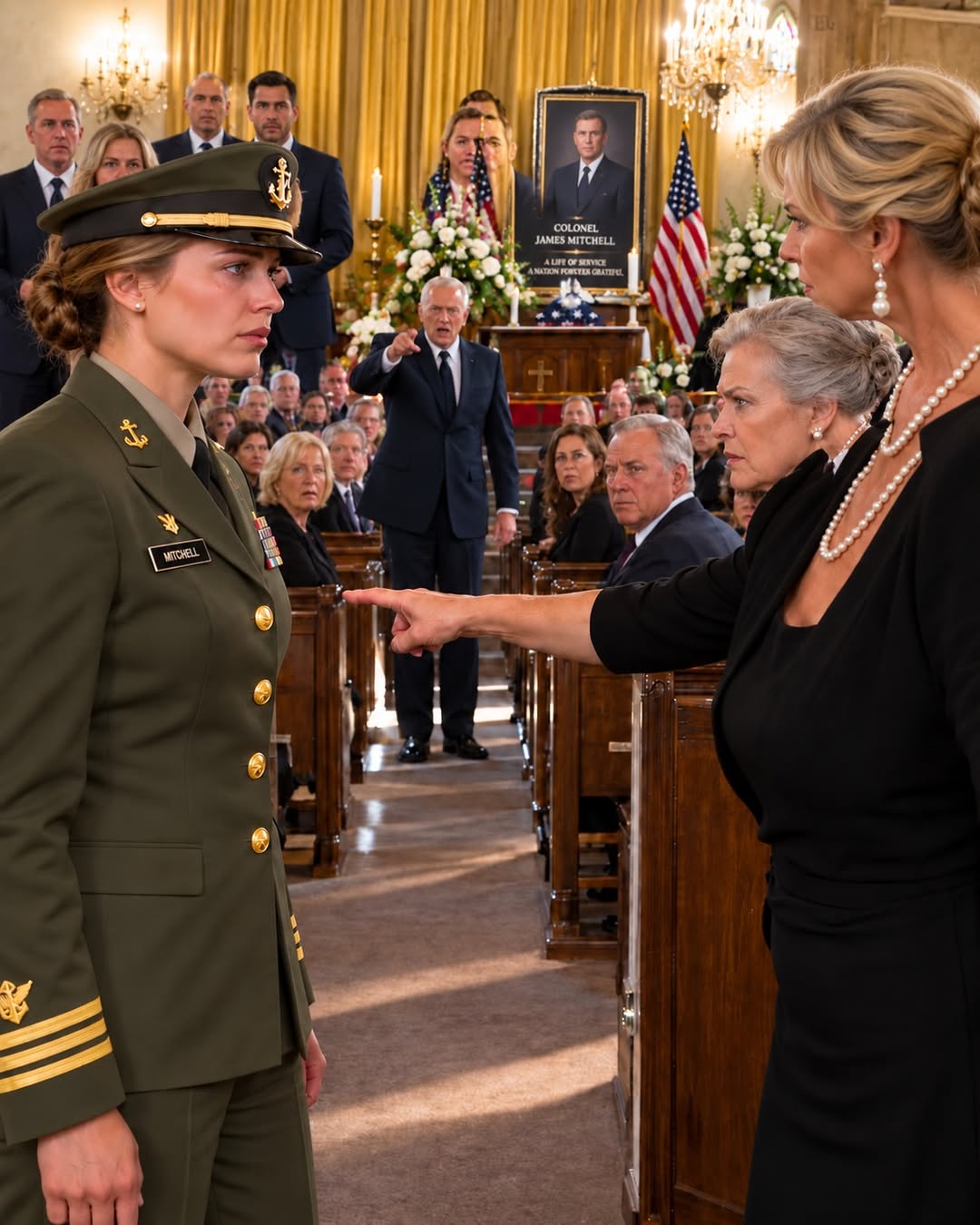
The elderly man took another step into the aisle.
My mother didn’t move.
But something in her face collapsed.
Not grief.
Not surprise.
Recognition.
She knew exactly what he was talking about.
“General,” she said quietly, “this is neither the time nor the place.”
The man’s gaze remained steady.
“I disagree.”
A murmur moved through the church.
That was when I recognized him.
Major General Thomas Mercer, United States Army, retired.
Dad had mentioned him in letters over the years. They had served together early in their careers, back when Dad was still a captain with more ambition than gray hair. I had seen photographs of them standing beside helicopters, sitting on ammunition crates, laughing with the careless confidence of men who had not yet learned how much a career could take from them.
Mercer was older now.
Late seventies, maybe.
He walked with a cane.
But his voice still filled the sanctuary.
He looked at me.
“Commander Mitchell?”
My breath caught.
“Yes, sir.”
He studied my uniform.
Then he looked directly at my mother.
“James did not ask Sarah to hide what she earned.”
Mom’s mouth tightened.
“Thomas—”
“He asked me to make certain she wore it.”
The church went silent.
Completely silent.
Even the whispers stopped.
I felt Emily turn toward me.
“What?” she breathed.
General Mercer reached inside his jacket.
He removed a cream-colored envelope.
My name was written across the front.
SARAH.
Dad’s handwriting.
I knew it instantly.
My knees almost gave out.
Mercer held it carefully.
“Your father gave this to me seven months ago.”
I stared at him.
“Why?”
“He was afraid there might come a day when his wishes became inconvenient to someone else.”
My mother’s face went from white to red.
“That is enough.”
Mercer ignored her.
“He asked me to bring this letter to his memorial if you came.”
“If?”
His eyes softened.
“He wasn’t certain you would be able to.”
Mom stepped forward.
“Thomas, please.”
He finally looked at her.
“No, Elaine.”
Two words.
Quiet.
Final.
“You have had twelve years to tell this town your version of Sarah Mitchell. James asked me for ten minutes to tell his.”
Nobody moved.
Then General Mercer looked toward the pastor.
The pastor hesitated.
And nodded.
I wish I could say I felt vindicated.
I didn’t.
I felt sick.
My father was dead.
My mother was furious.
My sister was crying.
And one hundred people were staring at me like they had suddenly discovered a hidden door in a house they thought they knew.
General Mercer walked toward me.
He handed me the envelope.
“James wanted you to have this after the service.”
I took it.
My fingers shook.
“Then why are you giving it to me now?”
“Because I believe circumstances have changed.”
I almost laughed.
Dad would have liked that answer.
Mercer turned toward the congregation.
“For those who don’t know me, my name is Thomas Mercer. James Mitchell and I served together for twenty-six years.”
He paused.
“I knew him as a soldier. I knew him as an officer. And I knew him as a father.”
Mom folded her arms.
“This memorial was supposed to honor my husband.”
“It still will.”
Mercer’s voice softened.
“But honoring the dead does not require lying about the living.”
That landed hard.
Mom stared at him.
“I never lied.”
Mercer tilted his head.
“Then perhaps Sarah attended James’s funeral six weeks ago?”
Mom said nothing.
“Perhaps she was physically able to attend?”
Still nothing.
My stomach tightened.
People began looking between us.
Mercer continued.
“Sarah Mitchell was not absent from her father’s funeral because she did not care.”
A woman near the front covered her mouth.
“She was absent because she was hospitalized in Germany.”
Emily made a sound beside me.
Not quite a gasp.
Not quite a sob.
Mercer looked toward the congregation.
“She had been injured while serving overseas.”
The room changed.
I could feel it.
Every stare that had followed me into the church suddenly carried a different question.
Mom finally spoke.
“She survived.”
I turned toward her.
I couldn’t believe what I had heard.
“What?”
“You survived, Sarah.”
Emily stared at Mom.
“Mom.”
Mom looked at me.
“I wasn’t going to turn your father’s funeral into some spectacle about you being injured.”
I felt the envelope bend beneath my fingers.
“You knew?”
She didn’t answer.
“You knew I was in the hospital?”
“Of course I knew.”
Emily stepped backward.
“You told me Sarah chose not to come.”
Mom turned.
“I said she wasn’t coming.”
“No.”
Emily’s voice shook.
“You told me she could have come if she wanted to.”
Mom’s expression hardened.
“This is exactly what I wanted to avoid.”
I almost whispered the question.
“Why?”
Mom looked at me.
And for one second, I saw something underneath the anger.
Fear.
General Mercer answered before she could.
“Because James knew.”
Mom snapped toward him.
“Stop.”
“He knew what?”
Emily’s voice was barely audible.
Mercer looked at me.
“Your father knew your mother had been telling people you abandoned the family.”
The words were strangely unsurprising.
Maybe some part of me had always known.
What I hadn’t known was that Dad knew too.
“How long?”
“Several years.”
That hurt.
More than I expected.
“Then why didn’t he stop her?”
Mercer’s face tightened.
“That question belongs to your father.”
“But he’s dead.”
“Yes.”
The answer was brutal because it was true.
There are questions we wait too long to ask.
Sometimes death keeps the answer.
The pastor finally approached.
“Perhaps we should continue the service.”
Mom nodded immediately.
“Yes.”
Then she pointed toward my uniform.
“But she can change first.”
General Mercer actually laughed.
Not loudly.
Just one stunned breath.
“Elaine.”
“What?”
“James specifically requested military honors at this memorial.”
“That was for him.”
“And he specifically requested that Sarah attend in uniform.”
Mom’s jaw tightened.
“You cannot prove that.”
Mercer looked at me.
Then at the envelope.
I understood.
I opened it.
The paper inside smelled faintly like Dad’s study.
Old books.
Coffee.
Maybe that was my imagination.
His handwriting was weaker than in his earlier letters.
But unmistakable.
Sarah,
If Mercer is giving you this at the church, then you came.
Thank you.
I had to stop reading.
My vision blurred.
Emily touched my arm.
I continued.
I have made many mistakes as a father. One of the greatest was confusing peace in my house with peace in my family.
My throat closed.
I spent too many years letting silence do work that courage should have done.
I looked at Mom.
She was staring at the floor.
I kept reading.
You earned every ribbon on your uniform. If anyone asks you to hide them because your service makes them uncomfortable, do not.
When they honor me, wear what you earned.
Don’t wear it for them.
Wear it for me.
I stopped.
There was more.
But I couldn’t read it aloud.
General Mercer apparently knew.
He placed a hand on my shoulder.
“Commander?”
I nodded.
“I’m staying.”
Mom looked up.
“Sarah.”
I met her eyes.
“I’m staying exactly like this.”
Nobody stopped me.
That mattered.
Not because I needed permission.
Because for twelve years, Cedar Creek had heard one story.
Sarah left.
Sarah stopped visiting.
Sarah cared more about the Navy.
Sarah thought she was better than everyone.
Sarah didn’t even come to her father’s funeral.
People had accepted it because it had been repeated often enough.
Now they were watching the supposedly selfish daughter walk down the aisle wearing the uniform her father had asked her to wear.
General Mercer walked beside me.
Emily followed.
Mom remained near the doors for several seconds.
Then she came in alone.
The memorial began.
Dad’s photograph stood near the altar.
Colonel James Mitchell.
He was smiling in the picture.
Not his formal military smile.
His real one.
Crooked.
Warm.
Slightly mischievous.
For a moment, I was eight years old again.
Dad was teaching me to ride a bicycle.
“Stop looking at the ground, Sarah.”
“I’m going to fall.”
“Probably.”
“Dad!”
“You’ll fall wherever you’re looking. Look where you want to go.”
I crashed into a hedge thirty seconds later.
He laughed until Mom yelled at him.
Then he helped me up.
Look where you want to go.
I had forgotten that.
The pastor spoke.
A former mayor spoke.
Dad’s old battalion commander spoke.
Several veterans shared stories.
Some were funny.
Some made me cry.
Then General Mercer approached the lectern.
He carried no notes.
“James Mitchell was my friend for fifty-one years.”
He looked toward Dad’s photograph.
“He was brave when bravery involved bullets.”
A few veterans nodded.
“He was less brave when bravery involved his own family.”
The sanctuary shifted.
Mom stiffened.
Mercer continued.
“James knew that.”
He looked at me.
“And before he died, he asked me not to turn him into something perfect.”
I lowered my eyes.
“He loved both of his daughters. He loved his wife. But love does not automatically make us courageous. Sometimes the people we love are the people we fail because confronting the truth costs more than staying quiet.”
My tears came then.
Quietly.
Mercer looked toward me.
“James was proud of Sarah.”
Mom closed her eyes.
“He followed her career. He kept every letter. Every photograph. Every public announcement he could obtain.”
I stared at him.
“What?”
Mercer smiled faintly.
“James had an entire drawer.”
I almost laughed through my tears.
“He bragged about you constantly.”
I shook my head.
“He never said.”
“No.”
Mercer’s smile disappeared.
“That was another mistake.”
Then he told the church something even I didn’t know.
Dad had been planning to visit me.
He had purchased a ticket.
He had intended to travel after a final round of medical appointments.
He never made the trip.
His health deteriorated too quickly.
Instead, he wrote letters.
Several of them.
Some mailed.
Some not.
Mercer had the rest.
Mom knew about them.
She had not destroyed them.
That mattered.
But she had not given them to me either.
After Mercer sat down, the pastor asked if anyone else wished to speak.
I had not planned to.
Then I stood.
Mom whispered my name.
I walked toward the lectern anyway.
My legs felt strangely heavy.
I looked out at Cedar Creek.
At people who had known me since childhood.
At veterans who had served with Dad.
At women from church who had whispered when I entered.
At my sister.
At my mother.
Then at Dad’s photograph.
“My father taught me that courage and fear can exist at the same time.”
I swallowed.
“I spent twelve years believing distance was the price of serving.”
Nobody moved.
“I missed birthdays. Thanksgivings. Anniversaries. I missed things I can never get back.”
My voice shook.
“But I did not stop loving my family.”
I looked toward Mom.
“And I did not choose to miss my father’s funeral.”
A woman in the second row began crying.
“I was unconscious for part of the time surrounding his death. When I became stable enough to understand what had happened, the funeral had already taken place.”
Emily covered her mouth.
I continued.
“I am not saying that for sympathy.”
My hand rested against the lectern.
“I’m saying it because apparently the truth needs to be said out loud.”
Then I looked at Dad’s photograph.
“I’m sorry I wasn’t there.”
My voice broke.
“I would have crossed the world if I could.”
I paused.
“In fact, I tried.”
After the service, people approached me slowly.
Some apologized.
That was uncomfortable.
Mrs. Patterson, my fourth-grade teacher, took both my hands.
“Sarah, I believed things I should have questioned.”
“You didn’t know.”
“I could have asked.”
That answer stayed with me.
I could have asked.
So many people could have.
Most didn’t.
But neither had I.
I had spent years assuming everyone in Cedar Creek wanted nothing to do with me.
Maybe some did.
Others had simply been given one version of the story.
Then a man wearing an Army veteran cap approached.
“Commander Mitchell?”
“Yes, sir?”
He held out his hand.
“Your father talked about you every Thursday at breakfast.”
I blinked.
“What?”
“He told us you were stubborn.”
I laughed.
“That sounds right.”
“He said you got it from your mother.”
My laugh disappeared.
The man realized what he had said.
“Sorry.”
“No.”
I smiled faintly.
“He was probably right.”
Emily found me near the fellowship hall.
She hugged me so hard my injured side protested.
I flinched.
She immediately released me.
“Oh God. I’m sorry.”
“It’s okay.”
“No, it isn’t.”
Her eyes dropped toward my side.
“How bad was it?”
“I’m recovering.”
“What happened?”
I hesitated.
“Something I’m not going to discuss here.”
She nodded.
Then started crying again.
“Why didn’t you tell me?”
“I tried.”
Her face changed.
“What?”
“I sent messages.”
“I didn’t get them.”
“I emailed you.”
She stared at me.
“When?”
I told her.
Emily pulled out her phone.
She searched.
Nothing.
Then she looked at Mom across the room.
Something passed over her face.
I recognized it.
Suspicion.
We found the answer later.
Not dramatic hacking.
Not some elaborate conspiracy.
Something simpler.
Years earlier, after one particularly ugly argument between Mom and me, Emily had changed email addresses.
Mom had given me the wrong new address.
Whether deliberately or carelessly, I could not prove.
More recently, Emily had changed phone numbers.
Again, Mom had been the person coordinating family contact.
Mom had told Emily I knew the new number.
She told me Emily wanted distance.
Neither was true.
We had spent years separated partly by assumptions that benefited someone else.
That evening, Emily came to my hotel.
General Mercer came too.
He brought a cardboard archive box.
Dad’s handwriting covered several envelopes.
Sarah — Christmas.
Sarah — promotion.
Sarah — if I chicken out again.
That one made me laugh.
Then I cried.
Mercer sat in the armchair by the window.
“There’s something else.”
I looked at him.
“Of course there is.”
He almost smiled.
“Your father updated his estate plan.”
I stiffened.
“General, I don’t care about Dad’s money.”
“I know.”
“This isn’t going to become some story where he secretly left me everything, is it?”
“No.”
Good.
That would have felt wrong.
“Your father divided his estate according to the plan he believed appropriate for his family.”
I nodded.
“Then why mention it?”
“Because the important part isn’t the money.”
He reached into the box.
There was a smaller wooden case.
He placed it in front of me.
I opened it.
Inside was Dad’s service watch.
His dog tags.
A unit coin.
And his Bronze Star.
I stopped breathing for a second.
“No.”
Mercer nodded.
“He wanted you to have these.”
I touched the edge of the case.
“Why me?”
“Because he said Emily had the best parts of him.”
I looked at my sister.
She began crying again.
“And you,” Mercer continued, “had the parts he understood too late.”
I looked at him.
“What does that mean?”
“He said you inherited his stubbornness, his need to prove himself, and his habit of leaving before someone could tell him to stay.”
That sounded painfully accurate.
“He wanted you to keep the medal not because he thought you needed another decoration.”
Mercer looked at my uniform.
“He wanted you to remember that medals tell only the part of a life people can see.”
Mom arrived at the hotel at 9:20 that night.
Emily had told her where we were.
I almost refused to let her in.
Then I decided I wanted answers.
Not revenge.
Answers.
She sat across from me.
No pearls now.
No perfect posture.
Just my mother.
Seventy years old.
Tired.
“Why?” I asked.
She looked at her hands.
“Which part?”
“That’s not encouraging.”
Emily sat beside me.
Mom exhaled.
“I hated the Navy.”
I stared at her.
“You hated my career?”
“I hated what it took.”
“What did it take from you?”
“You.”
The answer came immediately.
“You left.”
“I was twenty-two.”
“You kept leaving.”
“I was serving.”
“You missed holidays.”
“I was deployed.”
“You chose it.”
“Yes.”
She looked up.
“That’s the part you never understood. You chose something that could always take you away.”
I stared at her.
“And because you were afraid of losing me, you made sure I had nothing to come home to?”
Her face crumpled.
“That isn’t what I intended.”
“But it’s what you did.”
Emily leaned forward.
“Why did you tell everyone Sarah didn’t care?”
Mom wiped her eyes.
“I didn’t start that way.”
“How did you start?”
“I said she couldn’t come.”
“And then?”
“People asked questions.”
“So you lied?”
Mom’s voice rose.
“I was angry!”
“At me?”
“Yes!”
“Because I was unconscious in a hospital?”
“No.”
She covered her face.
“Because your father was dying and all he wanted was you.”
The room went still.
Mom lowered her hands.
“He kept asking whether you had called. Whether the Navy had contacted me. Whether anyone knew where you were.”
My anger softened despite myself.
“He knew I was injured?”
“Eventually.”
“Did he know before he died?”
“Yes.”
I closed my eyes.
Thank God.
That mattered more than I expected.
“What did he say?”
Mom cried harder.
“He said, ‘Tell her she doesn’t owe me an apology.’”
I bowed my head.
For several seconds, I couldn’t speak.
Then I asked the question I had been afraid to ask.
“Did you tell him I loved him?”
Mom looked at me.
“Yes.”
I searched her face.
“Truthfully?”
“Yes.”
Something in me loosened.
Not everything.
Just one knot.
“Why didn’t you tell people afterward?”
Mom looked toward the window.
“Because I was ashamed.”
“Of what?”
“That I had blamed you before I knew what happened.”
There it was.
Not hatred.
Not some grand scheme.
Pride.
Mom had told people I was selfish before she knew the full story.
Then the truth arrived.
And correcting the story would have required admitting she had been wrong.
So she protected the lie.
And the lie grew.
“You let me carry that for years.”
“I know.”
“You let Emily believe I didn’t want her.”
“I know.”
“You tried to stop me at Dad’s memorial.”
Her eyes closed.
“I know.”
“Why?”
She looked at my uniform.
“Because when I saw you walking toward the church wearing it, I saw everything I had blamed for taking you away.”
I shook my head.
“The uniform didn’t take me away from you.”
“I know that now.”
“No, Mom.”
I leaned forward.
“My service required sacrifices. But you made the distance permanent.”
She began crying again.
I did not comfort her.
That may sound cruel.
But sometimes comforting someone too quickly rescues them from the truth they need to sit with.
General Mercer left shortly afterward.
Before leaving, he handed me the archive box.
At the door, I stopped him.
“General?”
He turned.
“Did Dad really ask you to do all this?”
Mercer smiled.
“James gave me specific instructions.”
“And the speech?”
“That was mine.”
I laughed.
“I thought so.”
He looked at me for a long moment.
“Your father loved you, Sarah.”
“I know.”
“He also failed you.”
My smile disappeared.
“Yes.”
“Both things can be true.”
That sentence became one of the most important things anyone ever told me.
Mom and I did not repair twelve years in one hotel room.
There was no magical embrace.
No promise that everything was forgiven.
I told her I needed distance.
For once, she did not argue.
Emily stayed after Mom left.
We sat on the bed opening Dad’s letters until almost three in the morning.
Some were heartbreaking.
Others were ridiculous.
In one, Dad complained for an entire page about a neighbor’s leaf blower.
In another, he included a pancake recipe even though I already knew it.
Cinnamon.
Always cinnamon.
Then we found the letter marked:
Sarah — if I chicken out again.
I opened it.
Kid,
I have spent my life believing that if I waited long enough, difficult conversations would somehow become easier.
They don’t.
They become graves.
I stopped.
Emily took my hand.
I continued.
Your mother believes the Navy took you from us.
I think that is partly my fault.
I spent your childhood teaching you to be strong, independent, and useful. Then when you became all three, I acted surprised that the world found a use for you.
I laughed through my tears.
That sounded exactly like him.
Then came the sentence that broke me.
I am proud of the officer you became.
I am even more proud of the daughter you remained, even when we made it unnecessarily difficult.
I pressed the letter against my chest.
For twelve years, I had needed those words.
They arrived after the man who wrote them was gone.
But they arrived.
I returned to duty several months later after completing my recovery.
The shrapnel injury left a scar along my side.
I kept Dad’s service watch.
I did not wear it every day.
Only on days that mattered.
Emily and I rebuilt our relationship.
Slowly.
Without Mom carrying messages between us.
We called each other directly.
If one of us was angry, we said so.
If something sounded strange, we asked.
No more:
Mom said you said.
No more:
I heard you didn’t want me there.
Direct communication turned out to be remarkably effective.
Mom changed too.
Not immediately.
She wrote letters.
I ignored the first two.
Read the third.
Answered the fifth.
We eventually began speaking once a month.
Then twice.
She apologized without adding “but.”
That was important.
Not:
I’m sorry, but you were gone so much.
Not:
I’m sorry, but I was grieving.
Just:
I was wrong.
I told people things about you that were not true because I was angry and ashamed. I damaged your relationship with your sister and your hometown. I am sorry.
I did not erase the past.
But I allowed the apology to be what it was.
A beginning.
Not a reset button.
A year after Dad’s memorial, I returned to Cedar Creek.
This time, not for a funeral.
The local veterans organization had created a small scholarship in Dad’s name for students entering public service.
Emily helped organize the ceremony.
Mom attended.
So did General Mercer.
I wore civilian clothes.
Jeans.
Boots.
A navy-blue sweater.
Nobody objected.
Before the ceremony, Mercer found me near the church steps.
“No uniform?”
“Not today.”
He smiled.
“James would complain.”
“Dad complained professionally.”
“That he did.”
We stood together watching people arrive.
Then Mercer looked at me.
“You know, your mother was wrong about one thing that morning.”
“Only one?”
He laughed.
“Careful, Commander.”
“What thing?”
“She said the memorial wasn’t about you.”
I looked at him.
“It wasn’t.”
“No.”
He nodded toward the church.
“But grief is always partly about the people left behind.”
I thought about that.
“Maybe.”
Mercer smiled.
“You still argue exactly like your father.”
“So everyone keeps telling me.”
Inside the church, Dad’s photograph stood on a small table.
Beside it was a copy of his pancake recipe.
Emily’s idea.
I laughed when I saw it.
Mom came up beside me.
“He would have hated everyone knowing about the cinnamon.”
“He told everybody.”
“He told you.”
“He told half the Army.”
Mom smiled.
For a moment, we simply stood there.
Then she looked at me.
“I’m glad you came home.”
Home.
The word once felt complicated.
Now it felt unfinished.
Maybe that was better.
“I’m glad too.”
Before leaving Cedar Creek, I drove to the cemetery alone.
I wore Dad’s watch.
The November air had turned cold again.
Almost exactly one year.
I stood in front of his grave.
COLONEL JAMES EDWARD MITCHELL.
HUSBAND.
FATHER.
SOLDIER.
I touched the edge of the stone.
“I got your letters.”
Wind moved through the trees.
“I’m still mad at you.”
I smiled.
“You probably expected that.”
I sat in the grass.
For a while, I told him everything.
About recovery.
About Emily.
About Mom.
About returning to duty.
About General Mercer terrorizing half the church on his behalf.
Then I became quiet.
“You should have told me you were proud.”
My throat tightened.
“I needed to hear it from you.”
There was no answer.
Of course there wasn’t.
But for the first time, I wasn’t waiting for one.
I had his words.
I had the letters.
I had memories that belonged to me, not to my mother’s version of our family.
Before leaving, I placed my hand against the headstone.
“You told me to wear what I earned.”
I looked down at Dad’s watch.
“I did.”
For twelve years, Cedar Creek believed I abandoned my family.
For a while, I believed some version of it too.
That is what repeated stories can do.
They can turn absence into indifference.
Duty into rejection.
Silence into guilt.
But the truth was more complicated.
I had made choices.
So had my mother.
So had Dad.
My service cost me time with people I loved.
My mother’s resentment turned distance into punishment.
And my father’s fear of confrontation allowed a lie to live longer than it should have.
Nobody in our family was a perfect villain.
Nobody was a perfect hero.
Not even Colonel James Mitchell.
Especially not him.
Dad would have appreciated that sentence.
But on the morning of his memorial, I learned something I had spent years forgetting.
My uniform was not evidence that I had abandoned my family.
It was evidence of a life I had built.
Of promises I had kept.
Of work I had done.
Of sacrifices that were mine to understand.
And when my mother stood at those church doors and told me my father’s memorial was not about me, she was right in a way she never intended.
It wasn’t about me.
That was why I did not need to make myself smaller for anyone.
I had not worn the uniform to demand attention.
I had worn it because my father asked me to.
The decorated general who stood up that morning did not give me permission to enter the church.
He gave everyone else something they had been denied for twelve years:
the truth.
And Dad’s final gift to me wasn’t his medal.
It wasn’t his watch.
It wasn’t even the letters.
It was the sentence he had finally found the courage to put on paper:
Wear what you earned.
So I did.
And after twelve years of allowing other people to decide what my absence meant, I finally stopped apologizing for the space my life had earned me the right to occupy.