
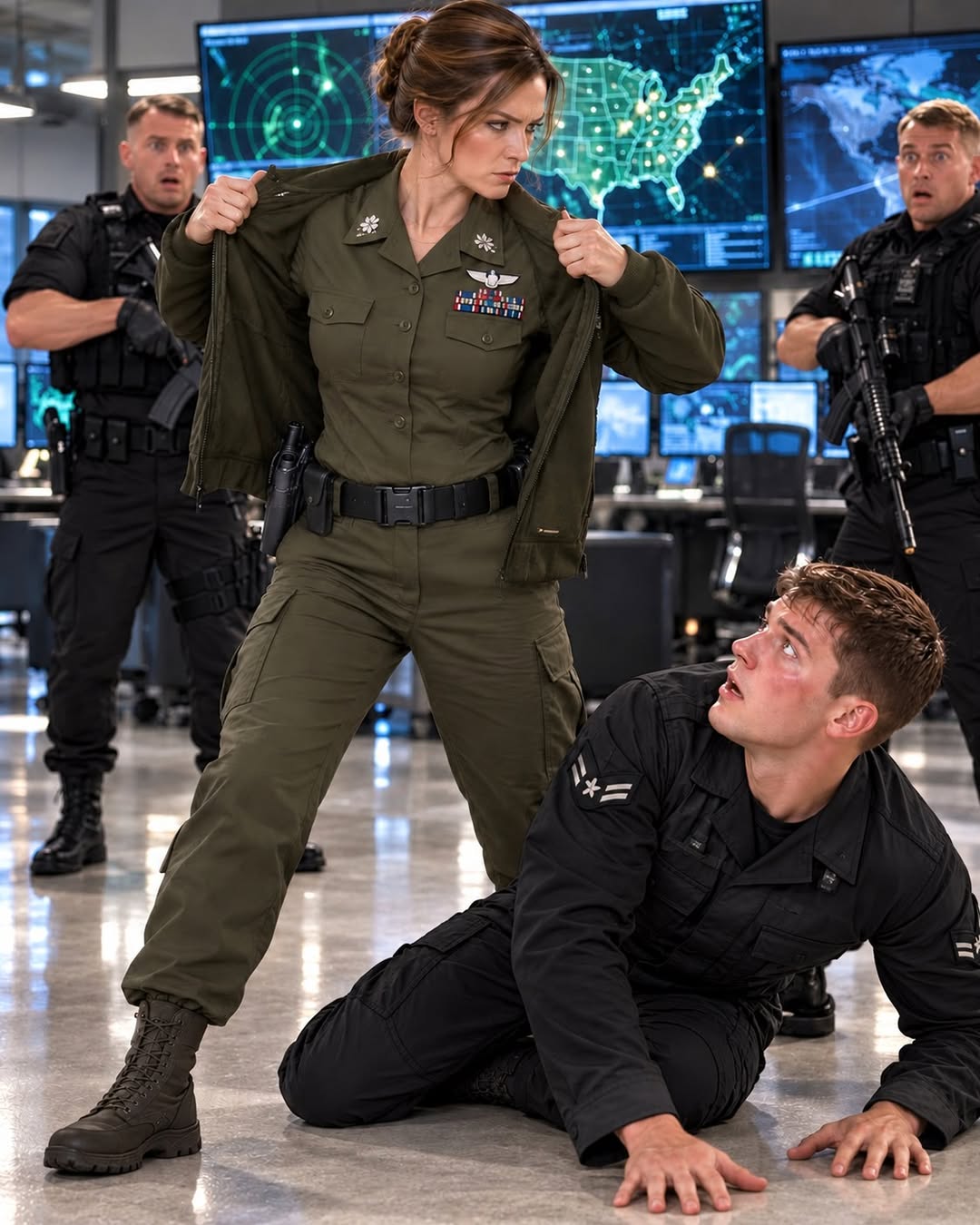
She Told Me to Shine Her Boots—Then Discovered I Was Her New Commander
The microphone clicked beneath my thumb.
“Viper One-One, Overlord. I have you. Maintain your current heading while we confirm your position. Say fuel and aircraft status.”
The response came almost instantly.
“Overlord? Ma’am?”
I knew that voice.
Major Daniel Mercer.
I had guided him through two deployments, three emergency recoveries, and one night neither of us had ever discussed outside a secure briefing room.
“Still with you, Viper,” I said.
There was a fraction of silence.
Then his voice steadied.
“Copy, ma’am. Good to hear you.”
Behind me, Airman First Class Nash stopped pulling at my fleece.
The operations floor went quiet.
Not because the emergency was over.
Because the frightened pilot had recognized the woman Nash had just ordered to shine his boots.
And because the senior controller at the adjacent station had finally looked up.
“Colonel?”
I kept my eyes on the display.
“Not now, Captain. Confirm the track data and coordinate with the supervisor.”
“Yes, ma’am.”
Nash’s hands fell away from my collar.
I did not look at him.
There were two aircraft in danger, and whatever consequences awaited that young man could wait until both pilots were safe.
My name is Colonel Rebecca Hayes.
I was forty-three years old, with twenty years of service in the United States Air Force, and I had spent most of my career working in places where the most important person in the room was rarely the one making the most noise.
An Air Battle Manager learns that early.
The job is not about sounding impressive over a radio.
It is about understanding a rapidly changing situation, communicating clearly, coordinating the people who have the necessary information, and making decisions without allowing fear to spread through the team.
Pilots depend on that discipline.
So do the people working beside you.
And on that particular morning, both were being tested.
The primary display showed two friendly aircraft separated in a rapidly changing tactical picture.
Their radar information was degraded.
The reported threat environment was unstable.
The communications traffic was overlapping badly enough that important calls were being lost beneath repeated transmissions.
Nash had been assigned to a supervised position.
He was not supposed to manage the situation alone.
But the qualified controller overseeing him had stepped away to coordinate with another station, and the handover had not been handled properly.
That was the first problem.
The second was Nash’s panic.
The third was his belief that the woman approaching his console could not possibly have anything useful to contribute.
I could address the third problem later.
The first two required immediate attention.
“Captain Ellis,” I said, “I need the qualified controller back at this station. Have the team verify the current picture and pass confirmed information only.”
“Yes, Colonel.”
“Keep the communications clear.”
“Understood.”
I pressed the microphone again.
“Viper One-One, Overlord. We are coordinating your recovery. Continue reporting changes. Your wingman is being contacted separately.”
“Copy, Overlord.”
His breathing was still heavy.
But he was answering.
That mattered.
I had known Major Mercer since he was a lieutenant.
He had once told me that my voice over the radio sounded like his grandmother telling him everything would be fine.
I had laughed.
“Your grandmother must have been terrifying.”
“She was,” he said. “That’s why I listened.”
Now, hearing him recognize me, I felt the old professional connection settle into place.
Not confidence that everything would end well.
No controller can promise that.
But confidence that we could work the problem together.
The qualified controller returned to the primary station.
I briefed him quickly.
He took over the console under the established procedures while I remained beside him, coordinating with the supervisor and monitoring the developing situation.
Nash stood several feet away.
His face was pale.
His mouth opened twice.
No words came out.
Finally, he whispered, “Colonel?”
I looked at him for the first time.
“Stand clear of the station, Airman.”
He straightened automatically.
“Yes, ma’am.”
“Do not interfere with the operating crew.”
“Yes, ma’am.”
That was all I said.
For the moment.
The next several minutes felt longer than the previous twenty years.
The team coordinated with the appropriate agencies and supporting elements.
The aircraft reported their changing conditions.
Information was checked before it was transmitted.
The radio traffic became more orderly.
At one point, Viper One-One reported that he had regained contact with his wingman.
I closed my eyes for half a second.
Then opened them.
“Copy, Viper. Continue with the recovery instructions from the controlling team.”
“Roger.”
A few minutes later, both aircraft were proceeding toward a safe recovery.
The immediate danger had not vanished all at once.
It diminished in stages.
A confirmed position.
A restored communication.
A stable recovery plan.
Then, finally, the report everyone in that room had been waiting to hear.
Both aircraft had landed safely.
Nobody cheered.
Not immediately.
The operations floor remained busy, and the team still had reporting and follow-up responsibilities.
But Captain Ellis leaned against the adjacent console and released a breath he seemed to have been holding for an hour.
The qualified controller removed his headset.
“Both aircraft recovered, ma’am.”
I nodded.
“Good work. Preserve the records and begin the required review.”
“Yes, Colonel.”
Only then did I turn toward Nash.
He stood rigidly near the back wall.
The young man’s expression had changed from arrogance to dread.
His eyes kept moving toward the black fleece jacket I was still wearing.
I reached for the zipper.
Slowly, I pulled it down.
Beneath it was my uniform blouse.
My rank insignia was visible.
Colonel.
Nash stared.
Then his gaze dropped to the name tape.
HAYES.
His lips parted.
He had apparently seen the name before.
Perhaps on the change-of-command program.
Perhaps on the unit announcement.
Perhaps on the photograph that had been circulated weeks earlier.
Whatever the reason, recognition finally arrived.
And it arrived too late.
“Airman First Class Nash,” I said.
He snapped to attention.
“Ma’am!”
“Who is your immediate supervisor?”
“Technical Sergeant Miller, ma’am.”
“Where is he?”
“At the coordination desk, ma’am.”
“Have him report to the conference room when operationally available.”
“Yes, ma’am.”
I looked toward Captain Ellis.
“Please arrange for Security Forces and the appropriate supervisory personnel to document the physical contact and the disruption at the console.”
Ellis nodded.
“Yes, Colonel.”
Nash swallowed.
“Ma’am, I—”
“Not here.”
He stopped.
I glanced at the clock.
The change-of-command ceremony was now less than twenty minutes away.
My first morning with the unit had already become more memorable than anyone intended.
I had arrived early because I wanted to understand the organization I was about to lead.
Not the polished version presented during a formal tour.
Not the carefully prepared briefing slides.
The real unit.
The people working through the night.
The junior personnel who rarely spoke during command visits.
The supervisors who made difficult decisions when senior leaders were asleep.
I had learned long ago that an organization revealed itself most clearly when it did not believe anyone important was watching.
That morning, I had seen courage.
I had seen professionalism.
I had seen a dangerous supervision gap.
And I had seen a young airman mistake contempt for authority.
My command chief, Chief Master Sergeant Angela Brooks, met me outside the operations room.
She looked at my fleece.
Then at my face.
“I heard.”
I nodded.
“Both aircraft recovered.”
“Thank God.”
“There’s more to discuss.”
“I know.”
She hesitated.
“Are you injured?”
“My ribs are sore. I’ll get checked.”
Her jaw tightened.
“Ma’am, Nash put his hands on you?”
“Yes.”
She took a breath.
“I’ll ensure the matter is documented.”
“Thank you.”
Then I looked at her.
“Chief, I also want the supervision and qualification issues reviewed. This isn’t only about one airman’s behavior.”
She nodded immediately.
“Understood.”
The ceremony proceeded.
I stood beneath the American flag while the outgoing commander delivered his remarks.
The guidon changed hands.
The official orders were read.
And I assumed command.
I looked out at the formation.
Rows of uniforms.
Young faces.
Experienced faces.
People who had spent the night working while others slept.
Nash was among them.
He stood near the rear.
His eyes remained fixed forward.
I did not mention him.
I did not turn the ceremony into a public humiliation.
The unit deserved a commander’s first words that were about the mission, not a personal confrontation.
When it was my turn to speak, I stepped to the podium.
“I’ve spent much of my career working with people whose names never appear in headlines,” I began.
“Controllers, technicians, maintainers, communications specialists, supervisors, and support personnel whose decisions matter long before anyone outside the mission notices.”
I looked across the room.
“Competence is not determined by how loudly someone speaks, how senior they appear, or what assumptions we make when they walk through a door.”
A few people shifted.
I continued.
“Every person on this team must be able to contribute without being dismissed, threatened, or humiliated. We cannot afford to ignore useful information because it comes from someone we have underestimated.”
I paused.
“Respect is not separate from mission readiness. It is part of it.”
After the ceremony, I returned to the operations building.
There were photographs to take.
Briefings to attend.
Senior leaders to greet.
But I had asked Chief Brooks to reserve time for the incident review.
I also went to the medical clinic.
The examination confirmed bruising along my ribs and irritation around my shoulder and collar.
The injuries were documented.
Then I returned to the conference room.
Nash was already there.
Technical Sergeant Miller sat beside him.
Captain Ellis was present.
Chief Brooks had arranged for the appropriate representatives to participate in the preliminary fact-gathering process.
I did not conduct the disciplinary investigation myself.
I was the person Nash had shoved and grabbed.
That mattered.
The process needed to be fair, properly documented, and handled by the appropriate authorities.
But I did want to understand what had happened on the operations floor.
Nash stood when I entered.
“Colonel Hayes.”
I nodded.
“Sit down, Airman.”
He obeyed.
For several seconds, he stared at the table.
Then he said, “Ma’am, I want to apologize.”
I looked at him.
“Tell me what you’re apologizing for.”
His face reddened.
“For putting my hands on you.”
I waited.
“And for what I said.”
“What did you say?”
He swallowed.
“I told you women didn’t belong on the operations floor.”
The room was silent.
“And?”
He looked down.
“I told you to shine my boots.”
I nodded.
“Why?”
He blinked.
“Ma’am?”
“Why did you say that?”
His eyes filled.
“I was scared.”
I looked at him.
“Fear explains why you may have struggled at the console. It does not explain why you decided a woman was beneath you.”
He said nothing.
Technical Sergeant Miller shifted in his chair.
“Colonel, if I may—”
I turned toward him.
“Yes, Sergeant.”
“Nash is inexperienced. He shouldn’t have been left without immediate supervision during that situation.”
“I agree.”
Miller looked relieved.
Then I continued.
“That is a separate failure. It does not excuse his conduct.”
The relief vanished.
“Understood, ma’am.”
Nash finally looked up.
“I thought you were support staff.”
I nodded.
“And if I had been?”
He stared.
I leaned forward.
“If I had been a civilian technician, a cleaner, or a junior enlisted woman assigned to another section, would your behavior have been acceptable?”
His eyes filled.
“No, ma’am.”
“Then my rank is not the reason this matters.”
He looked down.
“Yes, ma’am.”
That was the part I needed him to understand.
He had not simply insulted the wrong woman.
He had insulted a woman because he believed she lacked the authority to make him regret it.
The fact that I was a colonel exposed the behavior.
It did not create the wrongdoing.
The formal review continued over the following weeks.
Witness statements were collected.
The operational records were preserved.
The incident involving physical contact was addressed through the appropriate military processes.
Nash was removed from operational duties pending review and reassessment.
The unit also examined the supervision gap that had left him overwhelmed at the console.
The findings identified failures in handover discipline and oversight.
Corrective training followed.
Procedures were clarified.
Supervisors were held responsible for ensuring that personnel operated within their qualifications and that critical stations were properly covered.
I did not demand that Nash be destroyed.
I did not want a public spectacle.
I wanted the behavior addressed.
I wanted the unit to understand that panic could be trained for, inexperience could be corrected, and misconduct could not be ignored simply because the person responsible was young.
Those were different issues.
They required different responses.
A month later, Major Mercer visited the unit.
He had requested permission to speak with the operations team after the incident.
When he entered the briefing room, he recognized me immediately.
“Colonel Hayes.”
“Major Mercer.”
He smiled.
“Still keeping us out of trouble?”
“Doing my best.”
He looked toward the controllers.
Then his expression became serious.
“I wanted to thank the team.”
He described the confusion he had experienced during the emergency.
The uncertainty.
The difficulty maintaining awareness of his wingman’s position.
The relief of hearing a calm voice on the frequency.
He did not reveal sensitive operational details.
He did not dramatize the event.
He simply explained what clear communication had meant to him.
Afterward, he approached me privately.
“I heard about the airman.”
I nodded.
“It’s being handled.”
He hesitated.
“Are you all right?”
“Yes.”
He looked at me for a moment.
Then said, “You know, I recognized your voice before I recognized the call sign.”
I smiled.
“That’s because you never listen the first time.”
He laughed.
“Fair.”
Then his expression softened.
“Thank you, ma’am.”
I shook his hand.
“Glad you’re home, Major.”
Nash’s future was not decided by one conversation with me.
The formal process determined the consequences of his conduct.
He also underwent additional evaluation before any consideration of returning to operational responsibilities.
When he eventually requested a meeting with me, I agreed.
Chief Brooks attended.
Nash entered carrying a small notebook.
He looked older than he had that morning.
Not physically.
In the way people sometimes look after discovering that the world does not operate according to the assumptions they inherited.
“Colonel,” he began, “I’ve been thinking about what you asked me.”
I waited.
“About whether it would have been acceptable if you were support staff.”
I nodded.
He looked down.
“My mother cleans offices.”
I said nothing.
“She works nights. Sometimes people walk right past her like she isn’t there.”
His voice tightened.
“And I did the same thing.”
I watched him carefully.
He continued.
“I thought being on the operations floor made me important. I thought I could treat someone I assumed was below me however I wanted.”
He swallowed.
“I was wrong.”
I leaned back.
“Airman, understanding that is a beginning. It doesn’t erase what happened.”
“I know, ma’am.”
“You still have to accept the consequences.”
“Yes, ma’am.”
“And if you’re given another opportunity to serve in an operational role, your conduct has to change when nobody senior is watching.”
He nodded.
“Yes, ma’am.”
I did not promise him forgiveness.
I did not promise him a return to the console.
I told him that professional trust was rebuilt through conduct over time.
Then I dismissed him.
The following months brought changes to the unit.
We strengthened mentorship for junior personnel.
We improved supervision during demanding shifts.
We reinforced clear reporting channels.
We held discussions about professional respect, including the treatment of women and civilian staff.
Some people welcomed the changes immediately.
Others were uncomfortable.
That did not surprise me.
Real organizational improvement rarely begins with everyone applauding.
It begins when people recognize that the old way of doing things has created risks they can no longer ignore.
One evening, Chief Brooks found me standing at the back of the operations floor.
I was wearing the same black fleece.
She smiled.
“Trying to surprise them again, ma’am?”
I laughed.
“Not this time.”
We watched the controllers work.
The room was quiet except for the steady rhythm of radio calls and keyboards.
A young female airman approached a station with a folder.
The controller looked up.
Listened.
Asked a question.
Then thanked her.
It was an ordinary interaction.
No ceremony.
No applause.
No dramatic revelation.
And that was exactly why it mattered.
Chief Brooks glanced at me.
“Better?”
I nodded.
“Getting there.”
I still have the fleece jacket.
The collar was damaged during the incident, but I had it repaired.
Sometimes people ask why I kept it.
I tell them it reminds me of an important lesson.
Rank can make people listen.
Authority can make people obey.
But neither guarantees respect.
And neither should be necessary for a person to be treated with dignity.
The young airman thought I was someone he could dismiss.
He looked at my plain black fleece and assumed I had no place on the operations floor.
He told me to shine his boots.
He put his hands on me.
Then he discovered that the woman he had tried to remove was the incoming commander of his unit.
But the most important thing hiding beneath that jacket was not the rank insignia.
It was twenty years of experience.
Twenty years of responsibility.
Twenty years of learning that the mission depended on every qualified person being heard.
That morning, two pilots needed help.
A frightened young airman needed supervision.
And an entire unit needed to remember what professional respect actually meant.
The pilots came home.
The failures were addressed.
And I began my command with a lesson I hoped nobody in that building would forget.
Never decide someone’s worth by the uniform you think they’re wearing.
And never mistake a person’s quietness for a lack of authority.