
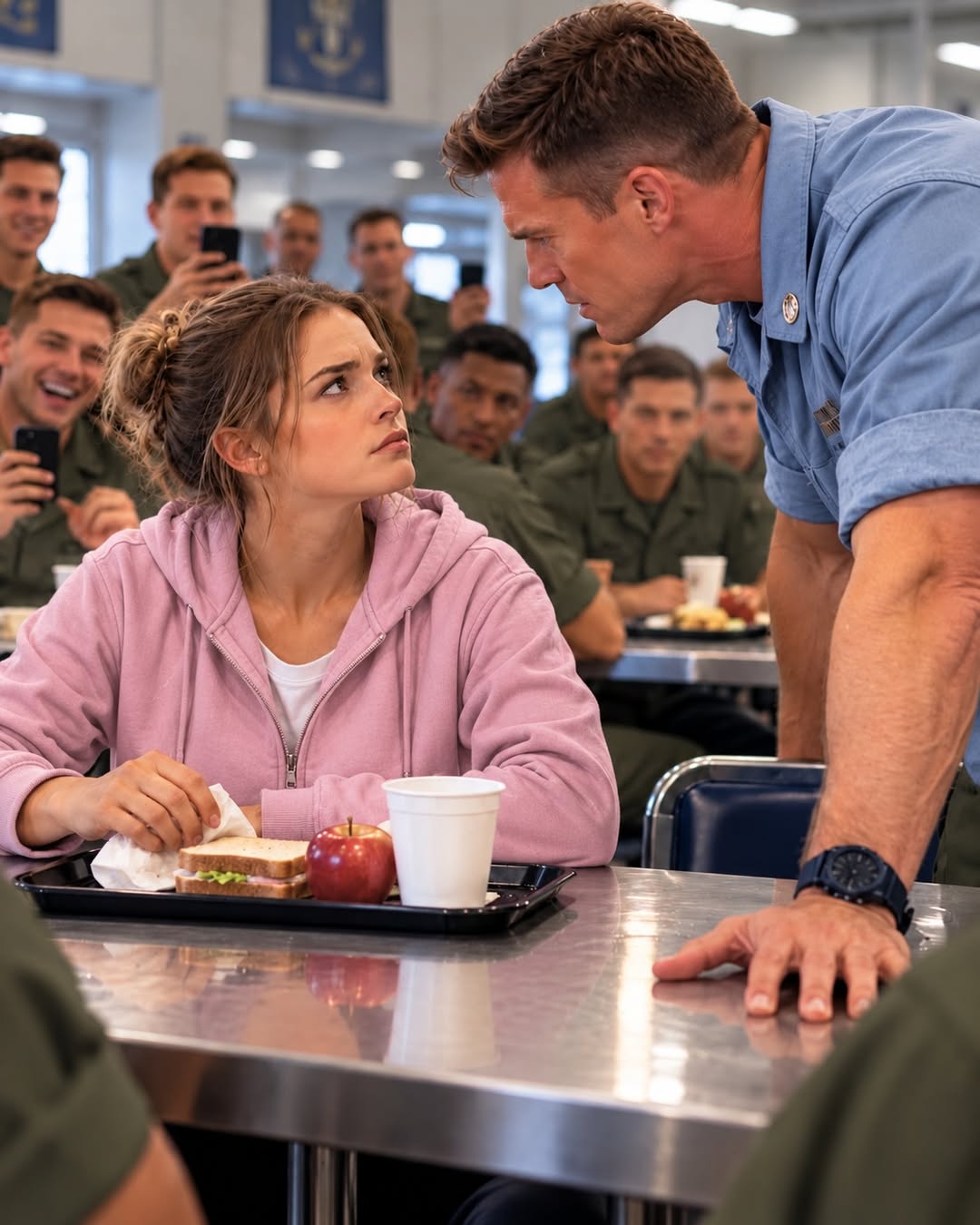
Emily Ross finished wiping the table.
Then she folded the damp napkin into a small square and placed it beside her tray.
Brandon Cole was still smiling when she looked up at him.
“Are you finished?” she asked.
He laughed.
“With what?”
“Making your point.”
A few of the sailors exchanged glances.
Brandon’s smile disappeared.
He wasn’t accustomed to being questioned, especially not in front of his teammates. And he certainly wasn’t accustomed to being questioned by a woman he had already decided was beneath him.
“You’ve got a lot of attitude for someone who doesn’t belong here.”
Emily glanced at the empty chair beside her.
“It’s a cafeteria, Petty Officer Cole. I didn’t realize lunch required a qualification.”
The room became quiet.
Brandon’s expression changed.
He hadn’t introduced himself.
His name was embroidered on his uniform, but Emily had addressed him with the correct rank without looking at it.
For the first time, he seemed to wonder whether he had misunderstood something.
Then Tyler Graves laughed.
“Come on, Brandon. She’s probably been reading the name tags.”
The tension broke.
Brandon leaned forward again.
“Listen carefully. You can either move to another table, or I can make this a very unpleasant afternoon.”
Emily held his gaze.
“I suggest you think carefully about that.”
He smiled.
“Is that a threat?”
“No,” Emily answered. “It’s advice.”
And then, from behind him, a voice cut through the cafeteria.
“Petty Officer Cole. Step away from that table.”
Brandon turned.
Commander Nathaniel Hayes stood near the entrance.
His expression was unreadable.
Beside him were a senior chief petty officer, a civilian woman carrying a leather folder, and a uniformed officer from the installation’s security department.
Brandon straightened instinctively.
“Sir.”
Commander Hayes didn’t acknowledge the greeting.
His eyes moved past Brandon.
They settled on Emily.
Then he said something that made every sailor at the table sit perfectly still.
“Commander Ross, I wasn’t expecting you until fourteen hundred.”
Emily picked up her cup.
“My schedule changed.”
Hayes glanced at the spilled water, the damp napkin, and the phones that were rapidly disappearing into pockets.
His jaw tightened.
“I see.”
Brandon looked from Hayes to Emily.
“Commander?”
Emily stood.
She was still wearing the black hoodie.
She was still holding a cafeteria tray with a half-eaten turkey sandwich and a bruised apple.
But the way everyone looked at her had changed.
And Brandon was about to discover that the woman he had spent the last several minutes humiliating was the officer assigned to evaluate the very program on which his next promotion depended.
Emily Ross had learned a long time ago that people often revealed more about themselves when they believed nobody important was watching.
It was one of the reasons she disliked arriving at a new assignment surrounded by introductions, briefings, and elaborate displays of professional courtesy.
She preferred to observe first.
Listen.
Ask questions.
And understand how people behaved when they weren’t trying to impress someone.
Her arrival at Naval Amphibious Base Coronado had been deliberately low-key.
She had traveled from Virginia the previous evening and was scheduled to begin a formal series of meetings that afternoon.
The assignment involved a review of training procedures, operational readiness, and the way several teams were implementing updated performance and leadership standards.
It was not a mission to catch people making mistakes.
The purpose was to identify weaknesses before they became serious problems.
Emily understood that distinction.
She also understood that no training program could succeed if the people responsible for carrying it out believed their qualifications entitled them to disregard basic standards of conduct.
At thirty-five, Emily had already spent more than a decade in the Navy.
She had begun her career in an operational support specialty before pursuing additional qualifications and accepting increasingly demanding assignments.
Her work had taken her overseas, placed her alongside joint-service teams, and required her to make difficult decisions under pressure.
She had earned a reputation for being thorough and composed.
She wasn’t physically imposing.
She rarely raised her voice.
And she had never been particularly interested in making people afraid of her.
Her colleagues respected her because she did her homework, accepted responsibility for her decisions, and expected the same from everyone around her.
She also understood that rank was not a substitute for competence.
A junior sailor could identify a problem that a senior officer had overlooked.
A civilian employee could possess technical knowledge that an entire operational team lacked.
And an experienced operator could make a serious mistake if he began believing that his achievements placed him above ordinary rules.
Those principles had shaped her approach to leadership.
They were also the reason the cafeteria incident disturbed her.
Not because Brandon had failed to recognize her.
But because he had decided that someone he considered unimportant was an acceptable target.
Commander Hayes approached the table.
“Commander Ross, are you all right?”
Emily nodded.
“I’m fine.”
His eyes moved toward Brandon.
“What happened here?”
Brandon opened his mouth.
“Sir, there was a misunderstanding.”
Emily looked at him.
“A misunderstanding?”
Brandon swallowed.
“I didn’t realize she was an officer.”
Hayes’s expression hardened.
“That wasn’t my question.”
The cafeteria had become almost completely silent.
Even the sailors at nearby tables were listening.
Brandon shifted his weight.
“Sir, I was just explaining that this table is normally used by our team.”
Emily spoke before Hayes could respond.
“Is there a written policy reserving this table?”
Brandon hesitated.
“No, ma’am.”
“Was the cafeteria at capacity?”
“No, ma’am.”
“Did I interfere with your meal or prevent anyone from sitting?”
“No, ma’am.”
Emily nodded.
“Then let’s be accurate about what happened.”
She turned toward Hayes.
“Petty Officer Cole approached me while I was eating. He told me the table wasn’t for office staff, made several comments about my appearance, and instructed me to move. Petty Officer Graves deliberately knocked my cup, spilling water onto my tray.”
Tyler’s face went pale.
Emily continued.
“Several sailors laughed. At least two appeared to record the interaction. I asked whether Cole was giving me an order, and he acknowledged that he had no authority to do so.”
Hayes looked at Brandon.
“Is that accurate?”
Brandon stared at the floor.
“Sir, we were joking.”
Emily’s expression didn’t change.
“I didn’t find it funny.”
Nobody laughed.
Hayes turned toward the senior chief beside him.
“Senior Chief Miller, please identify everyone directly involved and make sure the relevant information is preserved. We’ll address this through the appropriate command process.”
Miller nodded.
“Aye, sir.”
Then Hayes looked at the sailors holding their phones.
“Anyone who recorded the incident will preserve the original recording. Do not delete, edit, or distribute it while the matter is being reviewed.”
Several men shifted uncomfortably.
Hayes turned back to Emily.
“Commander, we can move somewhere private.”
She glanced at her tray.
“I’d prefer to finish my lunch.”
For a moment, Hayes looked surprised.
Then he nodded.
“Of course.”
Emily sat down.
She picked up her sandwich.
And the commander, the senior chief, and the security officer stepped away to begin addressing what had happened.
Brandon remained standing for several seconds.
Then Miller instructed him and Tyler to accompany him.
The two men left without speaking.
The cafeteria slowly returned to its normal rhythm.
Forks scraped plates.
Chairs moved.
And conversations resumed in cautious, subdued voices.
Emily ate the rest of her sandwich.
She drank her water.
Then she picked up the bruised apple.
A young sailor approached her table.
He looked nervous.
“Ma’am?”
Emily glanced up.
“Yes?”
He was a seaman named Lucas Bennett.
He had been sitting two tables away during the confrontation.
“I just wanted to apologize.”
Emily set down the apple.
“For what?”
Lucas hesitated.
“I saw what happened. I knew it was wrong, but I didn’t say anything.”
She studied him.
“Why not?”
He looked toward the cafeteria entrance.
“Cole’s one of the senior guys. People don’t like getting on his bad side.”
Emily nodded.
“Has this happened before?”
Lucas didn’t answer immediately.
Then he said, “Not exactly like that.”
“What do you mean?”
He took a breath.
“Sometimes people get singled out. New guys. Support personnel. Anyone who doesn’t fit in.”
Emily listened.
Lucas continued.
“Usually, everyone just laughs because they don’t want to be next.”
She nodded slowly.
“Thank you for telling me.”
He looked surprised.
“That’s it?”
“For now. If you have information relevant to the incident, Senior Chief Miller can explain how to provide it through the appropriate process.”
Lucas nodded.
Then he glanced at her tray.
“Do you need anything, ma’am?”
Emily smiled faintly.
“No, Bennett. I’ve got everything I need.”
At two o’clock, Emily entered the conference room for her scheduled briefing.
She had changed into her uniform.
Her hair was neatly secured.
And her expression was as composed as it had been in the cafeteria.
Commander Hayes stood at the front of the room.
Several senior officers and enlisted leaders were seated around the table.
Brandon Cole and Tyler Graves were not present.
Hayes greeted her.
“Commander Ross, thank you for coming.”
Emily nodded.
“Thank you for having me.”
He gestured toward an empty chair.
“Before we begin, I want to address what happened earlier.”
Emily sat.
“Go ahead.”
Hayes took a breath.
“The incident is being reviewed. The personnel involved have been directed to provide statements, and we are preserving the available evidence.”
Emily nodded.
“Good.”
He hesitated.
“I also want to apologize on behalf of the command.”
She looked at him.
“I appreciate that, Commander. But I don’t want the response to depend on my rank.”
Hayes nodded.
“I understand.”
Emily leaned forward.
“If I had actually been an administrative assistant, would anyone have intervened?”
Nobody answered.
She continued.
“If I had been a civilian contractor, would the incident have been dismissed as harmless joking? If I had been a junior sailor, would I have felt safe reporting it?”
Hayes looked down at the table.
Those were uncomfortable questions.
But they were the questions Emily believed mattered.
The briefing proceeded.
The team presented training schedules, readiness reports, personnel evaluations, and recent performance assessments.
Emily asked detailed questions.
She examined documentation.
And she listened carefully to the explanations provided.
She didn’t allow the cafeteria incident to distract her from the technical purpose of the visit.
But she also didn’t ignore it.
Leadership and organizational culture were part of the review.
And what she had witnessed during lunch was relevant to both.
By the end of the afternoon, Emily had identified several areas that required closer examination.
Some involved training documentation.
Others concerned communication between operational personnel and support departments.
She also wanted to understand how complaints were handled and whether junior personnel believed they could raise concerns without retaliation.
Commander Hayes agreed to provide the necessary records and arrange appropriate interviews.
As the meeting ended, he approached Emily.
“Commander, may I ask you something?”
She nodded.
“Of course.”
“Did you know who Cole was before today?”
Emily considered the question.
“I knew his name was on the personnel roster.”
Hayes looked thoughtful.
“Did you sit at that table to test him?”
“No.”
“Then why that table?”
Emily smiled faintly.
“Because it had an empty chair.”
That answer troubled Hayes more than he expected.
He had spent years developing training programs and maintaining high performance standards.
He knew that demanding environments could create intense pressure.
He also knew that close teams sometimes developed habits and traditions that outsiders didn’t understand.
But the cafeteria incident had not involved a harmless tradition.
It involved a group of experienced sailors using their status to humiliate someone they believed had less authority than they did.
And it had happened in public.
In front of people who had apparently learned that remaining silent was safer than objecting.
Hayes understood that the problem might extend beyond Brandon and Tyler.
The following morning, Senior Chief Miller began conducting interviews.
He spoke with the sailors who had been seated at the table.
He reviewed the available recordings.
And he collected statements from witnesses.
The footage was clear.
Brandon had approached Emily aggressively.
He had repeatedly told her to move.
Tyler had deliberately knocked her cup.
And several sailors had laughed while others recorded the interaction.
The recordings also showed something that troubled Miller.
At least three men had looked uncomfortable.
One had briefly opened his mouth as though he intended to speak.
But none had intervened.
Miller had served in the Navy for more than twenty years.
He understood the importance of trust within a team.
And he knew that trust could be damaged when people believed that challenging misconduct would make them targets.
During his interview, Brandon initially insisted that he had been joking.
He said Emily had misunderstood the team’s humor.
He argued that nobody had intended to hurt her.
Miller listened.
Then he asked a simple question.
“Would you have behaved the same way if you had known she was a commander?”
Brandon hesitated.
“No, Senior Chief.”
Miller nodded.
“Then you understood that the behavior was inappropriate. You simply believed she didn’t have enough authority to challenge you.”
Brandon looked down.
For the first time, he had no immediate answer.
Tyler’s interview was similar.
He admitted that he had knocked Emily’s cup deliberately.
He said he had been trying to make the others laugh.
When Miller asked why he had chosen to humiliate someone who was eating lunch, Tyler shrugged.
“I don’t know. Everyone was doing it.”
Miller looked at him.
“Everyone wasn’t doing it. You made a choice.”
Tyler fell silent.
The command’s review expanded beyond the incident itself.
Several junior sailors described occasions when they had been mocked for asking questions or making mistakes.
Civilian support personnel reported that some operational team members treated them dismissively.
Not everyone had experienced those problems.
Many described positive working relationships and strong leadership.
But the accounts were consistent enough to warrant attention.
The command began examining whether its informal culture had allowed certain individuals to behave in ways that contradicted its stated standards.
Emily continued her technical review.
She spent time observing training.
Met with personnel from several departments.
And examined how information moved between teams.
She was impressed by much of what she saw.
The sailors were highly skilled.
Their training was demanding.
And many demonstrated extraordinary professionalism.
But she also noticed that some junior personnel were reluctant to raise concerns in front of senior teammates.
They waited until meetings ended.
Then they approached her privately.
One young sailor told her that he had identified a recurring problem with a piece of equipment but had been hesitant to report it because he expected to be ridiculed.
Emily asked whether he had documented the issue.
He nodded.
“Then let’s make sure the right people review it.”
The problem was eventually evaluated through the appropriate technical channels.
It wasn’t a catastrophic failure.
But it was exactly the kind of issue that needed to be identified early.
Emily made a note in her report.
A team that discouraged questions could miss important information.
And in demanding operational environments, that could have serious consequences.
Three days after the cafeteria incident, Brandon requested an opportunity to speak with Emily.
She agreed to a meeting with Senior Chief Miller present.
Brandon entered the room looking uncomfortable.
He stood at attention.
“Commander Ross.”
Emily nodded.
“Petty Officer Cole.”
He took a breath.
“I wanted to apologize for what happened in the cafeteria.”
She waited.
He continued.
“I was disrespectful. I made assumptions about who you were, and I behaved in a way that was inappropriate.”
Emily studied him.
“Why did you make those assumptions?”
Brandon hesitated.
“Because you were wearing civilian clothes.”
She nodded.
“And?”
He looked down.
“Because I thought you were someone who couldn’t do anything about it.”
The room became quiet.
Emily leaned back.
“That is the part you need to think about.”
Brandon nodded.
“I understand, ma’am.”
“Do you?”
He looked up.
She continued.
“You didn’t disrespect me because you failed to recognize my rank. You disrespected me because you believed I didn’t have one.”
Brandon swallowed.
“Yes, ma’am.”
Emily allowed the silence to settle.
Then she said, “You have a reputation for being a capable operator. Your records show that you’ve performed well in demanding circumstances.”
Brandon straightened slightly.
“But competence in one area doesn’t excuse misconduct in another.”
His expression changed.
Emily continued.
“People look to experienced personnel for examples of how to behave. When you humiliate someone, you teach the people watching that humiliation is acceptable. When you use your position to intimidate others, you make it harder for them to speak up when something is wrong.”
Brandon looked at the floor.
“I didn’t think about it that way.”
“I believe you.”
He looked up.
“And that’s part of the problem.”
Brandon apologized again.
Emily acknowledged the apology.
But she made clear that the command would determine any administrative or disciplinary consequences through its established procedures.
She would not promise that the matter would disappear.
And she would not use her position to demand a particular punishment.
Her responsibility was to provide accurate information and carry out her assigned review.
The command’s responsibility was to address the conduct fairly.
The review eventually resulted in formal administrative action for Brandon and Tyler.
The specific measures reflected their conduct, service records, and the applicable procedures.
Their leadership also required them to complete additional training and demonstrate sustained improvement.
Other personnel involved in the incident received appropriate counseling or corrective action based on their individual roles.
The command introduced several changes intended to strengthen reporting channels and reinforce expectations for professional conduct.
Emily considered those steps necessary.
But she also knew that a policy memorandum alone could not change a culture.
That required consistent leadership.
Several weeks later, Emily returned to Coronado for a follow-up visit.
She arrived on a Monday morning.
This time, her schedule included meetings with the command leadership, training personnel, and representatives from several support departments.
At noon, she went to the cafeteria.
She was wearing her uniform.
The room was crowded.
She collected a tray and looked for somewhere to sit.
There was an empty chair at the same table where the incident had occurred.
She approached it.
Before she could ask whether the seat was available, a young sailor moved his bag.
“Ma’am, you’re welcome to sit here.”
Emily smiled.
“Thank you.”
She sat down.
The conversation at the table was ordinary.
Someone complained about the weather.
Another sailor discussed an upcoming training exercise.
A third asked whether anyone had seen the previous night’s baseball game.
Emily ate her lunch.
She didn’t make a speech.
She didn’t mention the earlier incident.
And she didn’t expect anyone to treat her differently because of her rank.
But she noticed something.
At a nearby table, a civilian employee was struggling to balance a tray while searching for an empty chair.
A young sailor stood.
He moved his belongings and gestured toward the open seat.
“There’s room here.”
The employee smiled.
“Thanks.”
It was a small moment.
Nobody applauded.
Nobody recorded it.
And nobody seemed to think it was remarkable.
Emily considered that a good sign.
Later that afternoon, she met with Commander Hayes.
He provided an update on the corrective actions and the command’s ongoing efforts to improve communication and professional standards.
Emily reviewed the information.
She asked questions.
And she noted areas that still required attention.
Hayes was candid.
Some personnel had responded positively.
Others believed the command was overreacting to a single incident.
Emily wasn’t surprised.
Organizational change rarely happened without resistance.
But she appreciated that Hayes was addressing the issue rather than pretending it had disappeared.
As the meeting ended, Hayes asked whether Emily believed the command was moving in the right direction.
She considered the question.
“I’ve seen constructive steps,” she said. “The important thing is whether those standards are applied consistently after the attention fades.”
Hayes nodded.
“We intend to make sure they are.”
Emily closed her folder.
“Then keep listening to the people who are least comfortable speaking.”
Brandon’s life had also changed.
The administrative action affected his immediate career plans.
His next advancement was delayed while he addressed the consequences of his conduct and demonstrated that he could meet the expectations placed on him.
At first, he was resentful.
He believed that one bad afternoon had overshadowed years of hard work.
But during the following months, he began recognizing that the incident had exposed a pattern he had previously refused to examine.
He had become accustomed to using ridicule as a way to establish dominance.
He had confused being feared with being respected.
And he had surrounded himself with people who laughed at his behavior rather than challenging it.
Senior Chief Miller assigned him responsibilities that required closer cooperation with personnel outside his immediate team.
Brandon worked with logistics specialists, administrative staff, and junior sailors.
At first, he found the assignment frustrating.
He considered much of the work routine.
But he gradually began understanding how many people contributed to the success of an operation.
Equipment didn’t appear by magic.
Schedules didn’t organize themselves.
Medical support, transportation, maintenance, communications, and administrative coordination all required skilled people doing their jobs correctly.
And when those people were treated dismissively, the entire organization suffered.
One afternoon, Brandon was reviewing a supply request with a young civilian employee named Rachel Kim.
He became irritated when she explained that a particular item could not be delivered by the date he wanted.
He started to raise his voice.
Then he stopped.
Rachel looked at him cautiously.
Brandon took a breath.
“Sorry. Let me ask that differently.”
He explained the operational requirement.
Rachel reviewed the available options and identified an alternative that met the team’s needs.
The problem was resolved.
It wasn’t a dramatic transformation.
But it was a different choice.
And over time, those choices began to matter.
Tyler Graves had a more difficult time accepting responsibility.
He initially blamed Brandon.
He claimed that he had simply followed the mood of the table.
But the review made clear that Tyler had acted independently when he knocked Emily’s cup.
He had chosen to participate.
Eventually, he acknowledged that.
He began working on his own behavior.
The process was uneven.
There were setbacks.
But his leaders required him to demonstrate improvement through his actions rather than his explanations.
Lucas Bennett, the young sailor who had apologized to Emily, also changed.
He became more willing to speak up when he saw something inappropriate.
He didn’t become confrontational.
He simply stopped assuming that silence was always the safest option.
During a later training discussion, he raised a concern about a procedure that several more experienced sailors had accepted without question.
His observation prompted a useful review.
Senior Chief Miller thanked him for speaking.
And Lucas began understanding that professionalism sometimes required the courage to ask an uncomfortable question.
Six months after the cafeteria incident, Emily received an update from Commander Hayes.
The command had completed its follow-up actions.
Several reporting procedures had been clarified.
Leadership training had been expanded.
And personnel surveys suggested that more sailors and civilian employees understood how to raise concerns.
The results weren’t perfect.
But they indicated progress.
Emily read the report carefully.
Then she sent a brief response.
She thanked Hayes for the update and encouraged the command to continue measuring whether the changes were effective.
She didn’t mention Brandon by name.
Her assignment had never been about one man.
It had been about the standards an organization expected its people to uphold.
Nearly a year later, Emily returned to Coronado for another professional engagement.
She arrived early and stopped at the cafeteria before her first meeting.
The room was busy.
She collected coffee and a sandwich.
Then she looked for an empty table.
“Commander Ross?”
She turned.
Brandon Cole was standing a few feet away.
He looked surprised to see her.
Emily nodded.
“Petty Officer Cole.”
He hesitated.
Then he gestured toward a nearby table.
“There’s an empty seat over here, ma’am.”
Emily looked at the table.
Several sailors were eating lunch.
She recognized Tyler among them.
For a moment, she considered sitting elsewhere.
Then she nodded.
“Thank you.”
The conversation was polite.
Brandon didn’t try to impress her.
He didn’t make exaggerated apologies.
And he didn’t expect her to congratulate him for behaving appropriately.
They discussed training, recent assignments, and the challenges of working across departments.
At one point, a civilian employee approached the table to ask Brandon a question about an equipment request.
He listened carefully.
Then he explained what information the employee needed.
The exchange was ordinary.
But Emily noticed that he didn’t interrupt, mock, or dismiss the person speaking to him.
When the employee left, Brandon returned to his lunch.
Emily said nothing.
She didn’t need to.
As she prepared to leave, Brandon stood.
“Commander?”
She looked at him.
“Yes?”
He took a breath.
“I’ve thought a lot about what you said that day.”
Emily waited.
He continued.
“About how I treated you because I thought you couldn’t do anything about it.”
She nodded.
“I remember.”
He looked down.
“I used to think respect was something people had to earn from me.”
Emily studied him.
“And now?”
He took a moment before answering.
“I think basic respect is something I should give people before I know anything about them.”
Emily smiled faintly.
“That’s a useful distinction.”
Brandon nodded.
“I’m still working on it.”
She picked up her folder.
“Most of us are.”
Emily left the cafeteria and walked toward her next meeting.
Outside, the California sunlight reflected off the pavement.
A cool breeze moved across the installation.
And the ordinary sounds of a working naval base surrounded her.
She thought about the first afternoon.
The spilled water.
The laughter.
The phones.
And the way Brandon had leaned over her, convinced that her silence meant she was afraid.
She also remembered the sailors who had looked uncomfortable but remained quiet.
The young man who had eventually apologized.
And the commander who had been willing to examine a problem within his own organization.
The incident had been unpleasant.
But it had revealed something important.
Professional standards mattered most when they were applied to people who lacked the power to demand them.
Emily had spent years working in environments where competence, trust, and accountability were essential.
She knew that no organization was perfect.
People made mistakes.
Leaders overlooked problems.
And even highly trained professionals could develop habits that undermined the values they claimed to uphold.
But she also believed people could change.
Not because someone delivered an impressive speech.
Not because a policy was posted on a wall.
And not because an officer with a higher rank demanded obedience.
Real change required people to recognize their choices, accept responsibility, and behave differently when nobody was watching.
The cafeteria incident had begun with a simple sentence.
“That seat is taken.”
Brandon had spoken those words because he believed he controlled who belonged at the table.
He had looked at Emily’s black hoodie, plain lunch, and quiet manner and decided that she was unimportant.
He had mistaken appearance for identity.
Silence for weakness.
And his own qualifications for permission to humiliate someone else.
But the moment Commander Hayes recognized Emily, Brandon discovered that the person he had dismissed possessed authority he hadn’t anticipated.
That revelation frightened him.
It also exposed the central problem with his behavior.
He had been prepared to show respect only when he believed someone had enough power to punish him.
Emily never wanted the incident remembered as a story about a powerful officer humiliating an arrogant sailor.
She wanted it remembered as a lesson about the danger of deciding that some people deserved less dignity than others.
Brandon believed the table belonged to him because he was part of an elite team.
He believed Emily didn’t belong because she was wearing civilian clothes and appeared to have no authority.
He encouraged others to laugh at her, allowed the situation to escalate, and treated her calm responses as an invitation to continue.
But when Commander Hayes entered the cafeteria, the assumptions supporting Brandon’s behavior collapsed.
The quiet woman in the black hoodie was Commander Emily Ross, an experienced naval officer assigned to review the program in which Brandon served.
The command investigated the incident, addressed the conduct through the appropriate procedures, and examined the broader problems it had exposed.
Brandon and Tyler faced consequences for their choices. Other personnel were reminded of their responsibilities. And the command began taking steps to strengthen its professional culture.
Over time, Brandon learned that respect wasn’t a reward he could reserve for people who impressed him. It was a basic standard he was expected to uphold in every interaction.
Emily learned something too.
She saw that an uncomfortable incident could reveal weaknesses that formal reports and carefully prepared briefings might never capture.
And she was reminded that the most important measure of leadership wasn’t how people behaved in front of senior officers.
It was how they treated others when they believed nobody important was watching.
A year after Brandon slammed his palm beside Emily’s lunch tray, she returned to the same cafeteria and sat at the same table.
This time, nobody questioned whether she belonged.
But the real change wasn’t that everyone knew her rank.
It was that the people around her were beginning to understand that a person’s right to be treated with dignity should never have depended on rank in the first place.