
The notebook had a blue fabric cover. That detail stayed with me. Not black. Not leather. Not something sinister. Blue. The kind of notebook someone might use for grocery lists, recipes, or church notes. Detective Harris placed it on the table between us. My son was asleep in the hospital bed behind the curtain.
For the first time in hours, his face looked peaceful. I kept my voice low. “What’s in it?” Harris did not open it immediately. “We’re still processing it.” “You said my mother documented punishments.” “She did.” “How many?” His eyes met mine. “Enough that I don’t want you hearing all of it at once.”
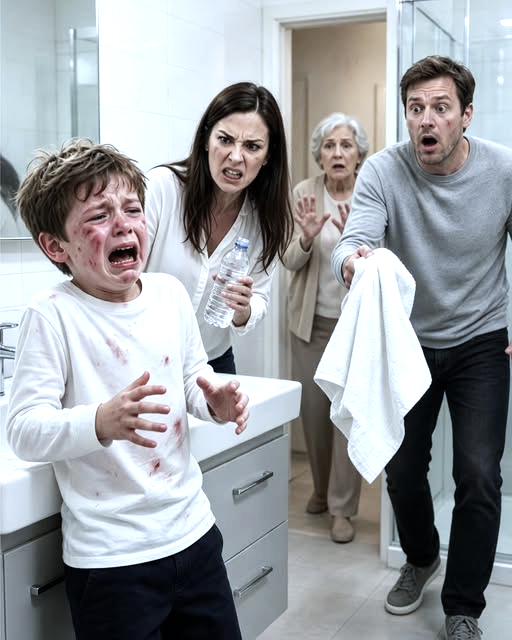
I stared at him. “I’m his father.” “I know.” “Then tell me.” He exhaled. The nurse had already warned me that shock can make people feel unnaturally calm. I understood now. My hands were steady. My voice was steady. Inside, I felt as if my entire life had broken loose from its foundation. Harris opened the notebook.
The handwriting was unmistakable.
My mother’s.
Neat.
Slanted.
Careful.
Dates down the left margin.
Then short phrases.
Talking back — 12 minutes laundry room.
Wouldn’t finish peas — no blanket.
Crying for father — cold shower.
I stopped breathing.
“What does that mean?”
Harris closed the notebook halfway.
“No.”
I reached for it.
“What does that mean?”
“We don’t know yet.”
“You just read it.”
“We know what it says.”
“We do not yet know exactly what happened on every date.”
That distinction mattered.
I hated him for making it.
I needed him to keep making it.
He continued.
“There are entries over roughly eight months.”
Eight months.
I had been working overtime for eight months.
Exactly eight.
My company had won a contract that required evening shifts.
I had been proud.
More money.
Better health insurance.
A chance to replace our old car.
All the practical things a father tells himself are proof he is taking care of his family.
While I worked, my son was apparently being punished for missing me.
I whispered:
“Why would she write this down?”
Harris looked at the notebook.
“That’s one of our questions.”
I knew my mother.
She recorded everything.
Birthdays.
Bills.
Blood pressure.
Miles driven.
She once kept a notebook listing every time my father forgot to take out the trash.
He died twenty years ago still insisting he had taken it out more than she claimed.
Mom believed records meant order.
Evidence.
Proof that her version of life was the correct one.
Maybe that was why.
Or maybe there was something worse.
My wife, Natalie, was taken to the station that night.
So was my mother, Elaine.
Neither was formally charged immediately.
They were questioned.
Separated.
The house was photographed.
The laundry room.
Bathroom.
My son’s bedroom.
Kitchen.
A hallway closet.
Officers collected the alcohol bottle.
The trash bag Natalie had tried to remove.
Inside it were more notebooks.
Not one.
Four.
My stomach dropped when Harris told me.
“Four?”
“Three older ones and the current one.”
“How far back?”
He paused.
“Almost two years.”
My son was six.
Two years meant four.
I sat down.
Harris continued.
“The notebooks don’t necessarily prove everything written happened exactly as described.”
“Stop saying that.”
He remained calm.
“I won’t.”
I looked at him.
“I need you to.”
“You need me to be careful.”
My eyes burned.
He was right.
Again.
I hated careful.
Careful felt like disrespect when the person you love is hurt.
But careless truth becomes another kind of lie.
My son’s name was Noah.
I had avoided saying it all night.
As though naming him would make the horror more real.
Noah woke just before sunrise.
He looked around.
Then saw me.
“Dad?”
“I’m here.”
His eyes moved toward the door.
“Is Mom here?”
“No.”
“Grandma?”
“No.”
He relaxed.
That hurt more than fear would have.
“Can we go home?”
I swallowed.
“Not tonight.”
He frowned.
“Why?”
“Doctors want to keep checking you.”
“Am I in trouble?”
That sentence broke something in me.
“No.”
My voice cracked.
“Noah, listen to me.”
He stared.
“You are not in trouble for anything you told me.”
“What if I tell more?”
“You are still not in trouble.”
“What if it’s bad?”
“You are not in trouble.”
His lip trembled.
“Mom says families don’t tell private things.”
I moved closer.
“Some things are private.”
“Like changing clothes.”
“Or a surprise birthday gift.”
“But when somebody hurts you or scares you, you are allowed to tell.”
“Even if it’s family.”
He looked down.
“Grandma says cops take kids away.”
I had to breathe before answering.
“Sometimes adults make things sound scary so children will stay quiet.”
“Am I going somewhere?”
“You’re coming with me.”
His eyes lifted.
“Just you?”
“Yes.”
He started crying.
Not loud.
Small tears.
Then:
“Can we get pancakes?”
I laughed through my own tears.
“Yes.”
That was the first promise I made that morning I knew I could keep.
We did not go back to our house.
Child protective services and police advised against it until the scene processing was complete and a safety plan existed.
I took Noah to my sister Rachel’s apartment.
Rachel lived forty minutes away.
She had never liked Natalie.
I had always thought it was personality.
Later I learned it was observation.
She opened the door at 7:22 a.m.
Saw Noah’s face.
Then looked at me.
“What happened?”
“Not in front of him.”
She nodded immediately.
No questions.
No gasps.
No:
I knew it.
That was one of the kindest things anyone did.
She crouched.
“Hey, buddy.”
Noah stared.
“You have cereal?”
Rachel smiled.
“I have the terrible sugary kind your dad hates.”
Noah looked at me.
I nodded.
“Today, I have no nutritional standards.”
He almost smiled.
That almost destroyed me.
After Noah went to sleep on Rachel’s couch, I told her.
Not every detail.
Enough.
She covered her mouth.
Then asked:
“How long?”
“I don’t know.”
“She kept notebooks.”
Rachel closed her eyes.
“What?”
“You knew?”
“No.”
She sat.
Then:
“I knew Mom was harsh.”
“Harsh is yelling.”
“This…”
“I know.”
She looked at me.
“Natalie too?”
“Yes.”
Rachel started crying.
I stared.
“Why are you crying like you expected something?”
She looked up.
“Because six months ago, Noah told me he hated laundry day.”
My stomach tightened.
“What?”
“I thought he meant folding clothes.”
“What exactly did he say?”
Rachel tried to remember.
“He said, ‘Laundry room is for bad boys.’”
I stood.
“You didn’t tell me?”
“I asked Natalie.”
My skin went cold.
“What did she say?”
“That they used the laundry room for time-outs.”
I stared.
“And you believed her.”
Rachel flinched.
“Yes.”
I turned away.
Anger rose.
Unfair.
Easy.
Useful.
I wanted somebody else to blame.
Rachel whispered:
“I should have told you.”
I looked at her.
“Yes.”
She nodded.
Then I saw her face.
Guilt.
Fear.
Exactly what I had been carrying.
I sat back down.
“So should I have noticed things.”
Rachel cried harder.
“That doesn’t make it okay.”
“No.”
“But if we spend all our energy deciding which safe adult failed fastest, we’re doing their work for them.”
She stared.
Then nodded.
That became our rule.
Accountability without cannibalism.
The first real break in the case came from the trash bag.
Natalie had not been trying to throw away clothes.
She had been trying to remove the older notebooks.
Three of them.
Inside the same bag were printed pediatric discharge papers.
Not from our regular doctor.
An urgent-care clinic across town.
Date:
Ten months earlier.
Reason for visit:
Bruising, left forearm.
I had never known.
The note said Natalie reported Noah fell from playground equipment.
The clinician documented a contusion.
No fracture.
No mandated report because the history was not obviously inconsistent and Noah apparently said little.
Next paper.
Another clinic.
Six months earlier.
Minor burn, right palm.
Cause reported:
Touched a hot baking tray.
I remembered that.
Natalie called me at work.
I offered to come home.
She said:
“No need.”
When I got home, his hand was wrapped.
I kissed his forehead.
He said:
“I’m okay.”
I believed him because I needed to.
The notebook entry for that day read:
Took cookies after being told no — hand lesson.
I vomited in Rachel’s sink.
Detective Harris called me that afternoon.
“We need you to come in.”
“Why?”
“Without Noah.”
My heart dropped.
“Is he in danger?”
“He’s safe.”
“Then what?”
“Please come.”
I hated that phrase.
I went.
Harris and a woman from the prosecutor’s office sat across from me.
She introduced herself as Assistant District Attorney Maya Chen.
No dramatic pile of evidence.
One file.
One tablet.
Chen said:
“We want to walk you through what we know and what we do not.”
I nodded.
Harris started.
“The alcohol incident was not the first event.”
“I know.”
“Your mother appears to have tracked discipline methods.”
“Why?”
“We’re developing a clearer answer.”
He turned the tablet.
A photograph of one notebook page.
At the top:
PROGRAM
Below it:
Noise
Food
Privacy
Cold
Waiting
My stomach turned.
“What is this?”
Harris said:
“Your mother describes these as categories.”
“Categories of what?”
“Consequences.”
I stared.
“She made a system?”
“It appears so.”
Chen spoke.
“We need to be precise.”
“Some entries describe punishments that may be legally abusive.”
“Some may be harsh but not criminal standing alone.”
“Some are ambiguous.”
“We’re corroborating.”
I looked at the list again.
Cold.
Waiting.
Privacy.
“What does privacy mean?”
Harris said:
“We think it means removing bedroom-door privileges.”
I closed my eyes.
Noah’s bedroom door had been removed for three weeks last winter.
Natalie told me the hinge broke.
I bought a new hinge.
Then got called into work.
By the time I came home, the door was back.
I had forgotten.
I whispered:
“I fixed that door.”
Harris waited.
“I saw it.”
“What?”
“The door was off.”
I pressed my palms against my eyes.
“They told me the hinge broke.”
“Did Noah say anything?”
“No.”
“Did you ask him?”
“No.”
The word felt like a confession.
Chen leaned forward.
“Mr. Bennett.”
I looked at her.
“Do not turn hindsight into evidence that you consented.”
“I lived there.”
“Yes.”
“And the evidence we have so far suggests deliberate concealment happened when you were absent.”
My voice rose.
“I lived there.”
“I understand.”
“No.”
“You don’t.”
“My son learned to stop crying in his own house.”
Silence.
Then Chen said:
“You cannot prosecute yourself into being a better father.”
I stared.
“Help us protect him now.”
That was the only direction available.
So I took it.
The deeper reason behind the notebooks emerged from my mother’s interview.
At first, Elaine said everything was “discipline.”
Then officers showed her the recording.
If your father finds out, we’ll say you fell.
She denied remembering.
Then they showed her notebook entries.
Then clinic records.
Then Natalie’s texts.
That was where the case changed.
Natalie and my mother had been texting each other constantly while I worked.
I had known they were close.
I did not know how close.
One thread from nine months earlier:
NATALIE: He cried for forty minutes.
ELAINE: Ignore it.
NATALIE: What if Ryan comes home early?
ELAINE: Wash his face. Tell him allergies.
Another:
NATALIE: He said he’ll tell Dad.
ELAINE: Children threaten. Don’t react.
Then:
ELAINE: Your mistake is apologizing afterward.
My hands began shaking.
I had spent years thinking Mom simply interfered too much in our marriage.
She had not been interfering.
She had been training my wife.
Chen let me read only selected portions.
Good.
More would not have helped.
Then came a message from Natalie:
I hate doing this.
My chest stopped.
Elaine responded:
You hate weakness. There’s a difference.
Natalie:
He’s six.
Elaine:
Then this is when you fix him.
I put the phone down.
For the first time, I felt something other than rage toward Natalie.
Not forgiveness.
Confusion.
Fear.
Because that message sounded like the woman I married.
A woman who sometimes knew.
Natalie’s attorney contacted mine the next day.
I had hired a family-law lawyer, Dana Price, within forty-eight hours.
I filed for emergency custody.
A protective order followed.
Natalie was barred from unsupervised contact with Noah.
Elaine was barred from contact entirely pending investigation.
Then Natalie asked to speak to me through attorneys.
I said no.
Then she sent a letter.
I almost refused it.
Dana said:
“You don’t have to read it.”
“I know.”
“Do not answer impulsively.”
“I know.”
I read it.
Ryan,
I know there is no version of this letter that makes what I did acceptable.
Good start.
Then:
I was afraid of your mother.
I stopped.
Anger came back instantly.
Afraid?
Elaine was five foot three.
Sixty-eight years old.
Sharp tongue.
Controlling.
But afraid?
I continued.
Not physically.
I was afraid of what she could do to our family if I stopped listening.
I almost laughed.
Then:
You don’t know what happened with the house.
My stomach tightened.
The house?
Our house had belonged to my parents originally.
After Dad died, Mom sold it to me below market value.
At least that was the story.
Natalie wrote:
Your mother still holds a private note against the property.
I read that sentence three times.
Then called Dana.
She said:
“What?”
I read it.
She went silent.
“Did you know?”
“No.”
“You signed mortgage documents?”
“Yes.”
“Any seller-financing note?”
“No.”
“Bring me everything.”
I did.
Two days later, Dana called.
“Your mother holds a recorded lien.”
My stomach dropped.
“What?”
“Not the bank mortgage.”
“A separate private note.”
“For how much?”
“Original principal, one hundred eighty thousand.”
I stared at the wall.
“I never borrowed that from her.”
“The document has your signature.”
“I did not sign a note.”
“Then we have another issue.”
Forgery.
Maybe.
Or a document buried in a closing packet I did not understand.
We needed handwriting review.
Title history.
Closing records.
Again, no instant certainty.
But Natalie’s letter suddenly had a context.
She continued:
Elaine told me if I left you or refused to follow her rules with Noah, she could force the house sale.
She showed me the lien.
She told me you would blame me for losing everything.
My throat tightened.
Then:
I believed her.
And instead of telling you, I let fear become obedience.
Then:
That does not excuse what I did to our son.
Good.
The first punishments came from her.
Then I started doing them when she was not there because I thought consistency would make Noah behave and make her stop controlling me.
I had to put the letter down.
Consistency.
As if terror were a parenting strategy.
I kept reading.
I poured the alcohol because he lost the spare key and your mother said carelessness had to hurt enough to be remembered.
When he screamed, I knew I had gone too far.
I still didn’t stop her from blocking you.
That is the part I cannot explain.
I whispered:
“You can.”
Fear.
Cowardice.
Control.
Choice.
All at once.
The lien became the second major investigation.
Not criminal at first.
Civil.
Old documents.
Closing records.
A notary.
Bank files.
The private note had been signed eight years earlier when I bought the house.
The signature looked like mine.
I did not remember signing it.
The closing attorney’s archive contained a packet.
Page after page.
My signature.
Some genuine.
Then the note.
Dana asked:
“Could you have signed without reading?”
I wanted to say no.
Then remembered myself at thirty.
Newly married.
Buying my parents’ house.
Mom sitting at the closing table saying:
“It’s just family paperwork.”
Could I have signed?
Yes.
That was worse than forgery in a different way.
The note was legally real.
But its terms had been described to me falsely.
It carried a balloon payment I had never understood.
Mom had never demanded payment.
Because payment was not the point.
Leverage was.
She reminded Natalie of it.
Not me.
Natalie had screenshots.
Messages.
If Ryan knew how close he is to losing the house, he’d see you differently.
You need to handle Noah better before I decide this arrangement isn’t working.
I felt sick.
My mother had used property to control my wife.
My wife had used fear to control my son.
And all three adults had hidden different truths from each other.
Noah was the smallest person in the system.
So the pressure rolled downhill.
Rachel knew nothing about the lien.
When I told her, she laughed once.
Not humor.
Recognition.
“Dad warned me.”
“What?”
“He once said Mom likes obligations.”
I stared.
“When?”
“Before he died.”
“What did he mean?”
“I thought he meant emotional obligations.”
Maybe he meant both.
Rachel looked at me.
“She loaned me money for college.”
“I know.”
“She used to mention it every time I disagreed with her.”
My throat tightened.
“How much?”
“Twelve thousand.”
“Did you repay it?”
“Every dollar.”
“She still brought it up.”
Of course.
Mom did not collect debts to get money.
She collected them to keep doors open inside people.
Police eventually determined Elaine’s punishment notebooks were partly modeled after methods she claimed her own mother used.
That came from family interviews.
Old stories.
My aunt.
A cousin.
No secret cult.
No hidden institution.
Just inherited cruelty dressed up as tradition.
Elaine believed crying was manipulation.
Fear built character.
Hunger taught gratitude.
Cold water taught control.
Privacy was a privilege.
Pain created memory.
She had said versions of those things my whole childhood.
But she had never done to me what she did to Noah.
Or maybe she had done less severe versions that I had normalized.
I remembered kneeling on rice once.
Not often.
Once was enough.
I remembered standing in the garage because I slammed a door.
I remembered Dad eventually saying:
“That’s enough, Elaine.”
Then letting it go.
I had told myself:
That was the old generation.
We turned out fine.
The most dangerous sentence in parenting may be:
I survived it.
Survival is not endorsement.
Natalie was charged first.
Child abuse-related offenses.
Assault.
Endangerment.
Additional counts tied to specific documented incidents.
Elaine faced similar charges, plus counts related to concealment and conduct where evidence supported direct involvement.
The notebook did not automatically turn every entry into a separate conviction.
Prosecutors were selective.
Good.
They chose incidents with corroboration.
Medical records.
Photos.
Audio.
Messages.
Physical evidence.
Noah was not asked to testify repeatedly.
A forensic interview had been recorded.
His therapist coordinated with advocates.
Where possible, adults built the case around evidence instead of making a six-year-old carry it.
That mattered more to me than any sentence.
The oldest confirmed incident happened when Noah was four.
A spilled glass of juice.
Elaine forced him to stand barefoot on cold tile in the mudroom for nearly an hour.
Natalie was present.
She did not stop it.
That sentence hurt differently from every other.
Because at four, Noah still used to crawl into my lap and fall asleep.
At four, I thought home was the safest place he knew.
I had photographs from that year.
Birthday cake.
Christmas pajamas.
His first bicycle.
Now each image carried a shadow I had not known existed.
Therapy taught me not to interrogate photographs.
A happy picture can be real even when something terrible is also happening.
Noah laughing on his bicycle had been laughing.
We did not need to erase every good memory to prove the bad ones mattered.
That lesson saved us.
Natalie took a plea.
Not quickly.
Almost a year after the bathroom incident.
The most serious counts carried significant prison exposure.
Her attorneys argued coercive control by Elaine should mitigate punishment.
Prosecutors agreed it mattered.
They did not agree it erased Natalie’s own decisions.
Neither did I.
At sentencing, Natalie spoke.
I attended.
Noah did not.
She looked thinner.
Older.
She said:
“I became afraid of my mother-in-law and made my child pay for my fear.”
The courtroom went silent.
Then:
“I told myself I was keeping peace in my marriage.”
“I was actually keeping secrets from my husband.”
She cried.
“I told myself harsh punishment would make Noah stronger.”
“What it really did was teach him to become quiet around me.”
My hands clenched.
She continued.
“I hurt him.”
“I allowed him to be hurt.”
“I lied about his injuries.”
“I tried to throw away records.”
“I am responsible.”
No:
But Elaine.
No:
But Ryan worked late.
No:
But Noah was difficult.
Just responsibility.
It did not repair anything.
Still, it mattered.
Natalie received a custodial sentence of several years, followed by supervised release and strict limitations on contact with Noah subject to future family-court review.
The exact sentence became less important than the fact that she could not simply return home and resume being his mother as though a court order were a timeout.
Elaine went to trial.
Of course she did.
My mother had spent sixty-eight years believing persistence eventually turned her version into reality.
She claimed the notebooks were “behavior logs.”
She claimed prosecutors misunderstood old-fashioned discipline.
She claimed Natalie exaggerated everything to save herself.
She claimed Noah had always been “dramatic.”
That word nearly made me stand up in court.
Dana touched my arm.
I stayed seated.
Then prosecutors played the recording.
If your father finds out, we’ll say you fell.
The jury heard Mom’s voice.
Calm.
Certain.
Not angry.
That made it worse.
She had not lost control.
She had created control.
The notebook became devastating not because every line described a crime, but because it showed pattern and intent.
Her own language.
Don’t react to tears.
Pain makes memory.
Father interfering — delay punishment until work shift.
I stopped breathing when that line appeared.
Delay punishment until work shift.
They had planned around me.
My work schedule had become a timetable for fear.
That destroyed whatever guilt remained that I should have “seen” everything.
I should have noticed more.
Yes.
But they had also actively hidden it.
Both truths existed.
Elaine’s defense called family members.
One cousin said she was strict but loving.
An old neighbor described her as generous.
Her church friend said she had cared for my father during cancer.
All true.
That confused reporters.
It did not confuse me anymore.
Cruelty does not require a person to be cruel every minute.
My mother had made soup for sick neighbors.
Volunteered at food drives.
Sent birthday cards early.
And hurt my son.
The good did not cancel the harm.
The harm did not require every good memory to become fake.
Human beings are inconvenient that way.
The jury convicted Elaine on multiple abuse and endangerment counts, along with evidence-related offenses connected to concealment.
She received a sentence longer than Natalie’s because prosecutors established a broader pattern and leadership role in several incidents.
Not life.
Not some cinematic hundred-year punishment.
Years.
Enough that she would be an old woman when she became eligible for release.
The lien on my house became part of separate civil litigation.
Ultimately, we reached a settlement through her conservator and counsel.
The note was not magically erased.
But evidence of misrepresentation and coercive use complicated enforcement.
I refinanced.
Paid an agreed reduced amount through the estate structure.
Then sold the house.
That surprised everyone.
“You fought to keep it,” Rachel said.
“I fought not to let Mom use it.”
“Different.”
Exactly.
I did not want Noah growing up in rooms that had become evidence labels.
We moved.
Smaller place.
Two bedrooms.
No laundry room door that locked from the outside.
That mattered.
Noah chose the paint for his room.
Green.
Awful green.
Bright enough to signal aircraft.
I said:
“Absolutely not.”
He froze.
Just for a second.
My heart broke.
Then I corrected myself.
“I mean, I hate it.”
“But it’s your room.”
His shoulders relaxed.
“Can I pick it?”
“Yes.”
“It’s ugly.”
“I know.”
“You still let me?”
“Yes.”
He smiled.
We painted the room radioactive green.
I complained the entire time.
He laughed.
That laugh became one of the sounds I measured healing by.
For months, he asked permission for everything.
Water.
Snacks.
Bathroom.
Turning on the television.
Using crayons.
Leaving a toy on the floor.
He once stood beside my bed at 2 a.m.
“Dad?”
“What?”
“Can I cough?”
I sat up.
“What?”
“My throat hurts.”
“Can I cough?”
I pulled him into my arms.
“You never need permission to cough.”
He nodded.
Then asked:
“Even loud?”
“Yes.”
He coughed.
Twice.
Then cried.
So did I.
Abuse had trained his body to request permission to exist.
Recovery meant teaching him the opposite.
Slowly.
Without turning freedom into chaos.
He still needed rules.
Bedtime.
Homework.
Seat belts.
No hitting.
No running into streets.
But rules had explanations.
Consequences were connected to behavior.
No pain.
No humiliation.
No fear.
If he spilled milk, we cleaned milk.
If he lost a key, we replaced a key.
That sentence became sacred.
We replace keys. We do not hurt children.
The missing key that started everything was eventually found.
Three months later.
Inside the couch.
Rachel discovered it while helping me move.
She held it up.
Neither of us spoke.
Then she started crying.
I stared at that tiny piece of metal.
A six-year-old had been hurt because adults decided an object mattered more than his safety.
I took the key.
Put it in a drawer.
For years, I kept it.
Not as evidence.
The police did not need it.
As a reminder.
Objects are replaceable.
Trust is slower.
Noah missed Natalie.
That was difficult for me.
At seven, he asked:
“Is Mom bad?”
I sat beside him.
“What do you think?”
He frowned.
“That’s cheating.”
I smiled.
“Yes.”
Then:
“Your mom did bad things.”
“Does that make her bad?”
“I don’t know if one word is big enough for a whole person.”
He thought.
“She made pancakes.”
“Yes.”
“She hurt me.”
“Yes.”
“She tucked me in.”
“Yes.”
“She lied.”
“Yes.”
Tears filled his eyes.
“I still miss her.”
“You’re allowed.”
“Are you mad?”
“No.”
That was not entirely true.
Part of me hated hearing it.
But parenthood is not making children feel what makes you comfortable.
“I won’t make you choose your feelings.”
He leaned into me.
That became another rule.
Natalie wrote letters through her attorney.
At first, I did not show them to Noah.
His therapist advised waiting.
Later, one was shared.
It did not say:
I miss you so much it hurts.
It did not ask him to forgive.
The approved version said:
Noah, what happened was not your fault.
You did not cause my choices by crying, losing things, or making mistakes.
Adults are responsible for keeping children safe. I did not do that.
I am sorry.
Noah read it.
Then asked:
“Did her lawyer write this?”
I almost laughed.
“Probably helped.”
He shrugged.
“Okay.”
Then went outside.
That was all.
Children do not always give adults the dramatic reaction adults crave.
Good.
Elaine wrote too.
Her first letter was rejected by everyone.
It began:
Someday you will understand I was trying to help.
Dana said:
“No.”
I said:
“Burn it.”
We didn’t.
Evidence and legal records mattered.
But Noah never saw it.
Years later, Elaine wrote another.
Different.
Short.
Noah, I hurt you and called it discipline. That was wrong. I also helped your mother hide injuries from your father. That was wrong. You owe me nothing.
I read it twice.
Then gave it to his therapist.
Noah was eleven.
He chose not to read it.
At fourteen, he did.
He said:
“She finally said it.”
“Yes.”
“Do I have to write back?”
“No.”
“Good.”
He didn’t.
Rachel became Noah’s emergency contact.
He adored her.
She overcompensated.
Gifts.
Ice cream.
No bedtime.
I stopped her.
“He needs an aunt.”
“I am an aunt.”
“You’re trying to be reparations.”
She stared.
Then laughed.
“Fair.”
We made another rule.
Love was not unlimited yes.
That mattered because abuse and permissiveness can both make children feel adults are unstable.
Safety has structure.
Gentle structure.
Predictable structure.
I changed jobs.
Not because work caused the abuse.
It didn’t.
But overtime no longer mattered more than evenings.
I took a lower-paying operations role.
Lost some income.
Gained dinner.
Homework.
Soccer practice.
Therapy appointments.
Laundry.
So much laundry.
At first, I hated every load.
Then Noah started helping.
One evening, he stood in the doorway.
“Can I come in?”
The laundry room in the new house.
Open doorway.
No lock.
“Of course.”
He carried socks.
We folded together.
Halfway through, he became quiet.
“You okay?”
He nodded.
Then shook his head.
I waited.
“Grandma used to turn the light off.”
My hands stopped.
“Okay.”
“When I was inside.”
I swallowed.
“Thank you for telling me.”
He stared at the open door.
“Can we leave the light on?”
“Yes.”
“Forever?”
I smiled sadly.
“As long as you want.”
We folded socks under every light in the room.
At nine, Noah asked to speak to Natalie through supervised video contact.
I did not want it.
His therapist thought he might benefit if properly supported.
Family court reviewed.
Conditions.
No discussion of the criminal case.
No blaming.
No asking him to keep secrets.
No promises about coming home.
The first call lasted seven minutes.
Natalie appeared on screen.
She cried immediately.
Noah froze.
The supervisor reminded her:
“Please regulate your emotions so he does not have to.”
That sentence impressed me.
Natalie took a breath.
“Hi, Noah.”
“Hi.”
“You got tall.”
He shrugged.
“I’m sorry.”
The supervisor looked at her.
Natalie corrected.
“I mean, I’m glad to see you.”
Noah stared.
Then asked:
“Why did you do it?”
Everyone stopped.
Natalie swallowed.
“Because I made wrong choices.”
“Because Grandma told you?”
“She influenced me.”
“But I chose.”
Noah looked down.
“Did you hate me?”
Natalie covered her mouth.
The supervisor waited.
Finally:
“No.”
“Then why?”
Natalie cried quietly.
“I thought making you afraid would make you behave.”
Noah stared.
“That’s stupid.”
I almost laughed.
Natalie nodded.
“Yes.”
The call ended two minutes later.
No hug.
No reunion.
No cinematic forgiveness.
But afterward Noah said:
“She didn’t say it was my fault.”
That mattered.
Natalie was released when Noah was older.
Not early enough to return to parenting a small child.
Late enough that he had become a teenager with his own opinions.
She completed mandated treatment.
Parenting programs.
Trauma therapy.
Supervision.
She did not move back in.
Our marriage had ended years earlier.
The divorce was quiet compared with everything else.
No custody war.
No property theatrics.
The house was already sold.
Finances divided.
Her contact remained structured.
Eventually, Noah agreed to meet her in person at a family-services office.
I waited outside.
When he came out, he looked tired.
“How was it?”
“Fine.”
“Fine good?”
“Fine fine.”
“Okay.”
Then:
“She brought me a keychain.”
I froze.
“What kind?”
He held it up.
A tiny silver key.
My stomach tightened.
Noah noticed.
“She asked first.”
“What?”
“If a key would bother me.”
I breathed.
“And?”
“I said no.”
He looked at it.
“She said losing things shouldn’t hurt people.”
My eyes filled.
Noah rolled his eyes.
“Dad.”
“What?”
“You cry too much.”
“Occupational hazard.”
“You work in logistics.”
“Emotional logistics.”
He groaned.
Good.
Elaine did not repair things the same way.
For years, she blamed Natalie privately.
Then me.
Then “modern parenting.”
Prison aged her.
Or maybe consequences removed the audience that supported certainty.
When Noah was sixteen, she requested one supervised meeting.
He said no.
At eighteen, he said maybe.
At nineteen, he chose yes.
I did not attend.
Rachel did, at Noah’s request.
Afterward he came home.
I asked nothing.
He volunteered later.
“She’s small.”
I smiled.
“She always was.”
“No.”
“I mean…”
He thought.
“She used to feel huge.”
I understood.
“What did she say?”
“That she was wrong.”
“And?”
“She cried.”
“And?”
“I didn’t.”
“Okay.”
He looked at me.
“She asked if I hated her.”
“What did you say?”
“That I don’t know her enough anymore.”
That sentence was not revenge.
It was reality.
Elaine had tried to make herself the central authority in Noah’s childhood.
By adulthood, she had become someone he barely knew.
That was consequence.
My mother died at seventy-nine.
Natural causes.
I was informed.
So was Rachel.
Noah was twenty-three.
He chose not to attend the funeral.
Rachel did.
I did too.
Not because reconciliation had happened.
Because she was still my mother.
Complicated does not mean meaningless.
At the service, people told stories.
How Elaine organized food drives.
How she remembered birthdays.
How she cared for my father.
All true.
No one mentioned the notebooks.
I struggled with that.
Then Rachel whispered:
“We know.”
I looked at her.
“That’s enough.”
Was it?
Maybe.
A funeral is not a trial.
The trial had happened.
The record existed.
We did not need to turn every memory into an exhibit.
At the cemetery, I stood by the grave after everyone left.
I said:
“You hurt my son.”
Wind.
Nothing.
“You hurt me too.”
Still nothing.
Then:
“And I loved you.”
That was the hardest sentence.
Because I did.
Love does not always survive as access.
Sometimes it survives only as grief.
Noah became a teacher.
That surprised me.
Middle school.
The age of chaos.
I asked why.
He said:
“Kids that age are weird.”
“Strong vocational call.”
He laughed.
Then:
“Somebody has to notice the quiet ones.”
I looked at him.
He saw my face.
“Dad.”
“What?”
“Don’t make it tragic.”
“I’m not.”
“You are.”
Fair.
He taught science.
Loved it.
Hated grading.
Brought snacks for students who forgot lunch.
Never asked a child:
“Why didn’t you tell sooner?”
That was his quiet revolution.
One year, a student confided something concerning.
Noah made a mandated report.
Came to my house afterward.
Shaken.
“I feel like I betrayed him.”
I knew exactly what he meant.
“You followed the law.”
“I know.”
“He asked me not to tell.”
“I know.”
“What if it makes his life worse?”
“You are not responsible for controlling the entire outcome.”
He stared.
“That sounds like therapy.”
“Expensive therapy.”
He smiled faintly.
Then:
“Do you think telling helped me?”
“Yes.”
“How do you know?”
“Because you’re here asking.”
He thought.
Then nodded.
The old towel survived too.
The one I wrapped around Noah’s face that night.
White.
Blue stripe.
I almost threw it away during the move.
Couldn’t.
Years later Noah found it in a linen box.
“What’s this?”
I stared.
“The towel.”
He knew immediately.
“Oh.”
“Do you want me to throw it away?”
He picked it up.
Thought.
Then walked to the kitchen.
Used it to dry dishes.
I laughed.
“What?”
He shrugged.
“It’s a towel.”
That became another marker of healing.
Not every object needs to remain sacred to trauma.
Sometimes a towel can go back to being a towel.
When Noah got married, Natalie attended.
That required discussion.
Boundaries.
Seating.
No private confrontation.
No Elaine—she had already died.
Natalie sat three rows back.
Not mother-of-the-groom front center.
Noah’s choice.
She accepted it.
At the reception, she approached me.
We had not spoken privately in years.
“Ryan.”
“Natalie.”
She looked older.
So did I.
“Thank you.”
“For what?”
“For raising him.”
I stared.
“He was my son.”
“I know.”
Then she said:
“I’m sorry I made that harder than it should have been.”
Good apology.
Specific.
No demand.
I nodded.
“Thank you.”
That was enough.
She looked toward Noah dancing with his wife.
“He seems happy.”
“He is.”
Tears filled her eyes.
“I’m glad.”
Then she walked away.
No reconciliation between us.
No second marriage.
No hug.
Some relationships end and still become less poisonous.
That counts.
Years after the case, I asked Detective Harris why he had been so careful with his words in the hospital.
We met accidentally at a hardware store.
I recognized him immediately.
He looked older.
Retired.
I said:
“You kept saying ‘we don’t know yet.’”
He laughed.
“Probably irritated you.”
“I wanted to punch you.”
“Reasonable.”
“Why did you keep doing it?”
He looked at me.
“Because frightened parents want certainty.”
“And investigations usually have evidence.”
“Those are not always the same thing.”
I nodded.
He continued.
“I’d seen cases destroyed by adults turning suspicion into facts too early.”
“We had enough.”
“We didn’t need exaggeration.”
I thought of Noah.
Of the notebooks.
Of Natalie.
Of Elaine.
Of all the years afterward.
“Thank you.”
“For what?”
“For not making the truth bigger than it already was.”
He nodded.
“Truth that ugly doesn’t need help.”
Exactly.
The legal records eventually went into storage.
The house was someone else’s.
The alcohol bottle was gone.
The notebooks remained evidence archives until retention rules allowed disposal.
Dana asked if I wanted copies.
“No.”
“Are you sure?”
“Yes.”
“I don’t need to own what she wrote.”
That was a turning point.
For years, I thought knowing every detail would make me a better father.
It didn’t.
Sometimes care means knowing enough.
Noah had a right not to have his childhood turned into a catalog everyone reread forever.
When Noah turned thirty, he had a son.
My grandson.
Eli.
The first time I babysat alone, Noah handed me a page.
I stared.
“What is this?”
“Instructions.”
“Feeding schedule?”
“Mostly.”
“Bedtime.”
“Allergies.”
“Emergency contacts.”
Then at the bottom:
If you get overwhelmed, call me.
I looked up.
Noah smiled.
“What?”
“You think I’m going to hurt him?”
His face changed.
“No.”
I regretted the question instantly.
He sat beside me.
“Dad.”
“I trust you.”
“I know.”
“I wrote that for me too.”
I waited.
He continued.
“I grew up thinking adults were supposed to handle everything without asking for help.”
My throat tightened.
“So I’m trying not to do that.”
I nodded.
“Good.”
Then:
“You forgot diaper cream.”
He groaned.
“I knew you’d find something.”
Life.
Ordinary.
Blessedly ordinary.
Eli lost a key when he was six.
Of course he did.
Not our house key.
A little brass key to a toy treasure chest.
He panicked.
Started crying.
“I lost it!”
Noah knelt.
“Okay.”
“I’m sorry!”
“It’s okay.”
“I can’t find it!”
“We’ll look.”
“I didn’t mean to!”
“I know.”
I stood in the kitchen.
Frozen.
Noah saw me.
For a second, father and son understood exactly what memory had entered the room.
Then Noah looked back at Eli.
“Buddy.”
Eli wiped his face.
“What?”
“Keys get lost.”
“We replace them.”
My eyes filled.
Eli sniffed.
“Will you be mad?”
“I might be annoyed sometimes.”
“But I will never hurt you over a key.”
Noah looked at me.
I had to turn away.
There are moments when a family curse ends without thunder.
No dramatic speech.
No court.
No police.
Just a father kneeling beside a crying six-year-old and choosing differently.
Later, after Eli went to bed, Noah found me on the porch.
“You okay?”
“No.”
He smiled.
“Same.”
We sat.
Then I said:
“I’m sorry.”
“For what?”
“For not knowing.”
He sighed.
“Dad.”
“I know.”
“No.”
He looked at me.
“You always do that.”
“What?”
“Try to go backward and protect me retroactively.”
I laughed sadly.
“Occupational habit.”
“You did protect me.”
“Eventually.”
“Yes.”
He pointed toward the house.
“Do you think Eli needs me to be perfect?”
“No.”
“He needs me to notice.”
I nodded.
“And apologize.”
“Yes.”
“And not scare him into silence.”
“Yes.”
Noah leaned back.
“That’s what you gave me after.”
After.
Not before.
I had spent decades wishing I could rewrite before.
He was reminding me after mattered too.
I thought often about the first night.
The bottle.
The screaming.
My mother blocking the bathroom door.
Natalie gripping Noah’s wrist.
The towel.
Then the silence when he realized crying made things worse.
That silence haunted me longer than the scream.
Children are supposed to be noisy.
Messy.
Annoying.
Repetitive.
They ask why seventeen times.
They lose things.
They spill things.
They cry when you think the problem is small.
The moment a child becomes unnaturally easy because fear has taught him invisibility, adults should worry.
I did not know that then.
I know it now.
People asked me for years:
“How could your wife do that?”
Then:
“How could your mother?”
Then:
“How could you not know?”
I eventually stopped answering all three.
There is rarely one answer.
Natalie was influenced.
Afraid.
Weak.
Responsible.
Elaine was controlling.
Traumatized by her own upbringing.
Certain.
Responsible.
I was working.
Trusting.
Distracted.
Sometimes oblivious.
Responsible for what I did after I learned.
Noah was a child.
Responsible for none of it.
That was the cleanest moral fact in the entire story.
When Natalie was sixty, she sent me one final letter.
Not to Noah.
To me.
Ryan,
I used to think you destroyed our family by calling the police.
Then I thought your mother destroyed it by controlling us.
Both ideas helped me avoid the simplest truth.
The family was already broken the moment Noah became afraid to cry in front of me.
I stopped.
Then continued.
The call did not destroy us.
It revealed us.
I sat with that sentence for a long time.
She ended:
Thank you for choosing him when I did not.
I never answered.
I did not need to.
Some apologies become useful without becoming conversations.
Noah eventually forgave Natalie.
His word.
Not mine.
He told me when he was thirty-four.
We were fixing a fence.
“I forgave Mom.”
I stopped hammering.
“When?”
“Not sure.”
“What does that mean?”
“I stopped wanting her to feel bad.”
I thought.
“That’s your definition?”
“For me.”
“Do you want more contact?”
“No.”
I nodded.
He smiled.
“See?”
“What?”
“Forgiveness isn’t parole.”
I laughed.
“That’s good.”
“I teach middle school.”
“Deep wisdom.”
He threw a glove at me.
He never used the word forgive for Elaine.
That was fine too.
Nobody owes symmetrical healing.
Some wounds close differently.
The key from the couch remained in my desk for decades.
When I downsized, I gave it to Noah.
He looked at it.
“You kept this?”
“Yes.”
“Why?”
“To remember.”
He rolled his eyes.
“You keep too much.”
“Runs in the family.”
He turned the key over in his hand.
Then tossed it in the trash.
I stared.
“That was symbolic.”
“It was garbage.”
“Noah.”
“What?”
“That key represented—”
“A key.”
He smiled.
“You taught me objects are replaceable.”
I laughed so hard my side hurt.
He was right.
Of course he was.
We took the trash out.
The key went with it.
Nothing happened.
The sky did not change.
The past did not disappear.
We simply stopped storing it in a drawer.
At seventy-five, I moved into a smaller apartment near Noah.
Not because I was helpless.
Because stairs became stupid.
He helped pack.
Found the towel.
Again.
“You still have this?”
“I use it.”
“It’s older than me.”
“So are you getting.”
He smiled.
Then:
“Dad.”
“Yes?”
“Do you ever wish you called someone before that night?”
Every day.
But I said:
“Yes.”
He nodded.
“Me too.”
“What would you change?”
He thought.
“I’d tell you sooner.”
My throat tightened.
“Why didn’t you?”
He looked at me.
“Because I thought adults already knew what adults were doing.”
That sentence stayed.
Children often assume cruelty has permission.
That is why safe adults have to say clearly:
You can tell me.
Even about family.
Especially about family.
Years later, Eli came home from school upset because a coach had grabbed his shoulder too hard.
Not abuse.
Maybe frustration.
Maybe inappropriate.
Noah listened.
Asked what happened.
Contacted the school.
Did not explode.
Did not dismiss.
The coach apologized.
The school reviewed.
A boundary was set.
Eli watched all of it.
No secrets.
No drama.
No revenge.
That was the future.
Not a world where nothing bad ever happened.
A world where speaking did not make things worse.
At my eightieth birthday, Noah gave a speech.
I told him not to.
He ignored me.
“Dad hates speeches.”
True.
“He also hates bright green walls.”
Still true.
“And lost keys.”
False.
Everyone laughed.
Then he looked at me.
“When I was six, Dad made me a promise.”
My chest tightened.
“He told me I would not stay alone with anyone I was afraid of that night.”
I looked down.
“He kept it.”
Silence.
Then:
“He didn’t fix everything.”
“Good.”
More laughter.
“He couldn’t.”
“But he believed me.”
“He stayed.”
“He learned.”
“And when he got things wrong after that, he apologized.”
My eyes blurred.
Noah continued.
“People talk about breaking cycles like it’s one heroic decision.”
“It isn’t.”
“It’s thousands of boring decisions.”
“Turning on the laundry-room light.”
“Letting a kid choose ugly paint.”
“Not making fear a teaching tool.”
“Saying sorry.”
“Listening when the answer is inconvenient.”
He looked at me.
“That’s what Dad gave me.”
I cried.
Of course.
I always cried.
After the party, Eli asked:
“What happened when Dad was six?”
Noah and I looked at each other.
His decision.
He said:
“Some adults hurt me when I was little.”
Eli’s face changed.
“Who?”
“People who were supposed to keep me safe.”
“Grandpa?”
“No.”
Eli looked at me.
Noah continued.
“Grandpa stopped it when he found out.”
Eli nodded.
Then asked:
“Were you scared?”
“Yes.”
“Are you still?”
Noah thought.
“Sometimes.”
Eli hugged him.
No speeches.
Children understand some truths faster than adults.
The last time I saw Natalie, we were old.
Very old.
Noah had arranged nothing.
We happened to be at the same school event for Eli’s daughter.
Our great-granddaughter.
Natalie sat several rows away.
Afterward, we stood near the exit.
She smiled faintly.
“Ryan.”
“Natalie.”
We looked at the little girl running through the hallway.
“She looks like Noah.”
“Yes.”
Then Natalie said:
“I’m glad he became a good father.”
I answered:
“He worked at it.”
She nodded.
“So did you.”
I did not reject the compliment.
That took years.
“Thank you.”
She touched my arm lightly.
Then asked permission with her eyes before doing it.
That small hesitation nearly broke me.
Boundaries learned.
Late.
Still learned.
She walked away.
That was the last conversation we had.
Enough.
The story began with alcohol on scratches.
For years, that was the image everyone remembered.
But it is not the image I keep.
I remember Noah at six asking:
“Are you going to leave me alone with her again?”
And me saying:
“No.”
I had no idea what that promise would cost.
Marriage.
House.
Money.
Family relationships.
Courtrooms.
Therapy.
Years.
I would pay it again.
Every time.
Because children should not have to calculate whether telling the truth will leave them more alone.
My mother had written thousands of words in punishment notebooks.
Dates.
Rules.
Minutes.
Infractions.
Pain translated into administration.
But the sentence that defined everything never appeared in her handwriting.
It came from Noah.
Years later.
He was standing in his bright green bedroom while we packed for college.
He found one of his old childhood drawings.
A house.
Three stick figures.
One outside.
Two inside.
I recognized it.
He looked at me.
“I drew this in first grade.”
“Who’s outside?”
“You.”
My throat tightened.
“Why?”
“You were at work.”
“Who’s inside?”
He did not answer.
Didn’t need to.
Then he turned the paper over.
On the back, in shaky child handwriting:
DAD COMES HOME.
I stared.
“That’s what you wrote?”
He nodded.
“What did it mean?”
He smiled sadly.
“It meant the bad part ended when you came home.”
I cried so hard he laughed.
“Dad.”
“Shut up.”
He hugged me.
And in that moment, I finally understood something that had taken me years to accept.
I had not been the father who prevented every wound.
I wish I had been.
I was the father who came home, saw one, and finally believed what it meant.
Then I refused to look away.
Sometimes that is where saving a child begins.
Not with knowing everything.
With listening the first time the truth is brave enough to appear.