
For several seconds, I couldn’t hear anything except the faint hum of the hospital equipment. The signature at the bottom of the form looked almost exactly like mine. Melissa Hart. The looping M. The long tail beneath the H. Even the strange little flourish I always made when I signed my last name.
But I hadn’t signed it. Five weeks earlier, I’d been sitting in a budget meeting at work while my husband, Daniel, was apparently sitting in this same hospital with our fifteen-year-old daughter, Grace. I looked at the doctor. “That’s not my signature.” Dr. Elena Vargas studied my face.
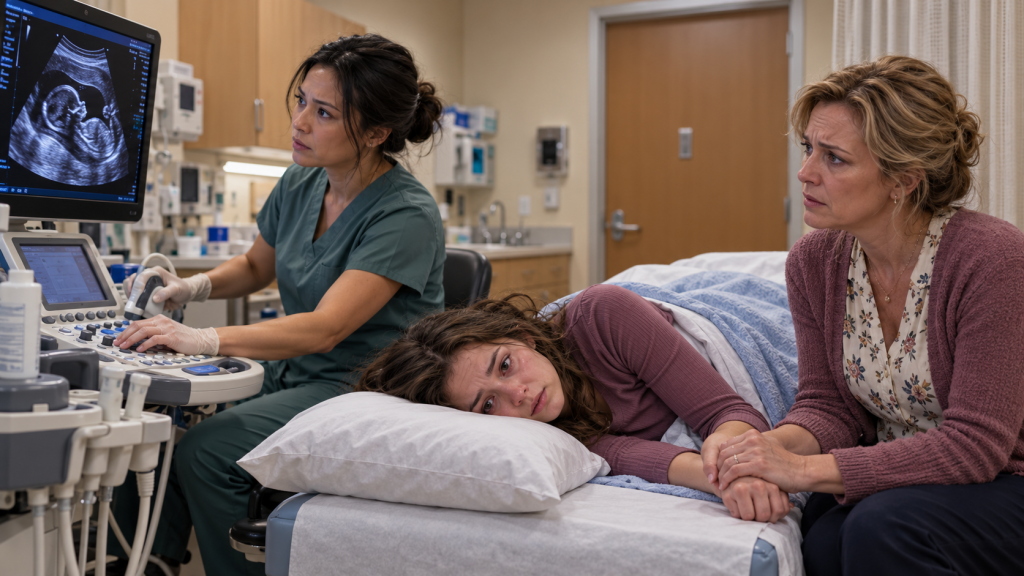
“Are you certain?” I almost laughed. “Doctor, I wasn’t here. I didn’t even know she’d been brought to the hospital.” Grace pressed both hands against her mouth. “Mom, I’m sorry.” I turned toward her immediately. “No, honey.” Her eyes filled. “I should’ve told you.” I moved closer and took her hands.
“Grace, look at me.”
She hesitated.
“Sweetheart, you’re fifteen. You were hurting, and you trusted your father to help you. You did nothing wrong.”
Her chin trembled.
Then she whispered something that made my heart crack.
“But I knew he was lying.”
I swallowed.
“What do you mean?”
She glanced toward my phone, still vibrating on the counter.
“He told me you’d signed the papers because you didn’t want any more bills.”
I felt as though someone had knocked the air from my chest.
“He told you that?”
She nodded.
“He said you were angry about how much the first appointment cost. He said if I kept complaining, we’d have to sell the house.”
For a moment, I couldn’t speak.
Our house.
The little white house with the blue front door.
The home where I’d painted a yellow sun on Grace’s bedroom wall when she was a baby.
The place where Daniel and I had celebrated birthdays, anniversaries, and Christmas mornings for seventeen years.
My daughter had been afraid her pain would cost us our home.
And my husband had allowed her to believe that.
Dr. Vargas gently interrupted.
“Melissa, I know this is distressing. But we need to address Grace’s condition first.”
I turned toward him.
“Please tell me what’s happening.”
He pointed to the screen.
The ultrasound showed a large complex mass near Grace’s right ovary.
The earlier imaging report, from five weeks before, described a smaller mass that already required prompt specialist assessment.
Today’s scan showed that it had enlarged, and Grace’s symptoms raised concern for intermittent or active ovarian torsion, a condition in which the ovary twists and its blood supply can be compromised.
“We can’t confirm everything from an ultrasound alone,” he explained. “But her pain, examination, and these findings mean waiting would be unsafe. A pediatric and adolescent gynecologic surgeon is coming to evaluate her now.”
I looked at Grace.
She was staring at the blanket.
“Is it cancer?” she whispered.
The doctor pulled his chair closer.
“We don’t know exactly what the mass is yet. Some ovarian masses in teenagers are benign cysts or other noncancerous growths. We need the specialist’s assessment and possibly surgery to understand what’s happening.”
Grace’s eyes filled.
“Am I going to die?”
My own heart lurched.
Dr. Vargas kept his voice calm.
“Nothing we’ve found means that you are dying. We are concerned about protecting your health, particularly the ovary, and that’s why we’re acting promptly.”
I squeezed her hand.
“You hear that, sweetheart? We’re going to take this one step at a time.”
She nodded.
But her eyes kept returning to my phone.
The screen lit up again.
DANIEL CALLING.
Then a text appeared.
I’M ON MY WAY. DO NOT LET THEM OPERATE.
I stared at it.
Grace saw the message and began shaking.
“Mom, he’s going to be mad.”
That sentence frightened me almost as much as the scan.
Not because Daniel could be difficult.
Not because he disliked unexpected expenses.
But because my daughter was in a hospital bed facing possible emergency surgery, and her first thought was that her father would be angry with her.
I turned the phone facedown.
“Grace, listen carefully. Your job is to tell the doctors how you feel. My job is to keep you safe and help you get the care you need. Your father’s feelings are not your responsibility.”
She stared at me.
Then tears began rolling down her cheeks.
“Okay,” she whispered.
A nurse named Tessa came in to take Grace’s blood pressure and prepare her for the specialist.
I asked whether someone could stay with Grace while I spoke briefly to Dr. Vargas.
Tessa nodded.
“Of course.”
I stepped into the hallway.
The moment the door closed, my knees nearly gave out.
Dr. Vargas guided me toward a chair.
“Melissa?”
I looked up.
“Five weeks.”
My voice sounded strange.
“She’s been hurting for months. He brought her here five weeks ago and knew she needed more testing.”
The doctor nodded carefully.
“Yes. The earlier notes document a recommendation for expedited specialist follow-up.”
“And he refused it?”
“The record shows that the recommended referral did not take place. The signed refusal document is one part of that record, but because you’re disputing the signature, we need the hospital’s records and patient relations teams to review how it was obtained.”
I covered my face.
“I thought she was having cramps.”
“You were responding to the information available to you.”
I shook my head.
“But I saw how tired she was.”
He sat beside me.
“Melissa, what’s important now is that you brought her in and we’re responding to what we’ve found.”
I looked at him through tears.
“Could waiting have made this worse?”
He didn’t offer me a comforting lie.
“A delay can increase the risk of complications with some conditions, including torsion. We can’t determine exactly what happened over the past five weeks or what a different timeline would have changed.”
I nodded slowly.
He continued.
“Right now, we’ll focus on helping Grace. Later, the documentation and what happened at that earlier appointment can be reviewed carefully.”
Twenty minutes later, a woman in dark green scrubs entered Grace’s room.
She introduced herself as Dr. Priya Raman, a pediatric and adolescent gynecologic surgeon.
Her manner was warm but direct.
She asked Grace to describe the pain in her own words.
“Where does it hurt?”
Grace pointed toward her lower right abdomen.
“Here.”
“Does it come and go?”
She nodded.
“It used to. Now it keeps hurting even when I’m lying still.”
“Have you felt nauseated?”
“Yes.”
“Have you been sick?”
“Twice this morning.”
Dr. Raman nodded.
Then she examined Grace gently and reviewed the images.
When she finished, she looked at both of us.
“I recommend urgent surgery to investigate the cause of the pain and address the mass.”
My stomach dropped.
“Today?”
“Yes. I’m concerned about torsion. We can’t safely rule it out based on the ultrasound findings, even when some blood flow is visible.”
Grace grabbed my hand.
“Surgery?”
Dr. Raman moved closer.
“I know that sounds frightening. We’ll explain what we’re considering and answer your questions before we proceed.”
She described a minimally invasive procedure using small incisions and a camera.
The goal would be to assess the ovary, untwist it if necessary, and address the mass while preserving healthy ovarian tissue whenever possible.
But there were uncertainties.
The actual condition of the ovary would only be clear during surgery.
Additional treatment might be needed if unexpected findings appeared.
I listened, trying to memorize every word.
Grace whispered:
“Will I still be able to have children someday?”
The question hit me with unexpected force.
She was fifteen.
She was supposed to be thinking about math homework, friends, and what to wear to the spring dance.
Instead, she was worrying about a future she had barely begun to imagine.
Dr. Raman answered gently.
“Many people do very well after ovarian surgery, including when one ovary has been affected. But we won’t make promises about what we’ll find today. Our priority is to protect your health and preserve ovarian function where we can.”
Grace swallowed.
“Will you try?”
Dr. Raman looked directly at her.
“Absolutely.”
For the first time since entering the hospital, I saw a small amount of trust return to my daughter’s face.
We had just finished discussing the consent process when loud voices came from the hallway.
“I am her father!”
Daniel.
My daughter’s entire body stiffened.
A moment later, the door opened.
He stood there wearing his dark work jacket, his hair disheveled, his face flushed.
He looked at Grace.
Then at me.
“What the hell is going on?”
I stood.
“Lower your voice.”
He ignored me.
“Why did you bring her here without telling me?”
Grace pulled the blanket toward her chin.
I stepped between them.
“Because she’s been in pain, Daniel.”
His eyes narrowed.
“We already dealt with that.”
Dr. Raman looked up.
“Mr. Hart, I’m Dr. Raman. Your daughter is being evaluated for a condition that requires urgent attention.”
Daniel frowned.
“I know what they told us last time.”
The room went silent.
I stared at him.
“You knew?”
He looked at me.
“Melissa, not here.”
“You knew she had a mass?”
His jaw tightened.
“It’s a cyst. Teenage girls get cysts.”
Dr. Raman’s expression remained composed.
“We haven’t established that the mass is harmless, and the current symptoms are concerning.”
Daniel looked irritated.
“Can everybody stop treating this like a catastrophe?”
Grace began crying.
And that was when something inside me changed.
For years, I’d explained away Daniel’s temper.
He was tired.
He was stressed.
He hated surprises.
He didn’t mean things the way they sounded.
But I was watching him stand beside our daughter’s hospital bed, and all he could think about was making the problem smaller than it was.
I looked straight at him.
“Grace needs surgery.”
His face changed.
“No.”
I blinked.
“What?”
“No one’s cutting her open without getting another opinion.”
Dr. Raman spoke evenly.
“We can discuss the medical findings and the reasons I recommend urgent treatment. Seeking another clinical opinion must not create an unsafe delay.”
Daniel pointed toward me.
“She doesn’t understand our finances.”
I stared.
“Finances?”
He looked away.
I thought of the forged signature.
The warning he’d hidden.
The appointments Grace had missed.
Then I said:
“Daniel, did you sign my name on the refusal form?”
His expression froze.
Grace stopped crying.
Dr. Raman looked between us.
Daniel swallowed.
“What are you talking about?”
I stepped closer.
“The document from five weeks ago. The one saying I declined her referral.”
He looked at Grace.
“Did you tell her about that?”
My daughter’s face drained.
I moved immediately.
“Don’t look at her. Look at me.”
Daniel’s jaw tightened.
“You’re making a scene.”
“No,” I said quietly. “I’m asking a question.”
He stared at me.
I repeated it.
“Did you sign my name?”
And this time, with our frightened daughter watching, he whispered:
“I did what I had to do.”
I stood so still that I could hear the monitor beside Grace’s bed.
I did what I had to do.
Not “I didn’t sign it.”
Not “There must be a mistake.”
He’d answered the question without quite admitting the act, as though he believed choosing the right words might make what he’d done disappear.
I looked at the man I’d married seventeen years earlier.
Daniel had once driven through a snowstorm to bring me medicine when I had the flu.
He’d cried when Grace was born.
He’d held our tiny daughter against his chest and promised her he would never let anyone hurt her.
And now he was standing in a hospital room refusing to acknowledge that he’d been the one hurting her.
“Why?” I whispered.
He looked toward Dr. Raman.
“This is a family conversation.”
Dr. Raman remained calm.
“Mr. Hart, Grace’s medical condition is our immediate concern. Whatever disagreement exists between you and your wife, she needs a timely decision about treatment.”
Daniel folded his arms.
“I want to see the scan.”
“Of course,” the doctor said. “I’ll explain the findings and the recommendation.”
I appreciated her patience.
But Grace had curled into herself beneath the blanket.
I knew that posture.
I’d seen it at our dinner table when Daniel criticized her grades.
When he complained about her leaving dishes in the sink.
When she tried to explain why she’d forgotten a chore.
She made herself small, as though taking up less space might prevent an argument.
My daughter was doing the same thing in a hospital bed.
Dr. Raman reviewed the imaging with Daniel.
She explained the mass, the concern for torsion, and the reasons delaying surgery could carry significant risk.
She also explained that no responsible physician could promise what the pathology would show before it was examined.
Daniel listened without interrupting.
For a moment, I hoped the information might reach him.
Then he said:
“How much is this going to cost?”
I stared.
Dr. Raman answered that billing staff could discuss coverage and financial questions, but urgent clinical decisions needed to be based on Grace’s health.
Daniel rubbed his forehead.
“I just don’t want everyone panicking over something that might go away.”
Grace whispered:
“Dad, it really hurts.”
He turned toward her.
“We know, Grace.”
She flinched.
His voice sharpened.
“You’ve made that very clear.”
I felt a terrible stillness settle over me.
“Daniel,” I said, “leave the room.”
His eyes widened.
“Excuse me?”
“Grace needs a chance to speak to her doctor without being afraid you’ll get angry.”
He laughed sharply.
“I’m her father.”
“And she’s our daughter.”
Dr. Raman stepped forward.
“Let’s give Grace some privacy. We can continue discussing your concerns with the medical team.”
Daniel looked at the staff gathering near the doorway.
He seemed to realize for the first time that everyone had heard him.
Then he pointed at me.
“This isn’t over.”
He walked out.
Grace burst into tears.
I sat beside her.
She tried to apologize again.
“Mom, I shouldn’t have said anything.”
I took her face gently between my hands.
“Grace, I need you to hear me.”
She looked at me.
“Nothing about what just happened is your fault.”
She shook her head.
“He’s going to be so mad when we go home.”
My heart broke.
“We’re not discussing going home with your father right now. We’re discussing your health. After that, we’ll decide what’s safe.”
Grace studied my face.
“Are you mad at him?”
“Yes.”
Her lower lip trembled.
“Because of me?”
“No, sweetheart. Because of his decisions.”
I held her until her crying slowed.
Then she whispered:
“He told me he took care of it.”
I pulled back.
“What?”
“The appointment. He said the hospital was just trying to make us pay for more tests.”
She swallowed.
“Then he said you didn’t need to know because you’d make a big deal out of it.”
I closed my eyes.
“Did he tell you anything else?”
Grace hesitated.
“He said you were already working too hard because money was bad.”
Something in her voice made me look up.
“Money was bad?”
She nodded.
“He said if we spent thousands of dollars on scans and surgery, you might lose the house.”
I stared at her.
Then she said quietly:
“Mom, are we poor?”
I shook my head, unable to answer immediately.
Our family had never been wealthy.
But we had savings.
Insurance.
Two working adults.
A mortgage we paid on time.
At least, that’s what I believed.
Tessa, the nurse, returned with a social worker named Joanne Ellis.
Joanne explained that she wanted to check in with Grace about her comfort, her understanding of the treatment, and the pressure she seemed to be experiencing around discussing her symptoms.
She didn’t interrogate her.
She didn’t ask Grace to make accusations.
She simply spoke gently and gave her time.
When Grace said she didn’t want her father present while she was prepared for surgery, Joanne took that seriously and discussed the request with the clinical team.
Daniel was not automatically stripped of his legal role as a parent.
But the hospital could manage visitors, assess safety concerns, and make sure Grace was able to speak about her condition without intimidation.
The medical and legal teams addressed the disagreement about consent while the surgeons continued preparing for the urgent procedure.
I remained at Grace’s bedside.
A little before six, Dr. Raman returned.
She’d consulted with the relevant team, reviewed Grace’s condition again, and explained the surgical plan to us.
The concern for torsion remained high.
Grace’s pain had worsened, and she was nauseated despite medication.
There was no longer any room for the fantasy that we could simply take her home and hope the problem disappeared.
I held my daughter’s hand as we completed the necessary consent process.
Grace asked three questions.
Would she wake up afterward?
Would it hurt?
Could I be there when she did?
Dr. Raman answered each one.
Then Grace looked at me.
“Promise you won’t leave.”
I kissed her forehead.
“I’ll be right here when they bring you back.”
She nodded.
But she held my hand until a nurse gently told her it was time.
Watching the operating-room doors close was the hardest thing I’d ever done.
Grace disappeared behind them wearing a hospital gown and a pale blue surgical cap.
She looked so young.
All I could see was the little girl who used to climb into my bed during thunderstorms.
The child who hated the dark.
The teenager who’d begun laughing less and apologizing more.
I stood staring at the doors long after they shut.
Then my legs gave way.
I sat in the waiting area and cried.
My phone rang.
Daniel.
I didn’t answer.
He sent a message.
You had no right to do this without me.
Then another.
You are turning Grace against me.
I stared at the screen.
For years, he’d accused me of overreacting whenever I was upset.
He’d say I was emotional.
That I made things worse.
That Grace was becoming too sensitive because I worried about everything.
I used to believe him often enough to apologize.
But now my daughter was in surgery.
I wasn’t interested in whether Daniel approved of my feelings.
I called my older sister, Rebecca.
She answered on the second ring.
“Mel?”
I tried to speak.
Nothing came out.
“Melissa, what’s wrong?”
“It’s Grace.”
Her voice changed immediately.
“What happened?”
I told her about the scan.
The surgery.
The earlier appointment.
The forged signature.
By the time I finished, Rebecca was crying too.
Then she said:
“Where are you?”
“At the hospital.”
“I’m coming.”
“Becca, you don’t have to—”
“Melissa.”
I went quiet.
“I’m not asking whether you need me. I’m telling you I’m coming.”
I began crying again.
For the first time that day, I didn’t feel completely alone.
Rebecca arrived carrying two cups of coffee and a sweater.
She didn’t ask whether I’d eaten.
She handed me a sandwich and waited until I took a bite.
Then she sat beside me.
“How long has Grace been in surgery?”
“About an hour.”
“And Daniel?”
“Somewhere in the hospital, I think.”
Rebecca’s expression tightened.
“Have you spoken to him?”
“No.”
She nodded.
Then I showed her the messages.
Rebecca read them without speaking.
When she finished, she handed the phone back.
“Melissa, this isn’t normal.”
I looked down.
“I know.”
She touched my arm.
“Do you?”
That question hurt.
Because I wasn’t sure.
I’d been married to Daniel for so long that his anger had become part of the furniture of our lives.
Something we stepped around.
Something we learned not to bump into.
Sometimes it was easier to change our behavior than to ask why he believed he could treat us that way.
I stared at the operating-room doors.
“Grace says she stopped telling him when it hurt.”
Rebecca’s eyes filled.
“She was afraid he’d get mad.”
My sister looked away.
I continued.
“He made her think getting medical treatment might cost us the house.”
Rebecca turned back.
“And did it?”
“I don’t know.”
She frowned.
“What do you mean?”
I thought about the last several months.
Daniel had started opening the mail before I got home.
He’d insisted on handling the household bills.
He’d complained that our bank’s website was unreliable whenever I asked why an account wouldn’t load.
He’d stopped discussing his bonuses at work.
And when I’d suggested increasing our retirement contributions, he’d said we needed to be careful because business had slowed.
I looked at Rebecca.
“I don’t know how much money we have anymore.”
A terrible possibility began forming in my mind.
I wanted to dismiss it.
But then I remembered the forged signature.
If Daniel could sign my name to refuse a medical referral, what else had he done without telling me?
I opened my banking app.
Our joint checking account displayed less money than I’d expected.
I switched to the savings account.
The balance was far lower than it should have been.
For a moment, I thought the screen hadn’t loaded.
Then I refreshed it.
The same number appeared.
$1,842.17.
I stared.
We’d had more than $38,000 in that account earlier in the year.
I pressed my hand against my mouth.
Rebecca leaned closer.
“Melissa?”
I turned the phone toward her.
She frowned.
“Where’s the rest?”
I couldn’t answer.
Then my phone displayed an alert from the bank.
A notification concerning a transfer request from an account I didn’t recognize.
Under the account nickname were two words.
HART VENTURES.
And suddenly, the forged signature at the hospital wasn’t the only secret my husband had been keeping.
I stared at the words until they seemed to lose their meaning.
HART VENTURES.
Daniel had never mentioned a company by that name.
He worked as an operations manager for a commercial supply business. At least, that was the job he left for every morning wearing a pressed shirt and carrying the same black leather briefcase he’d owned for years.
I looked at Rebecca.
“Do you know anything about this?”
She shook her head.
“No.”
I opened the transaction history.
Over the previous four months, money had been transferred out of our savings in amounts that started small and grew larger.
Three thousand dollars.
Five thousand.
Eight thousand.
Then a transfer of twelve thousand dollars.
I counted the entries twice.
My hands shook so badly that Rebecca finally took the phone and helped me write down the dates.
“Melissa,” she whispered, “we need to preserve this.”
I nodded.
We took screenshots of the account history and requested official statements through the bank.
I didn’t yet know whether Daniel had violated any banking agreement or law. A joint account could give either spouse broad authority to move funds, depending on its terms.
But he’d hidden the transfers.
And those transfers explained why Grace had been told our family couldn’t afford to investigate her pain.
I wanted to confront him immediately.
I wanted to find him in the hospital hallway and demand to know where our money had gone.
But then the operating-room doors opened.
A nurse approached.
“Mrs. Hart?”
I stood so quickly that my chair scraped the floor.
“Yes?”
“Dr. Raman will be out to speak with you shortly. Grace is still under the team’s care.”
My knees nearly gave way.
“Is she okay?”
The nurse’s face softened.
“The doctor will explain the findings. She’s on her way.”
Those few minutes felt endless.
I stood beside Rebecca, squeezing her hand until she finally whispered that I was hurting her fingers.
Then Dr. Raman came through the doors.
She pulled off her surgical cap.
Her expression was serious but reassuring.
“Melissa?”
I stepped forward.
“How is she?”
“Grace is stable. The operation went well.”
I began crying before she could finish.
Rebecca wrapped an arm around me.
Dr. Raman waited.
Then explained.
Grace had a sizable ovarian mass, and her right ovary had twisted.
The surgical team had untwisted it and removed the mass while preserving the ovary.
There had been concerning discoloration when they first examined it, but appearance alone didn’t reliably predict whether an ovary could recover, and the team had followed an ovary-preserving approach.
They hadn’t seen evidence of a widespread process during the procedure.
The tissue would be examined by pathology to establish the diagnosis.
I wiped my face.
“You saved her ovary?”
“We preserved it,” Dr. Raman answered. “We’ll monitor her recovery and discuss follow-up findings. We can’t promise every aspect of its function based on the appearance today, but preserving it gives it the opportunity to recover.”
I nodded, struggling to breathe.
“Was it cancer?”
“We won’t know the final diagnosis until the pathology report. Many masses of this kind in adolescents turn out to be benign, but we need the actual result.”
I looked down.
“And the delay?”
Dr. Raman’s expression softened.
“The mass was already large enough to warrant prompt evaluation five weeks ago. We can’t determine exactly when the torsion occurred or whether earlier surgery would have prevented it.”
I began crying again.
She continued.
“What matters is that Grace received treatment today and is doing well so far.”
I nodded.
“Can I see her?”
“As soon as she’s ready in recovery.”
When they finally allowed me into the recovery area, Grace was lying beneath a white blanket.
Her face looked pale.
There was tape on her hand where the IV had been secured.
Her hair had escaped from the surgical cap and lay in tangled strands across the pillow.
I sat beside her.
“Hi, sweetheart.”
Her eyes opened slowly.
“Mom?”
“I’m here.”
She blinked.
“Is it over?”
I nodded through tears.
“Yes.”
She looked frightened.
“Did they take everything out?”
I stroked her hair.
“No, honey. They removed the mass and preserved your ovary.”
Her face softened.
“Really?”
“Really.”
She exhaled.
Then whispered:
“Are you proud of me?”
The question nearly destroyed me.
I bent forward and kissed her forehead.
“Grace, I’m proud of you every day.”
Her eyes filled.
“Even though I cried?”
I shook my head.
“Being brave doesn’t mean you don’t cry.”
She reached toward me.
I took her hand.
And as the monitor beeped quietly beside us, I made a promise I should have made long before that day.
“From now on, when something hurts, you tell me. You never have to earn the right to be believed.”
Daniel appeared outside the recovery area twenty minutes later.
A nurse asked whether Grace wanted him to visit.
She looked at me first.
Then whispered:
“Not right now.”
I nodded.
The nurse communicated the request to the team managing her care.
Daniel’s voice rose in the corridor.
“She’s my daughter!”
Grace flinched.
I squeezed her hand.
“It’s okay.”
But she was staring toward the doorway.
Then she whispered:
“He’ll say I made you do this.”
I felt a deep, terrible sadness.
Because she’d learned to treat her father’s anger as something she caused.
Later that evening, Joanne, the hospital social worker, met with me privately.
I told her about the secrecy, the missed referral, and Grace’s fear of her father’s reaction.
Joanne listened carefully.
She explained that she would document Grace’s statements and coordinate with the medical team regarding any safeguarding concerns. Depending on the circumstances and applicable requirements, the hospital might need to make a report to child protection authorities.
I nodded.
“Will they take Grace away from me?”
Joanne looked at me.
“Nothing you’ve told me suggests that seeking treatment for your daughter is a reason to separate her from you. The focus is on understanding her safety and making an appropriate plan.”
I started crying.
For months, Daniel had told Grace that speaking up would ruin the family.
Now I was discovering how deeply she’d absorbed that fear.
Before leaving, Joanne asked one question.
“Melissa, do you feel safe going home with Daniel?”
I looked at her.
For seventeen years, I’d answered questions like that by thinking about whether he’d ever hit me.
He hadn’t.
He’d slammed doors.
Broken a kitchen cabinet once when he was furious.
Shouted until Grace cried.
Made us feel guilty for needing anything he hadn’t planned for.
But he’d never struck me.
I’d always used that fact to convince myself his behavior wasn’t serious.
Now I thought of Grace in the hospital bed.
Her eyes fixed on my ringing phone.
Her voice whispering, He’s going to be mad.
I took a breath.
“I don’t feel safe bringing Grace home to him while this is unresolved.”
Joanne nodded.
“Then let’s discuss practical options.”
Rebecca offered us her guest room.
Her house was forty minutes away, with a downstairs bedroom where Grace could recover without climbing stairs.
Joanne helped us identify what discharge planning would require and how to communicate concerns about contact with Daniel.
I also asked for information about medical records, support services, and how to document the disputed signature.
No one promised me that I could simply take away Daniel’s parental rights.
That wasn’t how family law worked.
But I could seek advice about safe temporary arrangements, preserve the evidence, and make decisions that centered on Grace’s immediate needs.
That night, while Grace slept, I sat beside her bed and called the bank’s fraud and account-security department.
I explained that I needed to review transfers from a joint account and secure my own online access.
The representative verified my identity and helped me take appropriate steps within the bank’s policies.
I learned that Hart Ventures was associated with a business account Daniel controlled.
Some transfers had been initiated from his authorized access to our joint account.
The representative couldn’t tell me how the money had been used after it left.
But she could tell me something else.
There had been recent changes to the contact information associated with certain alerts.
I stared at the wall.
“Changes I didn’t request?”
She explained the dates and how the changes were recorded.
I wrote everything down.
Another thing Daniel had done quietly.
Another decision he’d made without telling me.
The next morning, an email arrived from my employer’s human resources department.
I had requested verification of our insurance coverage the previous night, frightened by Daniel’s repeated warnings about medical expenses.
The response said our family was covered under my employer-sponsored plan.
The deductible was substantial, but the policy was active.
I stared at the message.
Daniel had made Grace believe the family might lose everything because she needed care.
Yet we had active insurance.
The cost would still matter.
We would have bills and financial decisions to make.
But the claim that her medical needs were an intolerable luxury wasn’t true.
I went into the hospital hallway and called Daniel.
He answered immediately.
“Finally.”
I kept my voice steady.
“Where is the money?”
Silence.
Then he said:
“What?”
“Our savings. The transfers to Hart Ventures.”
He exhaled sharply.
“Melissa, not now.”
“Why did you tell Grace we couldn’t afford her medical care?”
His voice hardened.
“Because we can’t just throw money at every problem.”
“She had ovarian torsion, Daniel.”
“I know what they found.”
“She needed surgery.”
A pause.
Then he said something I will never forget.
“And if we’d gone back five weeks ago, they’d probably have wanted surgery then too.”
I closed my eyes.
“Yes. They might have.”
He was silent.
I continued.
“You knew she might need it, and you let her keep hurting because you didn’t want another bill.”
“That isn’t fair.”
“Then explain it.”
His voice cracked.
“The business was supposed to work.”
I gripped the phone.
“What business?”
“Hart Ventures.”
I stared at the wall.
“Daniel, what have you done?”
And for the first time since I’d known him, my husband sounded genuinely afraid.
“I lost my job four months ago,” he whispered.
The hallway seemed to tilt.
“You what?”
“I was laid off.”
I pressed my free hand against the wall.
“Four months?”
“I didn’t want to tell you until I had something else.”
I thought of the mornings he’d kissed me goodbye.
The dress shirts.
The briefcase.
The lunches I’d packed when I had time.
“Where have you been going every day?”
He didn’t answer immediately.
Then he said:
“Trying to get the company running.”
I closed my eyes.
He had been pretending to go to work.
Meanwhile, he’d moved our savings into a business venture he hadn’t told me existed.
And when our daughter needed medical care, he’d treated the expense as a threat to the secret he’d built.
“Daniel,” I whispered, “you made Grace think her pain was ruining us.”
He didn’t answer.
“You made her think I didn’t want her to get treatment.”
Silence.
“You signed my name on a refusal form.”
His breathing changed.
“I just needed more time.”
I felt tears rising.
“More time for what?”
“To fix everything.”
I looked through the glass at Grace sleeping in her hospital bed.
And then I said:
“You were so busy trying to fix the money that you left our daughter alone with the pain.”
Daniel started crying.
But I wasn’t ready to comfort him.
Not this time.
When I hung up, I realized I was shaking.
I hadn’t raised my voice.
I hadn’t threatened Daniel.
I hadn’t even told him I wanted a divorce.
But something had shifted so completely that I knew our marriage would never return to what it had been.
For seventeen years, I’d believed we were partners.
Maybe not perfect partners.
Maybe not people who always agreed.
But people who faced difficult things together.
Now I knew he’d been living an entirely different life behind my back.
He had lost his job, started a business, transferred our savings, forged my signature, and hidden a medical recommendation concerning our daughter.
And somehow, through all of it, he’d made Grace feel responsible for the family’s problems.
I went back into her hospital room.
She was awake, sipping water through a straw.
“Mom?”
I sat down.
“Hi, honey.”
“Did you talk to Dad?”
I hesitated.
“Yes.”
She watched me carefully.
“Is he mad?”
I shook my head.
“I’m not going to make you worry about that right now.”
She looked down.
“Are we losing the house?”
My throat tightened.
“No one has told us we’re losing the house. Some things about our finances need to be sorted out, but that’s an adult responsibility. Not yours.”
She studied my face.
“Promise?”
I took her hand.
“I promise I will handle it honestly and get the help we need. You don’t have to carry it.”
Grace was quiet for a moment.
Then she whispered:
“Dad said you were already tired of taking care of everyone.”
I felt tears sting my eyes.
“He said that?”
She nodded.
“He said you worked all day and came home to problems. He told me you didn’t need another one.”
I covered my mouth.
I thought of all the evenings I’d come home tired.
The dishes in the sink.
The laundry.
The work emails.
The ordinary exhaustion of being a mother with a full-time job.
Had Grace watched those moments and decided her pain was one more burden I couldn’t bear?
I leaned closer.
“Grace, I get tired sometimes. Everybody does.”
She nodded.
“But I’m never tired of being your mother.”
Her eyes filled.
I continued.
“Your health is not an inconvenience. Your feelings are not attention-seeking. And needing help doesn’t make you a problem.”
She began crying.
“I thought you’d be disappointed in me.”
I pulled her gently against my shoulder, careful of her incisions.
“Oh, sweetheart.”
She sobbed.
And for a long time, neither of us said anything else.
The pathology results came several days later.
By then, Grace had been discharged to Rebecca’s house.
She moved slowly, slept often, and needed help with ordinary things she’d previously taken for granted.
We managed her prescribed pain medication according to the discharge instructions, watched for warning signs, and arranged follow-up appointments.
I worked remotely when I could.
Rebecca cooked meals.
Her husband drove us to the pharmacy.
And Grace’s best friend, Emma, sent voice messages describing everything that happened at school.
Then Dr. Raman called.
“Melissa, we have the pathology report.”
My stomach tightened.
I sat beside Grace on Rebecca’s couch and put the call on speaker, with her permission.
“The mass was a mature cystic teratoma,” Dr. Raman explained. “It’s a type of growth that is generally benign, and in Grace’s case, the pathology showed no malignancy.”
I covered my mouth.
Grace stared at the phone.
“So I don’t have cancer?”
“The pathology did not show cancer,” Dr. Raman answered.
Grace began crying.
So did I.
For a long time, we’d been holding our breath without realizing it.
The word mass had followed us through every waking hour.
Even after surgery, it remained in the room.
A shadow in our conversations.
An unspoken question each time Grace looked frightened.
Now we had an answer.
And it was the kind we’d been desperately hoping for.
Dr. Raman continued explaining Grace’s recovery.
The team would monitor her healing and assess the ovary at follow-up.
The surgical findings were encouraging, but recovery and future function needed to be evaluated over time rather than assumed from one successful operation.
Grace would need to return gradually to her usual activities.
She’d also need support with the anxiety that could follow a frightening medical experience.
I asked every question I could think of.
Could the mass return?
Would she need another scan?
When could she return to sports?
What symptoms should make us seek urgent care?
Dr. Raman answered patiently, without promising that everything would always be perfect.
When we finished, Grace looked at me.
“Mom?”
“Yes?”
“Can we get milkshakes?”
I laughed through tears.
“As soon as your doctor says your stomach’s ready for it.”
She smiled.
For the first time in weeks, she looked fifteen again.
But physical recovery was only part of what we faced.
The first night at Rebecca’s house, Grace woke crying.
I heard her from the hallway.
When I entered, she was sitting upright, clutching her pillow.
“What’s wrong?”
She looked at me, frightened.
“I dreamed the doctors told me to go home.”
My heart tightened.
She continued.
“I was screaming that it hurt, and nobody was listening.”
I sat beside her.
“I’m listening now.”
She pressed her face against my shoulder.
“What if it happens again?”
I held her.
“If you’re in pain again, we’ll tell your medical team. We won’t ignore it.”
She cried quietly.
Then whispered:
“What if Dad says I’m being dramatic?”
I closed my eyes.
“His opinion doesn’t change what’s happening in your body.”
She looked at me.
“Really?”
“Really.”
Grace started seeing a counselor with experience supporting teenagers after stressful medical events.
At first, she barely spoke.
She said she didn’t need therapy.
That she’d rather just go back to school and forget everything.
But slowly, she began talking.
About the pain.
About the fear of surgery.
About feeling responsible for our money problems.
And about the way she’d learned to measure her father’s mood before asking him anything.
Her counselor never told her what she had to feel.
She helped Grace recognize that she was allowed to have needs, boundaries, and opinions.
It was a lesson my daughter should never have had to learn in a hospital room.
Meanwhile, I requested the complete records from both hospital visits.
The records department provided the available documents through its established process.
There were clinical notes, discharge instructions, imaging reports, and communications concerning the recommended referral.
I read them sitting at Rebecca’s dining room table.
Some of the medical language was difficult to understand.
But one line was perfectly clear.
Parent advised that specialist evaluation should occur promptly and that worsening pain, vomiting, or sudden severe symptoms require urgent reassessment.
The listed parent was Daniel.
There was also a note documenting that the family had been contacted after the initial visit because the specialist appointment hadn’t been scheduled.
The contact number on that follow-up entry was Daniel’s mobile.
Not mine.
The disputed refusal form contained my signature.
But the clinician’s visit note identified Daniel as the parent present.
I stared at the contradiction.
Someone at the hospital had accepted a document bearing the name of a parent who wasn’t there.
I didn’t know whether Daniel had presented it as already authorized or whether the form had been entered incorrectly.
I wasn’t going to invent an explanation.
I submitted a formal request for review, clearly stating that I had not signed or authorized the refusal.
I asked the hospital to preserve the original document and related records, investigate how it had been obtained, and add an appropriate correction or clarification to Grace’s medical record.
The original record couldn’t simply be erased.
But false information could be challenged, and the dispute needed to be documented accurately.
A patient relations representative called several days later.
She confirmed that the hospital was reviewing the issue.
She couldn’t tell me everything immediately.
But she explained that the investigation would examine the workflow, the scanned form, and the communications recorded during the earlier visit.
I thanked her.
Then I hung up and stared at the kitchen table.
I used to think medical records were simply facts.
Dates.
Symptoms.
Test results.
Now I understood how much damage an inaccurate document could cause.
One forged signature had made it appear that I chose not to pursue care.
It had supported the lie Daniel told Grace.
And it had hidden from me the fact that my daughter needed help.
A week later, my friend Natalie recommended a family law attorney.
Her name was Beth Alvarez.
I made an appointment.
I wasn’t ready to say the word divorce aloud.
But I needed to understand my options.
Beth listened while I described the situation.
She didn’t gasp when I mentioned the money.
She didn’t promise Daniel would lose all parenting rights.
She didn’t tell me what I wanted to hear just to make me feel better.
She asked questions.
Where was Grace living now?
Had Daniel agreed to the temporary arrangement?
Were there any court orders?
What financial accounts were jointly held?
Did I have copies of the hospital records?
Had anyone threatened us?
I answered as honestly as I could.
Then Beth said:
“Melissa, there are two connected but distinct issues. One concerns the safety and emotional well-being of your daughter. The other concerns your marriage and finances.”
I nodded.
“Can he make Grace go home with him?”
“That depends on the circumstances and applicable court orders. Both parents generally have rights and responsibilities unless a court changes them. We need to establish appropriate temporary arrangements quickly, with Grace’s medical needs and safety clearly documented.”
I swallowed.
“She doesn’t want to see him right now.”
“Her views matter, particularly at her age, but we shouldn’t place the burden of deciding everything on her. We’ll work on a plan that protects her without making her responsible for the conflict.”
I nodded slowly.
That mattered.
I didn’t want Grace to spend the next few years believing she’d destroyed our marriage.
Daniel’s choices were the problem.
Not our daughter’s need for medical care.
Then Beth reviewed the bank statements.
She frowned.
“You said Daniel lost his job four months ago?”
“Yes.”
“And he didn’t tell you?”
“No.”
“Do you know what Hart Ventures actually does?”
I shook my head.
“Not really.”
Beth pointed at the transfers.
“We’ll need more documentation. Some of these funds may be marital property, but that doesn’t necessarily mean he can move them without consequences in a divorce. We’ll have to examine the accounts, the business, and any debts.”
I stared at her.
“Debts?”
She looked up.
“Have you checked your credit reports recently?”
My stomach tightened.
“No.”
Beth didn’t frighten me with predictions.
She simply advised me to obtain the reports and review my financial records.
I left her office carrying a folder.
And a growing fear that the missing savings might not be the end of what Daniel had concealed.
The credit reports showed two things I hadn’t expected.
The first was a business credit card Daniel had opened in his own name and used extensively.
The second was a personal loan he’d taken out several months earlier.
I was not listed as a borrower on that loan, but its existence raised questions about what other obligations the business had and how they might affect our marital finances.
Beth helped me understand the difference between being personally obligated to a creditor and having a debt considered during a divorce.
The answers weren’t always simple.
What was simple was that Daniel had concealed a financial crisis while telling our daughter that her pain was the reason we couldn’t afford ordinary expenses.
I finally learned what Hart Ventures was supposed to be.
Daniel had joined two former colleagues in a plan to purchase and resell specialized industrial equipment.
They believed they could obtain surplus machinery cheaply and supply it to smaller businesses.
It sounded plausible on paper.
But they had made commitments before securing reliable buyers.
Storage fees mounted.
Several purchases lost value.
One partner withdrew.
Daniel responded by investing more money.
He kept telling himself that one successful sale would fix everything.
Then he lost his job.
Instead of stopping, he doubled down.
He later told me he’d planned to reveal everything after the business became profitable.
I stared at him across Beth’s conference table.
“How profitable did it need to become before you told me Grace was sick?”
His face crumpled.
“Melissa, please.”
It was the first time we’d sat together since the hospital.
Beth was present because we’d arranged a meeting to discuss immediate finances and Grace’s recovery needs.
Daniel looked exhausted.
His beard had grown unevenly.
His wedding ring was still on his finger.
For one foolish second, I wanted to reach across the table and take his hand.
Seventeen years of marriage don’t vanish because one terrible day changes everything.
The memories remain.
The habits remain.
The instinct to comfort someone you once trusted remains.
But I kept my hands in my lap.
Daniel leaned forward.
“I thought the first scan showed a harmless cyst.”
I looked at him.
“The discharge instructions said she needed prompt follow-up.”
“I know that now.”
“You knew it then.”
He lowered his eyes.
I continued.
“You told her it was nothing.”
“I didn’t want to frighten her.”
“You told her I didn’t want the appointment.”
He covered his face.
“Melissa—”
“Why did you sign my name?”
For a long time, he said nothing.
Then he whispered:
“Because I knew you wouldn’t agree to cancel it.”
I felt tears sting my eyes.
There it was.
The answer.
He hadn’t misunderstood.
He hadn’t lost the paperwork.
He hadn’t simply forgotten.
He knew I would take Grace to the specialist.
So he prevented me from knowing there was one to see.
Daniel began crying.
“I thought I could get everything under control.”
I shook my head.
“Grace isn’t a bill you can postpone.”
“I know.”
“She’s a child.”
His shoulders shook.
“I know.”
“And she spent five weeks thinking her mother didn’t care whether she was in pain.”
Daniel looked up sharply.
“I never wanted that.”
My voice broke.
“But that’s what you taught her.”
He took a breath.
“Can I see her?”
I looked toward Beth.
She didn’t answer for me.
Grace’s safety and emotional needs were the focus of our temporary parenting discussions, and her medical team had recommended a careful, supported approach to contact while she recovered.
I turned back to Daniel.
“She’s not ready to see you.”
He flinched.
“I’m her father.”
“Yes.”
I swallowed.
“And you have a responsibility to her that didn’t disappear when she stopped being easy to care for.”
He began crying again.
I continued.
“If you want to rebuild a relationship with her, start by telling the truth and getting help with the way you’ve treated her.”
He nodded.
“I’ll do anything.”
I looked at him.
“Then do something. Don’t just promise.”
Over the following weeks, we worked through temporary legal arrangements.
Grace remained with me.
Daniel moved into a rented apartment.
Our attorneys addressed access to finances, payment of ongoing expenses, medical decision-making procedures, and parenting contact.
The court reviewed the relevant evidence and entered temporary orders reflecting Grace’s immediate needs and the concerns raised by the delayed treatment and her fear of her father’s reactions.
They were not a final declaration about Daniel’s character or an automatic termination of his relationship with Grace.
They were safeguards while the larger issues were assessed.
Daniel was furious at first.
He sent a message saying I’d destroyed his family.
Another claiming Rebecca had influenced me.
A third accusing the hospital of exaggerating Grace’s condition.
I saved the messages.
I didn’t argue.
Then, several days later, he sent something different.
I read the discharge summary from the first visit.
I can’t pretend I didn’t understand anymore.
I stared at the screen.
Another message followed.
I knew the recommendation. I chose not to act on it.
For the first time, Daniel had said the truth without hiding behind the word misunderstanding.
The hospital’s records review also reached a conclusion.
The disputed form had been submitted through an electronic document process associated with Daniel’s earlier visit.
The review identified a verification failure: the workflow had not adequately established that the person whose name appeared on the document had actually signed it.
The hospital documented my dispute, preserved the original entry, and added a clarification to the medical record.
It also reviewed its procedures for accepting electronically submitted parent authorizations.
The representative apologized for the distress caused by the inaccurate documentation.
I appreciated that.
But I didn’t feel triumphant.
A corrected record couldn’t give Grace back the nights she’d spent curled around a heating pad.
It couldn’t erase the hours she’d spent sitting in class, trying not to cry.
It couldn’t undo the moment she asked whether her pain would cost us our house.
One afternoon, Grace brought me a folded piece of notebook paper.
“Mom?”
I was working at Rebecca’s dining room table.
I looked up.
“What’s that?”
She sat opposite me.
“Something I wrote when I was still hurting.”
I unfolded it carefully.
The first line made my eyes fill.
Things I am not supposed to say.
Below it she’d written:
My stomach hurts again.
I don’t think it’s normal.
I’m scared when Dad gets angry.
I want Mom to know, but what if she believes him?
I covered my mouth.
Grace stared at her hands.
“I used to write things down because I couldn’t say them.”
I looked at her.
“Sweetheart, I’m so sorry you felt you had to do that.”
She shook her head.
“I know you didn’t know.”
I swallowed.
“But I wish I’d understood sooner.”
Grace looked up.
Then she asked:
“Can we keep the paper?”
I nodded.
“Of course.”
She hesitated.
“I don’t want to hide things anymore.”
I reached across the table.
“Then we won’t.”
That evening, I opened a new notebook.
On the first page, I wrote:
THINGS WE CAN SAY OUT LOUD.
I left it on the kitchen counter with a pen.
I told Grace she didn’t have to write in it.
She didn’t have to explain every feeling.
She could keep private thoughts too.
But whenever she wanted to tell me something difficult, I’d make time to listen.
The next morning, I found a sentence beneath mine.
I don’t like when people ask whether I’m all better.
I read it twice.
Then I wrote underneath:
Thank you for telling me. I’ll remember.
We began having conversations that weren’t about hospitals, lawyers, or Daniel.
Grace told me she hated how classmates treated her as fragile.
She admitted she’d fallen behind in chemistry.
She confessed she’d been worried Emma would stop inviting her places because she couldn’t do everything yet.
I listened.
Sometimes I helped.
Sometimes I asked whether she wanted advice.
And sometimes I simply sat beside her while she talked.
I was learning that protecting my daughter didn’t mean solving every problem before she had a chance to speak.
It meant believing her when she told me a problem existed.
At Grace’s next follow-up appointment, Dr. Raman reviewed her recovery.
The incisions had healed well.
Follow-up imaging was reassuring.
Grace was gradually returning to her usual activities, according to the surgical team’s guidance.
There were no signs of a new mass at that visit.
Dr. Raman answered questions about ovarian health and future monitoring without pretending she could predict every part of Grace’s adult life.
Grace listened carefully.
Then she asked:
“Can I try out for volleyball again?”
Dr. Raman smiled.
“Let’s talk about how you’re feeling and when you’ll be ready for full activity.”
Grace grinned.
And for the first time in months, I saw excitement in her face that had nothing to do with fear.
As we walked out of the clinic, Grace reached for my hand.
“Mom?”
“Yes?”
“Thank you for taking me to the hospital.”
My throat tightened.
I stopped walking.
“Grace, I wish I’d brought you sooner.”
She looked at me.
“But you believed me when I finally told you.”
I began crying.
She squeezed my hand.
“That mattered.”
I hugged her gently.
And I realized that while I couldn’t rewrite the weeks before her surgery, I could change what happened whenever she spoke from now on.
The first time Grace agreed to speak with Daniel again, she made three requests.
She wanted the meeting to happen somewhere neutral.
She wanted a counselor present.
And she didn’t want him to ask her to forgive him.
I thought those requests showed more maturity than I had managed at fifteen.
Her counselor helped us arrange an appropriate session consistent with the temporary parenting plan.
Daniel arrived early.
Grace nearly turned around when she saw his car outside.
I put my hand gently on her shoulder.
“You don’t have to pretend you’re comfortable,” I told her.
She swallowed.
“I know.”
“Your feelings are allowed to take time.”
She nodded.
Then she walked inside.
I didn’t sit in the room during their conversation.
That was between Grace, her father, and the professional helping them communicate.
But afterward, Grace told me what happened.
Daniel had apologized.
Not the old way.
Not, I’m sorry you got upset.
Not, I’m sorry everyone misunderstood.
He told her that he’d known the doctors wanted her to have another evaluation.
He admitted he’d ignored the recommendation because he was frightened about money and ashamed of the financial secrets he’d been keeping.
He admitted he’d told her I didn’t want the appointment.
And he told her that was a lie.
Grace said she’d asked him one question.
“Did you think I was making up the pain?”
Daniel had begun crying.
He told her that he’d convinced himself the symptoms couldn’t be serious because he didn’t want them to be.
Then Grace asked:
“Why did you get angry when I told you it hurt?”
He couldn’t give her a good answer.
He said he’d allowed his fear and frustration to become anger directed at her.
And that he’d been wrong.
Grace looked at me when she finished telling the story.
“Mom, I think he really is sorry.”
I nodded.
“He may be.”
She stared at her hands.
“But I don’t want to go back to how things were.”
I squeezed her shoulder.
“You don’t have to.”
She began crying.
“I still love him.”
My own eyes filled.
“Of course you do.”
“Is that bad?”
I shook my head.
“No, sweetheart. Loving someone doesn’t mean what they did was okay. And being hurt by them doesn’t mean you have to stop loving them.”
Grace leaned against me.
For a long time, we sat quietly.
Daniel continued individual counseling.
He worked with financial professionals to address his debts and wind down the failed business.
His attorneys provided the necessary financial records during our divorce.
Some of the equipment purchased through Hart Ventures was sold, allowing part of the money to be recovered.
Other losses were permanent.
The court and our attorneys addressed the financial consequences as part of the marital property and support arrangements.
It was complicated.
There were no magical bank transfers that restored everything overnight.
No judge waved a hand and made the bills disappear.
But the records were finally on the table.
And I no longer had to guess whether my husband was telling me the truth about our money.
I filed for divorce eight months after Grace’s surgery.
Daniel asked me to reconsider.
He said he’d started therapy.
He’d found steady employment.
He wanted a chance to rebuild our marriage.
I listened.
Then I told him something that had taken me months to understand.
“Daniel, I hope you become a healthier, more honest person.”
He looked at me hopefully.
“But I don’t want to be your wife anymore.”
His expression crumpled.
I continued.
“That doesn’t mean the years we spent together were worthless. It means I can’t build the rest of my life on trust that was broken in so many places.”
He began crying.
I cried too.
Because ending a marriage doesn’t require you to stop remembering the good parts.
I remembered our wedding.
The first apartment.
The day Grace was born.
The times he made me laugh so hard I couldn’t speak.
Those memories were real.
But so were the lies.
And I couldn’t keep sacrificing the present to protect the past.
Our divorce was finalized the following year.
The parenting arrangements accounted for Grace’s medical history, her well-being, her age, and the gradual progress of her relationship with Daniel.
Contact was approached carefully.
The goal wasn’t to reward or punish either parent.
It was to give Grace safe, stable relationships without forcing her to ignore what had happened.
She attended occasional sessions with Daniel and, later, agreed to short outings as the arrangements allowed.
Sometimes she enjoyed seeing him.
Sometimes she came home upset.
Her counselor helped her work through both feelings.
No one demanded that she declare herself healed.
We eventually sold the family house as part of resolving our finances.
I thought leaving would break my heart.
For seventeen years, that house had held our entire marriage.
Grace’s first steps.
Birthday parties.
Christmas decorations.
School projects spread across the kitchen table.
The height marks Daniel had penciled onto the pantry door.
I stood in Grace’s bedroom on moving day and looked at the faded yellow sun I’d painted above her crib.
She came in carrying a box.
“Mom?”
I turned.
“Are you sad?”
I smiled faintly.
“A little.”
Grace looked at the wall.
“I used to love that sun.”
“I remember.”
She put down the box.
Then she said:
“We can paint another one.”
I stared at her.
She smiled.
“At the new place.”
My eyes filled.
And for the first time, I understood that leaving our house didn’t mean leaving every good memory behind.
We moved into a smaller home not far from Rebecca.
There was a little garden.
A bright kitchen.
And a window in Grace’s bedroom that looked toward a maple tree.
The first Saturday after we moved, we went to a hardware store and bought yellow paint.
We spent the afternoon painting a small sun above her desk.
It wasn’t perfect.
One of the rays was crooked.
Grace accidentally got paint on her sleeve.
And I dropped the brush twice.
But we laughed.
Really laughed.
The sound filled the room.
I couldn’t remember the last time we’d been so careless and happy together.
One year after her surgery, Grace tried out for the school volleyball team.
She’d spent months rebuilding her strength and confidence, returning to activity in accordance with her medical team’s advice.
She was nervous.
She worried she wouldn’t be as quick as she used to be.
She worried the other girls would notice the faint scars on her abdomen when she changed clothes.
I told her she didn’t have to pretend the experience hadn’t changed her.
She only had to decide what she wanted to try.
She made the team.
Not as a star.
Not as the strongest player.
But as someone who’d worked hard and wanted to be there.
When she came running out of the gym holding the roster, she was laughing and crying at once.
“Mom! I made it!”
I hugged her.
“I knew you could try.”
She pulled back.
“You mean you knew I’d make it?”
I smiled.
“No, sweetheart. I knew you were brave enough to find out.”
That night, Grace placed her team photograph beside the hospital bracelet she’d kept in a small box.
I asked whether seeing the bracelet upset her.
She shook her head.
“Not anymore.”
I sat beside her.
“What does it make you think about?”
She considered the question.
Then said:
“That I was scared, but I got help.”
I smiled.
“Yes.”
She looked at me.
“And that people are supposed to listen when somebody says something hurts.”
My throat tightened.
“Exactly.”
At her sixteenth birthday dinner, Rebecca brought a homemade cake.
Emma came over with two friends from school.
There were balloons, music, and the smell of pizza.
Grace wore a yellow dress she’d chosen herself.
She laughed so loudly at one of Emma’s jokes that she nearly knocked over her lemonade.
I watched her from the kitchen doorway.
Her cheeks were pink.
Her eyes were bright.
She looked happy.
Not happy every minute.
Not untouched by what had happened.
But alive with the ordinary possibilities of being sixteen.
Later that evening, after the guests left, Grace helped me clean up.
She gathered the paper plates while I wiped the counter.
Then she stopped.
“Mom?”
I turned.
“Yes?”
“Do you ever wish you hadn’t taken me to the hospital that day?”
I froze.
“What?”
She looked embarrassed.
“I mean, everything changed afterward.”
I put down the cloth.
“Grace.”
She swallowed.
“You and Dad got divorced. We sold the house. Everything got complicated.”
My heart ached.
I walked toward her.
“Sweetheart, the truth didn’t cause the things your father did.”
She looked up.
“Finding out about them changed our lives. But that doesn’t make finding out wrong.”
Her eyes filled.
I continued.
“If I’d known what was happening earlier, I would have helped you earlier. And if I could go back to that afternoon, I’d take you to the hospital all over again.”
Grace began crying.
I held her.
“Every single time.”
A few weeks later, I came home from work and found our notebook sitting open on the kitchen table.
The one labeled:
THINGS WE CAN SAY OUT LOUD.
Grace had written something on a fresh page.
Sometimes I’m scared to tell you when something’s wrong because I remember how Dad reacted.
Below it, she’d added:
But I know you’ll listen. I’m practicing believing that.
I sat down.
For a long moment, I simply looked at the words.
Then I picked up the pen.
I wrote:
You never have to say something perfectly for me to take you seriously.
If you’re hurting, frightened, confused, or angry, you can tell me.
We can figure out what to do together.
Love, Mom.
That night, Grace came into my room.
She stood in the doorway wearing her favorite oversized sweatshirt.
“Mom?”
I looked up from my book.
“What’s wrong?”
She hesitated.
Then smiled a little.
“Nothing terrible.”
I put the book down anyway.
“Okay.”
She sat beside me.
“I had a weird day.”
“Want to tell me?”
She nodded.
And she did.
She told me about a disagreement with Emma.
A disappointing chemistry grade.
A boy who had asked her to the school dance.
And the nervous feeling she got whenever somebody sounded irritated with her.
I listened.
Sometimes I asked questions.
Sometimes I simply nodded.
When she finished, she leaned against my shoulder.
“Thanks, Mom.”
“For what?”
“For not telling me I’m being dramatic.”
My eyes filled.
I kissed the top of her head.
“You’re welcome, sweetheart.”
I used to believe the most frightening moment of my life was watching Dr. Raman explain that Grace needed urgent surgery.
Sometimes I still dream about the operating-room doors closing.
I remember the sound of the monitor.
The cold chairs.
The hours spent waiting.
The terrible uncertainty.
But when I think back to the day everything changed, another moment stands out.
My daughter looking at me with tears in her eyes and whispering:
I stopped telling Dad when it hurts. He says I’m just doing it for attention.
She wasn’t asking me to solve a complicated medical mystery.
She was asking me to believe her.
And the truth is, believing her was the most important decision I made.
It led to the hospital.
To the scan.
To the discovery of the mass.
To the surgery that addressed a dangerous condition.
And eventually, to the truth about the secrets that had shaped our home.
Grace still has follow-up appointments.
Her doctors continue to monitor her health as appropriate.
She still occasionally gets nervous when she feels an unfamiliar ache.
But she tells me.
We talk about it.
And when medical advice is needed, we seek it.
She doesn’t hide a heating pad beneath her bed anymore.
She doesn’t apologize for asking questions.
And she doesn’t believe that loving her means someone has to pretend her pain isn’t real.
As for Daniel, I hope he continues doing the difficult work of changing.
I hope he learns that love without honesty cannot make a child feel safe.
I hope he becomes a father Grace can trust in a way she couldn’t before.
But that part of her story belongs to her.
I will not force forgiveness out of her just to make the adults feel better.
Last Sunday, Grace and I sat together on the couch watching an old movie.
Halfway through, she shifted beside me.
“Mom?”
“Yes?”
“My stomach feels a little strange.”
For one second, the old fear returned.
Then I looked at her.
“Tell me about it.”
She described what she was feeling.
We discussed it calmly and followed the medical guidance we’d been given.
There was no shouting.
No accusation.
No suggestion that she wanted attention.
Just a mother listening to her daughter.
Later, after she felt better, Grace rested her head on my shoulder.
Then she whispered:
“I’m glad I can tell you now.”
I held her close.
“So am I, sweetheart.”
And as the movie played softly in the background, I realized that our greatest victory wasn’t the divorce, the corrected hospital record, or even getting our finances under control.
It was something quieter.
My daughter no longer believed she had to suffer in silence to deserve love.
And I would spend the rest of my life making sure she never forgot it.