
I watched the last thirty seconds of the recording seven times. Not because I couldn’t believe what I’d seen. Because I was terrified that I had understood it correctly. On the screen, my husband lifted a folded envelope from beneath the couch cushion, glanced toward the hallway where I’d disappeared with our children, and slipped it into his jacket pocket.
The words printed across the front were unmistakable. CUSTODY CONSULTATION. And directly beneath them was my name. Nora Bennett. For a moment, the kitchen seemed to tilt around me. The faucet was still running. A plate rested in my soapy hands.
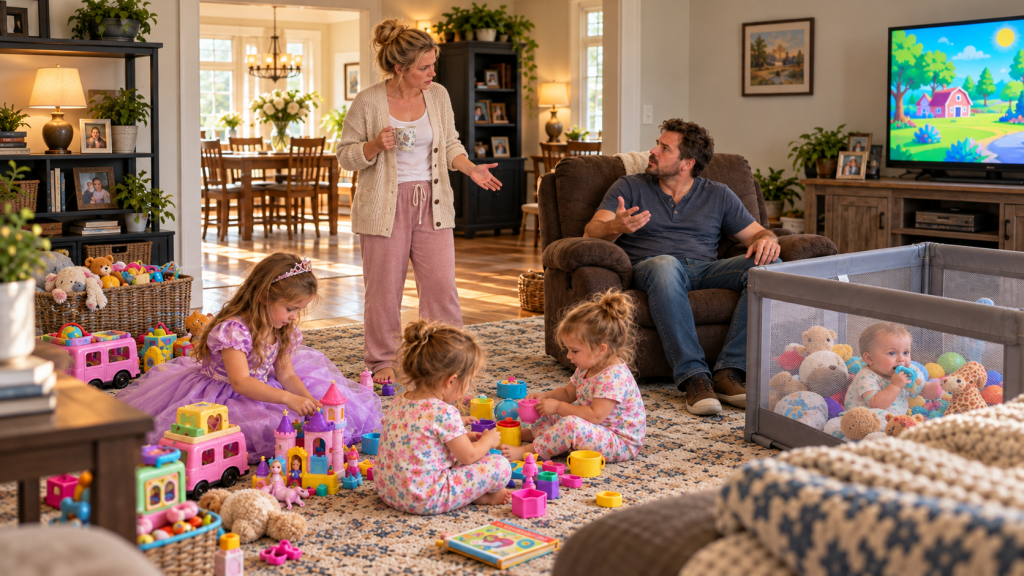
Upstairs, four children were sleeping in their beds, trusting that the two adults responsible for them would keep their world safe. And the man I’d married was apparently preparing to use my exhaustion against me. I shut off the water. Then sat down at the kitchen table.
My whole body trembled.
Twenty minutes.
That was all I’d asked for.
Twenty minutes to shower after spending the day feeding, changing, carrying, soothing, cleaning, and comforting four children who were all still too young to understand why their mother sometimes looked as though she might cry while folding laundry.
My husband, Adam, had agreed to watch them.
And while I was washing shampoo from my hair, he’d called his mother to discuss how to make me stop asking him for help.
Then he’d shouted at me.
Then I’d apologized.
Three times.
I watched myself on the recording.
My shoulders hunched.
My hair still damp.
My voice small and frightened.
“I’m sorry, Adam. I didn’t mean to make your evening harder.”
He leaned back on the couch.
“Well, you did.”
I paused the video.
For years, I’d believed that being a good wife meant recognizing how hard my husband worked.
He left home at eight every morning.
Returned around six.
Sometimes he brought unfinished work home and needed quiet.
I understood that.
What I hadn’t understood was why his eight-hour workday entitled him to rest while my day never seemed to end.
I thought about our oldest daughter, Maisie, who was four.
Our three-year-old twins, Ella and Evie.
And our little boy, Finn, who’d recently celebrated his first birthday.
I loved them beyond anything I knew how to explain.
But I couldn’t remember the last time I’d eaten an entire meal without someone needing me.
Or slept through the night.
Or gone to the bathroom without a small voice calling from the other side of the door.
I had been so tired that I’d started forgetting ordinary words.
Once, I’d stood in the grocery store staring at a shelf of cereal, unable to remember what I’d come to buy.
Adam had laughed when I told him.
“That’s what happens when your whole world is cartoons and diapers.”
I’d laughed too.
Now I wondered how many cruel things I’d accepted because I was simply too exhausted to challenge them.
My phone was still resting beside the sink.
I looked at the recording again.
At 7:11, Maisie approached her father with Finn’s pacifier.
She wasn’t screaming.
She wasn’t misbehaving.
She was trying to help.
At 7:17, Adam told his mother he’d make a fuss so I would stop asking him to supervise our children.
And at 7:19, he retrieved that envelope.
My hands began shaking again.
I saved a copy of the recording to a secure folder and made a separate backup.
I didn’t know whether it would ever matter legally.
I didn’t even know whether the audio could be used for anything beyond helping me understand what had happened.
But I knew I couldn’t trust myself to remember the details through the fog of exhaustion.
Then I quietly walked into the living room.
The couch cushion was still slightly crooked.
I lifted it.
Nothing.
I checked the space beside the armrest.
Nothing.
Adam had taken the envelope upstairs.
I stood there in the dim light, listening to the refrigerator hum.
Then I noticed something beneath the coffee table.
Finn’s pacifier.
The same one I’d opened the recording to find.
I bent down and picked it up.
Such a tiny thing.
A little blue pacifier with a plastic ring.
Yet finding it had uncovered a secret that threatened to change the lives of everyone in our house.
I held it in my palm.
Then whispered into the darkness, “What have you done, Adam?”
The next morning, I woke to Finn crying at five-thirty.
For a moment, I’d forgotten the video.
Then I remembered.
And my stomach tightened.
Adam was asleep beside me.
His phone rested on the nightstand.
I looked at him.
This was the man who used to bring me coffee when we were dating.
The man who held my hand during Maisie’s birth.
The man who cried when we learned we were expecting twins.
The man who once stayed awake all night holding our feverish baby girl because he was frightened something might happen to her.
I couldn’t make those memories fit the man I’d heard on the recording.
Perhaps that was what hurt most.
He hadn’t always been this way.
Or perhaps he’d always believed some of these things, and I’d never been exhausted enough to notice.
Finn cried again.
I got out of bed.
Adam stirred.
“Can you get him?” I asked quietly.
He opened one eye.
“Nora, I have work.”
I stared.
For the first time, I didn’t automatically apologize.
“I know.”
He closed his eyes.
“Then please don’t start.”
I stood motionless.
Finally, I walked into Finn’s room.
He was standing in his crib, cheeks pink, his little hands gripping the rail.
The moment he saw me, he reached out.
“Mama.”
I lifted him.
He rested his head against my shoulder.
And I began crying.
Not loudly.
Not enough to frighten him.
Just silent tears that slipped down my face and disappeared into his pajamas.
I kissed his hair.
“Oh, sweetheart.”
He patted my cheek.
For a moment, I imagined someone taking him away from me.
Taking all four of them.
And convincing a stranger that the woman who’d fed them, bathed them, comforted them, and stayed awake through every illness was somehow an unreliable mother because she’d needed twenty minutes to wash herself.
The thought almost brought me to my knees.
Then Finn lifted his head and smiled.
A sleepy, toothy smile.
Completely unaware of the fear inside me.
I hugged him.
And decided I needed help.
Not Adam’s reluctant help.
Not another apology from me.
Real help from someone who would listen.
I called my older sister, Rebecca, just after eight.
She answered from her car.
“Nora? Everything okay?”
I looked around the kitchen.
Maisie was building a tower with wooden blocks.
The twins were arguing over a purple cup.
Finn sat in his high chair rubbing banana into his hair.
An ordinary morning.
An ordinary, chaotic, beautiful morning.
And I felt as though I were standing at the edge of a cliff.
“Rebecca,” I whispered, “I need to tell you something.”
She heard it immediately.
“What’s wrong?”
I stepped into the laundry room, leaving the door open so I could still hear the children.
Then I told her about the shower.
Adam’s anger.
The security footage.
His conversation with his mother.
And the envelope.
For a long moment, Rebecca was silent.
Then she asked, “Are you and the kids safe right now?”
“Yes.”
“Has Adam threatened you?”
“Not directly.”
“Has he ever hurt you physically?”
“No.”
She took a breath.
“All right. I want you to listen carefully.”
My eyes filled.
“Nora, you have been telling me for months that you’re exhausted. Every time I’ve offered to visit, you’ve said you were fine because Adam didn’t want people interfering.”
I closed my eyes.
She continued.
“And every time I asked whether you wanted help, you said other mothers managed without complaining.”
My throat tightened.
“I know.”
“Who told you that?”
I stared at the washing machine.
Then whispered, “Adam.”
Rebecca was silent.
“And his mother.”
She exhaled slowly.
“Nora, you are raising four children under five. Needing rest does not mean you’re failing.”
I covered my mouth.
She continued.
“And your husband being alone with his own children for twenty minutes is not some extraordinary sacrifice.”
I began crying.
“Rebecca, he might try to take them.”
Her voice softened.
“Then we need to help you understand your options. You don’t have to figure this out alone.”
She arranged to take time off work the following afternoon.
She also gave me the number of a family-law attorney she’d met through a colleague.
Her name was Leah Porter.
I called while Finn napped.
The receptionist offered me a confidential consultation.
When I explained that I’d discovered a recording suggesting my husband might be documenting ordinary parenting situations as evidence against me, she found an earlier appointment.
For the first time in months, I put something on the calendar that wasn’t for Adam or the children.
It was for me.
That afternoon, while Adam was at work, I gathered our household documents.
I didn’t search his private messages or attempt to access accounts that weren’t mine.
I started with the shared family filing cabinet beside the dining room.
Birth certificates.
Insurance information.
Our mortgage.
Bank statements.
Medical records for the children.
I knew where everything was because I had always been the person responsible for keeping it organized.
Near the bottom of the drawer, I found a folder labeled HOUSEHOLD PLANNING.
Inside were several printed pages.
The first was a proposed weekly childcare schedule.
I almost laughed when I saw it.
According to the schedule, Adam handled breakfast three mornings a week.
He supervised afternoon playtime.
He managed bedtime on alternate nights.
And his mother provided regular childcare assistance.
I stared.
None of it was true.
Adam occasionally made toast on Saturdays.
He usually came home after I’d finished the children’s baths.
His mother visited once or twice a month, mostly to criticize how I handled feeding and discipline.
Yet here was a neat table describing a family in which the father performed half the daily childcare.
I turned the page.
PARENTING CONCERNS — NORA BENNETT.
My stomach dropped.
There were dated entries.
May 4: Became overwhelmed while twins cried.
May 18: Expressed inability to manage all four children.
June 2: Needed extended rest after difficult day.
June 11: Left children with father to take unnecessary shower.
I stared at the last entry.
Unnecessary.
The word seemed to burn through the paper.
I remembered May 4.
The twins had both been sick.
Finn was cutting teeth.
Maisie had spilled juice on the sofa.
I’d cried while trying to clean everything because I hadn’t slept more than three hours the previous night.
Adam had come home, found me sitting on the kitchen floor, and asked why dinner wasn’t ready.
He’d later told me I needed to get better at managing my emotions.
Now that evening was listed beneath my name as a parenting concern.
I turned another page.
There was a line describing me as “frequently emotionally unstable.”
Another called me “unable to maintain consistent household routines.”
I sat down.
I knew every child in that house.
I knew which twin needed the night-light turned toward the wall.
Which foods caused Finn to develop a rash.
How Maisie liked her bedtime story read twice, once normally and once with silly voices.
I kept four children fed, clothed, clean, loved, and safe through illnesses, sleepless nights, and the ordinary turmoil of growing up.
But the record Adam was assembling contained none of that.
It captured only the moments when I had struggled.
Stripped of context.
Arranged beneath a heading that made ordinary exhaustion sound like a character flaw.
Then I found the page that frightened me most.
It was a handwritten note in Marilyn’s distinctive slanting script.
Adam: Stop taking over when she complains. Let her show how poorly she manages. Be specific about dates. A good father needs evidence.
Below it, Adam had written:
Ask lawyer what happens if she refuses proposed schedule.
I put the paper down.
I sat there for a long time.
Then I photographed the documents as I found them and returned the folder to its place.
I didn’t know what any of it meant legally.
But I understood what it meant to me.
While I was trying to keep our family together, my husband and his mother were discussing how to build a case against me.
And every time I’d admitted being tired, I’d been handing them another sentence to write down.
At my consultation, Leah Porter listened without interrupting.
Her office was small and quiet.
A plant stood beside the window.
There were children’s drawings on one wall, framed in simple wooden frames.
I had expected someone severe.
Someone who would tell me I’d already made a dozen mistakes.
Instead, Leah handed me a glass of water and said, “Start wherever you need to.”
I told her everything.
Then I showed her the documents and the video.
She reviewed them carefully.
When she finished, she folded her hands.
“Nora, I want you to understand something important.”
I nodded.
“Being exhausted, asking your spouse to care for your children, or taking a shower does not make you an unfit parent.”
I began crying.
She offered me a tissue.
“Family courts generally focus on the children’s best interests and the actual circumstances of their care. Allegations need to be examined, not simply accepted because someone puts them in a document.”
I looked down.
“Can Adam take the children?”
“Both parents have rights and responsibilities. I can’t predict how a dispute would be resolved without reviewing the facts, the relevant law, and any actual filing. But there’s nothing you’ve described that makes caring for your own children for twenty minutes a reason to lose them.”
My shoulders sagged.
For the first time in days, I could breathe.
Leah continued.
“Don’t post the recording or circulate it. Laws governing recordings and their use vary, especially where audio is involved. Preserve the original files, and let us assess what can appropriately be used.”
I nodded.
“Should I confront him?”
“First, we should make a plan for your safety, the children’s routines, financial access, and legal options. You don’t have to make every decision today.”
I stared at the tissue in my hands.
Then whispered, “I don’t have a job.”
Leah looked at me.
“You have been working every day.”
I shook my head.
“I mean paid employment.”
“I understand.”
She leaned forward.
“Your contributions to the family matter. We’ll examine your finances and the options available if you decide to separate. Please don’t assume you have no choices simply because your work hasn’t come with a paycheck.”
I covered my mouth.
For years, I’d believed the salary Adam earned belonged to the family but the home I maintained belonged to me.
He was the provider.
I was the helper.
Now, sitting across from a woman who spoke about my time as something valuable, I realized how deeply I’d accepted that division.
Leah waited until I could speak.
Then asked, “Nora, what do you want?”
The question frightened me.
Because I didn’t know.
Not yet.
I only knew I couldn’t go back to apologizing for twenty minutes of hot water.
I didn’t tell Adam about the consultation that evening.
Not because I intended to keep secrets forever.
Because I needed a little time to understand what I wanted to say.
Rebecca came over the following afternoon.
She arrived carrying groceries, a bag of children’s books, and the determined expression she’d worn when we were girls and somebody had been unkind to me at school.
The moment Maisie saw her, she ran across the living room.
“Aunt Becca!”
Rebecca knelt.
“There’s my favorite four-year-old.”
Ella and Evie immediately demanded to know whether they were favorites too.
“Of course,” Rebecca said solemnly. “I have a whole collection of favorites.”
For the next two hours, she played on the floor with the girls while I fed Finn and prepared lunch.
Then she told me to go upstairs and rest.
I stared at her.
“What?”
“Rest.”
“Rebecca, the laundry—”
“Will still be here afterward.”
“The twins need—”
“They have an aunt.”
I opened my mouth.
She pointed toward the stairs.
“Nora, go.”
I went.
But when I reached my bedroom, I stood beside the bed without knowing what to do.
I hadn’t been alone in a quiet room during the day in so long that the silence felt unfamiliar.
I sat down.
Then lay back.
And within minutes, I fell asleep.
When I woke, almost ninety minutes had passed.
The house was quiet.
I rushed downstairs, expecting chaos.
Instead, Rebecca was sitting on the rug reading to the girls.
Finn was napping.
The kitchen was tidy enough.
Nothing extraordinary had happened.
I stared.
Rebecca looked up.
“Feel better?”
I nodded.
Then started crying.
She put down the book.
“Nora?”
I looked around.
“Nothing went wrong.”
She frowned.
“Of course not.”
I shook my head.
“I mean, you took care of them, and nothing went wrong.”
Rebecca stood and came toward me.
“Oh, sweetheart.”
I covered my face.
“I’ve been acting like if I stop moving for five minutes, the whole house will collapse.”
She hugged me.
“That’s what happens when nobody shares the weight.”
I held her tightly.
And in that moment, I realized just how much fear had become part of my ordinary routine.
Not fear that my children would hurt me.
Fear that I would need help and be punished for asking.
The next surprise arrived two days later.
A woman named Sandra called from a preschool.
“Mrs. Bennett?”
“Speaking.”
“I’m following up about the enrollment inquiry for Maisie and the twins.”
I frowned.
“What inquiry?”
There was a pause.
“Your husband submitted an interest form for three children. We were told the family might be changing its childcare arrangements.”
My stomach tightened.
“When?”
“Last week.”
I gripped the phone.
“Did he list me as a contact?”
“Yes, ma’am. That’s why I’m calling.”
I asked Sandra to email me the basic inquiry information.
When it arrived, I stared at the screen.
Adam had listed himself as the primary contact.
He’d described himself as the parent responsible for coordinating the children’s daily care.
And beneath a section asking about scheduling preferences, he’d written:
Likely need full-day placement following anticipated change in family residence.
My pulse thundered.
Change in family residence.
For whom?
I called Leah.
She asked me to forward the email.
“Don’t assume the worst from one form,” she said. “But we should ask Adam directly what arrangements he’s contemplating.”
I stared at the paperwork.
“He’s planning something.”
“He may be. We’ll address it carefully.”
Then she added, “Nora, whatever happens in your marriage, the children still need stable routines and safe, attentive care. Let’s keep that at the center of every decision.”
I nodded.
After the call, I sat at the kitchen table, staring at Maisie’s crayons.
I thought about the mornings we’d spent walking to the playground.
The songs we sang while folding tiny clothes.
The way the twins said “Mommy” together when they wanted to tell me a secret.
I had been their constant.
Their meals.
Their bedtime stories.
Their comfort when they woke frightened.
Now Adam was describing himself to strangers as the person who managed their daily lives.
I wasn’t frightened of him becoming a more involved father.
I wanted that.
I’d wanted it desperately.
What frightened me was the possibility that he’d decided his way to become their primary parent was to pretend I hadn’t been doing the job all along.
That evening, I asked Adam to talk after the children were asleep.
Rebecca was in the guest room, staying overnight at my invitation.
I had told Adam she was visiting because I needed help.
He’d rolled his eyes but hadn’t objected.
We sat at the kitchen table.
The same table where I’d packed lunches, cut sandwiches into triangles, and celebrated Maisie’s fourth birthday.
Adam looked tired.
“What’s this about?”
I placed a copy of the preschool inquiry in front of him.
His expression changed.
“Where did you get that?”
“They contacted me because I’m listed as a parent.”
He looked down.
I asked, “What family residence is changing?”
He rubbed his forehead.
“Nora, Mom thinks we should consider some options.”
I felt my heart pounding.
“Which options?”
He was silent.
I waited.
Finally, he whispered, “A separation.”
The word hung between us.
For months, I’d imagined telling him I couldn’t continue living this way.
I hadn’t realized he’d already been discussing leaving.
“How long?” I asked.
He looked confused.
“How long what?”
“How long have you been talking to your mother about separating from me?”
He stared at the table.
“Since spring.”
I closed my eyes.
Spring.
Months of bedtime stories.
Family meals.
Ordinary mornings when I’d kissed him goodbye and told him to drive safely.
All while he considered a future without me.
“Why didn’t you tell me?”
He looked up.
“Because every time I brought up problems, you got emotional.”
I took a slow breath.
“Adam, I cried because I was exhausted.”
He sighed.
“That’s exactly what I mean.”
Something inside me settled.
I opened my phone and placed it on the table.
“I watched the living-room recording from Tuesday.”
His face went pale.
For several seconds, he didn’t speak.
Then he whispered, “What?”
“I heard you call your mother.”
His eyes moved toward the doorway.
I continued.
“I heard you say you’d pretend the children were impossible so I’d stop asking you to supervise them.”
He stared.
“And I heard her tell you to keep notes about me.”
Adam leaned back.
“Nora—”
“Please don’t tell me I misunderstood.”
My voice trembled.
“Just tell me whether it was true.”
He looked away.
I waited.
Finally, he whispered, “Yes.”
The word broke something inside me.
I hadn’t realized how desperately I still wanted him to deny it.
To explain.
To somehow make the recording mean something less terrible.
Instead, he sat across from me and admitted he’d deliberately made me feel guilty for taking a shower.
“Why?” I asked.
His eyes filled.
“I didn’t want more responsibility.”
I stared.
He swallowed.
“I know how awful that sounds.”
I nodded slowly.
“It does.”
He looked down.
“At work, everybody needs something from me. When I get home, I just want quiet.”
I took a breath.
“Adam, the children need things from me all day too.”
“I know.”
“No, I don’t think you do.”
He didn’t argue.
I continued.
“You don’t get to stop being their father because you’ve finished your paid work.”
His eyes filled.
Then I asked, “What were you planning to tell a court?”
He covered his face.
For a long moment, I thought he wouldn’t answer.
Finally, he whispered, “That you couldn’t manage without help.”
I stared.
“But you refused to give me help.”
He began crying.
“I know.”
“And then wrote down the times I struggled?”
He nodded.
I looked at the man I’d married.
And suddenly, the truth was painfully clear.
He hadn’t been documenting my failures.
He’d been helping create the conditions in which I was most likely to struggle, then recording those moments as evidence.
I pushed back my chair.
“Adam, I need you to understand something.”
He looked up.
“I don’t know whether our marriage can survive this.”
His face crumpled.
But I continued.
“And I am not going to apologize for saying so.”
Adam stayed at the table long after I stopped speaking.
I could see him struggling to find the right words.
For years, I’d rushed into silences like that.
I’d reassured him.
Explained that I was probably overreacting.
Promised we could forget whatever had happened.
This time, I let the silence remain.
Finally, he asked, “What do you want me to do?”
I looked at him.
“Tell me the truth.”
He lowered his eyes.
“About everything?”
“Everything that affects me or the children.”
He took a long breath.
Then explained that his mother had started encouraging him to consult a lawyer after hearing him complain about the household.
At first, he’d spoken about wanting a more predictable schedule.
Then Marilyn had suggested that I might be incapable of caring for the children without constant assistance.
Adam admitted he’d repeated some of those claims during an initial legal consultation.
“What did the lawyer say?” I asked.
He hesitated.
“She said the court would want accurate information about the children’s care.”
I stared at him.
“And?”
“She asked who handled meals, appointments, bedtime, and the kids during the day.”
“What did you tell her?”
He looked down.
“That you did.”
My eyes filled.
He continued.
“She said I needed to understand what parenting time would actually involve if we separated.”
I waited.
“She didn’t tell you to pretend I was incapable?”
“No.”
The answer came quietly.
“That was Mom’s idea.”
I stared.
Adam added, “And mine. I agreed to it.”
At least he hadn’t tried to place all the blame on Marilyn.
Then he told me about another conversation.
His mother had offered to help him raise the children if he moved closer to her.
She’d even begun looking at houses with enough bedrooms.
My stomach tightened.
“You’re planning to move them away?”
He shook his head.
“I was thinking about it.”
“Without discussing it with me?”
He nodded.
I stood and walked toward the window.
Outside, our children’s little plastic watering cans were lined up beside the patio.
Maisie had arranged them by color that morning.
I stared at those bright objects, trying to steady myself.
Adam approached but stopped several feet behind me.
“Nora, I didn’t know what I was doing.”
I turned.
“You knew enough to keep it from me.”
He looked down.
I continued.
“You knew enough to prepare documents. To make calls. To arrange consultations. To describe me as incapable while I cared for your children.”
My voice shook.
“You had time to plan an entire life without me, but you couldn’t give me twenty minutes to shower.”
He began crying.
And for the first time, I didn’t feel responsible for stopping his tears.
Marilyn called the following morning.
Adam had told her about our conversation.
She demanded to speak to me.
I agreed, but only with Adam present.
I wasn’t willing to have my words carried back and forth between them anymore.
The call began exactly as I’d expected.
“Nora, I think you’ve misunderstood a mother’s concern for her son.”
I looked at Adam.
Then answered calmly.
“Marilyn, I heard you tell Adam to make a fuss when I came out of the shower.”
She went quiet.
I continued.
“I also heard you encourage him to collect evidence that I couldn’t cope.”
Her voice hardened.
“Four children are a lot for one woman.”
“Yes,” I replied. “That’s why I asked their father to help.”
She sighed.
“You know what I mean.”
“No, Marilyn. I don’t think I do.”
For a moment, nobody spoke.
Then she said, “I raised Adam almost entirely by myself after his father left. I know what happens when one parent gets overwhelmed.”
I looked at my husband.
He was staring at the table.
Marilyn continued.
“I wasn’t going to watch my son lose his children.”
Something about her words made the situation clearer.
She’d been frightened.
Perhaps genuinely frightened.
Her own marriage had ended painfully, and she’d never stopped expecting the same thing to happen to Adam.
But fear didn’t excuse the choices she’d made.
“Marilyn,” I said, “I’m sorry for what you experienced. But you are not protecting these children by making false claims about their mother.”
She started to speak.
I continued.
“You cannot rewrite what happens in our home because you’re frightened of what might happen someday.”
Her voice sharpened.
“Are you threatening to keep my grandchildren away?”
“No.”
I took a breath.
“I’m telling you that decisions about their care belong to their parents, and those decisions need to be truthful and focused on what the children need.”
Adam finally spoke.
“Mom, stop.”
There was silence.
Then Marilyn whispered, “Adam?”
He looked toward me.
Then said, “Nora hasn’t done anything wrong by asking me to watch the kids.”
His voice trembled.
“I lied about what happened.”
I closed my eyes.
Marilyn didn’t answer.
Adam continued.
“And I’m not going to use those notes against her.”
His mother began crying.
I listened quietly.
I didn’t feel triumphant.
I felt terribly sad.
A woman who’d once feared losing her child had helped her adult son turn that same fear against another mother.
And four innocent children were now at the center of it.
I ended the call by explaining that I needed a period of distance and that any future visits would need to respect our parenting arrangements.
Marilyn protested.
I repeated myself.
Then hung up.
Over the next several weeks, Adam and I attended separate legal consultations and began discussing a separation.
There were difficult conversations about housing.
Money.
Childcare.
Parenting schedules.
And what it would mean for four very young children whose lives depended on routine.
I didn’t pretend any of it was simple.
Adam was their father.
They loved him.
Despite his failures, there had been evenings when he’d read them stories and mornings when he’d carried Finn around the kitchen singing nonsense songs.
Those moments mattered.
But they didn’t erase his dishonesty.
And loving the children wasn’t enough if he refused to take responsibility for their actual care.
We agreed to begin working through a structured parenting plan with professional assistance.
Adam moved into an apartment nearby.
For the first time, he had to arrange his working hours around feeding, changing, bathing, and settling the children himself during his parenting time.
At first, he struggled.
He called me to ask which pajamas belonged to which twin.
He forgot to pack extra wipes.
He discovered that Finn hated having his sleeves pulled over his hands.
He learned that Ella needed to hear the same bedtime song twice, while Evie preferred a story about animals.
And one evening, he called looking utterly defeated.
“How do you do this every day?”
I stared at the phone.
For a moment, I wanted to laugh.
Another part of me wanted to cry.
Instead, I answered, “I learned. And I kept learning because they needed me.”
He was silent.
Then whispered, “I should have learned beside you.”
I closed my eyes.
“Yes, Adam.”
He nodded.
“You should have.”
But unlike before, I didn’t offer to take over simply because he was overwhelmed.
I helped him understand what the children needed.
I made sure they were safe.
And I expected him to become competent at caring for his own children.
Because the solution to his ignorance wasn’t for me to carry the entire burden again.
It was for him to grow into the father he’d always had the opportunity to become.
Six months later, our lives looked very different.
The separation had become formal.
With legal guidance, we had reached an arrangement that kept the children connected to both parents while recognizing the routines and care they needed.
I remained their primary day-to-day caregiver.
Adam had scheduled parenting time, clear responsibilities, and a plan for gradually handling longer stretches independently as the children adjusted.
We also agreed that neither of us would make major changes to the children’s living arrangements without properly addressing them together.
There were still disagreements.
Some weeks were exhausting.
But those disagreements were no longer supposed to be settled by threats, invented records, or secret conversations.
Adam acknowledged in writing that the earlier notes contained misleading descriptions of my caregiving.
They were not used as the basis for our arrangements.
Leah helped me understand the financial support and resources available while I began rebuilding my independence.
Rebecca continued visiting.
And I found part-time administrative work with a medical clinic, using skills I’d developed before Maisie was born.
It wasn’t a glamorous job.
But on my first payday, I sat in the car staring at the deposit notification.
Then I began crying.
Not because earning a paycheck made the years I’d spent raising my children more valuable.
Those years had always mattered.
I cried because I was beginning to have choices again.
Choices about my time.
My money.
My future.
And the kind of home I wanted my children to remember.
One Saturday afternoon, Adam arrived to collect the girls and Finn.
Maisie opened the door before I reached it.
“Daddy!”
She ran into his arms.
He lifted her carefully.
For a moment, I watched them.
Then Maisie asked something that made us both go still.
“Daddy, remember when I wanted to make Mommy tea?”
Adam looked at me.
I knew immediately what she meant.
The evening of the shower.
The little girl who’d carried Finn’s pacifier.
Who’d tried to help.
And who’d been told to sit down because her father didn’t want to be interrupted.
Adam knelt.
“Yes, sweetheart.”
Maisie looked at him.
“You were grumpy.”
He swallowed.
“I was.”
She considered.
“Mommy was very tired.”
Adam’s eyes filled.
“She was.”
Maisie looked toward the kitchen.
“I wanted to make her feel better.”
I pressed my hand against my mouth.
Adam took a breath.
“That was a kind thing to want, Maisie.”
He looked directly at her.
“And I’m sorry I spoke sharply to you.”
She nodded.
Then asked, “Can we make tea another time?”
He smiled through tears.
“Yes.”
I stepped closer.
“But you know something, sweetheart?”
She looked at me.
“It’s not your job to make sure Mommy feels okay all the time.”
She frowned.
“Why?”
“Because grown-ups are responsible for taking care of themselves and helping each other. You can be kind, but you don’t have to fix our feelings.”
She considered that.
Then smiled.
“Can I still make you a drawing?”
I laughed through tears.
“Always.”
Adam looked at me.
There was regret in his face.
But there was something else too.
Understanding.
At least the beginning of it.
I hoped it would grow.
For the children’s sake.
And for his own.
That evening, the house was quiet.
The children were spending their scheduled time with Adam.
For the first time in years, I had several uninterrupted hours to myself.
I looked around the living room.
Toys rested in baskets.
The twins’ blankets were folded on the sofa.
Finn’s little blue pacifier sat on a clean cloth near the kitchen sink.
I picked it up.
For a moment, I remembered the night everything changed.
The dishes.
The security recording.
The envelope.
My shaking hands.
And the terrible realization that the person I’d trusted most had been using my exhaustion as a weapon.
I still had difficult days.
Sometimes I cried after the children went to bed.
Sometimes I missed the marriage I’d believed I had.
Sometimes I wondered whether I could have recognized the warning signs sooner.
But I no longer blamed myself for needing rest.
Or for believing a husband would honor a promise to watch his own children.
I put the pacifier away.
Then walked upstairs.
I turned on the shower.
The water warmed slowly.
Steam gathered against the mirror.
I stood beneath the spray and waited for the familiar rush of guilt.
The urge to hurry.
The instinct to listen for crying.
The feeling that somebody would soon call my name and demand that I explain why I’d taken so long.
But nothing happened.
The house remained quiet.
I washed my hair.
Let the warm water fall across my shoulders.
And for once, I didn’t count the minutes.
When I finally stepped out, nearly half an hour had passed.
I looked at myself in the mirror.
My hair was damp.
There were shadows beneath my eyes.
A few new lines had appeared around my mouth.
I looked older than I had before the twins were born.
But I also looked like someone I recognized.
Nora.
Not just Mommy.
Not just Adam’s wife.
Not just the person who remembered the snacks, appointments, medicines, socks, and bedtime routines.
Nora.
A woman who had loved deeply.
Worked constantly.
Lost herself for a while.
And slowly begun finding her way back.
A year after that night, Maisie brought home a drawing from preschool.
It showed a house with a yellow roof.
Four small children stood in the garden.
Beside them was a woman with long brown hair.
The woman was holding a cup.
“What is this?” I asked.
Maisie smiled.
“Our family.”
I looked closer.
“What’s Mommy holding?”
“A cup of tea.”
I laughed.
“Why?”
She looked at me seriously.
“Because Mommy gets to sit down too.”
My eyes filled.
Then she pointed toward another figure.
It was a man standing near the children with a small red ball in his hand.
“That’s Daddy,” she explained.
I nodded.
“He plays with us now.”
My throat tightened.
I studied the drawing.
It wasn’t a picture of a perfect family.
We didn’t live together anymore.
There were still conversations Adam and I struggled to have.
Still memories I couldn’t forget.
Still questions about what our future relationships would look like.
But the children were learning that both their parents could care for them.
That they could ask their father for help.
That their mother could rest.
And that needing love and attention didn’t make them a burden.
I placed the drawing on the refrigerator.
Then took Maisie’s hand.
“Thank you, sweetheart.”
She smiled.
“You’re welcome.”
And ran off to join her sisters.
I stood looking at the picture for a long time.
For years, I’d believed being a good mother meant giving every part of myself away.
Every hour.
Every moment of rest.
Every quiet thought.
I thought if I loved my children enough, I should never feel overwhelmed.
And if my husband worked hard, I should never ask him to do more.
But the truth was simpler.
My children never needed a mother who sacrificed her health and happiness to prove she loved them.
They needed a mother who was supported, respected, and allowed to remain a person.
The twenty-minute shower hadn’t ruined my husband’s evening.
It had revealed a truth I could no longer ignore.
And though discovering that truth broke my heart, it also gave me the courage to rebuild a life where my needs were no longer treated as an inconvenience.
Because being a family doesn’t mean one person carries everyone while the others rest.
It means learning to carry life together, and never making someone feel guilty for needing a hand.
That evening, after the children were asleep, I made myself a cup of tea.
I sat beside the window.
The house was peaceful.
And for the first time in longer than I could remember, I didn’t feel guilty for sitting down.