
For fifty-six years, I had believed my mother sold her silver locket because she couldn’t afford the last year of my piano lessons. Now it lay in my palm, beneath the stained-glass windows of the same church where someone had once made us feel ashamed of honest work.
And Roland Upshaw was telling me his mother had taken it. I stared at him. “What do you mean, she took it?” His hands rested on the piano keys, but they had stopped trembling. The congregation was still standing. Behind us, I could hear people whispering, shifting in their pews, and wondering why two elderly strangers had interrupted the closing hymn.
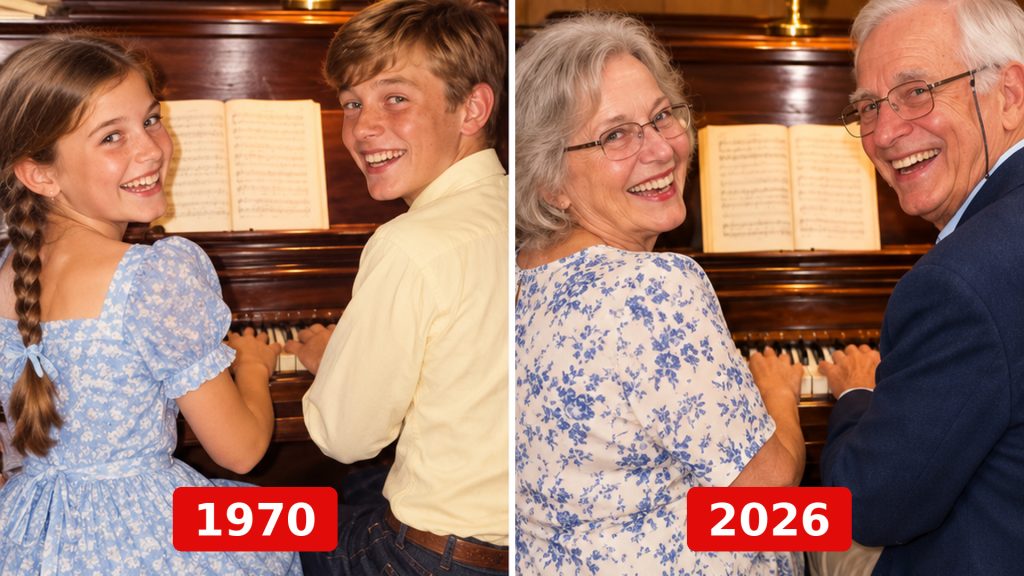
Roland looked toward the pastor. “Could we have a few minutes?” The young man nodded immediately. “Of course.” Then he turned toward the congregation. “Friends, we’ll conclude our service here. Please join us for refreshments in the fellowship hall.” People began moving toward the exits.
A few smiled at us.
One elderly woman pressed her hand against her heart.
But I didn’t look at anyone.
My eyes remained on the locket.
It was smaller than I remembered.
Oval.
Silver.
With tiny engraved flowers around the edges.
There was a dent near the clasp where I’d dropped it on Mama’s kitchen floor when I was seven.
I knew that dent.
I knew every mark on that piece of jewelry.
Mama used to wear it on a thin chain beneath her dress while she stood at her ironing board.
Sometimes, when the kitchen got too hot, she’d take it off and set it beside the radio.
I’d open it and stare at the little photographs inside.
One showed my father, Jonas Pate, wearing his Sunday suit.
The other showed Mama holding me when I was a baby.
After Daddy died, she almost never took it off.
Then one autumn morning in 1970, it disappeared.
Mama told me she’d sold it to pay for another year of lessons.
I remembered crying.
Not because I didn’t appreciate what she’d done.
Because I understood, even at twelve, that the locket was one of the few things she had left of Daddy.
I’d begged her to stop paying for lessons.
She’d cupped my face in her rough hands.
“Cora, your daddy would’ve wanted you to keep playing.”
And that had been the end of it.
Until now.
Roland carefully closed the piano lid.
“Cora, I didn’t know about the locket until eight months ago.”
I looked up.
“What happened eight months ago?”
“My mother died.”
I lowered my eyes.
Mrs. Upshaw.
The woman in the expensive hat.
The woman who’d decided a child wasn’t worthy of sitting beside her son because that child’s mother ironed other people’s clothes.
For fifty-six years, I’d remembered her voice more clearly than her face.
Roland took a breath.
“She was ninety-seven. Near the end, she started talking about things she’d never admitted before.”
He glanced at the pouch.
“She asked me to bring her jewelry box from the dresser.”
My fingers tightened around the locket.
“Was this inside?”
He nodded.
“Wrapped in a handkerchief.”
For a moment, I couldn’t speak.
Then I whispered, “Why would she keep it?”
Roland’s eyes filled.
“That’s what I asked her.”
He looked toward the empty pews.
“And what she told me made me ashamed of how little I understood about the woman who raised me.”
I felt something tighten in my chest.
Before he could continue, the pastor approached.
“Mr. Upshaw, I’ve opened the small meeting room beside the chapel. You can speak there if you’d like.”
Roland nodded.
“Thank you, Reverend Ellis.”
Then he stood slowly.
At sixty-nine, he was taller than I remembered, although that wasn’t saying much.
The boy I’d known had been thirteen.
The man beside me had white hair, slightly stooped shoulders, and hands that had spent more than four decades making music for other people.
He offered me his arm.
I looked at it.
Then took it.
And together, we walked away from the piano bench where our childhood had ended.
The meeting room smelled of coffee and polished wood.
There was a round table, four chairs, and a little bookshelf filled with donated Bibles.
Roland brought two paper cups of water.
I set the locket on the table between us.
For a long moment, neither of us spoke.
Then he reached into his jacket and removed another envelope.
It was yellowed, with a corner torn away.
Across the front, in handwriting I recognized as my own, were the words:
Roland Upshaw.
I stared.
“My letter.”
He nodded.
“Your second one.”
I reached toward it.
“How did you get it?”
“My mother gave it to me after my father died.”
“When was that?”
“1994.”
I looked up sharply.
Twenty-four years after we’d stopped playing together.
He watched my face.
“I was thirty-seven, Cora. Married. Teaching music. Trying to understand why my mother had kept a letter from a twelve-year-old girl in a locked desk for nearly a quarter of a century.”
My throat tightened.
“Did she tell you why?”
He shook his head.
“She said she’d done what she thought was best.”
I looked down.
That was what people said when they wanted their intentions to matter more than the damage they’d caused.
Roland continued.
“Until then, I believed you hadn’t answered a single letter.”
I stared at him.
“I wrote twice.”
“I know that now.”
His eyes filled.
“My first year at the academy, I wrote to you almost every Sunday. I addressed the envelopes to your old house, but my mother told me she had to forward them because the academy’s outgoing mail arrangements were unreliable.”
He gave a sad laugh.
“I believed her.”
I touched my own letter.
“Nothing ever came.”
“I know.”
He looked toward the window.
“At Christmas, she told me you’d asked her to make me stop writing.”
My heart seemed to fold in on itself.
“Roland, I never said that.”
His voice broke.
“I know.”
For a moment, we sat in silence.
Then I asked the question I hadn’t allowed myself to ask in fifty-six years.
“Why didn’t you come back?”
He lowered his head.
“I did come back. A few times. But the church had changed its youth program, and I didn’t know where you were.”
I waited.
He looked at me.
“And later, when I was old enough to find out, I was afraid.”
“Afraid of what?”
“That she had told me the truth.”
His eyes filled.
“That you really didn’t want anything to do with me.”
I looked down at my hands.
I wanted to be angry.
Part of me was.
We’d both grown into adults.
We’d both lived full lives.
There had been telephones, directories, mutual acquaintances, and more than enough years to look for one another.
But I also understood something about shame.
Once someone convinces you that you are unwelcome, it can take a lifetime to believe you’re allowed to knock on the door again.
Roland pushed the envelope toward me.
“Read it.”
I unfolded the letter.
The handwriting was childish.
My letters leaned in different directions, and I’d dotted one of the i’s with a little flower.
Dear Roland,
I don’t know why you haven’t written back. I hope you’re not sick. I hope you like your new school.
I practiced our song today. It’s hard without you because I keep playing too fast where you used to slow down.
Berniece says I ought to forget about it. But I don’t want to.
If you don’t want to write, that’s all right. I just wish you’d tell me yourself.
At the bottom, I’d added:
I still owe you a Co-Cola.
I covered my mouth.
Then I began crying.
Roland reached across the table.
“Cora, I carried that letter in my wallet for years after I finally got it.”
I looked up.
He smiled sadly.
“I kept thinking about that last line.”
My voice trembled.
“About the Co-Cola?”
He nodded.
Then whispered, “No. About wishing I’d told you myself.”
For a moment, I was twelve again.
Sitting at the piano.
Watching his mother take his arm.
Trying not to cry because the entire room was watching.
And for the first time, I understood that the little boy who had stared at the floor might have felt as powerless as I had.
But then Roland said something that brought me back to the present.
“There’s another letter.”
I looked up.
He reached into his jacket again.
“This one was written by your mother.”
My breath caught.
“And my mother kept it hidden for fifty-five years.”
The envelope was addressed to Mrs. Beatrice Upshaw.
I recognized Mama’s handwriting immediately.
She wrote slowly, carefully, the way she did when addressing Christmas cards or filling out important forms.
Her hands were often swollen after hours at the ironing board.
When I was little, she’d sit at the kitchen table with a pencil and practice writing her name because she wanted every letter to look beautiful.
Delia Mae Pate.
There it was, written across the bottom of the page.
My mother’s name.
I hadn’t seen her handwriting in nearly eighteen years.
My fingers trembled as I unfolded the letter.
Mrs. Upshaw,
I have worked for your family for nine years, and in all that time I have never taken a thing that didn’t belong to me.
I stopped reading.
Roland watched quietly.
I continued.
You said there was sixty dollars missing from your husband’s shirt pocket after I collected the laundry. You said you would keep my silver locket until the money was found or repaid.
My heart pounded.
I looked up.
“She accused Mama of stealing?”
Roland nodded.
“Yes.”
I stared at him.
“My mother?”
His eyes filled.
“I know.”
I looked down again.
I did not take that money. You know I did not. Mr. Upshaw told me himself that he had found the envelope among the papers in his office desk.
I pressed a hand against my chest.
The money had been found.
And still Mrs. Upshaw had kept the locket.
I forced myself to continue.
I am asking you to return what belongs to me. My husband gave me that locket the year our daughter was born. Its value is not something you can measure in dollars.
My eyes blurred.
I am also asking you to let the children write to one another if they wish. They have done nothing wrong.
I stopped.
Roland looked toward the table.
Mama hadn’t merely stood in silence.
She had spoken.
Maybe not in the church basement, where everyone watched her.
But later, when she had time to gather her thoughts, she’d defended herself.
And me.
I read the final paragraph.
I know you think your son is better than my daughter because your family has money and mine does not.
But my hands have never been dishonored by working. I press your husband’s shirts because I am paid to do honest work. I buy my daughter’s lessons because she has a gift worth nurturing.
You may decide whom your son sits beside. You cannot decide what my daughter is worth.
Please return my property.
Sincerely,
Delia Mae Pate.
I lowered the paper.
Then I began sobbing.
All those years, I’d remembered Mama standing beside a plate of tea cakes while Mrs. Upshaw humiliated us.
I’d remembered her folded hands.
Her silence.
The careful way she’d walked home afterward.
And I’d mistaken that silence for surrender.
But she’d written this letter.
She’d demanded her locket.
She’d defended her daughter.
And she’d refused to let an influential family define her worth.
Roland waited until I could speak.
Then he said quietly, “There’s something I need to show you.”
I looked up.
He placed a third piece of paper beside Mama’s letter.
This one was newer.
It had been written on white stationery, in a shaky hand.
“My mother dictated some of this to me during her final illness,” he explained. “She signed it herself after I read it back.”
I stared at the page.
“Why?”
Roland took a breath.
“Because I told her I wanted the truth in writing.”
He looked directly at me.
“And because I didn’t want you to have to choose between believing me and believing the woman who hurt your family.”
I unfolded it.
At the top was the date.
Eight months earlier.
Beneath it were the words:
A STATEMENT ABOUT DELIA PATE.
Mrs. Upshaw’s account was painfully direct.
She admitted that her husband’s missing money had been found in his office.
She acknowledged that she had continued withholding the locket after learning the accusation was false.
She wrote that she’d disliked the closeness between her son and a girl whose family occupied a lower social position.
She admitted intercepting letters because she wanted the friendship to fade.
And then came the sentence that made me put my hand over my mouth.
I did these things not because Delia Pate was dishonest, but because I was ashamed of my own cruelty and too proud to admit it.
I stared at the words.
For fifty-six years, I’d pictured Beatrice Upshaw as a woman who could never be wrong.
Now, in her final months, she’d apparently been frightened enough by her own conscience to tell the truth.
But a confession wasn’t the same thing as an apology received.
She’d died without ever speaking to Mama again.
Without returning the locket while Mama was alive.
Without giving those two children back the years she’d stolen.
I looked at Roland.
“Did she ask you to forgive her?”
He nodded.
“Yes.”
“Did you?”
He considered.
“I told her I loved her.”
Then he looked down.
“But I also told her that what she did was wrong.”
I sat quietly.
He continued.
“I think she wanted me to say everything was all right.”
“Was it?”
“No.”
His answer came immediately.
I looked at the locket.
He reached toward it but stopped short of touching it.
“I spent my whole life believing my mother was protecting me from something.”
His voice trembled.
“Near the end, I discovered she was protecting her pride.”
For a long moment, neither of us spoke.
Then I asked, “Why did you bring all this to church today?”
He looked surprised.
Then smiled sadly.
“Because it was the last place I knew I could find you if you ever returned.”
I frowned.
“Roland, you didn’t know I was coming.”
“No.”
He glanced toward the doorway.
“But after my mother died, I began carrying the locket and letters whenever I came here. I thought perhaps someone who remembered your family might help me find you.”
He paused.
“I asked the pastor to mention my retirement in the neighboring churches’ bulletins, and I hoped the old friends who saw it might come.”
I stared at him.
He continued.
“I didn’t expect you to walk down the aisle.”
He laughed shakily.
“I certainly didn’t expect you to sit down and start playing.”
I smiled through tears.
“Neither did I.”
Then he looked at the letter.
“I wasn’t trying to bring back the past, Cora.”
His voice softened.
“I wanted you to have the things that belonged to your family.”
I looked toward the locket.
And for the first time, I felt something I hadn’t expected.
Not joy.
Not relief.
Anger.
An old, quiet anger that had waited fifty-six years for permission to exist.
“Roland, your mother had no right.”
He nodded.
“I know.”
“She had no right to accuse Mama.”
“I know.”
“She had no right to keep Daddy’s locket.”
He lowered his eyes.
“I know.”
My voice broke.
“And she had no right to make two children believe they weren’t allowed to be friends.”
Tears slipped down his cheeks.
“No, Cora.”
I covered my face.
“She had no right.”
Roland didn’t tell me to calm down.
He didn’t defend his mother.
He didn’t ask me to understand that things were different in 1970.
He simply let me grieve something I’d never been allowed to name.
And somehow, that mattered.
I drove home that afternoon with the locket in my handbag.
Roland walked me to my car.
He’d written his telephone number on the back of the church bulletin.
“Would it be all right if I called you sometime?” he asked.
I smiled faintly.
“Roland, we’ve already spent fifty-six years not talking.”
He laughed.
“That’s true.”
“Seems foolish to make it fifty-seven.”
His eyes filled.
“Then I’ll call.”
I hesitated.
“Tell me something.”
“Anything.”
“Why did you always play only the top part of our duet?”
He looked toward the church.
For a moment, his face seemed younger.
“At first, because I couldn’t bear to play the whole arrangement alone.”
I swallowed.
“And later?”
He smiled sadly.
“Because people kept asking why the music sounded unfinished.”
I looked at him.
“What did you tell them?”
He took a breath.
“That some songs were written for more than one person.”
I stared.
Then he added gently, “But I also had a life, Cora. I married a wonderful woman. We raised our son. I loved her very much.”
I nodded.
“I loved Elam too.”
“I know.”
He glanced toward the car.
“My wife, June, used to say the last hymn sounded like someone had forgotten to come in on the second line.”
I smiled through tears.
“Did you tell her about me?”
“Yes.”
He nodded.
“She said if I ever found you, I ought to let you know there was still room on the bench.”
The words moved through me like sunlight entering a room that had been closed for years.
I looked toward the church.
Then back at him.
“Well,” I whispered, “you can tell June I finally showed up.”
Roland’s eyes filled.
“She would’ve liked you.”
I took his hand.
For a moment, we stood in silence.
Then I got into my car.
And drove home with my mother’s locket, her missing letter, and the strange feeling that a part of my childhood had finally been returned.
When I reached my house, the first thing I saw was Elam’s empty recliner.
It stood beside the front window, just as it had since the day he died.
His reading glasses still rested on the little table beside it.
A folded newspaper lay in the basket underneath.
I hadn’t been able to move any of it.
For three years, I’d walked around that chair as though my husband might return from the field at any moment, take off his boots, and ask what was for supper.
Now I stood in the doorway carrying another man’s letters.
Another man’s memories.
And a piece of my mother’s past I’d believed was gone forever.
I felt suddenly disloyal.
Then I imagined Elam standing in the kitchen with that steady expression of his.
Well, Cora, did you get your questions answered?
I laughed through tears.
“Some of them, honey.”
I set the locket on the table.
Then I sat in his chair.
For the first time in three years.
The cushion had grown stiff.
The armrests were worn smooth.
I could almost feel the shape of the life he’d lived there.
And I cried.
For Mama.
For the little girl who’d been humiliated in the church basement.
For Roland.
And for Elam, who’d loved me without ever demanding to know why I sometimes hummed a song I couldn’t bear to finish.
That evening, my daughter called.
“Well, Mama?”
Her name is Marian.
She has Elam’s practical mind and my mother’s determination.
I smiled.
“Well, what?”
“Don’t start that. Did you see your piano boy?”
I looked at the locket.
“Yes.”
She was silent.
Then she asked, “And?”
“We played together.”
A pause.
“You what?”
I laughed.
“Walked right up the aisle and sat down beside him.”
“Mama!”
“I know.”
She began laughing so hard I could hear her putting down whatever she’d been carrying.
Then her voice softened.
“What happened?”
I told her everything.
The letters.
The intercepted mail.
The stolen locket.
Mrs. Upshaw’s confession.
By the time I finished, Marian was crying.
“Mama, Grandma Delia never told you?”
“No.”
Marian took a breath.
“That poor woman.”
I looked down.
“She was stronger than I knew.”
My daughter was quiet.
Then she said, “Mama, maybe she didn’t tell you because she didn’t want you to grow up thinking that woman had power over your whole life.”
I considered.
“Maybe.”
Marian continued.
“Grandma always told me she wanted us to be proud of what we earned.”
I smiled through tears.
“She did.”
Then my daughter asked the question I’d been avoiding.
“How do you feel about Roland?”
I looked toward Elam’s chair.
“I don’t know yet.”
“Do you still love him?”
I smiled sadly.
“Marian, I was twelve years old.”
“I know.”
“He was my friend. And I think I loved him the way children sometimes love somebody who makes the world feel bigger.”
She waited.
I continued.
“But I spent thirty-five years married to your father. I wouldn’t trade those years for any unfinished song.”
My voice trembled.
“Roland lost his wife. I lost Elam. We aren’t the children we were.”
Marian spoke gently.
“Then don’t try to become those children again.”
I looked toward the locket.
“Just find out who you are now.”
I closed my eyes.
My daughter was right.
I didn’t need to recover fifty-six lost years.
I couldn’t.
I needed to decide what to do with the years still available to me.
Two days later, I drove to Thomaston to see Berniece.
My sister was seventy-four and still had a way of looking at me that made me feel twelve.
She opened the door before I reached the porch.
“Well, look what the cat dragged in.”
I laughed.
“Hello to you too.”
She hugged me.
Then stepped back.
“Did you find him?”
I nodded.
Her eyes widened.
“And?”
I opened my handbag.
When I placed Mama’s locket in her palm, her expression changed completely.
For a moment, she couldn’t speak.
Then she whispered, “Lord have mercy.”
She turned it over.
Touched the dent beside the clasp.
And began crying.
“That’s Mama’s.”
I nodded.
Berniece looked up.
“Where did you get it?”
I told her.
She listened without interrupting.
When I finished, she sat down at the kitchen table and stared at the little silver oval.
Then she said something that startled me.
“I remember the day Mama came home without it.”
My chest tightened.
“What?”
Berniece nodded.
“She’d been working at the Upshaws’. She came home with her face all red, like she’d been standing over a hot stove too long.”
I pulled out a chair.
“Did she tell you what happened?”
“Not then.”
My sister turned the locket in her hands.
“But that night I heard her crying.”
I swallowed.
Berniece continued.
“She was sitting at the kitchen table with a piece of paper. She kept writing something, crossing it out, and starting again.”
I stared.
“The letter.”
“Must’ve been.”
Her eyes filled.
“I asked what was wrong. She told me some people thought having money made them better than everybody else.”
I closed my eyes.
Then Berniece said, “And she told me something else.”
I looked up.
“She said, ‘Berniece, when somebody tries to make your sister feel small, don’t you ever help them do it.’”
I pressed my hand against my mouth.
Berniece began crying.
“That’s why I was always telling you to forget Roland.”
I stared.
She shook her head.
“I thought if you kept waiting for a letter from that boy, you’d keep giving his family the power to hurt you.”
My eyes filled.
“I thought you didn’t like him.”
“Oh, I liked him fine.”
She laughed sadly.
“I just didn’t like seeing my little sister sitting at the window every afternoon waiting for the postman.”
I reached for her hand.
She squeezed mine.
For the first time, I understood something about those years.
Mama hadn’t been the only person trying to protect me.
Berniece had been protecting me too, in the clumsy way teenagers sometimes do.
She hadn’t known the truth.
But she’d recognized the hurt.
We sat together for a long time.
Then Berniece opened the locket.
Inside were the little photographs.
Daddy in his Sunday suit.
Mama holding me as a baby.
Berniece smiled.
“Look at you. All cheeks and no hair.”
I laughed.
“Thank you very much.”
She studied Mama’s face.
Then whispered, “I wish she knew we got it back.”
I looked toward the window.
“I think she’d be glad.”
Berniece closed the locket carefully.
Then returned it to me.
“Don’t put that away in a drawer, Cora.”
I stared.
“Why not?”
“Because Mama wore it while she worked. You ought to wear it while you do something that makes you happy.”
I smiled through tears.
And suddenly, I knew what I wanted to do.
Roland called that Thursday.
I’d been waiting for him without admitting it, even to myself.
When the telephone rang, I answered too quickly.
“Hello?”
“Cora?”
His voice was warm.
A little uncertain.
“Yes.”
“This is Roland.”
I smiled.
“I remember.”
He laughed.
For a moment, neither of us spoke.
Then he said, “I have a question.”
“All right.”
“Do you still play?”
I looked toward the little electric keyboard in my spare bedroom.
Marian had bought it for me after Elam died.
She’d said I might enjoy having music in the house again.
I’d thanked her.
Then left it in its box for nearly a year.
Eventually, I’d put it on a stand.
But most evenings, I only played a few notes before closing the lid.
“Not much,” I admitted.
Roland was quiet.
Then he asked, “Would you like to?”
I looked at the locket beside my telephone.
“Maybe.”
He took a breath.
“There’s an afternoon music gathering at the church next week. Nothing formal. A few people play hymns, and some of the children are learning.”
I smiled faintly.
“Roland, I’m sixty-eight.”
He laughed.
“I’ve noticed.”
“And my fingers aren’t what they were.”
“Neither are mine.”
I looked down at my hands.
They were wrinkled now.
One finger had begun turning slightly inward from arthritis.
The nails were short.
The skin thin.
They weren’t the hands of the twelve-year-old girl who once practiced scales for an hour every afternoon.
Then Roland said quietly, “Cora, I don’t want you to come because you owe me a duet.”
I swallowed.
“I know.”
“I’d just like to hear what you sound like now.”
For a moment, I couldn’t answer.
Then I whispered, “I suppose I could come.”
His voice brightened.
“Good.”
I hesitated.
“Roland?”
“Yes?”
“Do you still drink Co-Cola?”
He laughed.
“Every now and then.”
I smiled.
“Well, I believe I owe you one.”
The following Wednesday, I returned to the church.
This time, I didn’t park at the back of the lot.
I parked near the entrance.
Walked inside without hiding.
And carried Mama’s locket around my neck.
Roland was sitting at the old upright piano.
He looked up when I entered.
Then smiled.
“Your elbow’s in my music.”
I laughed.
“I haven’t even sat down yet.”
He shifted along the bench.
“Just getting ready.”
I sat beside him.
For a moment, neither of us played.
Then I placed my hands on the lower keys.
The first chord came out unevenly.
I winced.
Roland didn’t comment.
I tried again.
The second attempt was better.
We played slowly.
Much more slowly than we had in 1970.
Roland missed a note.
I lost count.
We both began laughing.
At one point, my left hand cramped, and we stopped for a while.
I was embarrassed.
Roland simply stretched his fingers and said his right thumb was giving him trouble too.
Then we began again.
No audience.
No expensive hats.
No mothers watching from the basement stairs.
Just two aging people sitting beside one another, learning how to make room for the music again.
When we finished, I realized I was crying.
Roland looked concerned.
“Cora?”
I shook my head.
“I’m all right.”
He waited.
Then I smiled.
“I think I forgot how much I loved this.”
He looked down at the keys.
“So did I.”
And for the first time in fifty-six years, I believed the music belonged to me as much as it belonged to him.
Over the next few months, Roland and I began meeting at the church every Wednesday afternoon.
We didn’t always play.
Sometimes we drank coffee in the fellowship hall.
Sometimes we sat outside beneath the magnolia tree and talked about the years we’d lived apart.
He told me about June.
How she’d taught elementary school.
How she’d loved gardening, hated thunderstorms, and insisted he learn to cook something besides scrambled eggs.
He showed me photographs of their son, Andrew, and two grandchildren.
I told him about Elam.
How he’d farmed soybeans through drought and flood.
How he’d brought me flowers from roadside ditches because he said store-bought flowers looked too nervous.
How he’d once driven forty miles through a rainstorm to replace a broken piano pedal he thought might make me want to play again.
Roland listened.
Neither of us pretended those marriages had been mistakes.
They were the lives we’d chosen.
Lives full of love, work, ordinary disappointment, and happiness.
And I began to understand that finding an old friend did not require me to diminish the man I’d buried.
One afternoon, Roland asked whether I’d visit June’s grave with him.
I agreed.
We brought yellow flowers.
He told me she’d been the first person to encourage him to speak honestly about his childhood.
Then, the following week, he accompanied me to Elam’s grave.
I stood beside the headstone and told my husband I’d finally finished that old piano duet.
Roland waited several steps away.
When I turned toward him, his eyes were wet.
“Elam sounds like a good man,” he said.
“He was.”
I looked toward the cemetery gate.
“So was June, from everything you’ve told me.”
Roland nodded.
“She was.”
We walked slowly toward the car.
Two people who had loved deeply, lost terribly, and learned that life could hold more than one kind of tenderness.
In January, Reverend Ellis asked whether we would consider helping with a new youth music program.
Several children in the congregation wanted lessons, but their families couldn’t afford them.
I listened as he explained the idea.
Then I looked at Roland.
He was already looking at me.
“What?” I asked.
He smiled.
“I think your mother would have something to say about this.”
My throat tightened.
I thought about Mama’s ironing board.
The stacks of shirts.
The radio playing softly while steam filled the kitchen.
The coins she saved in a flour tin so her daughter could learn music.
Then I looked at the pastor.
“I’d like to help.”
Roland nodded.
“So would I.”
We spent the following weeks working with the church council to establish a small fund.
It would provide lesson assistance and instruments to children whose families needed financial support.
The assistance would be awarded without making anyone feel ashamed of asking.
Roland offered to contribute from his savings.
I contributed what I could.
Several church members joined us.
But I insisted on one thing.
The fund would not carry Roland’s name.
Or mine.
It would be called the Delia Pate Music Fund.
When I told Berniece, she cried.
“Mama would’ve said we were making too much fuss.”
I laughed.
“She certainly would.”
Then I grew quiet.
“But I think she’d be pleased.”
The first recital took place in May.
The church basement had been repainted.
The old piano stood near the front wall, repaired and freshly tuned.
Someone had placed a vase of yellow flowers beside it.
Marian arrived early with Berniece.
Andrew came with his children.
Roland sat beside me in the front row, wearing a navy blazer and a tie that looked almost as uncomfortable as the clip-on one he wore when we were children.
Before the program began, an elderly woman approached.
She leaned on a cane.
Her white hair was pinned neatly beneath a small hat.
“Cora Pate?”
I looked up.
“Yes?”
She smiled sadly.
“I’m Margaret Dillard. I used to bring cookies to the youth fellowship.”
I recognized her only vaguely.
Then she took my hand.
“I was there that afternoon in 1970.”
My chest tightened.
She looked toward the piano.
“I heard what Beatrice said to your mother.”
I waited.
Her eyes filled.
“And I didn’t say a word.”
For a moment, the church basement seemed to return around me.
The tea cakes.
The embarrassed silence.
Mama folding her hands.
Mrs. Upshaw taking Roland away.
Mrs. Dillard swallowed.
“I’ve regretted it for years.”
I looked at her.
She squeezed my hand.
“Your mother had done nothing wrong. Neither had you.”
Tears filled my eyes.
“I know that now.”
She nodded.
“I wish I’d told you then.”
I looked toward the children gathering around the piano.
Then back at her.
“Perhaps we can make sure nobody else has to wait fifty-six years to hear it.”
She began crying.
And I hugged her.
The youngest performer that afternoon was a little girl named Tessa.
She was eleven.
Her father worked at a tire shop, and her mother cleaned rooms at a nearby hotel.
When she came forward, she was so nervous that her sheet music slipped from her hands.
A boy named Matthew hurried to help her.
He was the son of a local attorney.
The two had been practicing a duet for weeks.
I watched them sit side by side on the bench.
Tessa’s hands trembled.
Matthew leaned toward her and whispered something.
She laughed.
Then they began playing.
The music wasn’t perfect.
One note came too early.
Another came too late.
Their elbows bumped.
And both children smiled.
I looked at Roland.
His eyes were filled with tears.
He reached for my hand.
Fifty-six years earlier, a woman had decided that children from different circumstances shouldn’t sit together because one family had more money than the other.
Now two children sat on that same bench, making music without wondering what their parents earned.
The old piano sounded beautiful.
Not because the playing was flawless.
Because nobody was asking either child to move.
After the recital, Reverend Ellis invited me to say a few words.
I hadn’t planned to speak.
I was never one to make a fuss.
But as I stood beside the piano, I thought about Mama’s letter.
My hands have never been dishonored by working.
I looked at the children.
Then at their parents.
“My mother ironed clothes for a living,” I began.
The room became quiet.
“She stood over that board for hours so I could have piano lessons. When I was young, somebody made me believe her work was something to be ashamed of.”
My voice trembled.
“For a long time, I let that shame keep me from playing.”
I looked toward Roland.
He smiled gently.
“But I’ve learned something.”
I took a breath.
“There’s no shame in honest work. There’s no shame in needing help. And no child should ever be made to feel that their family doesn’t belong in a room where something beautiful is happening.”
I touched Mama’s locket.
“This fund is named for a woman who never had much money, but who believed her daughter’s music mattered.”
My eyes filled.
“Every child here deserves to be treated that way.”
For a moment, nobody moved.
Then the applause began.
I returned to my seat.
Marian hugged me.
Berniece was crying openly.
Roland leaned toward me.
“Cora?”
I smiled.
“Yes?”
“Your elbow’s in my music.”
I laughed through tears.
“Then play it in tune.”
That evening, after the church had emptied, Roland and I returned to the piano.
The room was quiet.
Sunlight fell through the basement windows.
We sat on the old bench together.
He opened the cracked hymnal to the arrangement we’d practiced as children.
For a moment, neither of us touched the keys.
Then Roland looked at me.
“Do you ever wish things had been different?”
I thought about the question.
Of course I did.
I wished Mrs. Upshaw hadn’t humiliated Mama.
I wished she’d returned the locket.
I wished our letters had been delivered.
I wished I’d been brave enough to search for Roland when I was older.
And I wished he had found the courage to look for me.
But I also thought about Elam.
Marian.
The life I’d built.
The years I’d loved.
The mornings in our soybean fields.
The quiet evenings when my husband sat reading the newspaper while I hummed a melody he never asked me to explain.
“I wish we hadn’t been hurt,” I answered.
Roland nodded.
“Me too.”
“But I don’t wish away the lives we had.”
His eyes filled.
“Neither do I.”
I looked down at the keys.
“Roland, we can’t get fifty-six years back.”
“I know.”
I smiled faintly.
“But we’ve got Wednesday afternoons.”
He laughed.
“And the occasional Co-Cola.”
I nodded.
“That’s enough to start with.”
Then we played.
Slowly.
Carefully.
Two sets of hands marked by time.
Two hearts carrying memories that would never disappear.
And music that had waited far too long to be finished.
When the final chord faded, Roland didn’t move his hands.
Neither did I.
Outside, children were laughing in the churchyard.
Somewhere, a bell began ringing.
And I imagined Mama standing in our old kitchen, pressing one of Mr. Upshaw’s shirts while the radio played.
I imagined Daddy smiling from the photograph inside her locket.
I imagined Elam looking up from his newspaper and asking what I was humming.
For most of my life, I’d believed silence was the safest answer when someone tried to make me feel small.
But at sixty-eight, I finally understood that my mother’s dignity had never depended on Mrs. Upshaw’s approval.
And my place at the piano had never belonged to anyone else to give or take away.
Fifty-six years earlier, someone told me I wasn’t good enough to sit beside a boy whose family had money.
Now I sat beside that same boy, both of us old enough to know that the worth of a human being cannot be measured by the work their parents do.
Mama’s locket rested against my heart.
Her name stood on the music fund.
And her daughter was playing again.
I hadn’t recovered the childhood that was taken from me.
But I had recovered something I once thought was lost forever.
The simple, beautiful certainty that I had always belonged.