
“Jenny, don’t let Mom talk to that lawyer.” My brother’s voice came through the telephone sharp and breathless. I stood in our mother’s living room, staring at the financial statement Mr. Cole had placed on the coffee table. Scott Brennan. My younger brother.
The man who had sold our father’s watch for forty dollars and spent the money drinking. His signature appeared beside a withdrawal from a trust established for a woman none of us had known existed. A woman named Anna. Our mother’s niece. The child she had mourned for forty-four years.
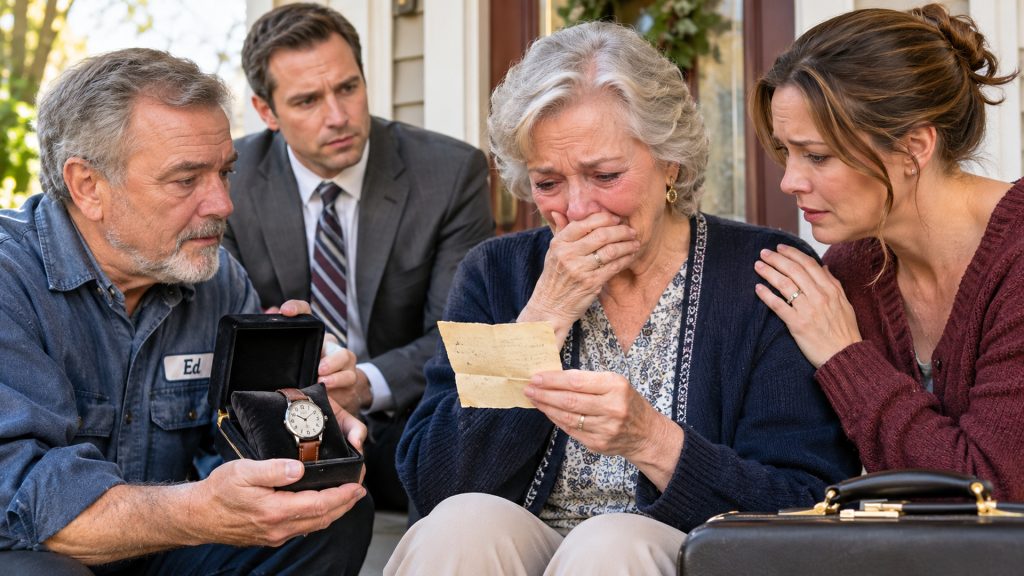
“Scott,” I said quietly, “where are you?” “That’s not important.” “Then tell me why your name is on a withdrawal from Dad’s trust.” The silence was immediate. Behind me, Mom sat with her hands wrapped around the velvet box containing Dad’s watch. Ed, the secondhand shop owner, stood near the doorway, looking as uncomfortable as a man who had accidentally walked into the middle of a family tragedy.
Mr. Cole remained still.
Waiting.
Scott finally spoke.
“You don’t understand what’s happening.”
“Then explain it.”
“Dad had money he never told us about.”
I closed my eyes.
“So you took it?”
“No.”
The answer came too quickly.
Then he added, “Not exactly.”
My stomach tightened.
“Scott.”
“Listen, Jenny. Whatever that lawyer is telling you, Dad wasn’t innocent.”
I looked toward Mom.
She was watching me with frightened eyes.
“What do you mean?”
Scott lowered his voice.
“There are things about Dad you don’t know.”
I swallowed.
“Then come here and tell us.”
“No.”
“Why not?”
Another silence.
Then my brother whispered something that made my blood run cold.
“Because the police have already been to my apartment.”
And the line went dead.
For several seconds, I stood holding the phone against my ear.
I could hear Mom breathing.
The refrigerator humming in the kitchen.
The old grandfather clock ticking near the hallway.
Everything sounded painfully normal.
Yet nothing in our family would ever be normal again.
“Jenny?” Mom whispered.
I lowered the phone.
“He hung up.”
She looked at the statement.
“Did he take the money?”
I wanted to protect her.
After everything she’d endured, I desperately wanted to say there had been some mistake.
That Scott’s name appeared on the document for an innocent reason.
That Dad hadn’t spent decades carrying a secret.
That the woman named Anna was a misunderstanding.
But I had already watched too many people suffer because someone decided the truth was too painful to tell.
So I sat beside my mother.
“I don’t know everything yet,” I said. “But we’re going to find out.”
Mom stared at the watch.
Then whispered, “Your father would know what to do.”
My throat tightened.
For forty-nine years, Harold Brennan had been the person our family turned to when something broke.
He repaired leaking pipes.
Fixed broken appliances.
Helped neighbors with their cars.
And somehow managed to make even the worst problems feel manageable.
Now he was gone.
And the last thing he’d left behind was a secret none of us knew how to carry.
Mr. Cole gently cleared his throat.
“Mrs. Brennan, I think we should begin with what we can establish.”
Mom looked up.
He opened his briefcase and removed another folder.
“Your husband established a trust for Anna many years ago. It was intended to provide financial support while preserving her privacy.”
Mom’s fingers tightened around the watch.
“Why?”
Mr. Cole hesitated.
“Because he learned that the child born to your sister Evelyn had survived.”
Mom stared at him.
“My mother told me the baby died.”
“I understand.”
“She told me there were complications.”
Her voice broke.
“She said Evelyn was gone, and the baby was gone, and there was nothing anybody could do.”
Mr. Cole nodded sympathetically.
“I’m very sorry.”
Mom pressed the watch against her chest.
“Then my mother lied to me.”
I reached for her hand.
She shook her head slowly.
“Forty-four years.”
Tears spilled down her cheeks.
“For forty-four years, I thought there was nobody left of Evelyn.”
My mother, Rose Brennan, was seventy-three years old.
She’d spent most of her life caring for other people.
She worked as a school secretary until retirement.
Raised two children.
Looked after our grandparents.
And helped Dad manage the long, exhausting years he spent at the steel mill.
She wasn’t a dramatic woman.
When something hurt, she usually went quiet.
When Dad died in October, she barely cried at the funeral.
She simply held my hand and stared at the casket.
But now, sitting in the living room with that tiny folded paper in her lap, she began to sob.
Not the gentle crying I’d heard after Dad’s funeral.
This was grief returning from a place she thought had healed.
A grief she’d carried since 1981.
I wrapped my arms around her.
“Mom.”
She leaned against me.
“Evelyn had a daughter, Jenny.”
“I know.”
“A little girl.”
Her voice shattered.
“And I never knew.”
Ed stood awkwardly beside the door.
Finally, he spoke.
“Mrs. Brennan, I didn’t know what I was getting into when I opened that watch.”
Mom looked at him.
He continued.
“I thought maybe there was a little love note inside.”
His eyes filled.
“Something your husband wanted you to find.”
Mom wiped her cheeks.
Ed looked toward the velvet box.
“But once I saw the name and the date, I thought somebody ought to know.”
I stood.
“Thank you.”
He shook his head.
“Don’t thank me yet.”
He reached into his pocket and removed a small receipt.
“This is what your brother got when he sold the watch.”
Forty dollars.
I stared at it.
Ed continued.
“I was going to put it in the display case. Then I noticed the back had been sealed differently from the rest.”
He looked down.
“I’ve repaired watches for years. I’d never seen one quite like it.”
Mom touched the polished steel casing.
“Harold could fix anything.”
Ed smiled sadly.
“Apparently, he knew how to hide things too.”
Mr. Cole explained that the note was not itself a legal instruction transferring money or property.
It was a message Dad had written decades earlier.
The trust, adoption records, and financial documents had to be examined separately.
That distinction mattered.
Because Dad’s handwriting could explain why he’d done something.
But it couldn’t automatically establish every legal right or obligation.
Mr. Cole had been involved with the later administration of the trust, though its original formation predated his work on the matter.
He’d obtained relevant records through the appropriate parties after concerns arose.
And he was careful about what he could disclose.
“The person responsible for administering Anna’s trust is reviewing the account activity,” he explained. “The disputed withdrawal has been reported, and the financial institution is cooperating with the investigation.”
I looked at the statement.
“How much?”
He hesitated.
“Approximately seventy-eight thousand dollars is currently in dispute.”
Mom made a small sound.
I stared.
“Seventy-eight thousand?”
Mr. Cole nodded.
“The investigation will determine what actually moved, where it went, and whether any funds can be recovered.”
I looked toward the telephone.
My brother had sold Dad’s watch for forty dollars.
But apparently, he had been reaching for something far larger.
After Mr. Cole and Ed left, I stayed with Mom.
We sat at the kitchen table until evening.
Dad’s watch rested between us.
The second hand moved steadily around its face.
Ed had repaired the mechanism.
After months of silence, the watch was ticking again.
Mom stared at it.
“Your father wore that every day.”
I nodded.
“He never took it off.”
“Except when he showered.”
I smiled faintly.
“And when he worked on the car.”
Mom laughed through tears.
“He’d lay it on the windowsill and forget where he put it.”
I looked at the watch.
Then asked the question that had been troubling me.
“Mom, do you think Dad was wrong not to tell you?”
She remained quiet.
For a long time, I thought she wouldn’t answer.
Then she whispered, “Yes.”
My chest tightened.
She looked at me.
“I understand why he might have been afraid.”
Her eyes filled.
“But he should have trusted me with the truth.”
That night, I couldn’t sleep.
I kept thinking about Evelyn.
My mother’s younger sister.
I remembered photographs of her.
She had dark curls, bright eyes, and a smile that seemed too big for her face.
Mom rarely spoke about her.
When she did, her voice changed.
She became softer.
More distant.
Evelyn had died giving birth in 1981.
At least, that was the story we’d always known.
The baby was believed dead too.
Our grandmother, Beatrice, had handled the arrangements.
She told Mom there was nothing she could do.
No baby to hold.
No future to imagine.
Only a funeral.
And now we knew something extraordinary.
Evelyn’s child had lived.
Somewhere, a woman in her forties was walking around with my aunt’s smile.
Perhaps she had children.
Perhaps she had a family of her own.
Perhaps she’d spent her entire life wondering where she came from.
I stared at the ceiling.
And wondered whether Dad had known her.
Not just as a name on a document.
But as a person.
The next morning, Mom called me before eight.
“Jenny?”
“Yes, Mom?”
“I want to meet her.”
My throat tightened.
“Anna?”
“Yes.”
I sat up in bed.
“Mom, we don’t know whether she’s ready for that.”
“I know.”
Her voice trembled.
“But I want her to know she has family.”
I took a breath.
“Then we’ll ask.”
She began crying.
“Do you think she’ll hate me?”
I closed my eyes.
“Why would she?”
“Because I wasn’t there.”
I swallowed.
“Mom, you didn’t know she existed.”
She whispered, “But I should have.”
I shook my head, though she couldn’t see me.
“You were told she died.”
There was a long silence.
Then Mom said, “I spent forty-four years believing something that wasn’t true.”
Her voice broke.
“I don’t want to spend another day without trying to find out who she is.”
Mr. Cole helped us make contact through the appropriate channels.
Anna’s attorney was already involved because of the disputed trust withdrawal.
We asked that our information be passed along, without pressure or expectations.
Mom wrote a letter.
She spent three days on it.
Every morning, she’d begin again.
She’d write a sentence.
Cross it out.
Cry.
Then start over.
Finally, she called me.
“Jenny, can you come read this?”
I drove over.
She handed me two pages.
The letter began:
Dear Anna,
My name is Rose Brennan.
I am your mother Evelyn’s older sister.
Until a few days ago, I believed you died when you were born.
My eyes filled.
I continued reading.
I don’t know what you’ve been told about your birth family.
I don’t know whether you want to meet me.
But I want you to know your mother was loved.
She was funny and stubborn and could sing beautifully.
She loved yellow flowers and cinnamon toast.
And she once rescued a stray kitten by hiding it in our bedroom for three weeks.
I laughed through tears.
Mom smiled sadly.
“Remember that story?”
I nodded.
“You told it every Christmas.”
She wiped her eyes.
The letter ended:
I cannot give you back the years we lost.
But if you ever want to know about Evelyn, I would be honored to tell you.
You have family here.
And you are welcome in our lives whenever you choose.
With love,
Rose.
I looked up.
“Mom, it’s beautiful.”
She began crying.
“I just hope she reads it.”
Meanwhile, Scott’s situation grew worse.
I didn’t hear from him for several days.
Then his girlfriend, Melissa, called.
She sounded exhausted.
“Jenny, have you talked to Scott?”
I sighed.
“Not since he hung up on me.”
She hesitated.
“He’s been drinking.”
My stomach tightened.
“How much?”
“Too much.”
I closed my eyes.
Melissa continued.
“He keeps saying everybody’s blaming him for things Dad did.”
I took a breath.
“Where is he?”
“At my apartment.”
She paused.
“But I told him he can’t stay if he keeps drinking and lying.”
I nodded.
“That’s fair.”
She began crying.
“I love him, Jenny.”
“I know.”
“But I can’t keep fixing everything.”
I looked toward Dad’s photograph on my desk.
Neither could I.
Scott had been the younger child.
The charming one.
The boy who could talk his way out of almost anything.
When we were little, he broke a neighbor’s window with a baseball.
Dad asked what happened.
Scott said the ball had slipped out of his hand.
Technically, it had.
Dad made him apologize and help pay for the repair.
But as Scott grew older, his explanations became more elaborate.
A job ended because the boss was unfair.
A credit card balance grew because the bank was unreasonable.
A loan went unpaid because a friend hadn’t returned money.
And Dad kept helping.
Again and again.
He paid Scott’s rent.
Covered debts.
Helped repair cars.
And once gave him several thousand dollars to keep a small business afloat.
Each time, Scott promised things would change.
Sometimes they did.
For a little while.
Then the same problems returned.
Dad never stopped loving him.
But toward the end of his life, I noticed something different.
He stopped writing checks immediately.
He began asking questions.
And Scott resented it.
A week after the watch was returned, Scott finally came to Mom’s house.
I was there.
He arrived wearing an old jacket and jeans.
His face was pale.
His eyes were red.
He stood in the doorway looking like the frightened boy who used to hide behind the garage after getting into trouble.
Mom looked at him.
“Scott.”
He swallowed.
“Hi, Mom.”
She stepped aside.
“Come in.”
He walked into the living room.
Then stopped.
Dad’s watch was sitting on the mantel beside his reading glasses.
Scott stared at it.
For a moment, I thought he’d cry.
Instead, he looked at me.
“So you got it back.”
I crossed my arms.
“Yes.”
He nodded.
“Good.”
Mom stared at him.
“Scott, sit down.”
He obeyed.
We sat around the coffee table.
For several minutes, nobody spoke.
Then Mom asked, “Why did you sell your father’s watch?”
Scott looked down.
“I needed money.”
She swallowed.
“You could have asked.”
He laughed bitterly.
“I asked Dad for money my whole life.”
Mom’s eyes filled.
“That watch wasn’t yours.”
He nodded.
“I know.”
She took a breath.
“It was fifty-one years of his life.”
Scott stared at the floor.
“I know.”
Mom’s voice broke.
“Then why?”
He covered his face.
“Because I was angry.”
The room went silent.
Scott continued.
“Dad was gone.”
His voice trembled.
“And all I could think about was how much he’d left behind.”
I stared at him.
“What do you mean?”
He looked up.
“Bills.”
“Old furniture.”
“A house that needs repairs.”
He swallowed.
“And secrets.”
I leaned forward.
“Scott, you found the trust documents.”
He closed his eyes.
“Yes.”
Mom made a small sound.
I continued.
“When?”
“After the funeral.”
He rubbed his hands together.
“I was sorting through Dad’s desk.”
I remembered the drawer.
Dad kept everything organized.
Insurance papers.
Receipts.
Old warranties.
Tax records.
Scott looked toward the mantel.
“I found a folder with Anna’s name.”
Mom whispered, “You knew?”
He nodded.
Her face crumpled.
“Scott, you knew Evelyn’s daughter was alive?”
He began crying.
“Yes.”
Mom pressed a hand against her mouth.
“And you didn’t tell me?”
He looked down.
“I didn’t know how.”
I felt anger rise.
“You knew enough to access her trust.”
Scott flinched.
“Jenny—”
“No.”
I leaned forward.
“You don’t get to hide behind confusion now.”
He began explaining.
At first, he’d only wanted to understand what Dad had been doing.
He saw account statements.
Trust records.
Correspondence.
Then he discovered that the trust had accumulated a substantial amount of money.
Money Dad had carefully set aside over the years.
Scott became furious.
He believed Dad had secretly supported someone else while refusing to continue paying his debts.
He told himself it wasn’t fair.
That he was Dad’s son.
That he deserved help.
That the money should have belonged to the family.
I stared at him.
“Anna is family.”
Scott looked away.
Mom whispered, “She is Evelyn’s daughter.”
He began crying.
“I know that now.”
I shook my head.
“You knew enough.”
Scott admitted that he had used information from Dad’s records to obtain access to funds he had no authority to take.
He described actions that investigators would need to verify.
I didn’t interrupt.
I didn’t try to solve his legal problems.
And I didn’t promise to keep the confession between us.
When he finished, the room was silent.
Mom stared at her hands.
Then she asked, “How much is left?”
Scott swallowed.
“Not enough.”
My heart sank.
He continued.
“I used some to pay debts.”
I closed my eyes.
“And the rest?”
He looked down.
“Other bills.”
I took a breath.
“Scott, you took money Dad saved for someone else.”
He began crying.
“I know.”
I leaned forward.
“And now she’s the one dealing with the consequences.”
He nodded.
“I know.”
Mom looked at him for a long time.
Then she said something I never expected.
“Scott, your father loved you.”
He began sobbing.
She continued.
“But he didn’t owe you the right to take from somebody else.”
I looked at her.
Her voice was shaking.
“You’re my son.”
She swallowed.
“And I will always love you.”
Scott looked up.
“But I won’t protect you from the truth.”
He covered his face.
Mom began crying.
“I’ve lost your father.”
Her voice broke.
“I’ve just learned that my sister’s child is alive.”
She looked at Scott.
“And now I have to watch you decide whether you’re going to keep destroying your own life.”
Scott stayed for another hour.
He didn’t ask for money.
He didn’t ask us to lie.
For once, he seemed to understand that the consequences were larger than a family argument.
Before leaving, he stood beside Dad’s watch.
He stared at it.
Then whispered, “I thought it was worthless.”
Mom wiped her eyes.
“It wasn’t.”
Scott nodded.
“I know.”
He turned toward the door.
Then looked back.
“I’m sorry.”
I believed he meant it.
But I also knew apologies couldn’t return stolen money.
They couldn’t undo decades of silence.
And they couldn’t restore the trust he’d broken.
The investigation continued.
The financial institution reviewed the disputed transactions.
The trust’s authorized representatives worked with legal counsel and investigators.
Scott retained his own attorney.
Some funds were recovered through appropriate processes.
Repayment obligations and other consequences were addressed through formal proceedings.
The remaining losses were handled according to the applicable legal remedies.
It was not quick.
It was not simple.
And it did not end with one dramatic confession.
There were months of paperwork.
Accountings.
Interviews.
And painful conversations.
But eventually, the truth became clear enough that our family could stop arguing about what had happened and begin deciding how to live with it.
Anna answered Mom’s letter six weeks after receiving it.
I was at work when Mom called.
“Jenny.”
Her voice sounded strange.
I stood.
“Mom?”
“She wrote back.”
My heart stopped.
“Anna?”
Mom began crying.
“Yes.”
I sat down.
“What did she say?”
Mom took a shaky breath.
“She wants to meet us.”
I drove to Mom’s house immediately.
She was sitting at the kitchen table holding a white envelope.
Her hands trembled.
I sat beside her.
“Can I read it?”
She nodded.
The letter was written in careful handwriting.
Dear Rose,
Thank you for writing.
I have spent much of my life wondering about my birth family.
My adoptive parents loved me, and I am grateful for them.
But there were always questions nobody could answer.
I knew my birth mother’s name was Evelyn.
I knew she died when I was born.
I did not know I had an aunt who believed I died too.
My eyes filled.
I continued.
I have two daughters.
And a grandson named Oliver.
They are the greatest joys of my life.
I would like to meet you.
Not because I expect us to become family overnight.
But because I think we’ve both lived too long with unanswered questions.
With hope,
Anna.
Mom covered her mouth.
“She has children, Jenny.”
I nodded.
“And a grandson.”
Mom laughed through tears.
“I’m a great-great-aunt.”
I smiled.
“Yes, Mom.”
She looked toward Evelyn’s photograph.
Then whispered, “Oh, Evie. Your little girl grew up.”
We arranged the meeting carefully.
Anna lived about two hours away.
She worked as a librarian.
She had been married for twenty years.
Her daughters were grown.
Her grandson Oliver was four.
She wanted to meet us at a quiet restaurant rather than someone’s home.
Mom agreed.
She spent days worrying about what to wear.
What to say.
Whether to hug Anna.
Whether Anna would recognize any resemblance.
I tried to reassure her.
But I was nervous too.
On the morning of the meeting, Mom called before sunrise.
“Jenny, should I bring photographs?”
I smiled.
“Yes.”
“Which ones?”
“All the ones you think she’d like.”
She hesitated.
“Should I bring Evelyn’s necklace?”
My heart tightened.
It was a small silver pendant.
A gift from our grandparents when Evelyn turned sixteen.
Mom had kept it for decades.
I took a breath.
“Only if you want to.”
She whispered, “I think it belongs with her daughter.”
We arrived early.
Mom wore a pale blue blouse.
She had Evelyn’s photographs arranged in a small album.
The necklace rested in a velvet pouch inside her handbag.
I ordered tea.
Mom couldn’t drink hers.
Then the restaurant door opened.
A woman stepped inside.
She had dark hair.
Warm brown eyes.
And a smile that made my mother rise so suddenly her chair scraped against the floor.
Anna looked around.
Then her eyes found Mom.
For a moment, neither woman moved.
I watched Mom’s face change.
She looked younger.
Older.
Devastated.
Joyful.
All at once.
Then she whispered, “Evelyn.”
Anna’s eyes filled.
Mom covered her mouth.
“Oh, I’m sorry.”
She began crying.
“You look so much like her.”
Anna stepped forward.
“Rose?”
Mom nodded.
Anna smiled through tears.
“I’m Anna.”
And my mother reached for the daughter of the sister she’d mourned for forty-four years.
They hugged.
Not politely.
Not cautiously.
They held each other as though the years between them were something they could finally touch.
Mom sobbed.
Anna cried too.
I stood beside them with tears running down my face.
After a long time, they sat.
Mom couldn’t stop looking at Anna.
“Your eyes,” she whispered.
Anna smiled nervously.
“Are they like hers?”
Mom nodded.
“Exactly.”
She reached for the photo album.
“Would you like to see?”
Anna’s face softened.
“Very much.”
Mom opened the first page.
There was Evelyn at sixteen.
Standing beside a bicycle.
Laughing.
Anna touched the photograph.
“Oh.”
Her voice broke.
“That’s my mother?”
Mom nodded.
“Yes.”
Anna stared.
For a long time, she didn’t speak.
Then she whispered, “I’ve never seen a picture of her this young.”
Mom told stories.
About the kitten Evelyn hid beneath her bed.
About the time she accidentally dyed her hair orange.
About her beautiful singing voice.
About the way she loved yellow flowers.
Anna listened as though every word mattered.
Sometimes she laughed.
Sometimes she cried.
At one point, Mom reached into her handbag.
“I brought something.”
Anna looked up.
Mom opened the velvet pouch.
Inside lay Evelyn’s silver necklace.
Anna covered her mouth.
“Oh.”
Mom held it gently.
“She wore this all the time.”
Anna’s eyes filled.
“I don’t know what to say.”
Mom smiled through tears.
“You don’t have to say anything.”
She placed the necklace in Anna’s hand.
“I kept it because I couldn’t bear to let her go.”
Her voice broke.
“But I think she’d want you to have it.”
Anna began crying.
Then whispered, “Thank you.”
We spent nearly four hours together.
Anna told us about her childhood.
Her adoptive parents had been kind.
They never hid the fact that she was adopted.
But the records available to her contained limited information.
She’d known Evelyn’s name.
And that her birth mother had died.
She hadn’t known about Mom.
Or the circumstances surrounding the adoption.
As she grew older, she’d searched for more information.
Some records were incomplete.
Others difficult to obtain.
Eventually, she stopped looking actively.
Not because she stopped caring.
But because she had built a life of her own.
Then the trust dispute brought new information to light.
And Mr. Cole’s office contacted her about the financial matters.
She learned that Harold Brennan had established a trust in her name.
At first, she assumed he was a distant relative.
Then she discovered he was her mother’s brother-in-law.
A man who had apparently known she existed for decades.
Mom listened carefully.
Then asked, “Did you ever meet Harold?”
Anna hesitated.
“Not in person.”
My chest tightened.
She continued.
“But I knew he helped.”
Mom stared.
Anna explained that when she was young, certain educational expenses had been supported through arrangements handled by legal and financial representatives.
Her adoptive parents had described the assistance as coming from someone connected to her birth family.
She’d never been told much more.
Later, when the trust became more formalized and its records were clarified, she learned Harold’s name.
She had considered contacting him.
But life became busy.
Children.
Work.
Family responsibilities.
And she wasn’t certain whether he wanted a relationship beyond providing support.
Mom stared at the table.
Then whispered, “He was afraid of hurting me.”
Anna nodded slowly.
“That’s what I wondered.”
As we talked, another part of Dad’s secret became clear.
He hadn’t hidden Anna’s existence because he was indifferent.
He had been trapped between two loyalties.
He believed Mom deserved the truth.
But he’d learned that our grandmother Beatrice had arranged the adoption under circumstances surrounded by family conflict and secrecy.
At the time, Mom was devastated by Evelyn’s death.
Beatrice had insisted the baby had died too.
When Dad later uncovered records suggesting otherwise, he confronted her.
She warned him that revealing the truth would destroy Mom.
She claimed the adoption could be disrupted.
That legal complications might follow.
That the child could suffer.
Dad apparently believed some of those warnings.
Or perhaps he wanted to.
Because silence was easier than confronting the people who’d created the deception.
So he began trying to help Anna privately.
And once the years started passing, telling Mom became harder.
Every birthday.
Every Christmas.
Every family gathering.
The secret grew heavier.
I thought about Dad wearing that watch.
Day after day.
Year after year.
A tiny note hidden behind its movement.
A reminder of the truth he hadn’t told.
Perhaps he meant to confess.
Perhaps he tried.
Perhaps every time he looked at Mom, he imagined what the revelation would do to her.
I loved my father.
But for the first time, I understood that loving someone didn’t require pretending they had never made mistakes.
He’d done something generous for Anna.
He’d also allowed Mom to live with a devastating falsehood.
Both things were true.
And Mom deserved to acknowledge both.
After the meeting, we drove home quietly.
Mom held the photo album on her lap.
At a red light, she looked toward me.
“Jenny?”
“Yes?”
“I’m happy.”
I smiled.
“I know.”
She swallowed.
“And I’m angry.”
My chest tightened.
“I know that too.”
She looked down.
“Your father should have told me.”
I nodded.
“Yes.”
She wiped her eyes.
“But he helped her.”
“Yes.”
Mom took a breath.
“I don’t know what to do with all these feelings.”
I reached for her hand.
“Maybe you don’t have to decide today.”
She nodded.
We drove the rest of the way in silence.
Over the following months, Anna became part of our lives.
Slowly.
Carefully.
Without pretending forty-four years could be repaired overnight.
She visited Mom.
We met for lunch.
Exchanged photographs.
Talked about family history.
Sometimes the conversations were joyful.
Sometimes they were difficult.
Anna had questions about Evelyn that Mom couldn’t answer.
Mom had questions about Anna’s childhood that Anna found painful.
But they listened.
And when they didn’t know what to say, they allowed silence to exist without turning it into rejection.
That mattered.
One Sunday afternoon, Anna brought her daughters and grandson to Mom’s house.
Oliver was four.
He had curly hair and endless energy.
He ran into the living room carrying a toy airplane.
Mom laughed.
“Well, hello there.”
Oliver stopped.
“Are you Aunt Rose?”
She smiled.
“Yes.”
He considered.
“Mommy says you’re family.”
Mom’s eyes filled.
“I am.”
Oliver grinned.
“Okay.”
Then he ran toward the kitchen.
I burst out laughing.
Anna smiled.
“Children make things simple sometimes.”
Mom wiped her eyes.
“Yes.”
Then she whispered, “Thank goodness.”
The house slowly changed.
Not dramatically.
Dad’s chair remained beside the window.
His reading glasses stayed on the dresser.
The watch still sat in its velvet box.
But now there were new photographs.
Anna with her daughters.
Oliver smiling beneath the maple tree.
Mom and Anna standing together outside the restaurant.
And one picture of Evelyn placed beside a recent photograph of Anna.
They looked so much alike it made my heart ache.
Scott watched these changes from a distance.
He wasn’t excluded from the family forever.
But there were boundaries.
His legal matters continued.
He had repayment obligations.
And he needed to demonstrate meaningful change before Mom felt comfortable trusting him with anything financial.
At first, he resented those limits.
He accused me of turning Mom against him.
Said Anna had become the family’s favorite.
Complained that everyone cared more about the trust than about his problems.
I listened once.
Then said, “Scott, this isn’t a competition.”
He laughed bitterly.
“Easy for you to say.”
I took a breath.
“Dad spent years helping you.”
He looked away.
“And Anna didn’t take anything from you.”
He remained silent.
I continued.
“You took something from her.”
Eventually, Scott began counseling.
He also sought help for his drinking.
His progress was uneven.
There were setbacks.
Difficult weeks.
Arguments.
And moments when he wanted to blame everyone except himself.
But over time, he started making different choices.
He found steady work.
Reduced his expenses.
Followed the repayment arrangements established through the appropriate processes.
And began learning how to live without expecting Dad’s money to solve every crisis.
It wasn’t a miracle.
It was work.
Uncomfortable.
Ordinary.
Necessary work.
One evening, Scott came to Mom’s house carrying a toolbox.
She opened the door.
“Scott?”
He smiled nervously.
“Hi, Mom.”
She looked at the toolbox.
“What’s that?”
He glanced toward the kitchen.
“Jenny said your faucet’s been leaking.”
Mom hesitated.
“Yes.”
He swallowed.
“I thought I could fix it.”
For a moment, she looked at him without speaking.
Then stepped aside.
“Come in.”
He spent an hour beneath the sink.
Cursing softly when a fitting wouldn’t loosen.
Laughing when water splashed his shirt.
And finally replacing the worn part.
When he finished, Mom turned on the tap.
No leak.
She smiled.
“Thank you.”
Scott nodded.
“Sure.”
Then he looked toward Dad’s photograph.
“He would’ve fixed it in ten minutes.”
Mom laughed softly.
“Probably.”
Scott smiled sadly.
“I wish I’d learned more from him.”
Mom’s eyes filled.
“You still can.”
That evening, I stopped by after work.
Scott was sitting at the kitchen table drinking coffee.
He looked up.
“Hey, Jen.”
I nodded.
“Hi.”
Mom was humming in the kitchen.
I hadn’t heard her do that in months.
Scott looked toward the mantel.
Dad’s watch rested there.
He stared for a long time.
Then whispered, “I still can’t believe I sold it.”
I sat across from him.
“Neither can I.”
He nodded.
“I thought if I got rid of some of Dad’s things, maybe I wouldn’t have to think about him being gone.”
I looked at him.
“Scott, you sold it because you wanted money.”
He lowered his eyes.
“Yeah.”
Then he swallowed.
“But I think I was angry too.”
I nodded.
“Both things can be true.”
He looked up.
For the first time in years, my brother didn’t argue.
The next Thanksgiving, Anna and her family joined us.
Mom spent three days preparing.
She made Evelyn’s favorite sweet potato casserole.
Used the good china.
And insisted everyone bring something.
Scott arrived with a pie.
Not an expensive one.
Just a simple apple pie from a local bakery.
He stood awkwardly in the doorway.
Anna was already in the living room.
For a moment, they looked at each other.
Then Scott stepped forward.
“Anna?”
She nodded.
“Yes.”
He swallowed.
“I’m Scott.”
“I know.”
There was a long silence.
Then he said, “I’m sorry.”
Anna looked at him carefully.
He continued.
“For what I did.”
His voice trembled.
“I know I can’t undo it.”
She remained quiet.
Then said, “No, you can’t.”
Scott nodded.
“I know.”
Anna took a breath.
“But I hope you’re serious about making things right.”
He looked down.
“I am.”
She nodded.
“Then keep doing the work.”
They didn’t hug.
There was no dramatic forgiveness.
No sudden restoration of trust.
But they sat at the same table.
Shared a meal.
And spoke respectfully.
For our family, that was a beginning.
After dinner, Mom stood beside the window watching Oliver chase falling leaves.
Anna came to stand beside her.
“He’s got Evelyn’s energy,” Mom said.
Anna laughed.
“Was she always this active?”
Mom smiled.
“Worse.”
They laughed together.
Then Mom’s eyes filled.
“I wish she’d lived to see him.”
Anna took her hand.
“Me too.”
For a long time, they watched the little boy playing outside.
Then Anna whispered, “I’m glad I found you.”
Mom began crying.
She squeezed Anna’s hand.
“So am I.”
Later that evening, after everyone left, I helped Mom wash dishes.
The kitchen smelled of cinnamon and roasted turkey.
The house was quiet.
Mom handed me a plate.
“Jenny?”
“Yes?”
“Do you think Harold knew what would happen?”
I looked at her.
“With the watch?”
She nodded.
I thought carefully.
“I don’t know.”
She smiled sadly.
“He always did have a way of leaving things unfinished.”
I laughed.
“Remember the porch railing?”
Mom smiled.
“Three years.”
I shook my head.
“He said he’d fix it every spring.”
She laughed through tears.
Then her expression softened.
“But he loved us.”
I nodded.
“Yes.”
She looked toward the mantel.
“And he made mistakes.”
“Yes.”
Mom took a breath.
“I think I’m finally able to hold both truths.”
The following spring, Ed called.
He wanted to know how Mom was doing.
He’d heard through Mr. Cole that the watch had become part of a much larger family discovery.
I thanked him again.
He laughed.
“Jenny, I just opened a watch.”
I smiled.
“You did more than that.”
He grew quiet.
Then said, “Your father must have been carrying that paper a long time.”
I looked toward Dad’s photograph.
“Forty-four years.”
Ed whistled softly.
“That’s a heavy secret for such a small watch.”
I swallowed.
“Yes.”
He paused.
“Tell your mother I hope she’s doing well.”
“I will.”
Then I asked, “Ed, why did you bring the watch back instead of selling it?”
There was a silence.
Finally, he said, “Because some things don’t belong in a display case.”
My eyes filled.
“And some things are worth more than what somebody paid for them.”
I never forgot those words.
The watch cost Dad a few dollars in 1974.
Scott sold it for forty.
Ed could have polished it and sold it for more.
But none of those prices measured its value.
It had been there when Dad married Mom.
When Scott and I were born.
When he worked long shifts at the mill.
When he retired.
When he became ill.
When he died.
And hidden inside it was a secret that connected our family to a woman we’d lost before we ever knew her.
Mom eventually decided to have the watch placed in a small display case on the mantel.
Not because she wanted to turn Dad into a monument.
But because she wanted to remember him honestly.
She asked a local craftsman to make a simple wooden case.
Inside, the watch rested on dark velvet.
Beside it was a small engraved plaque.
Harold Brennan.
1974–2025.
A lifetime measured in love, mistakes, and the courage to make things right.
When I saw it, I began crying.
Mom stood beside me.
“Do you like it?”
I nodded.
“It’s perfect.”
Years passed.
Anna became a familiar face at family gatherings.
Oliver grew taller.
Mom taught Anna how to make Evelyn’s cinnamon bread.
And sometimes, on quiet afternoons, they sat together looking through old photographs.
Scott continued rebuilding his life.
He worked.
Made payments.
Learned to apologize without expecting immediate forgiveness.
And slowly began earning back pieces of the trust he’d damaged.
Our family didn’t become perfect.
There were still difficult conversations.
Occasional disagreements.
And memories that hurt.
But we stopped pretending that love required silence.
One winter afternoon, Mom called me.
“Jenny, come over when you can.”
I drove across town.
She was sitting beside the fireplace.
Dad’s watch rested in its case.
Anna had visited earlier.
They’d spent the afternoon looking through Evelyn’s old school photographs.
Mom looked peaceful.
“Sit down, sweetheart.”
I sat beside her.
She took my hand.
“Do you know what I’ve learned?”
I smiled.
“What?”
She looked toward the watch.
“That people can love you and still hurt you.”
My chest tightened.
She continued.
“That doesn’t mean the love was false.”
She swallowed.
“But it doesn’t make the hurt disappear either.”
I nodded.
Mom smiled sadly.
“Your father loved me.”
“Yes.”
“And he should have told me the truth.”
I squeezed her hand.
“Yes.”
She looked toward the photographs.
“But because of what he did, Anna had support.”
I nodded.
“And now she’s here.”
Mom smiled.
“Now she’s here.”
She sat quietly for a moment.
Then whispered, “I think that’s what matters most.”
I looked at her.
“What?”
“That we don’t waste the time we still have.”
My eyes filled.
She squeezed my hand.
“We can’t get back the years.”
Her voice trembled.
“But we can decide what to do with the ones ahead.”
That evening, I stayed for dinner.
Scott stopped by after work.
Anna called to say Oliver wanted to show Mom a drawing.
We put the phone on speaker.
Oliver excitedly described a picture of a big house with flowers and people standing outside.
“That’s Aunt Rose,” he announced.
Mom laughed.
“And who’s that?”
“That’s you!”
She smiled.
“And who are all these people?”
Oliver sounded puzzled.
“Family.”
Mom began crying.
I looked at her.
She wiped her eyes and laughed.
“Of course.”
Later, after everyone had gone home, I stood alone beside the mantel.
Dad’s watch ticked softly inside its case.
I remembered the day Ed arrived with the velvet box.
Mom sitting on the porch steps.
The tiny folded paper.
The lawyer’s briefcase.
Scott’s frightening phone call.
And the truth that had changed everything.
For months, I thought the story was about betrayal.
A stolen watch.
A hidden trust.
A brother who took money he had no right to touch.
A father who kept a secret too long.
But over time, I realized it was also about something else.
The possibility of beginning again.
Dad’s watch had measured fifty-one years.
But it couldn’t measure the love Mom felt when she met Anna.
It couldn’t measure the courage Scott needed to accept responsibility.
It couldn’t measure the forgiveness that came slowly, imperfectly, and only where trust could be rebuilt.
And it couldn’t measure the quiet joy of a little boy named Oliver running through our family home.
The greatest gift Dad left wasn’t the trust.
It wasn’t the watch.
It wasn’t even the secret hidden behind the movement.
It was the chance to discover that our family was larger than we’d believed.
That the truth, however painful, could still bring people together.
And that love could survive mistakes without pretending those mistakes never happened.
Today, when I visit Mom, the first thing I see is Dad’s watch on the mantel.
The steel casing still bears tiny scratches.
The glass still catches the light.
And the second hand continues its steady journey around the face.
Sometimes Mom sits beside it with a cup of tea.
Sometimes Anna visits.
Sometimes Scott comes over to repair something.
And sometimes Oliver runs through the hallway asking questions nobody knows how to answer.
The house is full of ordinary sounds again.
Laughter.
Conversation.
Footsteps.
The clatter of dishes.
And the quiet ticking of a watch that once carried a secret for forty-four years.
One evening, Mom looked toward me and smiled.
“Jenny?”
“Yes?”
“Do you think your father would be happy?”
I looked around the room.
At Anna laughing beside the window.
At Scott helping Oliver build a toy airplane.
At the photographs of Evelyn.
At Mom’s peaceful face.
Then I smiled.
“I think he’d be grateful.”
Mom nodded.
“And maybe a little embarrassed.”
I laughed.
“Definitely.”
She smiled through tears.
Then reached for my hand.
I thought about the forty dollars Scott had received for the watch.
Forty dollars.
A bar tab.
A few hours of forgetting.
And nearly the loss of something precious.
But the watch found its way home.
And with it came a truth that had been waiting for decades.
My brother thought Dad’s watch was worth forty dollars.
My father knew it carried something far more valuable.
And my mother discovered that the family she thought she’d lost wasn’t entirely gone.
Some things can be sold.
Some things can be stolen.
Some things can be hidden for years.
But love, when given the chance, can still find a way to reach the people it was meant for.
And sometimes, the smallest objects carry the biggest stories.
As I prepared to leave that evening, Mom walked me to the door.
She hugged me tightly.
“Thank you, Jenny.”
I smiled.
“For what?”
She looked toward the mantel.
“For not giving up on finding his watch.”
My eyes filled.
I hugged her again.
“I couldn’t.”
She smiled sadly.
“I know.”
I stepped outside into the cool evening air.
The porch light glowed behind me.
Through the window, I could see Mom returning to her chair.
Dad’s watch rested on the mantel.
Ticking.
Steady.
Faithful.
And for the first time since the funeral, the sound didn’t remind me only of what we’d lost.
It reminded me of everything we’d found.