
Tessa’s words followed me all the way to the hospital. “Elaine, your daughter wasn’t the first.” I had spent thirty-four years as a prosecutor. I had listened to witnesses describe terrible betrayals, watched ordinary families discover extraordinary cruelty, and stood in courtrooms where the truth arrived too late to save someone.
But nothing in my career had prepared me to watch my own daughter being carried out of a locked garage. Rachel was thirty-two years old. She had a master’s degree in business administration, a thriving career, and the same stubborn independence I’d spent her childhood trying to encourage. She was the woman who remembered birthdays, rescued injured birds from sidewalks, and called me every evening just to say goodnight.
And now she lay beneath a hospital blanket, so weak that lifting her hand seemed to exhaust her. I sat beside her bed, holding that hand. “Sweetheart,” I whispered, “I’m here.” Her eyelids fluttered. “Mom?” “Yes, baby.” Her lips trembled. “Did he find you?” I felt something break inside me.
“No.”
She tried to sit up.
I gently stopped her.
“Rachel, you’re safe. The doctors are taking care of you, and the police are handling everything else.”
Her breathing quickened.
“The papers.”
“We’ll take care of the papers.”
“He said he’d take everything.”
I leaned closer.
“Listen to me. No document is worth your life.”
Tears slipped down her cheeks.
Then she whispered, “He told me you’d never believe me.”
I pressed her hand against my cheek.
“He was wrong.”
My name is Elaine Harper.
I was sixty-four when I discovered that my daughter had been trapped inside the garage of the house where she’d once imagined raising children.
I had raised Rachel alone after her father died when she was nine.
My husband, David, had been a high school science teacher.
He loved astronomy, terrible puns, and Sunday breakfasts that somehow left every dish in the kitchen dirty.
When he died unexpectedly, I was thirty-nine.
Rachel was still young enough to believe that if she behaved perfectly, nothing else bad would happen to us.
For months afterward, she slept with David’s old sweater beneath her pillow.
One evening, I found her sitting on the stairs crying.
“Mom, what if you disappear too?”
I sat beside her.
“I’m not planning to disappear.”
She shook her head.
“Dad wasn’t planning to either.”
I didn’t have an answer.
So I held her.
And I promised that whenever she needed me, I would do everything I could to come.
That promise stayed with me through every difficult year of motherhood.
Through adolescence.
College.
Her first job.
Her marriage.
And the night I heard a weak cough coming from a locked garage.
The emergency physician explained that Rachel was severely dehydrated, exhausted, and suffering from injuries that required careful treatment and documentation.
She was stable, but her recovery would take time.
The medical team also requested specialized support because of the circumstances surrounding her confinement.
I listened to everything.
Asked questions.
Wrote down instructions.
And tried not to imagine what might have happened if I’d dismissed that faint scraping sound.
A nurse named Olivia brought me a cup of tea.
“You should drink something, Mrs. Harper.”
I looked at the cup.
“Thank you.”
She sat beside me for a moment.
“Your daughter’s asking whether you’re staying.”
My throat tightened.
“Tell her I’m not going anywhere.”
Olivia smiled gently.
“I think she’d like to hear that from you.”
I went back inside.
Rachel was watching the doorway.
When she saw me, her expression softened.
“Mom.”
I sat beside her.
“Still here, sweetheart.”
She closed her eyes.
And for the first time since I’d found her, she slept without keeping one hand curled tightly around the blanket.
The next morning, Detective Sarah Moreno came to the hospital.
She was in her early forties, with dark hair pulled neatly away from her face and the tired, attentive expression of someone who took her work seriously.
I recognized that expression.
I’d worn it myself for decades.
She introduced herself and explained that investigators were examining the circumstances of Rachel’s confinement.
Nolan had been taken into custody following the initial police response, and the case was being reviewed for appropriate charges.
Tessa had provided documents and a statement.
The garage was being processed as part of the investigation.
Moreno was careful not to promise outcomes.
I appreciated that.
Real investigations are built from evidence, not dramatic declarations.
But I wanted answers.
“Detective, what did Tessa mean when she said Rachel wasn’t the first?”
Moreno looked at me.
“That’s something we’re examining.”
I leaned forward.
“Do you believe another woman was harmed?”
She paused.
“We have information suggesting Mr. Pierce may have used similar methods of coercion in an earlier relationship.”
My stomach tightened.
“Is that woman alive?”
Moreno nodded.
“As far as we’ve established, yes.”
I closed my eyes.
For the first time since the rescue, I felt something other than fear.
Relief for a stranger whose name I didn’t know.
Then I asked, “Does Rachel know?”
“Not yet.”
I looked toward my daughter’s room.
“Please be careful how you tell her.”
Moreno’s expression softened.
“We will.”
Tessa requested to speak with me two days later.
At first, I refused.
Seeing Rachel’s embroidered cardigan on her shoulders had become one of the images I couldn’t get out of my mind.
The tiny white flowers.
The faded blue wool.
The way Tessa had smiled while telling me Rachel was away.
She had stood beside her brother and helped conceal my daughter’s disappearance.
Even if she eventually helped rescue Rachel, I wasn’t ready to overlook what came before.
But Detective Moreno explained that Tessa wanted to clarify what she had known and why she had handed over the envelope.
I agreed to a conversation with an investigator present.
We met in a small conference room.
Tessa looked exhausted.
Her eyes were swollen.
Her hands trembled around a paper cup.
When she saw me, she stood.
“Mrs. Harper.”
I remained near the doorway.
“Sit down, Tessa.”
She obeyed.
For a long moment, neither of us spoke.
Then she began crying.
“I’m sorry.”
I looked at her.
“For which part?”
Her face crumpled.
I continued.
“For wearing Rachel’s clothes while she was locked in the garage?”
She covered her mouth.
“For lying to me about the retreat?”
Tessa nodded.
“Or for waiting until she was barely conscious before you finally told somebody?”
She began sobbing.
I didn’t comfort her.
Not yet.
Tessa wiped her face.
“Nolan told me Rachel had become dangerous.”
I stared at her.
“What?”
“He said she was having some kind of breakdown.”
I remained silent.
“He said she’d attacked him.”
My stomach tightened.
“And you believed that?”
She looked down.
“At first.”
I took a breath.
“Then what happened?”
Tessa swallowed.
“I heard her crying.”
The room became still.
“She kept asking for water.”
Her voice broke.
“Nolan said she was pretending.”
I stared at her.
“He told me she’d agreed to stay in the garage until she calmed down.”
Tessa wiped her eyes.
“But then he started locking it from the outside.”
I clenched my hands.
She continued.
“I asked why she couldn’t come inside.”
“What did he say?”
Tessa looked up.
“He said she needed to learn that marriage wasn’t a business negotiation.”
I stood very still.
Marriage wasn’t a business negotiation.
The words sounded exactly like Nolan.
Softly spoken.
Proud of their cleverness.
Cruel in a way designed to make the cruelty seem reasonable.
I remembered family dinners when Rachel disagreed with him about something small.
He would smile.
Tilt his head.
And say, “Darling, you’re approaching this like a negotiation.”
Everyone would laugh.
Rachel usually wouldn’t.
I used to notice that.
Then persuade myself I was reading too much into it.
Tessa looked at me.
“I should have called the police earlier.”
“Yes,” I said.
She nodded.
“I know.”
I took a breath.
“Why didn’t you?”
Her lips trembled.
“Because he threatened me too.”
Tessa explained that Nolan had been supporting her financially for years.
He paid part of her rent.
Covered debts.
Helped her after she’d lost her job.
He had also gained access to sensitive information about her finances and used that dependence to control her.
Whenever she questioned him, he reminded her how much she owed.
He threatened to stop helping.
To expose embarrassing personal information.
To make sure she had nowhere to live.
Those threats had frightened her.
But fear didn’t erase the fact that Rachel had been trapped.
Tessa seemed to understand that now.
“I kept telling myself I’d convince him to let her out,” she whispered.
I looked at her.
“And did you?”
She shook her head.
“No.”
I took a breath.
“Then what changed?”
Tessa swallowed.
“When I heard her coughing, I realized she might die.”
Her voice broke.
“And Nolan was more worried about the papers than about whether she could breathe.”
The envelope she’d given the police contained copies of several documents.
Some related to Rachel’s business interests.
Others concerned Nolan’s prior financial dealings.
And one set included records from a company I had never heard of.
Pierce Advisory Holdings.
I knew Rachel had invested in a technology consulting firm with two colleagues.
She had worked hard to build her position.
Her shares represented years of savings, professional effort, and calculated risk.
Nolan had always spoken about that company as though he were responsible for its success.
But he had no ownership interest simply because he was married to Rachel.
That distinction apparently infuriated him.
According to the documents and messages under investigation, Nolan had pressured Rachel to sign agreements that would transfer control of her shares or grant him authority over transactions involving them.
The paperwork raised serious questions about coercion, authenticity, and whether any effective transfer had occurred.
The truth was more complicated than a single signature.
Corporate approvals mattered.
Shareholder agreements mattered.
The validity of any authorization mattered.
And, most importantly, documents signed under unlawful pressure were not automatically beyond challenge.
When I learned that, I felt the first small measure of hope.
Rachel’s business attorney, Daniel Foster, met with me and Detective Moreno after obtaining the appropriate authorization to discuss the situation.
He was a composed man in his fifties who had worked with Rachel’s company for several years.
“Mrs. Harper,” he said, “your daughter was very careful about her business arrangements.”
I nodded.
“That sounds like Rachel.”
He opened a folder.
“Her shareholder agreement contains restrictions on transferring ownership.”
I leaned forward.
“What does that mean?”
“It means that certain transfers require additional approvals and procedures.”
I felt my heart lift.
“So Nolan couldn’t simply force her to sign something and walk away with everything?”
Daniel answered carefully.
“Not necessarily. We need to examine exactly what was signed, what was submitted, and what actions followed. But we have identified serious irregularities.”
I closed my eyes.
“Thank God.”
He continued.
“Rachel had also raised concerns with us before she disappeared.”
My eyes opened.
“What concerns?”
Daniel hesitated.
“She believed someone had attempted to access company financial information without authorization.”
A cold feeling moved through me.
“Was it Nolan?”
“That is one of the matters being investigated.”
That afternoon, I sat beside Rachel’s hospital bed.
She was awake.
Stronger.
Able to drink water comfortably and speak without becoming exhausted after every sentence.
I brushed a strand of hair away from her forehead.
“Sweetheart, Daniel came by.”
Her face tightened.
“The company?”
I nodded.
“It’s being protected while everything is reviewed.”
She closed her eyes.
“Nolan said he’d already taken it.”
I squeezed her hand.
“He said a lot of things.”
She looked at me.
“Mom, I signed papers.”
“I know.”
Her eyes filled.
“I was scared.”
I leaned closer.
“Rachel, being threatened into signing something doesn’t make what happened your fault.”
She began crying.
“I should have been stronger.”
My heart broke.
I shook my head.
“No.”
My voice trembled.
“Surviving isn’t weakness.”
She stared at me.
I continued.
“You did what you could while someone was threatening you. Now the professionals can review those documents and help protect your rights.”
She began sobbing.
I held her as gently as I could.
And for the first time, she let herself cry without apologizing.
Over the next several days, Rachel told me pieces of what her marriage had become.
Not everything.
Some memories were too painful to discuss.
Others belonged in conversations with her therapist and investigators.
I didn’t demand details.
I listened when she wanted to speak.
And stayed quiet when she needed silence.
She told me Nolan had changed gradually.
At first, he admired her career.
He brought flowers after important meetings.
Celebrated her promotions.
And told everyone he was proud of his brilliant wife.
Then he started questioning her decisions.
Why did she need to travel?
Why did she spend so much time at work?
Why did she consult colleagues before discussing business matters with him?
His questions became complaints.
His complaints became accusations.
He began suggesting that people were taking advantage of her.
That her coworkers didn’t respect her.
That her friends were jealous.
And that I was too involved in her life.
Rachel tried to reassure him.
Then began changing small things to avoid arguments.
She stopped mentioning certain friends.
Reduced her visits with me.
And started apologizing for professional obligations she’d once enjoyed.
By the time she recognized the pattern, Nolan had made her feel as though every disagreement was evidence that she was unreasonable.
One evening, Rachel looked at me.
“Mom, I thought I was losing my mind.”
I swallowed.
“Why?”
She stared at the blanket.
“He’d say something cruel.”
I listened.
“Then later, he’d insist he never said it.”
Her voice trembled.
“He’d tell me I was remembering wrong.”
I closed my eyes.
She continued.
“I started writing things down.”
My eyes opened.
“Writing what down?”
“Dates.”
“Conversations.”
“Things he’d said.”
She swallowed.
“I kept a notebook at the office.”
I leaned forward.
“Did he know?”
She shook her head.
“Not at first.”
Then she whispered, “He found it.”
My stomach tightened.
“What happened?”
Her eyes filled.
“He told me I was collecting evidence against my own husband.”
I took her hand.
She began crying.
“And then he said if I didn’t stop treating him like an enemy, he’d give me a reason to be afraid.”
That was when I understood why Rachel had stopped calling me.
It wasn’t because she didn’t love me.
It wasn’t because she’d suddenly decided her mother was too involved.
She had been trying to survive in a home where ordinary communication had become dangerous.
And Nolan had learned to exploit her desire to keep the peace.
He didn’t need to shout every day.
He didn’t need to threaten her constantly.
He simply made sure she understood what might happen if she resisted.
Control had entered her life quietly.
Then taken up every available space.
The investigation into Nolan’s earlier conduct brought another woman into the story.
Her name was Vanessa Reed.
She was thirty-eight.
A former business associate of Nolan’s who had also been romantically involved with him several years before he met Rachel.
Investigators contacted her after examining the records Tessa provided.
Vanessa had previously reported concerns about financial coercion, threats, and attempts to pressure her into signing documents connected to a business venture.
At the time, the available evidence had not established everything she alleged, and the matter had remained unresolved.
Now some of the documents in Tessa’s envelope appeared connected to that earlier dispute.
There were similarities.
The language in certain agreements.
The pressure surrounding financial control.
And communications in which Nolan accused Vanessa of disloyalty when she questioned him.
I learned about these developments through the appropriate channels.
I wasn’t entitled to every detail of Vanessa’s life.
And I didn’t want to turn another woman’s experience into a story told without her permission.
But I understood one thing.
Nolan’s treatment of Rachel might not have been an isolated act of desperation.
Investigators were examining whether it reflected a broader pattern.
Vanessa eventually asked whether she could contact me.
I hesitated.
Then agreed to a brief conversation.
We met in a quiet café with a victim-support advocate present.
Vanessa had dark hair, careful eyes, and a soft voice.
When she saw me, she stood.
“Mrs. Harper?”
I nodded.
“Elaine.”
She smiled sadly.
“Thank you for meeting me.”
We sat.
For a moment, she looked down at her hands.
Then whispered, “How is Rachel?”
My throat tightened.
“She’s recovering.”
Vanessa nodded.
“I’m glad.”
There was a long silence.
Then she said something I’ll never forget.
“When I heard they’d found her in the garage, I cried.”
I looked at her.
She continued.
“Because I remembered how long it took me to believe I could leave.”
Her voice broke.
“And because I wished somebody had stopped him sooner.”
Vanessa didn’t give me every detail of her experience.
She didn’t have to.
She explained that Nolan had initially appeared supportive and charming.
Then gradually inserted himself into her business decisions.
He pressured her to give him access to accounts.
Tried to convince her that her colleagues were dishonest.
And made threats when she resisted.
She eventually left.
It cost her friendships, professional opportunities, and years of emotional recovery.
But she survived.
I listened.
Then whispered, “I’m sorry.”
Vanessa shook her head.
“You didn’t do anything.”
I looked down.
“I knew something was wrong with Rachel’s marriage.”
Her expression softened.
I continued.
“I saw the comments. The way he spoke to her.”
My voice broke.
“And I kept hoping she’d work it out.”
Vanessa reached for my hand.
“Elaine, he was the one making those choices.”
I nodded through tears.
She continued.
“What matters is that when you realized she might be in danger, you acted.”
I covered my face.
For several minutes, I couldn’t speak.
Rachel’s recovery was slow.
There were medical appointments.
Follow-up evaluations.
Counseling sessions.
Nights when she woke frightened.
Days when she wanted to talk.
And days when even answering a simple question seemed exhausting.
She stayed with me after leaving the hospital.
I prepared the guest room.
Fresh sheets.
Soft blankets.
A vase of yellow flowers beside the window.
Her childhood photographs remained on the bookshelf.
One showed her at twelve, grinning beside a science fair project.
Another captured her college graduation.
And there was a picture of David holding her on his shoulders when she was six.
The first night home, Rachel stood in the doorway staring at the room.
“Mom?”
“Yes?”
“Can I sleep with the light on?”
My throat tightened.
“Of course.”
She nodded.
“And can you leave the door open?”
I smiled gently.
“As wide as you want.”
She began crying.
I hugged her.
And for a moment, she was my little girl again.
Not because she’d become helpless.
But because she finally had somewhere she could stop pretending to be strong.
One morning, I found her sitting at the kitchen table.
She was staring at a cup of coffee.
I sat beside her.
“Morning, sweetheart.”
She looked up.
“Morning.”
I smiled.
“Sleep okay?”
She hesitated.
“Some.”
I nodded.
We sat quietly.
Then she whispered, “I feel stupid.”
My heart tightened.
“Why?”
She looked down.
“Because I didn’t leave sooner.”
I took a breath.
“Rachel, can I tell you something?”
She nodded.
“I spent thirty-four years prosecuting cases.”
She looked at me.
“I’ve seen intelligent, capable people manipulated by people they trusted.”
Her eyes filled.
I continued.
“Abuse isn’t proof someone lacks intelligence.”
She swallowed.
“Then why couldn’t I see it?”
I thought carefully.
“Because he didn’t begin by showing you the worst parts of himself.”
She looked down.
“And because you loved him.”
Tears slipped down her cheeks.
I reached for her hand.
“That love was real on your side, sweetheart. His choices were his responsibility.”
Rachel began seeing a therapist named Dr. Miriam Ellis.
She was experienced in helping people recover from coercive relationships and trauma.
I encouraged Rachel to take the process at her own pace.
I didn’t ask what they discussed.
I didn’t expect immediate improvement.
And I didn’t measure recovery by whether she seemed cheerful.
Some days she cried.
Some days she was angry.
Sometimes she wanted to be alone.
Other times she sat beside me while I folded laundry, as though being near another person made the world feel less frightening.
I learned that support wasn’t always about finding the right words.
Sometimes it meant making soup.
Driving to appointments.
Listening without interrupting.
Or simply sitting quietly while the person you loved found her way back to herself.
Meanwhile, the business dispute became more complicated.
Daniel Foster and Rachel’s company’s counsel reviewed the disputed documents.
They examined shareholder records, communications, attempted transfers, and the company’s approval procedures.
The evidence supported serious concerns about coercion and unauthorized actions.
Protective steps were taken to prevent disputed changes from being treated as valid without proper review.
Rachel’s ownership interests were preserved while the legal questions were resolved.
The matter involved both civil and potential criminal issues, and the professionals carefully distinguished between them.
Nolan’s assertion that he controlled the shares did not make it true.
But neither did the problem disappear simply because Rachel had been rescued.
There were filings.
Hearings.
Document reviews.
And months of uncertainty.
Rachel sometimes became overwhelmed.
One evening, she threw a stack of paperwork onto the kitchen table.
“I can’t do this anymore.”
I looked up.
She began crying.
“Every time I think it’s over, there’s another document.”
I moved beside her.
“I know.”
She covered her face.
“I just want my life back.”
I wrapped an arm around her.
“You don’t have to solve everything tonight.”
She cried against my shoulder.
“And you don’t have to do it alone.”
The legal proceedings involving Nolan continued.
Investigators reviewed the evidence relating to Rachel’s confinement, threats, and financial coercion.
Tessa’s testimony and records were examined.
Vanessa’s earlier experiences were assessed insofar as they were relevant and legally admissible.
Medical evidence and communications were documented.
Nolan had legal representation.
The proceedings followed their course.
There were contested facts.
Arguments.
Delays.
And moments when Rachel feared the truth would be buried beneath technicalities.
But the case did not depend on dramatic speeches.
It depended on evidence.
Ultimately, Nolan faced substantial legal consequences for conduct established through the judicial process.
Protective orders and other measures addressed Rachel’s safety.
The disputed financial arrangements were resolved through the appropriate proceedings, and his attempts to claim control over her business interests did not succeed.
I was relieved.
But I didn’t celebrate as though a verdict could erase what had happened.
Rachel still had to heal.
And that work would take longer than any hearing.
Tessa also faced scrutiny for her role.
Her eventual cooperation mattered.
It had helped investigators understand what occurred.
But it didn’t automatically excuse her earlier silence or any conduct that had harmed Rachel.
The authorities reviewed what she had done and what she had failed to do.
She accepted legal advice and participated in the process.
I didn’t ask for her to be treated as either a hero or a villain.
She was a woman who had made frightened, harmful choices and then finally decided to act.
Those choices deserved separate consideration.
Months later, she sent Rachel a letter.
Rachel asked whether I wanted to read it.
I shook my head.
“That’s yours.”
She looked down.
“I don’t know if I can forgive her.”
I took her hand.
“You don’t have to decide today.”
Rachel eventually read the letter.
Tessa apologized for lying about the retreat.
For helping maintain the appearance that everything was normal.
For wearing Rachel’s cardigan while knowing she was trapped.
And for failing to seek help sooner.
She wrote that Nolan had controlled much of her life too, but acknowledged that her fear did not erase Rachel’s suffering.
She did not ask to be welcomed back into Rachel’s life.
She simply accepted responsibility.
Rachel cried for a long time after reading it.
Then she folded the letter.
Placed it in a drawer.
And said, “Maybe someday.”
I nodded.
“That’s enough.”
Nearly a year after the rescue, Rachel asked whether I would accompany her to see the house.
It had remained subject to legal and practical arrangements while the relevant matters were resolved.
She wanted to collect certain belongings and decide what to do next.
Her attorney helped coordinate access.
We did not go alone.
When we arrived, the white house looked painfully ordinary.
The porch light was off.
The grass had grown too long.
Rain had stained the fence.
I remembered the day I’d driven four hours to find her.
Nolan standing in the doorway.
Tessa wearing the blue cardigan.
The weak cough from the garage.
My hands began trembling.
Rachel noticed.
“Mom?”
I turned.
“Yes?”
“Are you okay?”
I looked at her.
For a moment, I considered pretending.
Then I shook my head.
“Not entirely.”
She took my hand.
“Me neither.”
We stood together in the driveway.
Then she whispered, “Let’s do this.”
Inside, the rooms looked smaller than I remembered.
The living room where we’d shared Thanksgiving dinners.
The kitchen where Rachel had baked her first disastrous birthday cake for Nolan.
The hallway where family photographs had once hung.
Some frames were missing.
Others remained crooked.
Rachel walked slowly.
She paused beside the dining table.
“Mom, I used to love this house.”
My throat tightened.
“I know.”
She looked toward the window.
“I thought we’d grow old here.”
I took her hand.
“It’s okay to grieve that.”
Her eyes filled.
“I feel like I’m mourning somebody who never really existed.”
I thought about Nolan.
The charming husband.
The supportive partner.
The man Rachel believed she’d married.
Then I nodded.
“Sometimes the loss is of the future we imagined.”
She began crying.
I held her.
And we stood there until she was ready to move.
We didn’t enter the garage that day.
Rachel wasn’t ready.
Neither was I.
We collected photographs.
Books.
Her jewelry.
Her father’s old astronomy notebook.
And a small wooden music box David had given her when she was little.
In the bedroom, she found a framed photograph from her wedding.
She stared at it.
Then placed it gently inside a box.
I looked at her.
“You don’t have to keep that.”
She nodded.
“I know.”
She took a breath.
“But I don’t want to pretend it never happened.”
I smiled sadly.
“That makes sense.”
On the drive home, Rachel rested her head against the window.
The sky was clear.
Fields stretched along the highway.
For a long time, neither of us spoke.
Then she whispered, “Mom?”
“Yes?”
“Do you think I’ll ever trust someone again?”
My throat tightened.
I considered the question.
“I think you can.”
She looked at me.
“But you don’t have to rush.”
She nodded.
“And trust doesn’t have to mean ignoring your instincts.”
I smiled gently.
“Real trust should make room for questions, boundaries, and disagreement.”
Rachel looked toward the road.
Then whispered, “I want that someday.”
I reached for her hand.
“I hope you have it.”
The following spring, Rachel returned to work gradually.
Her company had supported her during the recovery process.
Her colleagues had handled responsibilities while she was away.
And Daniel helped coordinate the practical details of her return.
She began with shorter days.
Then increased her hours as her health allowed.
The first morning, she stood in my kitchen wearing a navy blazer.
She looked nervous.
I smiled.
“You look wonderful.”
She laughed softly.
“I feel like I’m going to my first day of school.”
I handed her a travel mug.
“Coffee.”
She took it.
“Thanks, Mom.”
Then she hesitated.
“What if I can’t do it?”
I looked at her.
“Then you adjust.”
Her eyes filled.
“You don’t have to prove anything by exhausting yourself.”
She nodded.
I smiled.
“One day at a time.”
She hugged me.
And left.
I stood at the window watching her car disappear.
Then cried.
Not because I was afraid she’d never come back.
But because she was beginning to trust herself enough to go.
Over time, Rachel rebuilt her friendships.
She called people she’d stopped seeing.
Apologized for disappearing.
Explained what she felt comfortable explaining.
And learned that many of them had been worried long before she vanished.
Her closest friend, Natalie, came over one Saturday carrying flowers and a box of pastries.
When Rachel opened the door, Natalie began crying.
“I missed you.”
Rachel covered her mouth.
“I missed you too.”
They hugged for a long time.
Later, while they sat in the garden, I heard Rachel laugh.
A real laugh.
Unrestrained.
The sound traveled through the open kitchen window.
I stopped washing dishes.
Closed my eyes.
And let myself enjoy it.
My own healing took time too.
I hadn’t expected that.
For months, I was afraid whenever Rachel didn’t answer a call immediately.
If she was late returning home, my mind traveled straight back to the garage.
If rain began falling heavily, I remembered standing beneath the broken streetlight.
If I heard a cough from another room, my stomach tightened.
I eventually sought counseling myself.
It was one of the most difficult decisions I’d made.
I’d spent decades being the person others turned to during crises.
Now I had to admit that I needed support.
My counselor helped me understand that surviving a frightening event doesn’t mean its effects disappear once the immediate danger ends.
I learned ways to manage my anxiety.
To respect Rachel’s growing independence.
And to stop confusing constant vigilance with protection.
My daughter was recovering.
She needed a mother.
Not a guard standing at every doorway.
One afternoon, Rachel caught me checking my phone for the fifth time.
She smiled gently.
“Mom.”
I looked up.
“Yes?”
“I told you I’d be home after six.”
I laughed nervously.
“I know.”
She sat beside me.
“You don’t have to worry every minute.”
My eyes filled.
“I know.”
She took my hand.
“I’m learning how to live again.”
I nodded.
“And I need you to learn too.”
I began crying.
She hugged me.
For the first time in our lives, we were both learning how to feel safe in a world that had frightened us.
Two years after the rescue, Rachel moved into a small house near the edge of town.
It had yellow shutters, a wide porch, and a garden that had been neglected for several seasons.
She loved it immediately.
The first time we toured it, she walked into the kitchen and smiled.
“Mom, look at the windows.”
Sunlight filled the room.
I nodded.
“Beautiful.”
She looked toward the backyard.
“There’s room for vegetables.”
I laughed.
“You’ve never grown a vegetable in your life.”
She grinned.
“Then I’ll learn.”
I smiled.
“Your father would have loved that.”
Her eyes filled.
“I know.”
We spent weekends painting walls.
Planting flowers.
Assembling furniture.
And arguing cheerfully about where the sofa belonged.
Natalie helped.
So did several colleagues.
Rachel insisted on choosing everything herself.
The curtains.
The dishes.
The bookshelves.
Even the color of the front door.
She painted it bright red.
I raised an eyebrow.
“Red?”
She smiled.
“Very red.”
I laughed.
“Clearly.”
She stepped back to admire it.
Then whispered, “I want every part of this house to feel like a choice I made.”
My throat tightened.
I looked at the red door.
Then at my daughter.
“Then it’s perfect.”
Rachel also began volunteering with an organization that supported people rebuilding their lives after abusive relationships.
She didn’t become a counselor.
She didn’t pretend personal experience qualified her to replace trained professionals.
Instead, she used her business skills.
Helped with budgeting workshops.
Reviewed administrative systems.
Supported fundraising.
And assisted with practical planning.
At first, she wanted to do everything.
Then she learned to set limits.
She volunteered one afternoon a week.
Took breaks when she needed them.
And protected her own recovery.
I was proud of that.
Not because she was turning pain into something useful.
She didn’t owe anyone that.
But because she was choosing how to spend her energy.
For years, Nolan had told her that her choices were selfish.
Now she was learning that having choices was part of being free.
One evening, after a volunteer event, Rachel sat beside me on my porch.
The sky was turning violet.
Crickets sang in the grass.
She held a cup of tea.
“Mom?”
“Yes, sweetheart?”
“Do you ever wonder what would’ve happened if you hadn’t heard me?”
My chest tightened.
I looked toward the garden.
“Sometimes.”
She nodded.
“I do too.”
I took a breath.
“But I try not to stay in that question.”
She looked at me.
“Why?”
I smiled sadly.
“Because we can’t change what might have happened.”
I reached for her hand.
“We can only live the life we still have.”
Her eyes filled.
She leaned against my shoulder.
For a long time, we sat quietly.
Then she whispered, “I’m glad you came.”
I closed my eyes.
“So am I.”
The third anniversary of Rachel’s rescue arrived on a rainy Saturday.
I woke early.
The sound of rain against the windows brought back memories I could almost feel in my bones.
The garage.
The padlock.
The coughing.
The dispatcher telling me to stay safe.
The sirens.
Rachel being carried into the ambulance.
I sat at my kitchen table for a long time.
Then my phone rang.
Rachel.
I answered immediately.
“Good morning, sweetheart.”
She laughed.
“Morning, Mom.”
I smiled.
“How are you?”
“Good.”
She paused.
“Actually, really good.”
My eyes filled.
“I’m glad.”
Then she said, “I have a surprise.”
I laughed.
“Should I be nervous?”
“No.”
Her voice brightened.
“Come over for lunch.”
When I arrived at her house, there was a little sign beside the front door.
Welcome Home.
I smiled.
Rachel opened the door wearing jeans and an oversized sweater.
“Mom!”
She hugged me.
I held her tightly.
Then she led me into the kitchen.
Natalie was there.
So were two of Rachel’s colleagues.
On the table sat a small cake decorated with yellow flowers.
I looked around.
“What’s all this?”
Rachel smiled.
“Three years.”
My throat tightened.
She continued.
“Three years since you found me.”
I shook my head.
“Sweetheart, you don’t have to celebrate that day.”
She took my hand.
“I know.”
Then she smiled.
“But I want to celebrate being here.”
Tears filled my eyes.
She squeezed my fingers.
“Not what happened.”
Her voice trembled.
“What came afterward.”
We ate lunch.
Laughed.
Told stories.
And spent the afternoon in her garden.
Rachel had become surprisingly good at growing vegetables.
Tomatoes.
Peppers.
Herbs.
And a row of sunflowers that reached above the fence.
She showed me the raised beds.
“Look, Mom.”
I leaned closer.
“Those tomatoes are enormous.”
She grinned.
“I know.”
I smiled.
“Your father would’ve been jealous.”
She laughed.
“He would’ve wanted to measure them.”
We stood together among the flowers.
The rain had stopped.
Sunlight broke through the clouds.
And for a moment, everything felt beautifully ordinary.
That evening, as I prepared to leave, Rachel handed me a small envelope.
I looked at it.
“What’s this?”
“Open it when you get home.”
I smiled.
“Very mysterious.”
She laughed.
“Trust me.”
I looked at her.
Then smiled gently.
“I do.”
At home, I sat beside the window and opened the envelope.
Inside was a letter.
Rachel’s handwriting filled the page.
I began reading.
Dear Mom,
For a long time, I believed being strong meant never asking for help.
I thought if I worked hard enough, loved carefully enough, and avoided enough arguments, everything would eventually become peaceful.
I was wrong.
Tears filled my eyes.
I continued.
When Nolan began controlling my life, I stopped trusting my own judgment.
I believed the things he told me.
That I was confused.
That I was difficult.
That nobody would understand.
By the time I realized how frightened I’d become, I didn’t know how to ask for help anymore.
I covered my mouth.
Then continued.
But you came.
You didn’t believe the retreat story.
You didn’t accept that I wanted to disappear.
You listened when something felt wrong.
My vision blurred.
I used to think you were fearless because you spent your life standing in courtrooms.
Now I know you were frightened that night too.
And you came anyway.
A tear fell onto the paper.
I wiped it away.
Then read the final lines.
Thank you for being the person who never stopped looking for me.
But most of all, thank you for helping me learn that I no longer have to be afraid.
I love you, Mom.
Always.
Rachel.
I sat there crying for a long time.
Then I looked toward the photograph of David on the mantel.
He was smiling.
Holding Rachel when she was six.
I stood and touched the frame.
“We did all right, David.”
My voice broke.
“Our little girl came home.”
Years passed.
Rachel continued growing into a life that belonged to her.
She traveled.
Worked.
Built friendships.
Learned new skills.
And gradually discovered that peace didn’t have to be earned through obedience.
She sometimes spoke about the past.
Sometimes didn’t.
I never demanded that she turn every experience into a lesson.
She was allowed to have ordinary days.
Bad moods.
Unfinished laundry.
Work stress.
And the freedom to be imperfect without fear.
That freedom mattered.
Eventually, Rachel began dating again.
Not immediately.
Not because anyone told her she should.
Only when she felt ready.
She met a man named Thomas at a community gardening event.
He was a landscape architect with a quiet sense of humor.
He listened when she spoke.
Respected her independence.
And never treated her boundaries as an insult.
When she told me about him, I felt a familiar fear rise.
I didn’t want to.
But it did.
Rachel noticed.
“Mom.”
I looked at her.
“Yes?”
“I know you’re worried.”
I nodded.
She took my hand.
“But I’m not the same person I was.”
My eyes filled.
She smiled gently.
“I know what respect feels like now.”
I nodded.
“And I know I can leave a relationship that isn’t good for me.”
I took a breath.
Then smiled.
“That’s what I want for you.”
Thomas never tried to replace anyone.
He didn’t demand to know every detail of Rachel’s past.
Didn’t insist she prove her trust.
Didn’t question her friendships or her work.
He showed up when he said he would.
Apologized when he made mistakes.
And treated disagreements as problems to solve, not battles to win.
Over time, I came to like him.
Not because he was charming.
Nolan had been charming.
But because Thomas was consistent.
And I had learned that consistency mattered more than polished words.
One afternoon, Rachel invited me to lunch.
We sat at her kitchen table.
She looked nervous.
“Mom?”
I smiled.
“Yes?”
“Thomas asked me to marry him.”
My heart skipped.
I stared.
Then whispered, “And what did you say?”
She smiled.
“I told him I needed time to think.”
I felt tears rise.
She laughed softly.
“Then we talked for three hours.”
I smiled.
“About what?”
“Everything.”
She looked down.
“Money.”
“Work.”
“Where we’d live.”
“What marriage means to us.”
“And what we’d do if one of us needed space.”
I nodded slowly.
Then she looked up.
“And after all that, I said yes.”
My eyes filled.
I stood and hugged her.
“Sweetheart.”
She began crying.
“I think I can be happy, Mom.”
I held her tightly.
“You already are.”
They married in a small garden ceremony.
Nothing extravagant.
Close friends.
Family.
Soft music.
And flowers Rachel had helped grow herself.
I walked beside her.
She wore a simple white dress.
Her hair was pinned loosely.
And her smile was steady.
Before we reached the aisle, she stopped.
“Mom?”
I looked at her.
“Yes?”
“Thank you.”
My throat tightened.
“For what?”
She smiled through tears.
“For helping me get here.”
I kissed her forehead.
“It’s been an honor, sweetheart.”
Then we walked forward together.
I watched Rachel exchange vows with a man who looked at her as an equal.
Not as someone to control.
Not as a possession.
Not as a source of money or status.
But as a person.
A woman with dreams, choices, strengths, fears, and a life of her own.
When Thomas promised to respect her independence, I felt tears rise.
I knew words alone couldn’t guarantee anything.
But I also knew Rachel had learned to judge people by what they consistently did.
And I trusted her to keep listening to herself.
After the ceremony, Rachel found me sitting beneath a tree.
“Mom?”
I smiled.
“Yes?”
“Are you crying?”
I laughed.
“A little.”
She sat beside me.
For a moment, we watched the guests dancing.
Then she whispered, “I used to think love meant trying not to upset someone.”
My chest tightened.
She continued.
“Now I know love should make room for honesty.”
I smiled.
“Yes.”
She looked toward Thomas.
“And being safe doesn’t mean never disagreeing.”
I nodded.
“It means you can disagree without being afraid.”
Rachel smiled.
“Exactly.”
Later that night, I stood alone for a moment beneath the stars.
The music drifted from the garden.
Laughter carried across the lawn.
And I thought about the day I’d driven four hours through the rain because my daughter hadn’t answered her phone.
I remembered Nolan’s smile.
His carefully rehearsed explanation.
The faded cardigan.
The locked garage.
The scrape.
The cough.
The sound that had made me stop walking.
I closed my eyes.
For years afterward, those memories had haunted me.
But now they existed beside other memories.
Rachel laughing in her garden.
Rachel returning to work.
Rachel painting her front door red.
Rachel holding a wedding bouquet and smiling without fear.
Her story had become larger than the worst thing that happened to her.
And that was the greatest gift I could have imagined.
People sometimes ask whether I knew immediately that Nolan was lying.
The answer is complicated.
I noticed inconsistencies.
The forgotten retreat name.
The deleted message.
The fact that nobody else had heard from Rachel.
Tessa wearing her cardigan.
And Nolan’s eagerness to send me away.
None of those details alone proved what was happening.
But together, they justified concern.
And when I heard that weak cough from the locked garage, concern became an emergency.
I called for help.
I didn’t confront Nolan alone.
Didn’t force the door myself.
Didn’t assume my instincts were enough to investigate everything.
I alerted people who could respond safely and lawfully.
Then I stayed close enough to reassure Rachel that she hadn’t been abandoned.
I learned that intuition is not a substitute for evidence.
But it can be a reason to seek help when something is seriously wrong.
I learned that control can hide behind charm.
That isolation can be disguised as privacy.
And that people experiencing coercion may struggle to ask for help even when they desperately need it.
I also learned that love is not measured by how much pain someone is willing to endure.
Love should never require a person to surrender their freedom.
Their work.
Their friendships.
Their dignity.
Or their right to feel safe.
As for Tessa, Rachel eventually chose to speak with her.
It happened years after the rescue.
They met with appropriate boundaries and support.
Tessa apologized again.
Without excuses.
Without demanding forgiveness.
Rachel listened.
Then told her something I admired.
“I understand you were afraid.”
Tessa began crying.
Rachel continued.
“But I was afraid too.”
Silence.
“And I needed you to help me sooner.”
Tessa nodded.
“I know.”
Rachel took a breath.
“I hope you keep working on your own life.”
Tessa wiped her face.
“Thank you.”
Rachel stood.
“But I don’t want us to pretend everything is normal.”
Tessa nodded.
“I understand.”
They parted peacefully.
Not as close friends.
Not as family reunited through a dramatic apology.
But as two women who had finally told the truth about what happened.
Vanessa remained an occasional part of Rachel’s life too.
They shared a quiet understanding.
Not because their experiences were identical.
But because both had learned what it meant to rebuild after someone tried to take control of their choices.
Sometimes they met for coffee.
Sometimes they exchanged messages.
And sometimes months passed without contact.
Their connection didn’t need to become a public symbol of survival.
It was enough that they understood one another.
I eventually retired fully from legal work.
For decades, I’d believed my purpose was found in courtrooms.
In arguments.
In evidence.
In the pursuit of justice.
But growing older changed the way I understood those things.
Justice mattered.
It always would.
But so did recovery.
So did dignity.
So did the quiet work of helping someone feel safe enough to live again.
I began volunteering with organizations supporting families navigating difficult circumstances.
I offered guidance within my professional qualifications and referred people to appropriate services.
I didn’t pretend that one rescue made me an expert on every kind of abuse.
I listened.
Learned.
And tried to use what I knew responsibly.
One afternoon, a young woman approached me after a community event.
She looked nervous.
“Mrs. Harper?”
I smiled.
“Elaine is fine.”
She nodded.
“Can I ask something?”
“Of course.”
She hesitated.
“How do you know when someone really loves you?”
The question caught me off guard.
I thought about Rachel.
About David.
About Nolan.
About Thomas.
Then I answered carefully.
“Love doesn’t look the same in every relationship.”
She nodded.
“But respect matters.”
I continued.
“Do they listen when you say no?”
“Do they allow you to have your own friends?”
“Can you disagree without being frightened?”
“Do they take responsibility when they hurt you?”
The young woman looked down.
Then whispered, “I think I already know the answer.”
My heart tightened.
I spoke gently.
“If you’re concerned about your safety, there are people who can help you think through your options.”
Her eyes filled.
I connected her with the appropriate resources.
And afterward, I sat quietly for a long time.
Because I knew how much courage it could take to ask that first question.
One spring evening, several years after Rachel’s rescue, she invited me to dinner.
Thomas was cooking.
The house smelled of rosemary and roasted vegetables.
Rachel opened the door wearing a faded blue cardigan.
For a moment, I froze.
Then I noticed the cuffs.
Tiny white embroidered flowers.
The same cardigan Tessa had worn when I came looking for my daughter.
Rachel saw my expression.
She looked down.
Then smiled gently.
“I found it in the box from the old house.”
My throat tightened.
She continued.
“I washed it.”
Her voice softened.
“And I decided I wanted it back.”
I stared at her.
For years, that cardigan had represented the moment I realized something was terribly wrong.
Now Rachel wore it comfortably in her own home.
She touched one of the embroidered flowers.
“You made these, remember?”
I nodded through tears.
“Of course.”
She smiled.
“I still love them.”
Then she hugged me.
And something inside me finally loosened.
Dinner was ordinary.
Thomas burned the bread.
Rachel teased him.
I laughed until my eyes watered.
Afterward, we sat on the porch.
The red front door stood open behind us.
Crickets sang.
The garden smelled of damp soil.
Rachel leaned against my shoulder.
“Mom?”
“Yes, sweetheart?”
“Do you ever think about that day?”
I took a breath.
“Yes.”
She nodded.
“Me too.”
We sat quietly.
Then she whispered, “I used to wish I could erase it.”
My chest tightened.
I looked at her.
“And now?”
She smiled sadly.
“Now I wish it had never happened.”
I nodded.
“But I don’t want to erase everything that came afterward.”
My eyes filled.
She continued.
“I learned how to trust myself.”
“How to ask for help.”
“How to choose people who respect me.”
She looked toward Thomas through the window.
“And how to build a life that doesn’t depend on keeping somebody else happy.”
I smiled through tears.
“I’m proud of you.”
She squeezed my hand.
“I know, Mom.”
We sat there until the stars appeared.
Then Rachel turned toward me.
“Can I tell you something?”
“Always.”
Her eyes filled.
“That week in the garage, I thought nobody was coming.”
My throat tightened.
She continued.
“I kept listening for footsteps.”
“For cars.”
“For any sound that meant somebody might notice.”
Tears slipped down her cheeks.
“Then I heard your voice.”
I closed my eyes.
She whispered, “I thought I was dreaming.”
I took her hand.
“I was there.”
She nodded.
“I know.”
Her voice broke.
“And when you said help was coming, I believed you.”
I began crying.
Rachel leaned against me.
For a long time, neither of us spoke.
I thought about the mother I’d been before that day.
The prosecutor who believed she could recognize danger from the smallest inconsistency.
The widow who’d spent decades protecting her daughter from everything she could.
The woman who thought knowledge and experience would make her prepared for whatever life brought.
But motherhood had taught me something no courtroom ever could.
You cannot control every danger your child encounters.
You cannot make every choice for them.
And you cannot guarantee they will never be hurt.
What you can do is remain someone they can turn to.
Someone who listens.
Someone who believes their concerns deserve attention.
Someone who acts when there is reason to fear for their safety.
And someone who understands that recovery belongs to the person who lived through the harm.
I didn’t rescue Rachel because I was fearless.
I was terrified.
I didn’t act because I knew exactly what was happening.
I didn’t.
I acted because the facts didn’t make sense and because I heard something that suggested someone might need urgent help.
I called the authorities.
I remained available.
And I refused to dismiss the possibility that something serious was wrong.
That decision changed our lives.
But Rachel’s courage changed them too.
She endured.
She told the truth when she could.
She accepted help.
She rebuilt her independence.
And she learned to believe that her future still belonged to her.
The greatest surprise wasn’t discovering what Nolan had done.
It was watching Rachel reclaim the parts of herself he’d tried to erase.
Her laughter.
Her confidence.
Her career.
Her friendships.
Her ability to disagree.
Her willingness to dream.
And her belief that love should feel safe.
One morning, long after the court proceedings had ended and the old house had been sold through the proper process, Rachel called me.
I answered with a smile.
“Good morning, sweetheart.”
“Morning, Mom.”
She sounded cheerful.
“What are you doing?”
“Making coffee.”
She laughed.
“Of course.”
I smiled.
“And you?”
“Getting ready for work.”
Then she paused.
“Mom?”
“Yes?”
“I just wanted to say I love you.”
My throat tightened.
For years, she’d ended every evening with those words.
Then, for seven terrible days, they disappeared.
Now they were back.
Not because she felt obligated.
Not because she was afraid.
But because she wanted to say them.
I closed my eyes.
“I love you too, Rachel.”
She laughed softly.
“Talk tonight?”
I smiled through tears.
“Whenever you like.”
After the call, I stood beside my kitchen window.
The morning sun was rising.
Birds moved through the garden.
The house was quiet.
And I thought about how many ordinary sounds had filled my life.
The ticking clock.
The rain against the glass.
The telephone ringing.
Rachel laughing.
David’s old records playing.
And the faint scrape from a locked garage that I would remember for the rest of my life.
Some sounds bring comfort.
Others bring warning.
That one had brought me to my daughter when she needed help.
Nolan believed he could make Rachel disappear behind a convincing story.
He believed charm would silence questions and fear would keep her obedient.
He believed that if he controlled the documents, the money, and the doors, he controlled her future.
But he was wrong.
Rachel’s life was never his to own.
Her choices were never his to take.
And her worth was never measured by what he could force her to surrender.
The woman who walked out of that garage was frightened and exhausted.
But she was still Rachel.
My daughter.
The girl who loved sunsets.
The woman who built a career through hard work.
The person who embroidered little hearts on birthday cards and cried when she saw stray animals in the rain.
She had been hurt.
But she had not been reduced to what had happened to her.
Today, when I see Rachel standing in her garden beside the red front door, I don’t think first of the garage.
I think of her laughter.
Her strength.
Her kindness.
And the way she has built a life shaped by her own decisions.
I think of the young woman who once worried that asking for help meant she had failed.
And the confident adult who now understands that seeking support can be one of the bravest choices a person makes.
I also remember something David once told me when Rachel was little.
We were watching her ride a bicycle.
She kept falling.
Scraping her knees.
Getting up.
Trying again.
I wanted to run beside her every second.
David gently stopped me.
“Elaine,” he said, “we can’t ride the bicycle for her.”
I looked at him.
“Then what can we do?”
He smiled.
“Make sure she knows we’ll be there when she needs us.”
For years, I thought that was simply advice about raising children.
Now I understand it was something much deeper.
Rachel will face challenges I cannot solve.
She will make decisions I might not always understand.
She will experience joy, disappointment, uncertainty, and change.
But she knows that she can speak honestly to me.
That asking for help will never make her weak.
And that love should never require silence.
On the anniversary of the day I found her, I no longer sit alone remembering the rain.
Instead, I visit Rachel.
We cook dinner.
Walk through her garden.
And talk about whatever happens to be on our minds.
Sometimes we remember the past.
Sometimes we don’t.
There is no obligation to turn every anniversary into a ceremony.
The important thing is that she is here.
Living.
Choosing.
Laughing.
And looking toward a future that belongs to her.
One evening, as I prepared to leave, Rachel walked me to the door.
The sky was deep blue.
The garden lights glowed softly.
Thomas was washing dishes inside.
Rachel hugged me.
“Drive safely, Mom.”
I smiled.
“Always.”
She stepped back.
Then whispered, “I’m really happy.”
My eyes filled.
I looked at her.
The woman who had once been unable to reach her phone.
The woman who’d feared nobody would come.
The woman who’d spent years learning that safety could be real.
I smiled through tears.
“Then that’s everything I ever wanted for you.”
I walked toward my car.
At the end of the path, I turned.
Rachel stood beneath the porch light.
She raised her hand.
I waved back.
Then I got into the driver’s seat.
For a moment, I sat quietly.
Remembering the rain.
The alley.
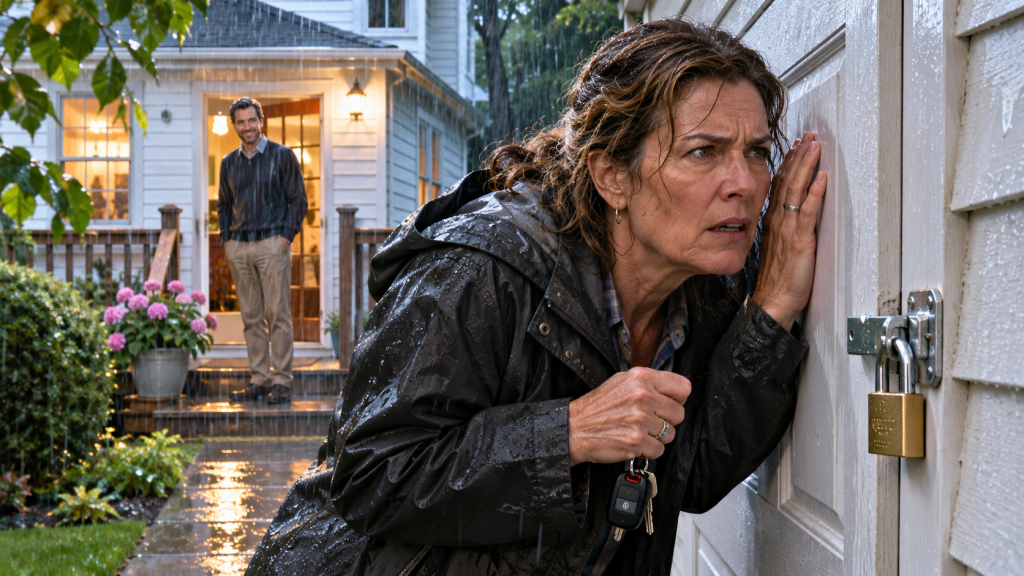
The locked garage.
The faint cough.
And the terrible fear that I’d arrived too late.
Then I looked toward my daughter’s house.
The curtains were open.
Warm light spilled across the porch.
Rachel was laughing at something Thomas had said.
And I smiled.
Because the story that began with a mother searching for her missing daughter had become something larger.
A story about truth.
Courage.
Boundaries.
Recovery.
And the extraordinary strength of a woman who refused to let another person’s cruelty decide the rest of her life.
I found my daughter because I refused to dismiss the warning signs.
But Rachel found herself again through courage, support, and the freedom to choose her own future.
And that is the part of our story I treasure most.
Not the darkness behind the garage door.
But the light she built afterward.