
The four words on the paper seemed to steal all the air from the principal’s office. MY MOTHER IS ALIVE. I read them once. Then again. The handwriting was uneven, the letters pressed so hard against the paper that the pencil had nearly torn through it.
My ten-year-old son stood beside me, watching my face. “Mom?” Ethan whispered. “Is Lily in trouble?” I looked down at him. His brown eyes were filled with worry. The same eyes that had sparkled every afternoon that week when he came home describing his new friends, the playground, and the excitement of finally belonging to a classroom.
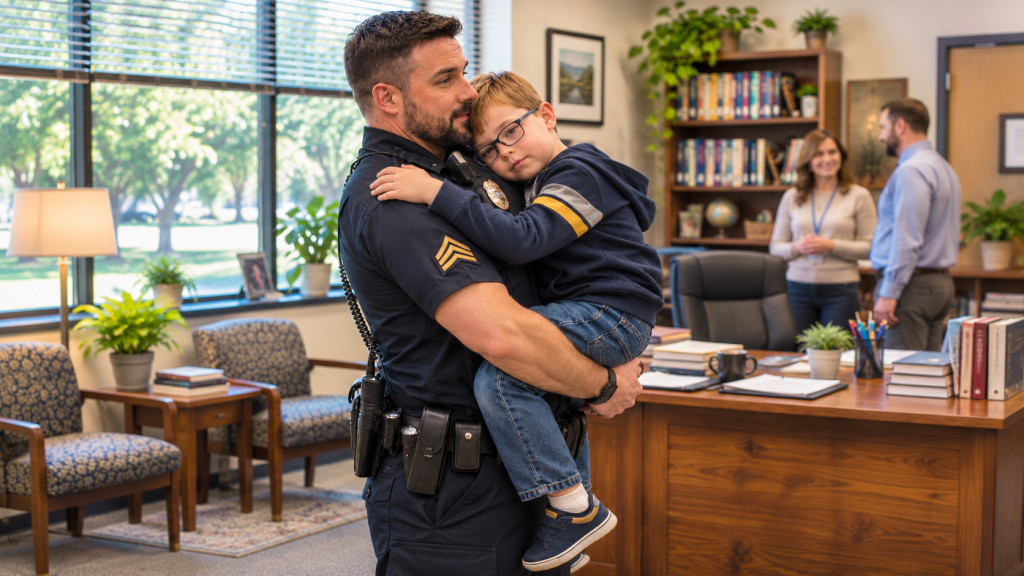
I had spent years worrying that the world wouldn’t make room for him. Now he was standing in a principal’s office with two police officers because he had refused to ignore another child’s fear. I knelt in front of him. “Sweetheart, you did something very important by telling us.”
His lower lip trembled.
“But I pulled the alarm.”
“I know.”
“Principal Harris said it was for fires.”
I touched his cheek.
“The fire alarm is for emergencies, and pulling it can be dangerous when there isn’t a fire. But I understand you were frightened because you believed Lily needed help.”
He swallowed.
“I told the grown-ups first.”
My heart broke.
“I know you did.”
Detective Elena Ruiz stepped closer.
“Ethan,” she said gently, “could you tell me exactly when Lily gave you that paper?”
He looked toward me.
I nodded.
“It’s okay to tell her what you remember.”
He thought carefully.
“Yesterday. After lunch.”
“Where were you?”
“By the library.”
“Was Lily alone?”
Ethan nodded.
“She was crying.”
Detective Ruiz crouched beside us.
“What did she say?”
My son hesitated.
Then whispered, “She said people would get mad if she told the truth.”
The detective’s expression changed.
“What truth?”
Ethan pointed toward the paper.
“That her mommy didn’t die.”
I felt my stomach tighten.
Then he said something that made every adult in the room fall silent.
“Lily said her mommy was locked up too.”
My husband, Michael, moved closer.
“What do you mean, locked up?”
Ethan looked confused.
“She said Miss Clara knows where.”
Detective Ruiz exchanged a glance with her colleague, Officer James Miller.
Principal Harris slowly lowered himself into his chair.
I could see the horror beginning to settle across his face.
An hour earlier, he had apparently believed he was dealing with a behavioral emergency involving a child who had pulled a fire alarm.
Now the possibility was far more frightening.
A missing girl.
A school employee.
A message claiming that a mother believed to be dead was alive.
And my son, who had been attending the school for only five days, appeared to be the person who had noticed something everyone else had dismissed.
Detective Ruiz turned toward Harris.
“Who is Lily’s legal guardian?”
He cleared his throat.
“Her aunt. Margaret Collins.”
“Since when?”
“Approximately eighteen months.”
“And the mother?”
Harris hesitated.
“Our records indicate she died in a traffic accident.”
The detective frowned.
“Do you have a death certificate?”
“I’d have to check the enrollment file.”
“Please do.”
As Harris reached for his telephone, Ethan tugged my sleeve.
“Mom?”
“Yes, sweetheart?”
He looked toward the detectives.
“Are they going to take me to jail?”
My chest tightened.
“No.”
“But I broke a rule.”
I put both hands on his shoulders.
“You need to tell the truth about what happened, and the adults will handle the rest. You’re not being arrested.”
Detective Ruiz nodded.
“That’s right, Ethan. You’re helping us understand something important.”
He considered that.
Then whispered, “Can I still go to school Monday?”
I nearly started crying.
Even after everything, that was what frightened him most.
Not the police.
Not the principal.
But the possibility of losing the school he’d waited so long to attend.
I kissed his forehead.
“We’re going to make sure you have a school where you can learn and feel safe.”
He nodded.
Then looked toward the photograph of Lily.
“Can she come back too?”
Nobody answered immediately.
Finally, Detective Ruiz said, “We’re going to do everything we can to find her.”
Within twenty minutes, the office had become the center of an active investigation.
Detective Ruiz requested the school’s visitor records, staff schedules, and unedited security footage.
Another officer contacted the appropriate child-protection agency.
Principal Harris provided Lily’s enrollment file.
And Ethan, after giving his account with me present and without unnecessary repeated questioning, was allowed to sit in a quieter room with Michael.
I remained with him while the investigators worked.
He opened his lunchbox.
Inside were two crackers, a small apple, and a folded napkin on which I’d drawn a smiling dinosaur that morning.
He offered me one of the crackers.
“Mom, you can have this.”
I smiled through tears.
“Thank you, sweetheart.”
He watched me.
“Are you sad?”
“A little.”
“Because Lily is missing?”
“Yes.”
He looked down.
“I want her to be okay.”
I put my arm around him.
“So do I.”
He leaned against my shoulder.
Then whispered, “Lily was nice to me.”
I turned toward him.
“What did she do?”
He smiled faintly.
“On Wednesday, somebody laughed when I couldn’t open my juice.”
My heart tightened.
“Who?”
He shook his head.
“I don’t know his name.”
I waited.
“Lily told him to stop.”
I swallowed.
“And then?”
“She opened it for me. But she didn’t do it like I was a baby.”
“What do you mean?”
“She asked if I wanted help first.”
I closed my eyes.
Such a small act.
Such an extraordinary difference.
“Then she said I had cool dinosaur shoes.”
He looked down at his sneakers.
“She was my friend.”
I held him closer.
And silently promised that if there was anything appropriate I could do to help Lily, I would.
An hour later, Detective Ruiz asked to speak with Michael and me privately.
A school counselor stayed nearby with Ethan, and we made certain he understood where we were going.
The detective led us into a conference room.
She closed the door.
“Mr. and Mrs. Parker, we’ve uncovered some discrepancies.”
I gripped Michael’s hand.
“About Lily?”
“Yes.”
She placed a photocopy of the enrollment form on the table.
“According to the school’s records, Lily’s mother, Sarah Collins, died eighteen months ago. Her aunt, Margaret Collins, became her guardian shortly afterward.”
I nodded.
“But?”
Detective Ruiz looked at me.
“We haven’t been able to locate a corresponding death record.”
My heart began pounding.
“Could it be a clerical error?”
“Possibly. We’re checking other records. But the circumstances are concerning.”
Michael leaned forward.
“Who is Miss Clara?”
The detective opened another folder.
“Clara Voss. Forty-six. She has worked at the school as a classroom support aide for two years.”
“Does she know Margaret Collins?”
“We’re investigating that.”
I swallowed.
“And the security footage?”
Detective Ruiz took a breath.
“It shows Clara leaving through a side door with a child at approximately ten fifty-four this morning.”
My stomach tightened.
“Lily?”
“The child’s appearance is consistent with Lily’s, but we’re working to confirm that.”
She continued.
“Clara signed out for a medical appointment. She didn’t have documented permission to remove Lily.”
I covered my mouth.
Michael stared at the detective.
“Has anyone found her?”
“Not yet.”
Then Detective Ruiz said something unexpected.
“There’s another reason we’re concerned about the guardianship documents.”
I looked up.
“What?”
“The signature attributed to Lily’s mother appears on a document dated after the reported death.”
I stared at her.
“That doesn’t make sense.”
“No.”
She folded her hands.
“And the document authorizes Margaret to make decisions about Lily’s education and medical care.”
Michael shook his head.
“Could someone have forged it?”
“That’s one possibility. We need the originals and a proper examination.”
I looked toward the window.
Beyond the glass, children were returning from the playground.
Some were laughing.
Some carried jump ropes.
Others chased one another across the grass.
Their world continued, unaware that a child from their school might be in danger.
“What does this mean for Lily?” I asked.
Detective Ruiz’s expression softened.
“It means we need to find her quickly and understand who has been making decisions on her behalf.”
At nearly three o’clock, we were finally told Ethan could go home.
Principal Harris came to speak with us.
He looked exhausted.
His tie was loosened, and his face had lost the confident expression he’d worn when we first arrived.
“Mrs. Parker, Mr. Parker,” he began, “I want to apologize for how this morning was handled.”
Michael folded his arms.
“We’d like to understand that.”
Harris nodded.
“Ethan told his teacher about Lily yesterday. The report should have been documented and assessed promptly.”
I stared at him.
“Was it?”
He looked down.
“No.”
“And this morning?”
“He repeated the concern.”
“What did the teacher do?”
Harris swallowed.
“She asked him to return to class.”
My chest tightened.
“Because he has Down syndrome?”
The principal looked uncomfortable.
“I can’t tell you what motivated her response.”
I took a breath.
“But you know what was said?”
He nodded slowly.
“The aide involved reportedly suggested Ethan might have confused something he’d heard with an imaginary game.”
I felt anger rise.
“Did anyone check the auditorium?”
Harris lowered his eyes.
“Not before the alarm.”
For a moment, I couldn’t speak.
Then I asked quietly, “Would they have checked if another child had made the same report?”
He didn’t answer.
And that silence told me more than any explanation could have.
Ethan appeared in the doorway.
He was holding his backpack.
“Mom?”
I turned.
“Yes?”
He looked at Principal Harris.
“Am I in trouble?”
The principal knelt.
“No, Ethan.”
My son hesitated.
“Can I come back Monday?”
Harris looked at us.
Then at Ethan.
“Yes. We’ll talk with your parents about making sure school feels safe and supportive.”
Ethan smiled.
“Okay.”
Then he added, “I hope Lily comes back.”
Harris’s eyes filled.
“So do I.”
That evening, our house was quieter than usual.
Normally, Ethan spent dinner describing everything that had happened at school.
He loved telling us who sat beside him, which books the teacher read, and whether the cafeteria served pizza.
But that night, he pushed his peas around his plate.
Michael reached across the table.
“Buddy, are you feeling okay?”
Ethan nodded.
Then shook his head.
“Not really.”
I set down my fork.
“Do you want to talk about it?”
He looked toward the window.
“Everybody looked at me today.”
My heart tightened.
“Who?”
“At school.”
He swallowed.
“When the alarm went off, everybody stared.”
Michael nodded.
“That must have felt uncomfortable.”
Ethan looked down.
“Some boys said I ruined recess.”
I felt tears rising.
“I’m sorry they said that.”
He shrugged.
Then whispered, “Maybe I should have stayed quiet.”
I moved my chair closer.
“Ethan, there’s something important I want you to understand.”
He looked up.
“If you’re frightened because you believe someone is in danger, you should tell a trusted adult. And if that adult doesn’t listen, you can tell another.”
He nodded.
“But alarms are only for emergencies?”
“Yes. And grown-ups need to help you learn what to do in different situations.”
He thought about that.
Then asked, “What if all the grown-ups say no?”
Michael and I exchanged a glance.
I took a breath.
“Then you keep looking for someone safe who will listen. You can always call us.”
Ethan nodded.
A moment later, he whispered, “I told Lily that too.”
I froze.
“What?”
He looked at me.
“I told her my mom listens.”
My throat closed.
He continued.
“Yesterday, when she gave me the paper, she said nobody believed her.”
I swallowed.
“And what did you say?”
Ethan smiled faintly.
“I said my mom would.”
I reached for him and held him close.
He had trusted me with something much larger than either of us understood.
At six thirty that evening, Detective Ruiz called.
I answered immediately.
“Have you found Lily?”
“Not yet,” she said. “But we’ve located her aunt.”
My heart pounded.
“Margaret?”
“Yes.”
“Does she know where Lily is?”
“We’re speaking with her now.”
There was a pause.
Then the detective continued.
“Mrs. Parker, I also wanted to ask whether Ethan has mentioned anything about a blue house.”
I frowned.
“A blue house?”
“Yes.”
I looked across the room.
Ethan was sitting on the carpet, building a tower out of colored blocks.
“Not that I remember.”
“If he brings it up naturally, please let us know. Don’t question him repeatedly.”
“Of course.”
I swallowed.
“Why a blue house?”
The detective hesitated.
“We found a drawing in Lily’s desk.”
My chest tightened.
“What kind of drawing?”
“A house with blue shutters. Beneath it, Lily wrote, Mommy waits where the roses grow.”
I stood very still.
“What does that mean?”
“We don’t know yet.”
After the call, I sat beside Ethan.
He was carefully arranging green blocks around his tower.
“Mom?”
“Yes?”
“Can you help me with the roof?”
I smiled.
“Of course.”
We worked quietly for several minutes.
Then Ethan looked at the blocks and said something that made my heart race.
“Lily likes blue houses.”
I kept my voice calm.
“Oh?”
He nodded.
“She drew one.”
I looked at him.
“Did she tell you about it?”
“Yeah.”
“What did she say?”
He searched for the words.
“She said the windows were sad.”
I frowned.
“Sad?”
“Because they didn’t open.”
My chest tightened.
He placed another block.
“Lily said her mommy was there.”
I swallowed.
“Did she tell you where the house was?”
Ethan shook his head.
Then pointed toward the window.
“She said it was near the river, where the big bridge looks like a rainbow.”
I contacted Detective Ruiz.
I repeated Ethan’s words exactly.
The detective thanked me and assured me the information would be checked.
I didn’t know whether it would help.
But I hoped.
At eight forty-five, my phone rang again.
This time, Detective Ruiz’s voice sounded different.
More urgent.
“Mrs. Parker, do you know whether Ethan has ever been to the old Riverside pedestrian bridge?”
I frowned.
“No. Why?”
“We believe we’ve identified the area he described.”
My stomach tightened.
“Have you found the house?”
“We’ve located a property that may be relevant.”
I closed my eyes.
“And Lily?”
“We’re working on it.”
That night, I barely slept.
Every time I closed my eyes, I saw Lily’s photograph.
Her dark braids.
Her careful smile.
The folded paper.
My mother is alive.
I thought of her sitting alone somewhere, hoping the right person would finally believe her.
And I thought about Ethan.
How easily his concerns had been dismissed.
How quickly someone had suggested he’d imagined everything.
I had spent years preparing him for a world that might underestimate him.
Yet I hadn’t fully prepared myself for the anger of seeing it happen.
At dawn, Michael found me sitting in the kitchen.
He placed a cup of tea beside me.
“You haven’t slept.”
I shook my head.
He sat across from me.
“Neither have I.”
For a while, we remained silent.
Then he whispered, “We were so afraid of sending Ethan to school.”
I nodded.
“We worried he’d be lonely.”
“Or bullied.”
I looked down.
“Or that he wouldn’t understand the rules.”
Michael took my hand.
“And on his fifth day, he understood something the adults didn’t.”
I looked up.
“What?”
“That a frightened child needed someone to listen.”
Before I could answer, my phone rang.
Detective Ruiz.
I grabbed it.
“Hello?”
“Mrs. Parker?”
“Yes?”
“We’ve found Lily.”
I covered my mouth.
“Is she alive?”
“Yes.”
Tears filled my eyes.
“Thank God.”
The detective continued.
“She’s receiving medical attention, but she’s conscious.”
I began crying.
Michael moved beside me.
Then I heard Detective Ruiz take a breath.
“And, Mrs. Parker, we found her mother.”
I stared at the phone.
“What?”
The detective’s voice softened.
“Sarah Collins is alive.”
For several seconds, I couldn’t speak.
The words seemed impossible.
A mother declared dead.
A daughter who had insisted otherwise.
And a little boy who had refused to stop asking questions.
I gripped the edge of the table.
“Where was she?”
Detective Ruiz paused.
“In a house near Riverside Bridge.”
My chest tightened.
“The blue house?”
“Yes.”
I began crying harder.
Michael put his arm around me.
“Are they okay?”
“Sarah is receiving medical care. We have serious concerns about what she’s experienced, and the investigation is ongoing.”
I swallowed.
“Was Lily with her?”
“Not when officers first reached the property. Lily was located at a separate address connected to Clara Voss.”
My stomach tightened.
“Clara?”
“Yes. Both locations are now part of the investigation.”
I looked toward the living room.
Ethan was asleep on the sofa, his dinosaur blanket pulled up to his chin.
He had no idea that the girl he’d tried so desperately to help had been found.
“Can I tell him?” I whispered.
“You can tell him Lily has been found and is receiving care. Please avoid discussing details that haven’t been confirmed.”
I nodded.
“Of course.”
When the call ended, I sat beside my sleeping son.
I brushed a strand of hair from his forehead.
And whispered, “They found her, sweetheart.”
He stirred.
Opened one eye.
“Lily?”
I nodded through tears.
“They found Lily.”
He sat up immediately.
“Is she okay?”
“She’s safe with people helping her.”
His face brightened.
“Really?”
“Really.”
He wrapped his arms around my neck.
Then began crying.
Not loudly.
Just quiet, relieved tears.
“I knew she was real,” he whispered.
I held him close.
“I know.”
The following days revealed a story far more complicated than anyone had imagined.
Detective Ruiz later explained the confirmed facts to us within the limits of what she could share.
Sarah Collins had not died in a traffic accident.
Eighteen months earlier, she had survived a serious collision and undergone extensive treatment.
During her recovery, she experienced physical limitations and periods of confusion that made it difficult to manage her affairs independently.
Her sister, Margaret, initially stepped in to help with Lily.
At first, the arrangement appeared temporary.
But when Sarah began recovering, Margaret resisted returning control over Lily’s care and certain financial matters.
Sarah had inherited a modest property and received compensation related to the collision.
The money was intended to support her rehabilitation and provide stability for Lily.
Investigators were examining whether Margaret had misused her access to those funds.
Clara Voss, who knew Margaret through a personal connection, had become involved in arranging Sarah’s care and limiting who could reach her.
According to the emerging evidence, Sarah had been moved between facilities and private residences without appropriate oversight.
Margaret told Lily that her mother had died.
She told school staff the same thing.
And she provided guardianship documents that appeared to support her claim.
But Sarah had survived.
And as her condition improved, she repeatedly tried to contact her daughter.
Her messages went unanswered.
Her requests for visits were delayed.
And when she questioned the arrangements, she was told Lily had adjusted to life without her.
I listened to Detective Ruiz describe the situation and felt sick.
A mother had spent eighteen months believing she might never see her child again.
A daughter had been told her mother was dead.
And the truth had been hidden behind documents, explanations, and the authority of adults who believed no one would question them.
Then came another revelation.
Lily had discovered her mother was alive not through a secret phone call or a hidden photograph.
She’d overheard a conversation between Margaret and Clara.
The women had been arguing about Sarah’s increasing ability to communicate.
Margaret was frightened that Sarah might seek legal assistance.
Clara believed the arrangement was becoming impossible to conceal.
Lily heard her mother’s name.
Then the words:
“She remembers everything.”
For days, Lily tried to ask questions.
Margaret told her she’d misunderstood.
Clara insisted it was a conversation about someone else.
But Lily knew her mother’s voice.
She remembered the blue house.
The roses.
The narrow windows.
And the song Sarah used to sing while brushing her hair.
Lily began looking for evidence.
At home, she found an old photograph of Sarah standing beside a house with blue shutters.
The photograph had a handwritten address on the back.
She tried showing it to Margaret.
Margaret took it away.
The next day, Lily drew the house from memory.
Then she wrote four words on a folded piece of paper.
My mother is alive.
She carried the note to school.
And when she saw Ethan sitting alone outside the library, she gave it to him.
Why Ethan?
The answer came from Lily herself.
She told the investigators that on Wednesday, she’d watched another child laugh at Ethan when he struggled with his juice carton.
She’d helped him.
And he’d thanked her with a smile so genuine that she’d remembered it.
Later, when she asked whether he liked school, he’d said:
“Yes. Everybody should have a friend.”
Lily had smiled.
“Even me?”
Ethan nodded.
“Especially you.”
The next day, Lily was frightened.
She believed the adults around her were hiding something terrible.
And she didn’t know whom to trust.
Then she saw Ethan.
He didn’t laugh when she said her mother might be alive.
He didn’t tell her to stop making things up.
He listened.
And when she told him she was scared, he said:
“My mom listens. I can tell her.”
Lily gave him the paper.
Not because she expected him to solve everything.
But because she believed he would remember.
And he did.
The investigation also established that Clara had taken Lily from the school without proper authorization.
Investigators believed she was attempting to prevent Lily from speaking with the authorities after concerns were raised.
The circumstances of Lily’s time in the locked school room and her subsequent movements were examined carefully.
Evidence from the room, security footage, and witness accounts became important.
Clara was taken into custody.
Margaret faced legal proceedings involving the alleged misuse of documents, interference with Sarah’s parental relationship, and financial misconduct.
The exact charges and outcomes would be determined through the legal process.
But for Lily and Sarah, the most important thing wasn’t punishment.
It was reunion.
That reunion didn’t happen immediately.
Sarah needed medical evaluation and support.
Lily needed careful reassurance after months of fear and confusion.
Professionals worked to determine the safest way for them to reconnect.
Then, one afternoon, they were finally brought together.
I wasn’t there.
I learned about it later through the family liaison, with Sarah’s permission.
Sarah sat in a wheelchair in a quiet room.
Her hair had grown longer than Lily remembered.
There were scars on her arms.
And her voice was weaker than it had once been.
But when Lily walked through the doorway, Sarah lifted her head.
For a moment, neither moved.
Then Lily whispered, “Mommy?”
Sarah began crying.
“Lily.”
The little girl froze.
As though she’d spent so long imagining that moment she didn’t know whether she was allowed to believe it.
Then she ran forward.
Sarah opened her arms.
Lily fell against her.
And for several minutes, they simply held each other.
Lily cried into her mother’s shoulder.
“They said you died.”
Sarah held her tighter.
“I know, sweetheart.”
“I thought you forgot me.”
Sarah’s voice broke.
“Never.”
Lily looked up.
“Were you looking for me?”
Tears streamed down Sarah’s face.
“Every day.”
The room fell silent.
Then Sarah whispered, “I never stopped being your mother.”
When the liaison told me, I cried so hard I couldn’t speak.
I thought about all the evenings I’d spent helping Ethan with homework.
All the mornings I’d kissed his forehead before school.
All the ordinary moments I sometimes took for granted.
Sarah had been denied those moments for eighteen months.
And Lily had been forced to grieve a mother who was still alive.
But they had found each other again.
And that mattered.
A week later, Principal Harris requested a meeting with Michael and me.
This time, he didn’t call us in a panic.
He asked whether we could discuss Ethan’s experience and the school’s response.
I agreed.
But I told him we wanted Ethan included in the parts of the conversation that concerned him.
Harris accepted.
We arrived after school.
Ethan held Michael’s hand as we walked through the entrance.
He looked nervous.
“Mom?”
“Yes?”
“Am I getting sent home again?”
I squeezed his hand.
“No, sweetheart. We’re here to talk about how school can be better.”
He considered that.
Then nodded.
“Okay.”
Principal Harris greeted us in the conference room.
Ethan’s classroom teacher, Mrs. Dalton, was there.
So was the school’s special education coordinator, Ms. Bennett.
I sat beside Ethan.
Michael sat on his other side.
Harris began.
“Ethan, I want to say something to you.”
My son looked up.
“Yes?”
The principal took a breath.
“You told adults that someone needed help. They didn’t respond the way they should have.”
Ethan studied him.
Harris continued.
“I’m sorry.”
For several seconds, Ethan said nothing.
Then he asked, “Did you think I was making it up?”
The room went silent.
Mrs. Dalton looked down.
Principal Harris swallowed.
“We didn’t take your concerns seriously enough.”
Ethan considered.
Then whispered, “But I was telling the truth.”
Harris nodded.
“Yes, you were.”
My eyes filled.
For years, Ethan had worked hard to be understood.
He sometimes needed extra time to find words.
Sometimes he repeated questions.
Sometimes he struggled to explain what he’d noticed.
But none of those things meant he didn’t understand what was happening around him.
Mrs. Dalton leaned forward.
“Ethan, I owe you an apology too.”
He looked at her.
She continued.
“I should have listened more carefully when you told me Lily was frightened.”
He nodded.
“Okay.”
Then he asked, “Will you listen next time?”
Her eyes filled.
“Yes.”
Ethan smiled faintly.
“Good.”
Harris turned toward Michael and me.
“We’re conducting a full safeguarding review. That includes how student reports are documented, how staff respond to concerns, and how children receive support when they communicate differently.”
I nodded.
“That needs to happen.”
He continued.
“We’re also reviewing procedures for releasing children from school, staff supervision, and emergency escalation.”
Michael leaned forward.
“And Ethan’s education?”
Harris nodded.
“We want him to continue learning here with the supports he’s entitled to.”
I looked at the principal.
“Ethan didn’t come to school to become a hero.”
Harris nodded.
“He came to learn.”
My voice trembled.
“To make friends.”
I glanced toward my son.
“And to be treated as a child who belongs.”
Harris’s expression softened.
“I understand.”
I took a breath.
“I hope you do.”
We discussed Ethan’s support plan.
His communication needs.
His classroom accommodations.
And ways to make sure he could report concerns without being dismissed or unnecessarily singled out.
The school committed to staff training.
Not simply a presentation about disability.
But practical work on listening, safeguarding, and recognizing that children communicate important information in different ways.
We also discussed the fire alarm.
Ethan needed clear guidance about emergency procedures.
He needed to know when to seek another adult, how to contact us, and what to do if he believed someone was in immediate danger.
He didn’t need to be shamed.
He needed to be taught.
And the adults needed to learn too.
At the end of the meeting, Ethan raised his hand.
Principal Harris smiled.
“Yes, Ethan?”
My son looked serious.
“Can Lily come back to school?”
The room grew quiet.
Harris took a breath.
“That will depend on what Lily and her family decide.”
Ethan nodded.
Then whispered, “I hope she does.”
That evening, I asked Ethan how he felt.
He sat on the living room rug, sorting his toy dinosaurs.
“Better.”
I smiled.
“Why?”
“Principal Harris said sorry.”
I nodded.
“That was important.”
He picked up a plastic triceratops.
“Mrs. Dalton too.”
I watched him.
Then asked gently, “Do you still want to go to school?”
He looked at me as if I’d asked whether he wanted ice cream.
“Of course!”
I laughed.
“Of course?”
He grinned.
“Oliver is my friend.”
My heart warmed.
“And?”
“We’re making a volcano next week.”
I smiled.
“That sounds exciting.”
He nodded.
“It’s going to explode.”
Michael looked over from the sofa.
“Safely, I hope.”
Ethan laughed.
“It’s baking soda, Dad.”
I watched him arrange the dinosaurs around an imaginary mountain.
And for the first time since the principal’s call, I felt my shoulders begin to relax.
The following Monday, Ethan returned to school.
I walked him to the entrance.
He wore his favorite blue jacket and carried the backpack he’d chosen himself.
Before entering, he turned toward me.
“Mom?”
“Yes?”
“Do you think people will stare?”
My heart tightened.
“Some might.”
He looked down.
I knelt.
“But staring doesn’t change who you are.”
He nodded.
I continued.
“You’re Ethan. You love dinosaurs, science, and your friends. And you deserve to be here.”
He smiled.
Then hugged me.
“I love you.”
“I love you too.”
He ran toward the entrance.
Oliver was waiting near the doors.
When he saw Ethan, he waved both arms.
“Ethan!”
My son grinned.
“Oliver!”
They hurried inside together.
And I stood in the parking lot, crying quietly.
Because that simple moment was something we’d worked toward for years.
Over the next several weeks, Ethan settled back into school.
There were difficult days.
He sometimes became overwhelmed by noise.
He occasionally needed extra support with classroom routines.
And some children still asked questions that were awkward or unkind.
But there were good days too.
Days when he came home laughing.
Days when he told us about science experiments.
Days when he proudly showed us work he’d completed.
We didn’t expect every day to be perfect.
We wanted him to have opportunities to learn, grow, make mistakes, receive support, and belong.
One afternoon, he came home carrying a certificate.
I smiled.
“What’s that?”
He held it up.
“Science helper!”
Michael grinned.
“Congratulations!”
Ethan beamed.
“I helped clean up the experiment.”
I took the certificate.
At the bottom, his teacher had written:
Ethan showed excellent teamwork and persistence.
My eyes filled.
Not because he needed a certificate to prove his worth.
But because he was finally being recognized for ordinary classroom contributions.
Just like any other child.
Then, nearly two months after Lily disappeared, I received a letter.
It came through a family-support organization assisting Sarah and Lily.
The envelope was pale yellow.
My name was written carefully on the front.
I opened it at the kitchen table.
Dear Mrs. Parker,
My name is Sarah Collins.
You don’t know me, but your son helped save my daughter.
For eighteen months, I lived with the fear that Lily believed I had abandoned her.
There were days when I thought I would never see her again.
Then a little boy listened when she said something was wrong.
He didn’t laugh at her.
He didn’t tell her she was imagining things.
He believed her enough to ask for help.
I know the police and many other people worked to find us, and I’m grateful to all of them.
But I wanted you to know how much your son’s kindness meant.
Lily talks about Ethan often.
She says he was the first person at school who made her feel brave.
Thank you for raising a child who understands that friendship means listening.
With gratitude,
Sarah Collins.
I read the letter twice.
Then a third time.
By the time Michael came home, I was sitting at the table with tears streaming down my face.
He looked worried.
“What’s wrong?”
I held out the letter.
He read it.
Then sat beside me.
For a long time, neither of us spoke.
Finally, Michael whispered, “We were so afraid the world wouldn’t understand Ethan.”
I nodded.
He looked toward the living room, where our son was happily singing to himself.
“And he understood something the world needed.”
I took a deep breath.
“Can we show him?”
Michael smiled.
“Of course.”
Ethan came into the kitchen carrying a toy dinosaur.
“What’s happening?”
I smiled.
“We got a letter.”
He looked curious.
“From who?”
“Lily’s mom.”
His eyes widened.
“Really?”
I nodded.
I read the letter aloud, explaining parts he didn’t understand.
When I finished, Ethan was quiet.
Then he asked, “Is Lily happy?”
I smiled.
“She’s with her mother.”
He nodded.
“Good.”
He looked toward the letter again.
“Did her mommy get better?”
“She’s recovering and getting help.”
Ethan smiled.
“That’s good too.”
Then he asked something that made me laugh through tears.
“Can I have a snack now?”
Michael burst out laughing.
I wiped my face.
“Of course, sweetheart.”
And just like that, Ethan returned to being ten years old.
A child who cared deeply about his friend.
And who also wanted crackers after school.
I think about that often.
The way adults sometimes turn children into symbols.
Heroes.
Inspirations.
Examples.
But Ethan didn’t wake up that Friday morning planning to become any of those things.
He wanted to see Oliver.
Eat lunch with his classmates.
And maybe learn something new about volcanoes.
He was a child.
And that was enough.
Several months later, Sarah contacted us again.
Lily wanted to see Ethan.
Their family-support team had helped arrange a gradual return to ordinary routines, including contact with trusted friends.
Michael and I agreed to a short meeting at a community garden.
The afternoon was warm.
Flowers bloomed beside the paths.
A fountain splashed gently in the center.
Ethan wore his dinosaur shirt.
He’d insisted on bringing two small notebooks.
“One for me,” he explained, “and one for Lily.”
When Sarah and Lily arrived, I recognized the little girl immediately.
The photograph Detective Ruiz had shown us hadn’t captured how expressive her face was.
She wore her dark hair in two braids.
Her eyes were cautious.
But when she saw Ethan, her face brightened.
“Ethan!”
My son turned.
“Lily!”
They ran toward each other.
Then stopped awkwardly.
For a moment, neither seemed sure what to do.
Finally, Lily smiled.
“Hi.”
Ethan grinned.
“Hi.”
He held out one of the notebooks.
“This is for you.”
Lily took it.
“Why?”
“So you can draw.”
She smiled.
“Thank you.”
Sarah approached us.
She moved carefully with a cane.
Her face was thinner than in the old photographs, but her eyes were warm.
“Mrs. Parker?”
I smiled.
“Yes. Please call me Anna.”
She reached for my hand.
“I’m Sarah.”
For a moment, she simply held my hand.
Then her eyes filled.
“I don’t know how to thank you.”
I shook my head.
“You don’t need to.”
She looked toward Ethan.
“Your son…”
Her voice broke.
I swallowed.
“He’s a wonderful boy.”
Sarah nodded.
“He is.”
We sat on a bench while the children drew flowers and dinosaurs.
Sarah told me a little about her recovery.
The progress she’d made.
The challenges that remained.
And how carefully she and Lily were rebuilding their routines.
“It isn’t easy,” she admitted.
I nodded.
“I can imagine.”
Sarah looked toward her daughter.
“Some mornings, she wakes up frightened that I’ll disappear again.”
My heart tightened.
“What do you tell her?”
Sarah smiled sadly.
“That I’m here. That the people helping us have a plan. And that if she’s afraid, she can tell me.”
I looked toward Lily.
She was laughing as Ethan attempted to draw a dinosaur wearing sunglasses.
Sarah continued.
“I can’t give her back the months we lost.”
I nodded.
“But I can be present now.”
We sat quietly.
Then she whispered, “Sometimes that’s all I can manage.”
I took her hand.
“Being present matters.”
Nearby, Lily looked up.
“Mom?”
Sarah turned immediately.
“Yes, sweetheart?”
“Look!”
She held up her notebook.
It showed a blue house with bright yellow windows.
Red roses grew beside the door.
Two people stood in the garden.
A mother.
And a daughter.
Sarah covered her mouth.
Lily smiled.
“This is our house.”
Sarah’s eyes filled.
“Yes.”
“But I made the windows open.”
For a long moment, nobody spoke.
Then Sarah began crying.
Lily hurried toward her.
“Mommy?”
Sarah opened her arms.
“Come here, sweetheart.”
Lily hugged her.
And I turned away, wiping my face.
Because sometimes the deepest healing begins with something as simple as a child drawing windows that can finally open.
A little later, Ethan approached me.
“Mom?”
“Yes?”
“Can Lily come to my birthday?”
I smiled.
“You can ask her.”
He nodded.
Then hurried back.
I watched him lean toward Lily and say something.
She smiled.
Then nodded enthusiastically.
Michael slipped his hand into mine.
“Look at him.”
I smiled.
“I am.”
For years, I’d watched my son struggle to find a place in a world that moved too quickly for him.
I worried about his future.
About friendships.
About whether people would take his feelings seriously.
But that afternoon, sitting beneath the trees, I realized something important.
Ethan didn’t need to become exceptional to deserve belonging.
He didn’t need to rescue anyone.
He didn’t need to prove that children with Down syndrome were capable of kindness, intelligence, or courage.
He deserved friendship because he was a child.
He deserved education because he was a student.
And he deserved respect because he was a person.
What happened with Lily didn’t create his worth.
It revealed how much adults had underestimated him.
When the school year ended, Ethan brought home a folder filled with drawings, assignments, and photographs.
There were pictures of his science project.
A photograph of him standing beside Oliver.
And a classroom group picture in which he smiled so widely that his eyes nearly disappeared.
At the bottom of the folder was a handwritten note from Mrs. Dalton.
Dear Ethan,
Thank you for reminding our classroom that listening is part of being a good friend.
I’ve learned a great deal this year too.
Keep asking questions.
Keep learning.
And keep being yourself.
I read it while Ethan sat beside me.
He watched my face.
“Do you like it?”
I smiled.
“Very much.”
He nodded.
Then asked, “Can I keep going to school next year?”
I laughed softly.
“Of course.”
He grinned.
“Good. Oliver and I are going to build a rocket.”
Michael looked up from the sofa.
“A rocket?”
Ethan nodded seriously.
“A small one.”
I raised an eyebrow.
“How small?”
He thought about that.
Then smiled.
“Probably.”
We all burst out laughing.
That summer, we celebrated Ethan’s eleventh birthday in our backyard.
There were balloons.
Dinosaur decorations.
Chocolate cupcakes.
And a table covered with paper rockets.
Oliver came.
Several classmates came.
And Lily arrived holding a wrapped present.
Sarah walked beside her.
When Ethan saw Lily, he ran toward her.
“You came!”
She smiled.
“I said I would.”
He took her hand.
“Come see the cake.”
They hurried toward the table.
And I stood near the garden gate watching them.
A year earlier, I couldn’t have imagined this.
My son surrounded by friends.
Laughing.
Arguing about games.
Sharing cupcakes.
Belonging.
Michael came beside me.
He smiled.
“You okay?”
I nodded.
“Just happy.”
He looked toward Ethan.
“Me too.”
Then Sarah approached.
She looked stronger than she had at our first meeting.
She still used her cane on difficult days, but her smile came more easily.
“Anna?”
I turned.
“Yes?”
“Can I show you something?”
She handed me a photograph.
It showed Lily standing beside the front door of a small white house.
There were flowers along the walkway.
And Sarah stood beside her, smiling.
I looked up.
“You moved?”
Sarah nodded.
“We found a place closer to her school.”
I smiled.
“It’s beautiful.”
Her eyes filled.
“It feels like ours.”
I looked at the photograph again.
Then noticed something near the window.
A small sign.
In Lily’s handwriting.
EVERYBODY DESERVES TO BE HEARD.
My throat tightened.
Sarah smiled.
“She made it herself.”
I looked toward Lily.
She was helping Ethan arrange candles on his birthday cake.
Two children who had both experienced the pain of being underestimated.
And who had found friendship by listening to one another.
I handed back the photograph.
“Tell her I love the sign.”
Sarah smiled.
“I will.”
Later that evening, after the guests left and the backyard grew quiet, Ethan sat beside me on the porch.
He held a small toy rocket Oliver had given him.
“Mom?”
“Yes, sweetheart?”
“Did I have a good birthday?”
I laughed.
“Did you?”
He grinned.
“Yes!”
I smiled.
“Then I think you did.”
He leaned against me.
For a while, we watched the fireflies flicker beyond the garden.
Then he asked, “Mom, do you remember when Principal Harris called you?”
My heart tightened.
“Yes.”
He looked down.
“I was scared.”
I put my arm around him.
“I know.”
He continued.
“I thought you might be mad.”
I swallowed.
“I’m sorry you felt that way.”
He looked up.
“But you weren’t.”
I shook my head.
“No.”
He smiled.
“Good.”
Then he asked, “Do you think Lily will always be my friend?”
I looked toward the stars.
“I hope you’ll be friends for a long time.”
He nodded.
Then whispered, “She said I helped her.”
I smiled.
“You did.”
He thought about that.
Then said, “But she helped me first.”
My eyes filled.
“What do you mean?”
He looked at me.
“She was nice when I didn’t have many friends.”
I closed my eyes.
There it was.
The truth beneath everything.
Ethan hadn’t helped Lily because he wanted praise.
He’d helped because she had shown him kindness when he needed it.
And he wanted to return that kindness.
I kissed his forehead.
“That’s what friendship is, sweetheart.”
He smiled.
“I like friends.”
I held him closer.
“So do I.”
For a long time, we sat quietly beneath the evening sky.
Sometimes people ask me what happened on Ethan’s fifth day at school.
They expect a dramatic story.
A little boy who pulled an alarm.
Two police officers.
A missing girl.
A mother everyone believed was dead.
And those things happened.
But when I think about that day, I remember something smaller.
I remember Ethan sitting in the principal’s office, clutching his lunchbox.
I remember the fear in his eyes.
And the way he whispered:
Mom, I didn’t do bad.
That sentence still breaks my heart.
Because my son had spent so much of his life trying to understand what adults expected from him.
He wanted to follow rules.
Make friends.
And be good.
When he encountered a situation he didn’t understand, he tried to get help.
And when he wasn’t believed, he became frightened.
The adults around him had to learn something important.
A child’s disability does not make their concerns less worthy of attention.
A different way of communicating doesn’t make a child unreliable.
And needing support doesn’t mean a child has nothing meaningful to contribute.
Ethan was not right about every detail.
No child is.
But he was right that Lily needed help.
And he deserved to be listened to carefully.
The investigation revealed serious failures.
Documents that should have been verified.
Warnings that should have been examined.
Adult decisions that had placed a child and her mother in danger.
Those failures were addressed through the appropriate legal and safeguarding processes.
But the children needed more than investigations.
They needed safety.
Consistency.
And adults willing to admit when they’d been wrong.
Lily needed to know her mother hadn’t abandoned her.
Sarah needed support rebuilding the life she’d lost.
And Ethan needed to know that one frightening day didn’t mean school was no longer a place for him.
In time, all three began moving forward.
Not without scars.
Not without difficult moments.
But with help.
And with hope.
I often think about the folded paper Lily placed inside Ethan’s lunchbox.
Four words.
My mother is alive.
She could have hidden it somewhere.
She could have kept it to herself.
But instead, she trusted another child.
And Ethan kept it safe.
Not because he understood all the consequences.
But because a friend had asked him to.
That simple act became one piece of a much larger effort to find the truth.
And the truth changed lives.
I used to believe the greatest thing I could do for Ethan was protect him from every difficulty.
I wanted to shield him from disappointment.
From cruel words.
From people who might underestimate him.
But parenting doesn’t mean removing every challenge.
It means making sure a child has the support, knowledge, and security to face the world without believing they must face it alone.
Ethan taught me that too.
He still needs help with certain things.
He still has days when school feels overwhelming.
He still gets frustrated when words don’t come easily.
And he still asks a hundred questions before breakfast.
But now he has friends.
He has teachers who understand him better.
He has a classroom where his contributions matter.
And he has a future that belongs to him.
Not to anyone’s expectations.
Not to anyone’s fears.
And certainly not to the limits other people once imagined for him.
One afternoon, near the end of summer, I found him sitting at the kitchen table writing in his notebook.
“What are you working on?” I asked.
He smiled.
“A story.”
I sat beside him.
“Can I read it?”
He nodded.
At the top of the page, he’d written:
THE BOY WHO LISTENED.
Beneath it was a drawing of a boy standing beside a girl.
The girl held a blue house.
The boy held a dinosaur.
I smiled.
“That’s a lovely picture.”
Ethan looked proud.
Then he pointed toward the words he’d written underneath.
I read them carefully.
Sometimes people are scared.
Sometimes people don’t believe them.
But friends listen.
My eyes filled.
I looked at my son.
“Ethan, that’s beautiful.”
He smiled.
“It’s about Lily.”
I nodded.
“I thought so.”
Then he added one more sentence.
Everybody should have a friend.
I held him close.
And for a moment, I remembered the child who had spent years watching other children play through the window.
The little boy who wanted nothing more than to belong.
He’d finally found friendship.
And when one of those friends needed help, he’d done what he could.
That didn’t make him a superhero.
It made him Ethan.
And Ethan was enough.
Today, when I look back at the phone call from Principal Harris, I no longer remember only the fear.
I remember what came afterward.
A missing girl found.
A mother reunited with her daughter.
A school forced to confront its mistakes.
And two children who discovered the power of friendship.
But most of all, I remember the lesson that changed me.
Never mistake a child’s need for support as a lack of understanding.
Never confuse a different way of speaking with having nothing important to say.
And never make a child prove their worth before offering them a place to belong.
Because sometimes the person everyone overlooks is the one who notices something the rest of us have missed.
And sometimes the most important thing we can do is simply listen.
On Ethan’s first day at school, I worried that nobody would see the wonderful boy I knew.
By the end of his first week, I’d learned something.
I couldn’t control how everyone saw him.
But I could insist that he be treated with dignity.
I could help him understand his rights and responsibilities.
And I could remind him that his voice mattered.
One evening, as I tucked him into bed, Ethan looked up at me.
“Mom?”
“Yes, sweetheart?”
“Do you think I can help people when I’m big?”
I smiled.
“Of course you can.”
He thought carefully.
“Maybe I’ll be a scientist.”
I nodded.
“That would be wonderful.”
“Or a firefighter.”
I smiled.
“You’d have to learn a lot about safety.”
He laughed.
“Or a teacher.”
I brushed his hair away from his forehead.
“You have time to explore what you love.”
He smiled.
Then whispered, “I want to be someone who listens.”
My eyes filled.
I kissed his forehead.
“That’s a wonderful thing to want.”
I turned off the lamp.
The room grew quiet.
Outside, the neighborhood settled beneath the evening sky.
And as I closed his bedroom door, I thought about Lily.
About Sarah.
About the folded note.
And about the day two police officers sat beside my frightened son in the principal’s office.
I had arrived believing something terrible had happened because of Ethan.
Instead, something terrible had been happening around him.
And he’d tried to tell someone.
He wasn’t perfect.
He didn’t need to be.
He was a child learning how to navigate a complicated world.
But he knew that when a friend said she was afraid, her words mattered.
And that was something every adult in that school needed to remember.
My son went to school hoping to find a friend.
On his fifth day, he found one who desperately needed to be heard.
And by refusing to forget her words, he helped bring a mother and daughter back together.
Not because he was extraordinary for having Down syndrome.
But because kindness, courage, and friendship belong to everyone.
And sometimes, the beginning of a miracle is nothing more than one person saying:
“I believe you. Let’s find someone who can help.”