The moment Grandma Ruth saw the photograph in my hands, something changed in her face. She had been smiling only minutes earlier, waving goodbye to the last wedding guests and reminding Daniel’s mother to take home a slice of cake. Now she stood in the doorway of the empty reception hall, looking as though the past had walked into the room and called her by name. “Oh, Grace,” she whispered. “I can explain.” I stared at her. The photograph trembled between my fingers.
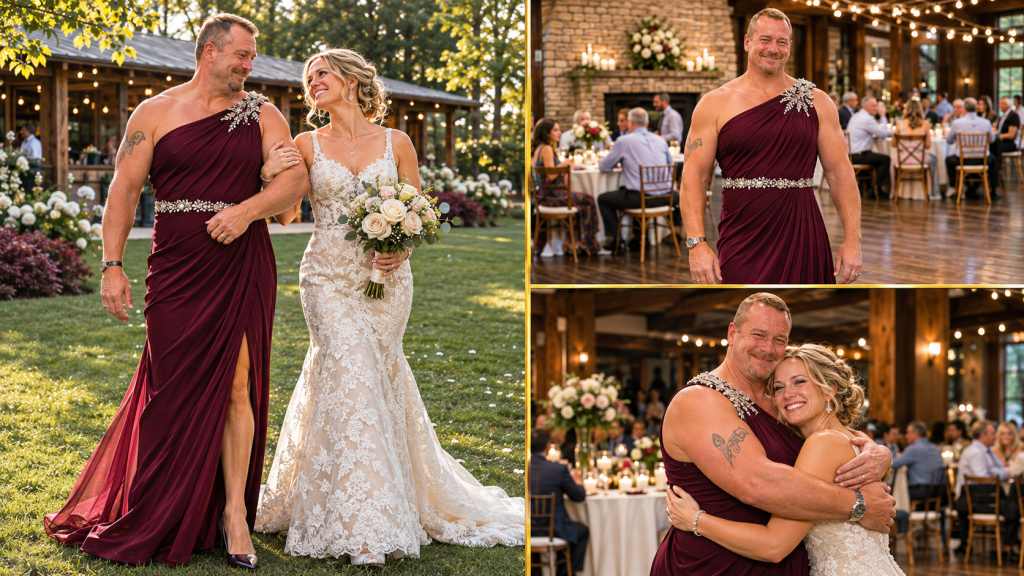
It showed a silver-haired man standing outside the very church where Daniel and I had exchanged our vows that afternoon. My wedding church. A place I’d chosen because my mother had worshipped there when she was young. A place Grandma had told me held some of our family’s happiest memories. And somewhere in the shadow of its stone archway stood a man who might be my father. “Grandma,” I said quietly, “who is Adrian Mercer?” She closed her eyes. Lucas stood beside me in his crimson dress, his mascara slightly smudged from crying during the ceremony.
He looked at Grandma. “Ruth, she deserves the truth.” Grandma opened her eyes. “I know.” Her voice was barely audible. “I’ve known that for a very long time.” I felt something tighten in my chest. “Did you know my father was alive?” She nodded. I stared at her. “All these years?” Tears slid down her cheeks. “Yes, sweetheart.” For a moment, I couldn’t hear anything. Not the soft music still playing through the reception hall speakers. Not the voices of the staff collecting empty glasses.
Not even the sound of Daniel approaching from behind me.
I could only hear one word.
Yes.
My grandmother had known.
The woman who tucked me into bed after my mother’s funeral.
The woman who held me when I cried on Father’s Day.
The woman who told me I could ask anything about my family.
She had known my father was alive.
And she had allowed me to grow up believing he had never wanted me.
I took a step backward.
“Why?”
Grandma reached for me.
I pulled away.
“Grace—”
“No.”
My voice cracked.
“Please don’t tell me you were protecting me. I’ve already heard those words today.”
Lucas lowered his head.
Grandma covered her mouth.
I looked at both of them.
“Mom died when I was twelve. I spent seventeen years after that wishing I could ask her why my father didn’t love me.”
Tears spilled down my cheeks.
“And you knew I was asking the wrong question.”
Grandma began sobbing.
I held the photograph against my chest.
“Tell me everything.”
And that was how, on the evening of my wedding, I finally began learning the story of the family I’d never known.
My name is Grace Bennett.
I was twenty-nine years old when I married Daniel Collins.
Until that evening, I believed I had grown up without a father because he’d chosen not to be part of my life.
My mother, Rachel Bennett, had raised me alone in Boise, Idaho.
She was an Army medic with a laugh that seemed to fill an entire room.
She loved strong coffee, country music, and the terrible jokes printed inside candy wrappers.
She couldn’t bake.
Not even a little.
Every birthday cake she made came out lopsided.
Every batch of cookies was either burned around the edges or raw in the middle.
But she kept trying because she said homemade things carried more love.
When I was little, she’d braid my hair before school and slip handwritten notes into my lunchbox.
Be brave today, little star.
Don’t forget to smile.
You are loved bigger than the sky.
I saved some of those notes.
I still have them.
When I was twelve, Mom deployed to Iraq.
Before leaving, she stood in our kitchen wearing her uniform while Grandma Ruth fussed over whether she had packed enough socks.
Mom laughed.
“Mother, the Army does issue socks.”
Grandma rolled her eyes.
“Well, the Army doesn’t know how cold your feet get.”
I remember standing beside the doorway, trying not to cry.
Mom knelt in front of me.
“Hey, little star.”
I looked at her.
“Are you going to be gone a long time?”
She smiled gently.
“Longer than I want.”
My eyes filled.
“What if something happens?”
For a moment, her smile faded.
Then she held my face between her hands.
“I’m going to do everything I can to come home.”
I nodded.
She kissed my forehead.
“And when you’re grown, I’m going to show up at your wedding wearing the brightest crimson dress anybody has ever seen.”
I laughed through my tears.
“Why crimson?”
“So you can spot me from a mile away.”
She grinned.
“And so your future husband knows exactly which woman he’s supposed to impress.”
I hugged her.
“Promise?”
Her arms tightened.
“I promise I’ll always love you, Grace.”
At twelve, I didn’t notice that she’d changed the wording.
Years later, I understood why.
She couldn’t promise she’d return.
But she could promise something stronger.
Her love.
My mother died while serving in Iraq.
The Army representatives came to Grandma’s house on a rainy Thursday.
I remember seeing them through the window.
Their uniforms.
Their solemn faces.
The way Grandma suddenly gripped the edge of the kitchen counter.
I remember thinking they’d come to tell us Mom was injured.
That she’d be coming home.
That we’d have to visit her in the hospital.
Then Grandma began crying.
And the world became a place I no longer recognized.
There are memories grief preserves with painful clarity.
The smell of coffee in the kitchen.
The ticking clock above the stove.
The little yellow dish towel slipping from Grandma’s hand.
And the way she whispered, “Oh, Rachel.”
For months afterward, I couldn’t bring myself to look at my mother’s uniform.
I couldn’t listen to her favorite music.
I couldn’t stand the sight of a crimson dress.
Because every beautiful red dress reminded me of the promise we’d never get to keep.
Then Lucas came home.
Lucas Harper had served alongside my mother.
He was younger than she was, with sandy hair, kind eyes, and a tendency to tell jokes whenever a room became too quiet.
Mom called him her little brother.
During phone calls from Iraq, I sometimes heard him making ridiculous comments in the background.
Once, he pretended to be a restaurant waiter while Mom was trying to ask about my math test.
“Today’s special is powdered eggs and disappointment,” he announced.
Mom laughed so hard she could barely finish speaking.
When he returned after her death, he came to our door holding a small cardboard box.
Inside were photographs.
Letters.
And a little stuffed camel Mom had bought for me.
I hugged him before he could say hello.
He cried too.
From then on, Lucas became part of our lives.
He showed up when Grandma’s kitchen sink leaked.
He helped me learn to drive.
He attended my school concerts.
And when I graduated from college, he stood beside Grandma Ruth with tears in his eyes.
He never tried to replace Mom.
He never insisted I call him Dad.
But over the years, he became the person I called when something broke, when I needed advice, or when I wanted to tell someone good news.
I called him Uncle Lucas.
And for a long time, I believed he’d told me everything he knew about my mother.
Now I was discovering how much he’d kept hidden.
Daniel found us standing near the reception hall doorway.
He took one look at my face and stopped.
“Grace?”
I turned toward him.
My husband.
I’d been his wife for less than six hours.
He wore the same navy suit from the ceremony, his tie loosened and his hair slightly disheveled from dancing.
A few hours earlier, he’d promised to stand beside me through whatever life brought.
Neither of us had imagined that promise would be tested before our wedding cake was cleared away.
“Daniel,” I whispered, “my father might be alive.”
His expression changed.
“What?”
I held up the photograph.
Then showed him Mom’s letter.
He read quietly.
When he finished, his eyes were wet.
He looked at Grandma.
“Is this true?”
Grandma nodded.
Daniel took my hand.
“Grace, what do you want to do?”
The question surprised me.
For the first time that evening, someone wasn’t telling me what they’d decided was best.
They were asking what I wanted.
I looked at him.
“I want answers.”
He squeezed my fingers.
“Then we’ll get them.”
We moved into a small sitting room beside the reception hall.
One of the staff members brought water.
Lucas closed the door.
Grandma sat opposite me, her hands folded tightly in her lap.
For a moment, she looked very old.
I’d always thought of her as unshakable.
She’d survived losing her husband, raising a daughter alone after his death, and then burying that daughter.
She’d been my shelter through the worst years of my life.
But now she looked frightened.
Not of illness.
Not of death.
Of what I might think of her when I knew the truth.
“Start at the beginning,” I said.
Grandma nodded.
“Your mother met Adrian when she was twenty-one.”
I leaned forward.
“They were in love?”
Grandma smiled sadly.
“Very much.”
She reached for the photograph.
I let her take it.
“Adrian worked as an apprentice architect. He came from a wealthy family in Salt Lake City. His parents owned a real-estate development company.”
I listened.
“Rachel was studying to become a nurse and considering military service.”
Grandma paused.
“They met at a community fundraiser. Your mother spilled lemonade on his shirt.”
Despite everything, I almost smiled.
“That sounds like Mom.”
Grandma laughed softly.
“She was so embarrassed. Adrian told her it was the most memorable introduction he’d ever had.”
She looked down at the photograph.
“They started seeing each other. Your mother was happy.”
I swallowed.
“What happened?”
Grandma’s expression darkened.
“His family happened.”
Adrian’s parents had already imagined the life they wanted for him.
A prestigious career.
A suitable marriage.
A permanent position in the family business.
They considered my mother unsuitable.
She was the daughter of a widow who worked two jobs.
She had no family fortune.
And she had ambitions that involved serving in the military rather than marrying into a wealthy household.
According to Grandma, Adrian’s parents made their disapproval unmistakable.
At first, Adrian resisted.
Then Rachel became pregnant.
I stared at Grandma.
“With me?”
She nodded.
The room seemed to tilt.
Grandma continued.
“Adrian wanted to marry her.”
I felt tears gathering.
“He did?”
“Yes.”
“Then why didn’t he?”
She took a shaky breath.
“His father threatened to cut him off financially. That didn’t frighten him as much as they expected.”
I leaned forward.
“But then his parents began talking about custody.”
My stomach tightened.
Grandma’s hands trembled.
“They told Rachel they had lawyers and money. They said Adrian could raise the child in their home and that she would be better off stepping aside.”
I felt sick.
“Could they actually do that?”
Grandma shook her head.
“Making threats is not the same as having legal grounds. Your mother had rights, and Adrian’s parents couldn’t simply take you because they were wealthy.”
She wiped her eyes.
“But Rachel was twenty-two, frightened, and pregnant. She didn’t know what to believe.”
I stared at my wedding ring.
The little diamond caught the light.
I thought about my mother at twenty-two.
Younger than I was now.
Trying to protect a child she hadn’t yet met.
Grandma continued.
“Adrian told his parents to stop. But Rachel had begun to fear that every disagreement would become a court fight.”
I swallowed.
“Did he agree with them?”
“Not then.”
Grandma hesitated.
“But he wasn’t always strong enough to stand up to them.”
That distinction mattered.
Because love wasn’t always the same as courage.
And sometimes the person who loved you still failed to protect you when it counted.
Grandma explained that Adrian and Rachel separated shortly before I was born.
There had been arguments.
Letters.
Attempts to reconcile.
And long periods when neither trusted what the other was being told.
After my birth, Adrian visited several times.
The photograph I held had been taken during one of those visits.
He was holding me.
I stared at it again.
My father had held me.
For twenty-nine years, I’d imagined he’d never bothered.
Now I could see him looking down at me with an expression so tender that it made my chest ache.
“What happened after that?” I whispered.
Grandma lowered her eyes.
“His parents became involved again.”
I felt anger rising.
“How?”
“They tried to negotiate arrangements through lawyers. Rachel wanted clear boundaries. Adrian said he wanted to be involved.”
She paused.
“Then there were disagreements about where he would live, whether he could travel with you, and how much contact his parents would have.”
I listened.
“Rachel moved back to Boise. Adrian remained in Utah for a while.”
Grandma’s voice broke.
“Eventually, communication collapsed.”
I looked at her.
“Why?”
For several seconds, she said nothing.
Then she whispered, “Because I interfered.”
The words settled between us.
I stared at her.
“What do you mean?”
Grandma began crying.
“Your mother was frightened. I was frightened too.”
I felt my stomach tighten.
“Grandma.”
She covered her face.
“When Adrian’s letters came, I sometimes kept them until Rachel was calmer.”
I stared at her.
“Kept them?”
She nodded.
“She was working. Studying. Trying to care for you. Every letter upset her.”
My heart pounded.
“So you decided when she could read them.”
Tears streamed down her cheeks.
“Yes.”
I closed my eyes.
I could scarcely believe what I was hearing.
“Did you ever throw any away?”
Grandma began sobbing.
For a moment, she couldn’t answer.
Then she whispered, “Two.”
I felt as though the floor had disappeared.
“Two letters?”
She nodded.
“They were angry. Adrian accused Rachel of keeping you from him. He threatened to go back to court.”
I stared at her.
“So you destroyed them?”
She covered her mouth.
“Yes.”
Lucas lowered his head.
Daniel squeezed my hand.
I looked at Grandma.
“And did Mom know?”
She shook her head.
“No.”
For a long time, nobody spoke.
Then I whispered, “You made choices about my life before I was old enough to know I had one.”
Grandma began crying harder.
“I know.”
I looked down at the photograph.
And realized this wasn’t going to be a story about one villain and one innocent parent.
It was going to be a story about frightened adults making decisions that changed a child’s entire life.
But there was another question.
One I’d been carrying since I opened the envelope.
“If Mom found Adrian before she deployed, why didn’t she tell me?”
Grandma wiped her eyes.
“Because she’d only recently reestablished contact.”
I leaned forward.
“What happened?”
She took a breath.
“Rachel contacted him after learning that his father had died.”
I frowned.
“Why did that matter?”
Grandma looked down.
“She believed the pressure from his family might finally be gone.”
I swallowed.
“And was it?”
“Partly.”
Grandma explained that Adrian had separated himself from the family business years earlier.
He’d moved to Oregon, started his own architectural practice, and built a quieter life.
He’d never married.
And according to the letters Mom had received, he’d continued trying to learn about me.
I stared at her.
“Trying how?”
Grandma hesitated.
“He wrote letters.”
“To Mom?”
She nodded.
“Some were returned. Some went unanswered. A few were sent through attorneys.”
I felt sick.
“Did he ever try to see me?”
Grandma looked at Lucas.
He took a slow breath.
“Grace, we don’t know everything he did. That’s something you should hear from Adrian himself.”
I nodded.
He continued.
“But your mom told me shortly before deployment that she and Adrian had spoken.”
My heart tightened.
“On the phone?”
“Yes.”
“What did she say?”
Lucas smiled sadly.
“She said he sounded older.”
Tears gathered in his eyes.
“And that he cried when she told him about your school play.”
I covered my mouth.
Lucas continued.
“She said he wanted to meet you, but she wasn’t sure how to explain everything after so many years.”
I looked down.
“Then she died.”
He nodded.
“Yes.”
I sat silently.
For seventeen years after her death, I had believed there was nothing more to learn.
Now I was discovering that the story had been interrupted just as my mother was trying to change its ending.
I turned toward Lucas.
“And you knew?”
His eyes filled.
“Some of it.”
“How much?”
He swallowed.
“I knew your mother had contacted Adrian. I knew she wanted you to have the chance to meet him when you were older.”
I stared at him.
“But you never told me.”
He nodded.
“No.”
My voice trembled.
“Why?”
He looked down at his crimson dress.
“Because I made a promise.”
I felt anger rising.
“To Mom?”
“Yes.”
“What promise?”
His eyes filled.
“She told me that if anything happened to her, I should give you the letters and photographs when you were ready.”
I shook my head.
“And you decided that meant my wedding day?”
He swallowed.
“Not exactly.”
He reached into the blue tin.
Then handed me a smaller folded paper.
It was written in my mother’s handwriting.
Lucas, if I don’t make it home, please make sure Grace receives everything I have kept about Adrian.
I hope Ruth will help her understand it.
But let Grace choose when and whether she wants to meet him.
And if she gets married someday, please wear something crimson so she knows I kept my promise in every way I could.
I stared at the paper.
For a moment, I couldn’t speak.
Mom had asked Lucas to wear crimson.
But she’d never asked him to wait seventeen years to tell me about my father.
I looked up.
“Why didn’t you give this to me when I turned eighteen?”
Lucas began crying.
“Because Ruth asked me not to.”
I turned toward Grandma.
Her face was wet with tears.
Lucas continued.
“She said you were finally doing well. That you’d just started college. That bringing up Adrian would reopen everything.”
My chest tightened.
“And you agreed?”
He nodded miserably.
“I did.”
I looked at him.
The man who’d taught me to drive.
Who’d helped me with homework.
Who’d sat beside me at graduation.
He had loved me faithfully.
But he had also helped preserve a silence that wasn’t his to keep.
“Lucas,” I whispered, “you should have trusted me.”
He closed his eyes.
“Yes.”
I took a shaky breath.
“And Grandma, you should have trusted Mom.”
She began sobbing.
I looked down at the envelope.
For years, I’d thought grief was the hardest thing a family could carry.
Now I knew secrets could be just as heavy.
And sometimes they wounded the very people they were supposed to protect.
Daniel was the first to suggest that we go home.
“Grace,” he said gently, “you don’t have to solve seventeen years of family history on your wedding night.”
I looked at him.
His eyes were full of concern.
“But what if I don’t ask now?”
He took my hand.
“Then you ask tomorrow. Or next week. You decide.”
I glanced toward Grandma.
She sat with her shoulders bent and her hands clasped together, looking smaller than I’d ever seen her.
Part of me wanted to comfort her.
Another part wanted to leave the room and never hear another explanation.
I loved her.
That hadn’t changed.
But something important between us had.
I no longer knew whether the stories she’d told me about my childhood were complete.
And I couldn’t repair that uncertainty simply because she was crying.
I stood.
“I need to go home with Daniel.”
Grandma nodded, tears slipping down her cheeks.
“Of course, sweetheart.”
I looked at Lucas.
“Can I keep the letters?”
He nodded immediately.
“They’re yours.”
“And the blue box?”
“All of it.”
I held the tin against my chest.
Then asked one final question.
“Does Adrian know I’m getting married today?”
Lucas hesitated.
“Yes.”
My heart tightened.
“Did he come?”
Lucas looked toward the photograph.
“He was in Boise earlier this week.”
I stared at him.
“Was he at the church?”
“No. He asked whether he could attend, but I told him you hadn’t been given the chance to decide.”
I exhaled.
Lucas continued.
“He respected that.”
I looked at the silver-haired man in the photograph.
“Then why was he standing outside my wedding church?”
Lucas swallowed.
“That picture was taken last month, when he came to Boise to speak with me. He wanted to see the place where your mother used to worship.”
I nodded slowly.
For a moment, I’d imagined him standing outside while I walked down the aisle.
Waiting.
Watching.
Perhaps hoping I’d recognize a man I’d never met.
But apparently he’d asked permission and accepted that the decision wasn’t his.
After a lifetime of other people choosing what I should know, that mattered.
“Does he know you gave me the letters?”
Lucas shook his head.
“Not yet.”
I took a breath.
“Then please don’t call him tonight.”
“All right.”
“I want to decide what happens next.”
Lucas’s eyes filled.
“Of course, Grace.”
I looked at Grandma.
“And I need some space.”
She nodded.
Her voice broke.
“I understand.”
I wasn’t sure she did.
But for the first time, I was willing to let my own needs come before somebody else’s desire to feel forgiven.
Our wedding night was nothing like I’d imagined.
Daniel and I had booked a small suite overlooking the river.
I’d pictured champagne, music, and perhaps laughing over the awkward moments from the reception.
Instead, we sat cross-legged on the hotel bed, surrounded by letters.
Daniel had taken off his jacket.
My wedding dress hung carefully in the closet.
The crimson ribbon Lucas had tied around my bouquet rested beside the blue tin.
I opened the oldest envelope first.
It was dated shortly after my first birthday.
Dear Rachel,
I don’t know whether you’ll read this. I hope Grace is healthy. I hope she’s laughing. I hope you know I think about her every day.
The handwriting was neat, almost painfully careful.
I understand why you don’t trust my family. I wish I’d stood up to them sooner. I was wrong to let their threats become your problem.
I stopped reading.
Daniel looked at me.
“You okay?”
I shook my head.
“I don’t know.”
He moved closer.
I continued.
But I want to be her father. I want to learn what makes her laugh. I want to know whether she likes books or music or chasing butterflies.
My eyes filled.
Please tell her I love her.
I pressed the letter against my chest.
For twenty-nine years, I’d imagined my father had never thought about me.
Now I was holding words he’d written before I could even speak in complete sentences.
I read another.
And another.
Some were angry.
Some were pleading.
Some contained ordinary details about his life.
A photograph of the first apartment he’d rented after leaving his parents’ home.
A postcard from Portland.
A note about a little wooden rocking horse he’d bought because he remembered seeing one in a shop window when I was a baby.
Not every letter was a declaration of love.
A few were painfully defensive.
In one, Adrian accused Mom of refusing to cooperate with arrangements they’d discussed.
In another, he admitted that he’d let months pass without writing because he was exhausted by conflict.
I read those too.
I wasn’t looking for proof that he was perfect.
I was looking for the truth.
And the truth was beginning to look less like a fairy tale and more like the complicated history of two young parents who’d loved each other but failed to find a way forward.
Near the bottom of the tin, I found a small envelope addressed directly to me.
The writing was my mother’s.
Grace, age thirteen.
My breath caught.
I opened it.
Inside was a letter she’d written shortly before leaving for Iraq.
My beautiful girl,
If you’re reading this, you are older than the little girl who keeps stealing my hairbrush.
I laughed through sudden tears.
Daniel smiled.
I continued.
There are things I haven’t explained about your father. Some of them are complicated. Some are painful. And some are mistakes I made because I was young and frightened.
My hands began trembling.
I don’t know whether Adrian will become part of your life. That decision should never be made by anyone except you and, while you are young, the adults responsible for keeping you safe.
But I want you to know something important.
He did love you.
Our relationship became tangled in fear, pride, and interference from people who believed they knew what was best.
I was hurt, and sometimes I was angry. I may have let that anger influence choices I made.
I closed my eyes.
The next paragraph was the hardest.
When I told you that we didn’t have a daddy living with us, I was trying to explain something I barely understood myself. I hope someday you’ll forgive me for not finding better words.
Tears slid down my cheeks.
You were never unwanted, Grace.
Not for one moment.
And whatever questions you have, you deserve honest answers.
At the bottom, she’d written the familiar words from my childhood.
I love you bigger than the sky.
I began sobbing.
Daniel wrapped his arms around me.
For a long time, I couldn’t speak.
Then I whispered, “She was trying.”
He kissed my forehead.
“Yes.”
I looked at the letter again.
“She wasn’t perfect.”
“No.”
“And neither was he.”
Daniel squeezed my hand.
“No.”
I wiped my eyes.
“But she wanted me to know.”
He nodded.
“And now you do.”
The next morning, I called Lucas.
He answered immediately.
“Grace?”
“Hello, Uncle Lucas.”
His voice softened.
“How are you?”
“Tired.”
He gave a sad little laugh.
“I imagine so.”
I looked toward the window.
“Can you give me Adrian’s contact information?”
There was a pause.
Then he said, “Of course.”
I swallowed.
“But please don’t tell him I’m definitely going to meet him.”
“I won’t.”
“I want to speak with him first.”
Lucas nodded, though I couldn’t see him.
“That sounds sensible.”
Before we hung up, he whispered, “Grace, I’m sorry.”
I closed my eyes.
“I know.”
His voice trembled.
“I should have told you sooner.”
“Yes.”
He was silent.
Then I said, “I still love you, Uncle Lucas.”
He began crying.
“I love you too, sweetheart.”
I took a breath.
“But I need you to understand that I’m hurt.”
“I do.”
“And I don’t want you and Grandma discussing what I should do next without me.”
His voice strengthened.
“Understood.”
For the first time since the reception, I felt a little of my trust returning.
Not because he’d apologized.
Because he’d listened without arguing.
I didn’t call Adrian immediately.
Daniel and I spent the next three days together.
We walked along the river.
Ate breakfast at a little café.
And talked about things that had nothing to do with my father.
I needed that.
My wedding was still mine.
Our marriage was still beginning.
And I wasn’t going to allow seventeen years of silence to consume every moment of the happiness Daniel and I had worked so hard to build.
But the blue tin remained on the bedside table.
Every evening, I read another letter.
Every evening, another piece of my childhood changed shape.
On the fourth day, I found a postcard that made me stop breathing.
It showed a field of sunflowers.
On the back, Adrian had written:
Happy seventh birthday, Grace.
Your mother once told me you love yellow flowers. I hope you still do.
I don’t know whether you’ll ever see this.
But if you do, please know your birthday has never been forgotten.
I stared at the date.
My seventh birthday.
I remembered that birthday clearly.
Mom had decorated our kitchen with yellow streamers.
She’d baked a disastrous sunflower cake.
And I’d asked why my father never sent cards.
She’d sat beside me and said, “Sometimes grown-ups don’t know how to find their way back to each other.”
At seven, I thought she’d meant he didn’t know where we lived.
Now I realized she might have been talking about something far more complicated.
I turned the postcard over.
The mailing address was Grandma Ruth’s house.
Not our old apartment.
Grandma’s house.
I stared at it.
Then I noticed the postal marking.
The card had been delivered years before Mom died.
I pressed my hand over my mouth.
This wasn’t a letter Lucas had saved after the funeral.
It was something Grandma had received while my mother was alive.
And somehow it had ended up hidden in the blue tin.
I called her.
Grandma answered on the second ring.
“Grace?”
“Grandma, I found a postcard.”
There was silence.
I continued.
“From Adrian. For my seventh birthday.”
Her breathing changed.
“It was addressed to your house.”
I heard her chair creak.
“Yes.”
I closed my eyes.
“Did Mom ever see it?”
A long pause.
Then Grandma whispered, “No.”
My stomach tightened.
“Why?”
Her voice shook.
“Rachel had just begun training for another assignment. She was exhausted. You were having a difficult time at school.”
I felt anger rising.
“That wasn’t your decision to make.”
“I know.”
“No, Grandma. I need you to hear me.”
She began crying.
I continued.
“You didn’t just protect Mom from a letter. You kept a birthday greeting from a little girl who thought her father had forgotten her.”
Grandma sobbed.
“I’m sorry.”
I stared at the postcard.
“How many others?”
She was quiet.
“Grandma?”
Her voice broke.
“Three postcards. Two letters I destroyed. And some correspondence I returned.”
I closed my eyes.
I had hoped yesterday’s confession was the whole truth.
Now I knew it wasn’t.
“Did Mom know about any of that?”
“She knew I sometimes held the mail. She didn’t know how much.”
I swallowed hard.
Then asked, “Why did you keep doing it?”
Grandma cried for a long moment.
Finally, she whispered, “Because I thought if Adrian became part of your lives, he would take you away.”
I stared at the wall.
She continued.
“I’d already lost your grandfather. I was afraid of losing Rachel. And I couldn’t bear imagining you leaving too.”
The words were heartbreaking.
But they didn’t make what she’d done right.
“Grandma,” I said quietly, “you were afraid of losing us, so you helped keep us apart.”
She began sobbing.
“I know.”
For a long time, neither of us spoke.
Then I said, “I need you to stop explaining this as love.”
Her breathing caught.
“I believe you loved us.”
I wiped my cheeks.
“But fear made you do something harmful, and I need you to take responsibility for that.”
She whispered, “You’re right.”
I looked at the postcard.
Then said, “I’m going to speak with Adrian.”
Grandma began crying again.
“All right.”
“And you don’t get to decide what happens after that.”
“I know.”
I ended the call.
Then sat quietly.
For years, Grandma had been the strongest person in my world.
Now I was learning that loving someone didn’t mean refusing to see their failures.
Sometimes it meant seeing them clearly and deciding what boundaries were necessary.
I called Adrian that evening.
My hands shook as I dialed.
Daniel sat beside me.
He offered his hand.
I took it.
The phone rang twice.
Then a man’s voice answered.
“Hello?”
It was deep.
A little hesitant.
Something about it made my chest tighten.
“Is this Adrian Mercer?”
“Yes.”
I swallowed.
“My name is Grace.”
Silence.
Then I heard a sharp intake of breath.
“Grace?”
I closed my eyes.
“Rachel Bennett’s daughter.”
For several seconds, he didn’t speak.
Then his voice broke.
“Oh, my goodness.”
I began crying.
He took a shaky breath.
“Is it really you?”
“Yes.”
He made a sound that was half laugh, half sob.
“I don’t know what to say.”
Neither did I.
For twenty-nine years, I’d imagined this conversation.
I’d pictured anger.
Accusations.
Questions.
But now that I could hear his voice, all I felt was a strange mixture of grief, curiosity, and fear.
Finally, I whispered, “Did you know I got married?”
He was quiet.
“Lucas told me you were getting married. I saw a photograph of the church, but I didn’t know whether you’d want me there.”
I swallowed.
“I didn’t know you existed.”
His breath caught.
Then he whispered, “I’m sorry.”
I looked toward Daniel.
He squeezed my hand.
Adrian continued.
“Grace, I wanted to meet you so many times.”
My eyes filled.
“Then why didn’t you?”
He was silent.
For a moment, I feared he’d give me a simple explanation that blamed everyone except himself.
Instead, he said, “Sometimes your mother and I couldn’t agree. Sometimes my family interfered. Sometimes I was too proud to keep trying the right way.”
I swallowed.
“And sometimes I was afraid that showing up would make things worse.”
His voice broke.
“None of that changes the fact that I should have done more.”
I covered my mouth.
He continued.
“I can’t ask you to forgive years you had to live without me.”
Tears slipped down my cheeks.
“But if you’re willing, I’d like the chance to answer your questions.”
I took a breath.
“Are you still in Oregon?”
“Yes.”
I looked at Daniel.
He nodded gently.
Then I said, “I’d like to meet you.”
Adrian began crying.
“I’d like that very much.”
We arranged to meet two weeks later at a quiet café in Boise.
I chose the location.
I chose the time.
Daniel came with me but agreed to sit nearby until I wanted him to join us.
Lucas offered to drive us.
I thanked him and declined.
This meeting belonged to me.
For the first time in my life, I was going to learn about my father without another adult deciding what I could handle.
When Daniel and I arrived, I saw Adrian immediately.
He sat near the window.
Silver hair.
Gray jacket.
Nervous hands wrapped around a cup of coffee.
He looked older than the man in the photograph.
Of course he did.
Twenty-nine years had passed.
But his eyes were the same.
And when he saw me, he stood so quickly that his chair scraped against the floor.
For a moment, we simply stared at each other.
Then he whispered, “Grace.”
I felt tears gathering.
“Hello, Adrian.”
He smiled through his tears.
“Hello.”
Neither of us moved.
Finally, he asked, “May I hug you?”
I considered it.
Then nodded.
“Yes.”
He stepped forward carefully.
His arms wrapped around me.
And for the first time in my life, I was held by the father I’d spent my childhood believing hadn’t wanted me.
He began sobbing.
I cried too.
But it wasn’t the simple, perfect reunion I’d imagined as a little girl.
It was sadder.
More complicated.
Filled with the weight of years that could never be returned.
When we pulled apart, he looked at me.
“You look so much like Rachel.”
I smiled through tears.
“Everyone says that.”
He nodded.
“She had your eyes.”
I took a breath.
“And your laugh.”
His face crumpled.
For a moment, we stood there crying over the woman who should have been part of this meeting.
Then we sat down.
And began telling the truth.
Adrian brought a small album to the café.
Its leather cover was worn, and several pages had begun separating at the edges.
He placed it between us.
“I didn’t know what you’d want to see,” he said.
I opened it carefully.
The first photograph showed my mother standing outside a little diner, laughing at something beyond the camera.
She looked impossibly young.
The next showed Adrian beside her, holding two paper cups.
Then came a photograph of my mother pregnant with me.
My hand stopped.
I’d never seen that picture.
Mom stood in front of a window wearing a loose blue sweater, both hands resting on her stomach.
She looked nervous.
But happy.
“Did you take this?” I asked.
Adrian nodded.
“She was about seven months pregnant.”
I touched the photograph.
“She looks beautiful.”
His eyes filled.
“She was.”
We sat quietly.
Then I turned another page.
There was the newborn photograph from the blue tin.
Adrian holding me.
Looking down at my face.
I swallowed.
“Do you remember that day?”
He nodded.
“Every detail.”
His voice trembled.
“You were sleeping when Rachel handed you to me. I was terrified I’d wake you.”
I smiled through tears.
He continued.
“Then you opened your eyes and stared at me.”
He laughed softly.
“And I thought I’d never seen anything so extraordinary.”
I began crying.
Adrian reached toward me, then stopped.
He didn’t assume he could comfort me.
He waited.
I appreciated that.
For almost three hours, we talked.
I asked why he hadn’t fought harder for contact.
He told me about the disagreements with Mom.
The custody discussions.
The pressure from his parents.
And the decisions he’d made when he was younger and less courageous than he wished he’d been.
He didn’t pretend that every failure belonged to someone else.
He acknowledged that he’d allowed long periods of silence.
That he’d sometimes confused respecting Mom’s wishes with avoiding difficult conversations.
And that he’d failed to pursue every reasonable avenue available to maintain a relationship with me.
“Grace,” he said quietly, “some letters never reached your mother. I know that now.”
I nodded.
“But not all of them were hidden.”
He looked down.
“I know.”
He took a breath.
“There were times she answered and said she wasn’t ready for contact. Times she was angry. Times I was angry too.”
I listened.
“We both made mistakes.”
His eyes filled.
“But you were the child. You shouldn’t have paid for them.”
I stared at him.
Then asked a question I’d carried since opening the blue tin.
“Did you stop loving me?”
His face crumpled.
“No.”
I swallowed.
“Not even when years went by?”
He shook his head.
“Never.”
Tears slipped down his cheeks.
“But Grace, I know love isn’t the same as showing up. I should have found better ways to be present.”
That answer mattered.
Because it didn’t ask me to excuse his absence merely because he’d felt love.
It acknowledged what I’d lost.
And that gave us somewhere honest to begin.
Before leaving, Adrian handed me a small velvet pouch.
My chest tightened.
“What’s this?”
He smiled sadly.
“Something I bought when you were born.”
Inside was a silver necklace with a tiny star-shaped pendant.
I held it in my palm.
“It’s beautiful.”
He nodded.
“I thought I’d give it to you on your first birthday.”
My eyes filled.
“Then I imagined your fifth. Your tenth. Your eighteenth.”
He looked down.
“Eventually, I stopped choosing a date.”
I touched the little star.
For a moment, I remembered Mom’s lunchbox notes.
Be brave today, little star.
I looked at Adrian.
“Did Mom ever tell you she called me that?”
His expression changed.
“Little star?”
I nodded.
He smiled through tears.
“That was what I called you when you were a baby.”
My breath caught.
I stared at the necklace.
Two people had carried the same name for me.
A name I thought belonged only to my mother.
I began crying.
And this time, when Adrian reached for my hand, I let him take it.
Our relationship didn’t become perfect overnight.
Adrian didn’t suddenly become the father I’d imagined when I was five.
I didn’t begin calling him Dad after one afternoon.
There were awkward conversations.
Long silences.
Questions he couldn’t answer.
Sometimes I felt angry about ordinary things.
The school plays he’d missed.
The birthdays.
The mornings when I watched other children arrive with their fathers.
Once, during a telephone call, I found myself crying because he’d never taught me to ride a bicycle.
The memory seemed ridiculous at first.
I was twenty-nine.
I could ride a bicycle perfectly well.
Lucas had taught me.
But that wasn’t the point.
The point was that there were ordinary moments I should have had the opportunity to share with my father.
Adrian listened.
He didn’t tell me to stop thinking about the past.
He didn’t insist we should focus only on the future.
He simply said, “I’m sorry I wasn’t there.”
And slowly, I began to believe that he understood.
Grandma Ruth and I needed more time.
I didn’t visit for several weeks after the wedding.
We spoke occasionally.
I told her I was safe.
That I loved her.
That I needed space to sort through what I’d learned.
She respected that.
Eventually, she asked whether we could have lunch.
I agreed.
We met at her house.
The kitchen smelled of cinnamon tea.
A little plate of biscuits sat between us.
For a while, we talked about ordinary things.
Then Grandma reached beneath the table and brought out a wooden box.
My heart tightened.
“What’s that?”
She placed it in front of me.
“Everything else I could find.”
Inside were old envelopes, photographs, and a few returned letters.
Some were unopened.
Others had been read and carefully refolded.
Grandma looked at me.
“I went through every drawer and every box in the house.”
Her eyes filled.
“I don’t want to keep another secret from you.”
I swallowed.
“Thank you.”
She began crying.
“Grace, I was wrong.”
I looked at her.
She continued.
“I loved Rachel. I loved you. And I let fear convince me that I had the right to decide what both of you should know.”
Tears slipped down her cheeks.
“I can’t undo that.”
I nodded.
“No.”
She took a shaky breath.
“But I can stop making excuses.”
For a moment, I couldn’t speak.
Then I reached across the table and took her hand.
“Grandma, you were there when Mom died.”
She nodded.
“You raised me.”
Her face crumpled.
“You loved me when I was angry, frightened, and difficult.”
I smiled through tears.
“You never made me feel like a burden.”
She began sobbing.
I squeezed her fingers.
“That matters.”
She looked up hopefully.
I continued.
“But so does what you kept from me.”
Her expression softened.
“I know.”
I took a breath.
“I want us to have a relationship where I don’t have to wonder whether you’re telling me the whole truth.”
She nodded.
“I want that too.”
For the first time since the wedding, I felt we might eventually find our way forward.
Not by pretending nothing had happened.
But by allowing love and accountability to exist together.
Lucas apologized separately.
He visited Daniel and me one Sunday afternoon wearing his usual jeans and a faded Army sweatshirt.
I’d grown so accustomed to remembering him in crimson that seeing him dressed normally made me smile.
He noticed.
“What?”
I laughed.
“Nothing.”
He looked embarrassed.
“Still thinking about the dress?”
“Of course.”
He grinned weakly.
“I’ve never worn anything that uncomfortable in my life.”
I laughed harder.
Then he grew serious.
“Grace, I need to tell you something.”
I looked at him.
He took a slow breath.
“I should have given you your mother’s letters when you were old enough to understand them.”
I nodded.
“Yes.”
He swallowed.
“I told myself I was honoring Ruth’s wishes. But your mother trusted me to make sure you had the truth.”
His eyes filled.
“And I failed her in that.”
I reached for his hand.
“Uncle Lucas, you helped raise me.”
He nodded.
“You were there for things you didn’t have to be there for.”
Tears slid down his cheeks.
“And I love you.”
His face crumpled.
I continued.
“But I need you to promise that from now on, you won’t decide what I should know just because the truth might hurt.”
He nodded immediately.
“I promise.”
I smiled.
“Good.”
He looked relieved.
Then I added, “And I still expect you at every important family occasion.”
He grinned.
“In the dress?”
I laughed.
“Only if you feel like it.”
He smiled.
“Well, it did get a lot of compliments.”
A year after the wedding, Daniel and I hosted a small anniversary dinner.
Nothing extravagant.
Just family gathered around our table.
Grandma Ruth came.
Lucas came.
And so did Adrian.
It was the first time all three had been together since the truth emerged.
I was nervous.
I didn’t know whether old accusations would surface.
Whether Grandma would feel ashamed.
Whether Adrian would become angry.
But before dinner, I spoke to each of them.
“This evening isn’t about deciding who was right twenty-nine years ago.”
They listened.
“It’s about celebrating the family we’re trying to become.”
Grandma nodded.
Adrian squeezed my hand.
Lucas smiled.
Dinner wasn’t perfect.
There were awkward silences.
A few careful conversations.
But nobody shouted.
Nobody tried to rewrite the past.
And when dessert arrived, something happened that made my eyes fill.
Grandma asked Adrian whether he’d like another slice of cake.
He looked surprised.
Then smiled.
“Thank you, Ruth.”
She nodded.
“You’re welcome.”
Two ordinary words.
But after everything we’d discovered, they felt like a door opening.
Later that evening, Adrian stood beside the photographs on our mantel.
He was looking at my wedding portrait.
The one showing Lucas in his crimson dress, walking beside me toward the ceremony.
Adrian’s eyes filled.
“Your mother would have loved that.”
I smiled.
“She would have laughed.”
He nodded.
“She would’ve laughed until she cried.”
For a moment, we stood quietly.
Then I asked, “Do you ever think about what might have happened if she hadn’t died?”
Adrian looked down.
“Every day.”
My throat tightened.
He continued.
“I think about how many things we might have done differently.”
I nodded.
Then he said, “But I try not to turn those thoughts into another excuse for missing what’s happening now.”
I looked at him.
He smiled sadly.
“I’ve lost enough years with you, Grace.”
My eyes filled.
“I don’t want to lose the ones we still have.”
I reached for his hand.
And for the first time, the word came naturally.
“Neither do I, Dad.”
He stopped breathing for a moment.
Then his face crumpled.
He covered his mouth.
“Grace?”
I smiled through tears.
“Dad.”
He pulled me into his arms.
And we stood there crying beneath the photographs of the family we’d spent so long trying to understand.
Two years have passed since my wedding.
Daniel and I are building a happy life together.
We still argue about ordinary things.
Laundry.
Household chores.
Whose turn it is to cook.
But we try to remember something the people before us struggled to learn.
Love doesn’t mean making decisions for someone without asking.
It means trusting them enough to share the truth, even when that truth is difficult.
Grandma Ruth is still part of my life.
We have rebuilt much of our closeness, although some things will always require care.
Lucas remains my Uncle Lucas.
He still tells terrible jokes.
Still calls on my birthday.
And still believes his crimson dress was the greatest fashion statement in wedding history.
As for Adrian, we’re learning what it means to be father and daughter.
We speak regularly.
Sometimes we visit.
Sometimes we simply exchange photographs of our days.
We’re not trying to pretend he raised me.
He didn’t.
We’re building a relationship that respects the years we lost without allowing those years to take every possibility from the future.
And that has become one of the greatest gifts I’ve ever received.
Last week, I opened the blue tin again.
The metal was scratched.
The lid still made a soft clicking sound when I lifted it.
Inside were Mom’s letters.
Adrian’s photographs.
The postcards.
And the little silver necklace he’d given me.
I took out the letter my mother wrote before deploying to Iraq.
I read it slowly.
Then I found the sentence I’d thought about so many times.
You were never unwanted, Grace.
For twenty-nine years, I’d wondered whether something about me had made my father stay away.
Whether I wasn’t lovable enough.
Whether I had somehow been a child too easy to forget.
Now I understood that the truth was more complicated.
The adults in my life had been frightened.
Proud.
Sometimes misguided.
Sometimes selfish.
They had loved me.
But their love hadn’t always made them wise.
And the harm that followed was never mine to carry.
I placed the letter beside a photograph from our anniversary dinner.
Grandma Ruth was smiling.
Lucas stood behind her making a ridiculous face.
Adrian sat beside Daniel.
And I stood in the center, laughing.
It wasn’t the family portrait I could have imagined as a little girl.
But it was real.
Imperfect.
Honest.
And finally, no longer held together by silence.
That evening, Daniel found me standing beside the window.
I was wearing the silver star necklace.
He smiled.
“Thinking about your mom?”
I nodded.
“Always.”
He stepped closer.
“Do you wish she could have seen all this?”
My eyes filled.
“More than anything.”
He wrapped his arms around me.
For a moment, we stood quietly.
Then I looked toward the crimson ribbon hanging beside our wedding photograph.
“I spent so many years believing Mom broke her promise.”
Daniel kissed my forehead.
“She wanted to be there.”
“I know.”
I touched the necklace.
“And in a way, she was.”
Through Lucas’s kindness.
Through her letters.
Through the truth she had tried to leave behind.
And through the love that had survived even when the people carrying it made mistakes.
I smiled through tears.
The greatest gift my mother left me wasn’t a perfect story about my family. It was the chance to learn the truth and decide what love would look like afterward.
I turned toward Daniel.
“Do you know what I think she’d say if she could see us?”
He smiled.
“What?”
I laughed softly.
“She’d say Lucas should have bought better shoes to go with that dress.”
Daniel burst out laughing.
I laughed too.
And somewhere in that laughter, I felt close to the woman I’d spent seventeen years missing.
The woman who’d promised to appear at my wedding in crimson.
The woman who couldn’t come home from Iraq.
The woman whose love had reached across the years through a worn envelope, a silver star, and the people who eventually found the courage to tell the truth.
I looked once more at her photograph.
Then whispered, “I love you bigger than the sky, Mom.”
And for the first time in a very long time, the words didn’t feel like a goodbye.
They felt like a beginning.