
The stranger in the dark suit stood just inside the auditorium doors, holding a leather briefcase against his chest. I had never seen him before. But when my son looked up from the letter in his hands, the expression on his face frightened me more than the words he’d just spoken. “Caleb,” I whispered, “what do you mean your father is trying to take our house?” He looked at me. For a moment, he seemed twelve again. The frightened little boy who had stood beside my hospital bed after the accident, trying so hard not to cry because he thought I needed him to be brave.
Now he was eighteen, wearing a graduation gown, holding a diploma he’d worked so hard to earn. And somehow, on what should have been one of the happiest days of our lives, his father had managed to cast another shadow over us. “Mom,” Caleb whispered, “there’s something I should have told you sooner.” My heart sank. He glanced toward the man at the doors. Then he turned back to the microphone. “I’m sorry, everyone. I didn’t mean for this to happen here.” The principal approached us immediately. “Caleb, perhaps we should step somewhere private.”
My son nodded. Several teachers helped clear a path toward the side exit. Caleb took hold of my wheelchair handles, but I placed my hand over his. “Sweetheart, I can manage.” He stopped. For a second, sadness crossed his face. Then he stepped beside me instead. “Of course, Mom.” I pushed my chair toward the exit, conscious of the hundreds of people watching. Some were whispering. Others looked confused. The applause that had filled the auditorium minutes earlier had faded into a silence so complete that I could hear the wheels of my chair moving across the floor.
Just before we reached the doorway, Caleb leaned down.
“Mom?”
“Yes?”
His voice broke.
“I didn’t want to ruin your day.”
I looked at him.
“Oh, honey.”
I reached for his hand.
“You could never ruin this day by telling me the truth.”
He began crying.
And I knew, before I saw another document, that my son had been carrying far more than he should have.
My name is Margaret Bennett.
I was forty-three when the accident changed my life.
My son, Caleb, was twelve.
We were returning home from a family gathering on a rainy Sunday afternoon.
I remember the sound of water against the windshield.
The headlights of an approaching truck.
Then a terrible impact.
When I woke in the hospital, my husband, Richard, was sitting beside my bed.
He looked pale.
I tried to move my legs.
Nothing happened.
At first, I thought the medication was making me confused.
Then the doctors explained that I’d sustained a serious spinal cord injury.
I was paralyzed from the waist down.
I would need a wheelchair for mobility.
And although rehabilitation could help me build strength and independence, there was no reliable expectation that I would walk again.
I remember staring at the ceiling.
Thinking about Caleb.
Thinking about our house.
Thinking about all the ordinary things I’d done without considering how quickly life could change.
Then I turned toward Richard.
“How are we going to manage?”
He didn’t answer.
At first, I thought he was overwhelmed.
I was overwhelmed too.
I didn’t expect him to have all the answers.
I only expected him to stay.
But a few weeks later, while I was still in rehabilitation, he told me he wanted a divorce.
“This isn’t the life I wanted,” he said.
I remember those words more clearly than I remember the accident.
He stood beside the window, refusing to meet my eyes.
“I deserve something better.”
I looked at him.
For a moment, I thought I’d misheard.
“Richard, I’m still your wife.”
He stared at the floor.
“I know.”
“We have a son.”
He nodded.
“I know.”
Then he left.
And somehow, after everything the accident had taken from me, his departure hurt in a completely different place.
The first year was difficult.
There were medical appointments.
Therapy sessions.
Changes to our home.
And countless moments when I had to learn new ways of completing tasks I’d once performed without thinking.
I had to learn how to transfer safely between my wheelchair and other surfaces.
How to navigate the kitchen.
How to manage fatigue and protect my skin.
How to ask for assistance when something wasn’t safe.
But the hardest part wasn’t learning those skills.
It was watching Caleb grow quiet.
He stopped asking about his father.
Stopped inviting friends over.
And began trying to do things no twelve-year-old should feel responsible for.
I remember finding him in the kitchen one evening, standing on a chair to reach a heavy pot.
“Caleb, sweetheart, what are you doing?”
He turned.
“Making dinner.”
I smiled.
“That’s thoughtful, but you don’t need to do that.”
He looked at me.
“You’re tired.”
My throat tightened.
“I am. But I’m still your mom.”
He climbed down from the chair.
Then whispered, “I don’t want you to be sad.”
I pulled him close.
“Oh, honey. I’m going to be sad sometimes.”
His eyes filled.
“But that’s not your job to fix.”
He hugged me tightly.
For years afterward, I reminded him of those words.
Sometimes I think I was reminding myself too.
We rebuilt our lives slowly.
I completed rehabilitation and learned to manage more independently.
I began working remotely for an insurance company, reviewing documents and coordinating claims.
I found ways to cook from my wheelchair.
I adapted my morning routines.
And when I needed help, I learned to ask without treating it as a personal failure.
Caleb helped around the house, as most children do.
But I insisted that he have time for homework, sports, friendships, and ordinary teenage mistakes.
He deserved a childhood.
Even when our circumstances were difficult.
Especially then.
There were months when money was tight.
Richard’s financial support was inconsistent, and enforcing the arrangements required additional effort.
Some nights, I lay awake worrying about bills.
But every morning, Caleb came downstairs with his backpack and asked what we were having for breakfast.
And somehow, that ordinary question gave me the strength to begin another day.
At first, I believed the house was the one thing Richard couldn’t take away.
We had purchased it twelve years before the accident.
It was a modest, single-story home with a wide front porch and a little garden.
After the divorce, our settlement provided that I would keep the property, subject to completing the required transfer documents.
Richard had agreed to that arrangement.
At the time, I assumed the paperwork had been completed correctly.
I was recovering from a life-changing injury, raising a frightened child, and learning how to survive on one income.
I relied on the professionals handling the divorce.
I signed what I was told needed signing.
And once the proceedings ended, I believed the matter was settled.
For six years, I paid the mortgage.
Property taxes.
Insurance.
Repairs.
Every bill that kept that house standing.
I never imagined that the paperwork from our divorce could become a weapon.
But as I was about to learn, Richard had been studying it much more carefully than I had.
The stranger introduced himself in the school’s conference room.
“My name is Nathaniel Brooks.”
He was about fifty, with silver-rimmed glasses and a serious expression.
He looked toward Caleb.
“I’m sorry about the timing.”
My son stared at him.
“You said you were coming next week.”
Nathaniel nodded.
“I intended to. But I received notice of another filing this morning and thought you should know immediately.”
I looked between them.
“Another filing?”
Caleb lowered his eyes.
Nathaniel turned toward me.
“Mrs. Bennett, I’m an attorney. Caleb contacted my office several weeks ago regarding some property documents.”
I stared at my son.
“Caleb?”
His face crumpled.
“Mom, I found something when I was helping you organize the old files.”
I remembered that afternoon.
Three months earlier, Caleb had offered to sort through the boxes in my home office.
I’d kept years of paperwork there.
Old insurance statements.
Medical bills.
School records.
Divorce documents I’d never wanted to look at again.
I hadn’t thought much about his offer.
He was applying for scholarships and helping me organize records for an accessibility grant.
Of course he’d need paperwork.
Now I realized he’d found something else.
“What did you find?” I whispered.
Caleb swallowed.
“A notice about the house.”
I stared at him.
He continued.
“It said Dad still had an ownership interest.”
My hands tightened around the wheelchair rims.
“That’s impossible.”
Nathaniel spoke gently.
“It may be possible that the divorce judgment awarded you the property but the separate deed transferring your former husband’s recorded interest was never properly completed.”
I shook my head.
“Richard signed everything.”
“Perhaps. We need to verify the original records.”
I looked down.
Nathaniel continued.
“Your former husband is now asserting that he remains a co-owner and has filed an action seeking a sale of the property or a financial resolution of his claimed interest.”
For a moment, I couldn’t breathe.
“A sale?”
He nodded.
“He’s asking the court to recognize his claim. That doesn’t mean the court will agree.”
I stared at him.
“But this is my home.”
His expression softened.
“I understand.”
My voice broke.
“I’ve paid for it for six years.”
“We have documentation of that.”
I turned toward Caleb.
He was crying.
“Mom, I didn’t want to scare you until I knew what it meant.”
My heart broke.
I reached for his hand.
“Oh, sweetheart.”
He shook his head.
“I thought if I could figure it out, maybe you wouldn’t have to worry.”
I closed my eyes.
The same little boy.
The same terrible belief.
That protecting me meant carrying his fear alone.
I squeezed his fingers.
“Caleb, you were never supposed to handle this by yourself.”
He began sobbing.
“I know.”
I pulled him close.
And even as I held him, I knew we would have to face Richard together.
The principal entered a few minutes later.
Her name was Dr. Eleanor Price.
She’d known Caleb since his freshman year.
She was a thoughtful woman who had helped him navigate difficult circumstances without ever making him feel different.
She looked at me with concern.
“Mrs. Bennett, I’m terribly sorry the letter reached Caleb during the ceremony.”
I managed a small smile.
“It’s all right.”
She shook her head.
“No. I should explain.”
She glanced toward Nathaniel.
“Caleb had arranged to receive a packet here because he was worried about documents arriving at home and upsetting you before he understood them.”
I looked at my son.
He stared at his hands.
Dr. Price continued.
“The envelope containing the property notice was delivered this morning and mistakenly placed with the documents for his graduation presentation. We should have kept it separate.”
I nodded slowly.
So that explained why the principal had handed Caleb the envelope.
She hadn’t intended to reveal anything.
The legal notice and the surprise he’d prepared for me had collided at the worst possible moment.
Nathaniel added, “I came because the new court filing made the timing important, not to interrupt the ceremony.”
I took a breath.
“I understand.”
Then I looked at Caleb.
“Sweetheart, was the graduation surprise real?”
He looked startled.
“Of course!”
I smiled through tears.
“The scholarship?”
He nodded.
“And the accessibility grant?”
He nodded again.
“The grant is approved subject to final contractor estimates and paperwork. Mr. Alvarez helped me with the application, and the counselor worked with us.”
My heart swelled.
“Caleb.”
He began crying.
“I wanted you to have a safer home before I leave for college.”
I squeezed his hand.
“That’s beautiful.”
Then I took a deep breath.
“But the rest of this, we handle together.”
He nodded.
For the first time that morning, he looked relieved.
I returned to the auditorium for the end of the graduation ceremony.
Caleb asked if I wanted to leave.
I shook my head.
“No, sweetheart.”
He looked uncertain.
“Mom—”
“You worked four years for this diploma. I’m not letting your father take the rest of your graduation too.”
My son smiled through tears.
We returned quietly.
Several parents smiled as we passed.
A teacher reached for my hand.
And when Caleb’s class finally tossed their caps into the air, I cheered louder than anyone.
Because whatever Richard was trying to do, he couldn’t erase that moment.
My son had graduated.
He had earned a scholarship.
He had worked hard and grown into a compassionate young man.
And I refused to let his father’s greed become the only memory we carried from that day.
That evening, Caleb and I sat at our kitchen table.
His diploma rested beside a vase of flowers.
The blue folder containing his grant paperwork lay nearby.
And across from it were the documents Nathaniel had given us.
I looked at both folders.
One represented my son’s hopes.
The other represented his father’s attempt to disrupt them.
For several minutes, neither of us spoke.
Then Caleb whispered, “Mom, are you mad at me?”
I looked up.
“Why would I be mad?”
“Because I kept it secret.”
I took a breath.
“Caleb, I wish you’d told me sooner.”
He lowered his eyes.
“But I understand why you were frightened.”
Tears filled his eyes.
I continued.
“You’ve spent years watching me handle difficult things. Sometimes you’ve tried to make them easier for me.”
He nodded.
“But I need you to understand something.”
He looked up.
“I am not fragile because I use a wheelchair.”
His face crumpled.
“I know, Mom.”
“I can be frightened. I can cry. I can need help.”
I reached for his hand.
“And I can still face problems.”
He nodded.
I smiled gently.
“You don’t have to protect me from every hard truth.”
He began crying.
Then whispered, “I just wanted to give you something good.”
I looked at the blue folder.
“You already have.”
He shook his head.
“Not enough.”
I squeezed his hand.
“Caleb, you are not responsible for repaying me for being your mother.”
His eyes filled.
I continued.
“You don’t owe me a ramp, a new bathroom, or a perfect life.”
My voice broke.
“You’re my son. I wanted to raise you. Loving you was never a debt.”
He leaned forward and hugged me.
For a long time, neither of us spoke.
Then he whispered, “I know.”
I kissed his forehead.
“And I’m proud of you.”
The next morning, Nathaniel called.
His voice was serious.
“Margaret, I’ve reviewed additional records.”
My stomach tightened.
“What did you find?”
He hesitated.
“Your former husband may have a more complicated problem than he realizes.”
I sat upright.
“What do you mean?”
Nathaniel took a breath.
“The divorce judgment contains language requiring him to transfer his interest in the home. We also located correspondence indicating that a deed was prepared for his signature.”
I closed my eyes.
“Then why is he claiming ownership?”
“That’s what we need to establish.”
He paused.
“But there’s another issue.”
My heart began pounding.
“What?”
“Richard’s filing includes a sworn statement claiming he contributed substantially to the mortgage and household expenses after the divorce.”
I stared at the wall.
“That’s a lie.”
Nathaniel’s voice remained calm.
“If the records support your account, we can challenge that statement with evidence.”
I swallowed.
“I paid everything.”
“Then let’s document it.”
I looked toward the hallway.
Caleb was packing his graduation decorations into a box.
He was humming quietly.
And for a moment, I realized how many years I’d spent keeping records because I was afraid of being unable to provide for us.
Every payment.
Every receipt.
Every repair.
At the time, I’d thought I was simply being careful.
Now those records might help save our home.
Nathaniel continued.
“Margaret, I also want you to be prepared for something.”
I took a breath.
“What?”
“Your former husband has asked to meet.”
I closed my eyes.
For six years, Richard had barely spoken to me.
Now he wanted a conversation.
I knew exactly what he’d say.
He’d tell me I was being unreasonable.
He’d claim he deserved a share.
He’d explain that his life hadn’t turned out as planned.
And somehow, he’d expect me to carry the consequences.
I took a slow breath.
“Tell him any discussion goes through you.”
Nathaniel paused.
Then said, “Good.”
I looked toward Caleb.
And whispered, “I’m not letting him make my son carry this anymore.”
Richard’s first message arrived two days later.
Not through Nathaniel.
Directly to my phone.
Margaret, we need to discuss the house without lawyers making everything complicated.
I read the message twice.
Then forwarded it to Nathaniel.
I didn’t answer.
Ten minutes later, another appeared.
I’m still Caleb’s father. You can’t shut me out forever.
I stared at the screen.
For six years, Richard had rarely called our son.
He’d missed birthdays.
School performances.
Parent-teacher conferences.
He’d failed to attend Caleb’s first basketball game, even though he’d promised to come.
And now, because he wanted money from the house, he was suddenly reminding me that he was a father.
I placed the phone facedown.
Then looked toward the living room.
Caleb was on the couch reading through his scholarship paperwork.
His legs were stretched across the cushions.
He’d been accepted into a respected state university to study mechanical engineering.
The scholarship covered tuition and standard university fees, and additional grants would help with living expenses.
He’d chosen that field because he loved figuring out how things worked.
When he was fourteen, he built a homemade device that allowed me to reach the high kitchen cabinets more easily.
It wasn’t elegant.
It looked like a broom handle attached to a kitchen utensil.
But he’d been so proud of it.
And I’d used it until the plastic cracked.
Watching him now, I felt something wonderful.
Hope.
My son was preparing to leave home, to learn, to meet new people, and to become his own person.
I wanted him thinking about dorm rooms and textbooks.
Not defending the house he’d grown up in against his father’s claims.
“Caleb?” I called.
He looked up.
“Yeah, Mom?”
“How would you feel about going out for pizza tonight?”
He grinned.
“Are we celebrating?”
I smiled.
“Absolutely.”
He looked confused.
“What?”
“Your graduation.”
His expression softened.
Then he put his papers down.
“Mom, with everything happening—”
I shook my head.
“Everything happening doesn’t mean we stop living.”
He smiled.
And that evening, we ate pizza at the little restaurant we’d visited every year after his report cards came home.
For two hours, we talked about college.
His favorite teachers.
His new roommates.
The classes he hoped to take.
We didn’t mention Richard once.
It was one of the best evenings I’d had in years.
The first unexpected visitor arrived the following Friday.
Her name was Elaine Foster.
She was fifty-two, a bookkeeper with tired eyes and a gentle voice.
I’d never met her.
But when she introduced herself, I immediately recognized the name.
Elaine was Richard’s second wife.
I knew he had remarried.
I’d heard it through mutual acquaintances.
But he hadn’t invited Caleb to the wedding, and neither of us had ever met her.
Now she stood on my porch holding a folder.
“Margaret?”
I nodded.
“Yes.”
She swallowed.
“I’m sorry to come unannounced.”
I looked at her cautiously.
“What can I do for you?”
She glanced toward the driveway.
“Could we speak for a moment?”
I considered refusing.
Then I noticed her hands.
They were shaking.
I opened the door wider.
“All right. Come in.”
She followed me into the living room and sat on the edge of the couch.
For a moment, she looked around.
At the family photographs.
The bookshelves.
The little table Caleb had built in his woodworking class.
Her eyes filled.
“This is a lovely home.”
I nodded.
“Thank you.”
She took a breath.
“Richard told me you were planning to sell it.”
I stared at her.
“What?”
“He said you wanted to move into an assisted-living facility.”
For several seconds, I couldn’t speak.
Then I felt anger rise through my chest.
“Elaine, I haven’t made any such decision.”
Her face changed.
“He said the house was becoming too difficult for you to manage.”
I gripped my wheelchair rims.
“Did he?”
She nodded.
“He told me Caleb was leaving for college and that you didn’t want to live here alone.”
I took a breath.
“That isn’t true.”
Elaine covered her mouth.
“Oh, Margaret.”
I leaned forward.
“What did Richard tell you about the property?”
Her eyes filled.
“He said you owed him a settlement payment from the divorce.”
I stared at her.
“And that the sale would finally settle things.”
She nodded.
Then whispered, “He said you’d already agreed.”
I closed my eyes.
There it was.
The same pattern.
Richard had left me when life became difficult.
Now he was attempting to turn my disability into a reason I shouldn’t keep the home I’d spent years maintaining.
I opened my eyes.
“Elaine, why are you telling me this?”
She stared at her hands.
Then reached into her folder.
“Because I found something.”
Inside were copies of financial statements.
Loan notices.
And emails between Richard and a private lender.
I didn’t understand everything immediately.
But one sentence stood out.
Expected proceeds from former marital residence upon resolution of ownership dispute.
I looked at Elaine.
“He promised someone money from my house?”
She nodded slowly.
“That’s what it looks like.”
I felt sick.
She continued.
“Richard and I invested in a property renovation business three years ago. We borrowed money for it.”
I listened.
“The business struggled. We fell behind on payments.”
Her eyes filled.
“I knew things were bad. But I didn’t know he’d told lenders he had an interest in this house.”
I looked down at the documents.
She whispered, “When I questioned him, he said the divorce never properly transferred his ownership.”
I swallowed.
“That’s what he’s claiming.”
Elaine nodded.
“Then he said you were planning to sell and would pay him from the proceeds.”
I stared at her.
“Did he tell you I agreed?”
“Yes.”
For several seconds, neither of us spoke.
Then Elaine said, “Margaret, I don’t know what the legal truth is. I only know he wasn’t honest with me.”
I looked at her.
Her eyes were red.
I recognized that expression.
I’d worn it myself six years earlier.
The expression of someone who had just discovered the person beside her had been building an entirely different story.
I took a slow breath.
“Thank you for coming.”
She began crying.
“I’m sorry.”
I shook my head.
“You didn’t create his choices.”
She wiped her eyes.
“I should have asked more questions.”
I looked at her gently.
“We all wish we’d asked questions sooner.”
I didn’t use Elaine’s visit as an opportunity to humiliate Richard.
I asked her to send the documents directly to Nathaniel if she was willing and legally able to do so.
She agreed.
Then I encouraged her to seek independent legal advice about her own finances.
Whatever happened between her and Richard was their responsibility.
I had enough to manage.
But after she left, I sat beside the window and cried.
Because the lie about assisted living hurt almost as much as the financial claim.
Richard had been telling people that my disability made me unable to decide where I wanted to live.
He’d turned a practical concern about accessibility into a story about incapacity.
I thought about the years since the accident.
The early mornings.
The complicated routines.
The work deadlines.
The bills I’d paid.
The birthday cakes I’d baked.
The school meetings I’d attended.
The thousands of ordinary decisions I’d made without Richard’s help.
I was disabled.
I wasn’t incapable.
And there was a world of difference between those two words.
Nathaniel located the most important piece of evidence three weeks later.
It was an archived file from the law office that had handled our divorce.
The attorney who represented me had retired, but the firm’s successor still maintained certain records.
Among them was a signed property transfer deed.
Richard had signed it as part of the settlement.
It had been properly witnessed and notarized.
For reasons that weren’t entirely clear, the document had never been recorded in the county land records.
That administrative failure had created the discrepancy Richard was trying to exploit.
But the divorce judgment and the executed deed showed what the parties had agreed.
Richard was required to transfer his interest to me.
He had signed the transfer.
He simply hoped the gap in recording could give him another opportunity to demand money.
I sat across from Nathaniel in his office.
My hands trembled as he explained.
“Does this mean the house is safe?”
He considered his answer.
“It substantially strengthens our position. We still need to address the pending court action and make sure the title record is corrected properly.”
I nodded.
“But he can’t just force me out?”
“Not merely because he’s filed a claim. A filing isn’t a judgment.”
My eyes filled.
He continued.
“We’ll respond through the legal process, present the divorce documents, and seek the appropriate orders.”
I took a slow breath.
“Thank you.”
Nathaniel smiled gently.
“Margaret, you’ve kept remarkable records.”
I laughed weakly.
“Forty-three years of being anxious about bills will do that.”
He smiled.
“Well, your records of the mortgage payments, taxes, and maintenance expenses are useful too.”
I looked down.
For years, I’d been frightened that I wasn’t doing enough.
Now the ordinary discipline of keeping my household together was helping defend it.
Richard’s attorney eventually reviewed the archived deed and divorce judgment.
Negotiations followed.
There were letters.
Requests for clarification.
And uncomfortable conversations between the lawyers.
Richard continued insisting that he deserved compensation.
But the documentary evidence made his position increasingly difficult to maintain.
His claim that he’d paid substantial household expenses after the divorce was contradicted by bank statements and other records.
Nathaniel raised those discrepancies formally.
I was prepared to testify if necessary.
Caleb was too.
But Nathaniel urged us to let the evidence do as much of the work as possible.
“Sometimes,” he told me, “the strongest response is a complete, organized record.”
He was right.
I didn’t need to shout.
I didn’t need to prove Richard was a bad husband.
I needed to establish what the divorce agreement required and what had actually happened.
Several months later, the property dispute was resolved through the court process.
Richard withdrew his claim to force a sale under terms documented in the proceedings.
The signed deed was properly addressed, and the title records were corrected to reflect my ownership.
The court also dealt with the inconsistent representations and the parties’ requests concerning legal expenses according to the evidence and applicable rules.
I wasn’t awarded some miraculous fortune.
Richard didn’t suddenly lose everything.
There was no dramatic scene where a judge ordered him to beg my forgiveness.
But I kept my home.
Legally.
Clearly.
Without surrendering the value Thomas and I had once worked toward—and that I’d continued paying for after the divorce.
When Nathaniel called with the news, I sat silently for several seconds.
Then I whispered, “It’s over?”
“The ownership dispute has been resolved, Margaret.”
I closed my eyes.
Tears slipped down my cheeks.
“Thank you.”
He paused.
“You’ve done the difficult part. You stayed engaged and kept going.”
I looked toward the front window.
Sunlight fell across the little garden.
The roses were blooming.
And for the first time since graduation, I could look at my house without feeling afraid.
Caleb was the first person I told.
He was in the garage helping Mr. Alvarez repair an old lawn mower.
I rolled down the driveway and stopped beside him.
“Sweetheart?”
He looked up.
“Hey, Mom.”
I smiled.
“I have news.”
His expression changed.
“What happened?”
I took a breath.
“The house is staying ours.”
For a moment, he didn’t move.
Then his eyes widened.
“Really?”
I nodded.
“Really.”
He dropped the wrench.
Then hurried toward me.
He knelt beside my wheelchair and wrapped his arms around me.
For a long time, he cried.
I held him tightly.
“It’s all right, sweetheart.”
His shoulders shook.
“I was so scared.”
I closed my eyes.
“I know.”
He whispered, “I thought Dad was going to take everything again.”
My heart broke.
I pulled back just enough to see his face.
“Caleb, listen to me.”
He looked up.
“Your father left us. That hurt us deeply.”
He nodded.
“But he didn’t take everything.”
My voice trembled.
“We still had each other. We still had our home. We still had the ability to build a life.”
Tears slid down his cheeks.
“And now you have a future waiting for you.”
He smiled through his tears.
I brushed his hair away from his forehead.
“Please don’t spend that future worrying about whether I’ll be okay.”
He swallowed.
“Mom—”
“I’ll have difficult days. Everybody does.”
I squeezed his hand.
“But I have friends, work, skills, and a community. And I know how to ask for help.”
He nodded.
“I know.”
I smiled.
“Now go back to fixing that lawn mower before Mr. Alvarez starts charging me for your mistakes.”
Caleb laughed.
And hearing that laugh was worth more than any court victory.
The accessibility renovation began in late summer.
There were complications, of course.
Real life rarely unfolds as smoothly as a graduation speech.
The original grant approval required additional paperwork.
The contractor’s first estimate exceeded the amount available.
And one of the proposed changes needed revision because it wouldn’t provide enough maneuvering space.
Caleb was frustrated.
He’d imagined everything would be completed before he left for college.
I reminded him that careful planning was more important than rushing.
We worked with a qualified accessibility specialist and contractor to identify practical improvements.
The entrance ramp was rebuilt with appropriate grading, handrails, and a safer surface.
The bathroom was modified to improve access and reduce the risk of injury.
We rearranged the kitchen so I could reach frequently used items more easily.
Some work was covered by the community grant.
Some was funded through the savings Caleb had chosen to contribute.
I paid for additional improvements I wanted, using my own budget.
I made sure he understood that his money wasn’t required.
He insisted it was a gift he could comfortably afford while preserving his college plans.
And because we’d discussed everything honestly, I accepted it.
Not as repayment for raising him.
But as an expression of love freely offered.
The day the new ramp was finished, Mr. Alvarez came over with a small ribbon.
He tied it across the entrance.
Caleb looked embarrassed.
“Seriously?”
Mr. Alvarez grinned.
“Every good project deserves an opening ceremony.”
I laughed.
My neighbor Patricia came over.
So did Caleb’s school counselor and two friends who had helped with fundraising events.
It wasn’t a large gathering.
Just a handful of people standing in the warm afternoon sunlight.
Mr. Alvarez handed Caleb a pair of scissors.
“Go on, graduate.”
My son shook his head.
“Mom should do it.”
He looked at me.
I smiled.
“Then we can do it together.”
Caleb knelt beside my chair.
We each held one handle.
Then cut the ribbon.
Everyone applauded.
I rolled forward.
The new ramp felt sturdy beneath my wheels.
The handrails were smooth.
The approach was comfortable.
There were no awkward turns or makeshift boards.
For the first time since the accident, entering my own home didn’t require me to worry about a winter ramp that became dangerous when it froze.
I stopped at the top.
Then turned toward Caleb.
He was crying.
I smiled through my own tears.
“Well, sweetheart.”
He looked up.
“What?”
“Now I can finally bring in the groceries without giving the neighbors a reason to panic.”
Everyone laughed.
And for a moment, all the fear and uncertainty of the preceding months seemed to lift.
Not because life had become perfect.
Because the house we’d worked so hard to keep was becoming a better place for me to live.
A week before Caleb left for college, Richard asked to see him.
He sent a message requesting lunch.
Caleb showed it to me.
“What should I do?”
I looked at my son.
“What do you want to do?”
He hesitated.
“Part of me wants to see him.”
I nodded.
“And part of me doesn’t.”
“That’s understandable.”
He stared at the phone.
Then whispered, “Are you going to be upset if I go?”
My heart tightened.
“Oh, Caleb.”
I took his hand.
“Your relationship with your father is yours to decide. You don’t need to choose between loving me and deciding whether to speak with him.”
His eyes filled.
“But after what he did—”
“I know.”
I squeezed his fingers.
“And you can hold him responsible for that without asking my permission to see him.”
Caleb eventually agreed to meet Richard at a café.
They spoke for nearly two hours.
When Caleb returned, he was quiet.
I didn’t press him.
Later that evening, he joined me on the porch.
“Dad apologized,” he said.
I looked at him.
“Did he?”
Caleb nodded.
“He said he was ashamed of leaving us after the accident.”
I listened.
“He said he’d convinced himself that he deserved part of the house because he’d helped pay for it before the divorce.”
My chest tightened.
Caleb continued.
“But when I asked why he lied about paying the mortgage afterward, he didn’t have an answer.”
I nodded slowly.
My son looked toward the garden.
“I told him I wasn’t ready to pretend we’re close.”
My eyes filled.
“And he said he understood.”
I squeezed his hand.
“How do you feel?”
Caleb considered that.
“Sad.”
I nodded.
“But also relieved.”
I smiled gently.
“Both feelings can be true.”
He looked at me.
“Mom, I don’t want to spend my life becoming angry like him.”
I took a breath.
“Then don’t.”
He smiled.
I continued.
“You can remember what happened without allowing it to decide the kind of man you become.”
He leaned against my shoulder.
And we sat together watching the evening light settle across the garden.
College move-in day arrived beneath a bright blue sky.
Caleb packed his clothes, books, and the little wooden toolbox Mr. Alvarez had given him as a graduation present.
I drove with him to campus.
The university had accessible parking and routes to the residence halls, and we’d checked the arrangements beforehand.
We unloaded the car with help from student volunteers.
Caleb’s new roommate introduced himself.
Parents carried boxes through the hallways.
Students laughed nervously.
And everywhere I looked, young people were beginning lives that would soon grow larger than their parents could imagine.
I watched Caleb arrange his books on a shelf.
Then he turned toward me.
“Mom?”
“Yes?”
His eyes filled.
“Are you going to be okay?”
I smiled.
“There you go again.”
He laughed softly.
“I know.”
I reached for his hand.
“Caleb, I’m going to miss you terribly.”
His expression softened.
“I know.”
“But missing someone isn’t the same as being unable to live without them.”
He nodded.
I continued.
“I have work. I have friends. I have a home that suits me better now. And I have an eighteen-year-old son who’s about to learn how to do his own laundry.”
He laughed.
“I’m actually pretty good at laundry.”
I raised an eyebrow.
“Then why did I find three socks in the dishwasher last month?”
He grinned.
“That was an experiment.”
I laughed.
Then pulled him into an embrace.
For a long moment, we held each other.
Finally, I whispered, “Go have a wonderful life, sweetheart.”
He began crying.
“You too, Mom.”
And in those four words, I heard something I’d waited years for.
My son no longer believed his future required putting mine on hold.
A few months later, Caleb called one Sunday afternoon.
“Mom, I have exciting news.”
I smiled.
“What happened?”
“I’ve been accepted into an undergraduate engineering design team.”
I laughed.
“That’s wonderful!”
He sounded breathless.
“We’re working on adaptive household tools. I showed them pictures of the device I made you when I was fourteen.”
My eyes filled.
“The ridiculous broom-handle invention?”
“Mom!”
I laughed.
He continued.
“The professor said the idea had potential. We’re going to develop a proper prototype.”
I sat back.
For a moment, I thought about the frightened twelve-year-old who’d stood beside my hospital bed.
The fourteen-year-old who’d tried to make my kitchen easier to use.
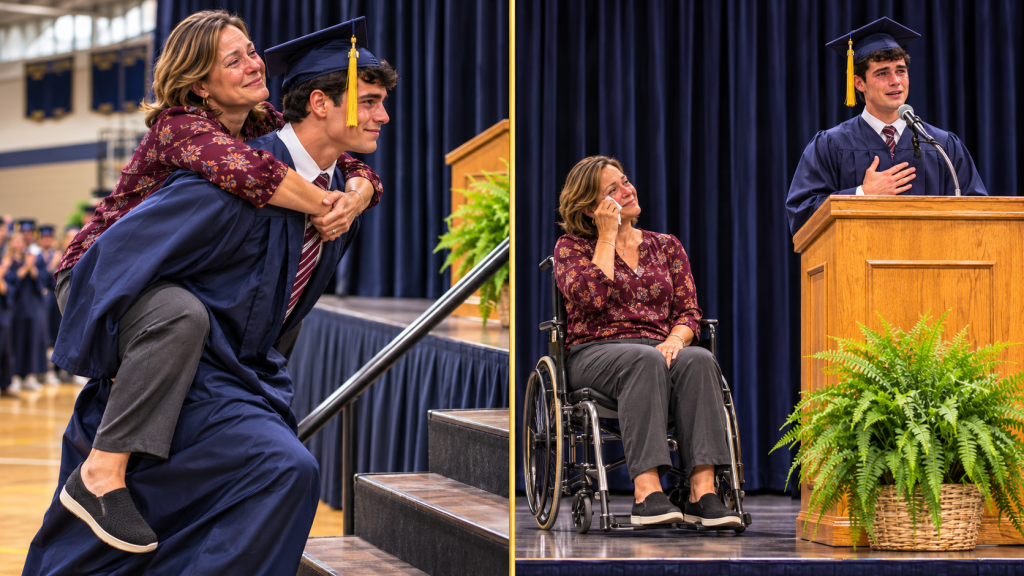
And the eighteen-year-old who’d carried me toward the graduation stage because he wanted me beside him.
Now he was discovering that his experiences could inspire work that helped other people.
Not because he owed me anything.
Because his compassion had become part of who he was.
“Caleb,” I whispered, “your father would have loved that.”
I stopped.
Then corrected myself gently.
“I mean, I’m so proud of what you’re doing.”
He was quiet.
Then said, “Mom, I think Grandpa would have loved it too.”
My eyes filled.
“Yes, sweetheart.”
I smiled.
“He certainly would.”
It’s been nearly two years since Caleb graduated.
The house is still mine.
The garden is still beautiful.
And the new ramp makes coming and going much easier.
I still work from home, though I’ve reduced my hours slightly.
I meet Patricia for lunch every Wednesday.
I volunteer with a local organization that helps people navigate accessibility needs after illness or injury.
And sometimes, when the weather is warm, I sit on the porch with a cup of tea and watch the neighborhood children ride their bicycles.
Caleb comes home during university breaks.
He still worries about me sometimes.
But now he also tells me about his classes, his friends, and the places he hopes to visit.
He has become the young man I always hoped he’d be.
Kind.
Responsible.
Independent.
And unafraid to ask for help.
Our relationship with Richard remains limited.
Caleb occasionally speaks with him.
I don’t interfere.
But I no longer allow Richard’s choices to control the peace I’ve worked so hard to build.
The property dispute is behind us.
And the person who once told me he deserved something better than a life with me no longer gets to decide what my life is worth.
Last weekend, Caleb came home carrying a small wrapped package.
He placed it on the dining-room table.
“Mom, I made you something.”
I smiled.
“Another invention?”
He grinned.
“Sort of.”
Inside was a small wooden plaque.
A photograph of us at his graduation was mounted at the center.
It showed me sitting in my wheelchair on the stage.
Caleb stood beside me in his cap and gown, one hand resting gently on my shoulder.
Below the photograph, he’d engraved a sentence.
You taught me that strength isn’t measured by standing. It’s measured by how we keep going.
My eyes filled.
I looked at him.
“Caleb, this is beautiful.”
He knelt beside me.
“Mom, I need you to know something.”
I wiped my cheeks.
“What, sweetheart?”
He took my hands.
“For years, I thought I needed to make up for everything that happened to you.”
My throat tightened.
He continued.
“I thought if I worked hard enough, earned enough money, or fixed enough things, I could give you the life you lost.”
Tears slipped down my face.
“But I finally understand something.”
I looked at him.
“You never asked me to replace your old life.”
I shook my head.
“No.”
“You taught me how to love the life we still had.”
I began crying.
Caleb smiled through his tears.
“And that’s what I’m trying to do with mine.”
I pulled him close.
For a long time, neither of us spoke.
Sometimes people ask how I managed to raise such a wonderful son after everything we experienced.
They expect me to talk about sacrifice.
About courage.
About the nights I stayed awake worrying.
And yes, those things were part of our story.
But they weren’t the most important part.
The most important part was that we kept choosing one another without making love into a debt.
I didn’t raise Caleb so he would spend his adulthood taking care of me.
I raised him so he could build a life of his own.
And somehow, in the process, he helped me remember that I deserved a life of my own too.
My wheelchair changed how I move through the world. It never changed my right to dignity, independence, or joy.
Richard saw my injury and imagined a life that had become smaller.
Caleb saw the same injury and learned that love could become more thoughtful, more patient, and more determined.
But the greatest gift my son ever gave me wasn’t the renovation.
It wasn’t the money he saved.
It wasn’t even the moment he carried me onto the graduation stage.
It was the day he finally understood that he didn’t have to carry me through life.
We could move forward together, each in our own way.
That evening, Caleb helped me hang the plaque beside his graduation photograph.
We stepped back to admire it.
Then he looked toward the porch.
“Mom, want to go outside?”
I smiled.
“Of course.”
He opened the front door.
I rolled down the ramp he had helped make possible.
The evening sun fell across the garden, turning the flowers gold.
Caleb walked beside me.
Not pushing my chair.
Not carrying me.
Simply keeping me company.
And for the first time in a long time, I felt that everything we had survived had brought us to a place where neither of us needed to be afraid of the future.
We hadn’t been given the life we’d expected.
But we’d built one filled with love.
And it was ours.