
“Still single. Still no husband. Still no children. Some women just aren’t meant to have it all.”
My ex delivered the insult over a microphone in front of two hundred guests, then raised his champagne toward me.
“And to my first wife, who was kind enough to come tonight and see what success looks like.”
Uneasy laughter rippled through the ballroom.
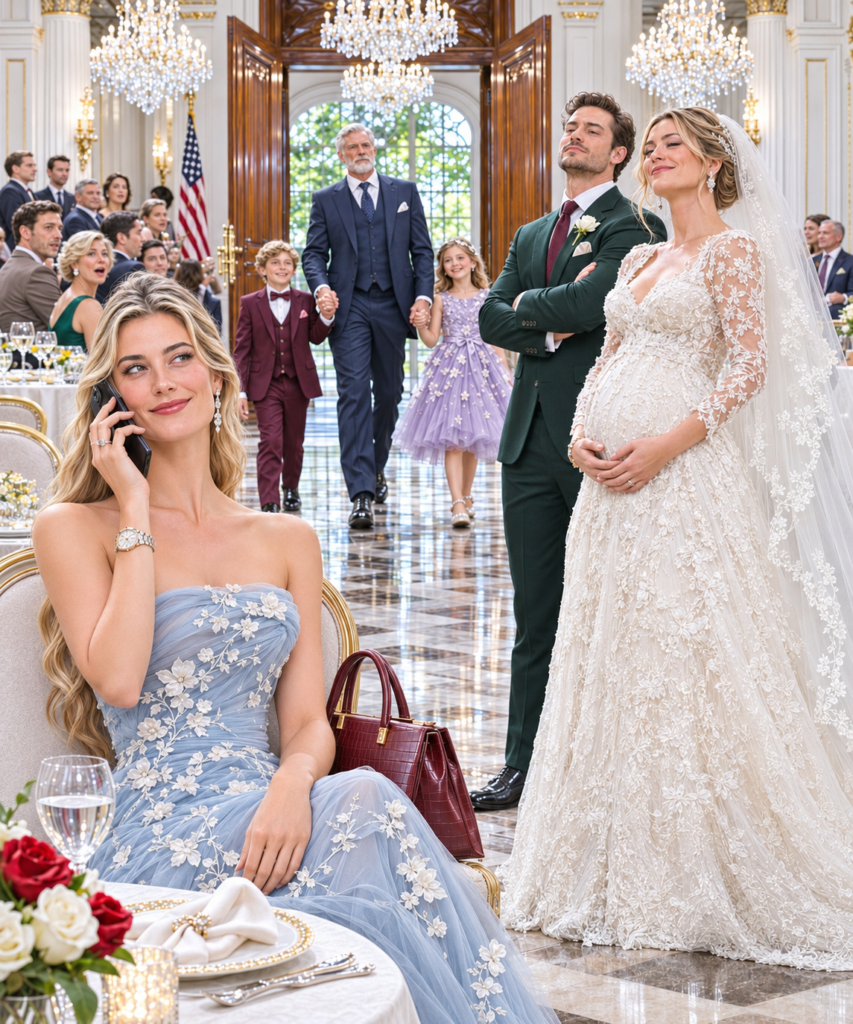

I’m Maris Whitcomb, thirty-five. Four years earlier, the man onstage had decided I was too ordinary for his ambitions. Now, his reception was meant to prove it.
Beside him stood his pregnant bride in a custom ivory dress. Diamond-bright chandeliers glittered overhead, and beyond the windows, Pittsburgh gleamed along the Allegheny River.
Luxury surrounded us. My humiliation was expensive, too.
“Maris,” Phoebe, my closest friend, murmured, catching my wrist. “We can leave. Right now.”
“No.”
“He’s deliberately embarrassing you.”
“I know.”
“Then why are you still sitting here?”
“Because I refuse to give him the satisfaction of watching me run.”
Evan Mercer beamed from across the room. His immaculate hair, designer suit, assured stance, and charming smile advertised more success than he possessed. Tonight, he aimed it at me.
DAD CALLING.
Dad seldom called at night unless it involved the twins.
“Dad? Is everything okay?”
“Everything’s fine, sweetheart. The railroad museum closed early, and the twins are exhausted. We’re only ten minutes from your hotel.”
“Okay. Take them home. I’ll get a cab.”
A child shouted through the phone.
“Mommy! Grandpa said we can see the big lights!”
Her twin brother chimed in. “Mom! I made a train! You have to see!”
“Not tonight, Miles. It’s almost bedtime.”
My father chuckled. “Wren has already informed me that refusing her request would be a serious violation of family law.”
“She’s three.”
“She’s a terrifying negotiator.”
Evan whispered to his bride as photographers adjusted their cameras. The guests had just laughed at my supposed childlessness.
I was done hiding my real life.
“Bring them to the main entrance,” I told Dad. “I’ll come down.”
“Ten minutes.”
“Thanks. Love you.”
“Love you, too.”
Evan approached with his bride.
“Important phone call?” he asked.
“Family.”
“Well, I’m glad you’re keeping busy.”
“Maris, I genuinely hoped you’d find someone by now. Four years is a long time to stay stuck.”
“I’m not stuck.”
“Of course not.”
“Evan, maybe we should go greet the other guests,” his bride said.
“I just want her to understand something, Tessa. I didn’t leave because I stopped caring. I left because we wanted different futures.”
I glanced at his expectant wife. “That’s not how I remember it.”
“People remember things differently.”
“Some people also rewrite history when the original doesn’t flatter them.”
The ballroom doors opened. A hotel worker entered with an anxious event manager. Behind them stood a silver-haired man in charcoal, holding a cane. Two toddlers held his other hand: a girl in a pale-blue coat and a sneakered boy carrying a cardboard train.
“Dad?”
Wren spotted me. “MOMMY!”
She ran across the polished floor, with Miles right behind her. Both children jumped into my arms as I knelt.
“Mommy, we found you!”
“Look! Grandpa helped with the wheels!”
I hugged them, laughing through tears. “You’re supposed to be sleeping, you little troublemakers.”
“Grandpa said we could say goodnight!”
Behind me, a guest dropped a champagne flute. The glass shattered, breaking the silence.
Evan’s smile was gone.
“No,” he whispered.
Someone at the head table stood. “Mr. Whitcomb?”
Another man rose abruptly. “Oh my God. That’s Graham Whitcomb.”
Dad was chairman and CEO of the multibillion-dollar Whitcomb Industrial Holdings, with businesses in manufacturing, transportation, and energy. Financial news covered Graham Whitcomb every week. Evan had spent nearly a year trying to secure an appointment with the billionaire, yet he’d assumed Dad was comfortably retired.
“Maris… that’s your father?”
I stood, holding Wren’s hand. “Yes.”
“Hello, sweetheart.”
“Dad, meet Evan Mercer.”
“I believe we’ve met briefly at an industry conference.”
Miles had Evan’s dark hair and the same unmistakable dimple. Even his puzzled frown was identical.
“How old are they?”
I held Wren’s hand more firmly. “That’s not a conversation we’re having here.”
“Maris.”
“Not in front of them.”
His bride touched her belly protectively. “Evan?” she whispered. “What’s going on?”
Evan seemed not to hear her. His eyes remained fixed on Miles.
“Maris…” His voice cracked. “Are those children mine?”
An investor behind Evan spoke before I could answer. “Evan, there’s something you need to know about Mr. Whitcomb’s acquisition of Horizon Ridge Capital.”
Horizon Ridge Capital—the fund Evan expected to rescue his business.
Dad glanced between the investor and Evan. This wedding might expose far more than family secrets…
Four years earlier, Evan ended our marriage over breakfast. A cereal bowl sat on the counter as he told me he’d outgrown us.
At thirty-four, he ran his logistics software company, Northline Systems. When we married, Northline was three laptops, an idea, and an office above a hardware store.
I helped prepare his first investor pitch. I checked agreements into the small hours. I cooked for prospective partners because restaurants cost too much. I held him as he cried over losing his first big client.
For years, I thought we were building a future together.
Investors finally took an interest in Northline. Evan began wearing costly suits and attending exclusive professional gatherings. He also began belittling my work in educational design.
“You could at least dress like a CEO’s wife,” he told me one evening. I was wearing a sweater and jeans as we ate reheated food at home.
When had he stopped loving my ordinary sweaters? Soon, even seeing me happy seemed to annoy him.
I was passionate about creating accessible spaces where children could learn, with library shelves and exhibits designed for varied learning styles. Evan dismissed it as charity.
“You’re wasting your potential,” he insisted.
“Not everything valuable comes with a seven-figure valuation.”
“That’s exactly your problem, Maris. You think small.”
He framed our divorce like a corporate restructuring: divergent priorities, conflicting objectives, no common vision. He left out the late dinners with a consultant and the messages I’d seen on his laptop.
I never asked if he had fallen for someone else. By then, it no longer changed anything.
“Did you ever love me, or did you just love having someone believe in you?”
I left with two packed suitcases.
Evan mistook my rejection of wealth for never having known it. My upbringing was wealthier than he could fathom.
Dad expanded Grandpa’s manufacturing firm into Whitcomb Industrial Holdings. By the time I graduated college, the group operated across eleven states. We had private planes, financial advisers, and homes I’d never visited.
I wanted none of that lifestyle.
Mom, Evelyn, taught me that money could provide comfort but did not confer moral worth.
After she died while I was in college, I resolved to build a life beyond Dad’s empire. For years, I worked under Mom’s maiden name, lived simply, and never sought Dad’s funding for my work.
Evan knew Dad owned companies, but assumed they were modest. I never corrected him, though I later realized that keeping the truth from him was unfair. Still, I had never claimed Dad was poor. Because Evan measured worth in money, revealing Dad’s fortune felt like bribing him to stay. So I kept quiet.
Twelve days after filing for divorce, I learned I was expecting. I stared at the positive result for almost an hour. I had hoped for a child throughout our marriage, but Evan kept putting it off: until the next investment round, until the product launched, until the business became profitable. The family he had repeatedly delayed was now growing inside me.
My first scan revealed two heartbeats. Two babies.
I called Phoebe from outside the clinic. “I’m having two babies.” Then I burst into tears.
At last, she asked the question I dreaded: “Have you told Evan?”
I drafted an email asking him to talk privately about my pregnancy. Before I could send it, his lawyer demanded that all communication go through counsel. Evan sent a brief follow-up: “Please stop creating emotional complications. We both need to move on.”
I erased the unfinished email. That was my first major mistake.
At first, keeping the pregnancy from him felt like self-protection. I kept promising myself I’d tell him after the birth, after their early checkups, or once life had settled down. My fear turned into one delay after another.
Dad raised the issue one Sunday. “Maris, your children deserve to know where they come from.”
“I know.”
“Then their father needs to know they exist.”
“You didn’t hear what he said to me.”
“I believe you. But being cruel to you and being unaware he has children are two different things.”
Our family attorney, Lena Porter, explained paternity and parental obligations. I mailed Evan a request to meet privately about an important family matter, but left out the pregnancy. His lawyer assumed it was about property.
When Wren and Miles arrived early at UPMC Magee-Womens Hospital, keeping them safe became my entire focus. Tiny, furious Wren arrived first. Miles needed closer observation, and every change in the monitor readings frightened me at night.
Dad brought luxury baby clothes and two enormous teddy bears. I told him to take the bears back.
“What do you actually need?” he asked.
“Groceries. Diapers. And someone to sit beside me while I figure out how to be their mother.”
He stayed overnight.
The next three years were noisy and messy, and more meaningful than Evan’s promises. Phoebe, architect Caroline Rourke, and I launched Open Path Studio. We designed accessible classrooms, interactive library displays, and adaptable furniture. Sometimes I answered clients while soothing a sick toddler.
By the twins’ third birthday, I was a mother employing seven people and serving schools across western Pennsylvania. Evan might not have recognized my success, but I respected the woman I had become.
The twins understood that our family was different. Once, Wren asked why a girl in a picture book lived with her father. I explained that families take many forms.
“Do we have a daddy?” Miles asked.
“Yes,” I said.
“Where is he?”
My silence no longer affected only Evan. It had begun shaping their childhood.
Then Evan’s wedding invitation arrived.
“I’d love for you to see how far I’ve come.”
He wanted witnesses to his triumph.
I planned to attend briefly with Phoebe while Dad watched the twins. Evan had secretly seated me by the service entrance and prepared a speech mocking my supposedly empty life. I also didn’t know his company depended on a fund tied to Dad. That connection was about to surface at the reception.
“Evan, this isn’t the place.”
Dad spoke softly, silencing everyone nearby.
We stayed by the ballroom entrance. Miles had begun rubbing his eyes, and Wren wanted to know whether the cake was strawberry. Evan looked shaken as Horizon Ridge Capital managing director Nathan Rowe retreated.
“I apologize,” Nathan said. “We can discuss the acquisition another time.”
But Evan had already heard too much.
“Acquisition?” he repeated. “What acquisition?”
Dad broke the awkward silence.
“Whitcomb Industrial recently completed a controlling investment in Horizon Ridge. It’s a portfolio diversification transaction.”
Horizon Ridge was reviewing Northline’s expansion funding. For months, Evan had treated the pending financing as guaranteed. Now he had learned that Dad controlled the fund’s parent company.
“You own Horizon Ridge?” he asked.
“Whitcomb Industrial owns a controlling interest, yes.”
“You knew?”
“No.”
“Your father just happens to buy the fund that’s financing my company?”
Dad’s expression hardened.
“Mr. Mercer, that transaction involved multiple companies, independent valuations, and months of review. It has nothing to do with my daughter’s divorce.”
I watched Evan scramble for another explanation. Then he said something that made Tessa step away from him.
“If I’d known who your father was, Maris, things might have been different.”
“Then you’re confirming that you would have treated her better if you’d known she came from money.”
I crouched beside Wren.
“Sweetheart, would you like Grandpa to take you to the car?”
Miles could barely stay awake. I kissed them and let Dad lead them to the lobby.
“Call me if you need anything.”
“I will.”
Once the children were gone, Evan turned back to me.
“Maris, you can’t just walk away.”
“I can, and I am.”
“What about the twins?”
“We’ll discuss that privately, through the appropriate process.”
“Are they mine?”
“There are serious questions we need to resolve. Not here, and not with your guests watching.”
Tessa stepped forward.
“Evan, stop.”
“You’re not understanding what’s happening.”
“No,” she replied. “I understand that you invited your former wife to publicly embarrass her, and now you’re acting as though discovering her father’s money is worse than discovering you might have two children.”
“This is complicated.”
“Then perhaps you shouldn’t have turned it into entertainment.”
I almost felt sorry for her. Five months pregnant and exhausted, she stood amid her ruined reception. None of this was her fault.
“Tessa,” I said, “I’m sorry this happened tonight.”
“You didn’t arrange this, did you?”
“No.”
“I didn’t think so. Unlike my husband, apparently.”
I left before the argument continued.
The twins slept in their car seats. Dad sat beside me in the back. Then I asked, “Did you know Northline was seeking funding through Horizon Ridge?”
“I knew the name appeared among several applications under review. I didn’t know the extent of its exposure until Nathan mentioned it.”
“Promise me something.”
“Anything reasonable.”
“Do not ruin his company because he humiliated me.”
“Maris—”
“Those employees didn’t embarrass me. They have mortgages and families. I don’t want them paying for Evan’s behavior.”
“I won’t interfere. The fund will evaluate Northline’s financial condition and contractual obligations. I’ll recuse myself from decisions involving him.”
“Thank you.”
“But you need to stop avoiding the other problem.”
“I know.”
“Do you?”
I looked at Miles, asleep with his cardboard train tucked beneath one arm.
“I’ve spent three years telling myself that silence kept them safe.”
“And now I’m afraid it’s going to hurt them.”
He took my hand.
“Then we deal with the truth. Not with money. Not with threats. With the truth.”
The next morning, a wedding photograph surfaced online. It showed me crouched beside the twins, with Dad behind us. The caption described me as the billionaire’s secret daughter.
Commenters speculated about my marriage, the twins’ father, and Evan’s business. Phoebe called, furious.
“Somebody actually posted a picture of Wren and Miles.”
“I saw.”
“We need to do something.”
“I already called Lena.”
Lena advised against a public response. She asked the organizers to remove photos that identified the twins, then helped me prepare a letter to Evan. It disclosed that there were two children whose paternity needed to be determined and requested a private meeting. I agreed to testing and legal proceedings.
At last, I wrote what I’d avoided for years: I should have told you earlier.
Then I signed the letter.
Evan was also facing worse business troubles than he’d admitted. Northline’s CFO, Daniel Kessler, had long warned him about the company’s unstable cash flow. Evan had authorized major spending before financing was approved. The company had leased an extravagant office, executive travel costs had soared, and several contracts were less profitable than his presentations claimed. Company funds had also covered apparently personal costs, including wedding expenses.
Nathan demanded updated accounts before advancing financing. Evan called him immediately.
“This is because of Graham Whitcomb, isn’t it?”
Nathan’s response was blunt.
“No, Evan. The concerns existed before the acquisition. Your own CFO documented them.”
“So you’re refusing the financing?”
“We’re reviewing the risks under the terms of the proposal.”
“You can’t do this to me.”
“We haven’t done anything to you. We’re asking you to account for money you’ve already spent.”
Evan ended the call.
That evening, Tessa confronted him in their barely used honeymoon suite.
“Did you pay for our wedding with company money?”
“Some expenses were part of business development.”
“Our wedding wasn’t a business development conference.”
“Important investors attended.”
She set her earrings on the dresser.
“Did you even marry me because you wanted a marriage?”
“Of course I did.”
“Then why did our wedding feel like an advertisement for you?”
He had no answer.
Tessa pulled her suitcase from the closet.
“I’m staying with my sister.”
“Evan, are you leaving me?”
“No. I’m giving you a chance to decide whether you’re capable of telling me the truth.”
Then she walked out.
For Evan, the silence that followed was worse than the laughter he’d tried to provoke at the wedding.
For years, he had believed that winning meant having more than everybody else. Now his values confronted something money couldn’t purchase.
When my attorney’s letter arrived the following morning, Evan finally had to face the question he’d been avoiding since the twins entered the ballroom.
What kind of father could he become after missing the first three years of his children’s lives?
Four days later, I met Evan privately in a neutral conference room. Without his costly watch, he looked unkempt, dark circles beneath his eyes. Lena took the chair beside me as his lawyer, Rebecca Sloan, opened a file.
“We’re here to establish the facts and discuss what arrangement would best protect the children,” she said.
“Are Wren and Miles my children?”
I took a breath. “Based on the dates, I believe they are. I agree we should confirm it through accredited testing.”
“Why didn’t you tell me?”
There it was—the question I’d long dreaded.
“Because I was afraid.”
“Afraid of what?”
“Of you turning them into another competition. Of spending their childhood negotiating every decision with a man who needed to win every argument.”
“So you decided to erase me?”
“I decided to postpone a conversation I couldn’t handle. Then I kept postponing it.”
“You stole three years from me.”
The accusation stung because it held some truth.
“I deprived you of the opportunity to know them. I shouldn’t have done that.” I spoke before he could interrupt. “But my mistake doesn’t make the way you treated me acceptable. We both have things to answer for.”
For a moment, he said nothing. Then he asked quietly, “Were they healthy when they were born?”
My throat tightened. “Miles needed extra monitoring. Wren was stronger than we expected. They’re both doing well now.”
“Did they ask about me?”
“Yes.”
He lowered his head. “God.”
I explained that the children knew they had a father they hadn’t met, but I hadn’t told them he had rejected them. He hadn’t; he couldn’t reject children he didn’t know existed. Despite his failings in our marriage, I wouldn’t falsely accuse him of rejecting them.
Rebecca outlined the testing, legal paternity, support and parenting duties, and a gradual, child-centered introduction.
Evan immediately asked about visitation. Lena answered carefully. “That can be discussed after the results. The children aren’t responsible for making up the time you’ve missed.”
“Will you let me know them?”
“If you’re willing to put their needs ahead of your pride.”
Then he surprised me. “Maris, what I did at the wedding was cruel. I invited you because I wanted you to feel like you’d lost something. I thought if you saw my success, you’d finally regret leaving.”
“You left me, Evan.”
“I know.” For the first time, he sounded ashamed rather than defensive. “I needed you to believe I was better off without you.”
I studied him. Once, I’d longed for that admission. Now it seemed surprisingly small.
“Thank you for admitting it,” I said. “But I’m not here to fix our marriage. I’m here for the children.”
Three weeks later, laboratory testing confirmed what we’d expected: Evan was the twins’ biological father. Lena called me immediately. I listened in my office as rain fell. I’d known the answer all along, but official confirmation made the truth undeniable. There would be no more postponing. The truth was no longer mine alone.
That evening, I sat with the twins on our living-room floor. Phoebe worked on a puzzle nearby. I showed them a photograph.
“Do you remember the man we saw at the hotel?”
“The one with the serious face?”
“Yes.”
Wren leaned closer. “Was he mad?”
“He was surprised.”
“Why?”
“Because he didn’t know about you. His name is Evan, and he’s your father.”
“Does he know how trains work?”
“I think he knows some things.”
“Can he make pancakes?”
“I don’t know.”
“We should find out.”
Their uncomplicated reaction overwhelmed me. I’d feared a catastrophe for years, but to them, he was simply a stranger to get to know. Their world didn’t collapse. It simply grew.
Professionals arranged his first visit in the children’s room of a community center. I stayed nearby. He arrived fifteen minutes early with two picture books.
Wren hid behind my legs. Miles inspected his shoes.
“Are you Evan?” my son asked.
“Yes.”
“Mom says you’re my daddy.”
Evan crouched. “That’s right.”
“Do you know how to make a paper boat?”
“I can try.”
For twenty minutes, they folded paper together. Evan’s first attempt was awful. It tilted and fell apart in Miles’s bowl of water.
Wren burst out laughing. “That boat is broken!”
Evan laughed, too. “Then I guess I need more practice.”
“Lots more,” Miles agreed.
Just a grown man sitting on the floor, taking instructions from two children who didn’t care how much his company was worth.
When the visit ended, Evan looked toward me. “Can I see them again?”
“We’ll follow the schedule we agreed on.”
Then Miles held up the ruined paper boat. “You can come back if you make a better one.”
“Deal.”
Outside, as I helped the twins into their car seats, Wren asked a question that stayed with me long afterward.
“Mommy, is Evan going to disappear?”
I stopped fastening her seat belt. “What makes you ask that?”
“Because we didn’t see him before.”
I touched her cheek. “I don’t know exactly how everything will work yet, sweetheart. But we’re going to make plans, and the adults will work hard to keep them.”
I closed the car door and stood in the parking lot for a moment. Evan couldn’t buy trust, and it wasn’t something I could promise on his behalf. He would have to earn it through steady, ordinary visits.
Northline’s financial review generated headlines Evan would once have dreaded. His company wasn’t worthless. It had real technology, capable staff, and clients who relied on it. But it was also dangerously overextended.
Executive expenses had ballooned. Revenue projections were overly optimistic. Several contracts were barely profitable. Horizon Ridge financing was never assured, yet Evan spent as if approval were certain.
Daniel, his CFO, placed the findings on the conference table.
“We need to reduce executive spending immediately.”
“What happens if we don’t?”
“We risk missing payroll.”
That sentence changed everything. Evan habitually called employees family. Now his decisions threatened actual families’ incomes.
The committee paused additional financing pending corrective action. Dad had no role in the decision; he formally recused himself. Evan initially suspected otherwise, but his own records told a different story. The problems predated Whitcomb’s acquisition of Horizon Ridge. There was no conspiracy.
Evan cut his pay, repaid improper personal charges as required, and left the lavish headquarters. The board ultimately appointed an experienced external CEO. Evan stayed in technical development but relinquished daily control. Northline could still survive.
One afternoon, a programmer named Jordan confronted him after a staff meeting.
“My wife just went back to work after having our second baby,” Jordan said. “Do you understand what happens if my paycheck doesn’t arrive?”
Then he closed it.
Finally, Evan answered, “I made decisions that put your family at risk. I’m sorry.”
Jordan didn’t thank him. He simply walked away. Evan later told me that moment hurt more than losing his CEO title.
I didn’t offer sympathy, but I was relieved when the company negotiated a workable restructuring plan. Its employees deserved stability, regardless of what I thought of its founder.
Meanwhile, Tessa was making her own decisions. She had moved into her sister’s apartment and hired an independent financial adviser. She discovered that Evan had exaggerated their financial security and concealed obligations tied to his business.
She was furious, but she wasn’t foolish. Her pregnancy meant every decision now affected someone beyond herself. She demanded transparent finances, separate legal advice, and a realistic plan for the baby’s arrival.
Evan initially interpreted these demands as rejection. Then he began attending counseling—not because Tessa threatened to leave permanently, but because he was finally recognizing a pattern he couldn’t keep defending.
For years, he had believed love meant admiration. Questions about his decisions felt like betrayal. Other people’s success felt insulting. Nobody was persecuting him. He was being held accountable.
The twins cared little about that transformation. They cared whether he remembered their interests. Wren drew detailed houses. Miles loved bridges, elevators, and railway crossings.
During one visit, Evan brought an expensive electronic train set. He reconsidered outside and returned with a notebook of engine drawings instead. Miles spent an hour asking questions, while Wren decorated the margins with purple flowers. I’d never seen them happier together.
Then Evan made another mistake. He promised to attend Wren’s preschool performance, but a meeting ran over, and he missed it. Wren was devastated.
When he arrived afterward, she folded her arms. “You said you’d come.”
“I know.”
“You didn’t.”
“You’re right.”
“Why?”
“Something at work took longer than I expected. I should have made better arrangements.”
She looked at him suspiciously. “Can you come tomorrow instead?”
“No, honey. The performance was today.”
Evan crouched. “I’m sorry I missed something important to you.”
He offered no toy and didn’t defend his meeting. She eventually performed her song in our kitchen. He listened on the floor and applauded.
Later, he told me, “I spent my whole career thinking a big moment could make up for a hundred small failures.”
“And?”
“I think I’ve had it backward.”
I didn’t answer, but I noticed.
In the months that followed, his visits became more dependable. He brought snacks, learned their allergies and routines, and stopped arriving with extravagant presents.
One afternoon, Miles simply called him Dad, then continued helping build a cardboard tunnel. Evan didn’t celebrate loudly or post a photograph. He quietly treasured the word.
Wren took longer. She still called him Evan.
Meanwhile, Open Path Studio faced its largest opportunity: a regional library consortium invited us to bid on a multiyear accessibility contract. Winning could reshape our firm. Losing meant months wasted.
Dad offered to introduce me to a major lender. I declined the introduction. This time, I asked him to assess our financial model.
“Treat it like a proposal from strangers,” I told him.
He spent an afternoon reviewing the figures and spotted three underestimated risks: material costs, delayed payments, and our capacity to complete multiple installations simultaneously.
We also needed enough capacity to complete multiple installations at once. I wasn’t thrilled, but he was right.
Phoebe, Caroline, and I revised the bid with two smaller contractors. Months later, our bid won in a competitive process.
I celebrated with pizza in our workshop. Dad brought a cake, and the twins got frosting on his suit. For once, he didn’t complain.
As we cleaned up, he took me aside. “Your mother would have been proud.”
“Because we won?”
“No. Because you built something that reflects what you believe.”
At last, I cried without feeling ashamed. The supposedly unambitious woman had built a firm while raising twins, without weaponizing success.
A few weeks later, Dad asked me to visit him privately. He sat in his study with a medical folder on the desk, looking grave.
“Maris, there’s something I need to tell you.”
My stomach tightened. “What’s wrong?”
He placed a hand over the folder. “My cardiologist found a problem.”
Suddenly, none of the business victories mattered. Dad’s heart condition was serious, though not immediately terminal. It required treatment, monitoring, and the lifestyle changes he had long avoided: less stress, fewer endless meetings, and more attention to his health.
Graham Whitcomb found the advice nearly insulting. “I’ve managed multinational companies for decades,” he complained. “Now I’m being ordered to take walks and stop checking emails during dinner.”
“Sounds like excellent management advice.”
He gave me a tired smile. “Your mother used to say the same thing.”
Dad had always solved problems with checks, acquisitions, or hired experts. Now he needed help without turning it into a transaction. He delegated more executive duties, and succession plans included independent trustees and safeguards for the twins.
I made one thing clear. “Wren and Miles are children, Dad. They’re not future corporate assets.”
“I know.”
“And I don’t want to inherit the CEO position just because I’m your daughter.”
“Then don’t.”
“I spent years trying to prepare a kingdom for you. Maybe I should have asked whether you wanted one.”
I reached across the desk and squeezed his hand. “I just want my father to be around.”
His eyes filled. “Then I suppose I have a better reason to follow the doctor’s orders.”
That winter, Tessa gave birth to a healthy baby boy. She and Evan named him Oliver.
Evan was there for the delivery. He didn’t photograph every moment or make a speech about becoming a father. He simply held his newborn son and cried.
Later, he sent a message through our agreed parenting channel: “Oliver was born this morning. Mother and baby are doing well. I’d like to discuss how to introduce him to Wren and Miles when everyone is ready.”
I congratulated him, then contacted our family counselor. The children deserved a chance to know their half brother without adult drama turning the meeting into another spectacle.
Several months later, we arranged a quiet visit at a neighborhood park. Tessa arrived pushing a stroller, Evan carried a diaper bag, and I brought Wren and Miles. There were no photographers.
Wren approached the stroller cautiously. “He’s really little.”
“He is.”
“Can I touch his hand?”
“Of course. Gently.”
Miles peered inside. “He looks like a potato.”
For a moment, nobody moved. Then Tessa laughed. So did I. Even Evan started laughing.
It was the first time I’d seen all of us in one place without anyone trying to control how the scene looked.
Tessa and I talked while the twins played.
She apologized for the wedding. “I should have stopped him when he started talking about you.”
“You didn’t know what he was planning.”
“I knew something was wrong. I just didn’t understand how wrong.”
I studied her. “None of us handled everything perfectly.”
She glanced toward Evan, who was helping Miles examine a park bridge. “He’s trying.”
“I can see that.”
“Does that make things easier?”
“Sometimes.”
“I don’t think I’ll ever forget that wedding.”
“Neither will I.”
We sat quietly for a moment. Then I added, “But I don’t want our children growing up inside it.”
“Neither do I.”
There was no dramatic embrace, just two women agreeing that children deserved more than the unfinished arguments of adults.
By spring, Evan and Tessa had resumed living together under carefully discussed arrangements. Their finances were transparent, and they continued counseling. Evan took an active role in caring for Oliver and kept to his agreed schedule with the twins.
He still made mistakes. So did I. But we were learning to address them without pretending they hadn’t happened.
One Sunday, Evan arrived to pick up Wren and Miles for an afternoon outing. Miles ran toward him, carrying a model locomotive.
“Dad! Look what Grandpa helped me build!”
Evan knelt. “That’s incredible.”
Wren approached more slowly and held out a drawing. It showed a house with a blue roof, a garden, and several people standing beside it.
“That’s Mommy’s house,” she explained.
“Who’s everybody?”
“Mommy. Me. Miles. Grandpa.”
She pointed to another figure standing near the gate. “And that’s you.”
“Why am I outside?”
Wren considered the question seriously. “Because you don’t live here.”
For a second, I saw pain cross his face.
“That’s right.”
She touched his sleeve. “But you can come visit.”
“Thank you, sweetheart.”
It wasn’t a perfect drawing of a perfect family. It was an honest drawing of a family that had learned to make room for complicated truths.
That summer, Dad took the twins to the Pennsylvania Railroad Museum. He moved more slowly now and needed to rest occasionally. Miles patiently explained different types of locomotives, while Wren insisted every train should have flowers painted on the side. Dad listened as though they were presenting a major engineering proposal.
When he returned home, he told me something unexpected. “I used to think my greatest accomplishment would be what happened to Whitcomb Industrial after I was gone.”
“And now?”
“Now I hope they’ll remember that I helped build a terrible cardboard train.”
“Was it terrible?”
“Structurally catastrophic.”
“Did they love it?”
“Absolutely.”
He looked toward the living room, where the twins were fighting over colored pencils. “Then I suppose it was successful.”
A year after Evan’s wedding, a business magazine contacted me for an interview about Open Path Studio’s expanding projects. But the proposed headline focused entirely on my billionaire father and my former husband’s wedding scandal.
I declined. “We can talk about our work,” I told her. “The accessible classrooms, the libraries, and the families using them. My private life isn’t our business model.”
She eventually agreed. The article appeared several weeks later, featuring our installations, our employees, and the people whose lives had become easier because of our designs. It barely mentioned my father.
It didn’t mention Evan.
I framed it for our office—not because I needed proof of success, but because everyone who had helped build our company deserved to see what we’d accomplished.
One Friday afternoon, I found myself driving past the hotel where Evan had married Tessa. The same windows glittered in the sunlight, and the same polished entrance stood beneath a canopy of flowers.
For a moment, I remembered everything: the microphone, the champagne glass, the laughter, and the look on Evan’s face when he realized I had children. I remembered the stunned silence when my father walked into the room, and how satisfying it had felt to watch the man who belittled me discover that the woman he considered insignificant came from a family wealthier than he could have imagined.
But something had changed. If my value had depended on my father’s fortune, Evan would have been right about one thing: money would have measured everything. It hadn’t.
My real victories had happened in hospital rooms, through sleepless nights, in tiny apartments, and in crowded workshops. They happened when I held my premature babies and promised to protect them; when I admitted I’d made a serious mistake by keeping their father uninformed; when I signed my first independent business contract; when I let my children build a relationship with Evan without reopening our marriage; and when I stopped needing him to understand my worth.
My phone rang as I approached a traffic light.
Dad.
“Sweetheart, are you picking up the children?”
“On my way.”
“Wren says she’s invited me to dinner.”
“She invited you yesterday.”
“She also insists we’re having pancakes.”
“Then we’re having pancakes.”
“And Miles says Evan is bringing him a book about bridges tomorrow.”
“That’s right.”
“You sound happy.”
I glanced at the framed photograph on my dashboard: Wren and Miles laughing beside a cardboard train.
“I am.”
That evening, the children ran into my arms as soon as I opened the front door. Miles had glue on his shirt, and Wren wore a paper crown. Dad stood in the kitchen wearing an apron that read “Grandpa’s Kitchen.”
The pancakes were slightly burned. The table was a disaster, and the house was filled with laughter.
“Mommy!” Wren shouted. “We made a surprise!”
Miles held up a cardboard model of a house. It had crooked windows and a roof that wouldn’t stay attached.
“What’s this?” I asked.
“Our home!”
I examined the tiny paper figures standing in front. There were three of us, and beside them stood a fourth figure holding a cane.
“Grandpa too?” I asked.
“Obviously,” Wren replied.
Then Miles pointed toward the cardboard gate.
“We made room for visitors.”
“That’s thoughtful.”
“Mom, does everybody need a big house to be happy?”
I thought of Evan’s wedding, his luxury office, my father’s estate, and all the expensive rooms where people had tried to prove they mattered. Then I looked around our messy kitchen.
“No, sweetheart.”
“What do they need?”
I pulled both children close.
“People who love them. People who tell the truth. And people who keep showing up.”
Wren considered that.
“Even when the pancakes burn?”
“Especially then.”
Dad shook his head beside the stove.
“There’s nothing wrong with these pancakes.”
Miles took one bite, then made a face.
“Grandpa, we need to talk.”
We all burst into laughter. In that moment, I realized something: four years earlier, Evan had looked at our ordinary life and decided it was not enough.
At his wedding, Evan had invited me to watch him celebrate the future he believed I had lost. He wanted me to feel ashamed, to see myself as the woman left behind.
Instead, ten minutes after my phone call, my father walked through those doors with the two children Evan never knew existed.
The billionaire CEO’s arrival had shocked everyone. But the real surprise wasn’t my father’s money. It was the life I had built after Evan decided I wasn’t worth keeping.
I didn’t need to marry a richer man. I didn’t need Evan’s company to collapse, or even an apology, to move forward. I had my children, my work, my family, and the freedom to be exactly who I was.
And the man who once told me I would never have anything worth showing the world eventually learned that a person’s greatest achievement isn’t always something the world can see.
Sometimes, it’s simply becoming someone your children can trust.
THE END! THANK YOU FOR READING!