
“Dad, we’re stopping your allowance. From now on, you’re on your own,” my son told me after pulling me aside at his mother’s funeral. My daughter-in-law stood beside him, smiling with the satisfaction of someone celebrating a victory. I didn’t object. Looking at them, I finally understood where I stood in my family…
Dorothy had been laid to rest less than an hour earlier when our son told me my allowance was ending.
Clutching the creased service program outside the church, I felt Trevor take my elbow and guide me away from the remaining mourners. At forty-three, he wore the stern expression of an adult about to discipline a careless child.
“Dad, we need to settle something.”
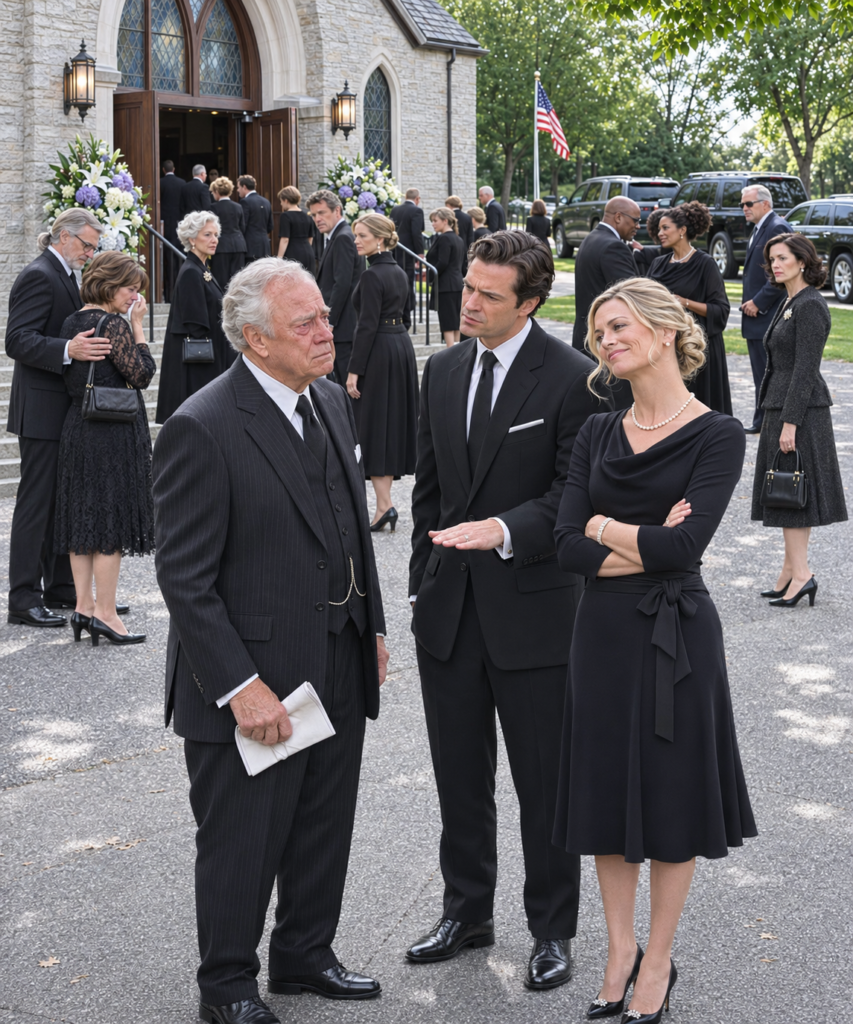

Behind him, flowers framed the church doors as Dorothy’s longtime friends murmured their farewells. I still couldn’t accept that she was gone. Some part of me expected her to be waiting in the passenger seat, reminding me to get my coat or asking whether I’d thanked the minister.
“Can this wait?” I asked. “We just buried your mother.”
Trevor glanced at Kendra, his wife.
A few steps away, Kendra adjusted the pearls above her dark dress. Dorothy had admired the necklace one Christmas, and Kendra had worn it often ever since. I had never seen her fuss with it so impatiently.
“It’s about money,” Trevor replied. “Kendra and I have discussed it, and we think it’s better to be clear now.”
I stared at him. “Now?”
“Starting next month, we’re stopping your allowance. You’ll need to cover your own expenses.”
For a moment, I wondered whether grief had distorted what I’d heard.
Kendra stepped closer and crossed her arms.
“Gerald, you’re seventy-one. We can’t keep supporting your lifestyle forever. We have our own future and the children’s needs to consider. It’s time you became financially independent.”
Her explanation carried neither anger nor embarrassment, which somehow made it worse. She presented it as a sensible adjustment no reasonable person could question.
Trevor lowered his voice. “Don’t take this personally, Dad. You’re getting older, and we can’t carry you forever.”
My grip crumpled Dorothy’s funeral program.
For three years, Trevor had deposited $2,000 into my account each month, calling it an allowance. In reality, those payments were deeply discounted rent for the six-bedroom home he shared with Kendra and the children.
Dorothy and I had allowed those two descriptions to blur.
Trevor apparently believed he was supporting us. Dorothy thought the illusion bolstered his pride, so we let it continue. Meanwhile, I contributed $4,000 of my own money each month to Sophie and Jack’s education trust.
I hadn’t spent a dollar of Trevor’s deposits.
I had no need for them.
Hollis Property Holdings, a business I owned outright, held the title to the house. I had bought it fourteen years earlier and leased it to Trevor’s family for far less than the cost of maintaining it. Dorothy and I paid the taxes, insurance, repairs, landscaping, pool care, and various other bills.
All told, our support amounted to almost $80,000 a year.
Yet beside Dorothy’s grave, Trevor implied that his monthly $2,000 was the only thing keeping me housed.
I could have corrected him then and there: who really owned the house, where his deposits went, and how much support Dorothy and I had quietly provided.
But grief had left me with no appetite for an argument.
I studied his uneasy but resolute face. Kendra, meanwhile, seemed pleased that the discussion was finally underway.
“You’re right,” I said. “Everyone should be responsible for their own expenses.”
Trevor visibly relaxed.
“I’m glad you understand.”
His reassuring pat on my arm felt like a reward for good behavior.
“I knew you’d see it our way.”
Neither of them understood what I really meant.
Alone, I returned to the smaller apartment behind the house.
We called it the guest apartment because the full explanation was complicated. Dorothy and I lived there while Trevor’s family occupied the main residence. It gave us privacy, kept us close to the grandchildren, and let us stay near family during her illness.
She loved the chair by the window, where the afternoon sun lingered before the big house blocked it. Beside the chair lay a half-read book, Dorothy’s glasses upside down on its open pages.
I paused in the doorway, listening to the silence.
In our forty-six years together, Dorothy had made our homes feel alive in ways I only appreciated after losing her: the gentle closing of kitchen cupboards, the radio playing while she did laundry, and the half-remembered songs she finished with invented lyrics.
Without her, even the rooms felt suspended.
I draped my funeral coat over a chair. Her scarf still hung by our bedroom, and I thought I could still smell a trace of her perfume, though perhaps it existed only in my memory.
An unopened envelope lay on her dresser, my name written across the front in Dorothy’s hand.
Before her hospitalization, she had organized various documents. I handled the insurance forms and medication records but avoided this letter. As long as it remained unopened, it could still be something unimportant.
Only after Trevor confronted me did I break the seal.
The message contained just six words:
Gerald, please start living for yourself.
I sat on our bed and read the line again.
Then I read it once more.
Dorothy understood me too well to write at length. If she had filled several pages, I would have searched them for duties involving Trevor, our grandchildren, property, or anyone but myself.
Her six words offered no escape.
Months earlier, we had discussed another service Trevor wanted us to pay for. At our kitchen table, I had agreed almost automatically. Compared with our other expenses, it seemed minor.
She watched as I signed the check.
“There’s a difference between helping someone and teaching them they’re entitled to everything you have,” she said.
“They’re raising two children.”
“I know.”
“I know that too.”
I lowered my pen.
“Then what worries you?”
“He’s starting to confuse our generosity with his independence.”
I gave a small laugh to avoid facing her point.
“He’ll understand one day.”
“Maybe. But generosity becomes dangerous when people mistake it for weakness.”
Back then, I dismissed her concern as excessive and defended the good heart beneath Trevor’s arrogance.
After her burial, I realized she hadn’t been suggesting retaliation. She wanted me to stop shielding our son from the reality of his choices.
I refolded the note along its existing crease.
That was when I wept.
I mourned the woman who knew when to challenge me and when to let me learn. I also grieved that my last meaningful exchange with our son had been about unnecessary money, rather than his mother’s courage and love.
Once my breathing steadied, I phoned Patricia Quinn.
For two decades, Patricia had overseen the family’s legal and financial affairs. She understood the company’s assets, our trusts, and the bills I had continued covering long after Trevor reached adulthood.
Several rings passed before she answered.
“Patricia speaking.”
“It’s Gerald.”
Her voice softened. “I was going to call tomorrow. How are you holding up?”
“I don’t know yet.”
“That’s an honest answer.”
From the window, I gazed at the larger residence.
Light shone through Trevor and Kendra’s curtains. From our apartment, the spacious home, carefully landscaped grounds, and the pool Dorothy had wanted for the grandchildren looked serene.
“I need to make some changes,” I said.
Patricia let the silence stand.
I recounted the conversation at the funeral, including Kendra’s insistence on financial independence. Patricia remained so quiet afterward that I wondered whether the call had dropped.
“Gerald,” she said at last, “what do you want to happen?”
“I don’t want revenge.”
“I didn’t ask what you don’t want.”
My eyes returned to Dorothy’s message.
“I want to stop paying for their life.”
“That’s clearer.”
“I want every existing agreement honored. I don’t want Sophie or Jack harmed because their parents behaved badly.”
“Good. Those are separate concerns, and we can treat them separately.”
“I also want to leave.”
“The guest apartment?”
“Yes.”
“Where will you go?”
“The lake cottage.”
The cottage had been our planned retirement retreat. Cancer interrupted the move before it became permanent. It was modestly furnished, fully paid for, and never part of Trevor’s household arrangement.
Patricia let out a measured breath.
“I’ll come Thursday morning. We’ll review everything before you act.”
“I’ve made up my mind.”
“I know. Reviewing the documents is how we make sure your decision does exactly what you intend and nothing you don’t.”
Her care with such decisions was precisely why I relied on her.
On Thursday, she arrived with her familiar battered briefcase, its corners worn and one brass latch as stubborn as ever.
She set it on the apartment’s kitchen table.
Outside, Kendra directed a gardener near the pool, pointing toward a hedge and inspecting the result as if she ruled the grounds herself.
Patricia noticed what I was watching.
“Are you sure you want to do this while you’re grieving?”
“I’m grieving because Dorothy is gone. Trevor didn’t cause that.”
“No.”
“But grief may be the only reason I can finally see the rest clearly.”
She unlatched the case.
We examined deeds, accounts, service agreements, insurance, and trust records all morning. Patricia carefully distinguished payments I could end, commitments requiring notice, and legal protections that had to remain.
The deed to Maple Ridge Drive belonged to Hollis Property Holdings. Trevor’s family had a lawful tenancy, and his $2,000 payments were recorded as rent, despite his repeated claim that they were my allowance.
I had let that story go uncorrected, assuming the feeling of responsibility might help him.
The documents revealed what our silence had accomplished: Trevor saw himself not as a privileged tenant receiving help, but as the provider for his aging father.
“The lease remains in force,” Patricia explained. “You can’t simply remove them, and I know you wouldn’t want to.”
“I don’t.”
“You can decline to renew it when the term expires. You can also stop paying their personal household expenses, as long as we honor any current service periods and contractual commitments.”
“That’s what I want.”
Across the table, Patricia studied me carefully.
“Accountability?”
“Not revenge.”
“What about the extra credit card?”
“Cancel it.”
“The pool and lawn services?”
“My payments stop when their current billing periods end.”
“Housekeeping?”
“The same.”
“The owner remains responsible for required maintenance,” she said. “Discretionary services and personal expenses do not.”
I nodded in agreement.
Patricia divided the records into two stacks: one for ownership and tenancy, the other for costs we had chosen to cover.
The stack of expenses was taller.
Seeing the full list left me ashamed.
“How did I let this continue?”
She pushed her glasses back into place.
“You and Dorothy wanted to help your family.”
“That doesn’t explain all of it.”
“No. But you don’t need to turn generosity into a character flaw just because someone misused it.”
“What would you call the rest?”
“A habit that stopped serving anyone.”
It could have been Dorothy speaking.
We checked Sophie and Jack’s college trust, too. My regular deposits had created a substantial, irrevocable education fund beyond either parent’s reach—and beyond my own ability to redirect.
“That remains untouched,” I said.
“I assumed it would.”
“The children did nothing wrong.”
She returned the trust papers to her case.
By afternoon, we had agreed on a course. Patricia would formally decline to renew the lease when it expired, giving the household time to relocate. My optional payments would end as the remaining billing commitments ran their course.
There would be no surprise lock changes, abrupt service shutoffs, or children finding their belongings dumped outside.
I wanted responsibility, not upheaval.
While Patricia prepared the notice, I contacted the providers.
I arranged the final pool payment, ended my responsibility for the lawn service after its current term, and confirmed housekeeping’s last prepaid visit.
Nobody needed an explanation about the family.
The card representative asked whether Trevor’s extra credit card had gone missing.
“No,” I said. “It’s simply no longer authorized.”
I kept thinking about my answer.
So much had continued with Trevor because I had never explicitly withdrawn permission.
Before I left, Patricia set the completed notice on the table.
“Don’t give this to him yourself,” she said. “I’ll send it through the proper channel.”
“I wasn’t planning to confront him.”
“Good.”
“I’m leaving Saturday.”
“Does he know?”
“No.”
She considered that.
“You’re entitled to privacy, Gerald. Just make sure someone knows you’re safe.”
“You will.”
“I will.”
Over the next two days, I moved my possessions to the cottage a little at a time. Driving gave me space to reflect, while packing kept me occupied.
I took clothing, books, prescriptions, personal records, and a few furnishings for the cottage. Anything belonging to the rented property stayed behind.
Sorting Dorothy’s belongings was much more painful.
Her coats still seemed shaped by her body. Handwritten reminders were tucked among recipes, and a grocery note remained beneath a refrigerator magnet.
Unable to bring everything, I chose our wedding picture, her wooden music box, the blue lake blanket, and her final six-word note.
I displayed Dorothy’s picture on the cottage mantel, leaving her music box shut.
On Saturday, Trevor and Kendra went to an expensive brunch. Once their car was gone, I returned for my last suitcase.
I packed fresh clothes, medicine, Dorothy’s message, and a few remaining personal possessions, then carried the suitcase through the main house.
Quiet rooms, sunlit polished floors, a vase of fresh flowers, and a decorative magnet holding next week’s schedule greeted me. For fourteen years, I had paid for the home’s comfort while its occupants acted as though it came automatically.
I left the keys and a handwritten note on the counter.
Trevor,
At your mother’s funeral, you said everyone should cover their own expenses. I thought about it, and you were right.
As of today, I’m no longer paying for your household. Have your lawyer contact Patricia Quinn about the house.
Dad
I read the note twice.
There was no insult or threat in it. I had no desire to match the cruelty of their timing. I wanted only to tell the truth and step away before they could persuade me to make another exception.
Leaving the driveway hurt more than I expected.
Dorothy and I had spent our final years in the apartment behind that house because she wanted to stay close to Sophie and Jack. The path between the buildings was full of memories: grandchildren running back and forth, holiday meals, and evenings when Trevor joined us for coffee.
The arrangement had not been entirely false. There had been love.
That was what made the loss difficult.
At the lake cottage, I set my suitcase in the bedroom and sat by the front window. The water was calm, disturbed now and then by the wind.
I poured coffee and forgot to drink it.
At exactly 4:12, my phone rang.
I let the call end.
Four minutes later, Trevor called again. Kendra called next.
By six o’clock, I had forty-seven missed calls. Messages followed one after another. Some demanded to know where I was. Others demanded explanations about canceled payments and Patricia’s notice.
None asked how I was managing after Dorothy’s funeral.
Patricia called in the early evening.
“Trevor left me a voicemail,” she said.
She played it for me.
“This is insane! Dad can’t just vanish. Who’s supposed to pay the bills on the house now?”
His voice filled my quiet cottage.
When the message ended, Patricia waited.
“He didn’t ask whether I was safe,” I said.
“No.”
“He didn’t ask where I was.”
“He asked me. But only after asking about the bills.”
I looked at Dorothy’s photograph.
“I suppose that answers something.”
“It answers what he’s thinking tonight. Don’t make it answer every question about your son.”
Patricia had a way of keeping anger from becoming a substitute for judgment.
At about 8:30, a text from Trevor appeared.
Dad, the county records say Hollis Property Holdings owns our house. Is that your company?
I read the message several times.
Part of me wondered whether his surprise was genuine. Trevor had signed a lease, but family arrangements can become invisible when they last long enough. He may have treated the document as a formality without ever looking at the company name.
At that point, I had no reason to assume anything more serious.
I replied only that Patricia would address questions about the property.
Kendra’s message arrived a few minutes later.
You can’t do this, Gerald. We have guests coming next month. What are we supposed to tell people?
Her concern wasn’t that Sophie and Jack might eventually have to move, or that the family had fractured days after Dorothy’s funeral. She was worried about explaining the situation to guests.
Then another message appeared.
We put $180,000 into renovating this place. You can’t suddenly claim it isn’t ours.
I sat upright.
I knew about ordinary repairs and improvements. As the owner, Hollis Property Holdings had paid for necessary maintenance. But I had never approved renovations costing anything close to $180,000.
I took a screenshot and sent it to Patricia.
She called almost at once.
“Did you authorize that amount?”
“No.”
“Did you sign any financing documents?”
“No.”
“Did Trevor ever ask to borrow against the property?”
“Never.”
Her voice tightened.
“We need to find out where that money came from.”
“You think he took out a loan?”
“Possibly. I don’t want to speculate until I see the records. But if he borrowed against Maple Ridge Drive, he would have needed to claim that he owned it or had authority to act for the company.”
“I gave him no such authority.”
“I know.”
“What should I do?”
“Nothing tonight. Don’t confront him, and don’t discuss financing by text. Forward me anything else they send.”
The calls continued.
By midnight, my screen showed 140 missed calls. Some were repeated attempts from Trevor and Kendra. Others came from relatives who had apparently been told I’d disappeared without explanation.
I turned the phone face down.
I had come to the lake hoping for quiet. Instead, one sentence from Kendra had raised a question far bigger than unpaid bills or an expiring lease.
If Trevor had used a house he didn’t own to obtain $180,000, whose authority had he claimed?
And whose name had he signed?
Patricia called at nine the next morning.
She skipped the greeting.
“I’m sending the documents. Sit down before you open them.”
I sat at the window table, a cold coffee beside me and Dorothy’s photo above the mantel.
Several attachments arrived by email.
First was a $180,000 home-equity agreement from Lakeshore Federal Credit Union, secured against Maple Ridge Drive.
The named borrower was Hollis Property Holdings.
A blue-ink signature appeared at the bottom:
Gerald T. Hollis, Managing Member.
It looked like mine.
The long stroke in the H, the slight backward slant, and the small hook at the bottom of the G were all familiar.
But I had never seen the agreement.
“I didn’t sign this.”
“I know,” Patricia said.
“How?”
“I compared it with the signature on Trevor’s lease. They’re identical—not merely similar. The pressure changes and even the hook on the G match exactly. It appears copied, traced, or digitally reproduced.”
I enlarged the two signatures side by side.
I had never expected my own name to be turned against the property I owned.
“There’s more,” Patricia said.
I opened the loan officer’s notes.
Trevor had presented himself as an authorized representative of Hollis Property Holdings. He claimed I was elderly, in declining health, and had delegated financial authority to him.
The same word appeared repeatedly.
Incapacitated.
I leaned back in the chair.
Only three weeks earlier, I had beaten branch manager Raymond Pratt by four strokes at golf. He had watched me manage the scorecard; nothing suggested my judgment was impaired.
“I played golf with their branch manager,” I said.
“I remember.”
“Raymond watched me calculate our scores.”
“That may help establish how unreasonable Trevor’s claim was.”
The legal implications were serious, but my first reaction wasn’t anger. It was a hollow kind of disbelief.
At the funeral, Trevor had spoken as if I were a financial burden. In the loan documents, he had described me as incapable of managing my own property.
Both versions were useful to him.
Neither resembled the man I actually was.
Patricia picked me up that afternoon. She carried her worn briefcase, and I wore the gray suit I had worn to Dorothy’s funeral. I hadn’t intended any symbolism. It was simply the first suit my hand found.
During the drive to the credit union, Patricia explained only what she could support with the documents. The loan appeared unauthorized. The company’s signature appeared forged. A lien had been recorded against property Trevor did not own.
“What happens to the lien?”
“If the bank confirms the loan wasn’t validly authorized, it should be removed. But that doesn’t erase the money advanced.”
“Trevor remains responsible.”
“Yes.”
“And criminal charges?”
“Possible. Forgery, fraud, and potentially financial abuse of an older person. But no formal decision has been made. Today, we establish the facts.”
Raymond Pratt met us in a conference room.
He looked older than he had on the golf course three weeks earlier. When he saw me walk in beside Patricia, he rose too quickly and caught the edge of the table with his hand.
“Mr. Hollis.”
“Raymond.”
“We were told that you—”
“That I was incapacitated?”
His eyes shifted toward Patricia.
“As you can see,” I said, “I’m not. I also never signed this agreement.”
Patricia opened her briefcase and arranged the documents on the table. She placed the lease signature beside the signature on the loan agreement and explained the comparison. Then she presented company records showing that I was the sole owner and that Trevor had no authority to borrow on its behalf.
Raymond loosened his necktie.
“The application included representations that Mr. Trevor Hollis was acting with your authorization.”
“He wasn’t.”
“There were supporting documents.”
“Then those documents need to be examined too,” Patricia said.
Raymond didn’t defend the loan. He called another employee, requested the original file, and promised that the institution would cooperate.
“Mr. Hollis, I’m very sorry,” he said. “We relied on the information presented to us.”
“I understand that,” I replied.
The bank had made mistakes it would have to address. But Raymond hadn’t attended Dorothy’s funeral and called me helpless. He hadn’t copied my signature.
My son had.
On the drive back to the cottage, Patricia explained that the lien would be challenged and removed because Hollis Property Holdings hadn’t authorized it. The debt itself would remain the responsibility of the people who obtained the funds.
“Trevor may face serious charges,” she said.
I watched the trees pass beyond the window.
“What would you do?”
“It isn’t my decision.”
“I know.”
She kept her eyes on the road.
“But I can tell you what I think Dorothy would say.”
“So can I. That’s the problem.”
Dorothy believed in accountability, but she had never stopped loving Trevor. She would not have wanted me to destroy him out of anger, and she would not have wanted me to rescue him from a decision this serious.
By the time we reached the cottage, I realized that mercy could not mean erasing the debt or restoring the lie.
Trevor and Kendra arrived that evening without calling.
Their car turned onto the gravel drive as the last light settled over the lake. Trevor stepped out slowly, his shirt wrinkled and his face unshaven. Kendra stayed in the passenger seat for several seconds before joining him.
She wasn’t wearing her pearls.
I met them on the porch and left the door closed behind me.
“Dad,” Trevor said. His voice broke on the word. “Please let me explain.”
“Explain.”
He looked toward the water rather than at me.
“The business has been struggling. Last year was bad, and this year got worse. I didn’t want you to know. I didn’t want Kendra’s parents to know either.”
Kendra stood with her arms close to her sides. The confidence she had shown at the funeral was gone.
Trevor continued. “The renovation was supposed to increase the value of the house. I thought we could refinance later and pay back the loan before anyone noticed.”
“Before I noticed.”
“Before anyone did.”
“You represented yourself as an authorized agent of my company.”
He nodded once.
“You said I was incapacitated.”
“I didn’t know what else to tell them.”
The answer hurt more than an elaborate excuse might have.
“You could have told them the truth.”
“Then they wouldn’t have approved the loan.”
“Exactly.”
Kendra stepped forward. “Gerald, we can fix this. We’ll repay it. We need time, and if you could help us manage the first—”
“Kendra.”
I spoke gently, but she stopped.
“At Dorothy’s funeral, you told me it was time I became financially independent.”
Her eyes lowered.
“I took your advice. I expect you and Trevor to do the same.”
“That was different.”
“How?”
She had no answer that didn’t require admitting she believed responsibility applied only to other people.
Trevor covered his face with his hands. “I’m sorry.”
“I believe you’re sorry this has been discovered.”
“I’m sorry I did it.”
I studied him. He looked frightened, ashamed, and exhausted. None of those emotions repaired the signature or restored trust.
“What did you think would happen when the loan came due?”
“I thought the business would recover. I thought the renovation would add enough value. I thought I could replace the money.”
“You treated my property and my name as backup plans for your pride.”
He looked down. “I couldn’t let everyone know I was failing.”
“So you decided to describe me as incapable.”
“I didn’t think of it like that.”
“You wrote it on a loan application.”
The lake moved quietly behind them.
I took Dorothy’s letter from Patricia’s folder.
“Your mother left me six words,” I said.
Trevor looked at the paper. “What did she write?”
“Gerald, please start living for yourself.”
His eyes closed.
“I thought she meant I should stop giving you things. I understand now that giving was never the whole problem. I let you mistake generosity for obligation. I protected you from the cost of your choices until you believed I owed you that protection.”
Tears moved down his face.
Once, I would have rushed to comfort him. I would have softened every consequence until it felt less frightening.
I remained where I was.
“Here is what happens next,” I said. “Patricia has prepared an agreement. You will provide a full written account of what you did, cooperate with the credit union, and repay every cent according to a schedule Patricia establishes with the bank. I will not pay the debt for you.”
Kendra’s voice was small. “What happens if we don’t sign?”
“The file goes to the district attorney that day. No one has been contacted yet. I’m willing to give Trevor the opportunity to accept responsibility, but I will not hide what happened while he refuses to make it right.”
Trevor nodded repeatedly. “I’ll sign.”
“You should read it first.”
“I’ll sign.”
“Read it first,” I repeated. “Taking responsibility means understanding what you agree to.”
He wiped his face with his sleeve.
I explained that their lease would end on its original date. After that, I would give them ninety days to find a new home. Patricia could help them locate a rental and arrange a school transfer if necessary, but I would no longer be their landlord.
“Sophie and Jack won’t be put on the street,” I said. “But the house is not yours, and borrowing against it won’t make it yours.”
Trevor swallowed. “What about the college fund?”
For one painful second, I thought he was already looking for another source of money. Then I saw the fear in his expression. He was thinking about his children.
“The fund belongs to Sophie and Jack. It’s held in an irrevocable trust. You can’t touch it. Kendra can’t touch it, and neither can I. It will pay for their education regardless of what happens between us.”
Trevor’s knees seemed to give way. He sat on the porch step and buried his face in his hands. “They’re safe?”
“Their education fund is safe.”
I watched him sob. He had betrayed me and exploited the family arrangements Dorothy and I had created to support him. He had tried to preserve an image of success by portraying me on paper as a fictional, incapacitated old man.
Yet he remained the child I had once carried on my shoulders. Both truths existed.
Eventually, I sat beside him. Kendra remained near the porch rail. None of us spoke. The sun disappeared beyond the water, leaving the lake dark and smooth.
Eight months have passed since that evening.
Trevor honored the agreement. He provided the written statement, cooperated with the credit union, and began repaying the debt through Patricia’s office. He sold his expensive car and accepted a salaried job. On the first of each month, Patricia receives his payment.
Kendra returned to work.
When the lease and the additional time ended, they moved into a three-bedroom rental across town. It had no pool or rooms designed for guests they rarely saw. But it did have a backyard with a tree Sophie and Jack liked to climb.
I did not pay their moving expenses or rent. Patricia helped them find the property and manage the school arrangements, exactly as I had promised.
Our relationship did not return to what it had been, and I did not expect it to.
Trust cannot be restored by a repayment schedule alone. Trevor’s monthly checks address the debt. They do not erase the funeral, the forged signature, or the fact that he described me as incapable because it was convenient.
For several months, our conversations remained limited and practical.
Then, two weeks ago, Trevor drove to the cottage alone. He stood on the porch with his hands empty.
“I’m not here to ask for anything,” he replied. “I wanted to see you.”
I waited before opening the door.
Once, that pause would have made me feel guilty. Now I understood that love did not require immediate access.
I let him inside and made sandwiches.
We talked about Dorothy, the house, and the children. We also spent long stretches discussing nothing important: the weather, the lake, and whether the old dock needed another coat of stain.
When Trevor left, he hugged me.
The embrace lasted several seconds. He did not mention money, the lease, or what he needed next.
For perhaps the first time in years, I believed it was an embrace without an ulterior motive.
Most Sundays, Sophie and Jack come to visit.
They fish from the dock with more enthusiasm than skill. Jack has become fascinated by Dorothy’s wooden music box. He winds it carefully and watches the small mechanism turn as its thin melody drifts through the cottage.
I let him play it.
Dorothy would have loved seeing them there.
Some evenings, after the children leave, I unfold her note beside the window.
Gerald, please start living for yourself.
I once believed living for myself meant withdrawing my generosity. It did not.
It meant giving without surrendering my judgment. It meant loving my son without financing every choice he made. It meant protecting my grandchildren without allowing their parents to use them as leverage. It meant leaving the door open when someone came honestly and keeping it closed when they came expecting entitlement.
The lake is quiet in the evenings.
In that quiet, I can hear the music box long after Jack has stopped winding it.
I can also hear Dorothy’s voice as clearly as if she were sitting beside me, reminding me that love does not need credit.
It does, however, need truth.
THE END! THANK YOU FOR READING!