
When my eight-year-old twin sons entered my mother’s funeral, Colonel Grant Whitaker dropped his coffee and staggered back, staring at them as if he’d seen ghosts.
His girlfriend caught his arm. “Grant? What’s wrong?”
Silence fell. He studied both boys, then looked at me.
“Audrey,” he murmured. “How old are they?”
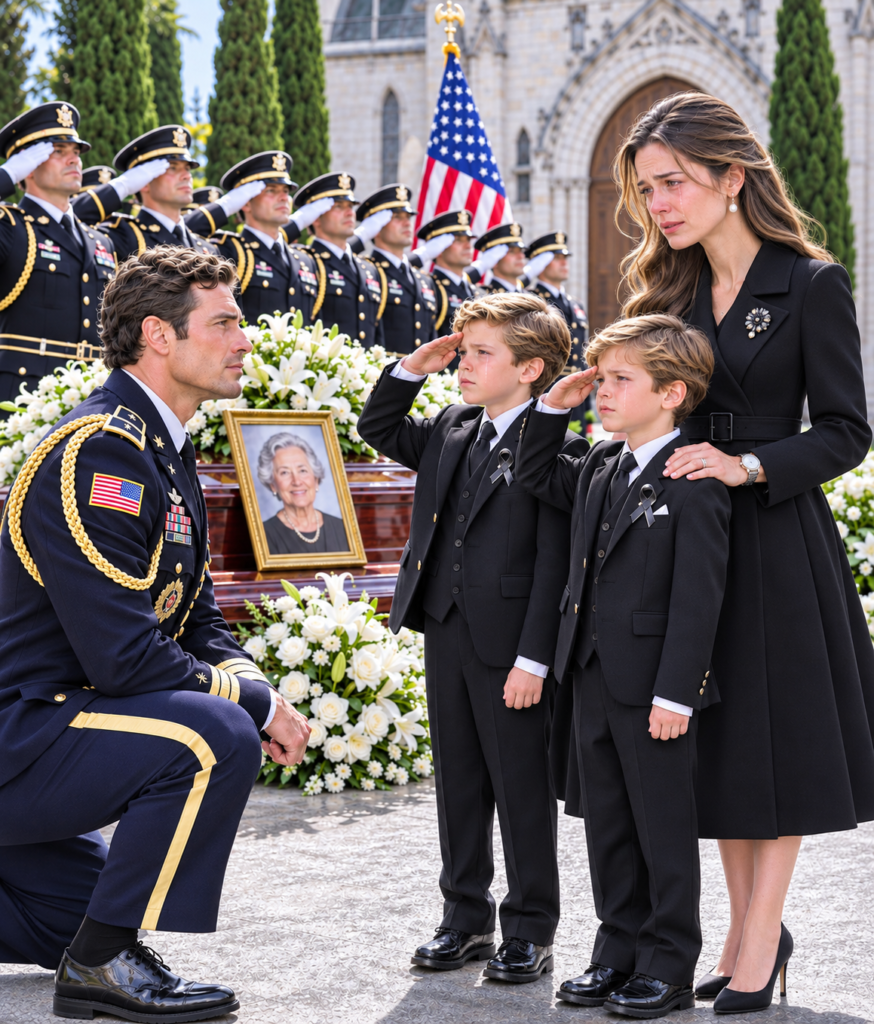

Before I could answer, the retired three-star general beside Mom’s casket struck his cane against the hardwood.
“Colonel Whitaker, on your feet.”
Grant instinctively stood at attention. Every officer in the chapel turned toward him.
General Raymond Holloway gestured to the wooden box in my older son’s hands. “Before you ask that woman a single question, you’re going to learn whose sacrifice made it possible for your father to come home alive.”
Grant turned pale.
My son lifted the lid.
The strongest man I’d ever known broke down in tears.
Nine years earlier, Grant had left a Colorado Springs courthouse without a backward glance. I’d signed the divorce papers with an ultrasound hidden inside my coat.
He knew nothing about my pregnancy.
Now, in a funeral chapel in Salida, Colorado, he was about to learn that ending our marriage hadn’t been his biggest mistake.
The nightmare had begun thirty-six hours earlier.
My phone rang at 1:47 a.m. I sat between my feverish sons, Everett and Nolan, still in scrubs creased from a fourteen-hour shift. I hadn’t eaten since lunch.
The hospital’s number appeared on the screen.
“Dr. Mercer?”
It was my colleague, Daniel Price.
“Daniel? Is something wrong with Mom?”
His hesitation told me everything.
“Audrey, I’m so sorry. Your mother passed away a few minutes ago.”
I stared at the wall. “No. I saw her this afternoon.”
“I know.”
“She was talking. She ate dinner. She asked me to bring her favorite sweater.”
“Her heart stopped. We couldn’t bring her back.”
My fingers went numb. Nolan stirred on the other side of the bed.
“Mommy?”
I hung up and covered my mouth with both hands.
I’d lost my mother, Helen Mercer. She’d held my hand during childbirth, cared for my boys through overnight surgeries, and never complained about the circumstances I’d brought home. Now she lay alone in the hospital.
I couldn’t let myself crumble. My boys depended on me.
By dawn, our neighbor had offered to watch them while I retrieved Mom’s things and organized the funeral.
As I searched her bedroom for her favorite navy dress, I found an envelope with Mom’s familiar handwriting across the front:
For Audrey. Open before the funeral.
A brief letter was tucked inside.
My darling daughter,
When Grant Whitaker arrives to pay his respects, contact Walter Brennan immediately. He has my final instructions and a box containing something your father left behind.
Everything must be revealed in Grant’s presence.
Promise me you won’t stop him from hearing the truth.
I read it three times.
Why Grant? Why would she expect a visit from someone she hadn’t seen in nine years? How was my father connected to him?
I called Walter Brennan, her lawyer and my late father’s Army friend. He answered on the second ring.
“I’ve been expecting your call, Audrey.”
“Did you know my mother left me a letter?”
“Yes.”
“She thinks Grant is coming.”
“He is.”
I froze. “How could you possibly know that?”
“Because I notified him myself. Your mother instructed me to.”
Anger pushed through my sorrow.
“Walter, he doesn’t know about the boys.”
“I know.”
“Then why would you invite him?”
“Your mother believed nine years was long enough.”
I clutched her dresser.
“Long enough for what?”
He paused.
“For the truth to remain buried.”
He offered no further explanation.
That afternoon, while sorting through memorial photographs, I made another discovery.
In an old photograph, Mom stood in her Army nursing uniform beside three young officers. One was my father, Captain Thomas Mercer. Beside him stood a young Raymond Holloway.
The third man’s face unsettled me. He looked unmistakably like Grant.
On the back, someone had written:
The Balkans, 1995. Before everything changed.
Mom had added another line beneath it:
Some debts can never be repaid.
I sank into a chair.
For nine years, I’d thought Grant’s departure had ended an unhappy relationship. Now Mom was revealing a connection between our families that went back further than we’d known.
The next morning, both boys wore identical black suits.
Everett clasped my hand. “Mom, is Dad really coming?”
I knelt. “Yes.”
“Does he know who we are?”
I swallowed hard. “No, sweetheart. He doesn’t.”
Nolan frowned. “Then how will he know we’re his?”
Before I could answer, Walter arrived with a polished wooden box. He handed it to Everett.
“Your grandmother wanted you boys to carry this.”
A black SUV stopped outside, beneath the chapel’s American flag. Grant stepped out in a spotless Army dress uniform. An attractive blonde woman followed, linking arms with him.
He looked assured and successful, unaware of what awaited him.
Walter leaned toward me. “Audrey, whatever happens today, remember one thing.”
“What?”
“Without your father, Colonel Whitaker would never have been born.”
Nine years earlier, I’d discovered that a marriage could be over long before the papers were signed.
Ours had lasted four years.
Grant was an ambitious officer stationed near Colorado Springs when we met. Charming and disciplined, he made me feel as if nobody else mattered.
I studied medicine and worked whenever I could. Thirty guests attended our modest wedding. Mom cried as Grant promised to protect me, and his father shook my hand with unexpected emotion.
I assumed it was his way of welcoming me. Only later did I understand why he couldn’t meet my gaze.
Grant spent months away on assignments, exercises, and career development courses. His service never bothered me. As a soldier’s daughter, I understood the sacrifices military families made.
Still, his presence at home could feel lonelier than his absence. He stopped asking about medical school. We talked only about practical matters: bills, groceries, and departures.
Then I saw the picture.
One rainy evening, Grant’s phone lit up while he slept on the couch. I hadn’t been snooping. I didn’t need to.
The notification showed Grant smiling over homemade soup in a luxurious apartment I didn’t recognize. Beneath it was a message:
Don’t forget breakfast tomorrow. I miss having you here.
I recognized that smile. Once, he’d smiled that way at me.
I waited beside him for almost a minute. He slept on.
The next morning, I made breakfast as usual. Three days later, he set divorce papers on our kitchen table.
“I can’t keep living like this, Audrey.”
I stared at him. “Like what?”
“Like I’m constantly disappointing someone.”
“Have I said that?”
“You don’t have to. I can feel it every time I come home.”
He massaged his forehead. “I need somebody who makes me feel wanted. Somebody who actually needs me.”
I nearly laughed.
For four years, I’d accommodated a man whose frequent absences had forced me to become self-sufficient. Apparently, that independence now made me undesirable.
“Is there someone else?”
Grant glanced at the window.
“This isn’t about another person.”
I stopped trying to save us.
The afternoon before our final hearing, nausea and fatigue sent me to the doctor. I’d blamed the stress. Twenty minutes later, the ultrasound technician smiled.
“Well, here’s one heartbeat.”
She repositioned the probe.
“And here’s another.”
Tears overwhelmed me. At seven weeks pregnant, I was carrying identical twins.
That night, I sat on the bathroom floor, holding the ultrasound picture. I considered telling Grant, but I knew how he’d respond. He’d cancel the divorce and stay because leaving a pregnant wife would ruin the image he’d cultivated. It wouldn’t restore his love. I’d always wonder whether he stayed out of affection or fear of the repercussions, and our babies would become his excuse for resenting home.
I refused that life.
The next morning, Grant appeared at court in uniform, repeatedly checking his watch as our lawyers finished the agreement. He answered the judge’s question about understanding the terms before I could.
“Yes, Your Honor.”
The ultrasound lay in my coat pocket. I felt its folded corners. I almost told him.
Then his phone buzzed. He checked it, briefly flashing that familiar smile—the one I’d seen in the picture.
I signed.
Turning down his offer to keep the apartment, I gathered my things and headed to Mom’s house in Salida. She was waiting on the porch. I got out carrying a single suitcase.
She asked nothing about Grant. Instead, she embraced me.
That evening, I showed her the ultrasound.
“Mom, I couldn’t tell him.”
She studied it. “Are you sure that’s what you want?”
“I don’t want him to stay because he feels trapped.”
She set it down. “Then we need to make sure these children grow up knowing they’re loved.”
I wept again. “What if I can’t do this?”
“You won’t do it alone.”
She kept her word.
Eight months later, Everett and Nolan arrived.
Mom shared feedings, appointments, and sleepless nights. As I finished surgical training and joined a regional hospital, she became the heart of our household. She made lunches, attended school performances, and taught the boys to ride bikes.
She never criticized their father. Whenever they asked about him, she explained that he was a soldier far away and that adult relationships could be complicated.
As the boys grew, I questioned my decision to conceal their existence. The divorce explained my actions, but someday they would still have questions. Eventually, I’d owe them answers.
I hadn’t imagined Mom would choose the occasion herself.
One week before she died, she showed both boys Grandpa’s picture on the porch.
“Your grandfather was a brave man,” she said.
“Braver than superheroes?” Nolan asked.
She laughed softly. “Superheroes don’t have to be real. Your grandfather did.”
Everett examined the picture. “Was our dad brave too?”
Her smile dimmed. “Being brave in uniform and being brave at home aren’t always the same thing.”
I hadn’t understood what she meant then. Seeing Grant arrive with another woman on his arm brought every word back.
Mom had organized more than a memorial. She’d arranged for truths to surface.
The box my sons protected contained the explanation.
Grant approached Mom’s casket with the bearing of someone attending an official ceremony. His ribbons were perfectly positioned, his shoes polished, and his expression appropriately mournful.
His girlfriend, Vanessa Caldwell, accompanied him. Younger than Grant, elegant, and accustomed to attention, she wore an expensive black dress, pearl earrings, and a fitted wool coat.
Conversation subsided, and relatives exchanged uneasy looks. My aunt leaned toward me.
“He actually brought her here?”
“Please don’t make a scene,” I murmured.
Grant laid flowers beside the casket and paused in silence before coming over to me.
“Audrey. I’m sorry for your loss.”
“Thank you.”
He waited expectantly. When I said nothing more, he cleared his throat.
“Your mother was a wonderful woman.”
“She was.”
Vanessa offered her hand. “I’m Vanessa. Grant has told me about you.”
I accepted politely. “I’m sure he has.”
Her smile tightened.
Grant surveyed the room. “If you’re having any difficulties arranging things, I can make some calls. I have connections that might help.”
My uncle shifted awkwardly.
Grant continued, “Regardless of what happened between us, I still consider Helen part of my family.”
I studied him. “That’s interesting.”
He frowned. “What is?”
“She spent two weeks in the hospital before she died. She spent years taking care of other people. I don’t remember receiving a single call from you.”
Nearby conversations fell silent.
Grant lowered his voice. “Audrey, this isn’t the time.”
“You’re right. It isn’t.”
I gestured toward the seats. “Everything has been arranged. Please have a seat.”
He seemed offended. I’d spent years letting him dominate conversations because resisting him was exhausting. He hadn’t expected me to stop seeking his approval.
Twenty minutes later, I encountered Vanessa alone in the hallway.
“Can I ask you something?” she began.
“Of course.”
“Do you still have feelings for Grant?”
I was taken aback. “Why would you ask that at my mother’s funeral?”
She looked embarrassed. “I’m sorry. I just don’t understand what’s happening. Everyone seems angry that we’re here.”
“I’m not responsible for everyone’s feelings.”
“He told me your divorce was mutual.”
“It was legally mutual.”
“That’s not the same thing?”
“No.”
She studied me, her confidence briefly giving way to doubt.
“Grant said you were emotionally distant. That neither of you was happy.”
I leaned against the wall. “Vanessa, I’m burying my mother today. Whatever version of our marriage Grant gave you is between the two of you.”
A voice interrupted before she could answer.
“Mom?”
It was Nolan. He was adjusting his small black tie in the family-room doorway.
“Is Dad here yet?”
Vanessa froze.
I went over to him. “Yes, sweetheart. But I need you to wait with Everett until Mr. Brennan comes back.”
“Okay.”
He went back inside. I turned and found Vanessa staring at me.
“Did he just say Dad?”
Three vehicles arrived before I could reply. Two uniformed personnel occupied the first. An aide opened the rear door of the second near the chapel entrance.
An elderly gentleman stepped out: retired Lieutenant General Raymond Holloway himself. At seventy-nine, he still commanded attention, his silver hair neatly combed and three stars shining on his ceremonial uniform.
Walter Brennan accompanied him.
Grant rose immediately. The other officers followed.
“General Holloway, sir.”
Grant offered a handshake. Holloway barely acknowledged it.
“Later, Colonel.”
He passed him by.
The general halted beside Mom’s casket and silently studied her picture. His shoulders began to shake.
I’d seen men crumble in emergency rooms and families face devastating news. But seeing a decorated general struggle with sorrow was especially painful.
“Helen,” he murmured. “You stubborn, extraordinary woman.”
He laid white roses beside her portrait, then turned to me.
“You must be Audrey.”
“Yes, sir.”
He clasped my hands. “The last time I saw you, you were small enough to sit on my knee.”
I blinked in surprise. “You knew me?”
“I knew your parents.”
“My mother never mentioned you.”
He smiled wistfully. “That sounds exactly like Helen.”
Grant came toward us again. “General, I didn’t realize you were acquainted with this family.”
Holloway turned slowly. “Acquainted?”
Grant hesitated. “Yes, sir.”
“Your father and I owe this family more than you could possibly imagine.”
Grant looked bewildered. “My father?”
The general regarded him intently. “Did he never explain why he visited the military cemetery every June?”
Something shifted in Grant’s expression. “He said he was honoring a fallen friend.”
“A fallen friend,” Holloway echoed bitterly. “That’s certainly one way of describing it.”
Walter arrived with a sealed envelope. “General, shall we begin?”
Holloway nodded, then turned his attention back to Grant.
“Colonel, your former mother-in-law requested that you be present for this reading. I expect you to listen carefully.”
“Of course, sir.”
“And whatever you hear, don’t interrupt.”
Grant sat again. Vanessa joined him but didn’t reach for his hand.
Walter approached the lectern. “Before we begin the formal memorial service, Helen Mercer left specific instructions regarding a personal letter and some military memorabilia.”
He looked my way. “Audrey, would you bring the boys?”
I headed for the family room. Both children stood when I entered. Everett hugged the wooden box to his chest, while Nolan seemed anxious.
“Mom, what if he doesn’t like us?”
I crouched and kissed their foreheads. “Listen to me. You don’t have to earn anyone’s love. Just be yourselves.”
Everett nodded, and we walked into the chapel together.
Grant looked up from across the room. He saw Everett first, then noticed Nolan. His coffee fell.
The colonel who’d left me so readily now seemed unable to move.
“Audrey,” Grant murmured. “How old are they?”
I said nothing. He examined the boys as though he recognized his own childhood face in theirs.
Vanessa caught his arm. “Grant? What’s wrong?”
Holloway struck the floor with his cane. “Colonel Whitaker, on your feet.”
Grant instinctively came to attention.
The general indicated the box Everett carried. “Before you ask that woman a single question, you are going to learn whose sacrifice made it possible for your father to come home alive.”
Walter opened Mom’s letter. “Everett, your grandmother wanted you to read the first page. Would you like to do that?”
Everett nodded. He passed Nolan the box and approached the microphone.
His little voice rang clearly. “To my beloved grandsons, Everett and Nolan.”
I struggled to swallow.
“If you’re reading this, Grandma has gone somewhere you can’t follow yet. I hope you remember that no matter where life takes you, you were loved from the moment your mother learned you existed.”
Grant eased back into his chair. Everett read on.
“Your father is Colonel Grant Whitaker. He is a soldier, just as your grandfather was. He has never met you because your mother and I decided not to tell him about you after the divorce.”
Gasps rippled through the room.
Vanessa withdrew her hand.
“He did not know your mother was pregnant. I want everyone here to understand that. Whatever happened between the grown-ups, you children were never responsible for it.”
Everett lifted his gaze.
Grant watched him through gathering tears.
My boy resumed reading.
“I hope you will give him the opportunity to know you, if he deserves your trust. But you must never believe that your worth depends on a man’s presence in your life.”
I covered my mouth with a tissue.
“Your mother worked hard to give you a happy childhood. She has never asked anyone for pity. Be proud of her, and always remember where you come from.”
After finishing, Everett neatly folded the sheet.
Walter accepted the microphone.
“Helen left additional instructions. General Holloway, the floor is yours.”
Nolan set the box on a table and opened it.
Inside were an old military photograph, handwritten letters, and my father’s posthumously awarded Distinguished Service Cross.
Holloway retrieved the photograph.
“Thirty-one years ago, I served during a multinational humanitarian operation in the Balkans. The situation deteriorated rapidly, and several American personnel were caught in an extremely dangerous area.”
He surveyed the room.
“Among them was a young officer named Douglas Whitaker.”
Grant’s own father.
“His group was isolated. They had wounded men and no reliable way out. Another officer volunteered to help them escape.”
Holloway held up the picture.
“That officer was Captain Thomas Mercer.”
I gazed at Dad’s smiling face.
Mom had always said he’d died while assisting fellow soldiers.
She’d never identified the men he saved.
“Thomas understood the danger. He could have stayed where he was and waited for help. Instead, he refused to abandon those men.”
The general paused.
“Douglas Whitaker survived because Thomas Mercer made a decision that cost him his own life.”
Grant parted his lips.
He couldn’t speak.
“Your father returned home, Colonel. He held your hand. He watched you graduate. He saw you receive your commission. He lived long enough to become a grandfather to your sister’s children.”
Holloway’s tone grew firm.
“Thomas Mercer never had those opportunities.”
Pain tightened my chest.
“He left behind a three-year-old daughter and a wife who had been serving as an Army nurse. Helen was treating wounded personnel when she learned her husband would never return.”
He glanced at Mom’s casket.
“She finished caring for her patients before allowing herself to grieve.”
Veterans bowed their heads.
“After returning home, Helen declined personal financial assistance from the Whitaker family. She insisted that Thomas hadn’t saved those men so his widow could collect favors.”
He faced Grant again.
“Your father spent years trying to honor that sacrifice. He was deeply grateful when he learned you were marrying Thomas Mercer’s daughter.”
Grant murmured, “He never told me.”
“Because Helen asked him not to.”
Holloway retrieved a second letter.
“She didn’t want gratitude to become an obligation. She wanted Audrey to be loved for who she was.”
Grant hid his face.
At our wedding, his father had clasped my hand and offered to help whenever I needed him.
I finally understood that gesture.
“When your marriage ended,” Holloway continued, “Douglas was devastated. Helen refused to let him interfere. She believed neither money nor military influence should be used to force a man to stay married.”
Grant wept openly.
“Nine years,” he murmured.
Taking the medal, Holloway approached the twins.
“Everett. Nolan. Your grandfather was one of the finest officers I ever knew. Your grandmother was one of the finest nurses.”
He entrusted the medal to them.
“Protect this. Not because it’s valuable, but because of what it represents.”
The general stepped back, straightened, and formally saluted Mom’s casket and the boys beside it.
Every officer in uniform stood and returned the salute. The veterans did the same.
Grant was the last to rise. Tears covered his face, and his jaw trembled. He saluted too.
After nine years, I finally saw beyond his uniform.
Since losing Mom, this was the first time I let myself cry openly.
It wasn’t Grant’s remorse, nor the revelation about my children. It was seeing a remarkable woman, who had spent her life caring for others, receive the acknowledgment she had never sought.
Mom had borne Dad’s sacrifice, my grief, and the boys’ secret without asking for recognition. Now everyone stood to honor her.
How I wished she could have witnessed it.
After the burial, Grant approached our bench behind the chapel.
Without his ceremonial jacket, he looked less like a senior officer and more like an exhausted man processing devastating news.
The twins shared some crackers. Everett edged closer to me when Grant arrived.
“Audrey,” Grant began. “Can we talk?”
I nodded.
His gaze moved to the children, then returned to me.
“Why didn’t you tell me?”
I’d expected that question for nine years.
“I was afraid you would stay for the wrong reasons.”
“I would never have left if I’d known.”
“That’s exactly what I was afraid of.”
He looked at me intently.
“I could have helped you.”
“Grant, you had already decided you didn’t want our marriage.”
“But those are my sons.”
“Yes. And they’re wonderful children.”
He sat on the bench opposite us and lowered his gaze.
“I missed everything.”
I stayed quiet.
“Their first steps. Their first words. Their birthdays.”
His voice cracked.
“All of it.”
I watched the boys eat their crackers in silence.
“I know.”
Grant rubbed his palms together.
“Did you ever consider calling me?”
“Many times.”
“What stopped you?”
“At first, fear. Then pride. Then the years started passing, and I didn’t know how to explain what I’d done.”
He looked up.
“I was wrong to leave the way I did. But, Audrey, you should have told me.”
I inhaled deeply.
“Maybe I should have. I thought I was protecting them. Looking back, I know my decision also meant they grew up without the opportunity to know you.”
My acknowledgment seemed to surprise him.
“I can’t undo it,” I added. “Neither can you. We have to decide what happens next.”
He turned toward the twins.
“Can I be part of their lives?”
“That depends on whether you’re willing to be patient.”
“Anything. I’ll do anything.”
“Don’t promise things you haven’t thought through. They don’t need a father who appears whenever he feels guilty and disappears whenever his schedule becomes difficult.”
He nodded slowly.
“I understand.”
“They need consistency. And they need to know that they’re allowed to feel whatever they feel.”
“I’ll respect that.”
Just then, Vanessa came outside, holding her coat and handbag.
“Grant, my ride is coming.”
Grant rose.
“Vanessa, wait.”
She shook her head. “I don’t think I should.”
“We need to talk.”
“We do. But not here.”
She turned to me. “Audrey, I’m sorry about your mother. And I’m sorry if my being here made today harder.”
“Thank you.”
Her attention returned to Grant. “You described your previous marriage as something you both peacefully outgrew. You never told me you were seeing someone else before the divorce.”
His silence was confirmation enough.
Vanessa sighed. “I’ve spent three years believing I knew the kind of man you were.”
“You do know me.”
“Apparently, not as well as I thought.”
She looked toward the boys. “They deserve your attention. And I deserve a relationship where I don’t have to discover important truths at somebody else’s funeral.”
Grant reached for her, but she stepped away.
“I’m not asking you to choose between me and your children. I’m choosing to leave.”
She headed for the parking lot. He watched until she was gone, then came back.
“I really have destroyed everything, haven’t I?”
I met his eyes. “That depends on what you do tomorrow.”
He slowly knelt in front of the twins. “Hi, guys.”
Nolan cocked his head. “Hi.”
“My name is Grant.”
“We know,” Everett replied.
Grant swallowed hard. “I’m your father.”
Both boys were quiet at first. Eventually, Nolan asked, “Did you know Grandma?”
“Yes. A long time ago.”
“What’s her favorite candy?”
Grant looked confused. “What?”
“Grandma’s favorite candy.”
He glanced at me for help. I offered none.
“I’m sorry, buddy. I don’t know.”
Nolan seemed disappointed. “Butter pecan toffee. She always kept some in her purse.”
Grant nodded. “Butter pecan toffee.”
Then Everett asked, “Were you there when we were born?”
“No.”
“Why?”
Tears returned to Grant’s eyes. “I didn’t know you were going to be born.”
“Didn’t you want to know Mom anymore?”
That question hurt more than the general’s words.
Grant paused before answering. “I made some selfish decisions a long time ago. Your mom and I stopped being married. But that doesn’t mean I wouldn’t have wanted to know you.”
Everett studied his face. “Are you going to leave again?”
Grant glanced my way, then turned back to his son. “I have to return to work. But I’d like to come back and visit you, if that’s okay.”
“Next Saturday?”
“Yes. Next Saturday.”
Everett gave a tentative nod.
Nothing more happened. They didn’t embrace him or forgive him. There were no declarations of affection. To them, Grant was a stranger with whom they shared DNA.
Six days later, an unassuming pickup pulled up outside. Grant climbed out in work boots, jeans, and a gray sweatshirt. His paper bag held apples, tea, and butter pecan toffee.
He set a little package beside Mom’s picture, then looked up at the ceiling. “That fan still making noise?”
I almost smiled. “Has been for years.”
“Do you have a ladder?”
Over the next two hours, he fixed the ceiling fan and a loose cabinet hinge, then swept dead leaves from the porch. Nolan brought him a broom. Everett brought him water. Grant thanked them both.
At lunch, I set out another plate. He looked at it like a treasure.
That afternoon, while sorting Mom’s possessions, I found another envelope beneath some old Army paperwork. Inside was a handwritten address in Montana and one last note:
“Audrey, there is a man named Samuel Keating who was with your father during his last days. He has something Thomas intended for you.”
“When you’re ready, take the boys to meet him.”
I glanced out the kitchen window. Grant and the boys were gathering leaves together.
For once, our silence didn’t suggest an ending. It suggested an uncertain but necessary new beginning.
Three months after Mom’s funeral, I headed north to Livingston, Montana, with the twins asleep in the back. Grant drove behind us.
Since the funeral, he’d visited nearly every free weekend, calling at agreed times whenever his military duties got in the way. Missing so many years had taught him the importance of keeping small commitments.
We’d consulted a family counselor and started formalizing our parenting arrangements. I refused to raise the boys around another unspoken understanding between adults. They needed security, and Grant had to prove he’d stay committed.
When I mentioned Samuel Keating, Grant asked to join us. I reluctantly agreed. Samuel’s story concerned both families.
His home stood beyond a gravel road, facing snowy mountains, with an American flag flying from the porch. An old man answered before we could knock. He studied me, and tears came immediately.
“Good Lord,” he murmured. “Thomas’s little girl.”
I told him who I was, and he embraced me warmly.
“I wondered if Helen would ever send you.”
Pictures of his military companions lined the walls. Samuel gave the twins hot chocolate and poured coffee for us, then went into another room. He returned holding a small canvas bag.
“Your father gave me this before we became separated. He told me to make sure Helen received it if anything happened.”
Inside were a folded note and a silver pocket watch. Across the front of the note was my name: “For Audrey, when she’s old enough.”
I unfolded it with trembling hands.
My sweet girl,
If you’re reading this, I may have missed more birthdays than I ever intended to.
I want you to know that your daddy loved you more than anything in this world. If I could choose between every medal in the Army and one more afternoon watching you play in the backyard, I’d choose you without hesitation.
I paused. Dad had existed mostly in photographs throughout my life. Now he felt real: a young father who’d wanted to see his daughter grow.
I resumed reading.
Don’t spend your life trying to prove that you deserve love. You already do. Be kind, but don’t allow people to mistake your kindness for weakness.
And if you ever have children, tell them their grandfather would have loved them more than words could explain.
Nolan climbed beside me on the couch.
“Mom, are you sad?”
I kissed his forehead.
“A little. But I’m happy too.”
Samuel turned to Grant.
“You’re Doug Whitaker’s boy, aren’t you?”
“Yes, sir.”
“Your father was a good man.”
Grant lowered his gaze.
“I wish I’d understood what Captain Mercer did for him.”
Samuel watched him closely.
“Understanding it now is better than never understanding it.”
Grant nodded.
“I wasn’t good to his daughter.”
“No?”
“No, sir.”
Samuel looked at the twins.
“Then be good to his grandsons.”
There was no judgment in his tone. He spoke with the wisdom of someone who knew remorse meant nothing without action.
Before we left, Samuel showed us how to open Grandpa’s watch. Everett listened to its ticking. Nolan wondered whether Grandpa Thomas had liked baseball.
“Liked it? Your grandfather could talk about baseball until everybody else fell asleep,” Samuel chuckled.
Both boys laughed. I glanced at Grant. Tears accompanied his smile.
Throughout the next year, Grant kept coming back. He attended school conferences, learned who disliked tomatoes, and discovered Everett’s passion for model planes and Nolan’s dream of becoming a veterinarian. He supported us under our formal parenting arrangement and mastered making pancakes without burning them.
One Saturday, Nolan knocked over a pitcher of lemonade and called across the kitchen, “Dad! Can you help me?”
Grant froze. Nolan didn’t realize what he’d just said, but I did. Grant glanced at me. I pointed to the mess. “You’ve got work to do.”
Laughing through tears, he fetched a towel.
That summer, he asked if we could revive our marriage. We sat on the porch after the twins went to bed.
“I still love you, Audrey.”
I watched the sun sink behind the mountains. “Grant, I loved you for a long time.”
“Could we try again?”
I gently shook my head. “I’m glad you’ve become a better father. I’m glad you’re learning what family means. But that doesn’t mean our marriage needs to begin again.”
He swallowed. “Is there someone else?”
“No.”
“Then why?”
“Because I don’t need to return to a relationship that ended nine years before you understood what you’d lost.”
Silence followed. At last, he nodded. “I understand.” This time, I trusted his words.
Two years after Mom died, our community hospital established the Helen Mercer Memorial Scholarship for future nurses. Holloway, Samuel, Grant, and dozens of local veterans attended the dedication.
The twins unveiled Grandma’s portrait in her Army nursing uniform. Everett wore Grandpa’s pocket watch, and Nolan held the medal’s wooden box. Grant applauded quietly beside them. Their family connection no longer needed explaining.
After everyone had gone home that evening, I visited Mom’s grave and left white roses by her headstone.
“The boys are doing well, Mom,” I murmured. “Grant is trying. And I’m happy.”
A breeze stirred the trees, and I recalled her lessons: dignity didn’t depend on revenge, forgiveness didn’t require a reunion, and true honor came not from military decorations but from keeping promises when nobody could see.
Nine years after our divorce, Grant had come to Helen’s funeral expecting only to pay his respects. He left with two sons, an unpayable family debt, and another opportunity without guarantees.
His place as my husband was permanently lost. Yet patience, humility, and affection had earned him a place as their father. That was precisely what Mom had wanted.
THE END! THANK YOU FOR READING!