
I was ironing my graduation gown in my tiny studio apartment when I overheard my mother on the phone.
“Yes, we’re attending the ceremony,” she said. “Although it’s really just a formality. Four years of struggling, living in that miserable apartment, and working at a coffee shop. I keep telling David we should have invested that money in Marcus’s law degree instead.”
Marcus. My older brother, and the undisputed favorite in our family.
He had graduated from Harvard Law with generous financial assistance and professional connections from our father. At twenty-eight, he was still living in my parents’ pool house, supposedly figuring out his future while relying on his trust fund.

Meanwhile, I was preparing to graduate after four exhausting years of balancing work and school.
I checked our family group chat. Dad had written:
“Parking is reserved for the two o’clock ceremony. Marcus, remember the good camera. Let’s finish this quickly and get dinner afterward.”
Nobody had asked whether I wanted to join them for dinner or considered that I might already have plans.
For four years, my parents had treated my education as an expensive obligation rather than an investment in my future. Every semester, Dad complained while paying my tuition.
What they didn’t realize was that I had been working about sixty hours a week across three jobs to support myself. They knew about my coffee shop position because they had visited once and spent twenty minutes criticizing my career prospects.
They knew nothing about the evening tutoring sessions where I helped students understand organic chemistry, or the three years I’d spent as a research assistant under Dr. Patricia Hendrickx in the molecular biology lab. And they certainly knew nothing about my recent discussions with Harvard Medical School.
Dean Morrison had asked me to help with some preparations, but I also wanted to avoid another lecture from Dad about setting realistic career expectations.
It was a beautiful May morning, and the campus looked magnificent beneath a clear blue sky.
“Sarah!”
I recognized Dr. Hendrickx’s voice at once. She approached with a genuinely proud smile.
“There’s our outstanding researcher! Are you ready for your big day?”
Dr. Hendrickx had been my academic adviser since my sophomore year. Over time, she had become much more than a professor. She was a mentor who saw my potential, encouraged my ambitions, and recommended me for a research scholarship that helped cover my lab expenses and textbooks.
“As ready as I’ll ever be,” I replied. “My family’s coming, so that should be interesting.”
Her expression softened. After three years of working together, she understood exactly what I meant.
“I suspect they’re going to receive quite a surprise today.”
Before I could ask what she meant, Dean Morrison approached us.
“Sarah, wonderful timing. I’d like to review the special announcements with you.”
“Special announcements?” My stomach tightened. I had expected to receive my diploma alongside everyone else.
Dean Morrison exchanged a knowing glance with Dr. Hendrickx.
“There are a few additional things we’d like to recognize. Don’t worry. Everything is positive.”
I suddenly felt more nervous than I had during any final examination.
Whatever had been planned, it seemed my graduation ceremony wasn’t going to be as ordinary as I’d expected.
Around 1:30 that afternoon, families began entering the auditorium. I spotted my parents immediately. Dad wore the same impatient expression he’d displayed at nearly every academic event throughout my childhood, while Mom repeatedly checked her watch.
Marcus arrived late, wearing sunglasses indoors and carrying Dad’s expensive camera. He seemed far more interested in photographing himself. My younger sister, Emma, sat between our parents, scrolling through her phone.
They’d reserved a seat for me at the far end of their row. Even the seating arrangement suggested I was only marginally included.
“There she is,” Dad announced as I approached. “Our graduate. How does it feel knowing this is finally finished?”
“Expensive,” Mom interrupted. “Twenty-three thousand dollars a year for four years, plus books, living expenses, and that computer you insisted you needed.”
Marcus lowered his sunglasses. “And I suppose you’ll be keeping your coffee shop job? The employment market isn’t particularly promising for… what exactly did you study?”
“Molecular biology,” I answered quietly.
“Right. Molecular biology. I’m sure there are plenty of opportunities for that.” His sarcastic tone made his opinion unmistakable.
Emma barely looked up from her phone. “Can we finish this quickly? I’m meeting Jessica at the mall at four.”
I sat down and tried to focus on the significance of the afternoon. Soon, I’d have my diploma. Four years of exams, demanding work schedules, financial sacrifices, and countless nights in the laboratory would officially be behind me. Whatever my family believed, I knew how much effort it had taken to reach this moment.
The graduation ceremony began precisely at two o’clock. Students entered the auditorium by academic department. As I walked alongside my fellow biology graduates, families throughout the audience cheered enthusiastically. My parents remained seated. Dad looked as though he was already calculating how much longer the ceremony would last.
Dean Morrison approached the podium. “Welcome, families and friends, to our university’s 156th commencement ceremony. Today, we celebrate the accomplishments and exciting futures of 847 exceptional graduates.”
His opening remarks included the usual acknowledgments of professors, families, and academic achievements. I glanced around the auditorium. Some families had brought magnificent bouquets; others had hired professional photographers. My relatives looked as though they were attending an inconvenient business meeting.
Then Dean Morrison continued. “Before awarding our degrees, we would like to recognize several extraordinary students whose academic achievements and research contributions deserve special acknowledgment.”
A sudden wave of nervousness washed over me. Several classmates had completed remarkable research projects. Jennifer Martinez had published important findings on sustainable agriculture, and Robert Kim had developed a statistical model for examining climate patterns. I quietly hoped my research might receive an honorable mention.
Dean Morrison began introducing the recipient of the Outstanding Undergraduate Research Award.
“This student has dedicated three years to investigating protein folding and its potential relationship with Alzheimer’s disease.”
My heart began racing. He was describing my research.
He explained that the work had been accepted for publication in the Journal of Molecular Biology and that the student had been invited to present at an international conference on neurodegenerative diseases.
Then he announced my name.
“Sarah Elizabeth Thompson, please join me on stage.”
For several seconds, I could hardly move. Hundreds of people turned toward me, including my family.
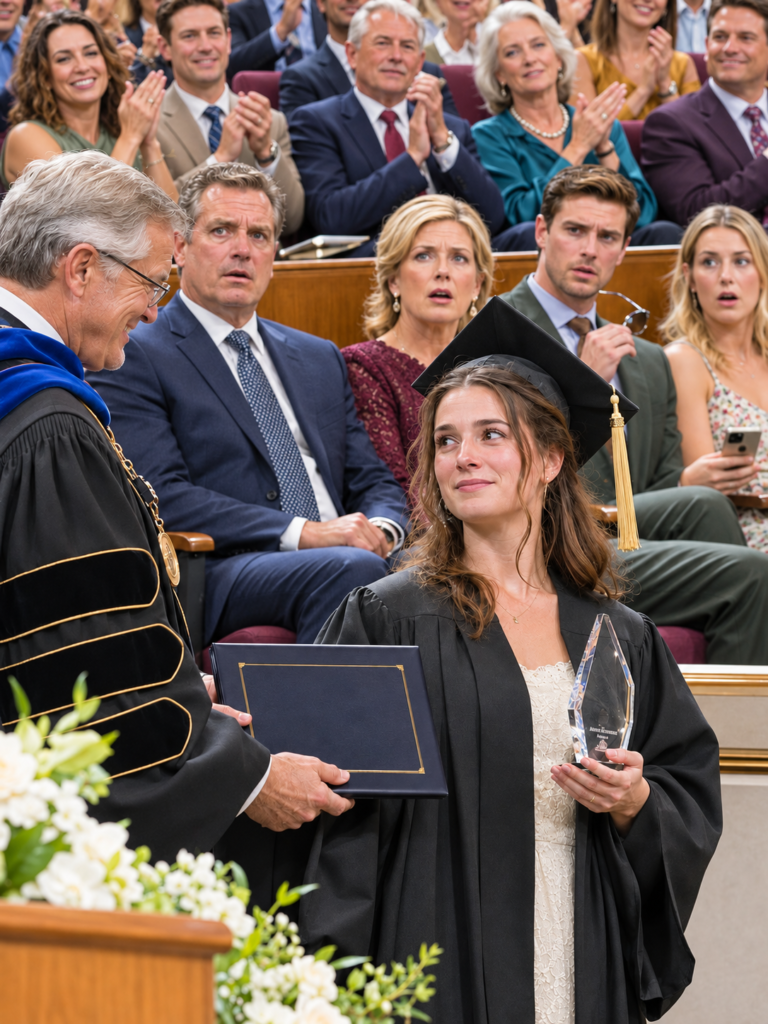
I walked onto the stage and accepted a beautiful crystal award as cameras flashed around me.
My father’s expression shifted from indifference to confusion. Mom stared at me in disbelief.
But Dean Morrison wasn’t finished.
“Sarah’s exceptional academic record and research contributions have also earned her a fully funded scholarship to Harvard Medical School’s prestigious MD-PhD program.”
The auditorium erupted in applause.
“For the next eight years, her tuition, accommodation, living expenses, and research funding will be covered.”
Dad’s mouth fell open. Mom’s face lost its color. Marcus slowly removed his sunglasses. Even Emma finally put down her phone.
Dean Morrison then explained that I had maintained a perfect 4.0 GPA while working multiple jobs to support myself throughout my undergraduate studies. He emphasized that my financial independence, determination, and remarkable discipline had impressed Harvard’s admissions committee.
That announcement seemed to affect my parents more than anything else. For years, they had complained about supporting my education without understanding how much of my living expenses I had covered myself. Now, hundreds of strangers were applauding accomplishments my family had never bothered to acknowledge.
As I returned to my seat, my friends enthusiastically congratulated me.
Harvard Medical School. Eight years of fully funded medical and scientific training. An opportunity to become both a physician and a research scientist.
Everything I had quietly worked toward was finally becoming reality. And for once, my family couldn’t minimize my achievements.
After the ceremony, my family surrounded me on the university lawn.
“When exactly were you planning to tell us about Harvard?” Mom demanded.
I explained that medical school admissions were extremely competitive and that I had wanted a confirmed offer before making any announcements. What I didn’t say at first was that I had been afraid of hearing another lecture about unrealistic ambitions if my application failed.
Mom then asked why I had worked so many jobs instead of requesting additional financial assistance.
“We would have helped you,” she insisted.
I remembered every complaint, every reminder about tuition, and every expectation of gratitude that came with their financial contributions.
Before the conversation became more uncomfortable, Dr. Hendrickx approached us with another woman.
“This is Dr. Amanda Foster. She’s traveled from Boston to meet Sarah and discuss their future research collaboration.”
My family’s attitude changed instantly.
Dr. Foster explained that my undergraduate research was unusually advanced. My findings on protein folding could potentially contribute to the development of future interventions for Alzheimer’s disease.
“Sarah’s work has the potential to benefit millions of people,” she explained. “Harvard is exceptionally pleased to welcome her.”
For the next twenty minutes, my family listened with the same enthusiasm they had always reserved for Marcus’s law school accomplishments. Dr. Foster described the MD-PhD program, international research partnerships, and professional opportunities that would become available after graduation.
When she finally left, Emma looked at me with genuine surprise. “I guess you’re actually really intelligent.”
I smiled gently. “I’ve always been intelligent, Emma. You’ve simply never shown much interest in finding out.”
Marcus lowered his head. For the first time that afternoon, he looked uncomfortable.
“I think we owe you an apology,” he said.
Mom seemed deeply unsettled. They were finally recognizing the academic achievements, research contributions, and personal sacrifices they had overlooked for years. But there was something I needed them to understand: receiving Harvard’s approval hadn’t suddenly made me worthy of their respect.
Dad tried to defend himself. “Sarah, we’ve never considered you a disappointment.”
I looked directly at him. “Just this morning, you were relieved that you could finally stop spending money on what you considered a failure.”
His expression changed at once. I reminded my parents how often they had suggested that Marcus’s education deserved greater financial support, how Dad introduced me to his colleagues as the daughter studying “something related to science,” and how Marcus received a brand-new BMW after high school while my valedictorian achievement was celebrated with dinner at Applebee’s.
I wasn’t interested in humiliating them. But years of dismissive treatment couldn’t simply disappear because a prestigious university had recognized my abilities.
Mom finally acknowledged that they hadn’t encouraged me properly.
“The important question,” I replied, “is what happens from here.”
In three months, I would move to Boston to begin eight years of demanding medical and scientific training. If my family wanted to remain part of my life, our relationship needed to change. I wanted genuine conversations, encouragement instead of criticism, interest instead of comparisons, and affection that didn’t depend on professional prestige.
Dad assured me they wanted to do better.
Then I shared another piece of news. Before leaving for Boston, I had accepted a three-month summer research position. The salary was $48,000, with additional publication bonuses. We expected to submit two more research papers, and three pharmaceutical companies had already expressed interest in our findings.
Marcus stared at me. My summer research salary exceeded what he had earned during his entire first year practicing law.
“Sarah,” he finally said, “I really do owe you an enormous apology.”
Mom nodded. “We all do.”
They suggested celebrating my graduation properly at any restaurant I wanted.
“Somewhere without a children’s menu,” I joked. “I’m twenty-two and heading to Harvard Medical School. I think I’ve earned cloth napkins.”
Dad laughed. “Our future doctor deserves the very best.”
Future doctor. For the first time I could remember, there was unmistakable pride in his voice when he spoke about my future.
It didn’t repair everything, but it gave me something I hadn’t experienced with my family in years: hope.
Not the expectation that everything would suddenly become perfect, but simply the possibility that things might finally improve.
She explained that Harvard had arranged a fully furnished graduate apartment near the medical school, with utilities included. My scholarship also provided an annual allowance of $25,000 for research expenses and conference travel.
My parents were only beginning to understand the extraordinary opportunity I had earned.
Dad stopped beside the car.
“Sarah, when I criticized your degree, I genuinely believed it wouldn’t lead to a practical career.”
He paused.
“But that doesn’t excuse how I treated you. I should have asked about your work. I should have understood your ambitions. Most importantly, I should have been a better father.”
I looked at him quietly.
“You still have the opportunity to become one, Dad, if that’s what you genuinely want.”
He nodded.
“It is.”
The journey home felt completely different from every family outing I remembered. Marcus didn’t dominate the conversation with stories about legal internships or influential professional connections. Instead, everyone asked about my research. They wanted to understand my medical training, scientific interests, and long-term ambitions.
For once, they were paying attention because they were interested in what mattered to me, not because they thought something about my life needed correcting.
That evening, we gathered at one of the finest restaurants in town. And yes, there were cloth napkins.
Before dinner, Dad raised his glass.
“To our future Dr. Sarah Thompson: a Harvard Medical School scholar, an accomplished researcher, and a young woman whose determination deserves more recognition than we’ve ever given her.”
He looked directly at me, and everyone raised their glasses.
I smiled, feeling a mixture of happiness and uncertainty. Their apologies were meaningful, but only time would reveal whether their attitudes had genuinely changed. Trust couldn’t be restored in a single afternoon, and years of criticism couldn’t be erased by one celebratory dinner. Nevertheless, I was willing to give them the opportunity to show that their promises were sincere.
As I looked around the table, I realized that my greatest graduation gift wasn’t the crystal trophy, the prestigious scholarship, the research salary, or even my family’s unexpected recognition. It was something I had given myself: the determination to keep pursuing my dreams when the people closest to me refused to believe in them.
I had spent four years building a future nobody could take away from me. Every early morning at the coffee shop, every late-night tutoring session, every exhausting hour in the laboratory, every sacrifice had brought me to this moment.
My family’s approval was no longer something I needed in order to believe in myself. I already knew my worth, and Harvard Medical School was only the beginning of everything I intended to accomplish.
THE END! THANK YOU FOR READING!