
Theo stood behind the microphone with tears rolling down his cheeks. For several seconds, nobody moved. The chapel was so quiet that I could hear the soft hum of the air conditioner and the occasional rustle of someone reaching for a tissue. My husband, Daniel, sat beside me with his hands clasped so tightly that his knuckles had turned white.
I stared at the young man in the red dress. The boy who had eaten breakfast at our kitchen table hundreds of times. The boy who used to leave his sneakers beside our front door. The boy who had stayed beside my son during the final fourteen months of his life. And now he was holding a letter Jack had written for us.
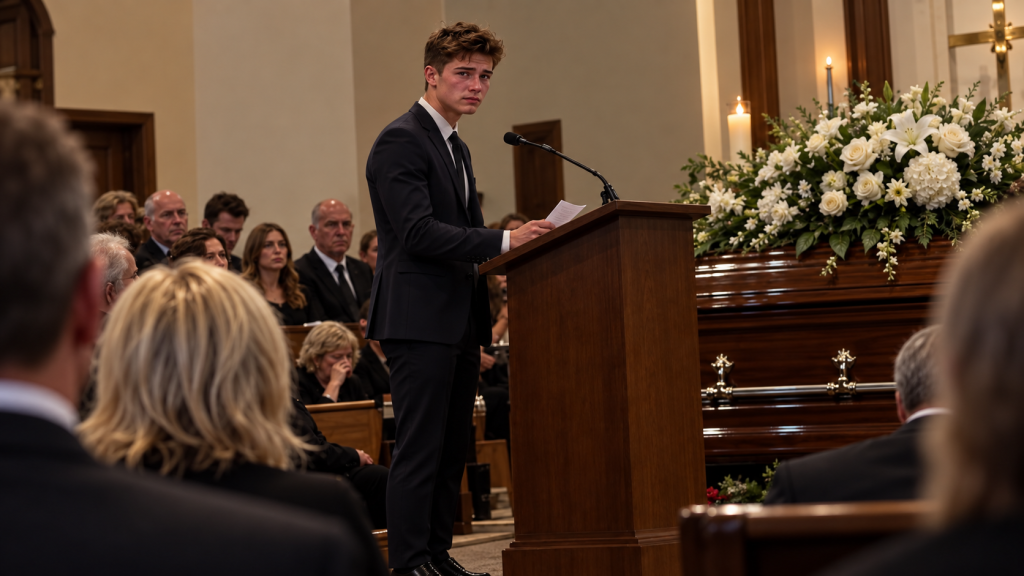
A letter we hadn’t known existed. Theo swallowed. “Jack told me something before he died,” he continued. “He said his parents would probably spend the rest of their lives wondering whether they could have done more.” My heart broke. Daniel lowered his head. Theo glanced at us.
“He made me promise to tell you that you couldn’t have loved him any harder than you already did.”
A sob escaped my throat.
“He said his mom would remember every treatment that didn’t work. Every night she fell asleep in the hospital chair. Every time she went home for a shower and wondered whether she should’ve stayed.”
I covered my mouth.
How could Jack have known?
Those were the exact thoughts that had tormented me since the moment his heart stopped.
Theo’s voice trembled.
“And he said his dad would remember every time he couldn’t find the right words. Every moment he stood in the hallway because he didn’t want Jack to see him crying.”
Daniel’s shoulders began shaking.
Theo looked straight at my husband.
“Jack said, ‘Tell Dad I always knew he was there. Even when he couldn’t come into the room, I knew he was standing outside.’”
My husband broke.
He bent forward, pressing both hands against his face.
I’d seen Daniel cry when the doctors told us the treatment wasn’t working.
I’d seen him cry when Jack died.
But this was different.
This was the sound of a father hearing that his son had understood the love he could never properly express.
Theo waited until the room settled.
Then he looked down at his red dress.
“Six months ago, I told Jack something I’d never been brave enough to tell anyone outside my sister.”
He smiled sadly.
“I told him I sometimes felt more like myself wearing clothes everyone said boys shouldn’t wear.”
A few people shifted in their seats.
Theo took a breath.
“I was terrified he’d laugh. We’d been friends since we were seven. I thought if I told him, maybe I’d lose the one person who had always made me feel like I belonged somewhere.”
He glanced toward Jack’s coffin.
“But Jack didn’t laugh.”
Tears gathered in his eyes.
“He asked whether wearing a dress made me happy.”
Theo swallowed.
“I said sometimes it did.”
He wiped his face.
“Then he asked what color I’d choose if nobody were watching.”
A small smile appeared.
“I told him red.”
A quiet laugh moved through the chapel.
Theo looked down at the borrowed dress.
“And Jack said, ‘Good. Because black makes you look like a substitute history teacher.’”
Several people laughed through their tears.
I laughed too.
It was exactly the kind of ridiculous thing my son would have said.
Theo’s smile faded.
“He made me promise that when the day came for everyone to say goodbye to him, I wouldn’t hide just because people might stare.”
He looked toward Daniel.
“He told me, ‘If you come to my funeral, come as yourself. I’ll already know what everyone else is thinking, and I promise I won’t care.’”
My husband slowly lifted his head.
His eyes moved from Theo’s face to the dress.
Then back again.
The anger I’d seen moments earlier was gone.
In its place was an expression I recognized.
Grief.
And shame.
Theo unfolded another page.
“Jack also wanted me to tell you about something he was doing during the last few months.”
He hesitated.
“I don’t think his parents knew.”
My heart tightened.
We had spent nearly every day worrying about Jack’s appointments, medications, blood counts, and pain.
What could he possibly have been doing without our knowledge?
Theo glanced toward the coffin.
“Jack hated being told there was nothing left he could do.”
His voice cracked.
“So he found something.”
He paused.
“Something for children who were frightened in hospital rooms, just like he was.”
I leaned forward.
Theo continued.
“He started recording bedtime stories.”
A ripple moved through the mourners.
“He called himself Captain Red. He made up stories about brave little animals, clumsy dragons, and a king who was afraid of thunderstorms.”
A few people smiled.
“Some of those recordings were shared through a children’s hospital volunteer program. Jack didn’t use his real name. He didn’t want the younger kids to worry about how sick he was.”
I felt a sharp ache in my chest.
I’d often heard Jack laughing with Theo behind his bedroom door.
I’d assumed they were watching videos or playing games.
I never imagined he was recording stories for children he’d never met.
“Jack received a message about one of those stories,” Theo said. “It came from the mother of a little girl named Ava.”
He looked toward the floor.
“She said Ava had listened to Captain Red’s stories during a long hospital stay. She said they helped her feel less frightened at night.”
Theo’s voice broke.
“Jack read that message about twenty times.”
He smiled through tears.
“He told me, ‘Theo, I can’t make myself better. But maybe I can make somebody’s worst night a little less scary.’”
I pressed my hands against my chest.
That was my boy.
My beautiful, stubborn boy.
Even while dying, he’d been looking for a way to make someone else’s darkness smaller.
Theo glanced at the paper again.
“Ava doesn’t know who Captain Red really was. And Jack wrote a letter for her.”
He swallowed.
“He said she shouldn’t receive it until after he was gone, because he didn’t want her feeling responsible for making him happy.”
The chapel was silent.
“He wanted her to know she had helped someone too.”
Theo carefully folded the letter.
“There’s a wooden box beneath Jack’s bed. Inside are letters for his parents, the message for Ava, and something he worked very hard to finish.”
His lips trembled.
“He told me I couldn’t open it without them.”
Then he looked directly at Daniel and me.
“I’m sorry I kept this from you.”
I was crying too hard to speak.
Theo continued.
“Jack asked me to promise.”
For a moment, he stood quietly.
Then he gave a shaky little laugh.
“One last thing.”
He looked toward Jack’s coffin.
“Jack told me that if I chickened out and wore a black suit today, he’d come back and haunt me by playing his terrible guitar songs every night.”
A broken laugh moved through the chapel.
Theo smiled.
“And nobody deserves that.”
He stepped away from the microphone.
For several seconds, nobody reacted.
Then an elderly woman near the front stood.
She was Jack’s former elementary-school teacher.
She began applauding softly.
Another person joined her.
Then another.
Within moments, nearly everyone in the chapel was standing.
Not because a funeral was supposed to end with applause.
But because a frightened young man had stood before them, wearing the clothes he’d been afraid to wear, and delivered one final act of friendship for a boy who had loved him exactly as he was.
Daniel rose beside me.
I looked at him.
His face was wet with tears.
Then, before I could speak, he stepped into the aisle.
Theo had reached the bottom of the platform.
When he saw Daniel approaching, he stopped.
For one terrible second, I thought my husband was still going to confront him.
Instead, Daniel opened his arms.
Theo’s face crumpled.
He stepped forward.
And my husband wrapped him in the tightest embrace I’d ever seen.
“I’m sorry,” Daniel whispered.
Theo began crying.
“It’s okay, Mr. Harris.”
“No.”
Daniel shook his head.
“It’s not okay that I almost made you leave.”
Theo clung to him.
Daniel’s voice broke.
“Jack loved you, son. You’re part of this family.”
The word son made Theo cry harder.
So did I.
I joined them in the aisle.
I wrapped my arms around both of them.
For a moment, standing beside my son’s coffin, I felt an unbearable emptiness.
Jack was gone.
Nothing would change that.
But the young man he’d called his brother was still standing in front of us.
Frightened.
Heartbroken.
And desperately in need of the family Jack had always insisted he belonged to.
When the service ended, Theo remained near the back of the chapel.
Some mourners approached to hug him.
Others thanked him for his words.
A few relatives still looked uncertain about the dress, but nobody confronted him.
I walked toward him.
“Theo.”
He turned.
His eyes filled immediately.
“Mrs. Harris, I’m sorry about the surprise.”
I shook my head.
“Don’t apologize.”
He looked down.
“I thought maybe I should’ve told you.”
I swallowed.
“Jack asked you not to.”
He nodded.
“Yes.”
I reached for his hand.
“Thank you for loving my son.”
Theo covered his mouth.
Then whispered:
“He was my brother.”
I squeezed his hand.
“I know.”
Outside, the sky was gray.
The air smelled of wet leaves.
Theo stood beside the chapel steps, hugging his arms around himself.
I noticed he was trembling.
“Are you cold?”
He nodded.
“A little.”
I removed the black shawl from my shoulders.
Then hesitated.
I didn’t want him to think I was trying to cover the red dress.
Instead, I asked:
“Would you like this?”
Theo looked surprised.
Then smiled through tears.
“Yes, please.”
I placed it gently around his shoulders.
And for the first time that day, I realized how much courage it had taken for him to walk into that chapel.
He glanced toward Daniel, who was speaking with the funeral director.
“Do you think Mr. Harris meant what he said?”
I looked at him.
“About you being family?”
Theo nodded.
I took his hand.
“Theo, when you were nine, you caught the chickenpox and refused to go home because Jack promised he’d finish building a model spaceship with you.”
A sad smile appeared.
“When you were twelve, you broke our kitchen window trying to hit a baseball over the garage.”
He laughed through tears.
“And when you were fifteen, you spent Christmas Eve asleep on our sofa because things were difficult at your house.”
I squeezed his fingers.
“You have always been family.”
Theo began crying again.
Then he looked toward me.
“Can we open Jack’s box together?”
My heart tightened.
I looked toward the waiting cars.
Toward the flowers.
Toward the funeral director preparing for the drive to the cemetery.
“After we say goodbye to him,” I whispered.
Theo nodded.
“Together.”
That evening, our house was full of people.
Relatives carried casseroles into the kitchen.
Neighbors brought cakes nobody wanted to eat.
Friends sat in small groups, speaking softly about Jack.
I heard laughter occasionally.
Then crying.
Then more laughter.
It was the strange rhythm of a house after a funeral.
For fourteen months, people had come here to visit our sick son.
Now they were here because he was gone.
By eight o’clock, the last guests had left.
Daniel stood beside the kitchen sink staring at a plate he’d been washing for far too long.
I touched his arm.
“Daniel.”
He looked up.
His eyes were red.
“Do you think Jack knew?”
My throat tightened.
“Knew what?”
“That I was scared.”
I smiled sadly.
“Of course he knew.”
Daniel looked down.
“I tried so hard not to show him.”
I squeezed his hand.
“Maybe he didn’t need you to be fearless.”
My husband’s face crumpled.
“Maybe he just needed you there.”
A soft knock sounded at the front door.
Theo.
He’d changed into jeans and a sweater.
His hair was damp from the rain.
He held a small paper bag.
“I brought the ribbon back,” he whispered.
I frowned.
“What ribbon?”
He opened the bag.
Inside was a thin strip of red satin.
“Lena let me borrow her dress. Jack asked me to keep this ribbon from it. He said it goes with the box.”
My heart tightened.
“Then let’s find out why.”
We walked upstairs.
For fourteen months, the door to Jack’s bedroom had rarely been closed.
Nurses came and went.
Theo brought homework.
Friends watched movies.
Daniel carried trays of food.
I changed sheets and checked medications.
But since Jack died, I’d been unable to enter the room without feeling as though I couldn’t breathe.
Now I stood outside it with my husband on one side and Theo on the other.
Daniel reached for the doorknob.
Then stopped.
“I don’t know if I can do this.”
I took his hand.
“Neither do I.”
Theo stepped closer.
“We don’t have to rush.”
I looked at him.
The red ribbon trembled between his fingers.
Then I whispered:
“Jack asked us to open it together.”
Daniel nodded.
And slowly, he opened the door.
Jack’s bedroom looked exactly as we’d left it.
His navy-blue comforter was neatly folded at the foot of the bed.
A stack of comic books sat beside the lamp.
There was a half-finished model airplane on his desk, its wings still waiting to be attached.
On the wall hung photographs of his friends.
In almost every one, Theo stood beside him.
Two boys at a baseball game.
Two boys wearing ridiculous Halloween costumes.
Two boys standing in the rain outside their high school, laughing so hard they could barely keep their eyes open.
I looked at the pictures and felt an ache that seemed to fill my entire body.
Jack had been eighteen.
He should have had decades ahead of him.
Instead, his life had become a collection of photographs and the things he’d left behind.
Theo knelt beside the bed.
“Jack said the box was underneath, near the wall.”
Daniel moved to help him.
Together, they pulled out a rectangular wooden box, about the size of a shoebox.
It was beautifully made.
The corners were joined with little dovetail joints, and a small brass latch held the lid shut.
Across the top, carved in uneven letters, were three words.
FOR THE DAYS AFTER.
I touched the wood.
“When did he make this?”
Theo smiled through tears.
“Last summer. In the workshop at school, before he became too weak to go.”
Daniel ran his hand across the lid.
“I taught him how to make those joints.”
His voice broke.
“He used to get so frustrated when the corners didn’t fit.”
Theo nodded.
“He said he had to start this one three times.”
A small red ribbon was tucked through the brass latch.
Theo threaded the strip he’d brought from his sister’s dress through the loop and tied it into a bow.
I watched him.
“Why the ribbon?”
He swallowed.
“Jack said there should be something red on the box when we opened it. He wanted us to remember that red didn’t have to mean danger.”
He looked down at the knot.
“Sometimes it could mean somebody was brave enough to show up.”
Daniel sat on the edge of the bed.
“Open it, Theo.”
The young man looked toward me.
I nodded.
He lifted the latch.
Inside were three envelopes, a small flash drive, a folded map, and a battered notebook.
On top lay a photograph.
Jack and Theo at about eight years old.
They were sitting on our back porch, each holding a melting ice pop.
Jack’s mouth was stained bright red.
Theo had blue juice running down his chin.
Across the bottom, in Jack’s handwriting, he’d written:
Before we knew we were supposed to be cool.
I laughed.
Then began crying.
Theo picked up the first envelope.
“It’s for you, Mrs. Harris.”
I recognized my son’s handwriting immediately.
MOM — OPEN WHEN YOU’RE READY.
For a moment, I couldn’t move.
During Jack’s illness, I’d memorized every change in his voice.
The way he said my name when he was tired.
The little cough he developed after treatment.
The strained whisper he used when his throat hurt.
But I hadn’t realized how much I’d miss his handwriting.
The crooked J.
The way he pressed too hard with his pen.
The little stars he drew whenever he thought a note needed decorating.
Now those marks were all I had left of him.
I opened the envelope carefully.
Inside were four pages.
The first began:
Dear Mom,
If you’re reading this, it means Theo finally remembered where I told him to hide the box. That’s impressive because he still forgets where he leaves his phone every fifteen minutes.
I laughed through my tears.
Theo smiled faintly.
Then I continued.
First, I need you to stop apologizing for being tired.
My eyes blurred.
You think I didn’t notice when you fell asleep sitting beside my bed. I did.
You think I was upset when you went home for a shower or went downstairs to cry. I wasn’t.
You were my mother, not a machine.
I covered my mouth.
I remember you brushing my hair when I was little, even though I hated it.
I remember you making pancakes shaped like dinosaurs.
I remember you standing outside the school office when I got in trouble for putting a fake spider in Mr. Bennett’s desk.
A broken laugh escaped me.
Jack had been eleven.
He’d insisted the spider was educational.
I had tried to look stern while the principal explained what happened.
I’d failed miserably.
Those are the things I think about when I’m scared.
Not the hospital.
Not the needles.
Not the days I couldn’t get out of bed.
I think about you singing badly while cooking dinner.
I think about the way you always cut my sandwiches diagonally because you said triangles tasted better.
I think about home.
My hands were shaking.
I could barely see the page.
Daniel moved closer.
He placed a hand against my back.
I kept reading.
Mom, I know you think you’re supposed to be strong all the time.
But please don’t make my death the reason you stop enjoying your life.
Go to the beach.
Eat the good chocolate instead of saving it for special occasions.
Laugh when something is funny, even if you feel guilty afterward.
And please don’t leave my bedroom exactly like this forever just because you’re afraid changing it means forgetting me.
I began sobbing.
How could he have known?
I’d already decided I would never touch his room again.
As though preserving his belongings exactly where they stood could somehow stop the world from moving forward without him.
I don’t need you to keep every shirt.
I need you to keep the memories.
And when those memories hurt, I hope someday they make you smile too.
You gave me eighteen years of being loved.
That’s not a small thing.
That’s my whole life.
I love you, Mom.
Jack.
I pressed the pages against my chest.
For fourteen months, I’d fought desperately to keep him alive.
Now my son was asking me to live.
I bent forward and cried until Daniel wrapped his arms around me.
Theo sat quietly beside us.
Nobody tried to hurry me.
Nobody told me to be strong.
For once, I didn’t try.
When I could breathe again, Daniel reached for his envelope.
His name was written across the front.
DAD — DON’T PRETEND YOU’RE NOT CRYING.
My husband gave a startled laugh.
“Little rascal.”
His voice broke.
Then he opened it.
Dear Dad,
I know you’re probably trying to fix something right now.
Daniel laughed through tears.
You’ve always fixed things.
Broken bikes.
Leaky faucets.
The toaster Mom wanted to throw away.
That terrible lawn mower you refused to replace because you said it only needed another chance.
My husband shook his head.
“That lawn mower was a good machine.”
Theo smiled.
Jack’s words continued.
But there was one thing you couldn’t fix.
Me.
Daniel stopped reading.
His face crumpled.
I reached for his hand.
For a long time, he stared at the page.
Then he continued aloud.
I know you hated that.
I saw it when you talked to the doctors.
I saw it when you read about treatments after everyone else had gone to bed.
I saw it when you tried to hide your crying in the hallway.
But Dad, I never needed you to fix everything.
I needed you to be my dad.
Daniel began sobbing.
I’d never heard him make a sound like that.
It was as though every frightened night he’d spent beside our son’s bed had finally found a way out.
He bent forward, covering his face.
I wrapped an arm around him.
Theo reached over and placed a hand on his shoulder.
After several minutes, Daniel continued.
Remember when I was nine and we went fishing?
We didn’t catch anything.
You said the fish were probably having a meeting about us.
I laughed so hard I dropped my sandwich in the lake.
Daniel smiled through tears.
He remembered.
Of course he remembered.
That’s what I want you to know.
When I think about being your son, I don’t think about the treatments that didn’t work.
I think about fishing.
About learning to drive.
About you teaching me how to change a tire.
About how you always came to my school plays even though I was usually just a tree.
Theo laughed.
Daniel wiped his eyes.
Then his expression changed.
He’d reached the final page.
I watched him read silently.
His mouth trembled.
He looked toward Theo.
Then handed me the letter.
I read the last paragraph.
Dad, I need you to do something for me.
Theo’s going to need you after I’m gone.
He acts like he doesn’t, but he does.
Sometimes people look at him like he’s wrong just for being himself.
I know you won’t always understand everything right away.
That’s okay.
You don’t have to understand every part of somebody to love them.
Please don’t let him think he lost his family when he lost me.
And don’t forget Mom needs you too.
I love you.
Your son, Jack.
Daniel reached toward Theo.
The young man moved closer.
My husband took both his hands.
“Theo,” he whispered, “I owe you another apology.”
Theo shook his head.
“You already apologized.”
Daniel swallowed.
“I’ve spent most of my life thinking I knew what strength looked like.”
He glanced at the red ribbon.
“I thought it meant keeping things together. Not showing fear. Doing what people expected.”
Tears filled his eyes.
“And today you stood in front of a chapel full of people who might judge you because you loved my son enough to keep your promise.”
Theo began crying.
Daniel squeezed his hands.
“That was brave.”
For several seconds, Theo couldn’t speak.
Then he whispered:
“Jack made it easier.”
Daniel nodded.
“I know.”
There was one envelope left.
Its surface was covered with small red stars.
Across the front, Jack had written:
FOR AVA — THE GIRL WHO KNOWS CAPTAIN RED BUT NEVER KNEW JACK.
I picked it up.
Beneath the envelope lay a smaller note.
Mom and Dad, please don’t deliver this yourself.
Ask Ms. Bell at the children’s hospital to contact Ava’s mother first. If Ava doesn’t want to know who I was, that’s okay.
She doesn’t owe me anything.
I looked up.
“Who’s Ms. Bell?”
Theo wiped his cheeks.
“Laura Bell. She coordinates the volunteer story program at St. Anne’s Children’s Hospital.”
I frowned.
“Is that where Jack recorded the stories?”
Theo nodded.
“At first, he recorded them for children staying on the pediatric floor. Later, Laura shared them through a secure library for families who wanted to listen at home.”
I looked at the envelope again.
“Ava must have meant a lot to him.”
Theo’s expression softened.
“She did.”
Then his eyes filled.
“But there’s something about her Jack never told you.”
My chest tightened.
“What?”
Theo looked toward the notebook.
“Maybe we should read that first.”
I opened it.
The pages were filled with drawings.
Little dragons.
Castles.
Stars.
A crooked spaceship with enormous wings.
There were lists of story titles, dates, and notes about sound effects.
Then I found a page headed:
THE SMALL HOURS LIBRARY.
Beneath it, Jack had written:
For kids who can’t sleep because they’re scared.
I stared at the words.
Theo leaned closer.
“That’s what he called the project.”
He explained that Jack had begun recording stories after meeting a little boy in the hospital who was frightened to sleep at night.
The boy’s mother had asked whether Jack would read him a comic book.
Jack had done it.
Then he’d invented an ending when the book finished.
The boy laughed.
For the first time in days, he asked to hear another story.
Jack came home that evening unusually cheerful.
I remembered it.
He’d barely eaten dinner.
He’d been weak after treatment.
But he kept smiling at his phone.
When I asked why, he told me Theo had sent him something funny.
That wasn’t entirely false.
But it wasn’t the whole story.
“He wanted to make a collection,” Theo explained. “Stories that children could listen to when nobody had the energy to read to them.”
I looked at the flash drive.
“Are they on there?”
Theo nodded.
“Most of them.”
I held it carefully.
I wanted desperately to hear Jack’s voice.
But I was frightened.
What if listening made the pain unbearable?
What if I couldn’t stop playing it?
What if hearing him laugh made his absence feel even larger?
Theo seemed to understand.
“We don’t have to play it tonight.”
I looked at him.
Then at Daniel.
My husband wiped his eyes.
“Jack worked hard on it.”
I nodded.
“Yes.”
I took a breath.
“Let’s hear one.”
We carried Jack’s laptop downstairs.
Theo connected the flash drive.
A folder opened.
Inside were dozens of audio files.
The titles made me smile through tears.
The Dragon Who Was Afraid of Toast.
Captain Red and the Very Angry Moon.
The Princess Who Refused to Sleep.
The Pirate Who Couldn’t Find His Socks.
I laughed.
That sounded like my son.
He’d always preferred making people laugh to sounding impressive.
Theo clicked the first recording.
There was a burst of static.
Then Jack’s voice filled our living room.
“Good evening, brave travelers. Captain Red reporting for duty.”
I gasped.
My hands flew to my mouth.
It was him.
My boy.
His voice.
A little weaker than it used to be, but warm and playful.
“Tonight,” Jack continued, “we’re visiting a castle where a dragon has a very serious problem.”
A dramatic pause.
“He’s scared of breakfast.”
Theo laughed softly.
Daniel covered his eyes.
I sat completely still.
Then Jack made an absurd dragon noise.
The kind he’d used to make when he was little.
And despite the tears streaming down my face, I began laughing.
For twenty minutes, we listened.
Jack told the story of a dragon who believed every toaster was a tiny fire-breathing monster.
The dragon eventually learned that even frightening things could become less frightening when somebody stood beside you.
I wondered whether Jack realized how much of himself he’d put into that ridiculous story.
Maybe he did.
Maybe that’s why he’d recorded it.
When the file ended, the room fell quiet.
Then Theo opened another folder.
It contained a final recording.
The title was different.
FOR WHEN YOU MISS ME.
My heart began pounding.
I looked at Theo.
He shook his head.
“I haven’t listened to that one.”
Daniel leaned forward.
“Did Jack make it?”
Theo nodded.
“A few days before he died.”
I stared at the screen.
For a moment, I couldn’t breathe.
Then I whispered:
“Play it.”
Jack’s voice came through softly.
“Hi, Mom. Hi, Dad. Hi, Theo.”
He paused.
I heard him take a breath.
“I know this is probably weird. Sorry.”
My husband gave a broken laugh.
Jack continued.
“I don’t know when you’ll hear this. Maybe tomorrow. Maybe next year. Maybe when Mom finally remembers how to use the laptop without calling Theo.”
I laughed through tears.
Then Jack’s voice softened.
“I just wanted you to hear me say something.”
A long pause.
“I was happy.”
My chest tightened.
“I know the last year was hard. Really hard. I know sometimes it felt like all we did was worry.”
He coughed gently.
“But I was still happy a lot of the time.”
I pressed Daniel’s hand against my heart.
Jack continued.
“When Theo fell asleep during the dinosaur movie and snored so loudly we had to turn the volume up.”
Theo covered his face.
“When Dad tried to convince me his burnt hamburgers were supposed to taste smoky.”
Daniel smiled through tears.
“When Mom danced in the kitchen because her favorite song came on.”
I closed my eyes.
I remembered that afternoon.
Jack had watched from the doorway.
He’d laughed and told me I was embarrassing him.
I’d told him mothers were contractually obligated to embarrass their children.
He’d rolled his eyes.
Now I realized he’d remembered it as happiness.
His voice grew quiet.
“Please don’t let the last few months become the only part of me you remember.”
My heart broke.
“Remember all the other stuff too.”
A pause.
“And please take care of each other.”
The recording ended.
No music.
No dramatic goodbye.
Just the little click of Jack stopping the microphone.
For a long time, none of us moved.
Then Daniel whispered:
“He knew.”
I looked toward him.
“He knew what?”
“That we’d need to hear his voice.”
His face crumpled.
“He was still taking care of us.”
Theo closed the laptop gently.
The red ribbon rested beside the wooden box.
There were so many things I wanted to ask Jack.
Why he hadn’t told us about the stories.
How he’d found the energy.
Whether he knew how much joy he’d given children who were frightened.
But I couldn’t ask him now.
All I could do was follow the instructions he’d left.
And one of them concerned a little girl named Ava.
The following morning, I called St. Anne’s Children’s Hospital.
I asked for Laura Bell.
When she answered, I introduced myself.
“Hello. I’m Jack Harris’s mother.”
There was silence.
Then her voice softened.
“Oh, Mrs. Harris.”
I swallowed.
“You knew my son?”
“Yes.”
She sounded as though she was fighting tears.
“Jack was extraordinary.”
My eyes filled.
“He left a letter for someone named Ava.”
Laura went quiet.
Then whispered:
“I wondered whether he would.”
I gripped the phone.
“Do you know who she is?”
“Yes.”
I took a breath.
“Can you tell me?”
Laura hesitated.
“I can explain how Jack knew her. But before I share personal information, I need to speak with her mother.”
I nodded.
“Of course.”
Then she said something that made me sit down.
“Mrs. Harris, there is another part of Jack’s project you may not know about.”
My heart tightened.
“What?”
Laura’s voice broke.
“He didn’t only tell stories to children who were afraid.”
She paused.
“He gave one little girl a reason to believe she’d have a future worth looking forward to.”
Three days later, Laura called again.
“Ava’s mother has agreed to speak with you,” she said.
I felt my pulse quicken.
“Really?”
“Yes. Her name is Marisol Alvarez. She’d like to meet before we discuss introducing Ava to Jack’s family.”
I looked toward Jack’s photograph.
“Of course.”
Laura hesitated.
“Mrs. Harris, I also want to explain that Ava has had a difficult medical journey. I don’t want anyone to feel responsible for making her happy or protecting her from every sad thing.”
I swallowed.
“I understand.”
“She doesn’t need to become a symbol of Jack’s legacy.”
The words struck me.
Laura continued gently.
“She needs to remain a little girl with her own life.”
I looked toward the letter resting beside Jack’s wooden box.
For a moment, I imagined how easily my grief could make me cling to a child who reminded me of my son.
How desperately I might want her to tell me something that made his death seem meaningful.
But Jack hadn’t wanted that.
He’d written that Ava didn’t owe him anything.
And I intended to respect it.
Marisol met us at a café near the hospital.
She was in her thirties, with tired eyes and a warm, cautious smile.
I arrived with Daniel.
Theo came too, but he’d asked to wait nearby until Marisol felt comfortable meeting him.
She stood when she saw us.
“Mr. and Mrs. Harris?”
I nodded.
“Yes.”
She took my hands.
“I’m so sorry about Jack.”
My eyes filled immediately.
“Thank you.”
She swallowed.
“I didn’t know Captain Red had died until Laura contacted me.”
I looked down.
“Did Ava know?”
Marisol shook her head.
“Not yet. Laura suggested we speak with the child-life team about how to explain it.”
I nodded.
“That’s a good idea.”
We sat.
Marisol placed a small pink notebook on the table.
“Ava is eight,” she explained. “She has a chronic medical condition. She spent much of last year receiving treatment and recovering from complications.”
Her expression softened.
“She’s doing better now, but there are still appointments and things we have to monitor.”
I listened.
Marisol continued.
“During one hospital stay, Ava became frightened of sleeping.”
I remembered Jack’s notebook.
For kids who can’t sleep because they’re scared.
Marisol smiled sadly.
“She started asking me whether tomorrow would be another bad day.”
My chest tightened.
“I didn’t know how to answer.”
Ava had loved stories before she became ill.
At home, she read books under the covers with a flashlight.
In the hospital, the familiar stories stopped comforting her.
She wanted something different.
Something that didn’t pretend frightening things never happened.
That was when Laura introduced her to Captain Red.
“The first story she heard was about a dragon who was afraid of toast,” Marisol said.
I laughed through tears.
“That sounds like Jack.”
She smiled.
“Ava loved it. She kept asking why the dragon was so silly.”
Marisol looked down.
“Then she listened to the story about the angry moon.”
I nodded.
“I’ve heard that one.”
Her eyes filled.
“She said the moon sounded like her.”
I looked up.
“Why?”
“Because it was tired of everybody telling it to shine.”
I remembered that story.
Jack’s moon was furious because the stars kept insisting it needed to be bright and beautiful every night.
Eventually, a little fox climbed a mountain and told the moon it was allowed to rest.
The moon still mattered when it wasn’t shining.
I’d laughed at the silly voices.
Now I heard the deeper meaning.
Jack had spent months being told to stay positive.
To keep fighting.
To smile for photographs when he barely had the strength to sit upright.
He knew what it felt like when everyone expected you to shine while you were exhausted.
And he’d turned that feeling into a story a child could understand.
Marisol opened the pink notebook.
“Ava started keeping a list after hearing another recording.”
I leaned closer.
Across the first page, in a child’s careful handwriting, were the words:
THINGS I WANT TO DO SOMEDAY.
Beneath them were small drawings.
Fly a kite.
Plant strawberries.
Go to the aquarium.
Learn a magic trick.
Make a birthday cake with purple frosting.
Read a whole book outside.
I smiled through tears.
“They’re beautiful.”
Marisol nodded.
“Captain Red called it the Someday List.”
She swallowed.
“He said you didn’t have to be certain about the future to imagine something lovely in it.”
My eyes filled.
I thought about the final weeks of Jack’s life.
The way he’d still asked what we were having for dinner.
How he’d wanted to watch the next episode of a television show.
How he’d looked forward to Theo bringing him a ridiculous novelty mug.
Small things.
Not because he didn’t understand how sick he was.
Because they were still worth enjoying.
Marisol turned the page.
Ava had written another sentence.
I want to make someone smile when they’re scared.
I stared at it.
Marisol began crying.
“She said Captain Red sounded like he knew what it was like to be afraid.”
I covered my mouth.
“She was right.”
For a while, we sat quietly.
Then Marisol asked:
“Was Jack very ill when he recorded the stories?”
I nodded.
“Yes.”
“Did he know he might die?”
My chest tightened.
“He knew the doctors were running out of options.”
Marisol wiped her eyes.
“I had no idea.”
I smiled sadly.
“He didn’t want the children to know.”
She looked at Jack’s photograph.
“Why not?”
I thought about the note he’d left with Ava’s envelope.
She doesn’t owe me anything.
Then I answered.
“Because he wanted them to enjoy the stories without feeling sorry for the storyteller.”
Marisol began crying.
I took the envelope from my handbag.
“This is for Ava.”
Marisol stared at the red stars drawn across the front.
Her hand trembled.
“Did he write it himself?”
I nodded.
“Yes.”
She reached for it.
Then stopped.
“Could we wait until Laura helps me decide how to explain his death?”
“Of course.”
I placed the envelope between us.
“There’s no deadline.”
For a moment, Marisol looked relieved.
Then she asked:
“Would you like to meet Ava someday?”
My heart tightened.
“Only if she’s comfortable.”
She smiled.
“I think she’d like to meet the people who knew Captain Red.”
I glanced toward Daniel.
His eyes were full of tears.
Then Marisol said something that surprised me.
“Ava has something for him too.”
I looked up.
“What?”
Marisol reached into her handbag.
She removed a folded piece of paper.
“She made this weeks before he died. Laura was arranging to send it through the program, but Ava became ill again, and we never finished preparing it.”
She carefully unfolded it.
Inside was a drawing of a little girl standing beside a red dragon.
The dragon was holding an enormous umbrella.
Beneath the picture, Ava had written:
Dear Captain Red, thank you for making the nights shorter. I hope someone tells you stories when you’re scared.
I covered my mouth.
Daniel reached for my hand.
And we both began crying.
It was such a simple message.
A little girl thanking somebody who helped her sleep.
But Jack had been frightened too.
Terribly frightened.
He’d hidden it behind jokes and dragons and silly voices.
And somewhere, without knowing who he was, a child had wished somebody would comfort him.
We asked Marisol whether we could make a copy.
She agreed.
Then she smiled.
“Ava said every brave dragon needs a friend.”
I looked at Daniel.
His lips trembled.
“Jack had one.”
I thought of Theo.
Standing in the chapel in a red dress.
Keeping a promise even though he was afraid.
“Yes,” I whispered.
“He did.”
When we returned home, Theo was waiting on our porch.
He’d brought a bag of groceries.
“I figured neither of you had eaten lunch,” he said.
I looked at the familiar young man.
The one who’d once shown up after school begging Jack to come outside.
The one who’d spent nights sitting beside his friend’s hospital bed.
Now he stood carrying bread, soup, and a carton of milk because he still wanted to take care of us.
I hugged him.
He looked startled.
“Mrs. Harris?”
“Thank you,” I whispered.
He hugged me back.
“For what?”
“For being here.”
That evening, we showed Theo Ava’s drawing.
He stared at it.
Then smiled through tears.
“Jack would have loved this.”
Daniel nodded.
“He would’ve put it on his wall.”
Theo laughed softly.
“He would’ve bragged about it for a week.”
I looked at the dragon with its enormous umbrella.
Then at Jack’s unfinished model airplane on the desk nearby.
Suddenly, an idea came to me.
“Theo, did Jack ever finish the last story he was working on?”
His expression changed.
“No.”
I looked up.
“What was it about?”
Theo hesitated.
Then whispered:
“A knight who was afraid to take off his armor.”
I stared.
“Theo?”
He looked down.
“It was about me.”
My heart tightened.
He continued.
“Jack started writing it after I told him about the clothes I wanted to wear.”
His voice softened.
“The knight thought everybody expected him to be strong and look a certain way. But the armor was so heavy that he couldn’t move.”
I swallowed.
“What happened?”
Theo gave a sad smile.
“He met a dragon who asked why he was wearing something that made him miserable.”
I laughed through tears.
That sounded like Jack.
Theo looked toward the notebook.
“Jack had the ending planned.”
I leaned forward.
“What ending?”
His eyes filled.
“The knight took off the armor.”
He swallowed.
“And underneath, he was wearing a beautiful red cloak.”
For a long moment, nobody spoke.
Then Daniel asked:
“Did Jack record it?”
Theo shook his head.
“He became too weak.”
My husband looked toward Jack’s photograph.
His expression changed.
“What if we finished it?”
Theo stared.
“What?”
Daniel took a breath.
“Not pretending to be Jack. Not replacing his words.”
He looked toward me.
“But maybe we could use the ending he left and complete the story with permission from everyone involved.”
Theo’s eyes widened.
I could see how much the idea frightened him.
Then he whispered:
“I don’t know if I can.”
I reached for his hand.
“You don’t have to.”
He stared at me.
I smiled.
“But if you want to try, we’ll help.”
That night, after Theo went home, Daniel and I sat beside Jack’s wooden box.
The house was quiet.
Too quiet.
I looked toward my husband.
“Daniel?”
He turned.
“Yes?”
“Why were you so angry when Theo walked into the chapel?”
He looked down.
For a long time, he didn’t answer.
Then he whispered:
“Because I thought he was making Jack’s funeral about himself.”
I swallowed.
“And now?”
Daniel covered his face.
“Now I know I didn’t even give him a chance to explain.”
I took his hand.
He continued.
“I saw the dress, and I made a judgment before he spoke.”
His voice broke.
“Jack would’ve been disappointed in me.”
I looked at him.
“Jack knew you were learning.”
Daniel shook his head.
“He shouldn’t have had to teach me that.”
I squeezed his hand.
“Maybe not.”
My husband sat quietly.
Then whispered:
“I keep thinking about all the times I told Jack to be tough.”
I looked up.
“When he cried over something at school. When he was frightened before a game. Even when he was little and hurt his knee.”
His eyes filled.
“I used to tell him big boys don’t cry.”
I swallowed.
Daniel looked toward Jack’s bedroom.
“Then he got sick, and I couldn’t stop crying.”
I moved closer.
He buried his face against my shoulder.
“I wish I’d told him it was okay to be afraid.”
My throat tightened.
“Daniel, he knew you loved him.”
He shook his head.
“But I wish he’d heard me say that too.”
For a while, we cried together.
Then I whispered:
“You can still tell Theo.”
Daniel lifted his head.
I continued.
“Maybe that’s one way we honor what Jack wanted.”
The following Saturday, Daniel invited Theo to the garage.
He’d been working on the old bicycle Jack used to ride.
The tires were flat.
The chain needed replacing.
Theo arrived looking nervous.
“Mrs. Harris said you wanted help?”
Daniel smiled faintly.
“Yes. If you have time.”
Theo glanced at the bicycle.
“Jack’s bike?”
My husband nodded.
“I thought we might fix it.”
Theo swallowed.
“Sure.”
They worked for almost three hours.
I watched through the kitchen window.
Sometimes they talked.
Sometimes they worked quietly.
At one point, Daniel handed Theo a wrench.
Theo said something that made my husband laugh.
It was the first genuine laugh I’d heard from Daniel since the funeral.
Later, Theo came into the kitchen for water.
He looked emotional.
“Everything okay?” I asked.
He nodded.
Then smiled.
“Mr. Harris asked me something.”
“What?”
Theo hesitated.
“He asked whether I felt comfortable with him calling me his son.”
My eyes filled.
“What did you say?”
Theo looked down.
“I said I’d like that.”
I reached for him.
He hugged me.
Then whispered:
“Mrs. Harris, I know Jack’s gone.”
My heart tightened.
“But sometimes I’m scared you’ll look at me and just remember what happened.”
I pulled back.
“Theo, we’ll always remember Jack when we see you.”
His face fell slightly.
Then I continued.
“But that’s not the only thing we’ll see.”
He looked up.
“We’ll see the boy who broke our kitchen window.”
He laughed through tears.
“The young man who makes terrible pancakes.”
Another laugh.
“And someone we love because of who he is.”
His eyes filled.
“Not just because he was Jack’s friend.”
Theo hugged me again.
For a moment, I felt something I hadn’t felt since my son died.
Not the end of grief.
Not relief.
But a small opening inside it.
A place where love could continue doing what love was meant to do.
Two weeks later, Theo came to dinner carrying a notebook.
He placed it on the table.
“I think I finished the story.”
I stopped.
Daniel looked up.
“The knight?”
Theo nodded.
His hands were trembling.
“I used Jack’s outline, and I wrote the ending in my own words.”
I smiled.
“Would you read it?”
Theo took a breath.
Then opened the notebook.
And as he began, I recognized something beautiful.
The boy who’d stood in a chapel wearing red was no longer apologizing for being seen.
He was telling a story.
One that Jack had begun.
And one that Theo was finally brave enough to finish.
Theo began reading.
“Once upon a time, there was a knight who lived inside a suit of armor.”
He glanced up nervously.
Daniel smiled.
“Keep going.”
Theo took a breath.
“The armor was polished and strong. Everyone admired it. The villagers said the knight looked exactly as a knight should.”
His voice steadied.
“But nobody knew how heavy the armor felt.”
I listened.
The knight wore the armor when he visited the market.
When he walked through the forest.
Even when he sat alone beside the river.
He wore it because people praised him for being brave.
And he was afraid they might stop praising him if they saw who he was underneath.
One day, a little red dragon found the knight crying beside a tree.
“Why are you sad?” the dragon asked.
“Because my armor hurts,” said the knight.
“Then take it off.”
The knight shook his head.
“I can’t.”
“Why not?”
“Because everyone expects me to wear it.”
The dragon thought carefully.
Then asked:
“Are you wearing it because you want to, or because you’re afraid of what happens if you don’t?”
Theo stopped reading.
His eyes filled.
For a moment, he seemed unable to continue.
Daniel leaned forward.
“Take your time, son.”
Theo looked up.
That one word changed his expression.
Then he returned to the page.
“The knight was frightened. He’d worn the armor for so long that he couldn’t remember what it felt like to move freely.”
Theo smiled through tears.
“But the dragon sat beside him and waited.”
I felt tears sliding down my cheeks.
“After a while, the knight unfastened one small piece.”
A pause.
“Then another.”
Theo looked toward Jack’s photograph.
“The knight discovered that beneath the armor, he wore a beautiful red cloak.”
His voice trembled.
“He was afraid the dragon would laugh.”
I held my breath.
“But the dragon only smiled and said, ‘There you are. I wondered when I’d finally meet you.’”
Theo closed the notebook.
The kitchen was silent.
Then Daniel began crying.
I reached for my husband’s hand.
“That was beautiful,” I whispered.
Theo wiped his cheeks.
“Do you think Jack would’ve liked it?”
Daniel stood.
He walked around the table and placed a hand on Theo’s shoulder.
“I think Jack would’ve loved it.”
Theo’s face crumpled.
My husband continued.
“And I think he’d be proud of you.”
Several weeks later, Laura helped us record the completed story.
Theo read it.
He was nervous at first.
He stumbled over the dragon’s lines and apologized every time.
But Laura reminded him that the children didn’t need a perfect performance.
They needed a voice that sounded kind.
So Theo started again.
And this time, he read as though he were telling the story to Jack.
When the recording ended, Laura looked toward us.
“Would you like it included in the library?”
Theo hesitated.
“Could we say Jack wrote the beginning?”
“Absolutely.”
He smiled.
“And that I finished it?”
Laura nodded.
“Yes.”
Theo looked toward me.
For a moment, I saw the little boy who used to sit beside Jack on our porch, begging him to play one more game.
Then he smiled.
“Okay.”
The recording went into the Small Hours Library under the title:
The Knight Beneath the Armor — Begun by Jack Harris, Finished by Theo.
I stared at those words.
Two names.
Side by side.
Just as they’d been for eleven years.
Ava listened to the story a few days later.
Marisol sent us a message through Laura.
She loved it. Especially the dragon.
Then came another message.
Ava says she hopes the knight keeps his red cloak forever.
Theo cried when he read that.
So did Daniel.
By then, Ava had been told about Jack’s death in a gentle, age-appropriate way.
Marisol explained that Captain Red was a young man named Jack, that he’d been very ill, and that he had died.
Ava asked questions.
She was sad.
But she also wanted to know whether the dragon stories would disappear.
Marisol reassured her that the recordings would remain available.
And when she was ready, she gave Ava Jack’s letter.
Marisol asked whether she could share the response with us.
We agreed.
She sent a photograph of a small handwritten note.
Dear Jack’s family,
I am sorry Jack died.
I liked his stories because nobody had to be perfect in them.
I hope he knew they were good.
Love, Ava.
I held the note against my heart.
I’d spent months wondering whether Jack had known how loved he was.
Now I realized how many other people might be wondering the same thing about him.
One evening, while putting the wooden box away, I noticed the folded map Jack had left beneath the letters.
We’d been so overwhelmed by the recordings that we’d forgotten it.
I opened it across the kitchen table.
It showed our town.
Jack had drawn a red circle around a small park near the river.
Beside the circle he’d written:
SOMEDAY NUMBER ONE.
I frowned.
“Daniel?”
He looked up.
“What is it?”
I showed him.
His expression changed.
“That’s Riverside Park.”
I nodded.
Then I noticed another note tucked inside the folds.
Theo knows the rest.
The next morning, we called him.
He answered sleepily.
“Hello?”
“Theo, what’s the map?”
Silence.
Then he whispered:
“Oh.”
My heart tightened.
“Jack planned something?”
Theo took a breath.
“Yes.”
“What?”
He hesitated.
“He wanted to hold a story day at the park when the weather got warm.”
I stared at the red circle.
“What kind of story day?”
“A little gathering. People could bring blankets. We could read stories. Maybe fly red kites.”
I swallowed.
“Why kites?”
Theo’s voice softened.
“Because Ava wrote that she’d never flown one.”
I remembered her Someday List.
Fly a kite.
My eyes filled.
“Jack wanted to help her do that?”
“Yes.”
Theo sounded nervous.
“He asked me to find out whether the park could be reserved for a small community event. Laura said the hospital program might help organize it if the families were comfortable.”
I looked toward Daniel.
He was watching me carefully.
Theo continued.
“Jack said it didn’t have to be big.”
His voice cracked.
“He just wanted the kids to have one afternoon that wasn’t about appointments.”
I stared at the map.
My son had known he probably wouldn’t be there.
And still, he’d drawn a red circle around a future he wanted somebody else to enjoy.
“Why didn’t you tell us?” I whispered.
Theo was quiet.
Then he answered:
“I didn’t know if you’d want to do it after he died.”
I looked at Jack’s photograph.
For a moment, I remembered the hospital room.
The machines.
The long nights.
The doctors explaining that another treatment hadn’t worked.
All those conversations had been about the things my son would never get to do.
And yet he’d been making plans for a park full of stories and red kites.
I took a breath.
“Theo.”
“Yes?”
“Let’s have Jack’s story day.”
He began crying.
“Really?”
“Yes.”
I looked toward Daniel.
He was smiling through tears.
“We’ll do it together.”
We worked with Laura, Marisol, and a local community organization to plan the event.
It wasn’t a hospital fundraiser or an occasion to share children’s private medical histories.
Families could attend if they wished.
Some brought children who’d spent time in the hospital.
Others simply came because they loved books.
Volunteers arranged blankets beneath the trees.
A local bakery donated cupcakes.
Jack’s friends offered to read stories.
Theo’s sister, Lena, helped decorate a small table with red paper stars.
I worried about the day constantly.
Would too few people come?
Would too many?
Would I be able to stand in the park without crying?
Would the stories remind me too painfully that my son wasn’t there to tell them?
Daniel had his own concerns.
He spent an entire afternoon checking the weather forecast.
Then he announced that if it rained, he’d find an indoor location.
I smiled.
“Daniel, we can change the date.”
He shook his head.
“Jack wanted a story day.”
I took his hand.
“And we’ll have one.”
On the morning of the event, I woke before sunrise.
For a moment, I forgot why the house felt so quiet.
Then I remembered.
Jack wouldn’t be calling down the hallway asking whether there was breakfast.
He wouldn’t complain that I’d bought the wrong cereal.
He wouldn’t leave his shoes in the middle of the living room.
I sat on the edge of the bed.
And cried.
Daniel came in a few minutes later.
He sat beside me.
“You okay?”
I shook my head.
“No.”
He nodded.
“Me neither.”
For a while, we sat together.
Then I whispered:
“I wish he could see today.”
Daniel wrapped his arm around me.
“Maybe what matters is that he imagined it.”
I looked at him.
He smiled sadly.
“And we’re making it real.”
At ten o’clock, we arrived at Riverside Park.
Red kites hung from a wooden stand.
Blankets dotted the grass.
Children were already gathering near the story table.
Some wore bright red shirts.
Others carried favorite books.
A little boy had brought a stuffed dragon.
I stopped walking.
My heart felt too full.
Then I saw Theo.
He stood beneath a tree wearing a red cardigan over a simple shirt and trousers.
He looked nervous.
When he saw us, he hurried over.
“Mr. and Mrs. Harris!”
I hugged him.
“Everything looks wonderful.”
His eyes filled.
“Jack would’ve loved it.”
Daniel looked around.
Then smiled.
“Where’s your dress?”
Theo blinked.
I looked at my husband.
He gave a small shrug.
“I just thought it looked nice.”
Theo laughed.
A real laugh.
The kind I’d heard through Jack’s bedroom door hundreds of times.
Then he smiled.
“Maybe next time.”
Daniel nodded.
“Your choice, son.”
The first stories began shortly afterward.
A volunteer read about a bear who couldn’t find his hat.
Then one of Jack’s classmates read The Dragon Who Was Afraid of Toast.
The children laughed.
At one point, a little boy shouted, “Why doesn’t the dragon just eat cereal?”
The entire crowd burst out laughing.
I smiled through tears.
Jack would have adored that question.
He would’ve spent half an hour inventing reasons the dragon was afraid of cereal too.
Then Laura stepped forward.
She explained that the next story had been started by Jack and completed by Theo.
She kept her introduction brief.
Warm.
Respectful.
No dramatic description of Jack’s illness.
No attempt to make the children carry our grief.
Then she invited Theo to read.
He approached the microphone.
For one moment, he looked exactly as he’d looked at the funeral.
Hands trembling.
Eyes uncertain.
But this time, nobody was whispering about his clothes.
The children simply waited for the story.
Theo opened the notebook.
“Once upon a time,” he began, “there was a knight who lived inside a suit of armor.”
And beneath the trees, Jack’s final unfinished story came alive.
When Theo finished reading, the children applauded.
One little girl raised her hand.
Theo smiled.
“Yes?”
She looked serious.
“Was the knight still brave without his armor?”
Theo paused.
For a moment, he seemed to be searching for the right answer.
Then he smiled.
“Maybe he was braver.”
The little girl considered that.
Then nodded.
“I think so too.”
I looked toward Daniel.
His eyes were full of tears.
He leaned close and whispered:
“Jack would’ve loved that.”
I nodded.
“Yes.”
Then I noticed a woman approaching with a little girl holding her hand.
Marisol.
And Ava.
Ava wore a yellow raincoat despite the sunshine.
Her dark hair was braided into two pigtails.
She carried a small red kite.
When Marisol saw us, she smiled.
“Mrs. Harris?”
I nodded.
“Hello.”
She stepped closer.
“This is Ava.”
My heart tightened.
The little girl looked up at me.
“Are you Captain Red’s mom?”
Tears filled my eyes immediately.
“Yes, sweetheart.”
She studied my face.
Then asked:
“Did he really make all those dragon voices himself?”
I laughed through tears.
“He did.”
Ava smiled.
“He was funny.”
I knelt slightly.
“Yes,” I whispered.
“He really was.”
Ava held out her kite.
“My mom says Jack wanted me to fly this.”
I looked toward Marisol.
She nodded gently.
Ava continued.
“I brought it because I finally get to do something from my list.”
My throat tightened.
“The Someday List?”
She grinned.
“Yes!”
Theo approached.
Marisol introduced him.
“Ava, this is Theo. He helped Captain Red make his stories.”
Ava’s eyes widened.
“You’re the one who finished the knight story?”
Theo smiled shyly.
“I am.”
She considered that.
Then said:
“I liked the red cloak.”
Theo’s face softened.
“Me too.”
Ava looked between us.
“Would you help me fly my kite?”
I glanced toward Daniel.
He smiled.
“We’d love to.”
We walked to the open grass near the river.
The wind was gentle.
Not quite strong enough at first.
Daniel helped Ava unwind the string.
Theo held the kite.
I stood beside Marisol.
For several minutes, the kite refused to rise.
It fluttered.
Tilted sideways.
Then fell into the grass.
Ava frowned.
“It’s not working.”
Theo laughed softly.
“That’s because the wind’s being stubborn.”
Ava put her hands on her hips.
“Like the dragon?”
“Exactly like the dragon.”
Then a stronger breeze swept across the park.
Theo lifted the kite.
Daniel helped Ava run a few steps.
The red fabric caught the wind.
And suddenly, the kite rose.
Higher.
Higher.
Until it was floating above the trees.
Ava screamed with delight.
“Mom! Look!”
Marisol began laughing.
“I see it, sweetheart!”
Ava held the string tightly.
“I’m doing it!”
I stood in the grass watching that little red kite dance against the blue sky.
My eyes filled.
Somewhere in Jack’s notebook, he’d written a wish for a child he’d never met.
And now, months after his death, that wish was floating above us.
Ava looked toward me.
“Mrs. Harris?”
I smiled through tears.
“Yes?”
“Do you think Jack would’ve liked this?”
I looked at the kite.
At Theo smiling beside her.
At Daniel laughing as he helped untangle the string.
Then I answered:
“I think he’d have loved every second.”
Later, when the event ended, Laura handed me a photograph.
It showed Theo reading beneath the trees.
Children sat in front of him.
Ava held her red kite.
Daniel stood beside the story table.
And I was smiling.
Not politely.
Not because someone had told me to.
Really smiling.
I stared at the picture.
For a moment, guilt rose inside me.
How could I be smiling when Jack was gone?
Then I remembered his letter.
Laugh when something is funny, even if you feel guilty afterward.
I pressed the photograph against my chest.
And allowed myself to feel happy.
Just for that moment.
Life after Jack’s death didn’t become easy.
There were mornings when I still reached for my phone to call him.
Days when I couldn’t bear to walk past his bedroom.
Birthdays that hurt.
Holidays that felt incomplete.
Sometimes I heard a boy laughing in a grocery store and had to leave because the sound reminded me too much of my son.
But there were other moments too.
Theo came over for Sunday dinners.
Daniel taught him how to repair the old bicycle.
We visited Riverside Park every spring.
And the Small Hours Library continued sharing stories with children who needed comfort.
A year later, Theo arrived at our house wearing a red dress again.
He stood nervously on the porch.
“Is this okay?”
I looked at him.
Then smiled.
“Theo, you don’t need permission to come here as yourself.”
His eyes filled.
Daniel appeared behind me.
He looked at Theo’s outfit.
Then grinned.
“Nice color.”
Theo laughed.
“Thanks, Mr. Harris.”
My husband stepped aside.
“Come on in, son. Dinner’s getting cold.”
That evening, we sat around the kitchen table.
Theo told us about his classes.
Daniel complained about the price of groceries.
I burned the garlic bread.
And for one beautiful, ordinary hour, our home was filled with laughter.
It wasn’t the same laughter we’d had before Jack died.
It never would be.
But it was still laughter.
And I knew Jack would’ve wanted us to hear it.
After dinner, Theo went upstairs to put something in Jack’s wooden box.
A copy of the photograph from Riverside Park.
On the back, he’d written:
We did it, Jack. The kite flew.
I watched him place it beside the letters.
Then he looked toward me.
“Mrs. Harris?”
“Yes?”
“Do you think he’ll always be part of us?”
I looked around the room.
At the photographs.
At the unfinished model airplane.
At the red ribbon still tied around the box.
Then I smiled through tears.
“I know he will.”
The day of Jack’s funeral, I thought Theo’s bright red dress was the most shocking thing I would see.
I was wrong.
The real surprise was discovering how much of my son’s heart had been working quietly, even when his body was failing.
He’d left letters to comfort us.
Stories to comfort frightened children.
A promise to help his best friend feel accepted.
And a future he knew he might never live to see.
I used to think losing Jack meant losing every beautiful thing that belonged to him.
But I understand something different now.
His life wasn’t measured only by the eighteen years he lived.
It was also present in the love he gave during those years.
The love that taught Theo to stop hiding.
The love that helped Ava look forward to tomorrow.
The love that reminded Daniel he didn’t have to fix everything to be a good father.
And the love that gave me permission to keep living.
Sometimes, on difficult evenings, I open Jack’s final recording.
His voice fills the room.
“Good evening, brave travelers. Captain Red reporting for duty.”
And for a little while, I can almost imagine him sitting beside us again.
Then I look toward the red ribbon on his wooden box.
I remember Theo standing in that chapel, trembling but refusing to break his promise.
And I think about the little girl flying her first kite.
My son couldn’t choose how long he lived.
But he chose how much love he would leave behind.
And on the day we buried him, his best friend wore red so that none of us would forget it.