
For a long moment, the only sound in the old Miller farmhouse was the wind slipping through a broken kitchen window. I held the note between my fingers. Tell Nathan the truth, Opal, or we’ll tell him what happened to his grandfather. Grandmother Opal stood beside the pantry doorway, one hand pressed against her chest. She was eighty-eight years old, but I had never seen her look fragile until that afternoon.
“Opal,” I whispered, “who wrote this?” She shook her head. “I don’t know.” I glanced toward the exposed compartment. The metal box was dusty, but the envelope wasn’t. Someone had placed it there recently. Someone who knew the hiding place. Someone who knew about Nate’s grandfather. And someone who expected Opal to find it.
My stomach tightened. “Does Nate know what happened to his grandfather?” Opal closed her eyes. “He knows what we told him.” The words landed harder than any accusation. “What does that mean?” She sank into an old kitchen chair. For several seconds, she stared at her trembling hands.
Then she whispered, “It means I’ve been a coward, Emily.”
I pulled out the chair opposite her.
The farmhouse smelled of old timber, damp plaster, and the lemon cleaning solution I’d used the previous weekend.
Sunlight slipped through the broken blinds.
On the windowsill sat a chipped ceramic rooster we’d found in the pantry.
I’d planned to throw it away.
Now I wondered whether it had belonged to someone Opal loved.
“Please,” I said, “tell me what happened.”
She looked toward the hallway.
“Where’s Nathan?”
“At work. He’s helping Mr. Patterson repair a combine.”
“Call him.”
I stared at her.
“Now?”
She nodded.
“He deserves to hear this from me.”
My heart began beating faster.
“Opal, are you frightened?”
Her eyes filled.
“I should have been frightened six years ago.”
I called Nate.
He answered over the rumble of machinery.
“Hey, Em. Everything okay?”
I looked at his grandmother.
She gave a small nod.
“Nate, can you come to the farmhouse?”
His voice changed immediately.
“What’s wrong?”
“Opal is here.”
“Is she hurt?”
“No. She’s all right.”
I hesitated.
“But there’s something she needs to tell you.”
Silence.
Then he said, “I’m coming.”
While we waited, Opal took a faded photograph from her handbag.
A young couple stood on the farmhouse porch.
The woman wore a simple white dress.
The man beside her had a broad smile and dark hair swept away from his forehead.
“That’s me and Calvin,” she said.
I studied the picture.
“Your husband?”
She nodded.
“We were married forty-seven years.”
I looked more closely.
Behind them, a little wooden sign hung above the door.
MILLER FARM.
“Your parents owned this place?”
“My father built most of it himself. I grew up here.”
Her voice softened.
“When Calvin and I married, we lived in town. But this place was always home.”
I glanced toward the pantry doorway.
“And the notch?”
She smiled sadly.
“My father marked my height there every birthday.”
I moved closer.
Tiny scratches climbed the wood.
Beside them were faded pencil marks.
Opal, 6.
Opal, 7.
Opal, 8.
I ran a finger along the oldest one.
Suddenly, the farmhouse no longer felt abandoned.
It felt as though the walls were holding their breath.
“Calvin loved this land,” Opal continued. “When my parents died, I inherited it. Years later, I agreed to place it into a family trust we established through an attorney.”
I frowned.
“For Nate?”
“Yes. Calvin wanted Nathan to have a place of his own someday. He saw how hard that boy worked, even when he was little.”
A smile trembled across her face.
“Your husband was the kind of child who would fix somebody else’s bicycle before playing with his own.”
I smiled.
That was still Nate.
“Calvin said Nathan would understand what the land was worth because he’d never expect it to be handed to him.”
Opal’s eyes filled.
“He was proud of that boy.”
I thought about Easter.
Three checks.
Sixty thousand dollars.
One greeting card praising how little help Nate needed.
“Then why didn’t Ron tell him?”
Opal looked down.
“That’s part of what I have to explain.”
Before she could continue, tires crunched over the gravel outside.
Nate’s truck.
He came through the front door still wearing his work clothes.
His hands were stained with grease.
His expression was worried.
“Grandma?”
Opal looked up.
For a moment, her face crumpled.
“Oh, Nathan.”
He crossed the room and knelt beside her.
“What’s going on?”
She cupped his cheek with one trembling hand.
“You look so much like your grandfather.”
Nate smiled uncertainly.
“You’ve told me that since I was five.”
Then he noticed the tears on her face.
His smile disappeared.
“Grandma, you’re scaring me.”
She took his hand.
“Sit beside me, sweetheart.”
I handed him the threatening note.
He read it.
Then looked up sharply.
“What is this?”
“We found it behind the pantry molding,” I explained.
He stared at Opal.
“What truth?”
She began shaking.
Nate reached for her other hand.
“Grandma?”
She whispered, “Your grandfather didn’t simply fall because he lost his balance.”
Nate went still.
For six years, he’d believed Calvin Whitaker died after an accidental fall down the back cellar steps.
He rarely discussed it.
But I knew that loss had changed him.
Calvin had taught him to repair engines, sharpen tools, and read the weather before planting.
The grandfather who’d shown up at every school event.
The man who’d slipped homemade biscuits into Nate’s coat pockets.
Nate had adored him.
“What are you saying?” he asked.
Opal closed her eyes.
“Your father was there when Calvin fell.”
The silence was immediate.
Nate’s voice came out strangely flat.
“Dad told me Grandpa was alone.”
Opal nodded miserably.
“I know.”
“Did Dad find him?”
“No.”
She swallowed.
“They were arguing.”
Nate stared at her.
“What about?”
“The trust. The money. The farmhouse.”
His gaze moved toward me.
I sat beside him.
Opal continued.
“Calvin discovered Ronald had withdrawn money that didn’t belong to him.”
Nate’s jaw tightened.
“How much?”
“At the time, nearly eighteen thousand dollars.”
I felt sick.
This hadn’t started with the Easter checks.
It had started years earlier.
“Calvin confronted him here,” Opal whispered. “They argued in the kitchen. Ronald said the trust was unfair because his other children wouldn’t receive the property.”
Nate shook his head.
“He never told me about a trust.”
“I know.”
Opal’s hands trembled violently.
“Calvin said the money had to be returned. Ronald became furious. He followed your grandfather toward the cellar, shouting that he was destroying the family.”
Nate leaned forward.
“And then?”
Opal looked directly at him.
“I wasn’t in the cellar, Nathan. I heard the shouting from the porch. Then there was a terrible crash.”
I held my breath.
“When I ran inside, Calvin was lying at the bottom of the steps.”
Nate’s face went white.
“Did Dad push him?”
Opal began crying.
“I don’t know.”
He stared.
“You don’t know?”
“I didn’t see what happened.”
She swallowed painfully.
“Ronald said your grandfather slipped. He said he’d reached for him but couldn’t catch him.”
Nate’s voice shook.
“Then why did everybody say Grandpa was alone?”
Opal covered her mouth.
“Because Ronald begged me not to tell anyone they’d argued.”
Nate stood.
His chair scraped violently against the floor.
“He lied?”
Opal nodded through tears.
“He was terrified. He said people would blame him, that nobody would believe it was an accident.”
Nate stared at her.
“And you helped him?”
“I did.”
“For six years?”
She nodded.
Nate turned away.
I watched his shoulders rise and fall.
He looked toward the cellar door.
Then back at his grandmother.
“Grandpa was dying, and you were worried about Dad getting blamed?”
“No,” she whispered. “I was worried about losing my son too.”
Nate laughed once, bitterly.
“So you lied to protect him.”
“Yes.”
Opal’s voice broke.
“And I’ve regretted it every day since.”
For a long time, Nate said nothing.
Then he turned back.
“Did Grandpa ever wake up?”
Opal shook her head.
“He was unconscious when the ambulance arrived. He died in the hospital the next morning.”
Nate closed his eyes.
I knew what he was remembering.
Calvin’s funeral.
The rain.
The folded flag from his grandfather’s military service.
Ron standing beside the grave with his arm around Judy.
Nate crying so hard afterward that he couldn’t speak.
And all that time, his father had known more than he’d told him.
“Why tell me now?” Nate asked.
Opal looked at the note.
“Because somebody else knows.”
I touched his arm.
“And because the trust may have been used to give your siblings money.”
Nate stared at me.
“What?”
I explained what Opal had told me about the sixty thousand dollars.
The Easter checks.
The property taxes she’d sent Ron.
The account that should have been managed for Nate.
My husband listened without interrupting.
His expression grew harder with every sentence.
When I finished, he looked at his grandmother.
“Is it true?”
Her tears began falling again.
“I believe so. I’ve seen records showing the withdrawals, but we need an independent accounting.”
Nate sat down slowly.
Then reached into his shirt pocket.
He pulled out his wallet.
From behind his driver’s license, he removed a little card.
A bluebird.
The Easter greeting card.
He’d kept it.
For two years, he’d carried the message that his parents were proud of him because he didn’t need their help.
He placed it on the table.
“My father knew Grandpa had left something for me.”
Opal nodded.
“And Mom knew?”
Opal hesitated.
“I don’t know exactly what Judith knew or when she learned it.”
Nate stared at the card.
Then whispered, “They made me feel selfish for wishing they’d treated us the same.”
I reached for his hand.
His fingers were cold.
Opal leaned toward him.
“Your grandfather loved you, Nathan.”
Nate looked up.
“He didn’t need to leave me property for me to know that.”
“I know.”
“Then why couldn’t Dad just tell me?”
Opal began crying.
“I wish I could answer that.”
Nate stood again.
He walked toward the pantry doorway and stared at the old height marks.
Then he said quietly, “I’m calling Dad.”
I rose immediately.
“Nate, maybe we should speak with an attorney first.”
He turned.
“Emily, he let us work ourselves sick for two years.”
“I know.”
“He watched me sell Grandpa’s fishing boat.”
My heart tightened.
He’d inherited that boat from Calvin.
Nate had sold it because we needed the money for our house.
At the time, he’d told me it was only a boat.
But I’d seen him sit beside the empty trailer afterward, staring at the space where it used to be.
“He watched you pick up shifts at the truck stop,” Nate continued. “He knew we were eating eggs four nights a week.”
His voice broke.
“And all that time, he was handing out money Grandpa meant for me.”
I stepped closer.
“I know, sweetheart.”
Nate looked toward the cellar door.
“Did he kill Grandpa?”
Neither Opal nor I answered.
Because we didn’t know.
And I wasn’t going to let anger turn suspicion into certainty.
I placed both hands on his arms.
“Let’s find out what really happened. But please don’t call him while we’re standing here furious and frightened.”
He looked at me.
For a moment, I thought he’d refuse.
Then he nodded.
“All right.”
Opal reached into her handbag.
She removed a small leather address book.
“There’s an attorney I want you to meet.”
Nate frowned.
“Who?”
“Marianne Ellis. She helped Calvin establish the trust.”
I stared.
“She’s still practicing?”
“Her daughter is. Marianne retired, but she kept copies of many of Calvin’s papers. I spoke with her several months ago.”
Nate’s eyes narrowed.
“You knew something was wrong months ago?”
Opal lowered her head.
“Yes.”
“Then why didn’t you tell me?”
Her voice was barely audible.
“Because I kept hoping Ronald would correct it himself.”
Nate stared at her.
And I watched another piece of trust break.
He walked out onto the porch.
I followed.
The afternoon sun had lowered behind the fields.
Our farmhouse stood quiet around us.
The roof needed replacing.
Two windows wouldn’t close properly.
The porch sagged.
But for the first time, I understood why Nate had been drawn to it.
He hadn’t known this property belonged to his family’s history.
He’d simply felt something here.
A familiarity he couldn’t explain.
I found him standing beside the porch railing.
“Nate?”
He didn’t turn.
“Remember the auction?”
I nodded.
“You kept telling me the structure was solid.”
He gave a bitter laugh.
“I walked through the weeds and thought, Grandpa would know how to fix this.”
My eyes filled.
He continued.
“I didn’t even remember being here when I was little. But something about the place felt right.”
I slipped my arms around his waist.
He leaned back against me.
“Emily, why did they do this?”
I pressed my cheek against his shoulder.
“I don’t know.”
His voice cracked.
“I never asked them for money.”
“I know.”
“I didn’t even complain about the checks.”
“I know.”
He covered his face.
“And they couldn’t leave me one honest memory of Grandpa.”
I held him while he cried.
Then he turned and pulled me into his arms.
For two years, we’d dreamed of owning a home.
We’d saved.
Worked.
Sacrificed.
And finally bought a falling-down farmhouse for forty-one thousand five hundred dollars.
Now it seemed the property might have belonged in Nate’s future all along.
But instead of feeling lucky, I felt as though someone had reached backward through our lives and taken the meaning out of every sacrifice.
A car passed slowly along the road.
Nate lifted his head.
The driver didn’t stop.
Still, I felt uneasy.
Someone had entered our property and left that note.
Someone knew about Calvin’s death.
And someone had decided Opal should be threatened into telling the truth.
I looked at the farmhouse.
Then at my husband.
“We need to change the locks.”
He nodded.
“And get copies of every document Grandma has.”
I squeezed his hand.
He looked down at me.
“Em?”
“Yes?”
“Whatever happens, this is still the first house we bought together.”
My throat tightened.
He glanced toward the porch we’d spent weeks trying to repair.
“They don’t get to take that away from us.”
I nodded.
“No, they don’t.”
Inside, Opal was waiting at the kitchen table.
Beside her sat the little bluebird card.
And for the first time, the message inside didn’t look like a compliment.
It looked like an excuse.
An excuse carefully written by people who’d decided that because Nate rarely asked for anything, they could take everything he would never think to demand.
The attorney’s office occupied the second floor of a redbrick building above a pharmacy.
Mara Ellis was younger than I’d expected, probably in her early forties, with dark hair pulled into a neat bun and the calm expression of someone accustomed to families arriving with boxes of paperwork and years of resentment.
She listened without interrupting.
Opal told her about Calvin’s trust.
Nate described the Easter checks.
I explained the auction and showed her the threatening note.
When I finished, Mara folded her hands.
“Before anything else, I want you to understand that we’re dealing with several separate issues.”
Nate frowned.
“Separate how?”
“The administration of your grandfather’s trust, the property-tax foreclosure, the money withdrawn from the trust account, and the circumstances surrounding his death.”
She looked toward Opal.
“And the note suggests we may need to address unauthorized entry into the farmhouse.”
I nodded.
“We’ve already changed the locks and saved photographs of where we found it.”
“Good.”
Mara opened a thick folder her mother’s old firm had preserved.
On top was a copy of the trust agreement.
I watched Nate’s expression change as he read.
His full legal name appeared several times.
Nathaniel James Whitaker.
The farmhouse.
The surrounding acreage.
A maintenance reserve.
Instructions for property taxes and repairs.
And a provision allowing the trustee to distribute certain funds for Nate’s eventual housing needs.
Calvin had been specific.
The land was to remain protected for Nate, subject to the trust’s terms, until the conditions for transfer were met.
Opal had transferred her inherited Miller property into the arrangement with full knowledge of what Calvin intended.
Ronald was named successor trustee after Calvin’s death.
Nate looked up.
“My father was supposed to manage this for me?”
Mara nodded.
“Yes.”
“And he never told me?”
“That is what we need to investigate.”
She turned to another page.
“Your grandmother has provided records of transfers she made to Ronald for property taxes. We need actual bank statements and trust account records to determine where those payments went.”
Opal lowered her eyes.
“I trusted him.”
Mara’s expression softened.
“I understand.”
Nate looked toward her.
“Can we get the land back?”
Mara paused.
“Emily and you purchased it at a tax auction. The fact that the trust previously owned it doesn’t automatically invalidate your purchase.”
He stared.
“So I bought the property that was supposed to benefit me?”
“Apparently, yes. But we must verify the tax foreclosure’s validity, any applicable redemption issues, the deed, and whether required notices were properly given.”
I swallowed.
“What happens if the sale was invalid?”
“We examine the remedy. It could involve correcting title, refunding auction payments, or other court-supervised relief. We won’t make assumptions before seeing the full file.”
I looked at Nate.
He had gone pale.
For months, we’d been scraping wallpaper and repairing wires.
We’d pictured ourselves sitting on the porch when we were old.
Now I was terrified that some technical legal dispute would take the house away.
Mara seemed to notice.
“Don’t mistake uncertainty for bad news,” she said gently. “You paid real money at a public auction in your own names. We’re going to establish the legal position before anyone starts making demands.”
I breathed out slowly.
Then she reached the bank statements.
Opal had brought copies of checks she’d written over the years.
The memo lines said things like Miller property taxes and farmhouse repairs.
Some had been deposited into a personal account controlled by Ron.
Others had gone through the trust account.
Mara studied them.
“Opal, did you ever receive tax receipts?”
Opal shook her head.
“Ronald always said he’d taken care of it.”
“Did he send an annual accounting of the trust?”
“No.”
Mara made a note.
“And did Nate ever receive information about the trust assets?”
Nate gave a bitter laugh.
“He received a bluebird card.”
Mara didn’t smile.
She looked at the card when Nate placed it on her desk.
Then set it carefully beside the financial records.
“Let’s deal in facts,” she said. “If trust assets were used for purposes the trust didn’t authorize, the trustee may have to account for and restore them. We need to identify every transaction.”
Nate leaned forward.
“Can he be removed as trustee?”
“If the evidence supports it, we can seek appropriate relief.”
He swallowed.
“What about the sixty thousand?”
“We’ll trace the payments.”
Opal opened her handbag again.
This time she removed a small notebook.
“I wrote down every time Ronald told me he paid the taxes.”
Mara looked at the pages.
The dates stretched back six years.
Next to each year was a careful entry in Opal’s handwriting.
January 17. Ron says paid.
February 4. Check sent.
March 9. Ron says settled.
I watched Mara read.
Then she looked up.
“Opal, this is helpful.”
Opal began crying.
“I thought I was keeping Calvin’s house safe.”
Nate reached for her hand.
But he didn’t say everything was all right.
It wasn’t.
Before we left, Mara told us not to confront Ron ourselves.
She would request a formal accounting and arrange for the trust records to be preserved.
She also recommended that Opal speak with an independent attorney about her account of Calvin’s accident before providing further details to investigators.
That afternoon, we made the first of several difficult decisions.
We agreed that if the evidence suggested crimes, we wouldn’t hide them to protect Ron.
Not for Judy’s sake.
Not for the grandchildren.
Not because his reputation in our small town mattered.
We’d spent too many years quietly accepting less than the truth.
Two days later, Judy called.
I was sanding a doorframe when my phone rang.
Her name appeared on the screen.
I almost ignored it.
Then I answered.
“Hello?”
“Emily, dear.”
Her voice was sweet.
Too sweet.
“I hear Opal has been filling your heads with nonsense.”
I set down the sandpaper.
“What nonsense?”
“Oh, something about the property belonging to Nathan. You know how confused she gets at her age.”
My stomach tightened.
“Opal seemed very clear to me.”
Judy sighed.
“She’s eighty-eight. Sometimes older people remember things differently.”
I thought about the trust documents sitting in Mara’s office.
“Is that why you haven’t told Nate about his grandfather’s trust?”
Silence.
Then Judy said, “Ronald and I always did what was best for our children.”
I looked toward the old pantry doorway.
“Did you know the Easter money came from Nate’s trust?”
She took a sharp breath.
“Those were private family gifts.”
“That isn’t an answer.”
“Emily, I won’t be interrogated by my daughter-in-law.”
I closed my eyes.
Then she added, “You and Nathan should be grateful you had the means to buy a house at all.”
I almost laughed.
“We earned that money.”
“Exactly,” she said. “You’re independent.”
I felt something settle coldly inside me.
That word.
Again.
Independent.
The compliment that had been used to excuse every unequal decision.
“Judy,” I said quietly, “being independent doesn’t mean people can take from us.”
She went silent.
Then her voice hardened.
“I’m warning you, Emily. If you keep encouraging Nathan to dig into things he doesn’t understand, you’ll tear this family apart.”
I stared at the phone.
“The family was already damaged. We’re only finding out how.”
She hung up.
Nate found me sitting on the floor beside the doorway.
He looked at my face.
“Mom?”
I nodded.
He sat beside me.
“What did she say?”
I told him.
Every word.
He listened.
Then leaned his head against the wall.
“Independent,” he whispered.
I looked at him.
He smiled without humor.
“I’m beginning to hate that word.”
That evening, we made another discovery.
While removing damaged wall panels in the kitchen, Nate found a small recess behind the old pantry.
Not the same compartment that held the threatening note.
This one was lower.
Almost hidden behind a narrow piece of molding.
Inside lay a bundle of photographs wrapped in brown paper.
Most showed Opal’s parents.
Harvest gatherings.
Children standing beside tractors.
The farmhouse before the porch began sagging.
Then Nate found a photograph of himself.
He couldn’t have been more than five.
He sat on Calvin’s shoulders, holding a wooden fishing rod.
On the back, in Calvin’s handwriting, were the words:
For my little partner. One day, we’ll fix this place up together.
Nate stared at the photograph.
His eyes filled.
“I remember this.”
I looked at him.
“Really?”
He nodded slowly.
“Grandpa told me we’d build a bench by the creek.”
He laughed through tears.
“I thought he was just talking.”
I put my arm around him.
Nate looked toward the window.
“Em, do you know why he liked fishing so much?”
I shook my head.
“He said fish didn’t care how much money a man had.”
I smiled.
“That sounds like him.”
Nate pressed the photograph against his chest.
Then whispered, “I wish I’d known he was trying to give me a home.”
A week later, the trust’s bank records arrived through the legal process.
Mara called us into her office.
The news was worse than we’d expected.
After Calvin’s death, the trust held the farmhouse and a cash reserve.
The reserve was supposed to cover maintenance, taxes, and distributions permitted for Nate.
Instead, substantial sums had moved into accounts controlled by Ron.
The three twenty-thousand-dollar Easter payments had been made using money traced to that reserve.
Other withdrawals appeared connected to Ron’s personal expenses.
And for multiple years, taxes on the farmhouse had gone unpaid.
Nate stared at the figures.
“So Grandma sent Dad money for taxes, and he spent it?”
Mara nodded cautiously.
“The records indicate that funds intended for taxes were not consistently applied to those bills. We are requesting explanations and supporting documentation.”
He rubbed his forehead.
“And then the county sold the house.”
“Yes.”
“And Emily and I paid forty-one thousand five hundred dollars to buy it.”
“Yes.”
He gave a broken laugh.
“Dad took the money Grandpa saved for me, let the house go, and then watched us buy it back with our own savings.”
Nobody spoke.
Because there was nothing to say that could make it less cruel.
Mara slid another document across the desk.
“There is one more thing.”
My heart began pounding.
“What?”
“The trust records contain a property appraisal commissioned shortly before the tax proceedings.”
Nate frowned.
“By Dad?”
“Yes.”
“Why?”
Mara looked at him.
“That’s what we’re trying to establish.”
She turned the page.
The appraised value was significantly higher than our winning bid.
The farmhouse was damaged, but the acreage and road access had value beyond the building itself.
Then I noticed another document.
An email.
A prospective buyer.
A company called Greenfield Land Development.
I stared.
“What is this?”
Mara’s expression tightened.
“Correspondence discussing a possible purchase of the land.”
Nate leaned closer.
The proposed price was one hundred and ninety thousand dollars.
I felt dizzy.
A property Ron had allowed to become delinquent.
A house we’d bought for forty-one thousand five hundred dollars.
And a developer interested in paying nearly five times that amount.
Nate looked up.
“Did Dad know somebody wanted the land?”
“Apparently, yes.”
He swallowed.
“Then why let it go to auction?”
Mara hesitated.
“We haven’t established his reasoning.”
I looked at the email again.
At the company name.
At the attached correspondence.
Then I remembered the investor at the courthouse.
The man in the padded vest who kept raising the price.
Until forty-one thousand dollars.
I felt cold.
“Can you find out who was bidding against us?”
Mara nodded.
“Tell me why.”
I explained.
She wrote down the description.
Then looked up.
“We’ll make inquiries through the proper records.”
That evening, Nate and I stood on the farmhouse porch.
The sun was setting over the fields.
He stared toward the road.
“Emily, do you think Dad wanted somebody else to buy the place?”
I took his hand.
“I don’t know.”
He looked toward the creek.
“And when we bought it instead?”
I thought of the card.
The silence.
The fact that Ron hadn’t congratulated us even after the transaction appeared in the newspaper.
“I think he was surprised.”
Nate closed his eyes.
Then whispered, “Grandpa trusted the wrong person.”
I squeezed his hand.
“Maybe.”
He looked at me.
“But he didn’t trust the wrong grandson.”
Three nights later, someone knocked on our door.
It was almost nine.
The farmhouse was dark except for the kitchen light.
Nate went to answer.
I followed.
Standing on the porch was his younger sister, Stacy.
She was pale.
Her eyes were swollen.
And in her hands she held a small stack of papers.
“Nate,” she whispered, “please don’t shut the door.”
He stared at her.
“What are you doing here?”
She swallowed.
“I need to tell you something.”
Then she looked past him at me.
Her voice broke.
“I’m the one who left the note behind the pantry.”
Nate stepped aside.
Stacy entered the kitchen but refused to sit down.
She was thirty-three, with the same dark eyes as her brother and the same habit of twisting her wedding ring when she was nervous.
At Easter two years earlier, she’d cried when she opened her twenty-thousand-dollar check.
I’d been happy for her.
Or at least I’d tried to be.
Now she stood in the farmhouse she’d once helped her father keep from Nate.
“Why?” my husband asked.
Her eyes filled.
“Because Grandma wouldn’t tell you.”
Nate folded his arms.
“So you threatened her?”
Stacy flinched.
“I thought if she knew somebody else had found out, she’d finally stop protecting Dad.”
“You could have called me.”
“I know.”
“Then why didn’t you?”
She looked down.
“Because I was afraid you’d ask what I knew about the money.”
Silence.
I stared at her.
“How long have you known?”
“Not at Easter. I swear I thought Dad was giving us money he’d saved.”
She swallowed.
“I found out after you bought the farmhouse.”
Nate’s expression hardened.
“And you kept quiet?”
Stacy nodded.
“I did.”
She placed the papers on the table.
“I was helping Dad clear out his old office. Mom wanted him to get rid of a computer he’d stopped using.”
She looked toward the cellar door.
“There were files labeled with Grandpa’s name. Financial statements. Trust documents. And an old video recording.”
Nate went completely still.
“What recording?”
Stacy started crying.
“The cellar.”
She explained that Calvin had installed a basic security camera near the rear entrance years earlier after repeated break-ins at nearby farms.
The camera covered part of the hall and the top of the cellar staircase.
The recordings were saved to a small digital system in his office.
After Calvin died, Ron took the equipment.
Everyone believed it had been discarded.
Instead, a copy of one recording remained on an old computer.
Stacy opened her laptop.
“I’ve given the original drive to my attorney. I have a copy here.”
Nate stared at the screen.
“I don’t know if I want to watch this.”
She nodded.
“You don’t have to.”
He looked toward me.
I took his hand.
“We can let the investigators examine it first.”
For a moment, he considered that.
Then he whispered, “I need to know what happened.”
The recording was grainy.
The date appeared in the corner.
Six years earlier.
Calvin stood near the top of the cellar stairs, holding a folder.
Ron approached from the kitchen.
There was no clear audio at first.
Just the faint sound of footsteps.
Then Calvin turned toward his son.
His face looked strained.
He stepped backward.
Ron reached for the folder.
Calvin pulled away.
His heel caught the edge of the first step.
And he fell.
I heard Nate gasp.
The camera didn’t show the bottom of the staircase.
But the sound was terrible.
A sequence of impacts.
Then silence.
Ron stood frozen at the top.
For several seconds, he didn’t move.
Then he descended.
The camera showed only the doorway.
He reappeared moments later.
Holding the folder.
He looked toward the cellar again.
Then carried the papers out of view.
Nate gripped my hand so tightly it hurt.
“Did he call an ambulance?”
Stacy shook her head.
“Not immediately.”
The recording continued.
Several minutes passed.
Ron returned without the folder.
Then Opal appeared from the porch.
She hurried toward the cellar.
The camera captured her reaching for the wall telephone.
The screen went dark.
Nate sat motionless.
I could hear the refrigerator humming.
Then he whispered:
“He took the papers.”
Stacy began crying.
“Yes.”
Nate stared at her.
“Grandpa was lying down there, and Dad took the papers.”
She nodded.
He pushed back his chair and stood.
For a moment, I thought he might be sick.
He walked to the window.
Then pressed both hands against the sill.
“Does Grandma know about this recording?”
Stacy shook her head.
“I told her I’d found proof Dad lied about being there. I didn’t show her the footage.”
Nate turned.
“Then why write that note?”
Her voice broke.
“Because every time somebody mentioned Grandpa, everyone pretended it was a simple accident. And I couldn’t keep listening.”
He stared at her.
“So you threatened an eighty-eight-year-old woman instead of telling me the truth yourself.”
She lowered her head.
“Yes.”
I expected Nate to scream.
Instead, he spoke quietly.
“Stacy, look at me.”
She did.
“You got twenty thousand dollars that came from my trust. You discovered a recording about Grandpa’s death. And you still made Grandma responsible for telling me.”
Tears streamed down her face.
“I was ashamed.”
He nodded once.
“So was everybody else.”
Stacy opened her handbag.
She removed an envelope.
Inside was a cashier’s check for five thousand dollars.
“The first installment,” she whispered.
Nate looked confused.
“For what?”
“The money Dad gave me. I can’t return all twenty thousand immediately. Some went into my mortgage down payment. But I’ve started arranging how to repay it.”
Nate stared at the check.
Then pushed it back toward her.
“Give it to the attorney handling the trust. We’ll make sure everything is accounted for properly.”
Stacy nodded.
He continued.
“And send the video to the investigators. Don’t let anybody decide it should disappear because the truth will embarrass Dad.”
“I already gave my lawyer the original drive.”
“Good.”
For a moment, Stacy looked relieved.
Then Nate added:
“This doesn’t mean we’re all right.”
Her face fell.
“I know.”
“I love you,” he said, his voice breaking. “But I’m not going to pretend this was harmless.”
She covered her mouth.
Then whispered, “You shouldn’t.”
When Stacy left, Nate remained by the window.
I stood beside him.
He didn’t look at me.
“Grandpa reached for the folder.”
I nodded.
“And Dad took it.”
“Yes.”
His voice broke.
“Do you think he could’ve saved him?”
I looked toward the cellar.
“I don’t know.”
He swallowed.
“Neither do I.”
I took his hand.
“But the investigators can examine the recording and the medical evidence. We don’t have to invent an answer just because the truth is painful.”
Nate nodded.
Then he began crying.
The next morning, we met with Opal.
She watched the recording only after speaking with her attorney.
When it ended, she sat in silence.
Then whispered:
“I should have told the police Ronald was there.”
Nate sat opposite her.
“Yes, Grandma. You should have.”
Her eyes filled.
“I was frightened.”
“I know.”
She reached for him.
He hesitated.
Then took her hand.
“But being frightened doesn’t make the lie disappear.”
She nodded.
“No.”
Opal told us she’d already arranged to correct her statement through counsel.
She also agreed to support the trust accounting and any legal action needed to protect its assets.
For the first time in six years, she stopped asking everyone else to keep the peace.
The financial records uncovered another betrayal.
Greenfield Land Development’s correspondence led to a real estate venture in which Nate’s brother Jeff had an undisclosed interest.
Jeff had received his Easter check like Kim and Stacy.
But he’d also been discussing the Miller acreage with a development partner.
He’d known the property was headed toward tax foreclosure.
And he’d encouraged Ron not to spend additional money trying to preserve it.
The bidder at the courthouse had been acting for a company interested in acquiring the land cheaply.
The evidence didn’t establish that the auction itself had been rigged.
The bidder had simply stopped at his authorized limit.
But the correspondence showed that Jeff and Ron expected an outside purchaser to acquire the property and later participate in a profitable development deal.
Neither had expected Nate and me to win.
When Nate learned this, he sat at our kitchen table for nearly an hour without speaking.
Then he looked at me.
“Emily?”
“Yes?”
“I think I’m done trying to understand why Dad didn’t help us.”
I sat beside him.
He continued.
“He wasn’t just withholding help.”
His eyes filled.
“He was making plans that depended on me never knowing what Grandpa left.”
Three weeks later, Ron arrived at the farmhouse.
Uninvited.
He parked his truck beside the porch and marched toward the front door.
Nate stepped outside before his father reached it.
I remained in the doorway.
“Dad,” Nate said.
Ron pointed toward him.
“You’ve embarrassed this family enough.”
I felt my blood turn cold.
Nate didn’t move.
“I’m not the one who took money from a trust.”
Ron’s face reddened.
“You don’t understand what it was like dealing with your grandfather.”
“Then explain.”
“He treated you like the son he wished he’d had.”
The words hung between them.
Nate stared.
Ron continued bitterly.
“Everything was Nathan this, Nathan that. Your grandfather never believed I was good enough.”
Nate’s voice was quiet.
“So you punished me for it.”
Ron looked away.
“I tried to make things fair.”
“By taking money Grandpa left for me and giving it to Kim, Jeff, and Stacy?”
“They’re your family too.”
“I know.”
Nate swallowed.
“But that money wasn’t yours to redistribute.”
Ron glanced toward the farmhouse.
“And now you’ve got the land. You’ve won.”
Nate shook his head.
“This isn’t a game.”
His father looked furious.
“Your grandfather played favorites. I corrected it.”
“And the taxes?”
Ron said nothing.
“Grandma sent you money for them.”
Silence.
“You let the property go to auction.”
Ron’s jaw tightened.
“It was a financial decision.”
Nate stared at him.
“Was taking Grandpa’s papers while he lay injured a financial decision too?”
Ron’s expression changed.
All the color drained from his face.
For the first time, he seemed genuinely afraid.
“What did you say?”
Nate held his gaze.
“We saw the recording.”
Ron’s mouth opened.
No words came.
I stepped onto the porch.
“We’ve turned it over through the proper channels.”
Ron looked toward the road.
Then back at Nate.
“Your grandfather slipped.”
Nate nodded slowly.
“The recording appears to show that.”
Relief flickered across Ron’s face.
Then Nate continued.
“But it also shows you leaving with the folder while he was lying at the bottom of those stairs.”
Ron’s eyes filled.
“I panicked.”
Nate stared at him.
“You took the papers.”
“I thought if they found out about the money—”
He stopped.
Too late.
Nate’s face crumpled.
“You were worried about getting caught.”
Ron looked down.
Nate whispered:
“Grandpa was hurt, and you were worried about money.”
Ron began crying.
It was the first time I’d ever seen him cry.
He reached toward his son.
“Nathan, I never meant for him to fall.”
Nate stepped backward.
“I believe that might be true.”
Ron looked up.
For a moment, hope appeared in his face.
Then Nate said:
“But that doesn’t mean I trust you.”
Ron stood on the porch for another minute.
Nobody invited him inside.
Finally, he returned to his truck.
As he drove away, Nate sank onto the porch steps.
I sat beside him.
He looked toward the fields.
“Grandpa used to tell me a man’s character showed when nobody was watching.”
I slipped my arm around him.
Nate smiled sadly.
“Turns out somebody was watching.”
The investigation into Calvin’s death took longer than any of us wanted.
Detectives examined the video, the original emergency-call records, the medical reports, and statements from Opal and Ron.
They asked difficult questions.
How long had Calvin been lying at the bottom of the stairs before someone called for help?
Had Ron physically pushed him?
Could the injury have been prevented?
What exactly had Opal told officers six years earlier?
The video answered some questions.
It left others open.
The investigators concluded that the available footage supported an accidental loss of balance during the confrontation, rather than proving a deliberate push.
They could not establish that Ron intended to injure Calvin.
But the recording also showed that Ron had been present and had failed to disclose his role in the argument.
He had removed paperwork from the scene before emergency help arrived.
Opal had given an incomplete account.
Those facts were documented, and investigators reviewed whether the delay and subsequent statements supported any further legal action.
No official finding could tell Nate how to feel.
His father hadn’t been proven to have murdered Calvin.
But the recording showed a man protecting himself at a moment when his own father desperately needed help.
Nate found that harder to forgive than the financial betrayal.
One evening, after another meeting with Mara, he came home carrying a small paper bag.
He placed it on the kitchen table.
Inside was a single fishing lure.
Old.
Scratched.
Blue paint peeling from its edges.
I looked up.
“What’s this?”
“Grandpa’s.”
My eyes filled.
“Where did you find it?”
“In the pocket of his old fishing jacket. Grandma kept it.”
Nate sat down.
“He used to tell me it was his lucky lure.”
I smiled.
“Did it work?”
“Not once.”
We both laughed.
Then Nate’s eyes filled.
“He kept using it anyway.”
I reached across the table.
Nate took my hand.
“I don’t think I’m ever going to understand Dad.”
I squeezed his fingers.
“You don’t have to understand every choice before you decide what place he has in your life.”
He nodded.
Then put the lure on the windowsill.
Where he could see it every morning.
Meanwhile, the financial case continued.
An independent accountant reconstructed the trust transactions.
Mara brought a petition seeking Ron’s removal as trustee and an accounting of what had happened to the assets.
The bank records established that the Easter gifts had been funded with trust money.
Additional transfers had paid personal expenses.
And Opal’s contributions for property taxes had not been used consistently for their stated purpose.
Ron initially argued that he’d only tried to treat his four children equally.
Mara answered that a trustee wasn’t free to rewrite Calvin and Opal’s arrangement because he disliked its terms.
The trust was a legal responsibility, not a family checking account.
After further proceedings, Ron was removed from control of the trust assets and ordered to account for and restore misused funds under a court-supervised arrangement.
Separate questions concerning possible financial offenses remained with the relevant authorities.
Our title issue took careful work, too.
Mara examined the tax-sale notices, the deed, and the applicable procedures.
Eventually, she confirmed that our purchase had become final and our title could be maintained.
The farmhouse belonged to Nate and me in our own names.
The trust’s claim to the prior property and any remaining sale proceeds had to be handled separately.
For the first time in months, I slept through the night.
I still remember the morning Mara called with that news.
I was standing in the hallway holding a paint roller.
“Emily,” she said, “you can stop worrying that the house will simply be taken away because of the trust history.”
I closed my eyes.
“Are you sure?”
“We’ve completed the necessary title review. There will still be financial issues to resolve, but you and Nate have a sound basis to keep the property.”
My eyes filled.
“Thank you.”
After I hung up, I ran outside.
Nate was repairing the porch steps.
He looked up.
“What’s wrong?”
I shook my head.
“Nothing.”
Then I began crying.
“Nothing’s wrong.”
He stood immediately.
“Emily?”
“We get to keep it.”
He stared.
“The house?”
I nodded.
He dropped his hammer.
Then crossed the yard and pulled me into his arms.
We stood there beside the broken porch, crying and laughing like two people who’d just won the lottery.
In one sense, we hadn’t won anything.
We’d bought the house with money we’d worked desperately hard to save.
We’d earned every inch of progress we’d made on it.
But after months of uncertainty, being able to keep the life we’d chosen felt like an enormous gift.
The biggest surprise came from Nate’s sisters.
Kim visited first.
She arrived carrying a folder containing her mortgage papers.
I invited her into the kitchen.
She looked around the unfinished room and began crying.
“I didn’t know,” she whispered.
Nate remained quiet.
Kim continued.
“Dad said the money came from an investment account he and Mom had built for us.”
She looked toward her brother.
“When you got that card, I thought it was strange. But I told myself maybe you’d already received help another time.”
Nate shook his head.
“We hadn’t.”
Kim wiped her face.
“I should have asked.”
She explained that she couldn’t repay twenty thousand dollars immediately.
The money had become part of her house down payment.
But she had spoken with an attorney and was willing to participate in a repayment plan if the accounting established the amount owed.
Nate studied her for a long moment.
Then nodded.
“I don’t want you to lose your house because Dad lied.”
Her eyes filled.
“But I also can’t pretend the money was his to give you.”
“I know,” Kim whispered.
Stacy made her first repayment through the trust’s legal arrangements.
Jeff was different.
He denied knowing anything improper about the land transaction.
Then records showed he’d participated in communications about acquiring the property through Greenfield’s interests.
Under pressure from the evidence and advice from his own lawyer, he eventually disclosed his financial interest in the proposed development deal.
He had hoped the farmhouse would be acquired cheaply and resold.
He hadn’t expected his own brother to buy it.
Nate met Jeff once, with their attorneys involved in the financial dispute.
I wasn’t present.
When he returned, he looked exhausted.
“What did he say?” I asked.
Nate sat beside me.
“He said he didn’t think it mattered who bought the place because Grandpa was dead.”
I felt sick.
“And what did you say?”
Nate looked toward the window.
“I told him the dead still matter when the living have made promises to them.”
Jeff faced financial consequences through the resolution of the trust and related claims.
Some of the money he’d received had to be accounted for and restored.
His interest in the development arrangement became part of the scrutiny.
I didn’t celebrate his embarrassment.
I just wanted him to stop pretending what had happened was harmless business.
Judy wrote to Nate several times.
Her first letter blamed Opal.
The second blamed Jeff.
The third claimed Ron had been under tremendous stress after Calvin’s death.
Nate didn’t answer.
Then, several months later, she sent a fourth letter.
It was shorter.
For the first time, it contained the words:
I knew you were being treated differently, and I let myself believe that was acceptable because you never complained.
Nate read it twice.
Then folded it.
“Are you going to write back?” I asked.
He shook his head.
“Not yet.”
I nodded.
He looked toward the little bluebird card, which he’d kept in a drawer.
“I spent years thinking being a good son meant not needing anything.”
I sat beside him.
He continued.
“But a good family shouldn’t make you feel guilty for having needs.”
I squeezed his hand.
“No. It shouldn’t.”
That spring, Opal came to stay with us for a weekend.
She carried one small suitcase and a tin of homemade biscuits.
Nate met her at the porch.
For a moment, they looked at one another.
Then Opal whispered:
“Am I still welcome here?”
My husband’s eyes filled.
“Grandma, this was your home long before it was mine.”
She began crying.
He hugged her.
We spent that weekend repairing little things.
Opal directed us from a chair in the kitchen.
She knew which windows always stuck.
Which door had a hidden latch.
And which corner of the porch needed extra support because her father had repaired it in a hurry during a storm.
Nate listened to every word.
Not because the information was necessary.
Because each story gave him back another small piece of Calvin.
On Sunday afternoon, Opal asked us to take her to the creek.
Nate helped her into the truck.
We drove slowly across the back field.
The old path had nearly disappeared beneath grass.
When we reached the water, Opal looked around.
Then smiled.
“Calvin used to bring Nathan here every Saturday.”
Nate stood beside her.
“I remember the fishing.”
She nodded.
“But you probably don’t remember the bench.”
He frowned.
“What bench?”
Opal looked at him.
“Your grandfather wanted to build one right here. He said when you were grown, you’d sit together and argue about which fish had gotten away.”
Nate’s eyes filled.
I slipped my hand into his.
Opal smiled sadly.
“He never finished it.”
For a moment, the creek was silent.
Then Nate looked toward the trees.
And said softly:
“Maybe it’s time somebody did.”
We built the bench over the next three weekends.
Nate chose oak.
He said Calvin would have complained that pine wouldn’t last.
I helped measure the boards, sand the edges, and stain the wood.
We argued about the height.
Nate said the seat needed to be wide enough for two people with fishing gear.
I said it needed to be comfortable enough for Opal.
He grinned.
“Grandpa would’ve liked that.”
When we finished, Nate carved a small inscription into the backrest.
CALVIN WHITAKER
For the years we had, and the ones we wish we’d had.
The first time Opal saw it, she covered her face and cried.
Nate sat beside her.
For a while, neither spoke.
Then she whispered, “Your grandfather would’ve been so proud of you.”
Nate looked toward the creek.
“I wish he’d told me about the farmhouse.”
Opal nodded.
“I wish I’d told you.”
He was quiet for a moment.
Then he reached for her hand.
“Grandma, I love you.”
Her eyes filled.
“But I need you to promise me something.”
“Anything, sweetheart.”
“No more protecting people by hiding the truth from me.”
She began crying.
“I promise.”
Nate squeezed her hand.
“And if you don’t know something, just tell me you don’t know. That’s better than giving me a story you think I need.”
Opal nodded.
“Your grandfather used to say that.”
“What?”
“That a difficult truth was still easier to live with than a comfortable lie.”
Nate smiled sadly.
“Sounds like Grandpa.”
During the summer, the financial settlement began taking shape.
It wasn’t a magical recovery of every missing dollar.
Some money had already been spent.
Some assets had to be sold.
Some repayments would take years.
But the court-supervised process created an accounting, removed Ron’s control, and established enforceable obligations rather than relying on another round of family promises.
Nate finally received information about what his grandfather had intended for him.
The remaining trust assets and recovery rights were placed under independent administration until the necessary distributions could be completed.
We didn’t become wealthy overnight.
I still worked at the hospital.
Nate still repaired farm machinery.
We still compared grocery prices and saved for repairs.
But we no longer felt as though we were working against a secret we couldn’t understand.
With our own savings and the funds that eventually became available through the trust, we repaired the roof and replaced the failing windows.
The farmhouse began looking less like a building we’d rescued from abandonment.
And more like a home.
One Saturday, Nate stood outside looking at the freshly painted porch.
He smiled.
“Remember when we bought this place?”
I laughed.
“How could I forget?”
“We were so scared somebody would outbid us.”
I nodded.
“Forty-one thousand five hundred dollars.”
He shook his head.
“Everything we had.”
I leaned against him.
“And a little more.”
He kissed my forehead.
“Do you ever wish we’d known about the trust before the auction?”
I thought about that.
“Of course. We could have avoided so much.”
He nodded.
Then I added:
“But I don’t regret buying this place with you.”
He looked down.
I smiled.
“It’s the first home we chose together. Nobody handed it to us. Nobody made us feel guilty for wanting it.”
Nate’s eyes filled.
“No.”
I squeezed his hand.
“And I wouldn’t trade that part of our story.”
As autumn approached, Judy asked if she could visit.
Nate hesitated for several days.
Then he agreed to meet her at a café in town.
He didn’t invite Ron.
He didn’t ask me to sit beside him.
He said he wanted one conversation with his mother in which she couldn’t look to anyone else to answer for her.
When he returned home, he sat quietly at the table.
I poured him coffee.
“How did it go?”
He thought for a moment.
“She apologized.”
I waited.
“Really apologized?”
He nodded.
“She said she knew Dad hadn’t treated us fairly.”
I sat opposite him.
“And?”
“She said she thought giving money to Kim, Jeff, and Stacy would prevent arguments about Grandpa favoring me.”
My stomach tightened.
“Even though it was your trust money?”
“Yes.”
He looked down.
“She admitted she knew where the money came from before the checks were handed out.”
I closed my eyes.
“So the bluebird card…”
Nate gave a sad smile.
“She said she wrote it because she didn’t know what else to give us.”
I stared.
For two years, I’d wondered whether Judy had written that card thoughtlessly.
Apparently, she’d known exactly what she was doing.
She’d needed to make the absence of a check sound like a compliment.
“What did you tell her?” I asked.
Nate looked toward me.
“That I could forgive her someday, but I wasn’t going to pretend the card was kindness.”
My eyes filled.
He continued.
“And I told her that if she wanted a relationship with us, she couldn’t keep asking me to carry the discomfort of everybody else’s decisions.”
I reached across the table.
He took my hand.
Ron never came to the farmhouse again without permission.
Several months later, a letter arrived.
His handwriting was uneven.
Nate left it unopened for three days.
When he finally read it, he sat on the porch.
I stayed inside until he called me.
Then I joined him.
He handed me the letter.
Ron admitted he’d resented Calvin’s trust arrangement.
He wrote that his father had always seemed to admire Nate’s patience and work ethic more than his own achievements.
He’d convinced himself the arrangement was unfair.
He’d taken the trust money because he believed he had the right to distribute family resources however he thought best.
And he’d allowed the property taxes to lapse while pursuing a potential land transaction he had no right to arrange for his own benefit.
Then came the paragraph Nate had been dreading.
I didn’t push your grandfather deliberately.
When he pulled the folder away, I reached for it. He stepped backward and lost his balance.
After he fell, I panicked. I knew I was in trouble over the money, and I took the folder before I called for help.
I have thought about those minutes every day.
I cannot tell you whether calling sooner would have saved him.
I know I should have tried.
Nate read that passage aloud.
His voice broke on the last sentence.
I put my arm around him.
He stared toward the field.
Then whispered:
“I spent six years thinking Dad was just as heartbroken as I was.”
I held him.
After a long silence, he added:
“Maybe he was. But he let the rest of us grieve a story he knew wasn’t complete.”
There was no grand reconciliation.
Nate didn’t drive straight to his father’s house.
He didn’t tell Ron that everything was forgiven.
Instead, he wrote a short reply.
He acknowledged receiving the letter.
He said he expected Ron to continue meeting his legal obligations and telling the truth.
And he explained that rebuilding any relationship would require consistent accountability over time.
Then he sent it.
And returned to work on the farmhouse.
I think that was the moment Nate finally stopped waiting for his father to become the person he’d needed all along.
Not because he stopped loving him.
But because he understood that love couldn’t do the work of responsibility for someone else.
The following Easter, Opal asked if we would host dinner at the farmhouse.
Nate looked at me.
I smiled.
“Why not?”
We invited Kim and Stacy with their families.
Jeff wasn’t ready to attend, and we respected that rather than forcing a gathering that would turn into another argument.
Judy came for a short visit in the afternoon, at Nate’s invitation.
Ron wasn’t included.
We cooked ham, roasted potatoes, fresh vegetables, and two pies.
Opal insisted on bringing her old china.
She made everyone help set the table.
As I placed the plates, I remembered the Easter dinner two years earlier.
The envelopes.
The gasps.
The checks.
The bluebird card.
The terrible effort of smiling while our future seemed to matter less than everyone else’s.
For a moment, my chest tightened.
Then Nate came up behind me.
“What are you thinking about?”
I smiled sadly.
“Last Easter.”
He knew which one I meant.
He kissed my cheek.
“This one’s different.”
I looked around.
The restored kitchen.
The freshly painted walls.
The sunlight across the floorboards.
“Yes,” I whispered.
“It is.”
After dinner, Opal asked everyone to gather in the kitchen.
She stood beneath the pantry doorway with one hand resting against the wood.
The old height marks were still there.
We’d cleaned around them carefully, preserving every scratch.
Opal smiled.
“My father measured me here every year until I was twelve.”
Kim stepped closer.
“I never knew that.”
“Neither did I,” Stacy whispered.
Opal looked toward Nate.
“Calvin loved this house because it held memories of people he never wanted to forget.”
Her voice trembled.
“And I nearly let fear destroy what he wanted to leave behind.”
She paused.
“I can’t change what happened. But I want the children in this family to know that money, property, and pride aren’t reasons to lie to the people we love.”
Nobody spoke.
Then Opal looked directly at Nate.
“I am sorry I didn’t tell you the truth sooner.”
He walked toward her.
And hugged her.
There were no envelopes beneath the plates that Easter.
No speeches about which child was the most independent.
No gifts designed to disguise unequal treatment.
Just a family that was still imperfect, still repairing damaged relationships, and finally learning that honesty mattered more than appearances.
Later, after everyone left, I found Nate standing in the nursery-sized bedroom we’d converted into a small study.
He was holding an old photograph of Calvin.
I leaned against the doorway.
“Everything okay?”
He nodded.
Then smiled.
“I was thinking about Grandpa.”
I stepped beside him.
“What about?”
“He always told me the best things in life were built slowly.”
I looked toward the photograph.
“That sounds like something he’d say.”
Nate laughed softly.
“Usually right after making me redo something I’d rushed.”
I smiled.
He looked around the room.
“The roof. The porch. The kitchen. Even our family.”
His expression softened.
“Turns out he was right.”
That summer, Opal asked us to plant an apple tree behind the farmhouse.
She brought the sapling herself.
Nate dug the hole.
I mixed compost into the soil.
Opal stood beside us, giving instructions nobody had asked for.
“Not too deep, Nathan.”
“Grandma, I’ve planted trees before.”
“Then you know not to make it too deep.”
I laughed.
Nate rolled his eyes.
And for a little while, everything felt beautifully ordinary.
When we finished, Opal rested her hand against the slender trunk.
“Your grandfather would’ve liked this.”
Nate nodded.
“Do you think it’ll grow?”
She looked up at him.
“If you take care of it.”
I remembered the neglected farmhouse we’d bought at auction.
The weeds taller than our knees.
The broken windows.
The porch sinking into the ground.
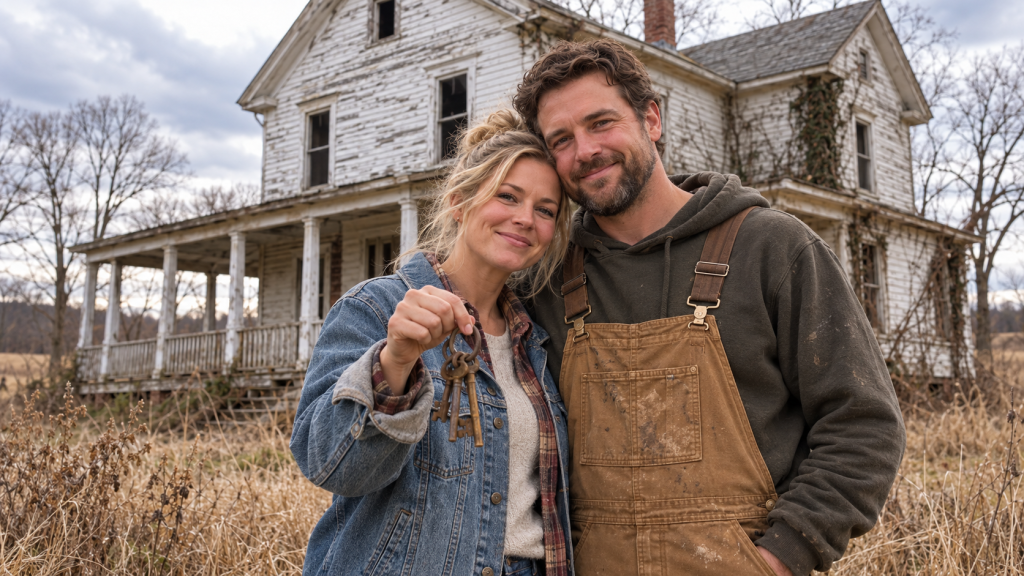
The rusty keys.
I remembered the nights Nate worked until his hands ached.
The weekends I waited tables when I could barely stay awake.
The envelope with the bluebird.
The threatening note.
The old recording.
All the years we’d spent believing our independence meant we weren’t worthy of anyone else’s consideration.
Then I looked at the apple tree.
Small.
Fragile.
Its roots settling into the same soil Calvin had loved.
And I finally understood what Opal meant.
Some things grow because somebody gives them an easy beginning.
Others survive because people keep choosing to care for them.
On our second anniversary of buying the farmhouse, Nate and I sat on the bench beside the creek.
The evening was warm.
Fireflies flickered above the grass.
The house stood behind us with its porch straightened and windows glowing.
Nate took my hand.
“Emily?”
“Yes?”
“Do you ever think about the forty-one thousand five hundred dollars?”
I laughed.
“Every time we pay a repair bill.”
He grinned.
Then his expression softened.
“I used to think that auction was the day we finally got lucky.”
I leaned against him.
“And now?”
He looked toward the farmhouse.
“Now I think Grandpa would’ve been glad we found our way here.”
I smiled.
“I think so too.”
Nate reached into his pocket and took out the blue fishing lure Calvin had left behind.
He held it between his fingers.
Then looked toward the water.
“Grandpa always said this was his lucky one.”
I laughed.
“Didn’t you say it never caught anything?”
“Not a thing.”
We smiled.
Then Nate whispered:
“Maybe it wasn’t supposed to catch fish.”
I looked at him.
He slipped the lure back into his pocket.
“Maybe it was just supposed to remind me where I belonged.”
For two years, I’d believed the most painful part of that Easter dinner was the money.
Sixty thousand dollars divided among three siblings.
And a greeting card for the son who’d never asked his parents for anything.
But the real wound was deeper.
Ron and Judy had treated Nate’s reliability as permission to overlook him.
They’d used his patience to justify taking what had been entrusted to him.
And when the truth threatened to emerge, they expected him to remain quiet because that was what he’d always done.
They hadn’t expected us to buy the abandoned Miller farmhouse.
They hadn’t expected Opal to walk through the old kitchen and remember her father’s height marks.
They hadn’t expected a threatening note to expose a six-year-old lie.
And they certainly hadn’t expected an old recording and financial records to reveal how much had been concealed.
But none of those discoveries meant as much to me as what happened afterward.
Nate stopped confusing silence with strength.
Opal stopped confusing loyalty with secrecy.
His sisters began taking responsibility for money they hadn’t realized was misused.
And I learned that standing beside my husband didn’t always mean fighting every battle for him.
Sometimes it meant holding his hand while he finally spoke for himself.
As the sun disappeared, Nate wrapped his arm around my shoulders.
“Em?”
“Yes?”
“Do you regret all those extra shifts?”
I thought about the truck stop.
The aching feet.
The smell of burnt coffee.
The tips counted late at night.
I thought about Nate selling his grandfather’s fishing boat and pretending it didn’t hurt.
Then I looked toward the farmhouse we’d brought back to life.
“No,” I said.
“Not one.”
He kissed my forehead.
“Me neither.”
We sat quietly until the stars appeared.
Behind us stood the home we’d bought with our own money.
Beneath our feet lay the land Calvin had wanted Nate to have.
And beside the creek was a bench bearing the name of a grandfather whose love had endured long after his death.
At Easter, my in-laws gave their other children sixty thousand dollars and told us independence was our reward.
Two years later, we bought an abandoned farmhouse and discovered they’d spent years hiding what was rightfully meant for my husband.
But the greatest thing we reclaimed wasn’t the money.
It wasn’t the land.
It was the right to build our lives without asking permission from people who’d mistaken our kindness for weakness.
And when Nate took my hand and led me toward the lights of our farmhouse, I knew something with absolute certainty.
We hadn’t bought a forgotten house.
We’d finally found our way home.